Valuing an apartment in Phoenix means working with rules and mechanics that sit well apart from European norms. This guide sets out how the local market actually prices homes, how the climate feeds into what a unit is worth, and the steps that turn a rough figure into an estimate you can defend across the Valley of the Sun.
Get the app
What nobody tells you.
Real prices, hidden costs and the traps to check before you commit.
What an apartment in Phoenix is actually worth, once daily life is priced in
Scroll
What an apartment in Phoenix is actually worth, once daily life is priced in
Valuing an apartment in Phoenix means working with rules and mechanics that sit well apart from European norms. This guide sets out how the local market actually prices homes, how the climate feeds into what a unit is worth, and the steps that turn a rough figure into an estimate you can defend across the Valley of the Sun.
Written by the ting.ad editorial team ·
North Central Avenue, Phoenix in Street View: drag to look around.
Understanding these structural realities lets you place your own figure against how the unit will actually be lived in.
Valuing an apartment in Phoenix is not a matter of multiplying square metres by a headline rate under permanent sunshine. Between the thermal management any unit needs to get through the summer months and the very particular urban layout of the Valley of the Sun, what drives value here differs radically from European norms. You have to weigh precisely what each co-ownership arrangement contributes in terms of thermal comfort, recurring charges and access to transport and services. Owners preparing an estimate routinely underrate how far the unit sits from the metro's centres of gravity, and how much strong shared equipment matters to holding value over the long run.
The headline appeal of sunlit urban living, connected to the busiest districts of the metro area.vsThe constraint of near total dependence on continuous air conditioning and on managing peaks in electricity consumption.
Any credible figure here has to absorb the real energy cost into the annual budget. Cooling equipment is not a comfort option but a structural part of keeping the building intact, and an ageing system pulls the estimate down.
The draw of a modern condominium with pools, gyms and built-in services.vsThe reality of unusually high association dues that rise steadily to fund maintenance of that same equipment under heavy climatic load.
Shared services lift daily life but weigh heavily on rental yield or on an occupier's budget, and buyers discount for them. Check the state of the association's reserve fund before you settle on a number.
The freedom of a horizontal way of life built around major arteries and quick access to the open landscape around the city.vsThe reality of a spread-out urban density where walking gives way to unavoidable car journeys for every routine errand.
Phoenix is organised around a freeway network and a grid of wide boulevards. The real distance to everyday services redefines what centrality means, and comparables only hold if they sit at a similar distance.
Which valuation actually answers your question about this place?
These use profiles show how far the local context sits from the reference points most owners arrive with.
The Phoenix market serves very different profiles, from the remote worker chasing light to the investor looking for a seasonal or long-term rental return, and the figure that matters is not the same for each. Every profile implies precise trade-offs about location, floor area and the nature of the co-ownership. The comparables you should be reading depend as much on your tolerance for summer temperatures as on how much you move around the metro area in a given week.
Owner-occupier value and local roots
For permanent use, the figure hinges on areas with a genuine neighbourhood fabric, shaded green space and immediate proximity to busy employment centres such as Downtown or Midtown. Apartments in recent buildings carry a premium for reinforced insulation and effective double glazing, both essential to holding the energy bill down, and appraisers treat that as a real adjustment rather than a cosmetic one. Weigh the presence of amenities you can reach on foot during the milder mornings of autumn and spring. The aim is to avoid the residential isolation that catches out newcomers who were poorly advised on local urban form, because it shows up later as a discount at resale.
Rental value with high turnover
University districts and the areas near the large technology and medical hubs support demand all year round, and that steadiness is what an income-based estimate leans on. For this profile, the compact footprint of a studio or one-bedroom is the efficient one, holding maintenance costs down while maximising gross return, so price it against comparable small units rather than against family stock. It is essential to read the co-ownership rules and confirm that medium or long-term furnished letting is fully permitted without burdensome restrictions, since a restrictive ruleset cuts directly into the value. Management by a local agency then becomes a line item to build into your projected figures.
Winter base and remote management
If you only occupy the apartment a few months a year, the security of the building and the quality of common-area management in your absence outweigh almost everything else in the valuation. Look for secure developments with on-site staffing and impeccable exterior maintenance to guard against heat damage, all of which shows up as a defensible premium. A well-administered condominium spares you unpleasant surprises on your return and preserves your capital without heavy intervention from abroad, which is precisely what buyers pay for when the time comes to sell.
Reading value here when your reference points come from abroad
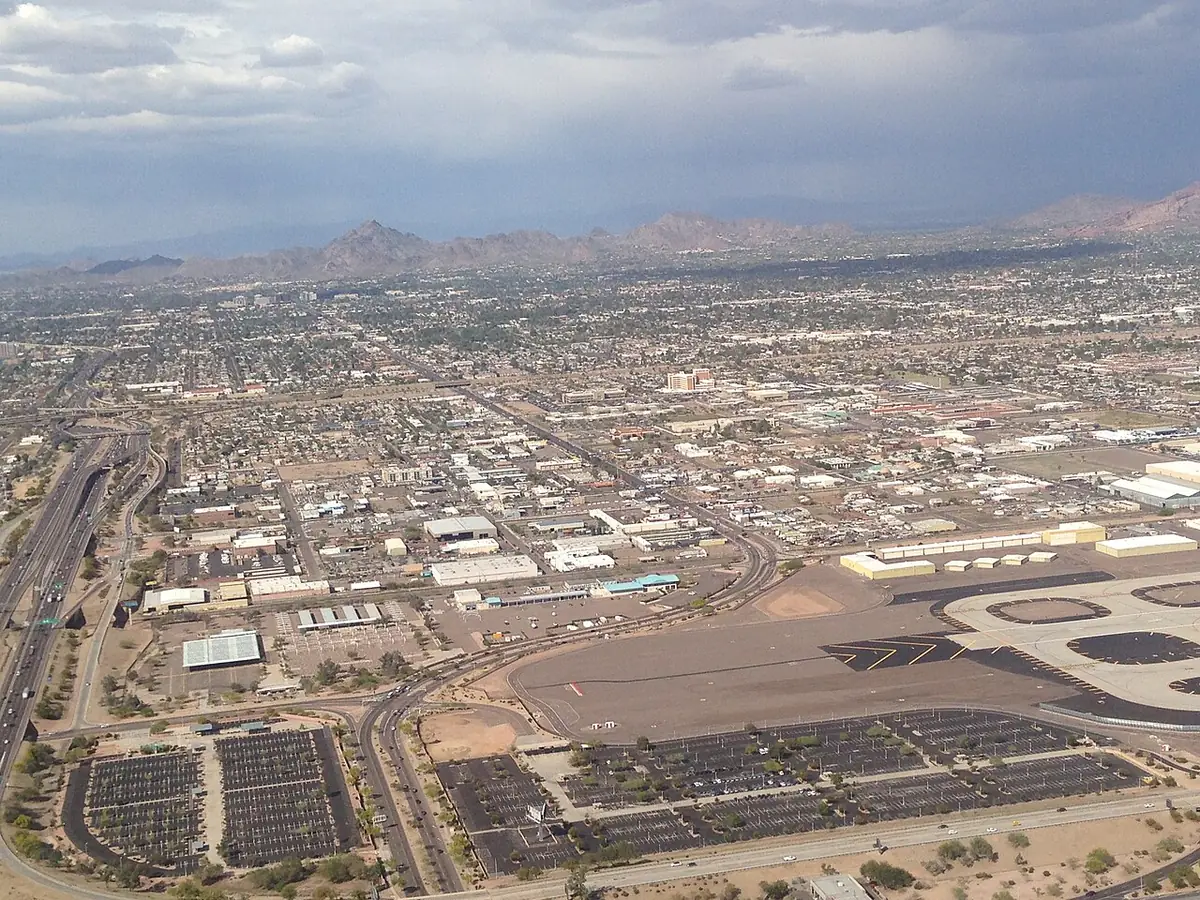
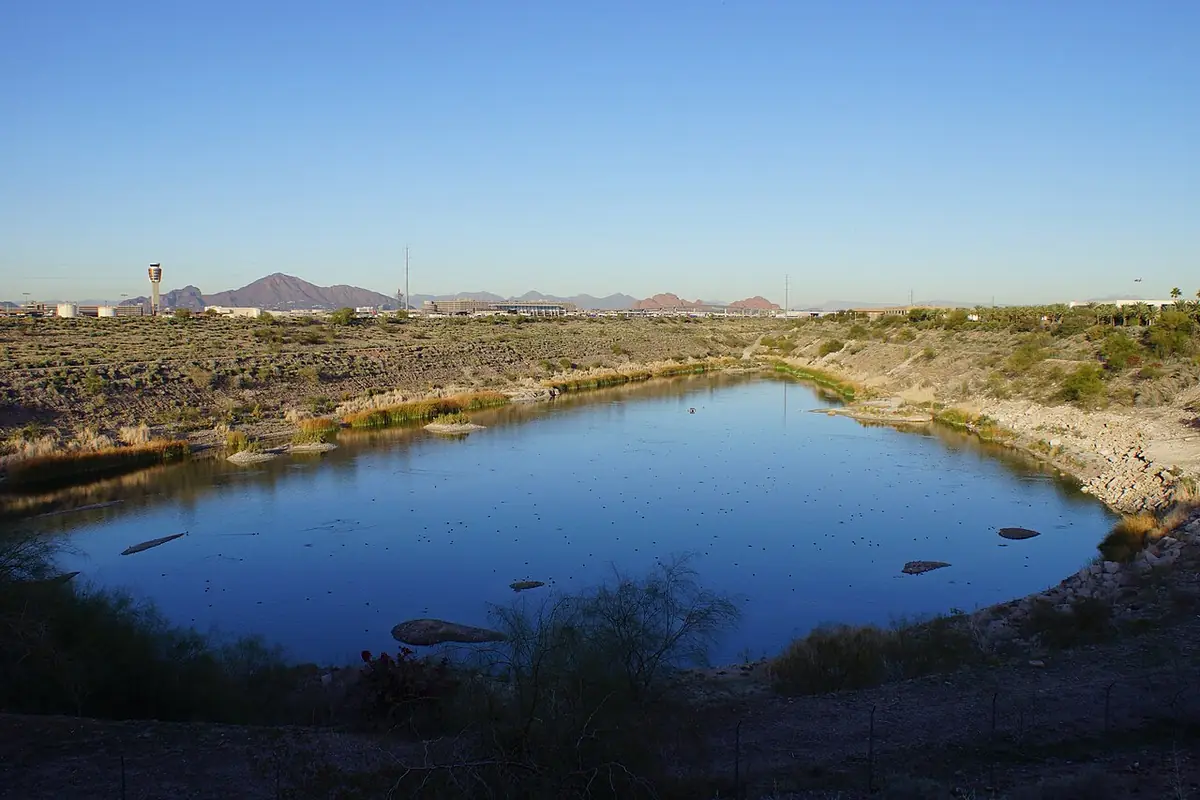
Phoenix spreads wide beneath its desert mountains — Photo: CyberXRef · CC BY-SA 3.0 · Wikimedia Commons
These structural differences translate on the ground into sharply contrasting district-level figures.
Valuing a property in Phoenix when your instincts were formed elsewhere means dismantling a good many assumptions about building age, the nature of ownership and the charges attached to it. Where many markets abroad reward old stone, historic centrality and walkable town centres, the reality here rests on the efficiency of modern infrastructure, functional sprawl and the weight of built-in community services. That shift, cultural as much as technical, redefines what counts as good value.
From abroad
The age and character of historic buildings in the older city centres you are used to.
Phoenix
A recent or contemporary housing stock that rewards material performance and large open volumes.
Structural renovation costs start out markedly lower, so the adjustment that matters is the durability of the air conditioning installation and the quality of the thermal envelope.
From abroad
Co-ownership charges calculated mainly around basic upkeep of common parts.
Phoenix
Monthly dues that cover pools, fitness rooms, security and sometimes central air conditioning as well.
The recurring monthly figure is higher than you would expect for an equivalent property elsewhere, which means the association's accounts have to be read carefully before you fix a value.
From abroad
Everyday shops and services reachable on foot at the end of the street.
Phoenix
A grid-based urban layout where most journeys are made by vehicle along major arteries.
The location of an apartment has to be valued against tolerance for daily driving and against genuine proximity to the main road network.
From abroad
A legal framework that strongly protects the borrower and the occupant through strict statute.
Phoenix
US property law founded on freedom of contract and regulated through the internal rules of the homeowners association (HOA).
Local professionals are essential for decoding the specific clauses of purchase contracts and association rules, because those clauses can move a valuation more than the building itself.
Which district your comparables should come from
Once the area is pinned down, the question of budget and real running costs has to be examined precisely.
The Phoenix metro spreads across a vast territory in which every district has its own identity, rhythm and resident profile, and a comparable drawn from the wrong one will mislead you. Between the cultural energy of the urban core, the technological momentum of the fast-growing areas and the residential calm of the outer sectors, the district conditions both daily life and the future liquidity of the property. Weighing the strengths and the trade-offs of each zone is what stops foreign owners from anchoring on the wrong figure.
Downtown Phoenix
An urban core in full transformation, driven by light rail, theatres and a growing supply of modern residential towers.
Suits
Valuing units aimed at urban professionals and at owners counting on long-term rental demand and cultural life.
Trade-off
Absolute quiet is rare, and the price per square metre is among the highest in the municipality, so comparables from here do not travel.
Midtown and Uptown
A balanced compromise between city life and tree-lined residential streets, marked by mid-size buildings and leading medical services.
Suits
Valuing homes sold on a more settled setting, fast access to medical centres and a genuine neighbourhood feel.
Trade-off
The stock is older here, so the condition of the co-ownership and its renovation record has to be checked before any figure is fixed.
Camelback Corridor
A prestigious, high-end area lined with premium buildings, business centres and luxury retail.
Suits
Valuing property at the top of the market, where the appeal is a stable, secure location that holds capital.
Trade-off
The financial barrier to entry is very high and gross rental yields are mechanically more modest, which caps income-based estimates.
What an apartment in Phoenix is actually worth: reading the ranges and the charges
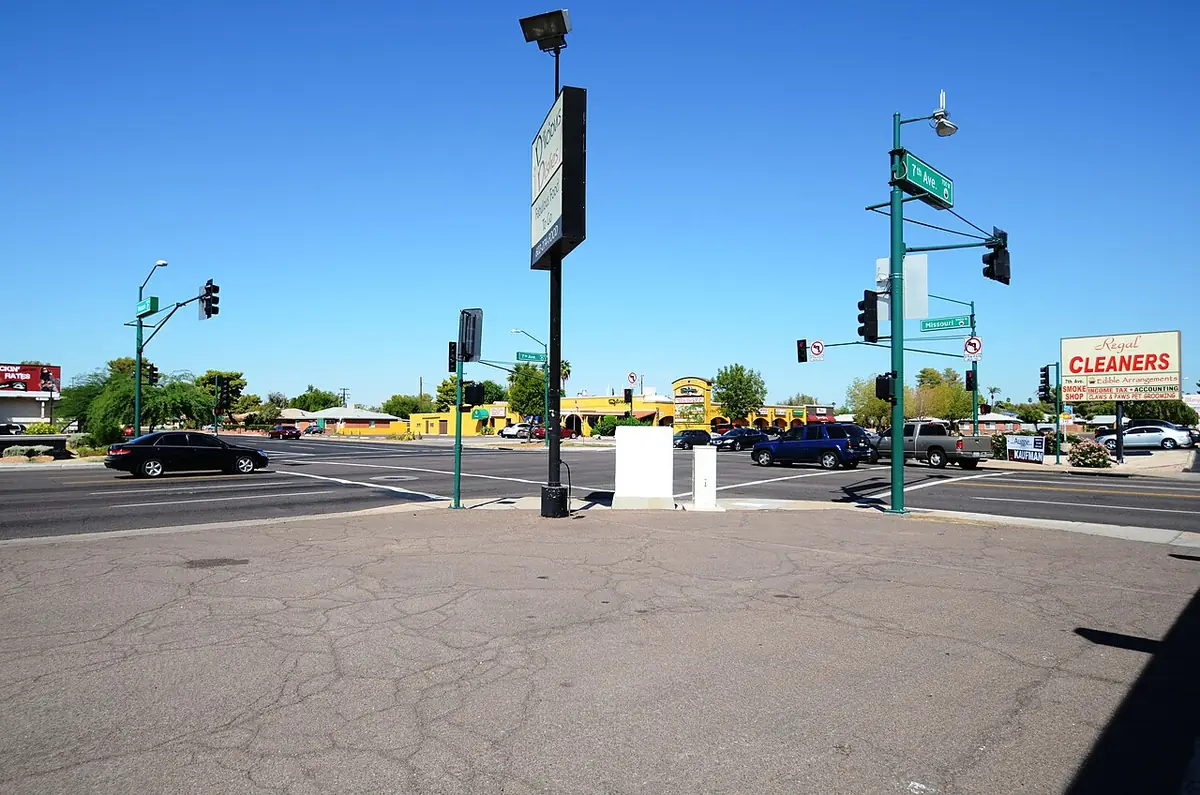
A busy Phoenix intersection on an ordinary day — Photo: Kabugenyo · CC BY-SA 3.0 · Wikimedia Commons
Beyond the raw numbers, the nature of what you own deserves examination in detail.
A valuation in Phoenix should never stop at the headline asking price displayed on listing portals. Between local property taxes, monthly homeowners association (HOA) dues and the unavoidable spending tied to air conditioning, the total cost of ownership follows rules specific to the US market, and buyers price all of it into what they will pay. The tables below set out the orders of magnitude observed in the market so you can sanity-check your own figure without a blind spot.
phoenixFor saleApartmentestimate
Median price / m²US$2,850Half the apartments sell below this
Median priceUS$405kthe average is 14% higher — a few very large properties pull it up
Most common3 bedrooms40 % of listings
Average size135 m²
By number of bedrooms
Bedrooms
Share of market
Avg price
Price / m²
Avg size
1
12 %
US$234k
US$3,600 +20 %
65 m²
2
30 %
US$328k
US$3,120
105 m²
3most common
40 %
US$432k
US$2,880
150 m²
4
18 %
US$554k
US$2,700best value / m²
205 m²
Each row is an average, compared against the area average of US$3,000 / m². These are indicative estimates of a typical local market, not a measured sample of live listings. Check current listings before relying on them.
What you actually own: full title and the rules of the homeowners association
That administrative rigour applies just as much to the process by which a figure is formally tested.
Owning an apartment in the United States, and in Arizona in particular, means absorbing the system of homeowners associations (HOA) into your estimate. Unlike the co-ownership regimes most owners arrive from, where statute fixes much of the framework, the US system grants these associations wide powers over the use, exterior appearance and daily management of your property. Understanding that balance between individual title and collective rules is what separates a defensible valuation from a hopeful one.
Full individual title, within a framework
You own the walls of your apartment plus a share of the common parts and the land beneath. The homeowners association nonetheless holds strong rule-making power to set the terms of daily life, to prohibit certain practices (such as unauthorised short-term letting) and to impose special levies when major work is needed on the building. Each of those constraints narrows the pool of buyers and therefore moves the number.
What it changesRead the HOA rules line by line before you settle on a value, because they dictate what an owner may do or change, and the market prices that freedom.
Financial autonomy and the management of reserves
US condominiums manage their budgets very actively through regular audits. If the HOA's reserves are too thin to cover a roof replacement or a lift refurbishment, the association can vote extraordinary levies (special assessments) that fall heavily on the owners in place. A thin reserve is one of the clearest downward adjustments an appraiser can apply.
What it changesAlways obtain the association's financial history and audit reports for the last three years, and treat a weak balance sheet as a deduction from the figure rather than a footnote.
The legal and financial rule to understand before any figure is agreed
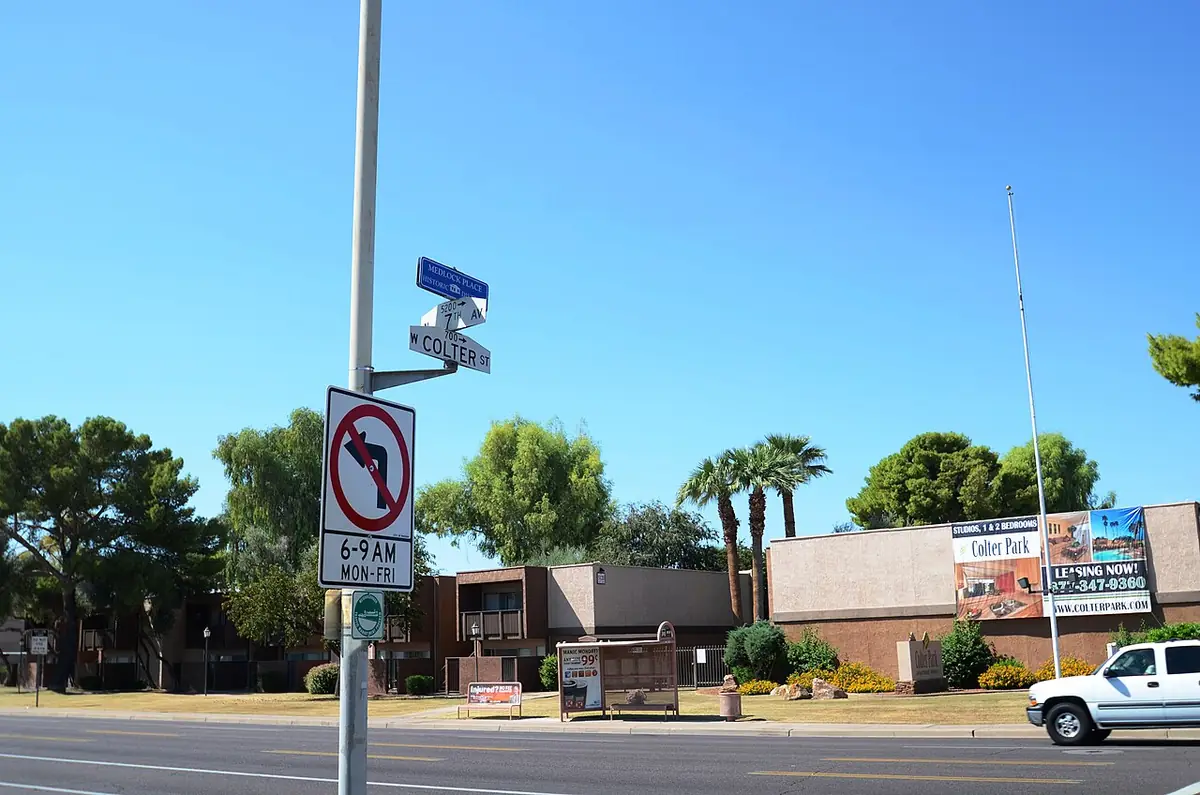
A quiet, historic residential corner of Phoenix — Photo: Kabugenyo · CC BY-SA 3.0 · Wikimedia Commons
To follow that route through, here is the chronological sequence of the parties and the actions involved.
Securing a transaction in the United States rests on a third-party mechanism that is well established but unforgiving for the unprepared, and it is the moment when a private estimate meets an outside opinion. An escrow company and title guaranteed by a specific policy (title insurance) protect both parties, but every contractual deadline has to be respected to the letter, and the lender's own appraisal is where an over-optimistic number comes apart.
The signing of the purchase contract and the payment of the earnest money deposit into a dedicated escrow account, at the figure the two sides have agreed.
The opening of the due diligence period, generally set at 10 to 14 days, during which an independent expert can examine the property and put a cost on anything that changes the value.
A close review of the condominium documents (HOA disclosures), the title and any easements attached to the property, all of which can move the figure.
The formal lender-ordered appraisal, commissioned to confirm that the market value of the property matches the agreed price.
The lifting of contingencies and the preparation of the final deed of sale by the escrow agent, once the value is settled.
The closing and the official recording of the deed with the Maricopa County offices, which is what makes the agreed figure part of the public record.
Who puts a number on a Phoenix apartment, and in what order
Valuing an apartment in Phoenix takes coordination between several local professionals, each of whom produces a different kind of number. From the opening position through to the handover of keys, every party plays a precise role in confirming that the figure holds. This operational timetable sets out who is responsible for what, and which estimate carries weight at each critical phase.
The ownerGathering the paperwork and confirming financing capacityBefore anything is viewed, a pre-approval letter from a US lender is what makes a stated figure credible, and on the selling side the equivalent groundwork is assembling dues statements, tax notices and service records.
The real estate agentComparative market analysis and the opening figureYour agent analyses comparable sales in the district, drafts the standard Arizona purchase contract and negotiates the contingencies, with the comparative market analysis as the anchor for the whole discussion.
The building inspectorTechnical inspection and the condition adjustmentsThe inspector examines the structure, the roof, the plumbing and above all the air conditioning system, producing a detailed report that sets out exactly what should be deducted from the headline figure.
The escrow companyHolding the funds and verifying titleThis neutral company holds the deposit and runs the historical searches on title to confirm that no hidden debt or lien sits against the property and quietly erodes its value.
The insurance companyIssuing the title insurance policyThis specific cover protects the owner against any future dispute over the historical validity of earlier transfers of ownership.
The closing agentFinal signature and release of fundsThe last documents are signed electronically or in person, the final funds are transferred, and the deed is officially recorded in the new owner's name at the agreed figure.
Apartment or single-family house: which holds its value better in Phoenix?
Once the property type is settled, the central question of financing and the wider cost structure comes into focus.
Comparing the value of an apartment inside a managed condominium against a single-family house with land in Phoenix touches your whole way of life as well as your long-term budget, and the two are priced on different logic. The city is defined by massive urban sprawl and a very particular climate, marked by extreme summer temperatures that feed directly into energy costs and into how much outdoor equipment gets used. Choosing an apartment downtown or in busy districts such as Downtown or Midtown means buying immediate proximity to employment centres, light rail and cultural venues, while cutting personal maintenance obligations sharply, and the market pays for that. Co-ownership dues generally include air conditioning of the common parts, security, and upkeep of the pool and the roof, heavy budget lines that need close analysis before any figure is agreed, because they are subtracted from what a buyer will pay.
A single-family house, more readily found in outer residential areas such as Paradise Valley, Arcadia or the northern extensions of the metro, offers total architectural freedom and no immediate neighbours above or to the side. That autonomy comes with sole financial responsibility for every repair, whether that is central air conditioning running flat out from May to October or protecting the roof against the intense ultraviolet light of the Sonoran Desert. The local market values these two property types differently across economic cycles: houses have historically held resale value better over the long term because buildable land is relatively scarce, while apartments appeal to a mobile working population and to owners chasing an attractive gross rental yield, which is why an income-based estimate and a comparable-based one can diverge on the same street.
Your own profile therefore has to lead the analysis rather than any purely speculative consideration, because it determines which comparables are relevant to you. If you travel frequently, dread garden chores under a punishing sun, or want to walk to modern urban amenities, a secure apartment in a serviced development is a particularly rational option and will be valued on the strength of those services. If, on the other hand, you have pets, need substantial private outdoor space, or expect to grow your household over the coming decade, the single-family house remains the obvious answer despite the heavier maintenance it demands day to day, and its scarcity value follows from exactly that.
You also have to build the tax and regulatory dimension specific to Arizona and to the municipality of Phoenix into any estimate, particularly property taxes and the dues attached to homeowners associations, known as HOAs. These bodies govern virtually all single-family subdivisions and apartment condominiums, dictating strict rules on the exterior appearance of buildings, paint colours, and even where vehicles may be parked on the street. Understanding how these entities work and how healthy their finances are is often more decisive for the value of your investment than the intrinsic quality of the construction itself, because a badly run HOA can trigger unforeseen special levies and weigh heavily on resale value.
The full cost picture behind a Phoenix valuation
With those financial figures set out, it is just as important to understand what an ordinary day in the metro actually involves.
Putting a value on a property in Phoenix cannot stop at the asking price shown on listing portals. You have to take in every associated cost of ownership in this state, including local property tax, home insurance priced for specific climate risks, and the summer energy bills that newcomers routinely underestimate, because all of it is discounted into what a buyer will offer. The tables below set out the orders of magnitude observed in the current market so you can calibrate your own figure realistically.
Estimated value ranges by property type in Phoenix
Property type
Central districts
Outer districts
Underlying trend
One-bedroom apartment
$200,000 to $320,000
$150,000 to $240,000
Strong rental demand and stable prices
Two-bedroom family apartment
$350,000 to $550,000
$250,000 to $380,000
Sharper competition from first-time buyers
Standard single-family house
$500,000 to $850,000
$350,000 to $550,000
Growing scarcity of well-located land
Median prices vary with year of construction, the presence of a private pool and the quality of the school infrastructure the address is assigned to.
Estimated recurring monthly and annual charges for an owner
Cost line
Estimated average amount
Frequency
Main factors
Property tax
0.6% to 0.8% of assessed value
Annual
Assessment by Maricopa County
Co-ownership or HOA dues
$150 to $500
Monthly
Services included, on-site staffing, pool
Home insurance
$1,200 to $2,500
Annual
Exposure to wind, heat and roof cover
Electricity bill (air conditioning)
$200 to $500
Monthly (peaks June to September)
Thermal insulation and floor area
The energy line is the most volatile of the year because of the heavy use of air conditioning through the hot season, and buyers treat a poorly insulated unit accordingly.
What an ordinary Tuesday looks like for a Phoenix resident
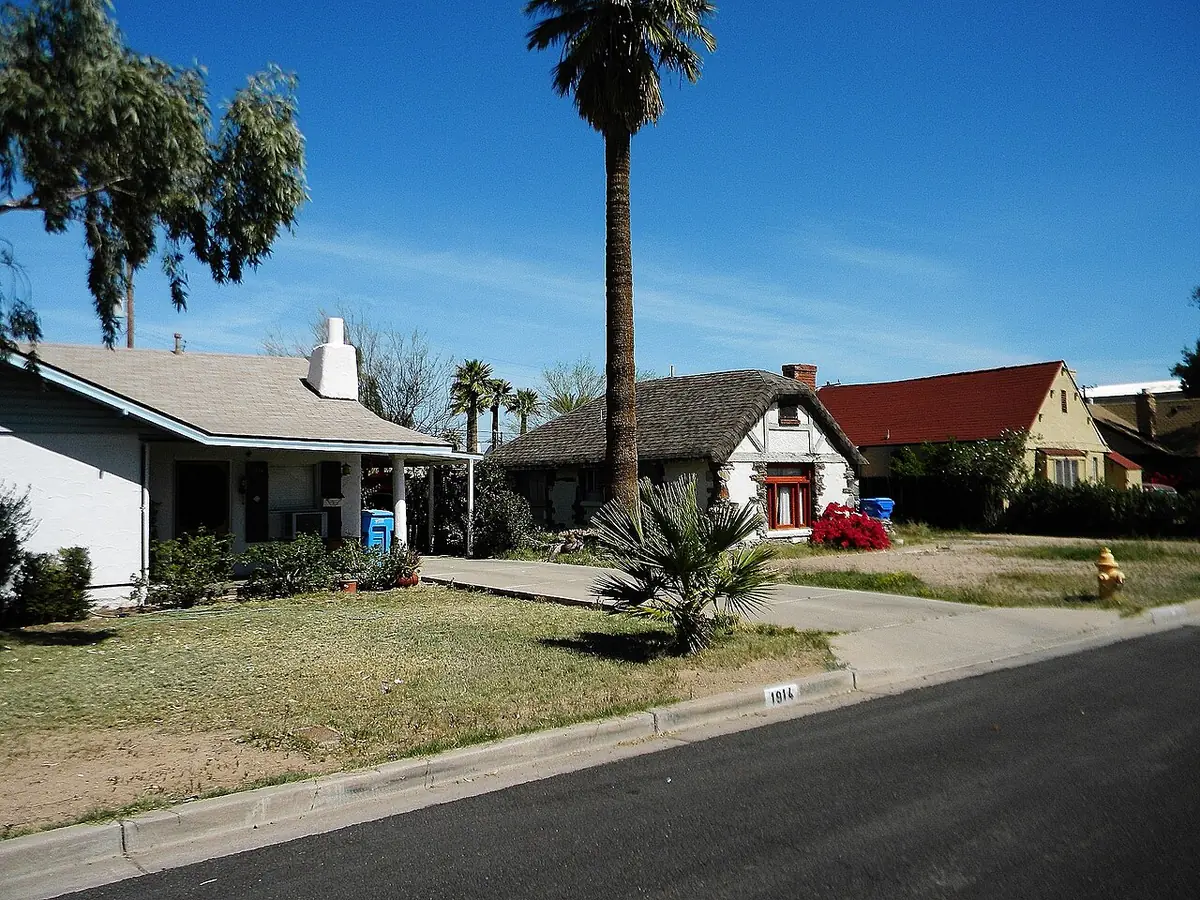
Classic ranch-style houses line this Phoenix street — Photo: Jon Roanhaus · CC BY-SA 3.0 · Wikimedia Commons
Beyond the postcard and the visible practicalities, some fundamental drivers of value escape owners entirely.
Living in Phoenix means coming to terms with a vast territory designed historically around the car, even as better-connected urban centres emerge, and how a given address sits inside that pattern is one of the quieter drivers of value. To understand the daily reality of a location you are pricing, follow an ordinary day from dawn through to the evening. This walk through the hours brings out real journey times, the effect of climate on movement and the accessibility of essential services, all of which show up in what buyers will pay.
07:00Residential district and the morning departureMorning temperatures are still mild for much of the year, allowing brief use of outdoor space before the heat builds. Setting off by car or joining the main road network happens in dense but flowing traffic compared with the coastal megacities, and a short commute reads as value.
08:30Arrival at work or at a coworking spaceWhether you work in the Downtown business district or in the technology hubs of Tempe and Scottsdale, offices depend on full air conditioning. Modern professional infrastructure makes it easier for newcomers to settle in and supports local networking, which is part of why proximity to those hubs carries a premium.
12:30Midday break and neighbourhood lifeLunch is generally taken in nearby retail areas or air-conditioned business centres. Walking at the height of the sun is limited, so people favour indoor spaces or the shaded, misted terraces characteristic of the region, and units near those clusters price accordingly.
16:30Local errands and health servicesShopping centres and supermarkets come with large shaded car parks. This is the moment for daily purchases or for medical appointments at the well-regarded clinics and hospitals of the Valley of the Sun, and that access is a recognised value driver.
18:30Leisure and the trip homeAt the end of the day, the relative drop in temperature invites physical activity, whether in an air-conditioned gym or on the hiking trails of Camelback Mountain or Papago Park when the season allows. Trail access is one of the amenities buyers pay for here.
20:30Unwinding at homeThe evening passes quietly indoors, where energy efficiency and the acoustic comfort of double glazing play a key role in the quality of rest, and where the condition of that glazing is exactly the sort of detail an inspection prices.
What Phoenix agencies leave out of a valuation
Knowing these blind spots lets you anticipate the classic traps and avoid the regrets that follow a figure set too high.
The enthusiasm generated by Arizona's sunshine and by the economic pull of Phoenix can mask technical and regulatory subtleties that move a valuation materially. Viewings usually take place in ideal conditions, far from the climatic extremes and the local administrative constraints. To avoid a figure that falls apart after the fact, you have to examine the structural and environmental factors that sales brochures systematically leave out.
Invisible wear in the air conditioning system (HVAC)
Central air conditioning is the single most critical budget and technical line in a Phoenix home, and its remaining life is one of the largest condition adjustments in any estimate. Replacing a failed unit in the middle of July, when temperatures pass 40 degrees Celsius, generates major extra cost and long waits for local contractors.
Strict homeowners association (HOA) restrictions
A property under an HOA is subject to fussy rules on landscaping, on parking certain utility vehicles in the street, and on exterior paint colours, with recurring fines for breaches. Restrictive rules narrow the buyer pool and pull the value down in ways a headline price per square metre never shows.
The complexity of water and irrigation rules
Watering green space and lawns is tightly regulated by the municipality and by Arizona's water authorities. Keeping a lawn green in the middle of the desert produces exponential water bills and pushes most residents toward desert rock, so a thirsty garden is a liability in the figure rather than an asset.
The direct effect of urban heat islands on the energy bill
The hard surfaces of central districts hold heat dramatically through the night, preventing buildings from cooling naturally. Without impeccable thermal insulation and effective glazing, summer electricity bills climb steeply, and buyers deduct that running cost from what they will pay.
The uneven quality of public school infrastructure
The school district system in Phoenix shows wide disparities from one district to the next. If you have school-age children, the location of the property dictates their access to the best schools or forces you to fund private education, and that difference is capitalised straight into value.
The valuation mistakes owners discover six months in
These hard-won lessons show that not every figure survives contact with the metro's realities.
Looked likeA charming house with a large green, shaded lawn for the children, valued as a premium feature
Turned outA monthly drain in water consumption and a partial watering ban issued by the municipality during drought, so the feature read as a cost rather than a premium.
Would have caught itValuing desert-appropriate xeriscaping instead, combining drought-resistant native plants with decorative gravel, and treating a conventional lawn as a deduction.
Looked likeAn apartment ideally placed right beside the main roads for a quick commute, priced on that access
Turned outConstant noise from heavy freeway traffic and noticeable air pollution during summer heat peaks, both of which the market discounts.
Would have caught itAlways checking the orientation of the unit and the acoustic quality of the double glazing, and visiting the district at different hours before you settle on a figure.
Looked likeA quick agreement with no thorough technical inspection, to stay ahead of the competition
Turned outMajor hidden defects in the frame, a roof damaged by ultraviolet exposure or an obsolete electrical system, all requiring heavy work never priced into the number.
Would have caught itAlways instructing an independent inspector who specialises in desert-climate housing before contingencies are lifted, and adjusting the figure by the report.
Looked likeA condominium showing very low, attractive monthly dues, read as a sign of good value
Turned outA complete absence of financial reserves in the association's accounts, leading to a massive special levy to replace the lift.
Would have caught itInsisting on a financial analysis of the association's accounts over the last three years and reading the minutes of general meetings before you trust the dues figure.
Which owners should walk away from the figure they were hoping for
With those filters applied and the risks measured, it is time to judge calmly whether your figure stands up.
The media appeal of Phoenix and the promise of permanent sunshine sometimes draw in profiles the market does not reward. The climate, the spatial organisation of the metro and the specific nature of the market demand a close fit between a person's way of life and local reality, and where the fit is poor, the value they place on a property rarely holds. Identifying those mismatches early avoids reckless numbers and deep personal disappointment.
The unconditional lover of cool, humid climates
→Settles in Phoenix while underrating the psychological and physical impact of four months of intense summer heat.
Prolonged confinement in air-conditioned spaces from May to September produces a sense of isolation and a climate fatigue that many cannot sustain, and an owner who leaves early rarely gets the figure they counted on.
The city dweller who cannot tolerate daily car use
→Values an outer-suburb apartment as though everything could be reached on foot or by light rail.
The sprawl of Phoenix makes a car indispensable for nearly every daily journey outside a few very central micro-districts, and the market prices that in even when the buyer does not.
The investor who cannot tolerate HOA rules
→Prices a subdivision property without reading the association's strict governing documents.
Fines, restrictions on seasonal letting and interference in the management of the property collide directly with the need for total freedom, and each of them narrows the market that sets the value.
The household on an extremely tight budget with no contingency savings
→Commits every last saving to the deposit without keeping cash available for the unexpected.
The slightest failure of the air conditioning system or an emergency structural repair can put an owner instantly into serious financial difficulty, and a forced sale rarely realises the value on paper.
So, is the figure you have in mind for Phoenix one you can defend?
Settling on a value for a property in Phoenix is not a matter of aesthetic enthusiasm for a sunlit villa or a modern apartment looking out at the Downtown skyline. It is a considered judgement that demands a clear-eyed fit between your ambitions, your real financial capacity and your tolerance for life in an arid environment, because those are precisely the factors the market prices. If you have accepted that air conditioning is a non-negotiable budget line, that car use is the keystone of local mobility, and that respecting the strict rules of homeowners associations is part of residential peace, then your figure rests on solid foundations.
The Phoenix market will keep moving with demographic flows, with innovation in water management and with the wider economic balance of Arizona. In that shifting context, the best protection against uncertainty is the rigour of your own analysis. Never give in to haste dictated by a temporary tightening of the market: insist on complete technical reports, audit the financial health of the condominium, and project your spending across a full year including the summer consumption peaks. Sanity-check the number against recent comparable sales in the same district and against what an independent professional would put on it. At that price, and with methodical preparation, your estimate stops being a guess and becomes a figure you can stand behind.
Related questions
How much property tax does an apartment in Phoenix typically carry?
Property tax in Phoenix, administered by Maricopa County, generally runs between 0.6% and 0.8% of the assessed value of the property. That rate is historically lower than in many other US states, but it moves with the county assessor's annual valuation and with the school district the address falls into.
Is joining an HOA (homeowners association) compulsory in Phoenix?
HOA membership is not universal, but it covers the large majority of single-family houses in recent subdivisions and effectively all condominium apartments. There is no opting out once a property is attached to one, and the monthly dues are mandatory, with legal penalties for non-payment.
How do summer temperatures affect electricity bills?
The summer months, June through September, mean heavy use of central air conditioning simply to hold an acceptable indoor temperature. That extra load pushes electricity bills up dramatically, sometimes reaching $300 to $500 a month depending on how well the home is insulated.
Can non-resident foreign owners buy and hold property in Phoenix easily?
The state of Arizona places no legal restriction on the purchase of real estate by foreign investors or private individuals. The process does require obtaining a US tax identification number (ITIN) first, and opening a local bank account to handle transfers of funds and the payment of ongoing charges.
What does water management really do to the value of a house with a garden?
Because of tightening restrictions on water in the Sonoran Desert, watering a conventional lawn is strongly discouraged and subject to strict quotas. Most owners switch to xeriscaping, a landscaping approach built on native plants and gravel that cuts water consumption sharply.
Which districts hold their value best for apartments?
Downtown Phoenix, Midtown and the lively Roosevelt Row area concentrate the strongest rental demand for apartments. These districts offer immediate access to the light rail lines (Valley Metro Rail), to restaurants and to cultural hubs, which draws a young, mobile working population.
Should an air conditioning replacement be priced into the valuation?
Absolutely. An air conditioning system (HVAC) has an average service life of 10 to 15 years under the harsh Phoenix climate. If the inspection turns up ageing equipment, the cost of a full replacement has to be carried straight into the figure you put on the house or apartment.
How does the public school district system work in Phoenix?
Phoenix is split across several independent school districts whose quality varies noticeably from one area to the next. The exact address of a property determines which public school children are assigned to, a criterion that feeds directly into resale value over the long run.
How long does a real estate transaction take to close in Arizona?
A standard transaction in Phoenix generally takes 30 to 45 days between signing the purchase contract and the formal handover of keys. That window covers the full technical inspection of the building, the review of title, and the finalising of the mortgage.
Do newer or older properties hold value better in the Phoenix market?
Older stock often carries more central locations, mature lots and pronounced architectural character, but it sometimes needs work to meet current energy standards. Newer stock, more common on the outskirts, comes with optimal insulation performance and builder warranties, but implies longer daily commutes.
Property review of ting
No ting properties in Phoenix yet
Be the first — share it on ting and it shows up right here.