Valuing a house in the Phoenix metro means reading the climate, the zoning pattern and the financial realities of the local market with a clear head. This guide sets out the criteria that actually move an estimate, how ownership is structured here, and how to sanity-check the figure you are given before you rely on it.
Get the app
What nobody tells you.
Real prices, hidden costs and the traps to check before you commit.
What a Phoenix valuation is really measuring
Scroll
What a Phoenix valuation is really measuring
Valuing a house in the Phoenix metro means reading the climate, the zoning pattern and the financial realities of the local market with a clear head. This guide sets out the criteria that actually move an estimate, how ownership is structured here, and how to sanity-check the figure you are given before you rely on it.
Written by the ting.ad editorial team ·
North Central Avenue, Phoenix in Street View: drag to look around.
This tension between environmental constraints and everyday comfort is exactly what separates one micro-market from the next, which is where any estimate has to start.
Putting a figure on a property in this desert metro raises the question of what is being valued at all: the physical shell, or the cost of living in it. Between the promise of generous living space and the thermal reality of an arid climate, the local market forces a more nuanced reading of value than raw floor area suggests. You have to weigh gross habitable surface against the real energy cost of holding a comfortable temperature all year, because a buyer will. Older neighbourhoods carry undeniable character but often demand heavy spending on insulation and on renewing the air conditioning circuits, and that spending gets deducted. Newer builds on the fringe guarantee optimal energy performance, at the price of distance from the main centres of activity, and that distance gets deducted too.
Floor area and outdoor spacevsThe cost and upkeep of the air conditioning
Large volumes and a private lot push the headline figure up, but they come with energy bills that are unusually high through the hottest months of the year. That balance between raw space and running costs has to be worked out at the first viewing, because it is the single most common reason an estimate built on square metres alone turns out to be too high.
A position in the central neighbourhoodsvsThe quiet and space of the suburbs
Living close to the busier corridors cuts daily travel time but means higher density and a noticeably higher price per square metre, and comparables from those streets will not transfer outward. Outlying areas offer a calmer residential setting at a lower rate, but every errand requires a car, and any valuation has to compare like with like on that point.
The character of older constructionvsCompliance with modern standards
Houses from earlier decades have a unique architectural appeal and often more mature, planted lots, but they frequently need the insulation and the roof brought fully up to standard, which is a concrete deduction rather than a matter of taste. Recent developments offer immediate technical peace of mind and value more predictably, though they lack the patina that supports prices in established areas.
Immediate proximity to amenitiesvsPreserving residential quiet
Sitting near the large shopping centres and transport corridors simplifies the logistics of the week and supports the figure, but it brings noise and heavy traffic that a careful valuer marks down for. Choosing the absolute calm of a residential cul-de-sac reads as a premium to some buyers and as an inconvenience to others, which is why estimates in those pockets spread more widely.
Does the figure fit the way this house is actually lived in?
Beyond the household profile, the reference points a newcomer brings from another country also need adjusting before any number makes sense.
A useful valuation rests on a close fit between the way a household lives and the territorial realities of the area being priced. The urban structure of Phoenix is defined by its sprawl and by a pronounced dependence on the road network to cross the valley, and buyers price that in without being asked. What a property is worth therefore turns partly on who is realistically going to want it, whether the working day is spent commuting or at home. Buyers looking for a walkable neighbourhood are competing for a very narrow set of streets, which is why estimates there behave differently, while those wanting space find a wide field of alternatives that caps what any one house can command.
Remote work and generous space
Outlying residential areas offer generous habitable surface and a value for money that compares well against the coastal metros, so a dedicated study and usable outdoor space are genuine value drivers rather than incidentals here. When you gather evidence for an estimate, record the room count and the quality of the outdoor space precisely, because these are what the comparable buyer is paying for. Check the standard of broadband service and the distance to health services too, since weakness on either point is the first thing a well-informed buyer will use to argue the figure down.
Family life and schooling
Where children are involved, the estimate turns on the exact school attendance zone and on how safe the walking and cycling routes are in the immediate streets, and both vary sharply over short distances in this metro. Areas with maintained parks and nearby sports facilities carry a measurable premium, so identify the ones your property genuinely serves rather than the ones merely nearby. Watch the traffic at school opening and closing times as well: a street that clogs twice a day is a discount that automated tools rarely capture.
Retirement and accessibility
Single-story properties with easy access to good medical care and suitable leisure facilities appeal to a distinct and reliable pool of buyers, and that demand supports the figure in the right locations. A pool and a garden cut both ways in a valuation: they raise the appeal but carry an upkeep commitment that a buyer nets off, so their condition matters more than their existence. The presence of an active community and good local services is a determining factor here, and worth documenting explicitly when you present the estimate.
Valuing here after owning abroad: what actually changes
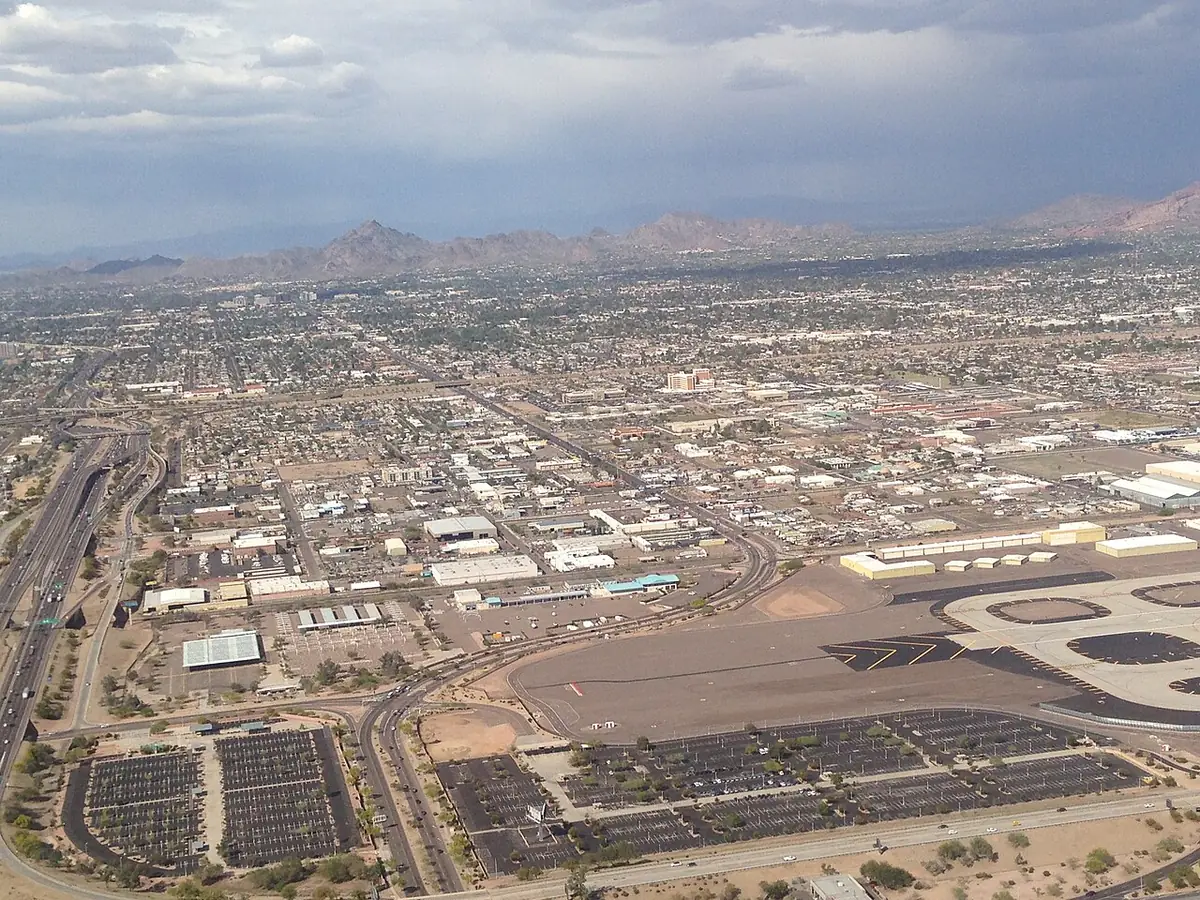
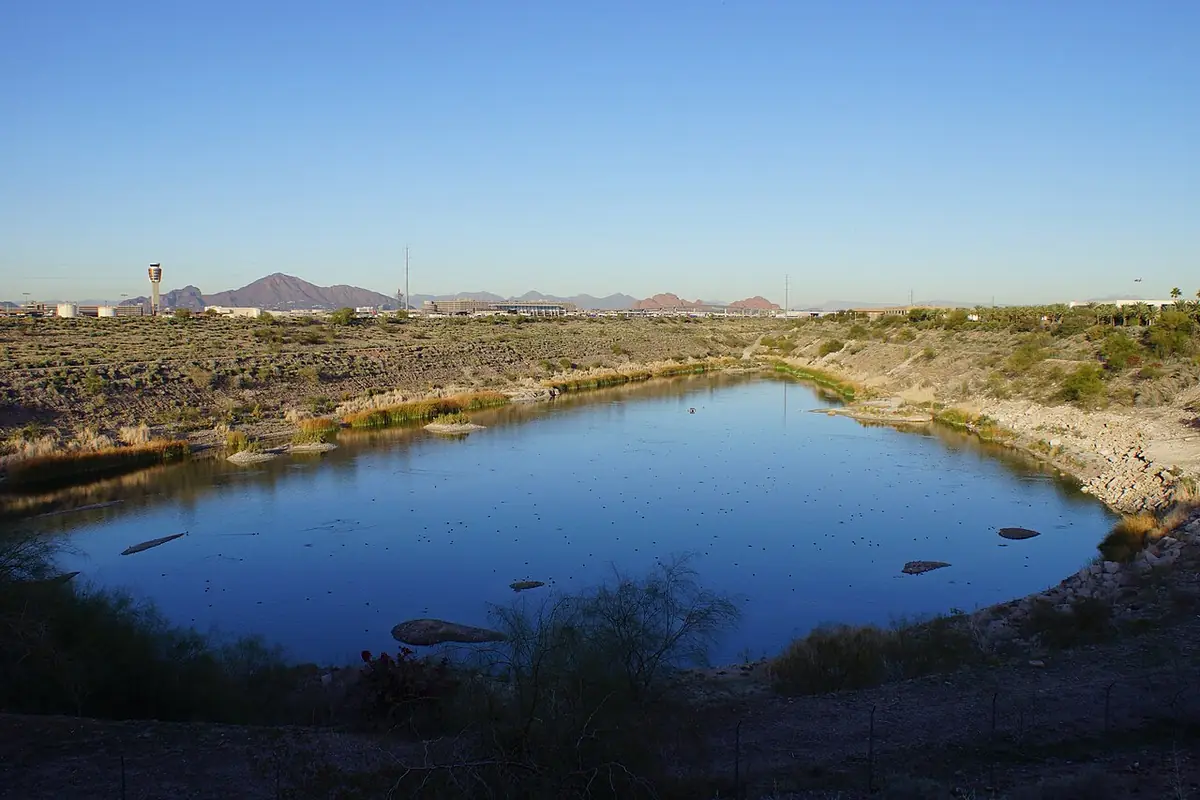
Phoenix spreads wide beneath its desert mountains — Photo: CyberXRef · CC BY-SA 3.0 · Wikimedia Commons
Once those reference points are reset, most of the remaining variation comes down to where in the metro area the property stands.
Arriving in Arizona from almost anywhere else unsettles a set of cultural, architectural and planning assumptions that quietly shape how people read prices. The absence of a dense historic core in the European sense completely redefines what proximity is worth and how neighbourhood life is priced. Movement is no longer intuitively on foot or by public transport, so a location that would command a premium elsewhere may command none here. In the same way, the thermal management of the building, dictated by particularly intense summers, changes what counts as a quality specification and therefore what an appraiser adds or deducts for.
From abroad
Walkable centrality and shops reachable on foot
Phoenix
A spread-out plan where services cluster in dedicated shopping centres
Do not assume a corner-shop location carries a premium here; test it against actual sales, because the value is in the drive time to the centres, not the walk.
From abroad
Traditional stone or brick construction with high thermal mass
Phoenix
Timber-frame or block houses built around central air conditioning
Insulation is judged against different technical standards, so the condition of the ventilation and cooling equipment carries far more weight in the adjustment than the wall material does.
From abroad
A dense public transport network structuring the metro area
Phoenix
Near-total reliance on the road network and roughly one vehicle per adult
The ownership cost a buyer nets off includes purchasing, insuring and maintaining reliable vehicles, plus the time spent on the urban freeways, and that shapes what they will pay.
From abroad
Purchase and lease contracts rigidified by strongly protective law
Phoenix
A fluid market governed by contractual rules and specific local charges
Assembling the file behind a valuation demands absolute documentary rigour and a precise grasp of local property taxes, since those figures are what a lender's appraiser will check first.
How the estimate shifts from one neighbourhood to the next
Once the neighbourhood effect is understood, the next step is to look at the actual numbers the single-family market is producing.
Phoenix spreads out into a mosaic of neighbourhoods with strongly marked identities, from urban bustle to quiet residential havens, and comparables rarely travel between them. Each area answers a specific set of expectations around travel time, budget and architectural feel, and prices follow those expectations rather than square metres. To avoid a misleading figure, test every comparable against the character of the street it came from, whether the driver is schooling or proximity to employment centres. Local market trends show that the scarcity of good stock in the most sought-after zones supports their values over time, which is why estimates there sit on thinner but firmer evidence.
Arcadia and the historic areas
A green, tree-lined atmosphere, rare in the desert, with quiet streets and properties of pronounced character.
Suits
Estimates that rest on character, mature planting and an established neighbourhood rather than on floor area alone.
Trade-off
Some of the highest prices per square metre in the metro and a structurally limited supply, so comparable sales are few and each one carries a lot of weight.
North Phoenix and the residential extensions
Modern, well-planned neighbourhoods with generous space, recent parks and direct access to hiking trails.
Suits
Estimates that can lean on plentiful like-for-like sales, since the housing stock is consistent and recent.
Trade-off
A pronounced distance from the heart of the metro that lengthens daily travel and caps what buyers will pay for extra space.
Downtown and the busy urban corridors
A city rhythm, shaped by proximity to cultural venues, theatres, restaurants and light rail.
Suits
Estimates where reduced car dependence and walkability are the value drivers rather than lot size.
Trade-off
A higher proportion of multi-unit housing and few large private lots, so single-family comparables are scarce and easily misapplied.
Paradise Valley and the prized residential enclaves
Absolute quiet at the foot of the mountains, prestige properties and a high standard of service and security.
Suits
Estimates on substantial properties where privacy and setting, not surface area, carry the figure.
Trade-off
Very high values with wide dispersion, and maintenance costs on large grounds that scale with the standing of the property.
What the Phoenix single-family numbers actually say
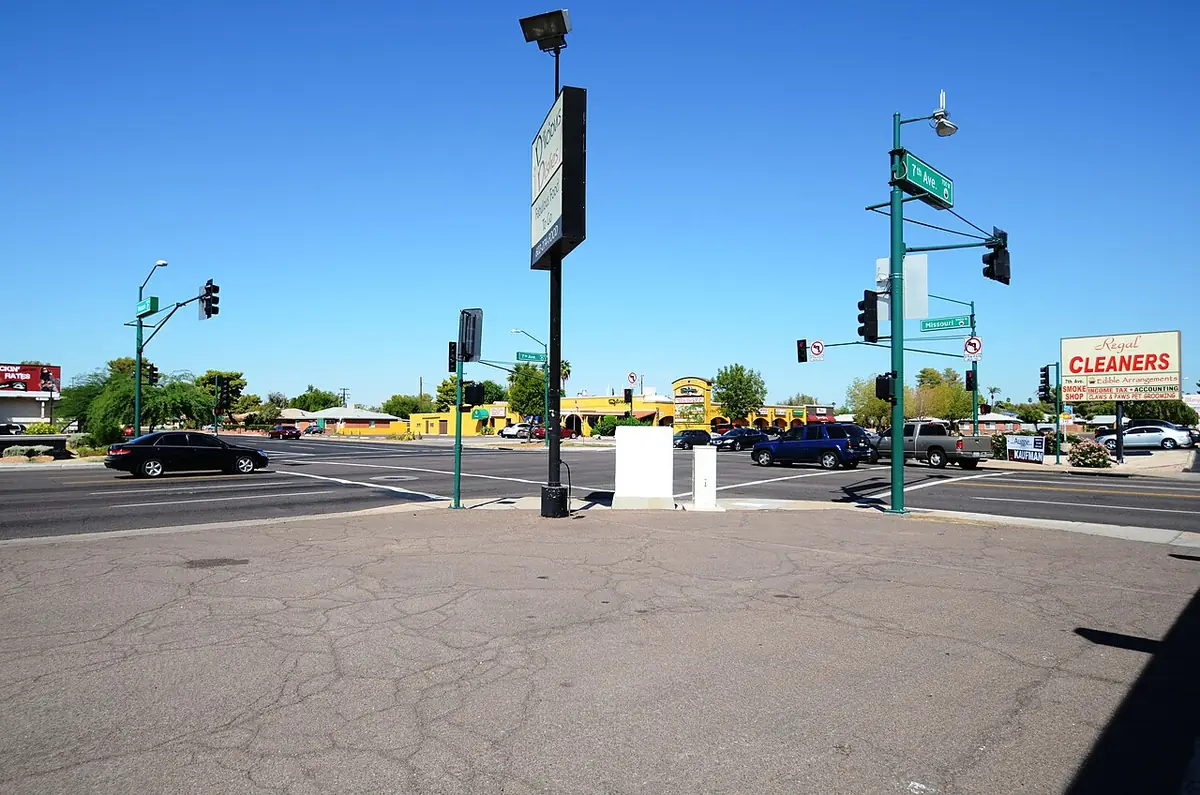
A busy Phoenix intersection on an ordinary day — Photo: Kabugenyo · CC BY-SA 3.0 · Wikimedia Commons
Beyond the face value of the property, the legal structure of ownership deserves close attention, because it changes the figure as well.
Assessing what a property is worth in the Phoenix area means looking past the headline asking price on any single house. The market reflects the sustained appeal of the area and the range of property types available, from the standard family house to the exceptional estate, and a median hides a great deal of that spread. Additional costs, including local property taxes and homeowners association dues, weigh significantly on the total cost of ownership and therefore on what a buyer will offer. Reading the price bands by area and by bedroom count is what turns a rough guess into a figure you can defend.
phoenixFor saleHouseestimate
Median price / m²US$2,337Half the apartments sell below this
Median priceUS$581kthe average is 14% higher — a few very large properties pull it up
Most common3 bedrooms45 % of listings
Average size236 m²
By number of bedrooms
Bedrooms
Share of market
Avg price
Price / m²
Avg size
2
34 %
US$470k
US$2,558
184 m²
3most common
45 %
US$620k
US$2,362
263 m²
4
20 %
US$794k
US$2,214best value / m²
359 m²
Each row is an average, compared against the area average of US$2,460 / m². These are indicative estimates of a typical local market, not a measured sample of live listings. Check current listings before relying on them.
What is actually being valued: the freehold and the HOA framework
That same careful structuring of collective ownership runs through the order in which the evidence for a valuation is gathered.
Owning a house in the United States, and particularly in the American West, comes with legal and community rules that materially change what is being valued. The great majority of homes in recent or mid-period subdivisions sit under a homeowners association that governs communal rules and exterior upkeep, and its documents are part of the valuation evidence, not a formality. Understanding how these structures work is essential to avoid an estimate that quietly ignores a liability. What you are weighing is the total freedom to alter the property against the value protection that a strict set of community rules provides.
Full ownership of the building and the land
You own the whole parcel and the structure, which gives complete legal autonomy over any structural change you want to make to the property. That freedom means carrying the entire cost of maintaining the roof, the elevations, the air conditioning systems and the private grounds alone, with nothing shared, and a valuer treats every deferred item on that list as a deduction.
What it changesThe figure reflects unrestricted control, but it should be read net of a realistic reserve for the major repairs this climate makes unavoidable.
The homeowners association (HOA) framework
In most subdivisions an association enforces visual consistency across the neighbourhood, keeps the common areas clean and controls exterior paint colours and yard treatments. In exchange for monthly or quarterly dues, the association funds upkeep of the parks, the shared pools and sometimes the internal roads of the residential area, and its financial statements show whether those dues are sufficient.
What it changesThe figure carries a well-kept setting that supports value, offset by dues and a strict rulebook that narrows the pool of buyers willing to pay it.
The rule to understand before you act on a figure
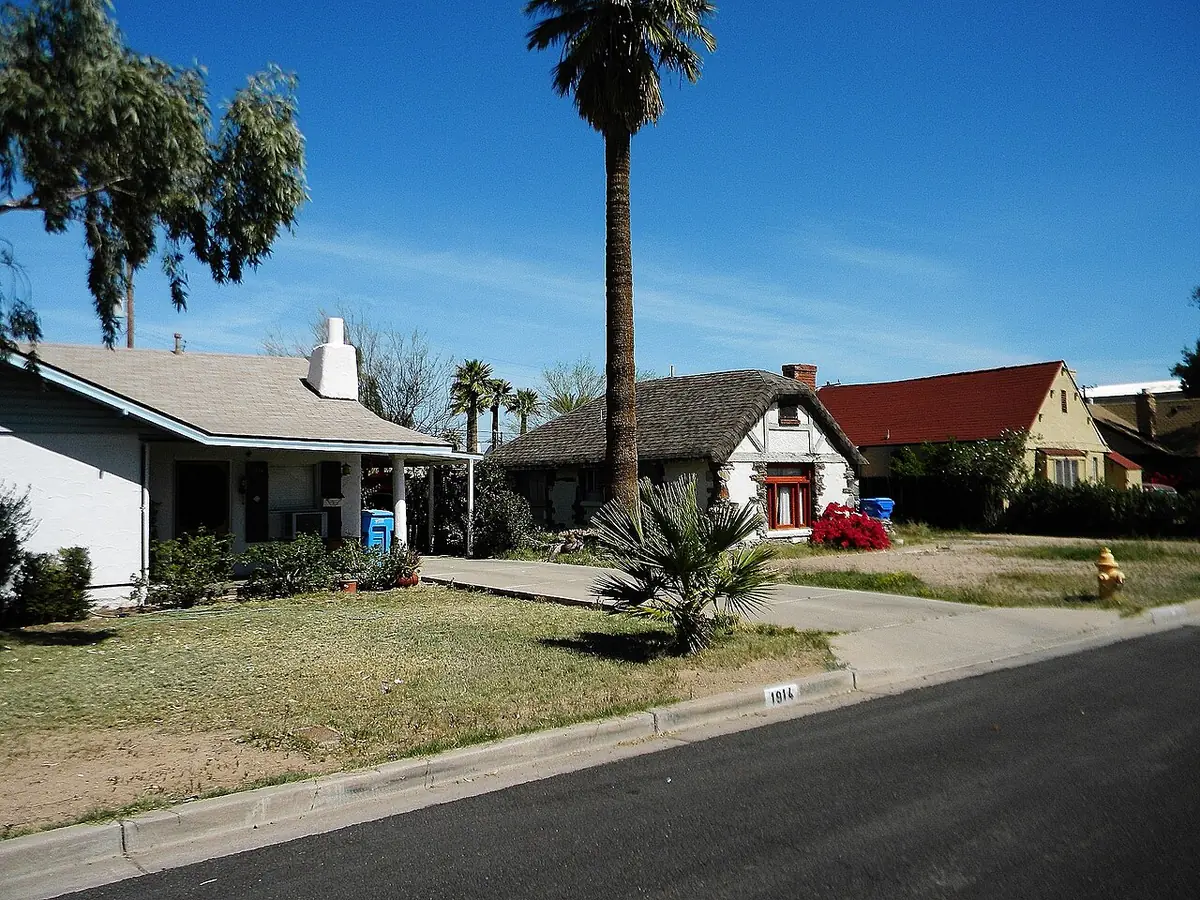
A quiet, historic residential corner of Phoenix — Photo: Kabugenyo · CC BY-SA 3.0 · Wikimedia Commons
To follow that sequence cleanly, it helps to see exactly which professional produces which number along the way.
Valuing a property in this region follows a strict order in which each verification stage protects the figure against hidden defects and administrative surprises. Unlike some European practice, an accepted offer opens a thorough technical investigation period during which you have an absolute right to examine the condition of the property, and the estimate is properly settled only at the end of it. Treating that stage as a formality, or rushing it to beat other bidders, is the most frequent and the riskiest trap for an owner working from a headline number. Rigour in reading the inspection and appraisal reports is what makes a figure durable.
A written estimate of value, set out and signed by the party producing it
Placing an earnest money deposit into escrow with the escrow agent or title company, which fixes the figure the parties are testing.
Commissioning a full technical inspection of the building by an independent certified professional to identify defects that would adjust the estimate downward.
Reading the homeowners association documents in detail, including the financial statements and any works already voted, since a pending special assessment moves the number.
Releasing the contingencies once the bank financing is in place and the appraisal report has been confirmed, which is the point at which the figure is finally validated.
Signing the transfer of ownership at closing, handled by the title and escrow company rather than by a civil-law notary
Who produces which number, step by step
That methodical approach is the best protection against relying on a figure that was never meant to carry the weight you put on it.
Valuing and transacting a property in the United States involves several specialists working in sequence, each producing a number with a different legal and technical standing. From the agent's comparative market analysis to the release of the keys by the title company, the process follows a standard timetable that keeps the transaction fair. Knowing what each participant is responsible for lets you see which figure is an opinion, which is a report and which is the one the lender will actually act on.
The owner and their agentThe comparative market analysisYou set the criteria with your agent, who pulls the relevant sales from the unified MLS system and produces a comparative market analysis, adjusting for lot, age, pool and condition against the selected areas.
The building inspectorThe detailed technical inspectionEngaged by you, the inspector examines the structure, the roof, the plumbing and the air conditioning to produce a full report on the real condition of the house, which is the evidence behind every condition adjustment.
The title companyVerifying ownership and encumbrancesIt reviews the legal history of the property to confirm that no hidden debt or ownership claim burdens the parcel, since an unresolved claim changes what the property is worth to a buyer.
The lender and its licensed appraiserThe independent appraisalThe lender reviews your file, commissions a licensed appraiser to produce an independent valuation of the property, and issues the final loan terms on the strength of that figure rather than the asking price.
The escrow and closing officerSigning the documents and transferring the fundsThe closing officer supervises the simultaneous signing of all the legal documents, collects the funds and records the sale officially with the county, which is what turns the agreed figure into a public comparable.
House or apartment in Phoenix: how the property type changes the valuation
With the property type settled, the next thing to price in is what the property actually costs to hold each month.
In Phoenix, the question of housing is framed first through thermal management and urban space, and both feed straight into the valuation. Single-family houses, overwhelmingly dominant in the Valley of the Sun, offer complete autonomy but place direct responsibility for maintenance on the owner, particularly against the extreme constraints of the arid summer, which is why condition weighs so heavily in the estimate. Condominiums and apartments in gated developments, rarer across the sprawling centre, considerably reduce the exterior upkeep burden while sharing the cost of collective equipment such as pools or the central air conditioning of the common areas, so their figures rest more on the accounts of the association than on the unit itself.
Financially, valuing a house in Phoenix means properly accounting for the energy bill that comes with large volumes under the roof and extensive glazing. Even though habitable areas are often more generous for a price per square metre below that of the American coastal metros, electricity consumption is a non-negotiable line in the budget for four months of the year, and buyers deduct for it. Apartments and townhouses value differently for that reason: more compact areas and better insulation from shared walls keep the fixed charges predictable, which narrows the spread of credible estimates.
The figure also depends on the relationship between the property and the car. A house in Phoenix almost always means a low-rise residential fabric requiring daily use of a vehicle for the smallest errand, whether shopping or leisure, and that is priced in as a given rather than as a fault. Condominiums closer to the urban development corridors or to areas under renewal sometimes offer more direct access to a denser neighbourhood life, which supports a premium, although the notion of walking remains relative in a metro built for the automobile.
Finally, how quickly a property converts back into cash varies by type, and that belongs in any honest valuation. Single-family houses benefit from constant demand from families and retirees moving to Arizona, which keeps the market active despite interest rate movements and keeps their estimates tight. Apartments, although more affordable to acquire, sometimes face competition from new developments on the fringe and require particular attention to the financial health of the association and the level of the monthly common charges, both of which can move the figure more than the unit's own condition does.
The carrying costs a buyer will net off your figure
With those numbers in view, it is worth walking through an ordinary day to see where the estimate meets daily reality.
Working out what a Phoenix property is worth to a buyer does not stop at the mortgage payment and the local property tax. You have to fold in the pronounced seasonality of the energy bills, the insurance costs specific to arid zones, and the fixed spending that comes with distance from services. A realistic estimate accounts for the summer peaks rather than an annual average, which is where thin valuations tend to fail.
Running costs and housing charges in Phoenix (average monthly estimate)
Cost item
Budget for an apartment
Budget for a house
What it means for the estimate
Electricity and air conditioning
$120 to $200
$250 to $450
Sharp summer increase, with temperatures regularly above 40 degrees Celsius.
Home insurance
$40 to $70
$90 to $160
Cover including dust storm and heat wave risks.
Property tax
$150 to $250
$250 to $500
Calculated from the Maricopa County Assessor's value and the municipal rate.
Homeowners association dues (HOA)
$200 to $400
$30 to $150
Varies with the services included, upkeep of common areas and the pool.
The amounts shown are indicative averages based on Maricopa County market data for a standard floor area.
Additional costs and everyday services
Category
Estimated amount
Frequency
What moves it
Air conditioning servicing
$150 to $300
Annual (inspection visit)
Essential before the hot season to avoid compressor failure.
Water consumption
$50 to $100
Monthly
Depends heavily on whether there is a lawn or water-efficient landscaping.
Broadband internet
$65 to $90
Monthly
Standard rate for fibre or cable connections in the metro area.
Converting to desert landscaping significantly reduces water and exterior maintenance bills, and a yard already converted removes a deduction from the estimate.
Health, schools, transport: the ordinary Tuesday behind the figure
Classic ranch-style houses line this Phoenix street — Photo: Jon Roanhaus · CC BY-SA 3.0 · Wikimedia Commons
Beyond that daily routine, it is worth looking at what the listing and the automated estimate leave out.
Reading the geography of Phoenix means understanding the rhythm of commuting and the access to service infrastructure, because both are priced into every comparable sale you will use. Between the morning traffic on the main freeways, the way temperatures govern outdoor activity and the distance to schools and health services, each part of the day is dictated by the layout of the valley, and walking through one is the quickest way to test whether an estimate reflects the real location.
07:00Home and the morning departureChecking traffic on the I-10 or Loop 101 before the commuter peaks; the drive time you record here is the same one a buyer will use to argue the figure.
08:15School or childcareDropping children at the local school district or a charter school, with the logistics built entirely around the family vehicle; the attendance zone is one of the sharpest price lines in the metro.
12:30Business district or commercial areaA midday break in an air-conditioned office area, with short drives from one parking lot to another for meetings or errands, which is what proximity to employment is actually worth here.
16:45Health centre or medical practiceAn appointment at one of the metro's many modern medical complexes, easily reached and generously provided with parking; distance to them is a documented driver in retirement-facing areas.
18:30Home and downtimeEnjoying the end of the day, often outside on the terrace as temperatures fall, or in the air-conditioned common areas; usable outdoor space is worth more where shade and orientation make it usable.
20:30Running the house and winding downChecking the connected home systems and setting appliances to run overnight to take advantage of electricity rates, a small saving that speaks to how efficiently the house holds its temperature.
What the listing and the automated estimate will not tell you about a Phoenix house
With those practical points covered, it is worth examining the misjudgements owners most often make about their own figure.
Sales copy and automated tools lead on light, floor area and the presence of a pool, but they routinely omit the structural constraints imposed by the desert climate and by municipal rules. Knowing these realities in advance keeps an estimate honest and lets you quantify the adaptation work a buyer will otherwise price in for you.
The strict rules imposed by homeowners associations (HOA)
Many subdivisions impose fussy rules on exterior paint colours, street parking and the appearance of the yard, which narrows the pool of buyers and is invisible to any tool working from floor area alone.
Premature wear of exterior materials under solar exposure
Paint, roof seals and the plastic components of outdoor equipment degrade faster here, so an estimate that ignores their age is quietly carrying a preventive maintenance bill it never deducted.
The complexity of water rights and mandatory landscaping
Some municipalities ban or heavily tax the watering of traditional lawns, forcing a conversion to gravel or xeriscape planting, and an unconverted yard is a known future cost against the figure.
How quickly the secondary roads saturate as the population grows
The freeway network performs well, but the connecting urban boulevards slow badly at peak hours because of continuing sprawl, so a map-measured distance overstates what a location is really worth.
The unavoidable pest management specific to an arid environment
Scorpions, termites and rodents naturally seek shelter in cool houses, requiring annual preventive treatment contracts with local specialist firms, which is a recurring charge no listing mentions.
Valuation mistakes that only surface six months later in Phoenix
To avoid those outcomes, it is just as important to know when a headline figure should not be relied on at all.
Looked likeA charming house with a large sunlit veranda facing due south, presented as a premium feature worth adding to the figure.
Turned outA genuine heat trap that makes the room unusable and sends the air conditioning bill through the roof all summer, so buyers discounted rather than paid for it.
Would have caught itAlways check the orientation of the glazing and whether external blinds or climate-appropriate shade structures are fitted before treating it as an uplift.
Looked likeA quiet, wooded residential neighbourhood offering a green and shaded setting away from the urban bustle.
Turned outPunishing irrigation costs and underground pipework damaged by the roots of trees unsuited to arid soil, both of which the buyer's inspection surfaced and deducted.
Would have caught itFavour local species and obtain a full survey of the drainage network before the figure is committed to paper.
Looked likeA condominium showing very low monthly charges, which made the carrying-cost line in the estimate look attractive.
Turned outA reserve fund so inadequate that it led to a large special assessment to replace the building's roof, wiping out the apparent advantage.
Would have caught itInsist on reading the minutes of recent homeowners association meetings to identify deferred work before it reaches the estimate.
Looked likeA location described as close to amenities and to the metro's main traffic corridors.
Turned outDaily access complicated by congested junctions and no safe pedestrian routes to local shops, which comparable buyers priced well below the map distance.
Would have caught itDrive the route yourself at peak time on a weekday before letting proximity carry any weight in the figure.
When a Phoenix valuation should not be trusted at face value
It is time now to set out the basis for your final judgement with a clear head.
A figure on a Phoenix property is only as good as the evidence and the time horizon behind it, and neither suits every situation. Certain profiles, constraints and expectations run directly against the reality of the local market, which is where a single headline number stops being useful and a full comparative analysis has to take over.
The owner of a car-dependent outlying house pricing it for a walkable-lifestyle buyer
→Reset the estimate against buyers who actually shop in that area
The absence of walkable urban density and the thin transport coverage outside the centre mean that pool of buyers never bids, so any figure built on them is unreachable.
The owner working to a short and uncertain time horizon
→Read the estimate net of transaction costs rather than as a gross figure
Buying and reselling costs in Maricopa County require a holding period of at least five years to absorb, so a gross valuation badly overstates what a quick exit returns.
The owner valuing a lush, heavily planted garden as an asset
→Test it against comparable sales rather than against personal taste
Strict water restrictions and the maintenance cost of lawned grounds in a desert setting mean local buyers frequently price such a garden as a liability instead of a feature.
The owner with no reserve for unforeseen spending
→Deduct the known equipment risks before relying on the number
The sudden failure of an air conditioning system in July is an immediate replacement cost that cannot be deferred, and an estimate that ignores it is not a net figure.
So, is the figure you have solid enough to act on?
Valuing a property in Phoenix rewards careful preparation and a clear head. If you have accounted for the climate constraints, accepted the reality of car-based travel and provisioned a suitable maintenance budget, the figure you arrive at will hold up in a metro that offers an exceptional setting, bathed in sun and driven by steady economic growth. The key is the fit between what you believe the property is and how this particular market actually prices it.
Take the time to visit several neighbourhoods at different hours, to compare homeowners association rules and to have the thermal installations inspected by an independent professional. Never let the pressure of a fast-moving market push you into acting on a number you have not tested. A sound valuation in the Valley of the Sun is built on a cool reading of the figures and a long view of how the property will be lived in.
If your comparables match the local way of living and your arithmetic absorbs the summer spending peaks without strain, the figure is ready to carry weight. The Phoenix market treats informed owners well, provided they approach their estimate with method, pragmatism and respect for the specifics of Arizona's arid environment.
Related questions
What time of year gives the most reliable read on a Phoenix valuation?
The Phoenix market is traditionally busiest between winter and spring, when mild temperatures draw in buyers from outside the state, so comparable sales from that window are plentiful and tightly clustered. Summer is quieter because of the heat, and the thinner run of comparables from those months can pull an estimate off, which is why a careful valuation says which season its evidence came from.
Are property taxes high in the Phoenix area, and do they affect the estimate?
Property tax rates applied in Maricopa County generally sit in the lower half of the range across the United States. The final amount depends on the assessed value kept current by the county and on exactly where the property sits relative to municipal and school district services, so two houses with the same market estimate can carry noticeably different annual bills.
How much does the air conditioning affect what a house is worth?
A great deal, because central air conditioning units are worked hard in the Phoenix climate and have a service life of roughly ten years. On an older property, the age and condition of the compressor and the thermal insulation are among the first things a valuer adjusts for, since a replacement due within a year or two is money the next owner has to find.
What is a homeowners association (HOA) and how does it enter a valuation?
An HOA manages the common areas and enforces the community or subdivision rules on exterior appearance and parking. Its monthly dues are a fixed carrying cost on top of everything else, and its decisions bind every owner inside the boundary, so both the dues and the health of its reserves belong in any honest estimate.
How quickly does a Phoenix property convert back into cash?
Liquidity depends directly on location, property type and general standard of upkeep, and a figure on paper means little if nothing at that level has actually traded. Well-maintained single-family houses in sought-after neighbourhoods enjoy steady demand thanks to the region's constant population growth, which is why their estimates hold up better under scrutiny.
Does the outdoor water setup change what a house is valued at?
Water use is governed by strict regulations designed to protect the resources of arid Arizona, and the landscaping choice follows from them. Many owners opt for desert landscaping, gravel and low-water planting, to cut the bill and stay within municipal guidance, and a yard already converted that way removes a future cost a valuer would otherwise deduct.
Which transaction costs should be netted off the headline figure?
In the United States the transaction is handled by a title company rather than by a civil-law notary, and its escrow account holds the funds. Closing costs take in transfer taxes, title company fees, lender administration charges and the pro rata share of property taxes, generally amounting to between 2% and 5% of the price, so the estimate on the page is never what lands in your account.
Do school districts move Phoenix valuations?
School quality varies considerably from district to district and from one municipality to the next across the wider metro area, and that variation shows up in prices street by street. Many families cross-check the public offer against charter school rankings, so a valuation that ignores which attendance zone a house sits in is missing one of the sharper local price drivers.
Which natural hazards should a valuation account for here?
Phoenix is exposed mainly to extreme heat waves, to the seasonal dust storms known as haboobs and occasionally to urban runoff during heavy thunderstorms. Appropriate insurance is essential to cover these local specifics, and the premium it costs is a real annual figure that belongs in the ownership arithmetic behind any estimate.
Does short-term letting potential raise a Phoenix valuation?
Short-term holiday letting is tightly governed by specific municipal regulations and is sometimes banned or capped by homeowners association rules. Anyone valuing a property on the strength of that income has to confirm the restrictions first, because a figure built on income the rules do not permit is not a valuation at all.
Property review of ting
No ting properties in Phoenix yet
Be the first — share it on ting and it shows up right here.