Buying an apartment in Phoenix means reconciling a sun-soaked lifestyle with the institutional and climatic realities of Arizona. This guide unpacks how the local market works, from choosing a neighborhood to the rules that govern condo associations, so you can invest with confidence.
Get the app
What nobody tells you.
Real prices, hidden costs and the traps to check before you commit.
Buying an apartment in Phoenix: what does choosing the urban desert really involve?
Scroll
Buying an apartment in Phoenix: what does choosing the urban desert really involve?
Buying an apartment in Phoenix means reconciling a sun-soaked lifestyle with the institutional and climatic realities of Arizona. This guide unpacks how the local market works, from choosing a neighborhood to the rules that govern condo associations, so you can invest with confidence.
Written by the ting.ad editorial team ·
North Central Avenue, Phoenix in Street View: drag to look around.
That tension between urban appeal and climatic constraint raises the real question of whether this market fits your daily life.
Buying an apartment in Arizona's capital means looking past the sunlit postcards to understand how this unusual property market really behaves. Between the sprawl that defines the valley and the gradual densification of downtown, every district offers a very specific trade-off between affordability, lifestyle and climate. The promise of a bright setting runs into planning choices where the car remains ever-present, which redefines what proximity means. You therefore need to weigh coolly what each kind of purchase can be expected to deliver over the long run, allowing for the particularities of the Valley of the Sun. Buyers discover quickly that a property's value lies as much in how it handles heat as in exactly where it sits.
The promise of modern, connected city livingvsThe reality of a downtown under permanent construction and heavy on hard surfaces
Central neighborhoods such as Downtown or Midtown offer cultural life and direct access to transit, but show pronounced urban heat island effects in summer. Accepting that density means giving up the calm of the leafier suburbs in exchange for time saved each day.
The appeal of gated communities with full amenitiesvsThe financial and regulatory weight of HOA dues
Pools, gyms and landscaped grounds are the norm in many of the valley's condominium developments. Those services carry high upkeep costs that rise steadily, eating into rental returns or the long-term budget for holding the property.
The search for a stable, sought-after long-term assetvsThe pronounced cyclicality of the Arizona property market
Driven by the steady arrival of working households fleeing coastal costs, Phoenix goes through phases of rapid growth followed by plateaus. A purchase here should be planned over several years so it can absorb those swings.
The comfort of modern housing built around air conditioningvsThe architectural sameness of some recent construction
New developments guarantee excellent insulation and controlled energy bills thanks to strict state standards. In exchange, historic character is all but absent and you are moving through residential complexes that can feel standardized.
What kind of buyer are you, measured against the realities of Phoenix property?
Understanding these profiles makes it easier to gauge the practical and cultural gap between a housing history built elsewhere and settling into the Arizona desert.
The Phoenix residential market answers very differently depending on whether you are after a winter base, a permanent home or a pure rental investment. The city's vast footprint means your purchase has to be matched to how you travel and how much summer heat you can tolerate. The options below describe how different buyer profiles take on vertical or semi-collective housing in the region, without illusions about local life. Each situation highlights an unavoidable trade-off between centrality, budget and the level of everyday comfort you want.
Permanent remote work in the sun
If you work remotely and want a bright setting, an apartment in a neighborhood such as Roosevelt Row or Midtown drops you into a creative, workable environment. You get coworking spaces, cafes set up for laptops and cultural life reachable on foot or by scooter during the mild months. In exchange, you will have to deal with extreme summer temperatures that keep people indoors from June to September, turning your apartment into a permanently cooled cocoon. Sound and thermal insulation in the building then becomes your number one criterion, both against isolation and against runaway electricity use.
A targeted rental strategy
Buying an apartment near the big university campuses or the tourist areas offers attractive yield prospects, but ones that are strongly seasonal. Demand surges from autumn to spring with the influx of winter visitors, the well-known snowbirds, before slowing markedly over the summer. Your plans have to account for strict condominium rules on short-term rentals, which the city regulates more closely every year. A careful review of HOA dues is essential to make sure they do not swallow most of your net operating margin.
An active primary residence
For a life built around services, secure gated communities or newer buildings with a front desk offer welcome peace of mind. You get direct access to maintained pools and common areas without having to worry about exterior upkeep. That formula does mean living by association rules that can be strict, and accepting community living governed by influential homeowners associations. It is the logistically simple choice, at the price of a certain standardization of your immediate surroundings.
Buying in Phoenix when you are arriving from abroad: what changes completely
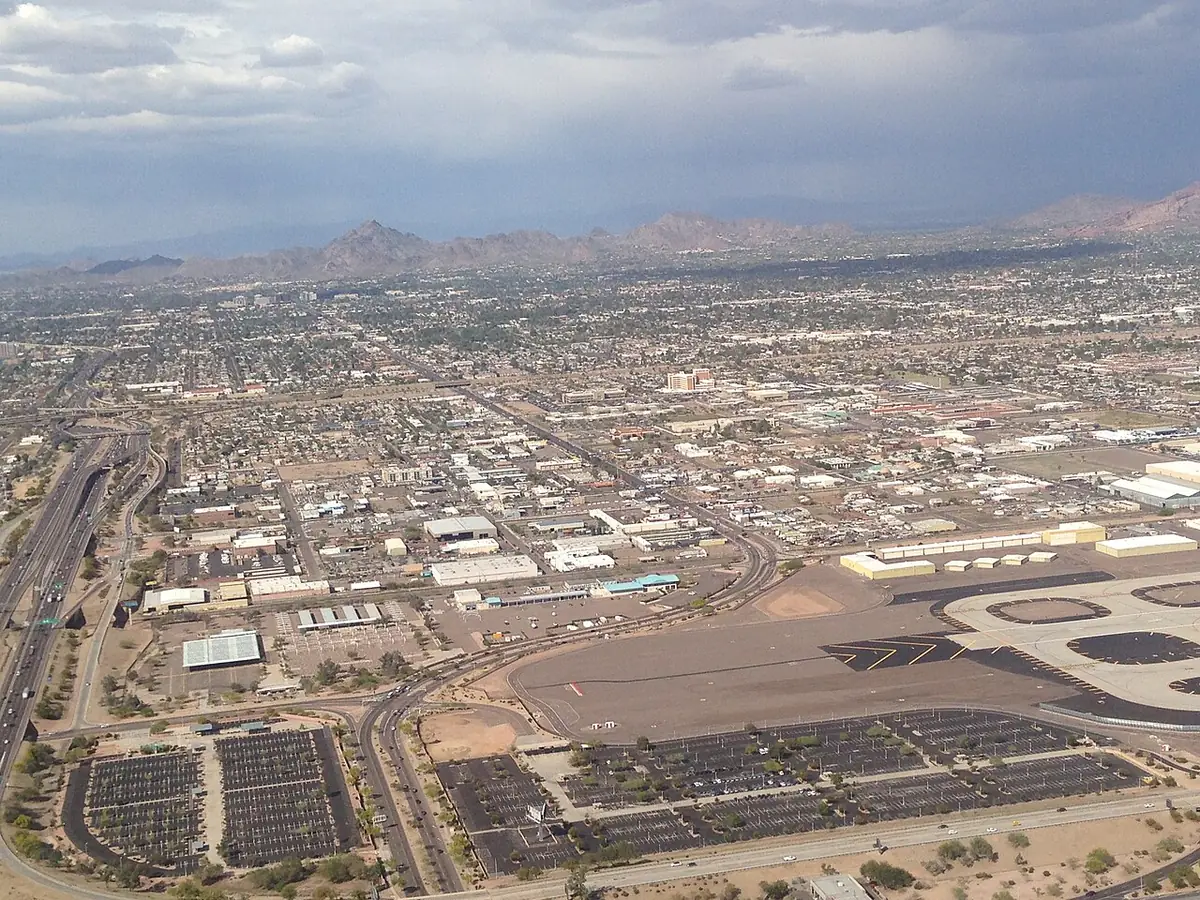
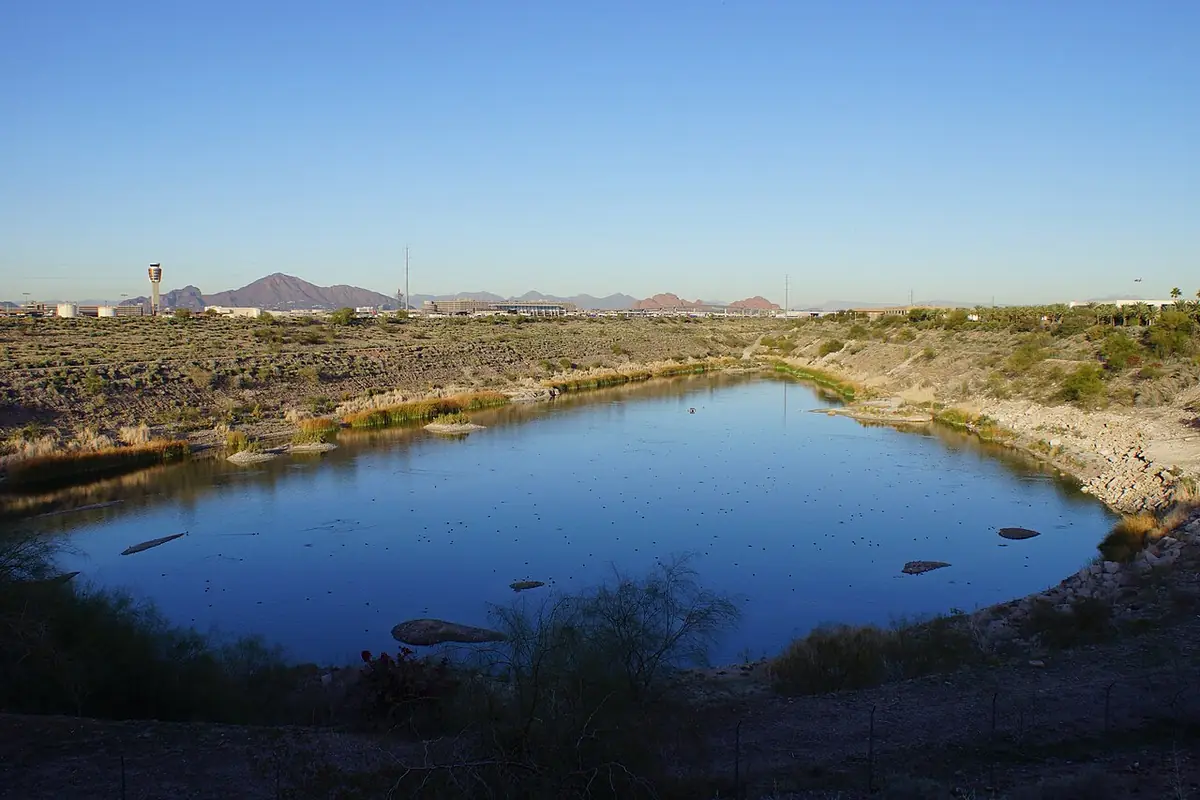
Phoenix spreads wide beneath its desert mountains — Photo: CyberXRef · CC BY-SA 3.0 · Wikimedia Commons
Once those institutional reference points are clear, the choice of district becomes the cornerstone of a successful purchase.
The American system for acquiring property, and Arizona's in particular, rests on legal and cultural mechanisms very far removed from what buyers from abroad are used to. Set aside the model of a single protective public officer drafting the deed, and the rigid structure of a professionally managed condominium board. Here contractual freedom dominates, framed by specialist agents and by title companies that underwrite legal security. Understanding those structural differences prevents disappointment at signing and protects your investment from the very first offer.
From abroad
A single notary or public officer who drafts the deed and guarantees the balance of the sale
Phoenix
A neutral title company, with real estate agents acting for each side
In the United States there is no equivalent of the continental notary; a title company secures the funds, checks the chain of title and orchestrates the closing without acting as anyone's personal legal adviser.
From abroad
Strong statutory protection for occupants and lengthy procedures when things go wrong
Phoenix
Contractual pragmatism and the strict rules of HOAs (homeowners associations)
Homeowners associations hold very broad, near-regulatory powers over your property, and can levy fines or require you to bring a facade or balcony back into compliance.
From abroad
Thermal insulation designed mainly around winter heating
Phoenix
Constant central air conditioning, solar orientation and managing extreme heat
Assessing an apartment starts immediately with how well the air conditioning performs, the quality of the double glazing and exposure to direct sun, all to avoid punishing summer electricity bills.
From abroad
A mortgage at a fixed rate negotiated through traditional brokers
Phoenix
Escrow accounts, variable local property taxes and a distinctive mortgage market
The total cost of ownership includes property taxes assessed locally and reassessed periodically, plus a homeowners insurance policy covering the region's specific climate risks.
From abroad
The historic centrality of dense, walkable city centers
Phoenix
Sprawl, the vital importance of parking and functional architecture
Even when buying an apartment, an assigned covered parking space is an absolute requirement for day-to-day usefulness and for future resale.
Which Phoenix neighborhood should you target for your purchase?
The neighborhood you choose directly sets the budget you need, which is best examined through real market data.
Metropolitan Phoenix is built around sharply contrasting urban cores, from an inner city in full transformation to quiet, leafy residential suburbs. Each district has its own rhythm, its own social mix and its own medium-term price trajectory. Looking for a universally perfect neighborhood is futile; everything depends on your tolerance for urban noise, your need for greenery and your overall budget. The options below compare the main buying areas to help you position your search pragmatically.
Downtown Phoenix
An active urban atmosphere, set by construction sites, light rail and cultural life.
Suits
Buyers who want to be a step away from theaters, museums, restaurants and institutional employers.
Trade-off
A higher price per square meter, often restricted parking and only relative quiet at night depending on the street.
Midtown and Encanto
A welcome balance of established residential buildings, streets lined with mature trees and proximity to the major hospitals.
Suits
Healthcare professionals, couples and buyers looking for a greener setting while staying very central.
Trade-off
An older housing stock in places, which means budgeting for interior renovation and energy upgrades.
Camelback Corridor / Arcadia Lite
A sought-after area combining upscale retail, notable restaurants and well-kept residences.
Suits
Those aiming at a solid long-term asset in one of the valley's most desirable and stable areas.
Trade-off
Sharper competition among buyers and entry prices well above the city average.
North Phoenix / Desert View
More open space, large recent residential complexes with excellent amenities and mountain views.
Suits
Buyers seeking quiet, the security of gated communities and modern, standardized comfort without compromise.
Trade-off
A pronounced distance from the historic center, making daily car use unavoidable for even the shortest trip.
What does an apartment in Phoenix really cost, area by area?
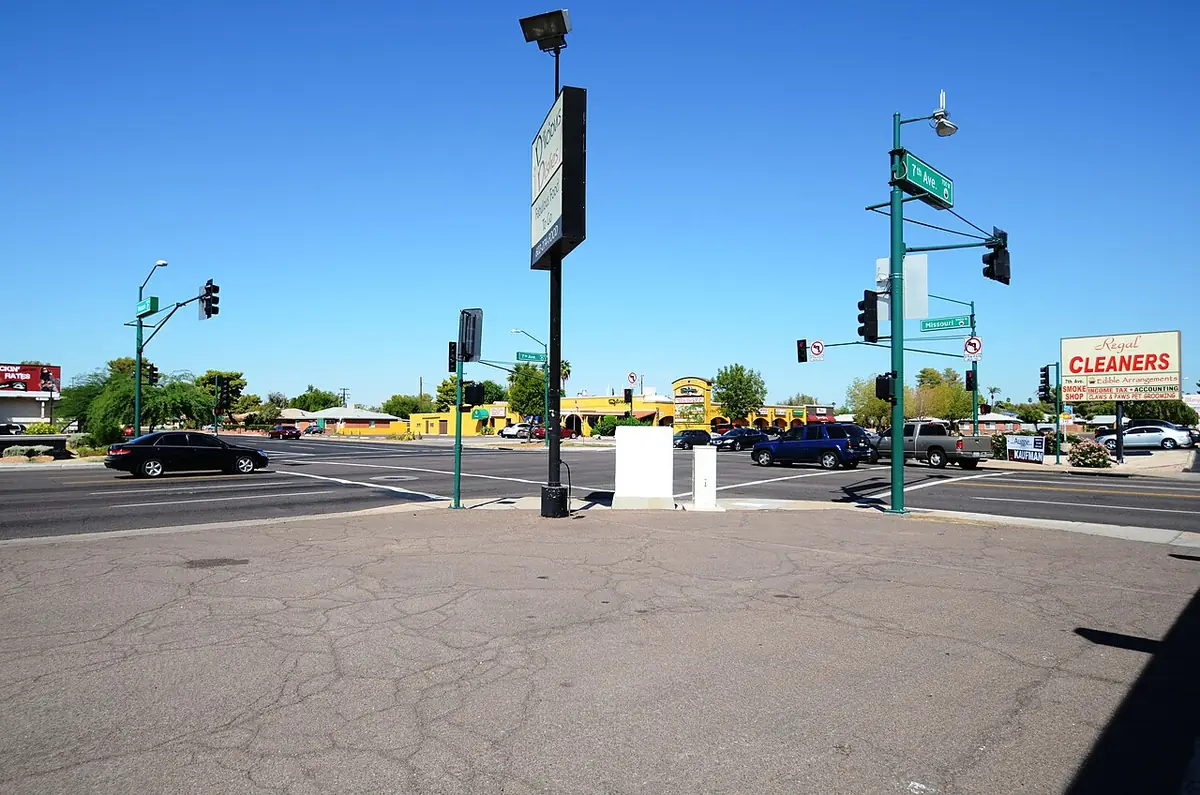
A busy Phoenix intersection on an ordinary day — Photo: Kabugenyo · CC BY-SA 3.0 · Wikimedia Commons
Beyond the headline purchase price, what you legally own deserves close attention if you want to avoid any misunderstanding.
The Phoenix housing market reflects Arizona's strong demographic pull, while still showing wide gaps between the inner core and the outer rings. Prices are quoted before transaction costs, which include local taxes and the initial contributions owed to the homeowners association. To avoid unpleasant surprises, separate the headline purchase cost from the recurring costs of ownership, notably energy and HOA dues. The table below sums up the trends observed across the main segments of multi-family housing.
phoenixFor saleApartmentestimate
Median price / m²US$2,850Half the apartments sell below this
Median priceUS$405kthe average is 14% higher — a few very large properties pull it up
Most common3 bedrooms40 % of listings
Average size135 m²
By number of bedrooms
Bedrooms
Share of market
Avg price
Price / m²
Avg size
1
12 %
US$234k
US$3,600 +20 %
65 m²
2
30 %
US$328k
US$3,120
105 m²
3most common
40 %
US$432k
US$2,880
150 m²
4
18 %
US$554k
US$2,700best value / m²
205 m²
Each row is an average, compared against the area average of US$3,000 / m². These are indicative estimates of a typical local market, not a measured sample of live listings. Check current listings before relying on them.
Outright ownership or regulated common ownership: what do you actually hold?
That legal structure sits inside a fast, codified transaction process whose every key stage you need to master.
Buying an apartment in the United States, and particularly in the American West, means accepting a strict division of responsibility between your private space and the commonly managed areas. Contrary to a common assumption, common ownership is not just a technical management arrangement; it is a binding legal framework that can shape how freely you use your home. Understanding the difference between the forms of ownership helps you avoid disputes with the bodies that run the building. The two perspectives below weigh the freedoms and constraints built into this kind of housing.
The condominium model (condo)
You own the interior of your apartment outright and share ownership of the land and shared amenities with all the other residents. That structure is run by a homeowners association (HOA) which votes the annual budget and maintains the pool, the roof and the landscaped areas. You get shared comfort without having to worry about heavy maintenance of the building envelope. In exchange, you have to live by rules that can be fussy about the look of balconies, the hours when common areas are open, or pets.
What it changesThis choice protects the collective value of the building through rigorous upkeep, but it demands a careful reading of the association's accounts and reserves before you make any offer.
The townhouse model (an attached house)
A hybrid form that is very popular in Phoenix, the townhouse often gives you ownership of the land beneath and of the roof, while still tying you to a neighborhood association for common areas or private roadways. You get your own direct entrance from outside and a small enclosed patio or yard, which removes the feeling of living in a dense vertical building. Dues are generally somewhat lower than in a large condominium tower, because the shared amenities are more limited. In exchange, responsibility for maintaining the exterior structure and the roof often falls to you directly.
What it changesIt is the ideal alternative for buyers who miss the single-family house but still want the security and simple management of a maintained community.
The golden rule to understand before you put money down on a Phoenix property
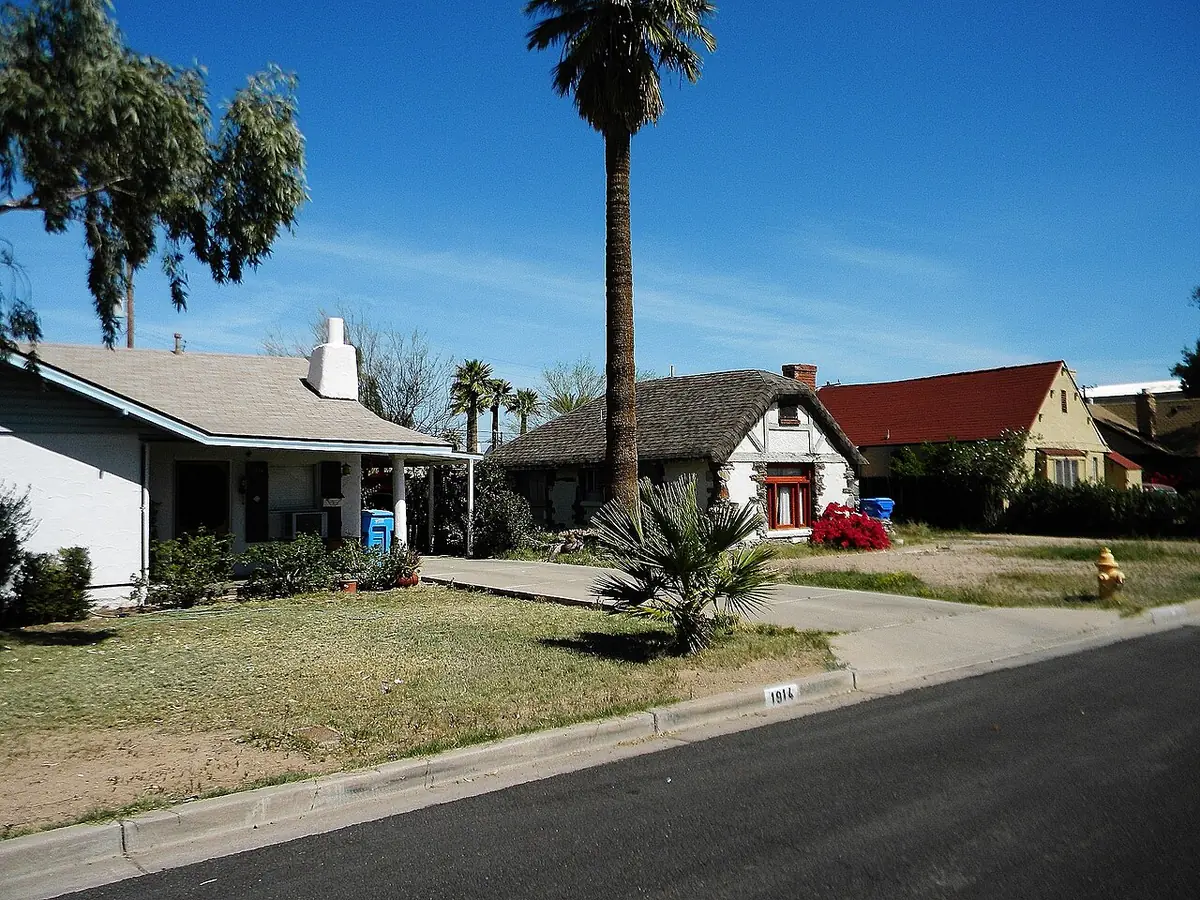
A quiet, historic residential corner of Phoenix — Photo: Kabugenyo · CC BY-SA 3.0 · Wikimedia Commons
Once those rules of engagement are understood, it is time to lay out the practical timeline of your purchase.
In the state of Arizona, financial commitment is formalized by a good-faith deposit, known as earnest money, as soon as the offer is accepted. That mechanism protects buyer and seller alike, but it runs on strict deadlines that must never be neglected. A delay in clearing a contingency can cost you your deposit or leave you permanently bound to a property with hidden defects. The chain below sets out the critical stages in protecting your investment.
The purchase contract is signed and accepted by the seller.
The earnest money deposit is placed with the title company within strict contractual deadlines, generally 48 to 72 hours.
The inspection or due diligence period opens, giving you the legal right to have the apartment surveyed by an independent professional and to review the HOA documents.
Repairs are negotiated, or the sale is cancelled without penalty, if the reports reveal major defects or unpaid association dues.
The lender's official appraisal is carried out to confirm the property's market value against the mortgage amount requested.
The closing takes place once the final documents are signed and the funds are transferred by the title company.
How does a property transaction in Phoenix unfold, step by step?
Carrying a purchase through in Arizona's capital means coordinating several professionals under the direction of your agent and the title company. Each plays a precise role that has to be respected to keep the sale on the usual 30 to 45 day schedule. The timeline below describes the successive steps that lead from the initial search to the keys of your new apartment.
The buyer and their real estate agentSelecting properties and drafting the offerSetting the budget precisely, obtaining pre-approval from a local lender and drafting the offer with the protective contingencies you cannot do without.
The title companyEscrow and title searchOpening the escrow account for the deposit and checking thoroughly that there are no liens or disputes attached to the property's title.
The licensed home inspectorTechnical and thermal surveyCareful inspection of the air conditioning, the plumbing, the condition of the building's roof, and a search for the pests specific to the region.
The homeowners association (HOA)Delivery of the financial documentsProviding the rules and CC&Rs, the minutes of general meetings and the financial statements for the buyer to review.
The appraiserOfficial valuationConfirmation for the lender that the purchase price is in line with local market prices, so the loan amount can be secured.
All parties togetherClosing and public recordingFinal signature of the documents, wiring of the remaining funds and official recording of ownership with Maricopa County.
Apartment or house in Phoenix: how do you choose a way of life under the Arizona sun?
Once the type of property is settled, the central question of total budget and additional costs arrives immediately.
Choosing between a condominium apartment and a single-family house in Phoenix depends entirely on how you relate to managing a desert climate and how much maintenance you are willing to take on. In the heart of the Valley of the Sun, summers are extremely long and marked by temperatures that regularly pass forty degrees Celsius for months on end. In a single-family house you get complete architectural freedom and private outdoor space, but you also inherit absolute responsibility for the central air conditioning, the insulation and the upkeep of a lot that forgives no neglect during drought. The energy costs of holding a comfortable temperature across a large floor area can climb dramatically during the summer peaks.
Buying a condominium apartment in lively neighborhoods such as Downtown Phoenix, Midtown or along the light rail corridor shifts a large share of the operating burden onto a homeowners association, the HOA. That collective structure takes on upkeep of the common areas, building security, the roof and, in the great majority of cases, the essential maintenance of the outdoor pool. For a buyer who travels often, or who refuses to spend weekends repairing cooling systems, the apartment offers considerable peace of mind. It does, however, mean submitting to strict rules on exterior modifications, short-term rentals and pets, while paying monthly dues that rise almost every year.
In purely financial terms, price growth in Phoenix has followed distinct paths depending on the type of property. Single-family houses in established residential areas such as Arcadia and Paradise Valley, or in the fast-growing suburbs of Gilbert and Peoria, have historically shown stronger capital appreciation, driven by land scarcity and constant demand from families looking for space. Apartments, by contrast, offer a distinctly more accessible entry point for first-time buyers or for investors seeking steady rental income from a population of young professionals and Arizona State University students. Even so, you should examine the HOA's financial health with the greatest care before committing, because a poorly run association with insufficient reserves can quickly hit you with very heavy special assessments for structural work.
Finally, your decision should rest on a clear-eyed reading of your daily life and your medium-term plans in the Phoenix metro area. If you value city living, being a step from the newer restaurants, the galleries and the transit lines without worrying about exterior maintenance, the apartment is the obvious answer. If you dream of open space, a drought-tolerant landscaped garden on drip irrigation and total independence from immediate neighbors, the single-family house remains irreplaceable despite the management it demands day to day in this arid environment.
What budget do you really need to live comfortably in Phoenix?
Understanding costs on paper is not enough; you also need to see concretely how an ordinary day in the city unfolds.
Buying property in Phoenix is not just the price on the listing or your monthly mortgage payment. The local market brings in variables specific to Arizona, notably property taxes, homeowners insurance that is rising because of climate risk, and summer energy bills. Working through these line items in advance prevents financial surprises in your first year in the metro area.
Estimated monthly and annual costs for an apartment in Phoenix
Cost item
Low end
High end
Context
Median purchase price
$250,000
$450,000
Varies sharply with proximity to downtown and the age of the condominium.
HOA dues
$200 / month
$550 / month
Usually includes water, the common areas and the building's insurance.
Annual property tax
0.6%
0.9%
Calculated on the value assessed by Maricopa County, and relatively moderate.
Electricity and air conditioning
$150 / month
$400 / month
Absolute peaks between June and September with heavy air conditioning use.
The figures are based on median trends observed in Maricopa County for standard properties.
Additional costs and recurring operating charges
Type of cost
Estimated amount
Frequency
Effect on the budget
Homeowners insurance
$800
Annual
Rising noticeably because of dust storm and extreme heat risk.
Closing costs
2% to 3%
One-off (purchase)
Title and escrow fees, transfer taxes and agent commissions to build into your cash contribution.
Maintenance and repairs
$1,500
Annual
Servicing the air conditioning units and preventive maintenance are essential.
Set aside a contingency fund dedicated to unexpected problems with the cooling system.
Health, schools and transport: what does an ordinary Tuesday in Phoenix look like?
Classic ranch-style houses line this Phoenix street — Photo: Jon Roanhaus · CC BY-SA 3.0 · Wikimedia Commons
Beyond that apparent routine, the local property market hides realities the brochures never mention.
Living in Phoenix means structuring your days around distances and around the heat of the Sonoran Desert. Between morning commutes on the main highways, managing the children's schooling and reaching healthcare, every hour of the day follows a particular rhythm that any newcomer has to absorb quickly to settle in well.
07:00On the main highways (I-10 or Loop 101)Commuting starts. Traffic is heavy but flows well compared with other American metro areas, provided you avoid the familiar bottlenecks toward Downtown.
08:30School or university campusDropping children at schools in the Phoenix unified district or at local charter schools, known for their varied teaching programs.
12:30Business district or coworking spaceIntense working hours. Professionals make use of modern air-conditioned offices, while trips outside are kept to a strict minimum during the hottest part of the day.
17:30Medical center or neighborhood clinicAccess to leading healthcare providers such as Banner Health or the Mayo Clinic, easily reached from the main residential areas.
19:00Outdoor space or urban park (Camelback Mountain)Temperatures ease enough for exercise or for the shaded patios of local restaurants.
What glossy Phoenix listings leave out
Ignoring these invisible factors often leads to bitter disappointment a few months after the closing.
Marketing photographs and virtual tours always show properties at their best, bathed in flattering golden light. Yet actually living in Phoenix reveals crucial practical, regulatory and environmental realities that sellers systematically leave out of their descriptions.
The real age and efficiency of the air conditioning (HVAC) units
An aging air conditioning system in Phoenix means an immediate replacement cost of $7,000 to $12,000 and sends your monthly electricity bills soaring as soon as summer heat arrives.
The strict restrictions imposed by homeowners associations (HOAs)
Many communities ban parking work vehicles on the street, prescribe exact paint colors for exterior walls and regulate the height of trees.
The acoustic reality of the flight corridors
Several popular residential neighborhoods sit under the approach paths to Phoenix Sky Harbor International Airport, generating regular noise that weekend viewings do not reveal.
The long-term impact of urban heat islands
Heavily paved areas without mature vegetation hold night-time heat to a striking degree, turning your yard or terrace into a furnace even after sunset.
The buying mistakes you only discover after six months in Phoenix
Faced with these technical and financial demands, it matters just as much to know whether this market is really right for you.
Looked likeA promising financial opportunity in a neighborhood in full renewal
Turned outAn isolated area badly short of shops and services, with a marked lack of safety at night
Would have caught itVisiting the neighborhood at different hours of the day and night, and reading local police reports before making an offer.
Looked likeA charming landscaped garden with superb cactus and exotic planting
Turned outA money pit of irrigation upkeep and a constant risk of scorpions and other desert pests
Would have caught itRequesting a full pest inspection and favoring restrained xeriscape planting.
Looked likeVery low HOA dues for a long list of advertised amenities
Turned outA chronically underfunded association heading straight for a massive special assessment to redo the roof
Would have caught itInsisting on a careful review of the HOA's meeting minutes over the past three years.
Looked likeA large, spacious family house with wide windows facing due west
Turned outAn unbearable furnace in the afternoon despite the air conditioning at full power, and punishing electricity bills
Would have caught itChecking the home's orientation, the quality of the double glazing and whether exterior sun shades are fitted.
Who really should not be buying property in Phoenix right now?
It is time to lay the ground for a clear-eyed conclusion about whether to go ahead.
The Phoenix property market has features that make it unsuitable for certain buyers. Insisting on investing here without the financial flexibility or the acceptance of the local way of life almost always leads to a dead end or to rapid regret.
The investor after an immediate, high rental yield with little money down
→To buy an affordable apartment in an aging condominium
Continually rising HOA dues and the cost of maintaining shared amenities quickly erode the net return they were counting on.
The buyer highly sensitive to intense heat and attached to temperate climates
→To settle permanently in a large, poorly insulated house with vast glazed areas
They will end up confined indoors for close to four months a year, held hostage to air conditioning that never switches off.
The household on a tight budget with no contingency savings
→To put every last saving into the down payment with no room to maneuver
The slightest major air conditioning failure or a special assessment from the HOA would put them immediately into default.
Buying an apartment or a house in Phoenix is not a matter of aesthetic infatuation or an impulsive financial decision driven by the trend of the moment. It is a deep commitment to a distinctive way of life, shaped by the vastness of the Arizona desert, the economic momentum of the Valley of the Sun and the implacable reality of a demanding climate. If you have understood the need to build summer energy costs into your monthly budget, if you accept the regulatory constraints imposed by homeowners associations, and if you value technical soundness over the superficial appearance of finishes, then this market offers remarkable opportunities to build a solid asset.
The success of your purchase rests above all on your ability to set marketing illusions aside and concentrate on the fundamentals: exactly where the property sits relative to where you work, the real structural condition of the building, the unquestioned financial health of the association and the quality of the insulation. Take the time to visit the neighborhoods you are considering at rush hour and during the hottest part of the day. Talk to current residents to understand community life beyond the brochures the agencies hand out.
In the end, Phoenix rewards the methodical, informed and clear-headed buyer. It is neither a lawless gold rush nor an unreachable market, but a dynamic environment that demands pragmatism and preparation. If you approach the move with that rigor and a long-term view, buying in Arizona's capital will prove a well-considered and fully rewarding decision for the years ahead.
Related questions
What is the median price of an apartment in Phoenix?
The median price of an apartment or condo in Phoenix generally falls between $250,000 and $450,000, depending on floor area, the age of the condominium and how close it sits to downtown or to transit lines.
What are average HOA dues in the region?
Condo dues in Phoenix most often run from $200 to $550 a month. They usually cover upkeep of the common areas, water, pool management and the building's master insurance policy, but their history of increases deserves careful checking.
How do summer temperatures affect energy bills?
The summer months, June through September, put central air conditioning under heavy strain. Electricity bills can double or triple to somewhere between $150 and $400 a month depending on floor area and how well the home is insulated.
Should you favor buying in Downtown Phoenix or further out?
Downtown Phoenix suits buyers looking for lively urban living close to restaurants and transit. The suburbs and outlying residential neighborhoods offer more space and quiet for families, at the cost of longer commutes.
What closing costs should you plan for when buying property in Arizona?
Closing costs, which include agent commissions, transfer taxes and title and escrow company fees, generally represent 2% to 3% of the total purchase price and need to be built into your cash contribution.
Are natural hazards a significant issue for Phoenix property?
Phoenix mainly faces extreme heat waves and, more occasionally, the seasonal dust storms known as haboobs. Flooding remains rare but does call for checking the exact location of the property.
How much do HOA restrictions affect daily life?
Homeowners associations tightly regulate the exterior appearance of properties, street parking and pets. Reading the rules and the CC&Rs carefully before signing any purchase contract is essential.
How can you research the quality of Phoenix public schools?
The education system rests on unified school districts and independent charter schools. Official rankings from the Arizona Department of Education let you assess each school's performance neighborhood by neighborhood.
Is it essential to inspect the air conditioning before buying?
A thorough technical inspection of the HVAC system (heating, ventilation and air conditioning) is absolutely indispensable in Phoenix, since replacing a failing unit is a very heavy expense.
Is the Phoenix property market suited to buy-to-let investment?
Phoenix draws large numbers of working professionals and students, which supports rental demand. Even so, rising taxes, insurance and HOA dues make it essential to calculate net returns carefully before committing.
Property review of ting
No ting properties in Phoenix yet
Be the first — share it on ting and it shows up right here.