Settling in Perth for the long term and buying a house there calls for a close understanding of how things work locally, from the coastal neighbourhoods to the legal requirements of the transaction. This guide unpacks how the Western Australian property market really works, so you can turn your plans into a clear-headed, confident decision.
Get the app
What nobody tells you.
Real prices, hidden costs and the traps to check before you commit.
What you really get when you buy a house in Perth
Scroll
What you really get when you buy a house in Perth
Settling in Perth for the long term and buying a house there calls for a close understanding of how things work locally, from the coastal neighbourhoods to the legal requirements of the transaction. This guide unpacks how the Western Australian property market really works, so you can turn your plans into a clear-headed, confident decision.
Written by the ting.ad editorial team ·
Perth in Street View: drag to look around.
Before committing to such a move, check whether your profile matches the day-to-day demands of this kind of home.
Investing in property in Perth is about more than buying square metres in a sunny climate. It means choosing a way of life in which outdoor space, natural light and the ocean close by completely reshape your daily routine. Buyers quickly discover that the living space comes with a generous plot, far from the usual standards in many big cities elsewhere. That reality profoundly changes how you think about your home, somewhere between relaxing outdoors and looking after far more land than in a dense city centre.
More generous living space for the same budgetvsOngoing maintenance and air conditioning costs to plan for
The promise of a big house with a garden comes with higher energy bills and regular maintenance that is essential to counter the effects of sun and sea wind on the exterior.
A lifestyle focused on the outdoors and naturevsMuch greater reliance on the car for even the shortest trip
The urban sprawl typical of this region brings real calm and space, but it means longer journeys to reach employment hubs and health services.
Easy integration into an active residential communityvsA slower pace of life that may surprise busy professionals
The calm of the suburbs appeals to families looking for peace, but it takes some cultural adjustment to appreciate the unhurried pace and quiet weekday evenings.
Potential capital growth driven by a dynamic regional economyvsDirect exposure to swings in the local mining sector
The region's economy remains closely tied to natural resource cycles, which directly affects property values over the medium and long term.
Does life in Perth really suit your current situation?
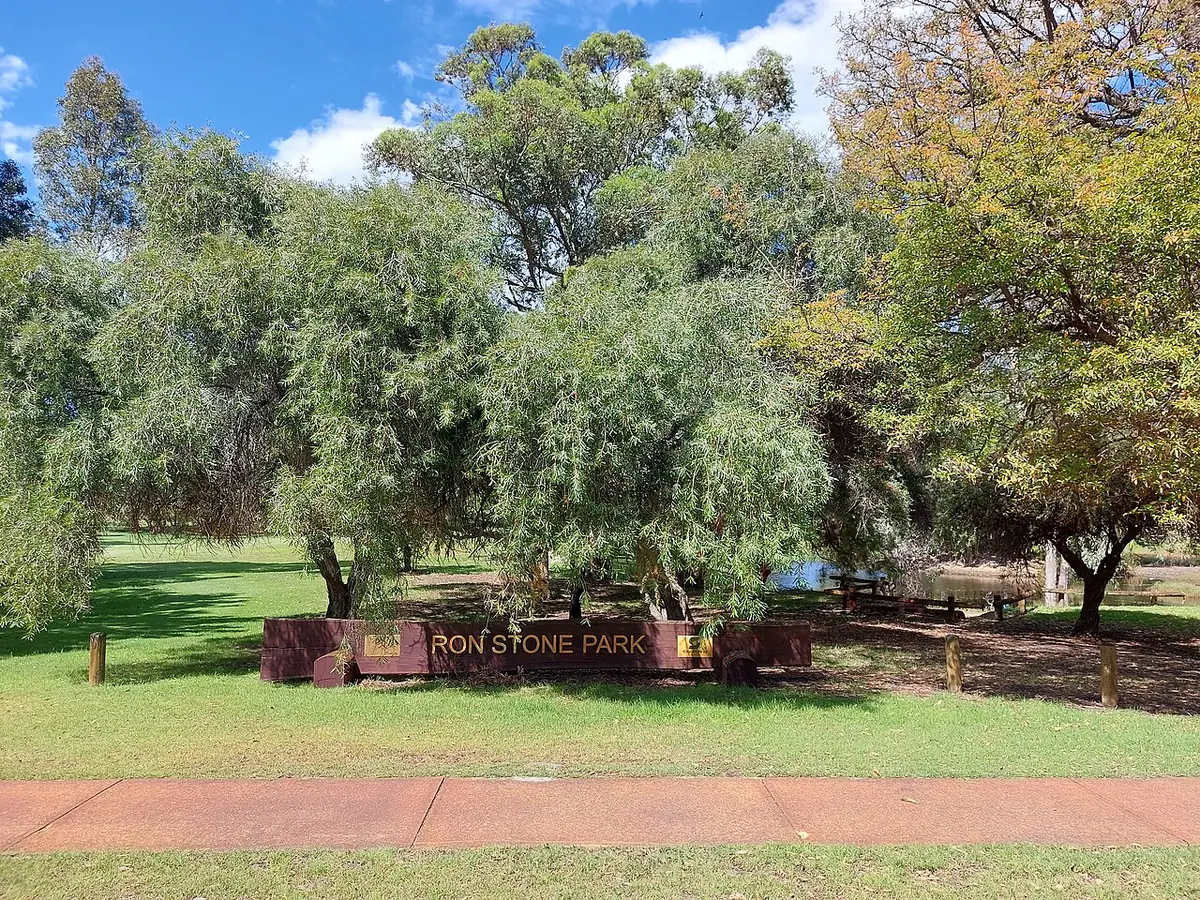
Ron Stone Park, a green space in Mount Lawley — Photo: Orderinchaos · CC BY-SA 4.0 · Wikimedia Commons
Understanding these local dynamics helps you gauge the cultural and practical gap between Perth and where you are starting from.
Perth's residential market suits very particular profiles, people looking to escape the density of big cities. Whether you arrive as a family with school-age children, as a couple changing direction or on your own for a fresh professional start, the reality of settling into a home here varies enormously. Each situation involves precise trade-offs between being close to urban amenities and seeking complete residential calm.
The big house with a garden and local schools
You want to give your children a healthy environment, with plenty of green space and outdoor activities every day. The outer residential suburbs let you buy family homes with pools and large gardens at a cost per square metre far lower than in most major capitals. In return, you will need to organise the daily trips to school and activities, as public transport is less dense than in many big cities.
This set-up favours a daily life centred on family, weekend barbecues and trips to the beach. It is therefore vital to involve the whole family in the move, so that the relative distance from the city centre does not become a growing source of frustration over the months.
The balance between connectivity and coastal living
Your work does not depend on a central physical office, which gives you complete freedom in where you settle. You can look at coastal suburbs where an ocean view turns every work break into a real chance to switch off. However, the time difference with Europe and other major business centres demands careful planning of when you communicate.
Investing in a good internet connection and a dedicated office space becomes the top priority from the moment you buy. That way you can make the most of the climate and the local calm while keeping up your professional standards remotely.
The practical, easy-to-maintain base
You want to simplify daily life by cutting back the work of maintaining an oversized plot while keeping a high level of comfort. More compact single-storey houses in well-connected middle-ring suburbs offer the ideal balance between independence and access to medical care. You benefit from a welcoming community and quick access to essential services.
This choice frees up time and money for travel or personal projects, while anchoring your assets in a stable, sought-after area.
Living here when you arrive from abroad: what really changes day to day
Once you have taken these differences on board, the next step is to pin down exactly which area will become your new home.
Leaving your home country to settle permanently in Perth is much more than a simple move: it means adopting a new social and spatial contract. Administrative, urban and social reference points fall apart within the first few months. This table sets the habits you bring from back home against the reality of your new surroundings, so you can anticipate the adjustments you will need to make.
From abroad
The period apartment or a dense, walkable city centre
Perth
The single-storey detached house with a plot and a driveway
You gain space and quiet, but you lose the spontaneity of small shops within walking distance on the corner.
From abroad
Public transport that is everywhere and well connected
Perth
Near-constant use of your own car for every journey
The cost of running a car (fuel, insurance, servicing) needs to be built into your cost-of-living calculations from the start.
From abroad
Formal administrative dealings and written procedures
Perth
A more direct, informal culture that is nonetheless strictly regulated
Contracts and leases demand absolute legal rigour, even though everyday conversations are relaxed and friendly.
From abroad
Café terraces and neighbourhood life at the centre of things
Perth
An outdoor culture of well-equipped public parks and patrolled beaches
Your weekends revolve around nature, sport and shared barbecues rather than visits to city museums.
From abroad
A seasonal rhythm marked by cold, dark winters
Perth
Almost constant sunshine that sets an early-morning rhythm
Your days start earlier to make the most of the cool mornings, radically changing your relationship with time and sleep.
Which neighbourhood should you settle in, depending on your priorities?
Now let us turn to the concrete financial realities, so there are no nasty surprises when you sign.
Each area of Perth has its own identity, its own microclimate and its own social make-up. Choosing the right neighbourhood depends as much on your budget as on how much commuting you will tolerate and whether you prefer urban buzz or the complete calm of the coastal fringe.
The western coastal suburbs (Cottesloe and surrounds)
A seaside rhythm set by morning swims and walks along the Indian Ocean.
Suits
Water sports lovers and households looking for a prestigious, established setting.
Trade-off
An extremely tight property market and purchase prices among the highest in the region.
The lively inner northern suburbs (Subiaco and Leederville)
A buzzing atmosphere mixing trendy cafés, tree-lined streets and restored heritage architecture.
Suits
Couples and professionals wanting to combine proximity to the city with friendly neighbourhood life.
Trade-off
Smaller plots and semi-detached or renovated houses where space can be tight.
The southern riverside suburbs (Applecross and surrounds)
A quiet, leafy residential atmosphere dominated by superb views over the Swan River.
Suits
Families looking for tranquillity, large green spaces and excellent schools.
Trade-off
Access to the main roads can be congested during the morning and evening rush hours.
The growth areas on the outer fringe
The complete calm of large modern estates where space is no issue.
Suits
First home buyers and families wanting a large new house on a controlled budget.
Trade-off
A long way from the main centres of economic activity, and a streetscape that can feel rather bare.
How much does buying a house in this region really cost?
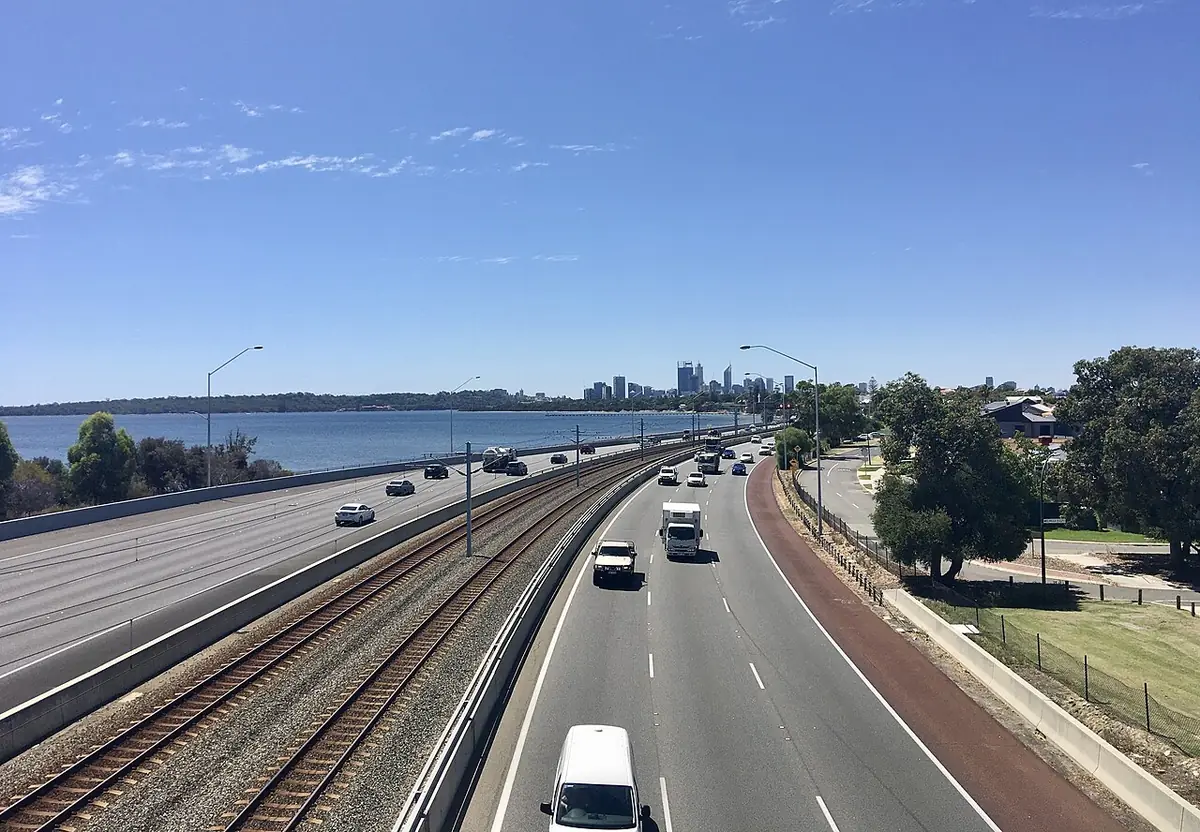
The freeway and rail line run along the river towards Perth city — Photo: Steelkamp · CC BY-SA 4.0 · Wikimedia Commons
Beyond the raw figures, the legal nature of the properties available deserves very close attention.
Budgeting for a property purchase in Perth means looking beyond the asking price shown on the listing portals. Additional fees, local taxes and maintenance requirements weigh heavily on the overall financial picture. The data below summarises the ranges seen on the market, to help you size your investment with full transparency.
PerthFor saleHouseestimate
Median price / m²A$5,920Half the apartments sell below this
Median priceA$1.2mthe average is 14% higher — a few very large properties pull it up
Most common3 bedrooms42 % of listings
Average size193 m²
By number of bedrooms
Bedrooms
Share of market
Avg price
Price / m²
Avg size
2
37 %
A$927k
A$6,232
149 m²
3most common
42 %
A$1.3m
A$5,920 −5 %
219 m²
4
21 %
A$1.76m
A$5,733best value / m²
306 m²
Each row is an average, compared against the area average of A$6,232 / m². These are indicative estimates of a typical local market, not a measured sample of live listings. Check current listings before relying on them.
What you can actually own: the legal structure of property
Once you have identified the type of property, the buying process follows a very strict sequence of steps.
Australia's land ownership system has legal subtleties that directly affect how freely you can manage your property. Understanding the difference between outright ownership of the land and collective forms of ownership is an essential step in securing your investment for the long term.
You buy both the building and the land it stands on, with no major collective restrictions. You handle maintenance, extensions and cosmetic changes to your property within the council's planning rules, without answering to an owners' corporation.
What it changesYou enjoy complete independence and the direct value of your land, but all maintenance costs and structural risks fall squarely on your shoulders.
Shared horizontal or vertical ownership (Strata Title)
Your property is part of a shared complex where common areas (driveways, gardens, leisure facilities) are managed collectively by a dedicated body. By-laws strictly govern how the premises are used, what exterior changes are allowed and the level of the compulsory quarterly levies.
What it changesYou benefit from shared services and exterior upkeep taken care of for you, but you have to live with collective rules that can be restrictive and with unpredictable increases in levies.
The key rule to understand before paying a deposit
To manage this move smoothly, let us look at the order in which the various professionals get involved.
Buying property in Australia does not work the way it does in many other countries. Offers, cooling-off periods and conditions follow a very strict legal timetable that you need to master before paying any deposit by cheque or transfer.
You find a house that meets your criteria and want to make a formal written offer.
Submit a written offer stating the proposed price and the essential conditions.
Negotiate the terms with the seller through the appointed real estate agent.
Sign the contract and pay the deposit, which is held in trust.
Carry out the essential technical inspections (structure, termites, plumbing) during the conditional period.
Conditions are satisfied and the transaction is finalised at settlement.
How a property transaction works, step by step
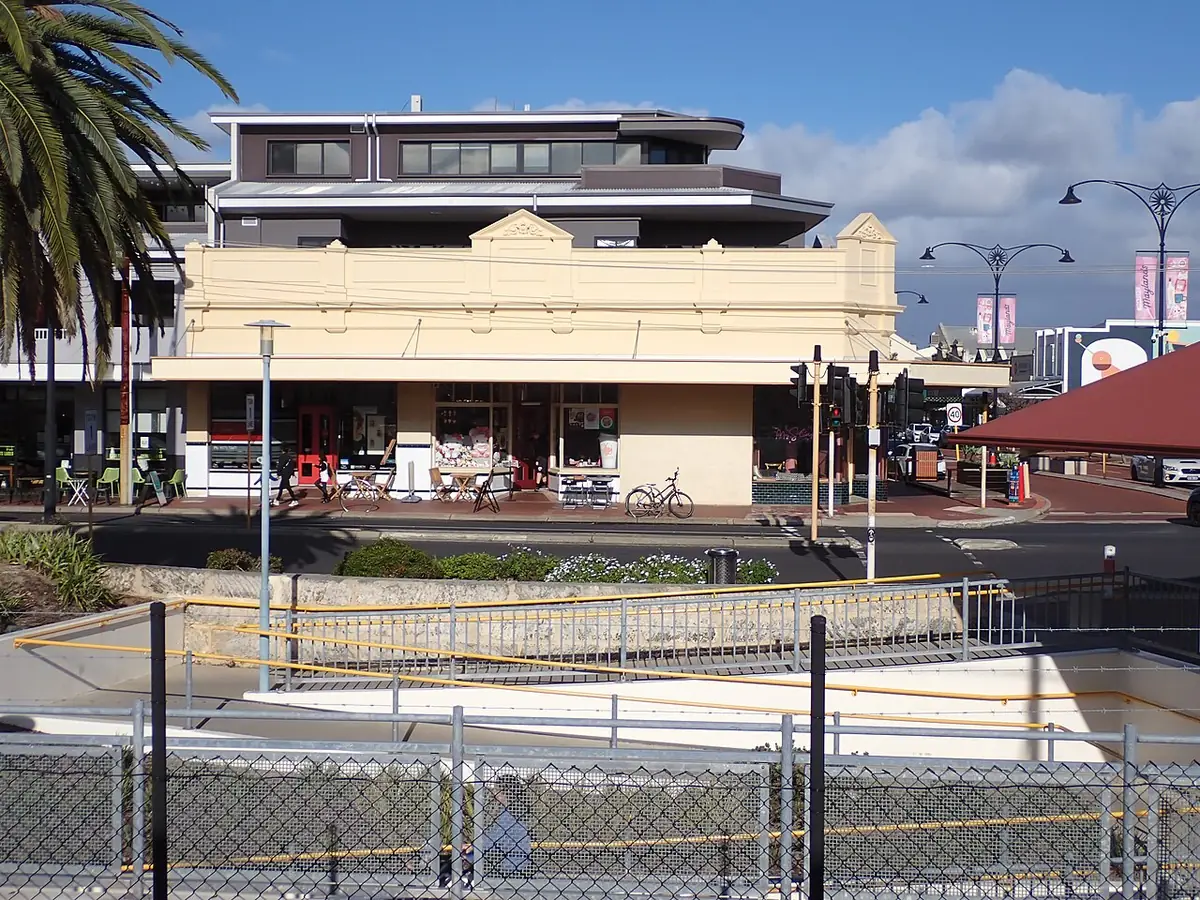
A heritage shopfront on Whatley Crescent in Maylands — Photo: Calistemon · CC BY-SA 4.0 · Wikimedia Commons
Ultimately, a successful purchase in Perth rests on careful preparation of your new life and strict respect for the local rules.
The success of your property purchase depends on precise coordination between several local professionals. From the real estate agent to the settlement agent and the building inspector, each plays a specific role in making sure your purchase is valid and secure.
The buyerSetting the budget and getting pre-approval from a lenderThis first step shows the seller your offer is serious and speeds up negotiations considerably.
The real estate agentTargeted viewings and handover of the sale documentsThe agent acts as the official go-between for you and the seller, and passes on the mandatory legal documents.
The building inspectorThorough building inspection and pest checkA non-negotiable step in Australia for detecting termites or hidden structural defects.
The conveyancer / settlement agentChecking the title and preparing settlementThey make sure the property is free of any undisclosed mortgage and handle the secure transfer of funds.
The buyer and the sellerFinal inspection of the property just before settlement dayThis lets you check that the house is in the agreed condition and that the included fittings work properly.
The authoritiesOfficial handover of the keys and registration with the land registryThis marks the actual transfer of ownership and the start of your new life in your Perth home.
House or apartment in Perth: why choosing a detached house reshapes your daily life
Once you have made this fundamental choice between vertical city living and the suburban horizon, it is time to look at the financial reality of the investment.
Buying property in Perth forces a structural choice right from the start: an apartment in the city centre or a detached house with a garden in the outer residential suburbs. Unlike the big cities where apartment living dominates, Perth has grown along a sprawling horizontal model inherited from the Australian tradition of the 'quarter-acre block'. Choosing a house means accepting longer journeys to the business district around Elizabeth Quay, in exchange for considerably more living space and independence from strata schemes.
Perth's detached house market is marked by strong demand in coastal areas such as Scarborough or Cottesloe, and in family suburbs in the north such as Joondalup. Buyers there are after the famous Australian lifestyle, built around the Sunday barbecue, the in-ground pool and the vast parks along the Swan River close at hand. However, this type of property brings recurring maintenance costs and direct exposure to Western Australia's summer climate, notably managing garden watering and bushfire protection in some semi-rural areas.
By contrast, opting for an apartment in Northbridge, the Perth CBD or South Perth is about saving time and cutting structural maintenance costs. These properties particularly suit young professionals and investors looking for steady rental yields, underpinned by population growth in the state capital. Nevertheless, apartment buyers have to deal with strata levies that can be high and a loss of control over decisions on energy upgrades or extensions. The final choice therefore depends less on aesthetic preference than on a clear-eyed acceptance of the trade-offs linked to distance and to how the building is managed.
What real budget should you plan to live comfortably in Perth?
With these financial benchmarks in place, it is time to step into everyday life and understand the real pace of living that comes with settling in the Western Australian capital.
Budgeting for a property purchase in Perth goes beyond the asking price displayed on listing portals such as REIWA or Domain. You need to factor in all the additional costs, from state transfer duty to the infrastructure spending needed to cope with the scorching summers of the west coast. Anticipating these costs avoids any financial disappointment in your first year.
Cost items and ballpark figures for buying a house in Perth
Budget item
Estimated amount or range
Comments and frequency
Purchase of a standard house
AUD 600,000 to AUD 950,000
Varies widely depending on distance from the CBD and proximity to the beaches.
Transfer Duty
AUD 22,000 to AUD 45,000
Government tax calculated on a sliding scale based on the value of the property.
Conveyancing and broker fees
AUD 3,000 to AUD 7,000
Settlement agent fees and mandatory bank valuation costs.
Home and building insurance
AUD 1,800 to AUD 3,500
Annual premium covering the climate risks specific to the Perth region.
These amounts are indicative and depend on the size of the plot and the exact location of the house.
Annual running costs for a homeowning household in Perth
Type of expense
Average annual cost
Details
Council Rates (local taxes)
AUD 1,800 to AUD 2,800
Waste collection, road maintenance and community services provided by the council.
Water Corporation (water and sewerage)
AUD 1,200 to AUD 1,800
Combined billing including network access charges and metered water use.
Maintenance and air conditioning
AUD 2,500 to AUD 5,000
Regular servicing of essential air conditioning systems and upkeep of gardens.
Water is particularly expensive in Perth because of the city's reliance on desalination plants and groundwater.
Health, schools and transport: what an ordinary Tuesday in Perth actually looks like
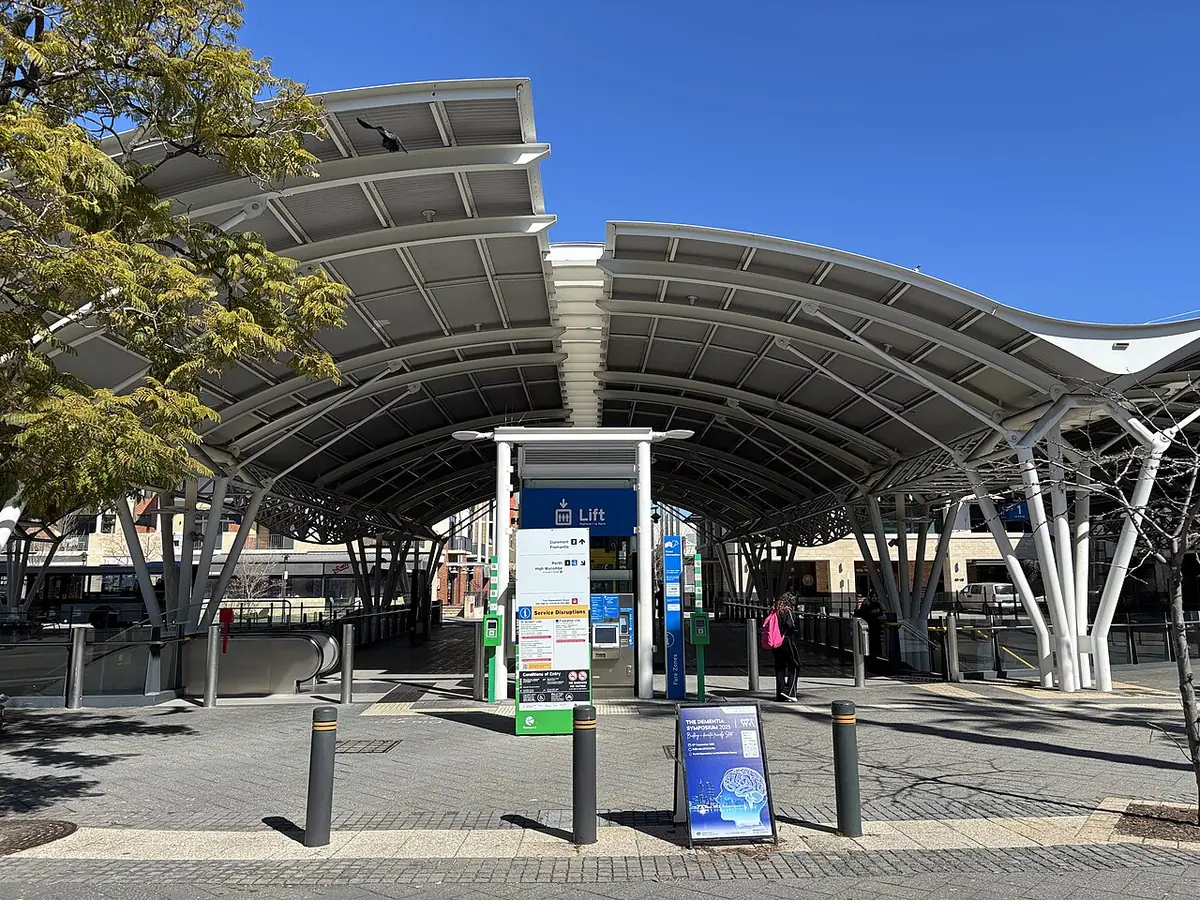
The curved canopy at the entrance to Subiaco station — Photo: Nick-D · CC BY-SA 4.0 · Wikimedia Commons
Beyond this apparent routine, the Perth property market has features that never appear in the brochures and that every buyer should know about.
Settling permanently in a house in Perth profoundly changes how you organise your working and leisure days. Between the morning commute on the Mitchell Freeway and managing the children's after-school activities in often sprawling suburbs, every hour has its own tempo. Describing an ordinary Tuesday helps you measure the real geographical impact of your future address on your quality of life.
07:00Kitchen or outdoor terraceThe early start usually comes with a coffee outside, making the most of the relative cool before summer temperatures climb. It is the moment to watch the neighbourhood slowly wake up, without the bustle of the world's megacities.
08:15Trip to school or workDriving along major roads such as the Kwinana Freeway, or taking the Transperth train network if the home is near a station on the Joondalup Line. How smooth the trip is depends heavily on the distance from the centre.
12:30Lunch break in the business districtBreaks are often spent in urban green spaces or the lively cafés of the CBD or secondary hubs such as Subiaco or Fremantle. The working atmosphere stays relaxed but efficient.
17:30Grocery shopping and local servicesA stop at a neighbourhood shopping centre (Coles or Woolworths) to stock up the household. Parking there is plentiful and free, in sharp contrast with the hassle of parking in the city centre.
19:00Garden or family living areaThe evening is devoted to family life, often around the barbecue or relaxing outdoors. The mild climate lets you live outside for much of the year, extending your living space beyond the walls of the house.
What the glossy photos from Perth real estate agents never tell you
With these technical points uncovered, it is just as important to look at the most common regrets new arrivals voice six months after moving in.
Property listings in Perth highlight natural light, sparkling pools and the nearby white-sand beaches. Yet several fundamental technical and environmental realities are routinely left unsaid by sellers. Knowing about these hidden aspects protects buyers from heavy financial setbacks after the sale contract is signed.
Thermal orientation and wall insulation
Many houses built in past decades have inadequate insulation against summer heatwaves and cool winter nights. Without double glazing and a well-planned north-facing orientation, electricity bills for air conditioning can soar.
Sandy soils and foundations
Perth's subsoil is mostly unstable coastal sand that can cause uneven ground movement. A thorough structural inspection by an independent expert is essential to spot any hidden cracks in concrete slabs.
Restrictions and costs linked to water
Owning a large leafy garden or a lush lawn in Perth means following strict watering days set by the government. Installing or restoring a bore is a substantial upfront investment, but a necessary one to keep bills under control.
The real level of aircraft noise
Some residential suburbs sit beneath the approach paths to Perth Airport or right next to major freight rail lines. Visiting the property at different times of day is a must to judge how quiet the area really is.
The regrets people discover six months after buying a house in Perth
Given these demands and measured risks, it is only honest to ask whether this kind of purchase really suits everyone.
Looked likeA great opportunity in an extremely quiet, leafy suburb on the outskirts.
Turned outUnbearable isolation day to day, with school runs and commutes stretching to more than an hour each way.
Would have caught itAlways test the journey at rush hour on a Tuesday morning before signing the final offer.
Looked likeA charming older house with a huge garden full of landscaping potential.
Turned outA money pit once it came to replacing old lead plumbing and bringing obsolete wiring up to standard.
Would have caught itCommission a full technical report (Building and Timber Pest Inspection) before any conditions are lifted.
Looked likeAn affordable purchase in a fast-developing area north of the city.
Turned outNo local shops within walking distance at all, so the car is needed for even the smallest last-minute errand.
Would have caught itMap out exactly which services can be reached within a one-kilometre radius of the future address.
Looked likeA beautiful ready-to-use pool for enjoying Australian summers with the family straight away.
Turned outAn outdated filtration system needing the pumps fully replaced and heavy, expensive chemical treatment.
Would have caught itHave the pool's plumbing and equipment checked by an independent specialist before the sale goes through.
Who should definitely not buy a detached house in Perth right now?
With these limits clearly set out, it is time to make the final decision and check whether you have everything you need to make your Perth property purchase a success.
Buying property is often presented as the inevitable milestone of any life path in Australia. Yet in Perth's specific economic and geographical context, buying a detached house can be a major strategic mistake for certain profiles. Recognising these situations avoids damaging financial and personal dead ends.
The mobile young professional or the worker on a temporary visa
→Flexible renting rather than a rigid property purchase
The high transaction costs when buying and selling (transfer duty, agent commissions) are hard to recoup over less than five to seven years of continuous residence in the country.
The investor who cannot stand hands-on property management
→Diversified financial investments or a rental property managed by an agency
Maintaining a detached house in Perth requires constant attention to the grounds, the roof and the equipment, which is incompatible with a purely passive, remote approach.
The dedicated city dweller attached to walking everywhere and public transport
→A central apartment or a shared house in the city
Perth's urban model relies very heavily on private cars; living in a suburban house without owning and driving a vehicle makes no sense logistically.
So, are you ready to take the plunge into Perth property?
Buying a house in Perth is about more than signing a purchase contract or getting pre-approval from a major Australian bank such as the Commonwealth Bank or Westpac. It is a life commitment that lastingly changes your relationship with space, time and the local community. If you have accepted that distance is an integral part of the Western Australian way of life, and you have enough savings set aside to absorb unexpected maintenance costs, then you have the green light to start searching on the ground.
Perth's property market keeps solid fundamentals, driven by the state's economic vitality and strong appeal to both interstate and international migrants. Still, haste remains the buyer's worst enemy. Take the time to visit several suburbs at different times of day, talk to local residents to understand what the streets are really like, and never skip the essential technical inspections before confirming your offer.
Ultimately, settling successfully into a home in Perth means combining enthusiasm for an exceptional setting, bathed in light and natural space, with unwavering rigour in the financial and legal analysis. Your future house is not just an asset; it is the stage for your daily life for years to come. Approach the process with clarity, method and patience, and the market will reward you with a secure and lasting investment.
Related questions
Which are the most sought-after neighbourhoods for buying a house in Perth?
Coastal areas such as Cottesloe, Scarborough and City Beach draw strong demand because they sit right on the Indian Ocean. For families looking for a balance between budget and lifestyle, the suburbs to the north towards Joondalup or to the south towards Fremantle offer excellent schools and plenty of residential space.
How long does a property transaction usually take in Perth?
Settlement in Western Australia traditionally takes between 30 and 60 days after the seller formally accepts the offer. That window allows all the legal checks with Landgate to be carried out, along with the essential technical inspections of the structure.
Do you have to use a mortgage broker in Perth?
It is not a strict legal requirement, but more than 60% of buyers in Australia use a mortgage broker. The broker compares offers from dozens of lenders free of charge and negotiates the interest rates and repayment terms best suited to your profile.
What is 'Stamp Duty' and how is it calculated in Western Australia?
Stamp Duty, or transfer duty, is a state tax charged when you buy a property. It is calculated on a sliding scale according to the purchase price of the property or land, with specific rates and partial or full exemptions for first home buyers.
Should you budget for air conditioning in a Perth house?
Absolutely. Ducted reverse-cycle air conditioning is essential for coping with summer temperatures that regularly go above 35 °C in Perth. Always check the age and energy efficiency of the installed system during viewings, because replacing it is a significant cost.
How do the water table and sandy soil affect buying a house?
Soil across the Perth region is mostly sandy, which calls for solid foundations on a reinforced concrete slab. In addition, a shallow water table in some areas near the coast or wetlands can affect damp in lower levels and the installation of pumping or bore systems.
How does garden watering work with Perth's water restrictions?
The Water Corporation enforces strict watering rules, with days assigned according to the last digit of your street number. Many owners invest in a private bore to draw groundwater, so they can keep their lawns green without risking fines.
Can foreign non-residents freely buy property in Perth?
Non-residents need prior approval from the FIRB (Foreign Investment Review Board). As a general rule, foreign investors can only buy new properties or off-the-plan developments, while buying established dwellings is strictly reserved for permanent residents and citizens.
What recurring costs should you expect on top of your mortgage repayments?
A homeowner in Perth pays Council Rates each year to the local council, water and sewerage bills to the Water Corporation, and comprehensive Home and Contents Insurance covering storms and local climate risks.
Where can you check sales history and actual market prices in Perth?
The official Western Australian property portal run by REIWA (Real Estate Institute of Western Australia), together with Landgate's government databases, lets you look up the exact history of past transactions and price statistics by suburb.
Property review of ting
No ting properties in Perth yet
Be the first — share it on ting and it shows up right here.