Buying an apartment in Phoenix means working methodically through the particulars of the Arizona market, from the central districts to the quieter residential pockets in the north of the valley. This guide unpacks the financial, legal and practical realities so you can decide with clear eyes, away from received ideas and vague promises.
Get the app
What nobody tells you.
Real prices, hidden costs and the traps to check before you commit.
What you actually get when you buy an apartment in Phoenix
Scroll
What you actually get when you buy an apartment in Phoenix
Buying an apartment in Phoenix means working methodically through the particulars of the Arizona market, from the central districts to the quieter residential pockets in the north of the valley. This guide unpacks the financial, legal and practical realities so you can decide with clear eyes, away from received ideas and vague promises.
Written by the ting.ad editorial team ·
North Central Avenue, Phoenix in Street View: drag to look around.
Understanding those basic trade-offs leads straight to the question of whether this way of living matches what you personally want.
Investing in a Phoenix apartment is not simply a matter of acquiring square metres under the Arizona sun. It is a bet on a fast-growing metro whose urban form completely reshapes your relationship with your home. On one side sits the promise of generous living space and often remarkable shared amenities, such as landscaped pools and built-in fitness rooms. On the other sits a demanding market, marked by tightly run owner associations and the absolute need to plan for summer cooling bills. Looking closely at what you really get dispels the illusions and lets you approach the purchase clearly.
Generous interior volumes and well-kept shared spacesvsHigh association dues that fund cooling for the common areas and upkeep of the pools
Condo developments offer a very easy way of living, but they require close reading of the forecast budgets voted through at owner meetings.
A strategic location close to the main corridors and employment centresvsAn almost systematic dependence on the car for the smallest daily errand outside the complex
Phoenix is a city built around the car; even the most central districts mean folding parking into both the financial and the practical equation.
Appreciation potential driven by the valley's demographic pullvsMarked sensitivity to local economic cycles and to swings in American interest rates
The Arizona market reacts sharply to migration between states, which calls for a medium-term view rather than a short-term speculative bet.
An outdoor-facing way of living, with terraces and finished patiosvsA strong climate constraint that limits use of unshaded outdoor space during the hottest months
The comfort of an apartment is measured as much by how well it is insulated as by how beautiful its view of the surrounding mountains is.
Does this place really suit the way you live?
These lifestyle choices sit inside a cultural and regulatory context that differs noticeably from what you may be used to.
Settling in Arizona's capital means adjusting your daily bearings according to what kind of buyer you are. The city shows very different faces, from a busy business core to the calmer residential pockets in the north of the valley. Each situation implies precise trade-offs on commuting time, the layout of the home and the room left for outdoor leisure. Here is how your daily life would actually fit into the fabric of Phoenix, depending on your circumstances.
Choosing central location and built-in services
If you work remotely or within the region's technology and finance hubs, a recent apartment in an area such as Downtown or Midtown puts you at the heart of the city's momentum. You get high-performance internet, shared coworking space inside your own building and cultural options a few minutes away. In exchange you have to accept urban density, potential traffic noise and the absence of large private gardens, offset by landscaped city parks.
The quieter developments with managed services
For those who put calm and security first without the demands of a single-family house, the gated communities and residential buildings of areas such as Paradise Valley or the northern foothills offer an ideal compromise. Grounds, security and pool maintenance are handled entirely by the homeowners association, which frees up time day to day. It remains essential to budget for the steady rise in those dues and to take part in association business so you can keep an eye on the financial health of the whole.
Targeting young professionals and university students
Buying an apartment to let near the major university campuses or hospital centres answers strong structural demand. The valley's population keeps growing, drawing skilled workers who look for easy mid-range housing. The success of your investment rests on carefully selecting a building that permits letting and offers amenities in line with local market expectations, while anticipating the strict rules set by homeowners associations.
Living here when you arrive from abroad: what changes completely
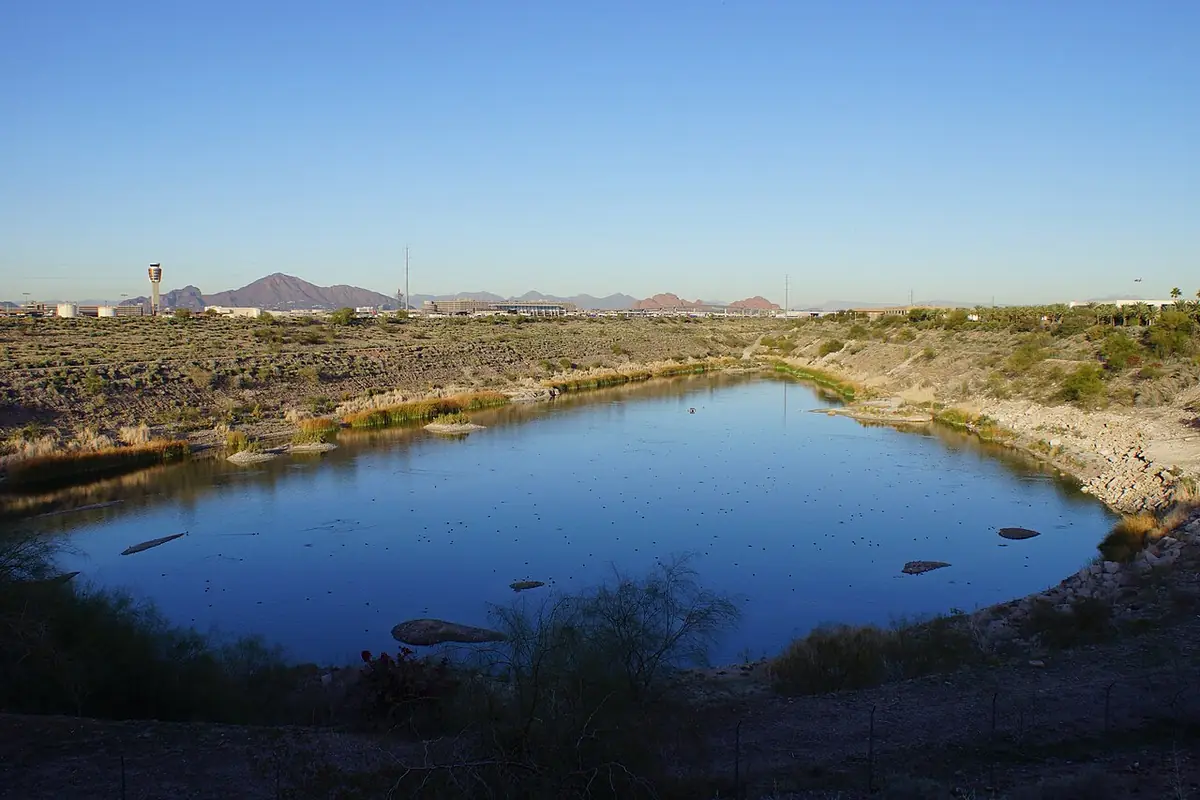
Phoenix spreads wide beneath its desert mountains — Photo: CyberXRef · CC BY-SA 3.0 · Wikimedia Commons
Once those bearings are in place, the geographic question becomes pressing: which part of the metro to target.
Moving from a tightly codified home market to the American system as it works in Arizona is disorienting in several ways. Notions of ownership, dealings with the body that runs your building and the very idea of urban housing rest on legal and cultural foundations that will be unfamiliar. For a buyer arriving from abroad, spotting these differences avoids misunderstandings at signing and makes for a calmer landing in a new environment.
From abroad
A historic centre with shops within walking distance
Phoenix
The sprawl of Phoenix and districts organised around major road corridors
You have to relearn how to plan your movements and accept that the car is the indispensable extension of your home.
From abroad
A protective framework of housing law and shared-ownership rules
Phoenix
The wide powers of HOAs (homeowners associations) and their strict internal rules
The association holds very broad authority over exterior appearance, parking and use of the common areas.
From abroad
Traditional heating systems suited to temperate or cold winters
Phoenix
Central air conditioning that is indispensable and runs for most of the year
The energy budget is a central line item you need to fold into the very first financial model of your purchase.
From abroad
A centralised, deed-focused signing process and a long sale timeline
Phoenix
A title company handling the transaction, which often closes far more quickly
The scrutiny shifts from a central legal office to close reading of the inspection reports and the seller's disclosure documents.
Which Phoenix district should you target, given your priorities?
These geographic differences translate directly into money, which makes a look at prices essential.
Phoenix is built around distinct cores, each with its own identity, rhythm and comparative advantages. Choosing an area depends not only on the budget available but on your tolerance for traffic, your appetite for cultural life and how close you want to be to open country. A side-by-side view helps place the most relevant options on the current market.
Downtown and Midtown
Distinct urban energy, with constant construction, a rich cultural offer and the light rail running through.
Suits
Urban professionals, people who want cultural life close by and anyone hoping to drive less.
Trade-off
A higher price per square metre and often a more compact home for the same budget.
Arcadia and its surroundings
A green residential setting lined with mature trees, with sought-after restaurants and a smart village atmosphere.
Suits
Buyers after real architectural character and an established neighbourhood in the heart of the valley.
Trade-off
Price levels among the highest in the city and a relatively thin supply of condominium apartments.
North Phoenix and Desert Ridge
A modern, orderly feel, close to the outlying business centres and the open desert to the north.
Suits
Families, executives after quiet and anyone drawn to large, secure residential developments.
Trade-off
A marked distance from the historic centre of Phoenix and total dependence on the car.
What does an apartment in Phoenix really cost?
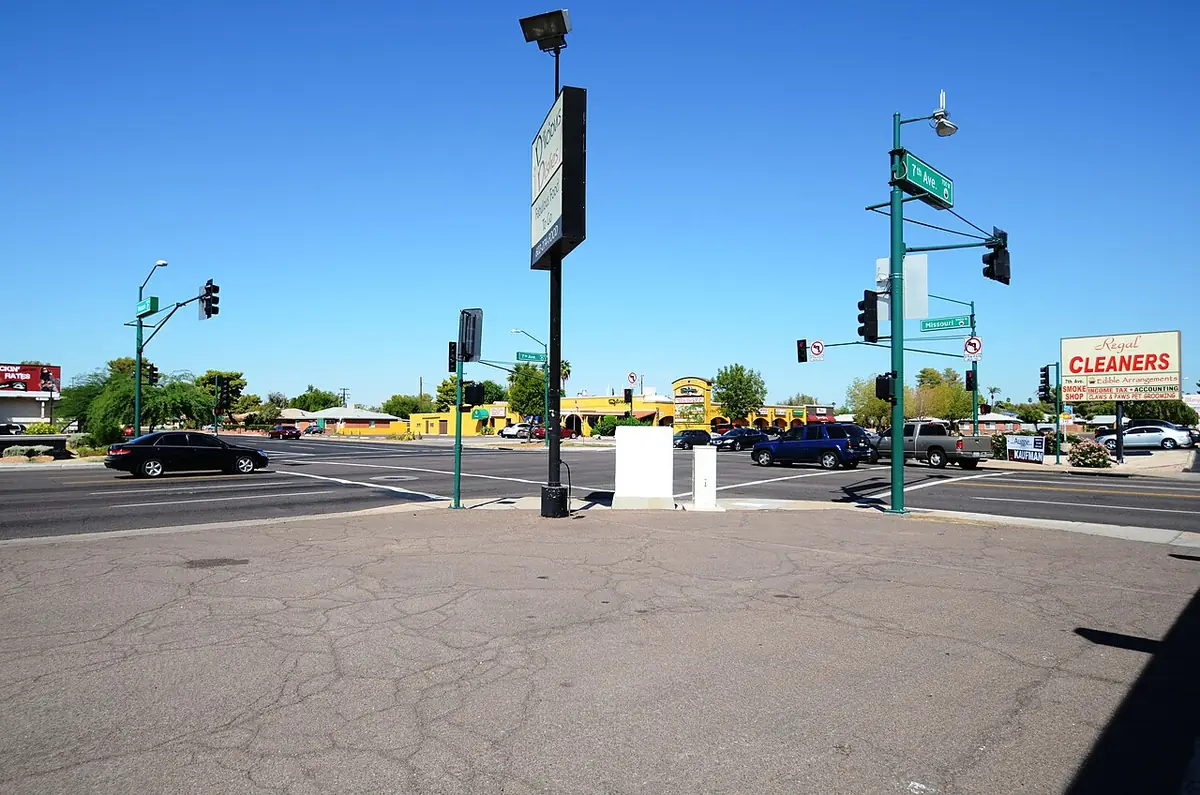
A busy Phoenix intersection on an ordinary day — Photo: Kabugenyo · CC BY-SA 3.0 · Wikimedia Commons
Beyond the headline financial picture, the legal nature of what you are buying deserves your full attention.
The Phoenix property market reflects the economic vitality of Arizona while showing notable variation according to the age of the building and the quality of the services attached to it. No single universal price can be set, but reading the underlying trends gives reliable orders of magnitude. Being clear about the additional charges is what keeps unpleasant surprises away after you move in.
phoenixFor saleApartmentestimate
Median price / m²US$2,850Half the apartments sell below this
Median priceUS$405kthe average is 14% higher — a few very large properties pull it up
Most common3 bedrooms40 % of listings
Average size135 m²
By number of bedrooms
Bedrooms
Share of market
Avg price
Price / m²
Avg size
1
12 %
US$234k
US$3,600 +20 %
65 m²
2
30 %
US$328k
US$3,120
105 m²
3most common
40 %
US$432k
US$2,880
150 m²
4
18 %
US$554k
US$2,700best value / m²
205 m²
Each row is an average, compared against the area average of US$3,000 / m². These are indicative estimates of a typical local market, not a measured sample of live listings. Check current listings before relying on them.
What you can actually own: the ownership structure
That same legal rigour shows up in the step-by-step timeline of an Arizona transaction.
Buying an apartment in the United States does not always follow the classic divided-ownership pattern used elsewhere. Between condominiums and cooperatives, the owner's rights and the collective's powers vary sharply. Grasping that legal distinction protects you from unexpected restrictions on use and secures your investment over the long run.
The condominium (condo)
You own the interior of your home outright, along with an undivided share of the common areas and the land. Operations are governed by a board elected by the owners, whose decisions bind everyone on repairs and general upkeep.
What it changesYou have more flexibility to resell and to let, provided you respect the association's internal rules on nuisance and exterior alterations.
The community run by an HOA (homeowners association)
Even in an apartment building, the legal structure often includes a homeowners association with near-legislative powers over appearance, permitted paint colours and parking rules on the site.
What it changesYou must study the HOA's accounts and meeting minutes before making any firm offer, because poor management or ongoing disputes can weigh heavily on your budget.
The rule to understand before you put money down
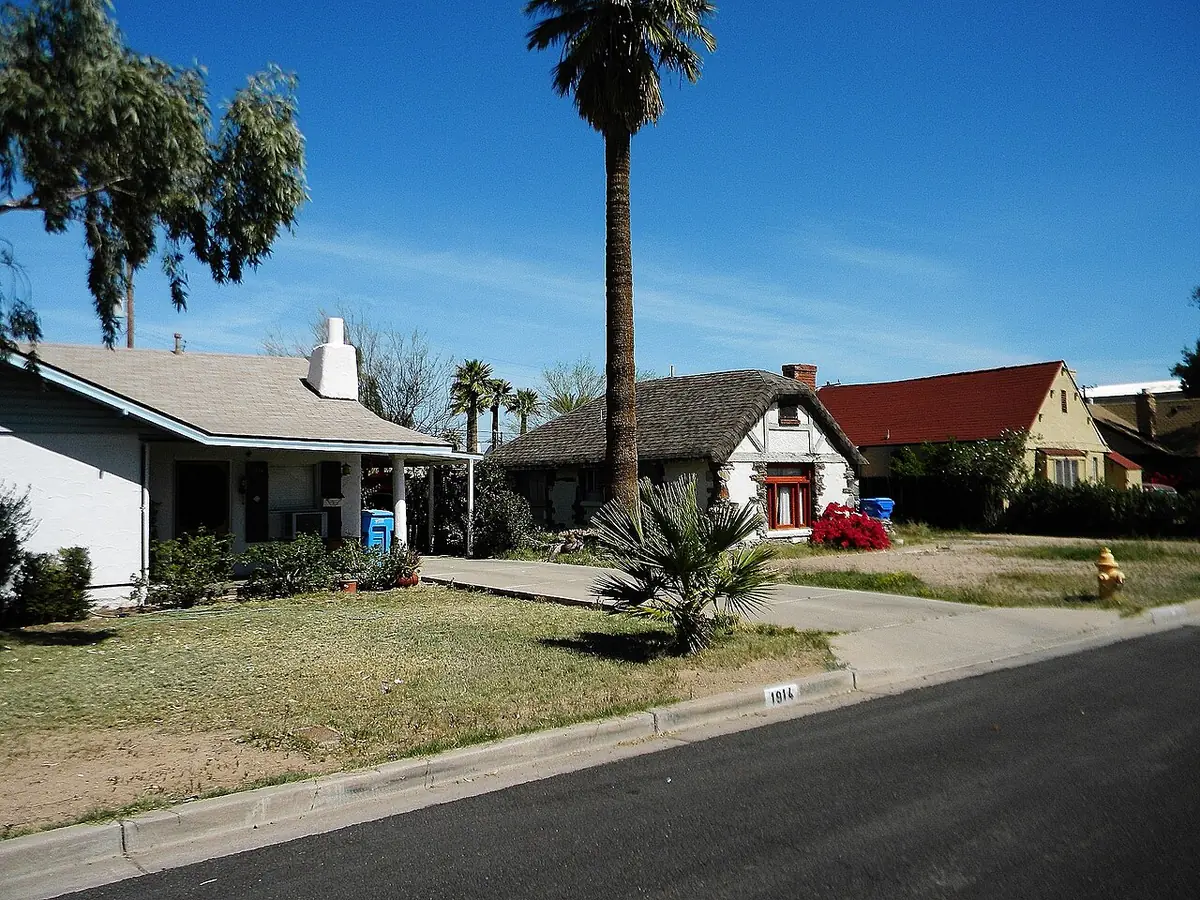
A quiet, historic residential corner of Phoenix — Photo: Kabugenyo · CC BY-SA 3.0 · Wikimedia Commons
To move calmly through these phases, it helps to picture the role each party plays in the transaction.
Buying property in Phoenix follows a precise calendar in which each phase is governed by standardised contracts. Unlike markets where a verbal offer commits you to little, a written commitment backed by an initial deposit into escrow carries immediate legal weight. Understanding that sequence keeps you in control of your negotiation and protects your own funds.
Drafting the formal purchase contract, accompanied by an initial earnest money deposit.
Opening the escrow account with an independent title company to secure the deposit paid by the buyer.
The inspection period (due diligence), during which an expert examines the condition of the building, the roof and the air conditioning.
Close review of the association documents and the HOA financial reports supplied by the seller.
Clearing the contingencies and securing final mortgage approval, or confirming the funds if you are paying cash.
Signing the transfer deed at closing and officially recording ownership with Maricopa County.
How a transaction unfolds, party by party
In short, buying an apartment in Phoenix is best treated as a structured project, demanding method and clarity at every step.
A successful property transaction in Arizona rests on a clear division of roles between specialised, independent professionals. There is no single officiating legal figure of the kind some countries use; instead an ecosystem of experts each protects one precise facet of the legal and financial safety of the deal. Knowing who is responsible for what makes the whole exchange run far more smoothly.
The real estate agent (Realtor)Negotiation and offer strategyThey draft the contract clauses, advise on what the property is really worth in that neighbourhood and manage the relationship with the other side.
The title companyLegal and financial safetyIt checks that no hidden lien exists, runs the escrow account and issues the title insurance that underpins your ownership.
The home inspectorThe physical audit of the homeThey produce a detailed report on the state of the plumbing, insulation, foundations and cooling equipment.
The HOA managerPassing on the collective rulesThey supply the full set of meeting minutes, the association's forecast budget and the internal rules that apply.
The mortgage brokerPutting the financing togetherThey confirm your borrowing capacity with local lenders and coordinate the release of funds for closing day.
Apartment or house in Phoenix: which type of property really secures your investment over the long term?
Once the property type is settled, the central question of financing and the real cost structure in Phoenix comes up immediately.
Choosing between a condominium apartment and a single-family house in Phoenix is not simply a matter of your current aesthetic preferences; it goes deep into your financial flexibility and your relationship with day-to-day maintenance. In the Valley of the Sun, the market splits clearly between urban condominiums, much sought after for their proximity to employment centres, and single-family houses that require more self-reliant management. The apartment often gives access to shared amenities such as large, cooling pools and gyms, while shifting the heavy burden of rooftop air conditioning and weatherproofing onto the owners association. That formula does, however, come with fixed monthly dues that rise steadily with inflation and with the cost of energy in the middle of a desert.
Conversely, opting for a single-family house in Phoenix guarantees complete freedom to alter the place, no neighbours directly above you and a private lot, but it puts you on the front line against the local climate. Scorching summers push air conditioning units, heat pumps and roofs hard, and those are line items whose full replacement you will carry with no collective cushion. On resale, houses on independent lots have historically shown stronger land appreciation, because land is growing scarce in the most dynamic parts of the metro. Apartments, by contrast, lend themselves better to letting quickly or to a pied-a-terre that needs little logistical care when you are away for several months a year.
The trade-off between the two therefore rests on your tolerance for maintenance risk and on your investment horizon. If you value operational simplicity and control over monthly surprises, the apartment steadies your daily life while exposing you to the sometimes slow decisions of owner meetings. If you are after independence in what you own and are willing to plan for replacing heavy equipment, the single-family house remains the safe-haven asset par excellence across the Phoenix metro area. Look hard at how you actually live before signing, because moving from one kind of housing to the other often proves more costly and more complicated than it looked at the time of the original purchase.
What overall budget should you plan to live comfortably and absorb the hidden costs in Phoenix?
With the financial frame in place, let us look concretely at how a typical week unfolds, to gauge what daily life is really like.
Building a forecast budget for a property purchase in Phoenix means going well beyond the mortgage repayment. You have to fold in Arizona's particular local taxation, the considerable weight of summer energy bills and any association dues. The tables below set out the unavoidable cost lines so you can structure your financing plan without unpleasant surprises.
Structure of the upfront purchase costs
Cost line
Order of magnitude
Analytical comment
Transfer and recording fees
Varies with value
Transfer and property recording charges collected at final signing.
Loan origination and brokerage
1% to 2% of the amount
Payment to the financial intermediaries and for putting the mortgage file together.
Association reserve contribution
2 to 6 months of dues
Cash advance required by the homeowners association when you buy an apartment.
These additional costs are always added on top of the headline price shown in listings and should be provisioned for from the very start of the project.
Recurring charges and running budget
Type of charge
Frequency
Main variable
Local property tax
Annual
Assessed value updated by the Maricopa County Assessor.
Energy and air conditioning
Monthly
A dramatic peak from June to September because of the extreme heat.
Home insurance
Annual
Cover for the specific risks tied to local climate exposure.
Energy is the most volatile line of the year and calls for smoothing your spending across twelve months to avoid a summer cash squeeze.
Health, schools and transport: what does an ordinary Tuesday in Phoenix look like?
Classic ranch-style houses line this Phoenix street — Photo: Jon Roanhaus · CC BY-SA 3.0 · Wikimedia Commons
Beyond appearances and sales copy, certain fundamentals deserve your full attention before you decide.
To judge whether a location will work for you, nothing beats walking through an ordinary working day hour by hour. Distances, how freely the road corridors move and access to nearby facilities shape your quality of life directly. This hour-by-hour account brings out real travel times and how the shared facilities get used across the metro.
07:30Leaving home and handling the morning flowThe main routes towards the business areas carry heavy volumes that need planning around if you want to avoid running late. A good location cuts that daily commute significantly.
09:00Settling in at the office or shared workspaceWorkplaces here are well equipped technologically and well cooled, which is essential for keeping productivity up.
12:30The midday break and nearby servicesResidential and commercial areas give quick access to primary healthcare and to places to eat that suit a working day.
17:00School pickup and after-school activitiesReaching schools and sports facilities takes careful logistical planning because of the sprawl that characterises the region.
19:00Getting home and running the householdThe move into the evening happens in a calm residential setting, good for winding down after a day punctuated by driving around the metro.
21:00Evening downtime and thermal comfortManaging the indoor temperature becomes the absolute priority of the evening, so you sleep well despite the summer heat outside.
What the sales brochures will never tell you about housing in Phoenix
These technical subtleties lead straight to the classic traps too many hurried buyers fall into.
Property listings showcase bright rooms and modern fittings but say nothing about technical points that matter enormously to your long-term comfort. Understanding these hidden realities will spare you serious financial and practical disappointment after you move in. Here are the decisive factors that usually only surface once the paperwork is signed.
The accelerated wear on air conditioning equipment
Running without pause through the hottest months, heat pumps and central units depreciate quickly, which requires a fixed annual preventive maintenance budget that is often underestimated.
The strict rules set by homeowners associations
Many subdivisions and buildings impose rigorous standards on exterior appearance, permitted paint colours or vehicle parking, limiting your freedom to make the place your own.
Sound and thermal insulation
Build quality varies considerably by the decade of construction, and a poorly insulated home will produce eye-watering electricity bills as soon as the first spring heat arrives.
Changes to the road network and urban construction
The metro's momentum regularly brings utility extensions and roadworks near residential areas, temporarily changing how easily you get around and how noisy things are.
The misjudgements you only discover six months after moving to Phoenix
Given those risks, it is just as important to recognise whether this market is genuinely right for you.
Looked likeAn excellent financial deal, with a very attractive price per square metre far out on the fringe.
Turned outA money pit in daily commuting time and fuel, wiping out the whole saving made on the original purchase price.
Would have caught itWorking out the full annualised cost of transport and testing the real journey time at peak hours before making an offer.
Looked likeA building with moderate monthly dues offering direct access to superb pool areas.
Turned outChronic under-funding by the association, leading to massive special assessments to repair ageing roofs and equipment.
Would have caught itInsisting on a detailed review of the minutes from the last three owner meetings and the state of the reserve fund before committing.
Looked likeA move-in-ready home needing no cosmetic refresh or immediate technical work.
Turned outOld electrical and plumbing installations concealed behind superficial surface work rushed through for the sale.
Would have caught itAlways hiring an independent expert to carry out a full, thorough technical survey of the building.
Looked likeA calm, peaceful neighbourhood offering an ideal setting to unwind at the end of the day.
Turned outA flight path, or an area subject to recurring night-time noise from nearby commercial activity.
Would have caught itVisiting the surroundings at different times of the week, especially evenings and weekends, to judge the real noise level.
Who is the Phoenix property market really for, and who should sit it out?
Time to draw all these factors together so you can make your final decision with confidence.
Not everyone has an interest in committing to a property purchase across the Phoenix metro area. The shape of the market, the climate and the logistical constraints demand particular profiles if the move is to work without frustration. Looking at typical profiles lets you judge objectively whether your own situation fits what this place asks of you.
The mobile professional who needs maximum flexibility
→A long-term rental rather than ownership
The difficulty of reselling quickly and the transfer costs make buying barely worthwhile if you expect to stay in the region less than five years.
The household that cannot live with the summer climate
→A move to a region with milder summers
Having to live in air conditioning for several months on end weighs heavily on anyone who values being outdoors all year round.
The investor allergic to maintenance costs
→Other, less capital-intensive asset classes
Physically managing a property in a desert climate demands close attention and regular spending to preserve its value.
So, are you ready to take the step and buy property in Phoenix?
At the end of this analysis, buying a property in Phoenix is no longer an impulsive infatuation but a carefully considered strategic choice. You can now weigh the importance of the local particulars, whether that is running the air conditioning carefully, the impact of association dues or the reality of travel times across the metro. If your investment horizon runs beyond five years and you accept the constraints of life in a desert climate, the region's economic fundamentals offer solid prospects for the value of what you own.
Take the time to test your financial criteria against the on-the-ground realities set out here. Visit several areas, examine the association accounts if you go for an apartment, and budget scrupulously for the additional costs before signing anything at all. A successful property project in Phoenix is built on method, meticulous checking of the technical details and a good fit between the way you live and the rhythms of the metro. Your decision should rest on tangible facts, which is what will make your investment durable and calm for the years ahead.
Related questions
How long does it usually take to complete a property purchase in Phoenix?
The full process, from signing the initial offer to receiving the keys, generally runs 30 to 45 days. That window covers the technical inspections, mortgage approval and the property recording formalities specific to Arizona.
Can foreign buyers purchase property in Phoenix without difficulty?
Yes. Arizona law places no particular restriction on property purchases by non-residents or foreign nationals. It is still advisable to work with a specialist tax adviser so the purchase is structured sensibly.
How are local property taxes calculated in this region?
Property taxes are assessed each year by Maricopa County on the basis of an estimated market value for the property. The applicable rate varies slightly by municipality and by local budget votes covering school and transport infrastructure.
Do you need to budget for renovation on an older property?
Homes built before the 2000s often need electrical work brought up to code and their air conditioning units replaced. It is prudent to set aside a dedicated allowance for that essential work from the first year of ownership.
Which property type offers the best rental returns in Phoenix?
Well-placed apartments near employment centres and university campuses generally show the most attractive gross yields. Single-family houses, for their part, deliver sturdier capital appreciation over the long run because land is scarce.
What are typical monthly dues for an apartment in a managed building?
Association dues vary considerably with the amenities on offer, such as a pool, an on-site attendant or landscaped grounds. They cover upkeep of the common areas and the building's master insurance policy.
How do you guard against excessive summer electricity bills?
Solar panels and a home with effective thermal insulation and double glazing cut energy use sharply. Careful programming of smart thermostats also helps keep costs under control.
Is it essential to work with a local real estate agent?
Working with an agent licensed in Arizona protects every stage of the transaction, from negotiating the purchase price to verifying title. Local custom and the complexity of the purchase contracts make that help particularly valuable.
Which districts are most sought after for settling long term?
The areas that balance economic energy, school quality and access to the main road corridors attract the strongest demand. The choice depends largely on your family situation and where you work.
How can you be sure there are no hidden defects before closing?
Hiring an independent certified home inspector is a standard and essential step in the American market. The detailed report sets out the condition of the roof, foundations, plumbing and air conditioning systems before you are finally committed.
Property review of ting
No ting properties in Phoenix yet
Be the first — share it on ting and it shows up right here.