Buying a house in Dallas is a major commitment, and it calls for a clear headed reading of the Texas market and of the way this metropolitan area is built. This practical guide walks you through reading the neighborhoods, working out the real costs and staying in control of the purchase process. Make your decisions calmly, with factual and structured reference points.
Get the app
What nobody tells you.
Real prices, hidden costs and the traps to check before you commit.
Why floor space changes the way you read Dallas so completely
Scroll
Why floor space changes the way you read Dallas so completely
Buying a house in Dallas is a major commitment, and it calls for a clear headed reading of the Texas market and of the way this metropolitan area is built. This practical guide walks you through reading the neighborhoods, working out the real costs and staying in control of the purchase process. Make your decisions calmly, with factual and structured reference points.
Written by the ting.ad editorial team ·
Main Street, Dallas in Street View: drag to look around.
Beyond raw floor space, it is your daily routine that is shaped directly by the geography of the city.
Buying a house in Dallas is not simply a matter of paying for square meters of living space or glancing at the Texas property market. Every home sits inside a vast urban fabric, where the distance to the economic center redefines every trip you make. Buyers quickly discover that the space on offer comes with a very particular layout logic, dictated by urban sprawl and by the way the road infrastructure is organized. Understanding that reality means accepting that comfort indoors is paid for with a heavy reliance on the highway network for even the smallest errand.
Substantial living space at a moderate price per square meter compared with the coastal metrosvsNear total dependence on the car to reach services, shops and job centers
This spatial setup gives families a great deal of room indoors and out. In exchange, it means building travel time and the running costs of daily car use into the household's overall budget.
Recent subdivisions with shared amenities built in and centralized managementvsStrict community rules and monthly association dues that are sometimes steep
HOAs, or homeowners associations, keep residential areas visually consistent and well kept. They also sharply limit your freedom to change the exterior of your property, and they will require a regular payment for as long as you own it.
Open, light filled architecture designed to keep you comfortable through intense heatvsHigh energy bills through the summer because the air conditioning runs constantly
Insulation and the performance of the cooling system are decisive criteria at the point of purchase. A poorly insulated home translates into significant monthly running costs that should be anticipated from the very first estimate.
What kind of buyer are you, faced with the way Dallas is laid out?
Where you settle takes on a particular weight when you arrive with reference points formed abroad.
Where your future house sits will decide the shape of your days, from the commute to your free time. Between the fast pace of the central neighborhoods and the residential calm of the suburbs, expectations pull in different directions. Looking honestly at your own situation is what prevents the classic mistake of buying purely for floor space, at the expense of how you will really use your surroundings.
Choosing proximity and the busiest corridors
You want to cut travel time drastically in order to protect your personal balance. Living in or next to the central districts means accepting smaller plots and noticeably higher prices per square meter. In return, you get culture on your doorstep and direct access to the region's main professional hubs.
The option of the residential suburbs and open space
Your absolute priority is the quality of the school districts and the safety of a green, single family environment. In exchange you accept longer trips into the center at peak hours. This choice demands a well organized routine, with the car becoming the essential tool for every member of the household and every activity.
Looking at transitional neighborhoods and emerging areas
You are watching the region's demographic momentum and targeting areas in the middle of gentrification or urban renewal. That approach carries some uncertainty about how quickly the immediate surroundings and local crime levels will change. It calls for close attention to municipal infrastructure plans to be sure your investment still makes sense over the long term.
What fundamentally changes when you move here from abroad
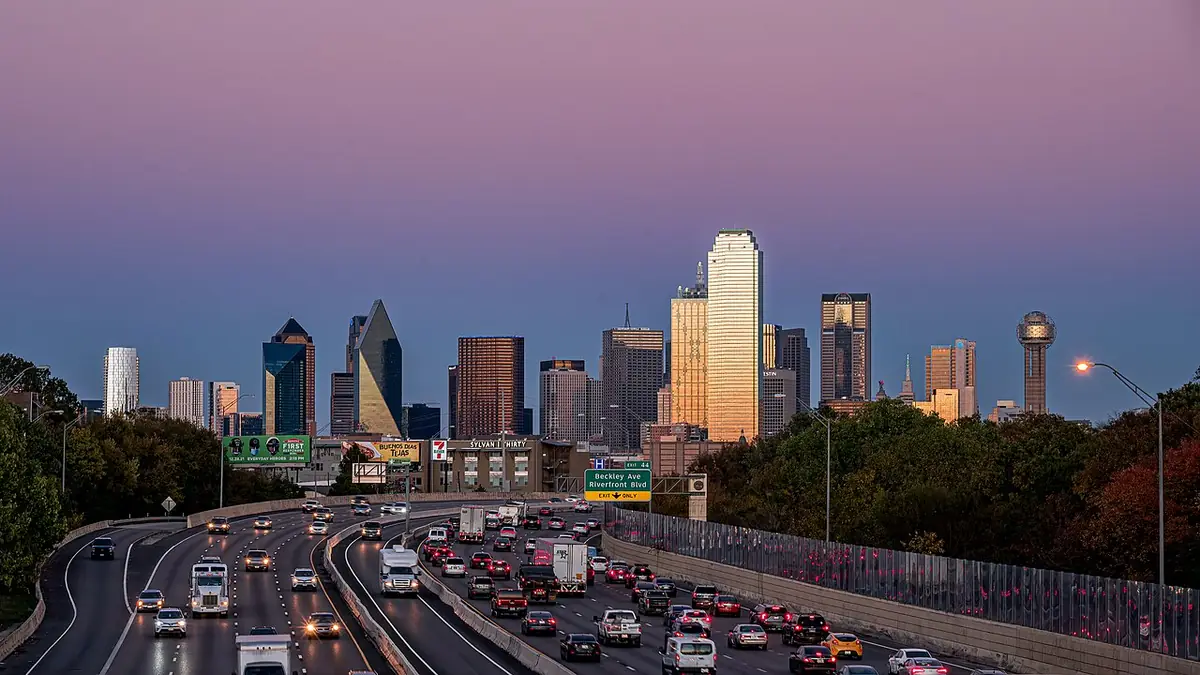
Downtown Dallas glows at dusk above a curving highway — Photo: Shiva Shenoy · CC BY 2.0 · Wikimedia Commons
That cultural shift shows up first in the crucial question of which neighborhood you unpack your bags in.
Going from a city life built around walking, public transport and dense shopping streets to the reality of Texas is both a cultural and a practical shock. Your sense of distance falls apart in the face of the sheer scale of the infrastructure and the centrality of the car. Anticipating these differences, cultural and logistical alike, will spare you the disappointments of the first few months after you move in.
From abroad
Dense city centers where you pick up bread and fresh produce on foot at the end of the street
Dallas
Giant retail zones grouped into plazas that you can only reach along major roads
Every everyday errand has to be planned in advance and needs a vehicle, which deeply changes your relationship with time and with spontaneity.
From abroad
An older housing stock, protected by strict planning and heritage preservation rules
Dallas
Recent, modular construction dominated by timber, siding and total architectural flexibility
Maintaining a Texas house demands constant vigilance against bad weather, temperature swings and termites, a long way from the cut stone many buyers grew up with.
From abroad
A centralized administration with public services held to uniform national standards
Dallas
Fragmented local government, where local property taxes directly fund services and schools
Property tax levels vary a great deal from one municipality to another, which durably affects the real cost of owning your property over the years.
From abroad
Informal relations with neighbors, built on street life and nearby shops
Dallas
Community life often framed by homeowners associations and neighborhood committees
Social life is organized differently, often more privately inside homes or at collective events held at the level of the subdivision.
How to choose between the metro area's residential districts
Once you have identified the right area, it is worth looking hard at the financial reality of local property transactions.
The geography of Dallas is a mosaic of neighborhoods with very distinct identities, from fashionable, busy districts to the peaceful residential enclaves of the surrounding counties. Picking the right area does not depend only on your initial budget, but on how much travel time you can tolerate and what atmosphere you are looking for. Each zone strikes its own balance between accessibility, quiet and cultural energy.
Uptown and the central corridor
Constant urban energy, set by people on foot, cafe terraces and a high density of modern buildings. Parking is difficult and life runs at a distinctly faster pace.
Suits
Young professionals without children, people who want to be right next to the major business centers, and anyone who enjoys nightlife.
Trade-off
High prices per square meter, almost no land with the property, and homes that are mostly apartments or attached townhouses.
The northern residential enclaves (Park Cities, Plano)
Complete quiet along wide avenues lined with mature trees, well kept parks and immaculate lawns. The atmosphere is family oriented, reassuring and firmly focused on comfort at home.
Suits
Families with school age children and buyers looking for stability, quiet and an excellent reputation for the local schools.
Trade-off
A particularly high purchase budget, fierce competition on the market, and complete dependence on the car for any trip at all.
Neighborhoods in renewal (Deep Ellum, Bishop Arts)
A creative, artistic and bohemian spirit, marked by converted industrial buildings, studios, galleries and a rich independent food scene.
Suits
Creative profiles, people who love unusual architecture, and investors betting on medium term gentrification in historically working class areas.
Trade-off
Sharp differences in safety from one street to the next, potential noise at the weekend, and greater price volatility.
The market in figures, and the local taxes that come with it
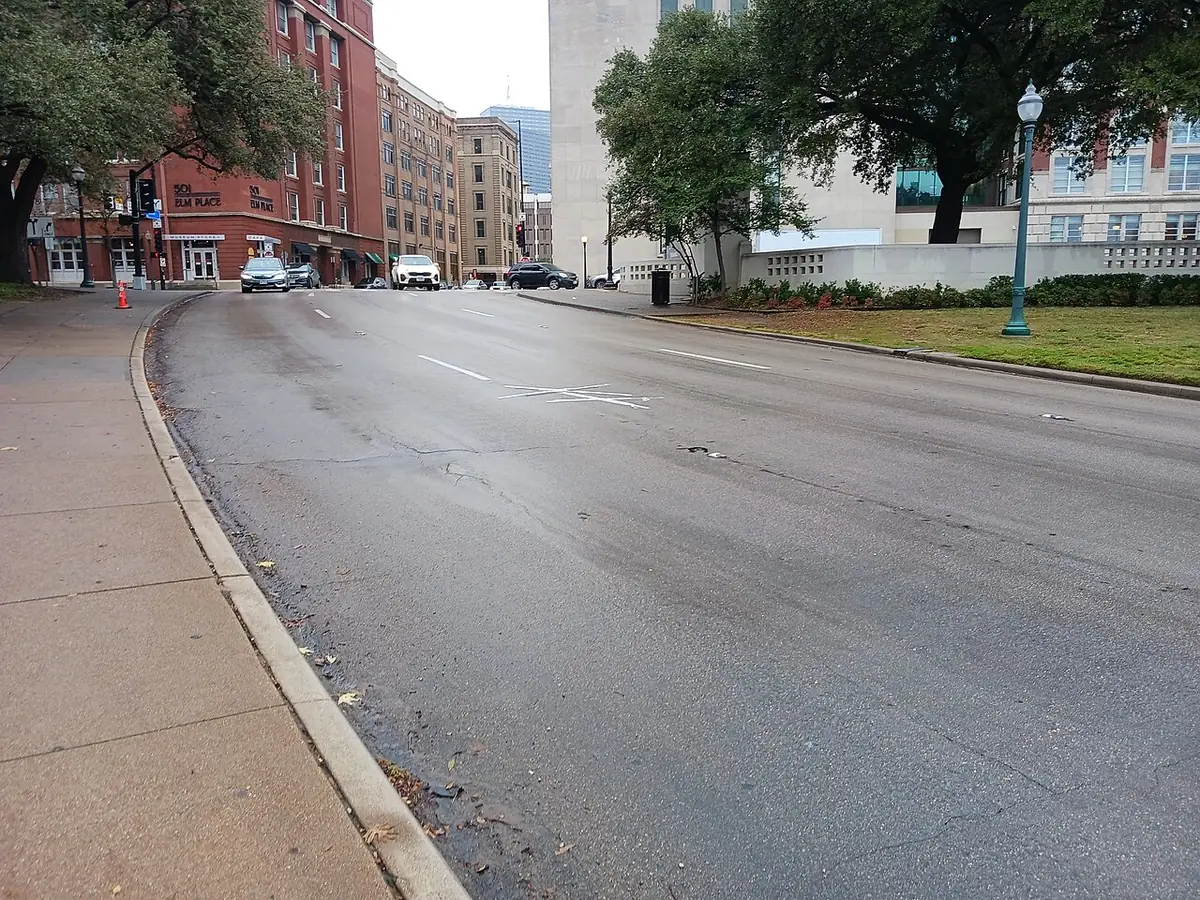
A quiet stretch of downtown Dallas streets, framed by red brick and trees — Photo: Jidanni · CC BY-SA 4.0 · Wikimedia Commons
Beyond the raw numbers, the legal and structural nature of what you are buying deserves careful attention.
Setting a purchase budget in Dallas means looking past the price shown on the listing portals. The cost structure includes local property taxes that are often higher than in other American states, along with closing costs that are far from trivial. Pricing these recurring charges accurately is what keeps your project financially viable over the long term and avoids nasty budget surprises.
dallasFor saleHouseestimate
Median price / m²US$2,259Half the apartments sell below this
Median priceUS$375kthe average is 14% higher — a few very large properties pull it up
Most common2 bedrooms63 % of listings
Average size158 m²
By number of bedrooms
Bedrooms
Share of market
Avg price
Price / m²
Avg size
2most common
63 %
US$383k
US$2,378
161 m²
3
31 %
US$489k
US$2,235best value / m²
219 m²
4
6 %
US$659k
US$2,283
289 m²
Each row is an average, compared against the area average of US$2,378 / m². These are indicative estimates of a typical local market, not a measured sample of live listings. Check current listings before relying on them.
What you really own once you sign the deed
To carry this purchase through in the best conditions, the transaction follows a timetable and a set of rules you need to master.
Property rights in the United States, and in Texas in particular, come with legal subtleties that differ noticeably from the practices buyers know elsewhere. Between outright ownership of the land and the restrictions imposed by easements or homeowners associations, an owner's freedom of action is bounded by strict rules. It is essential to measure the exact scope of your rights before committing to a construction project or a heavy renovation.
Outright ownership of the building and the land it sits on
In the great majority of cases, outside of strict condominium ownership, you have full use of your plot of land and of the structure built on it. That gives you complete autonomy to carry out extensions, landscaping or outdoor comfort installations, subject to municipal planning codes.
What it changesYou carry the entire burden of maintenance, repairs and bringing things up to code, with no collective reserve fund to fall back on as there would be in a vertical condominium.
Restrictions and easements imposed by homeowners associations (HOA)
If your house sits inside a planned subdivision, you have to comply with the internal rules set by the local association. Those provisions govern the exterior appearance of homes, which species of tree are tolerated in the yard, parking rules on the street, and sometimes even the color of shutters or the front door.
What it changesYou are buying visual calm and a collective consistency that protects the value of the neighborhood, at the price of a notable limit on your individual architectural freedom.
The legal and financial mechanism to master before you put money down
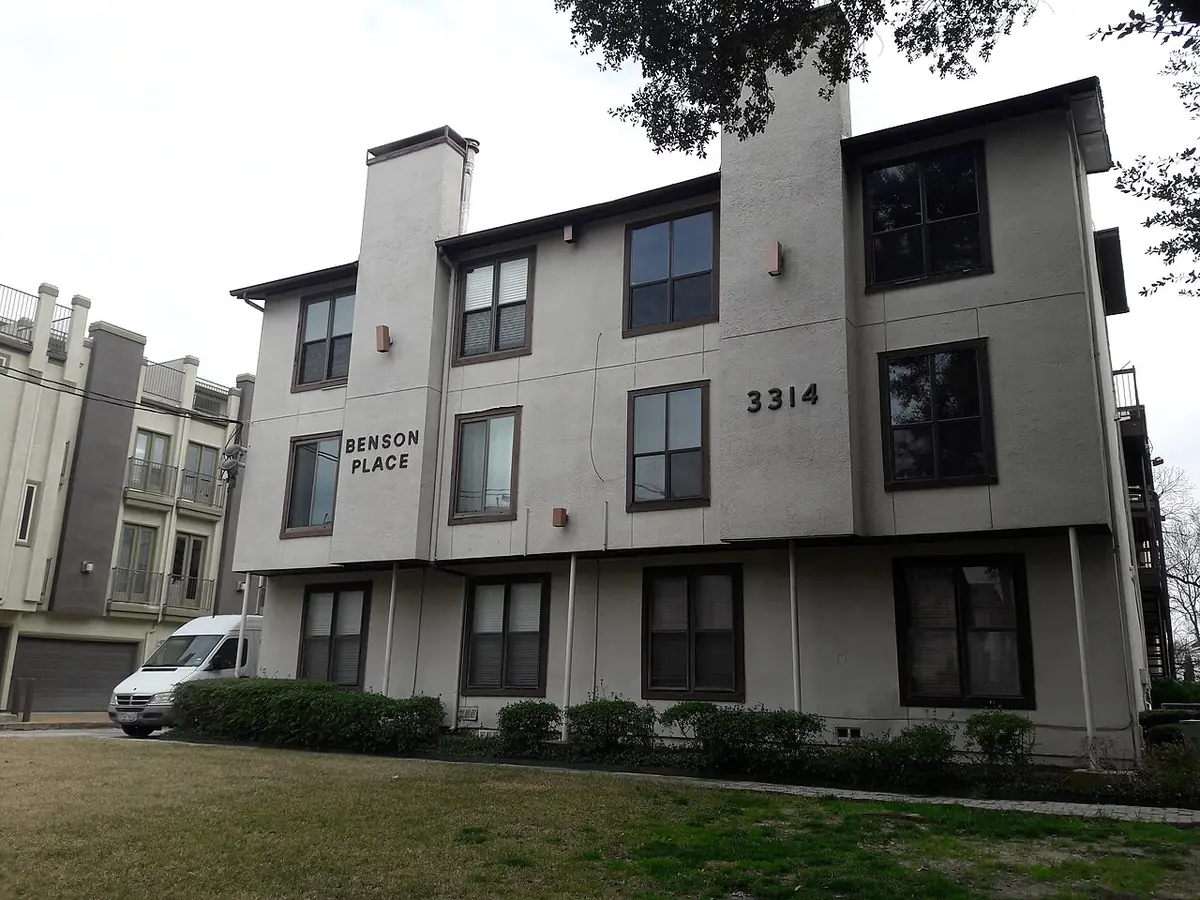
A modern low-rise apartment building typical of Dallas infill housing — Photo: Usernet123u · CC BY-SA 4.0 · Wikimedia Commons
Let us now look at how the various professionals come in, one after another, along this path.
Signing an offer to purchase in Texas commits the buyer far more firmly than it does in many other countries, above all through the earnest money mechanism. Understanding how the contingency clauses follow one another, and the role of the inspection period, is the key to a calm transaction. Not knowing these contractual steps can cost you significant sums if you withdraw outside the allowed window.
Your licensed real estate agent drafts the initial offer to purchase
Earnest money is placed with a third party escrow account within days of the offer being accepted, to seal the agreement.
The option period opens, giving you the discretionary right to walk away from the sale in exchange for the flat fee that option costs.
An independent inspector carries out a thorough technical survey of the building to identify hidden defects or necessary repairs.
Repairs or price adjustments are negotiated, if needed, on the basis of the inspection report and before the contingencies are lifted.
Final signature of the deed of sale (closing) and the official transfer of ownership.
Who does what, and in what order, as the transaction unfolds
A successful property transaction rests on the smooth coordination of a number of specialists, from the mortgage broker through to the title company. Each one plays a precise role in making the transfer of ownership legally and financially secure. Knowing how the tasks are divided lets you steer your project with confidence and know who to turn to at each key moment.
The buyerObtaining a mortgage pre-approvalThis unavoidable step proves your ability to finance the purchase to sellers, even before you start viewing what is on the market.
The real estate agentSelecting and viewing target propertiesThe agent analyzes comparable local market data to help you frame a realistic and competitive offer.
The home inspectorFull audit of the structure and the systemsThe inspector goes over the roof, the foundations, the plumbing and the air conditioning system to produce a detailed technical report.
The title companyVerifying title and any liensIt confirms that the property is free of hidden liabilities and secures the transaction legally by issuing a title insurance policy.
The closing officerSigning the final deed (closing)The closing officer gathers the signatures, orchestrates the transfer of funds and records the ownership officially with the county.
House or apartment in Dallas: weighing private space against shared management
Buying property in Dallas forces an immediate choice between the single family house with its own land and the apartment in a vertical condominium. Established residential neighborhoods such as Lakewood, along with the outer suburban extensions, overwhelmingly favor the single family model, with a substantial footprint on the ground and total responsibility for the structure. That option appeals to buyers who want control over their own space and their own temperature, despite the burden of maintaining the roof, the foundations sitting on black clay and the automatic watering system that becomes essential in summer. The owner alone carries every line of spending tied to keeping the building sound, with no intermediary to arbitrate maintenance priorities.
Choosing an apartment instead, whether in a high end building in Uptown or a recent development in Deep Ellum, shifts the complexity of physical management onto collective governance. The condominium charges, called HOA fees in the Texas context, cover the upkeep of common areas, security, the pool and sometimes the insurance on the exterior of the building. This formula suits mobile professionals or buyers who would rather not deal directly with the local weather, such as the violent hail that damages roofs. On the other hand, an apartment owner depends on the decisions of the general meeting and on the financial health of the association when major work comes up.
In terms of long term value, the single family house in Dallas has historically benefited from a more direct appreciation tied to land value, which grows scarce as you get closer to the economic center. Texas ground has its own dynamic, in which location outweighs the building itself, allowing well placed houses to outperform during rising cycles. The apartment, in exchange, offers a financially more accessible entry point in dense areas where walking is possible, reducing your initial financial exposure while imposing resale constraints tied to the building's internal rules and to the level of the compulsory monthly dues.
The final choice therefore depends on your tolerance for operational risk and on how you live day to day. If you accept spending your weekends maintaining a lawn in summer temperatures that regularly pass forty degrees Celsius, and watching the moisture around your foundations, the single family house is the obvious structural answer. If you would rather outsource the material constraints in exchange for a fixed monthly contribution and shared space, the urban apartment will better match what you want in terms of efficiency and immediate logistical freedom.
What budget do you really need to live in a home in Dallas?
Buying a property in Dallas is not just the purchase price shown on the online platforms. The buyer has to account for a recurring cost structure specific to Texas, marked by the absence of state income tax and the fact that this shortfall is made up with particularly high property taxes. Sound financial analysis means breaking down each line of spending over the long term, so nothing catches you out during the first year of ownership.
Recurring costs and local taxes in Dallas
Budget line
Average amount or rate
Impact on cash flow
Property tax
1.8% to 2.5% of the assessed value
A high annual charge that varies with the municipal and school assessments from year to year.
Home insurance
2,500 to 4,000 USD per year
Rising noticeably because of Texas climate risks, including hail and windstorms.
Association dues (HOA)
200 to 800 USD per month
Mostly applies to apartments and to some horizontal single family associations.
Property tax rates depend precisely on the Independent School District the property sits in, which creates significant gaps from one neighborhood to the next.
Operating and maintenance costs for a single family house
Type of work
Frequency
Indicative budget
Foundation treatment
Occasional, depending on ground movement
5,000 to 15,000 USD for each major intervention required.
Air conditioning (HVAC)
Replacement every 10 to 12 years
8,000 to 14,000 USD for a complete system installed.
Roof maintenance
Annual inspection and repairs
1,000 to 4,000 USD depending on the hail damage found.
The humid subtropical climate of Dallas pushes air conditioning equipment to its limits, which speeds up normal wear.
Health, schools and transport: an ordinary Tuesday in Dallas
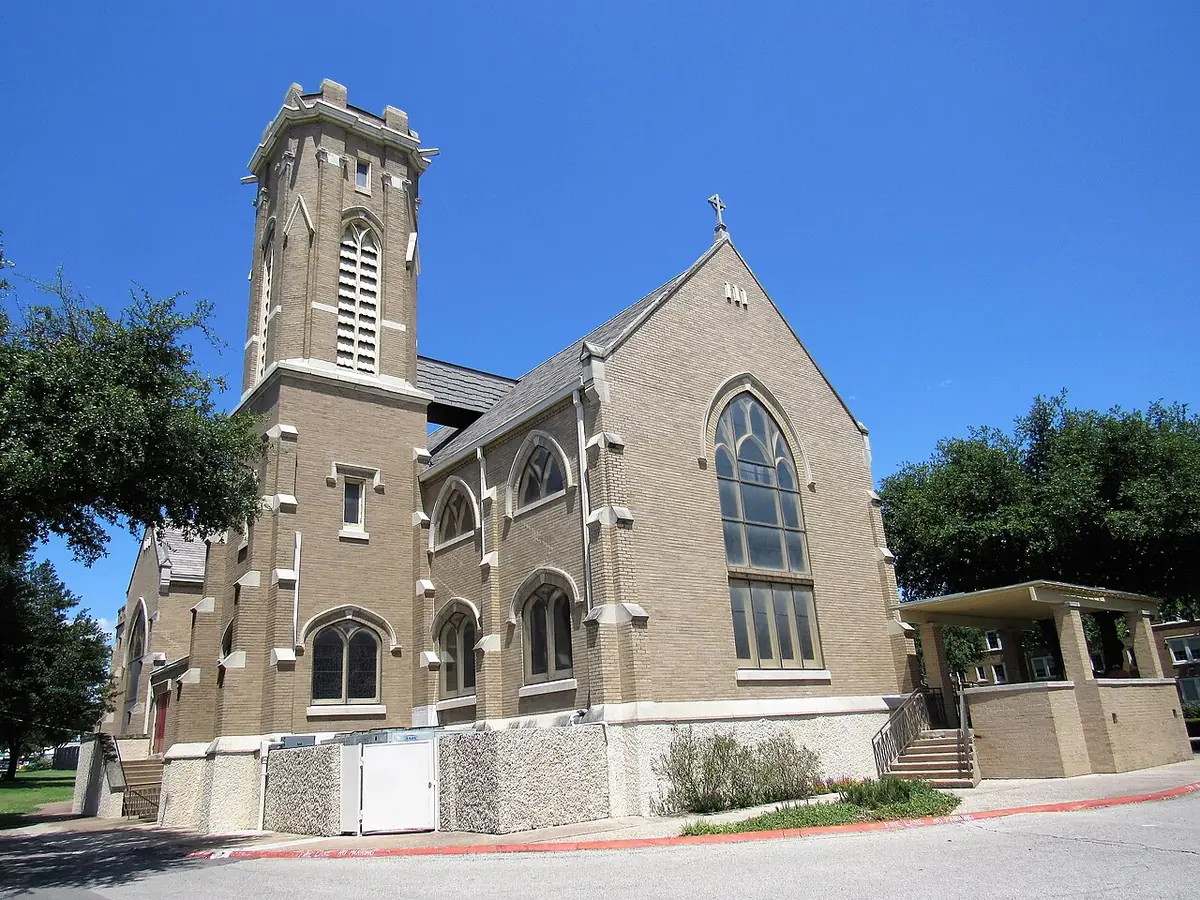
St. Matthew's Cathedral, a Gothic landmark in the heart of Dallas — Photo: Farragutful · CC BY-SA 4.0 · Wikimedia Commons
Grasping what buying in Dallas really means calls for walking through a typical day, to measure how the infrastructure shapes daily life. The city is organized largely around the personal vehicle, despite the growth of public transport lines such as DART. Every trip, morning or evening, tests the real proximity between where you live, where the jobs are and the essential health services.
07:00Leaving homeOut of the garage or the parking space and onto the main roads, such as Interstate 35E or North Central Expressway.
07:45School drop offArriving at the school attached to the neighborhood, whether that is a public school in the district or a private institution.
08:30Arriving at workParking in the Downtown or Uptown business district, or at an outlying office hub such as Legacy West, depending on where the company sits.
12:30A work trip or a breakOccasional use of pedestrian links if you live in a dense neighborhood, or a drive out to a retail zone.
17:30Heading back to the residential neighborhoodDealing with rush hour traffic on the urban highways that are characteristic of this Texas metro area.
19:00Local shopping and servicesArriving at the neighborhood shopping center to stock up, or stopping at a primary care clinic.
The hidden realities a listing will never mention
Sales descriptions for properties in Dallas highlight the living space, the quality of the interior finishes and how close the lively streets are. They systematically leave out fundamental physical and regulatory factors that shape both comfort and future value. A careful buyer has to investigate these technical points, which are often hidden behind superficial selling points.
The clay nature of the soil and the stability of the foundations
Texas soil shrinks and swells significantly between dry and wet seasons. Without a perimeter watering system, or with poor drainage, you can end up with expensive structural cracks that fresh paint hides temporarily during viewings.
Real exposure to aircraft and rail noise
Proximity to the freight rail lines crossing the region and to the flight paths serving Dallas-Fort Worth (DFW) or Love Field can significantly change how peaceful a place feels at peak hours or overnight.
The restrictions imposed by homeowners associations (HOA)
Some horizontal associations ban parking commercial vehicles in the driveway, impose strict exterior paint shades or limit the installation of solar panels, all of which reduce an owner's autonomy over their own property.
The real age and energy efficiency of the electrical system and the air conditioning
The occasional harsh winter and the scorching summer both push the systems to the extreme. Aging equipment leads to exorbitant electricity bills and forces an early replacement not long after the purchase.
Planning projects and road infrastructure expansion
A future widening of a stretch of highway, or a new transport line right next door, can turn a quiet residential neighborhood into a permanent construction site and change the whole feel of the place.
The buying mistakes you only discover six months after settling in Dallas
Looked likeA remarkable architectural opportunity in a neighborhood on the rise, at a very attractive price per square meter.
Turned outAn area exposed to flooding during the violent storms typical of the Texas spring, with prohibitive flood insurance premiums.
Would have caught itAlways consult the official flood zone maps issued by FEMA and check the water history of the plot before making any offer.
Looked likeA very quiet outlying location with a large wooded plot for a moderate financial outlay.
Turned outA daily commute regularly passing two hours round trip because of chronic congestion on the access highways.
Would have caught itTest the drive at genuine peak hours between the property you want and your usual workplace before signing the contract.
Looked likeAn older house full of charm, with period details and unique character in the heart of a historic area.
Turned outDegraded cast iron plumbing and insufficient insulation, producing energy bills that could not be sustained.
Would have caught itCommission a thorough technical inspection from an independent expert who specializes in older Texas homes.
Looked likeA modern condominium with low monthly dues, promising simple, worry free management.
Turned outAssociation reserves too thin to cover the work, leading to immediate special assessments to repair the building's roof.
Would have caught itInsist on reviewing the accounts and the minutes of the general meetings for the last three years, obtained through the title company.
Which buyers should walk away from a property project in Dallas?
Buying property in Dallas is often presented as the logical step once you have settled in Texas. Yet the economic, tax and climate constraints of the region make it counterproductive for several types of people. Identifying those situations avoids major financial disappointment and the capital losses that come with selling too early in a market that is dynamic but volatile.
The professional on a short assignment or facing uncertain international mobility
→Carrying on renting a flexible apartment
Transaction costs on the way in and the way out (agency fees, transfer taxes and closing costs) absorb any potential gain if the property is sold again before a minimum of five years.
The household on a tight budget with no room for the unexpected
→Waiting until a solid safety cushion has been built up
Local taxation based on assessed land value, and the high cost of maintaining air conditioning systems, demand the ability to draw on savings quickly if something major breaks or taxes suddenly rise.
The buyer who refuses to use a car every day
→Looking instead at dense cities in other regions
Dallas and its wider suburbs are organized almost entirely around the road network, which makes life without a personal vehicle very hard for ordinary activities.
So, are you really ready to take the step and buy in Dallas?
A pocket park offering a green pause in Dallas — Photo: Nightryder84 · CC0 · Wikimedia Commons
Reaching the end of this analysis confirms that buying property in Dallas is a strategic decision to be thought through carefully. You now understand that the economic appeal of Texas comes with structural financial counterweights, starting with a high level of property tax and a constant demand for maintenance in the face of the summer climate. That should not put you off. It should place you in the position of an informed buyer, able to separate an emotional response to a building from its technical reality.
If your professional horizon is a long one, if you accept the reality of driving on the big Texas roads, and if your savings capacity absorbs the unpredictability of foundation and air conditioning maintenance, then the Dallas property market offers solid long term prospects. Established neighborhoods and areas in transition alike offer real opportunities for anyone able to read the technical reports rather than the agencies' advertising.
Take the time to view properties at different hours of the day, check the quality of the school network if you have children, and insist on full transparency about the history of work carried out. A successful property investment in Dallas is one that builds in the total cost of ownership from the start, making sure your home stays a place of stability and calm for years to come.
Related questions
How much is the average property tax on a home in Dallas?
Property tax in Dallas generally runs between 1.8% and 2.5% of the value assessed by the local authorities. The exact rate depends on the specific school district and municipality the property sits in, and it weighs heavily on an owner's annual budget.
Do you need a car to live in a home in Dallas?
Yes. The spatial organization of the Dallas metropolitan area rests almost entirely on the road and highway network. A few central neighborhoods have pedestrian friendly stretches, but owning a personal vehicle remains essential for getting through an ordinary day.
What are the main climate risks affecting property in Dallas?
Homes face spells of intense summer heat that push air conditioning systems hard, along with occasional hailstorms that can severely damage roofs and call for frequent repairs.
How does the clay soil in Dallas affect house values?
The region's clay soil shrinks and swells with moisture levels, which can cause ground movement and weaken foundations. A perimeter watering system and careful upkeep are essential to preserve the structural stability of the building.
Should you budget separately for home insurance in Texas?
Home insurance premiums in Dallas are among the highest in the country because of recurring climate risks, including windstorms and hail. You need to build a substantial annual budget line to cover this essential protection.
What is a homeowners association, or HOA, in a shared development?
An HOA is a body that manages common areas, security and the enforcement of the rules of the community in a condominium or a single family subdivision. It charges regular monthly dues and makes sure appearance and maintenance standards are respected.
How much does the school district matter when choosing a neighborhood in Dallas?
The quality of the public schools attached to an area directly drives housing demand and resale value. Families look first at the areas with the best school rankings when they invest.
What is the minimum recommended holding period to make a purchase in Dallas pay off?
The usual advice is to hold a property bought in Dallas for at least five years, so that the upfront transaction costs are absorbed and the local market has time to add value to the investment.
Do condominium apartments offer a good rental yield in Dallas?
Apartments in lively neighborhoods such as Uptown or Downtown attract a young, mobile population and offer steady rental prospects, provided you check the level of the association dues, which eat into profitability.
How do you check whether a house in Dallas is in a flood zone?
It is essential to consult the official FEMA (Federal Emergency Management Agency) maps and to look at the rainfall history of the plot, to be sure the property is not exposed to major water accumulation during storms.
Property review of ting
No ting properties in Dallas yet
Be the first — share it on ting and it shows up right here.