Buying a house in Dallas is a major commitment, and it asks you to look past the photographs that first caught your eye. Between the way property taxes are assessed, the choice of neighbourhood and the sheer scale of the metro area, this guide gives you what you need to make the purchase with clear eyes.
Get the app
What nobody tells you.
Real prices, hidden costs and the traps to check before you commit.
Why space and distance reshape what you are buying in Dallas
Scroll
Why space and distance reshape what you are buying in Dallas
Buying a house in Dallas is a major commitment, and it asks you to look past the photographs that first caught your eye. Between the way property taxes are assessed, the choice of neighbourhood and the sheer scale of the metro area, this guide gives you what you need to make the purchase with clear eyes.
Written by the ting.ad editorial team ·
Main Street, Dallas in Street View: drag to look around.
Understanding those basic trade-offs makes it much easier to work out whether the local market genuinely suits the way you want to live.
Buying a property in Dallas is not simply a matter of adding up habitable square metres. Here, every square foot sits inside an urban and suburban fabric where distances, access to the main highways and the structure of the counties all redefine what the property is really worth to you. Buyers have to work with a spatial reality on a very large scale, one that completely changes the meaning of proximity and of everyday comfort. What looks like an excellent deal on paper can quickly translate into unexpected commuting times if you ignore the effect of local geography and of the way the urban motorways are organised.
Substantial living space for a price per square metre that is often lower than in the coastal metros.vsAn almost total dependence on the car for every journey, which makes the choice of location critical.
Buying big on the outskirts means accepting hours of travel every week. The space you gain inside the house is paid for in time spent on the ring roads.
Quiet residential neighbourhoods with generous plots and a strong architectural consistency.vsStrict community rules and homeowners associations whose dues and aesthetic requirements weigh on the long-term budget.
The apparent freedom of a detached house usually comes with rigid oversight from the HOA. Those rules keep the neighbourhood uniform but limit what you can change yourself.
Exceptional regional economic momentum that supports capital values and rental demand.vsDirect exposure to local property taxes, often higher than in other states, which fund municipal infrastructure.
The absence of a state income tax in Texas translates into substantial property taxes. You have to build that recurring cost into your annual affordability calculation from the outset.
A plentiful supply of recent construction built to modern insulation standards and specifications.vsMaintenance costs that can run high because of extreme summer conditions, particularly for air conditioning and roofing.
Texas summers put houses through a hard test. An ageing air conditioning system or a poorly maintained roof becomes an immediate financial burden the moment you own the place.
Does this market really match the way you intend to live?
The practical gap between compact cities elsewhere and the way Texas is laid out also deserves a close look before you commit.
Choosing a house in Dallas does not answer to the same priorities depending on whether you value urban cultural life, the quiet of a residential suburb, or the flexibility of a long-term asset. Every buyer profile faces its own constraints, and they are worth analysing before you sign a binding offer. Working through the different scenarios is what stops you making the classic mistake of buying a property that does not fit the rhythm of your daily life.
Close to the centre
For buyers attached to city living, to restaurants within walking distance and to lively districts such as Uptown or Deep Ellum, the standalone house with a large plot is rare and very expensive. Buying a house here often means moving away from the centres of activity, or looking instead at townhouses. The arbitrage is between the appeal of a lively neighbourhood and the need for interior space.
Suburban family life
Families find in the surrounding municipalities and the established residential neighbourhoods of Dallas an environment designed around them, with parks, sports facilities and well-regarded school districts. That option does mean accepting a daily life built around car journeys for school, activities and shopping. The house becomes a haven, but it demands disciplined logistics.
Buying as an asset
The Dallas property market attracts buyers for its economic solidity and the steady growth of its working population. For an investor, buying a house means targeting with real precision the areas where family rental demand stays strong and where property taxes do not eat too far into the net yield. Here the choice of neighbourhood matters more than falling for the look of a place.
Buying here when you are arriving from abroad: what changes most
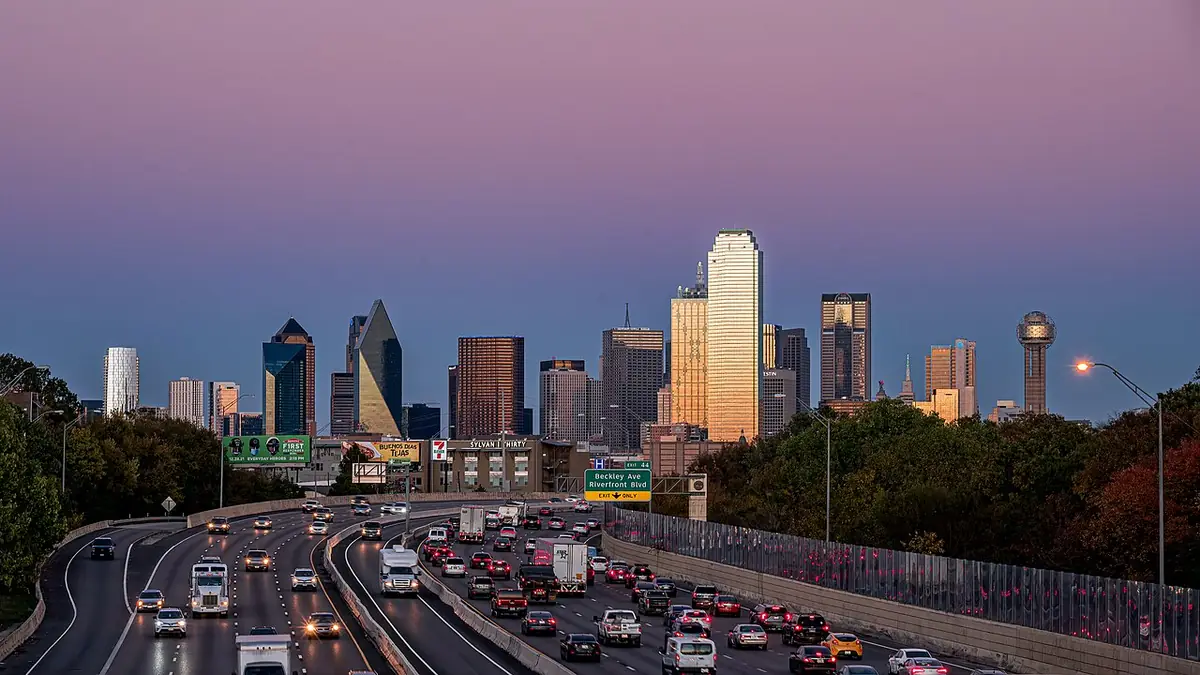
Downtown Dallas glows at dusk above a curving highway — Photo: Shiva Shenoy · CC BY 2.0 · Wikimedia Commons
Beyond these broad principles, it is the precise choice of district that will decide the quality of your everyday life.
Buying property in Texas from overseas puts a buyer in front of spatial, legal and cultural reference points that have been completely rearranged. What counts as normal in many countries (the compact city, shops you can walk to, centralised administration) gives way to a territorial model built on scale, self-sufficiency and private contract. Anticipating those differences is what lets you settle into your new environment without a logistical or psychological shock.
From abroad
A dense town centre where you shop on foot and public services are grouped nearby.
Dallas
Massive urban sprawl in which retail, residential and business zones are strictly separated.
Every trip out of the house needs a vehicle and a bit of planning, which changes your relationship with time and with freedom of movement quite profoundly.
From abroad
Purchase procedures and leases governed by uniform, protective national law.
Dallas
A contractual system governed by Texas law, layered with the strict internal rules of homeowners associations.
You have to read and understand every restrictive clause on the exterior appearance of the house, on parking and on short-term letting rights before you commit.
From abroad
Older or historic housing with thick walls, stone and traditional architectural character.
Dallas
Mostly recent or contemporary construction, favouring timber frames, large open volumes and modern thermal comfort.
Maintaining a Texas house rests on different materials, which calls for extra vigilance around storms, termites and moisture management.
From abroad
Local taxes set against national criteria and collected indirectly or at a flat rate.
Dallas
Local property taxes tied directly to the value the county assesses the property at.
The size of that recurring bill varies between municipalities and school districts, which permanently changes the total cost of owning the property.
Which part of Dallas should you be shopping in?
Once the area is settled, a rigorous look at the budget and the running costs becomes the decisive step.
The Dallas metro is not one homogeneous whole but an archipelago of neighbourhoods with sharply contrasting identities, budgets and rhythms. From the energy of the areas near the centre to the residential suburbs known for their parks and schools, each district offers a unique compromise between access, space and quiet. Knowing what these areas are actually like day to day stops you relying on agency marketing brochures alone.
The historic, central neighbourhoods (Munger Place, Lakewood)
A green and mature setting, walkable streets lined with century-old trees and a strong sense of community right next to the centre.
Suits
Buyers after architectural character, history and relative proximity to the cultural and dining scene.
Trade-off
Noticeably higher prices per square metre, and older properties that often need energy and electrical upgrading.
The established northern suburbs (Plano, Frisco, Richardson)
Carefully planned development, modern shopping centres, first-rate sports facilities and busy corporate campuses.
Suits
Families prioritising excellent school districts, the security of planned subdivisions and the comfort of spacious, practical houses.
Trade-off
A sometimes uniform streetscape, long drives into the heart of Dallas at peak times and heavy dependence on the car.
The districts in transition (Bishop Arts District, Oak Cliff)
An artistic, relaxed atmosphere with independent cafes, designer shops and a stimulating architectural mix.
Suits
Bolder buyers looking for long-term upside in areas going through real cultural change.
Trade-off
Marked variation from one street to the next, and municipal investment that can be uneven block by block.
What does buying and then holding a house here really cost?
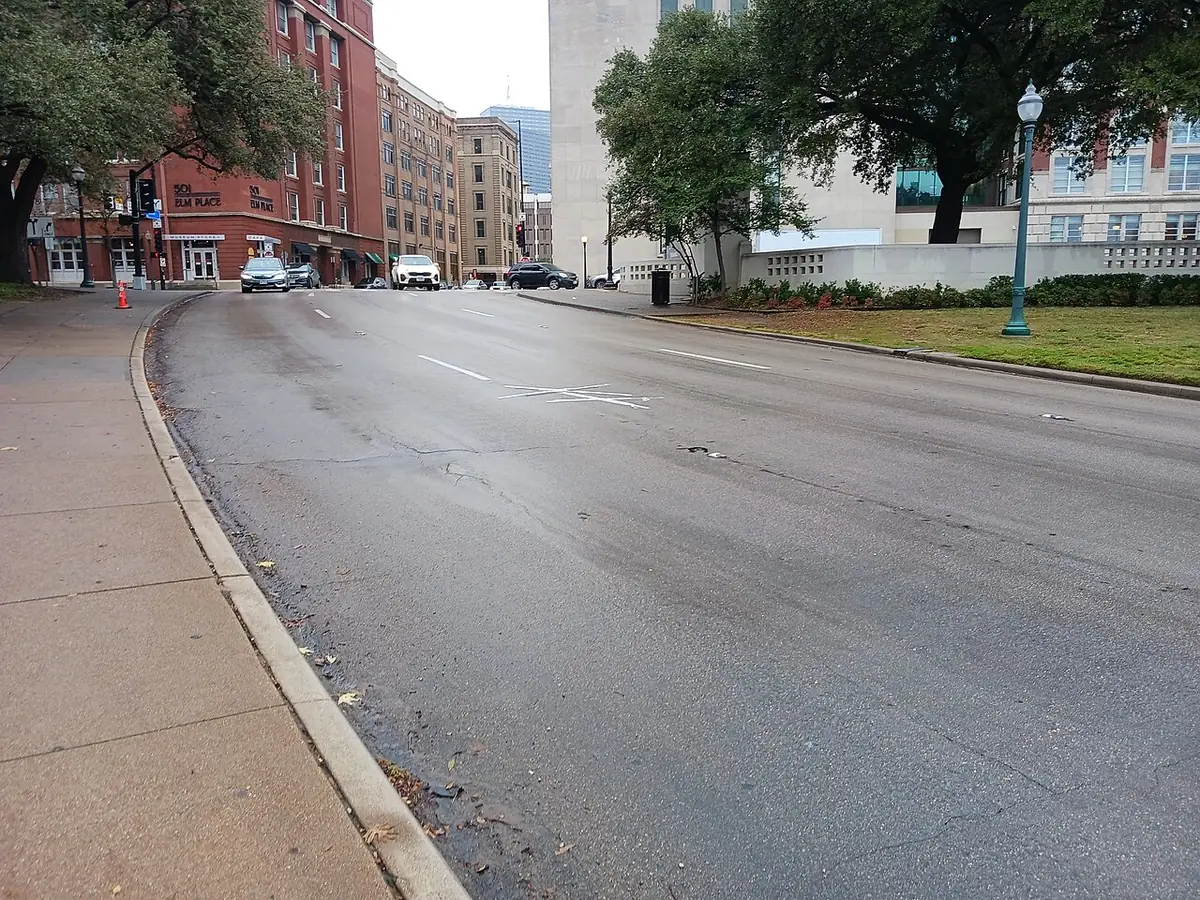
A quiet stretch of downtown Dallas streets, framed by red brick and trees — Photo: Jidanni · CC BY-SA 4.0 · Wikimedia Commons
This cost structure sheds light on exactly what ownership rights you will hold once the process is complete.
Estimating the cost of a house in Dallas does not stop at the headline price you sign for at the title company. The Texas market carries specific financial components that have to be modelled over several years if you want to avoid unpleasant surprises. Between property taxes calculated by the counties, homeowners association dues and the cost of running air conditioning through summer, the overall budget calls for rigorous and realistic accounting.
dallasFor saleHouseestimate
Median price / m²US$2,259Half the apartments sell below this
Median priceUS$375kthe average is 14% higher — a few very large properties pull it up
Most common2 bedrooms63 % of listings
Average size158 m²
By number of bedrooms
Bedrooms
Share of market
Avg price
Price / m²
Avg size
2most common
63 %
US$383k
US$2,378
161 m²
3
31 %
US$489k
US$2,235best value / m²
219 m²
4
6 %
US$659k
US$2,283
289 m²
Each row is an average, compared against the area average of US$2,378 / m². These are indicative estimates of a typical local market, not a measured sample of live listings. Check current listings before relying on them.
What you actually buy: full ownership set against collective rules
Respecting those local rules is part of a highly formalised purchase process that is worth mastering from day one.
Buying a house in Texas plays to the classic image of American freedom over your own land, but the contemporary legal reality is more nuanced. The title gives you possession of the land and the building, yet how you use and alter them is framed by strict local rules. Understanding the boundary between what is yours outright and what the community governs is essential if you want to avoid disputes with neighbours.
Full ownership of the building and the land
You own the physical structure of your house as well as the plot it stands on, which entitles you to carry out interior renovations and to rearrange your living spaces to suit yourself, subject to obtaining the municipal permits required.
What it changesYou keep complete freedom over the inside, but you also carry the full cost of maintenance and structural repairs on your own if something goes wrong.
The binding framework of subdivision rules (HOA)
The great majority of houses in the newer subdivisions around Dallas fall under a homeowners association that sets precise aesthetic standards, from the permitted colours of a facade to the hours when bins may be put out and the vehicles you may not park on your own driveway.
What it changesYour freedom outside is constrained in order to preserve the visual harmony and the collective value of the neighbourhood, which protects your investment but limits how far you can express your own taste.
The legal and financial rule to understand before you put money down
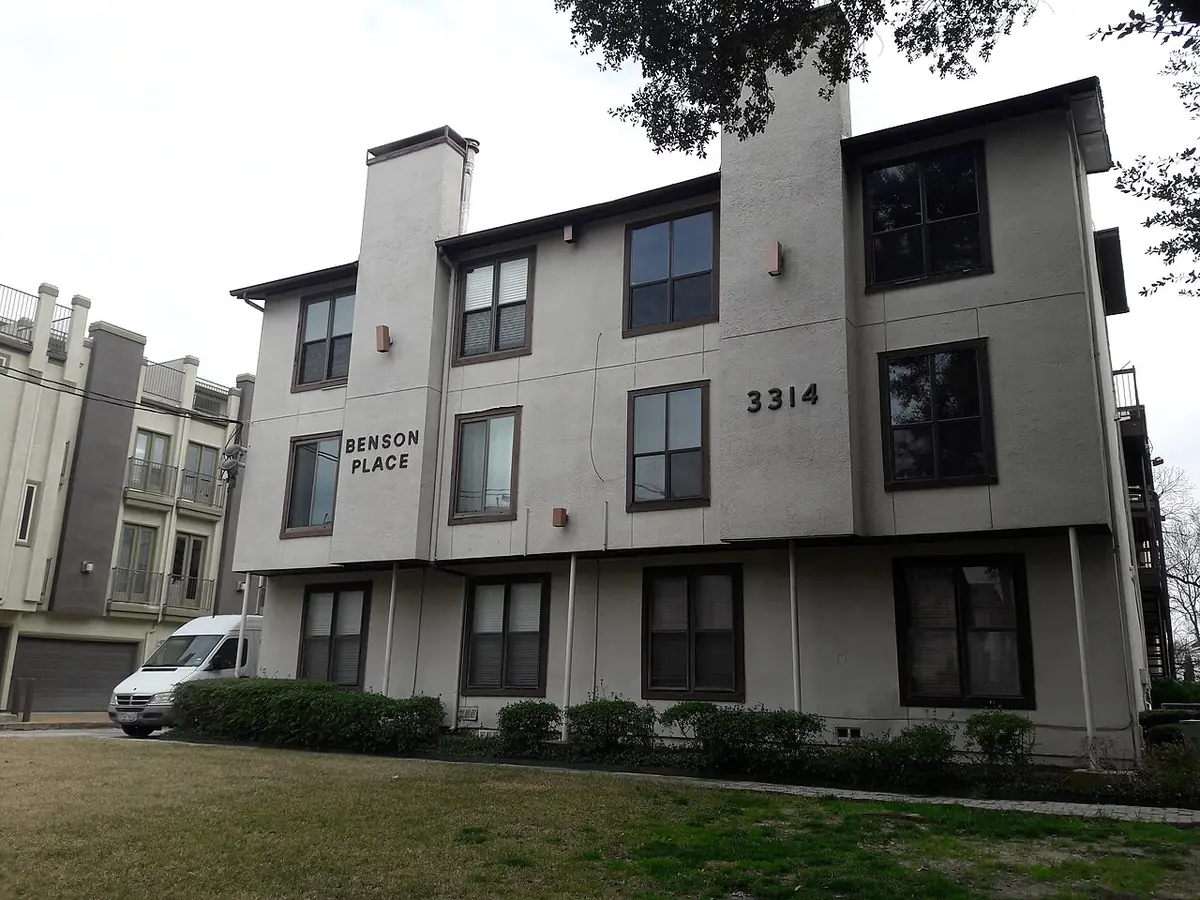
A modern low-rise apartment building typical of Dallas infill housing — Photo: Usernet123u · CC BY-SA 4.0 · Wikimedia Commons
That procedural discipline runs along a chronology of professionals it pays to coordinate methodically.
Buying property in Texas rests on extremely precise standardised contracts that protect the buyer as much as the seller, provided the deadlines are scrupulously respected. Unlike the practice in many other countries, an accepted purchase offer is immediately accompanied by funds being locked into an escrow account. Getting on top of this chain of legal commitments is the best way to protect your capital and carry the transaction through without needless stress.
Both parties draw up and sign a purchase contract (the Earnest Money Contract).
The earnest money deposit is paid into the title company's escrow account within the time allowed.
The inspection window opens (the Option Period), letting the buyer have the property examined by an independent professional.
Repairs are negotiated if needed, or the buyer legally withdraws without penalty if the defects found prove to be deal-breakers.
The lender signs off on the financing file and the conditions are progressively released.
Final signature of the deed (Closing) and the official transfer of title.
How a purchase actually unfolds, step by step
Seeing a Dallas house purchase through means coordinating several specialists whose roles are divided up in a very formal way. From choosing your agent to the intervention of the title company, each party secures one precise facet of the transaction. Knowing the order in which they act lets you steer your purchase with confidence and efficiency.
The buyerFinancial pre-qualificationObtaining a pre-approval letter from a lender, which is essential to demonstrate your standing to sellers from the very first viewings.
The agent (Realtor)Shortlisting and targeted viewingsExploring neighbourhoods, running a comparative analysis of the local market (MLS) and selecting the properties that match your brief.
The licensed inspectorTechnical survey of the buildingProducing a full report on the condition of the structure, the roof, the foundations and the electrical and plumbing installations.
The title companyTitle search and escrowResearching the legal history to guarantee there are no hidden liens or land disputes attached to the property you want.
The appraiserAssessment of market valueConfirming for the lender that the price you negotiated genuinely matches what comparable properties fetch in the same area.
The closing agentFinal signature (Closing)Validating the legal documents, releasing the final funds and formally handing over the keys to your new house.
House or apartment in Dallas: how to choose what to buy
Once that first choice between house and apartment is settled, the central question of the total budget and the running costs arrives immediately.
In Dallas, the housing question traditionally sets the detached house with a garden against the urban condominium apartment, often in a lively area such as Uptown or Downtown. Choosing between the two does not depend only on your initial budget, but above all on your tolerance for daily driving and your appetite for property maintenance. Houses offer generous living space, complete independence from your neighbours and far more freedom to alter things, but they leave you alone with the grounds, the roof and foundations sitting on clay soils that can be temperamental. Apartment condominiums, by contrast, pool those maintenance obligations and often include shared amenities of some standing, such as supervised pools, gyms and a permanent security service, which makes life a good deal simpler for very busy professionals.
Financially, buying a detached house in Dallas comes with property tax bills that are often higher, calculated by counties such as Dallas or Collin, and they weigh heavily on the total cost of ownership over the long run. Texas has no state income tax to offset those property taxes, which means every dollar of assessed value on your property turns into a significant annual contribution. Apartments generally carry lower individual property tax bills, but they require monthly service charges that can be substantial, funding the upkeep of common areas, the lifts and the roof of the building. It is therefore crucial to look hard at the financial health of the condominium before you sign, because badly managed reserve funds can lead to very heavy special assessments landing on owners.
The way you want to live day to day is the second great arbiter of this decision. If you want quiet, privacy, the ability to park several vehicles without constraint and private outdoor space for your pets, the single-family house in a residential neighbourhood such as Lakewood or the M Streets will suit you exactly. If instead you want to cut down your driving, live within reach of the best restaurants and galleries and stay close to fast transport links, the apartment higher up or the urban townhome makes its own case. Density in Dallas is increasing along the main corridors, and vertical properties offer a commanding view of the skyline while lifting you out of the noise of the ring roads.
Finally, resale and the liquidity of your investment differ appreciably depending on the type of property you buy. Well-located detached houses in well-regarded school zones generally hold sustained demand, drawing families in search of long-term stability and offering excellent protection against property inflation. Apartments and condos, on the other hand, go through market cycles that can be more volatile, influenced by the volume of new construction in the sector and by the interest rates applied to mortgages. Understanding those local dynamics lets you target the property that matches not only what you want right now, but also your investment horizon in a Texas metro that keeps changing.
What total budget should you plan for to buy in Dallas?
With the budget under control, it is worth looking concretely at how a typical week runs, so you can judge the travel reality before you buy.
Buying a house in Dallas is not summed up by the price displayed on the listing portals. You have to factor in the decisive impact of Texas property taxes, of home insurance that is expensive because of weather risk, and of the closing costs particular to Texas. Careful budgeting has to anticipate every line of spending so that the first year in the house holds no unpleasant surprises.
Initial and recurring property costs
Cost line
Estimated amount or range
Impact and frequency
Median house price
$400,000 to $450,000
Typical value for a standard three-bedroom property
Annual property tax
1.8% to 2.5% of value
Levied every year by the county, with no major relief
Home insurance
$2,500 to $4,000 per year
Rising steadily because of hail storms and droughts
Closing costs on purchase
2% to 3% of the purchase price
Covers title, conveyancing and appraisal fees
Property tax rates vary precisely according to the school districts and municipalities included in the Dallas metro area.
Monthly running budget for a household
Cost category
Average monthly cost
What drives the figure
Electricity and air conditioning
$150 to $350
A sharp peak in summer, when the heat keeps the air conditioning running constantly
Upkeep and garden
$100 to $250
Needed for watering and mowing lawns through the growing season
Transport and fuel
$300 to $500
Unavoidable given the urban sprawl and daily use of the car
Internet and broadband
$70 to $110
Several providers depending on the neighbourhood, with fibre available in most areas
These amounts are indicative and depend on the size of the house you buy and on how well it is insulated.
Health, schools and transport: test a house against an ordinary Tuesday
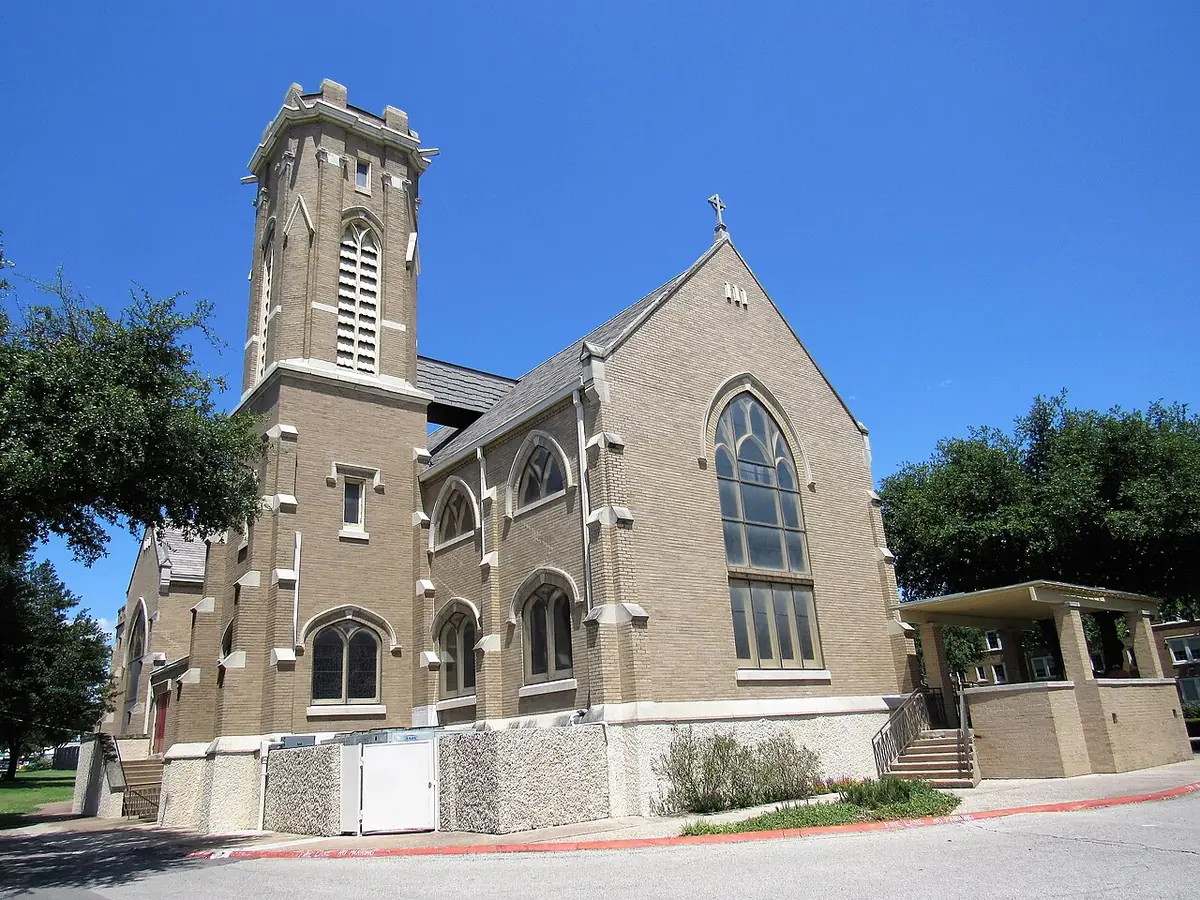
St. Matthew's Cathedral, a Gothic landmark in the heart of Dallas — Photo: Farragutful · CC BY-SA 4.0 · Wikimedia Commons
Beyond that well-oiled routine, some realities of the local market deserve careful scrutiny before you make an offer.
Daily life in Dallas is paced by the unavoidable use of the car and by tightly organised family schedules. Between drives on the ring roads and after-school activities, every day calls for a good sense of journey times if you want to avoid the peaks on the main routes. Running a candidate house through this timetable, before you buy, is the fastest way to find out whether its address really works.
07:30School drop-off in the districtParents drop children at the public or private schools in the area, often less than fifteen minutes by car from home. Check the drive from any house you are considering, not just the district rating.
08:30Drive to the business districtRunning the main highways such as I-35E or US-75 to reach Downtown, Uptown or the technology corridor in Richardson. Time that same run from the property before you commit.
12:30Lunch near the office or the neighbourhoodA break in a local restaurant, and a chance to sample the tex-mex cooking and the range of options in the retail areas around a prospective address.
17:00Grocery shopping and errandsA stop at a local supermarket for the week's shopping, with vast free parking and wide aisles. Note which stores are actually near the house you are viewing.
18:30Home and unwindingArriving back at the house, the moment to enjoy the garden or relax in the living room after a full day. Whether that arrival feels easy is a fair test of the location.
20:00Family or neighbourhood activitiesA quiet evening at home, or a neighbourhood meeting run by the local HOA to discuss community projects. Sitting in on one before you buy tells you a lot about how the association operates.
What the listing will never tell you about a Dallas house
These technical points underline how much it pays to anticipate the classic traps rather than regret the purchase later.
Property listings showcase the light, the modern finishes and the floor area, but they stay silent on major technical and environmental constraints. Knowing about these hidden aspects will spare you heavy financial disappointment after the deed has been signed at the title company.
The condition of foundations on clay soils
The Blackland Prairie soils of north Texas contract and expand with moisture, which can crack concrete slabs if watering around the house is not carefully regulated all year round.
The real cost of weather insurance
Home insurance premiums are soaring because of the frequency of hail storms that destroy asphalt shingle roofs, sometimes forcing a roof replacement every ten years.
The discretionary power of HOAs
Many planned communities have very strict homeowners associations that regulate exterior paint colours, on-street parking and fence heights.
How the air conditioning actually performs
An old or undersized air conditioning system will send the energy bill through the roof during the summer months, when temperatures regularly pass 38 degrees Celsius for weeks at a time.
Planned road infrastructure
The rapid expansion of the metro area means a quiet plot today could find itself beside a widened highway ramp or a noisy new retail development within a few years.
The mistakes buyers discover six months after buying in Dallas
That experience makes it possible to pin down exactly which buyer profile should think twice about buying here at all.
Looked likeA charming older house with a large, tree-filled garden in a historic neighbourhood
Turned outEye-watering plumbing costs from ageing cast iron pipework, and insulation that was completely out of date
Would have caught itInsisting on a full technical inspection with a thermal camera and a sewer scope before you release the contingencies
Looked likeAn extremely calm, peaceful residential street viewed on a Sunday afternoon
Turned outA busy, congested cut-through clogged with rat-running traffic on weekday peaks
Would have caught itVisiting the surroundings at different times, notably a Tuesday morning and a Friday evening when traffic is heavy
Turned outAn empty reserve fund, which led to a massive special assessment to replace every roof on the development
Would have caught itReading the minutes of the last three years of owners' meetings to spot work that has been voted through or deferred
Looked likeA residential area inside a school district with respectable ratings
Turned outA school boundary redraw the following year, sending the children to a lower-rated school
Would have caught itChecking proposed boundary changes with the Dallas ISD school board before you finalise the offer
Who should not be buying a house in Dallas right now?
With those warnings on the table, it is time to take a final view of your purchase.
Buying property in Dallas calls for a geographic and financial stability that not every buyer has. Committing to a market with high property taxes and significant maintenance costs can turn quickly into a money pit for buyers who are underprepared or in too much of a hurry.
The buyer stretching the budget with no emergency savings
→To borrow to the absolute limit of their capacity in order to afford a large house
The first air conditioning failure or property tax increase will put them straight into default
The mobile professional expecting to leave the region soon
→To buy a property they will occupy for less than three years
Transaction costs on both the purchase and the resale, combined with local taxes, will wipe out any gain over so short a period
The buyer who wants a walkable, car-free urban life
→To settle in a large suburban house far out from the centre
The absence of nearby public transport will condemn them to hours in daily traffic
The investor with no patience for regulatory constraints
→To buy in a condominium or a subdivision governed by a strict HOA
Fines for breaching the aesthetic rules and restrictions on furnished letting will ruin the rental return
So, are you ready to buy in Dallas?
A pocket park offering a green pause in Dallas — Photo: Nightryder84 · CC0 · Wikimedia Commons
Buying a house or an apartment in Dallas is a structuring decision that commits your financial future and your quality of life for many years. This dynamic market offers exceptional opportunities to buyers who have taken the trouble to understand its local particulars, from the impact of property taxes to the disciplined management of foundations on clay soils. If you have a stable investment horizon of more than five years and enough of a cash reserve to absorb weather and regulatory surprises, the Texas metro will give you a stimulating place to live and solid prospects for capital growth.
Take the time to validate each step with independent professionals, whether that is a building inspector who specialises in Texas structures or a broker who knows the subtleties of the different school districts and homeowners associations inside out. Never give in to the pressure of urgency or to the marketing pitch of a listing that looks too good. Every property decision should rest on tangible facts, a clear-eyed analysis of what you need day to day, and a complete budget that includes all the recurring charges.
In the end, buying well in Dallas means accepting that the comfort of a spacious house or the convenience of a city apartment is earned through constant attention. If you are ready to take on this Texas way of living with clarity and preparation, you will hold every card you need to turn your purchase into a lasting success for you and the people close to you.
Related questions
What do property taxes typically cost on a house in Dallas?
Property taxes in Dallas generally run between 1.8% and 2.5% of the assessed value of the property each year. The rate depends on the exact county, the municipality and the school district the home sits in, and it is levied annually with no state-level relief.
Is hail storm insurance compulsory in Texas?
Cover is not formally required by law for a property bought in cash, but lenders require it as a condition of any mortgage. Premiums tend to rise sharply because severe weather is frequent in the region.
How do homeowners associations (HOAs) work in Dallas?
HOAs govern day-to-day life in many Dallas subdivisions and condominium buildings, imposing strict rules on exterior upkeep, paint colours, parking and bin storage. Breaking those rules leads to financial penalties that the board can enforce.
Which neighbourhoods are most sought after for buying a family house?
Areas such as Lakewood, the M Streets, Preston Hollow and the residential pockets of North Dallas are particularly prized for the quality of their amenities, the reputation of their schools and the quiet of their tree-lined streets.
How long do the formalities of buying a home in Dallas usually take?
The full process, from the moment a purchase offer is accepted to the final signing at the title company, generally takes between 30 and 45 days. That window allows time for the technical inspections and for the financing to be put together.
What are closing costs in a Texas transaction?
Closing costs bundle together conveyancing fees, transfer taxes, the title company's charges, appraisal fees and loan underwriting costs. They most often come to between 2% and 3% of the total purchase price.
Are Dallas clay soils a serious risk for houses?
Yes. Blackland Prairie soils contain clay that shrinks in drought and swells in wet weather. That movement can weaken concrete slab foundations if watering around the house is not managed consistently.
Is it possible to live without a car in the Dallas metro area?
Living without a vehicle in Dallas is extremely difficult because of the urban sprawl and the way the road network is laid out. A public transport network does exist in the form of DART, but a car remains essential for everyday journeys.
How do school districts affect property values?
The perceived quality of public school districts is one of the main drivers of housing demand in Dallas. Houses in the areas with the best ratings consistently command noticeably higher prices per square metre.
Should you budget separately for air conditioning in summer?
Absolutely. Summer months in Dallas bring heatwave temperatures that keep the air conditioning running non-stop. Monthly electricity bills can double or triple compared with the milder months of spring or autumn.
Property review of ting
No ting properties in Dallas yet
Be the first — share it on ting and it shows up right here.