Buying property in Dubai calls for a clear-eyed reading of local dynamics, well away from the usual advertising cliches. This practical guide unpacks the legal side, what sets each district apart, and the steps you cannot skip if you want your purchase to hold up over time.
Get the app
What nobody tells you.
Real prices, hidden costs and the traps to check before you commit.
What you actually get when you buy an apartment in Dubai
Scroll
What you actually get when you buy an apartment in Dubai
Buying property in Dubai calls for a clear-eyed reading of local dynamics, well away from the usual advertising cliches. This practical guide unpacks the legal side, what sets each district apart, and the steps you cannot skip if you want your purchase to hold up over time.
Written by the ting.ad editorial team ·
Dubai in Street View: drag to look around.
Beyond the macroeconomic figures, whether the purchase works out depends above all on how you actually live day to day in this very particular environment.
Buying property in Dubai is not simply acquiring a roof under a sunny sky. The local market has to be read at two speeds at once, swinging between ultra-modern infrastructure and rental yield dynamics that are highly specific and deserve a sober look. Every district has its own unwritten rules, shaped by demanding international demand and by developers whose promises are sometimes overstated. So it is worth going past the postcard to understand what your capital genuinely buys in terms of floor area, services and durability. Grasping these fundamentals will spare you the most common disappointments and set a solid base for the decision.
The promise of a quick gain, carried by the emirate's global pull and by the launch of large-scale projectsvsThe reality of a highly competitive market where resale depends strictly on the quality of the original location and the true condition of the building
Off-plan schemes are attractive for their payment terms, but the secondary market often gives you immediate visibility on service charges and on real rental demand, two things that decide profitability over the medium term.
The sheer comfort of a building with permanent hotel-style services, infinity pools and a high-end concierge deskvsThe recurring financial weight of service charges, often calculated per square foot, which bear heavily on the annual net yield
Exceptional facilities are paid for at full price every month, whatever your occupancy rate, and that sometimes eats into the initial tax advantage compared with other international cities.
The complete freedom of freehold ownership in the zones open to foreign buyers, with a lasting right to deal with the propertyvsThe local regulatory and administrative constraints, which call for constant vigilance when the reservation contracts are drawn up
Freehold status gives real legal security, provided you bring in independent experts to audit the developer's track record and check that the plans handed over on signing day match exactly.
Does this place actually match your way of life and what you expect day to day?
Where you place yourself in relation to the city echoes directly in the cultural and practical contrasts you meet once you leave your familiar reference points behind.
Settling in or buying in Dubai means accepting a distinctive urban rhythm, marked by long distances and a pronounced reliance on air-conditioned space for much of the year. Buyers are an extremely mixed group, from the young mobile professional to the couple with children looking for stable international schooling. Each personal situation calls for a completely different approach to geography and property, because the ideal district for an investor chasing a short-term yield will not necessarily suit a permanent resident. Working out your daily priorities is what stops you making the classic mistake of buying purely for a theoretical return on paper.
The urban, connected profile
You favour centrality, proximity to the main arteries and the buzz of business districts such as Downtown or the Dubai International Financial Centre. Your days are paced by meetings, quick journeys and the search for services reachable on foot or by a short taxi ride. In this scenario you accept more compact floor areas in exchange for a prestigious address and maximum rental liquidity among a young, working population.
That choice does mean living with dense traffic at peak hours and a constant level of city noise that contrasts sharply with the calm of the outer areas. Service charges tend to be higher there, but sustained demand keeps vacancy to a minimum provided the property is carefully maintained.
The residential, family profile
Your absolute priority is the quality of life of the people close to you, which naturally points you towards secure villa communities or calmer coastal districts such as Dubai Marina or Palm Jumeirah. You are looking for parks, playgrounds, local supermarkets and international schools you can reach without spending hours in traffic. Indoor space and access to private outdoor space then matter more than simply being near a business hub.
This option means accepting a larger initial outlay and longer daily journeys when you need to get to the city's economic core. The running of the building or of the owners association becomes central to your peace of mind, because the upkeep of shared community space feeds directly into the long-term value of what you own.
The long-term investor profile
You approach property from a purely strategic angle, targeting districts still under development where the price per square foot leaves room to grow before the surrounding infrastructure is fully delivered. Your attention goes to the advertised gross yields, closeness to future transport lines and the reputation of the local developers. You do not plan to live in the property in the near term, which frees you from purely personal questions of taste.
That said, this route demands tighter administrative discipline, both to anticipate possible delivery delays from developers and to price correctly the management fees you hand to a third-party agency. Competition between similar units in areas still being built also means careful refurbishment or interior fit-out if you want to stand out when the property goes on the rental market.
Buying here when you are arriving from abroad: what changes radically in daily life
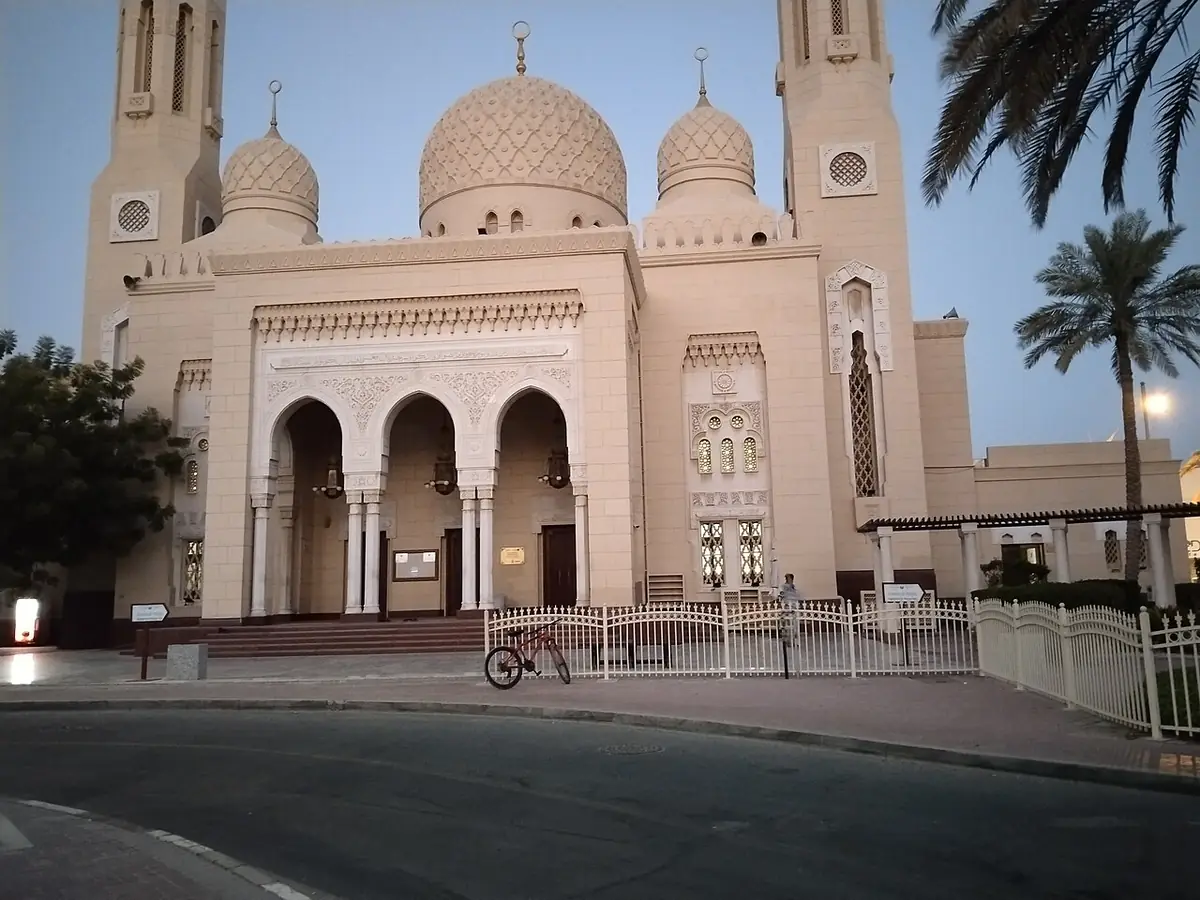
Jumeirah Mosque, a well-known landmark in Dubai — Photo: ZI Jony · CC BY-SA 4.0 · Wikimedia Commons
Once those reference points are reset, the crucial question of exactly where to buy comes sharply into focus across the mosaic of districts.
Settling in Dubai after living elsewhere is a deep shift, both in how the city is built and in how everyday administration works. Far from historic centres built around old stone and pedestrian streets, the Emirati city grew on a modern model, designed around the car and organised around geographically distinct hubs of activity. Familiar assumptions fall away quickly, whether about utilities, dealings with landlords, or the flexibility of work and tenancy contracts. Anticipating these cultural and logistical differences is the key to a transition that goes well and leaves no bitter taste.
From abroad
A heavily regulated rental market that strongly protects the tenant and imposes rigid long-term leases
Dubai
A liberal contractual system where payment terms (often by staggered cheques) and rent increases are framed by specific local regulation (RERA)
You need cash you can mobilise immediately to meet payments due in advance, and you should check the official indices before any rent review by the landlord.
From abroad
Dense historic city centres built around local shops you can reach on foot at every corner
Dubai
Vertical, zoned urban planning where you get around almost exclusively by air-conditioned car or on a modern metro network whose stations sit far apart
Organising your shopping, your work appointments and your children's activities calls for constant logistical planning if you want to avoid losing time on congested roads.
From abroad
A centralised state welfare system and traditional paperwork handled at physical public offices
Dubai
Almost complete digitisation of administrative dealings through unified government apps, and health cover tied to private insurance
The speed at which things get done is a pleasant surprise, but it does require you to keep your health insurance contracts up to date so there is no gap if you are suddenly hospitalised.
From abroad
A temperate climate with four distinct seasons that shape how you dress, how you live and what you do outdoors
Dubai
Near-permanent sunshine plus an extremely hot summer season when life retreats into sealed, air-conditioned space
Your choice of apartment has to take in the quality of the thermal insulation and how well the air conditioning performs, if you want to keep summer energy bills under control.
Which district should you choose to settle in or to buy into for the long run?
Choosing the district is only the first step before facing the financial reality and the price structure on the ground.
Dubai is made up of a multitude of micro-markets whose visual and economic identities are radically opposed. Between the futuristic waterfront towers, the quiet homes lining golf greens and the humming business districts, each zone answers precise criteria of yield and quality of life. Wanting everything in one place is an illusion; you have to trade off being right by the sea, how easily the roads flow, and the overall budget you are prepared to commit. Weighing up what each area asks of you lets you narrow the search precisely.
Dubai Marina and Jumeirah Beach Residence (JBR)
Permanent urban buzz at the water's edge, combining spectacular high-rises, luxury yachts and a lively seaside life.
Suits
Investors after strong seasonal rental demand, and busy professionals who want everything within walking distance in the evening.
Trade-off
Prices per square foot among the highest in the emirate, and extremely difficult car traffic at weekends and in the evening.
Downtown Dubai and Business Bay
The nerve centre and financial heart of the city, dominated by monumental structures, giant malls and busy boulevards.
Suits
Those who need a prestigious address, unquestionable international visibility and to be right by corporate headquarters.
Trade-off
Private outdoor space often reduced to the bare minimum, and service charges that run particularly high.
Dubai Hills Estate and the green communities
A modern, leafy residential haven laid out around landscaped parks and a golf course, away from the crush of the main roads.
Suits
Families with children and long-term residents who put calm, space, security and neighbourhood schools first.
Trade-off
Total dependence on a personal vehicle for the slightest work journey into the city's nerve centres.
What does a property here really cost, by area and by specification?
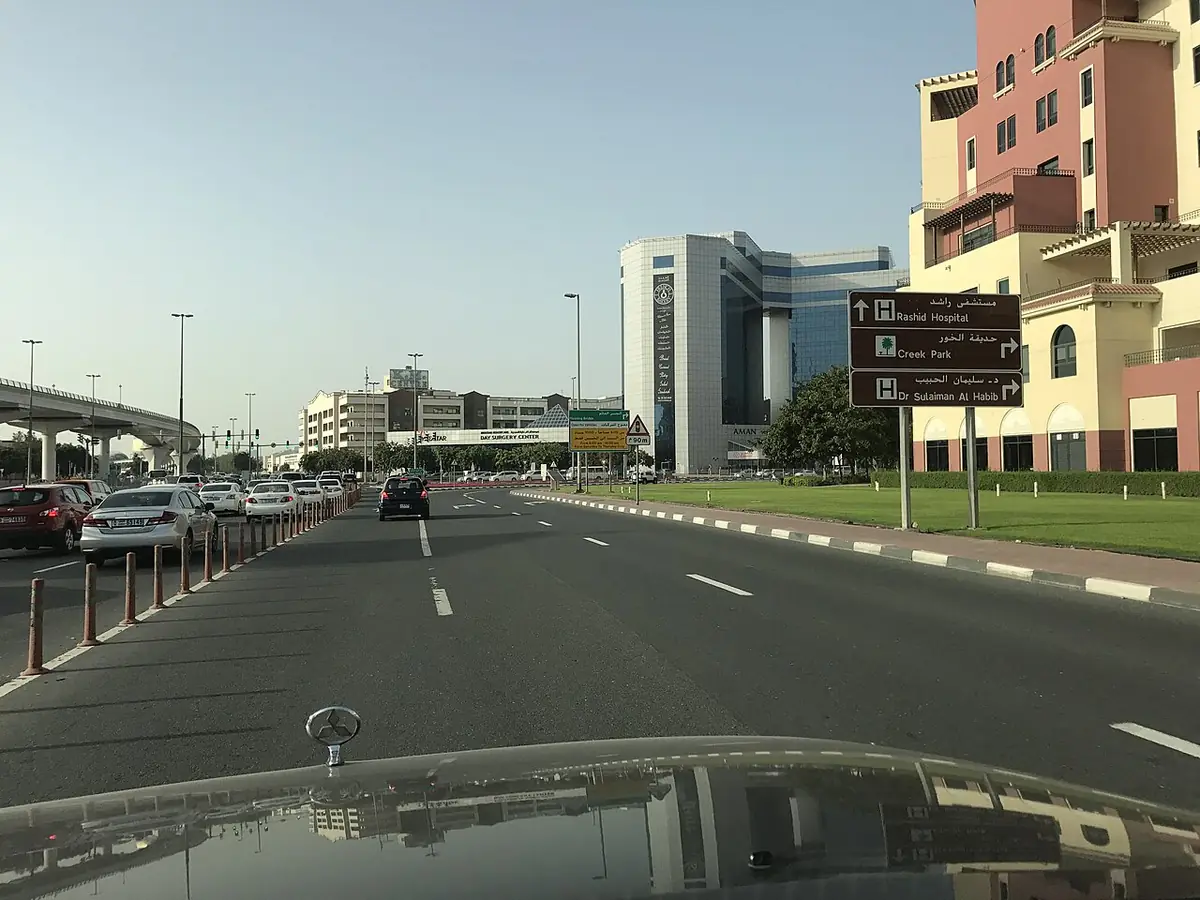
A typical Dubai street, wide and lined with modern buildings — Photo: Darvin.wilson · CC BY-SA 4.0 · Wikimedia Commons
Knowing the price brackets is not enough if you have not grasped the exact legal nature of what you are buying and owning.
Approaching the budget question in Dubai means dropping the simplistic idea of a single price per square metre. The local property market segments according to the developer's standing, direct proximity to transport infrastructure and the intrinsic quality of the interior finish. Price brackets vary fourfold between a standard studio out of the centre and a high-specification penthouse on the waterfront. On top of that, the buyer must absolutely factor in the compulsory extra costs at acquisition, such as land registration fees and agency fees, in order to gauge the real financial effort.
dubaiFor saleApartmentestimate
Median price / m²AED 14,250Half the apartments sell below this
Median priceAED 1.57mthe average is 14% higher — a few very large properties pull it up
Most common2 bedrooms37 % of listings
Average size105 m²
By number of bedrooms
Bedrooms
Share of market
Avg price
Price / m²
Avg size
1
36 %
AED 1.14m
AED 16,350 +9 %
70 m²
2most common
37 %
AED 1.56m
AED 14,850
105 m²
3
20 %
AED 1.97m
AED 14,100best value / m²
140 m²
4
7 %
AED 2.99m
AED 15,750 +5 %
190 m²
Each row is an average, compared against the area average of AED 15,000 / m². These are indicative estimates of a typical local market, not a measured sample of live listings. Check current listings before relying on them.
What you can actually hold: the essential distinction between ownership regimes
That legal clarity has to be matched by a full understanding of the procedural steps required before you part with a single deposit.
Property ownership in Dubai follows specific legal rules that a foreign buyer must absolutely take in before signing any binding document. Once reserved for nationals, the market opened to international buyers through defined geographic zones offering distinct guarantees of tenure. Confusing freehold ownership with a long lease can compromise the future resale of your asset or limit your succession rights. A rigorous reading of the title deed issued by the Dubai Land Department is the only defence against unpleasant legal surprises.
The freehold regime (full and outright ownership)
This status allows any buyer, whatever their nationality, to acquire outright ownership of the property and the land it stands on, with no time limit. The buyer's name is registered directly with the official land authorities, giving them the full right to let, sell or pass the asset to their heirs under the laws in force.
What it changesIt is the ideal formula for securing a long-term holding, guaranteeing complete freedom of management and excellent liquidity on the secondary market among international buyers.
The leasehold regime (long-term lease)
Under this legal framework, you buy the right to occupy and use the property for a period set by contract, generally between 30 and 99 years, from the original owner of the land. Although it can be passed on and assigned throughout the term of the lease, that right lapses automatically at the agreed expiry date if no renewal has been negotiated beforehand.
What it changesThis option calls for close attention to the start date of the original lease and to any review clauses, because resale value tends to erode as the expiry date approaches.
The absolute rule to understand before you pay a first deposit on a property
Following that chain of safeguards methodically leads on to a precise transaction timetable that has to be steered with method.
Dubai's property ecosystem moves at a speed that is disconcerting for a buyer used to the slow conveyancing of older markets. A reservation can sometimes be settled in a matter of hours, which carries obvious risks if you do not follow a rigorous audit method. Whether you are buying off-plan from a developer or on the secondary market, bringing in independent trusted third parties is essential to protect your funds. Skipping these preliminary steps exposes the buyer to uncompensated delivery delays or to complex disputes if the builder fails.
Finding the right property and putting an initial offer in writing through a preliminary agreement (the MOU)
Check that the developer or agency is officially registered with the competent regulator (RERA) and insist on being shown the escrow account number dedicated to the project.
Have the draft contract (Form F for the secondary market, or the SPA for a new build) reviewed by an independent legal adviser who specialises in local law.
Make sure funds are paid exclusively into the approved official escrow account, and never into the agent's personal or direct account.
Obtain the no objection certificate (NOC) issued by the developer or the owners association, confirming that the property carries no debts or unpaid charges whatsoever.
The final signing of the transfer before the sworn officer at the Dubai Land Department, and the issue of the new title deed.
How a property transaction actually unfolds, step by step
Anticipating each milestone lets you go through the buying process calmly and time your international transfers properly. From the first viewing to the handover of keys, the role of each party (agent, developer, lawyer, authority) is strictly defined by the emirate's regulations. Contrary to what is often assumed, the transparency of the local digital platforms makes tracking a file much easier, provided you work with accredited professionals. Here is the chronological road map you need to bring your purchase through in the safest conditions.
The buyerSetting the budget and the search criteriaYou set your overall financial envelope, administrative costs included, then identify the areas compatible with your goals for living or for yield.
The estate agentTargeted viewings and negotiating termsYour agent arranges viewings of the shortlisted properties and negotiates the financial terms and payment arrangements directly with the seller or their legal representative.
Both partiesSigning the memorandum of understanding (MOU / Form F)This written commitment formalises the sale, fixes the deadline for transfer and comes with a deposit held in escrow (generally ten percent of the total amount).
The developer or the building managerObtaining the no objection certificate (NOC)The seller must supply this official document confirming that the property is entirely clear of any financial liability or unpaid service charges.
The land authority (DLD)Official transfer of ownership and registrationThe final appointment takes place at the registration office or through the dedicated app, to make full payment, settle the transfer fees and issue the new title deed.
Apartment or villa in Dubai: which to buy, depending on your profile?
Choosing between a city apartment and a villa further out is the first structuring decision for any buyer or resident settling in Dubai. On one side, an apartment in a residential tower offers immediate centrality, high-end shared facilities and rental liquidity that has historically been superior. Dense districts such as Downtown, Dubai Marina or Business Bay capture constant demand from young professionals, single expatriates and visitors looking for short stays. That configuration secures a high occupancy rate, though it comes with sharper competition between owners and with service charges that can be substantial enough to erode the net return.
A villa or town house in an outlying community such as Arabian Ranches, Damac Hills or Dubai Hills Estate answers a fundamentally different aspiration, centred on space, family life and holding value over time. These properties suit long-term residents who will accept a longer daily commute in exchange for markedly more living space, a private garden and a quiet setting. The villa market shows remarkable resilience through economic cycles, driven by a chronic shortage of land in areas already built up and by growing appetite among wealthy families for these secure enclaves.
On the purely financial side, values do not move along the same curves. Apartments often show a more attractive initial gross yield on paper, generally swinging between six and eight percent, but their long-term capital growth is tempered by the steady delivery of new schemes into the Dubai skyline. Villas deliver a slightly lower gross yield at the outset, often between five and seven percent, but they capitalise on much stronger capital appreciation because the existing gated communities cannot be extended indefinitely. The final choice therefore depends on your time horizon: a decision oriented towards immediate cash flow favours the apartment, while a long-term wealth strategy points to the house.
You also have to factor in the complexity of day-to-day management and the impact of indirect taxation. Owning an apartment means delegating the upkeep of the common areas to an owners association manager whose rigour can vary considerably from one tower to the next, which feeds directly into the resale value. With a villa, responsibility for structural upkeep, central air conditioning and the outdoor space falls entirely on the owner, and that is a meaningful annual budget to anticipate from the moment you buy if you want to avoid a nasty cash-flow surprise.
What budget do you really need to live in and maintain an apartment in Dubai?
Once the initial budget and the running costs are clear, it is worth looking at how a typical day actually unfolds in the emirate's urban setting.
Buying an apartment in Dubai is not just the price on the developer's or the agency's brochure. You have to take in every compulsory extra cost, from the initial registration fees through to the recurring costs of maintenance and service charges. Getting these charges wrong can turn an apparently profitable purchase into an unforeseen money pit for an unprepared owner.
Initial acquisition costs for an apartment in Dubai
Cost item
Indicative rate or amount
Impact on the overall budget
DLD registration fee
4 percent of the purchase price
Payable to the Dubai Land Department, often split between buyer and seller but traditionally borne in full by the buyer.
Estate agency fee
2 percent of the purchase price
Standard commission paid to the intermediary agent on signature of the sale contract (the memorandum of understanding).
NOC and transfer fees
AED 500 to AED 5,000
Administrative fees charged by the developer to issue the no objection certificate required for the transfer of ownership.
These acquisition costs sit straight on top of the net price to the seller and must be funded from your own money if you are buying outright, or set aside on top of your deposit if you are borrowing.
Recurring annual costs for an apartment
Type of cost
Typical order of magnitude
What it covers
Service charges
AED 15 to AED 30 per square foot per year
For the upkeep of the common areas, the lifts, security and the pools of the building run by the owners association.
Utility bills (DEWA)
AED 500 to AED 1,500 per month
Covers water and electricity consumption plus the municipal fee calculated as a percentage of the property's estimated rental value.
Comprehensive home insurance
AED 1,000 to AED 3,000 per year
Covers water damage, fire and the liability of the owner, whether living there or letting it out, depending on the cover taken.
Service charges vary considerably with the standing of the tower and the presence of sophisticated facilities such as a spa, a round-the-clock concierge desk or an olympic pool on the roof.
Health, schooling and transport: what does an ordinary Tuesday look like for a resident in Dubai?
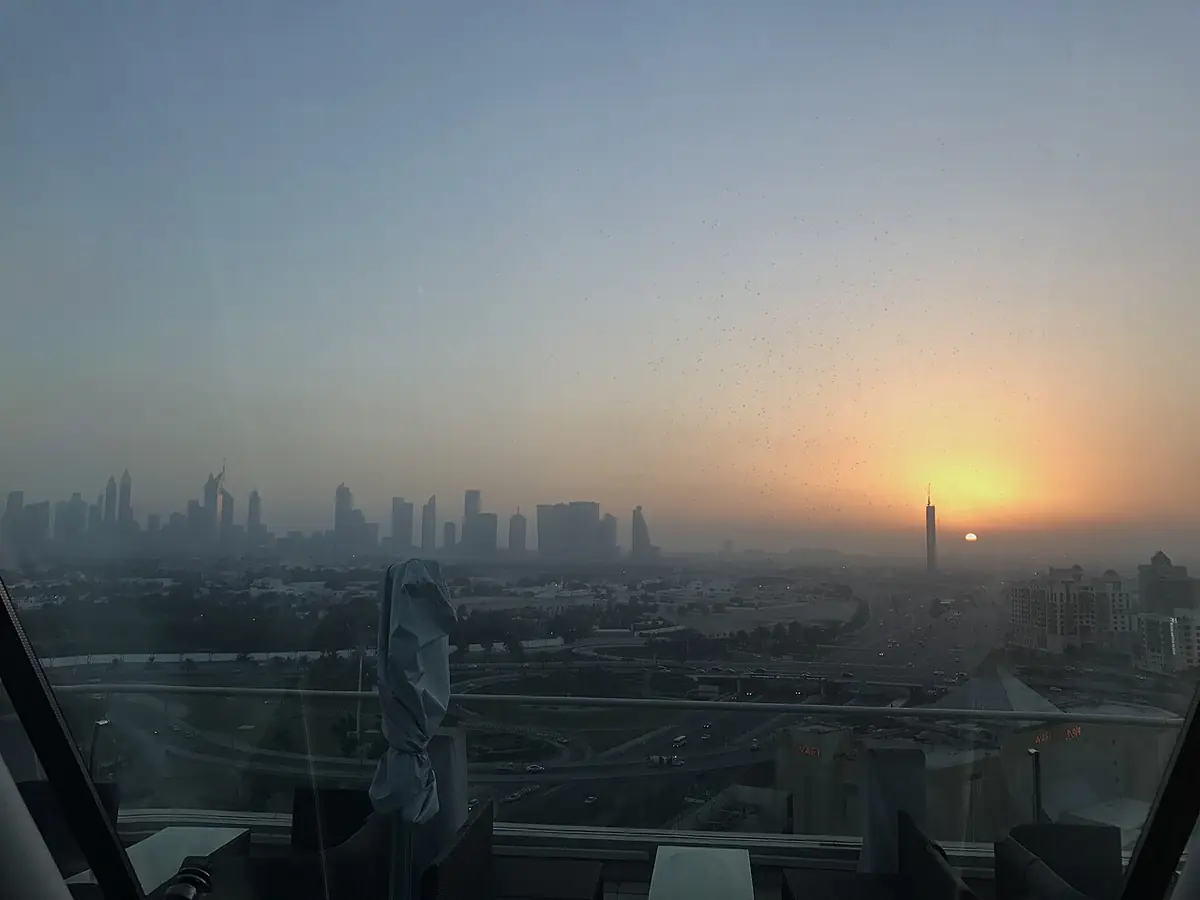
Dubai's skyline at sunset, a fitting close to the day — Photo: Lxs · CC BY 4.0 · Wikimedia Commons
Logistics dictate quality of life in Dubai, a sprawling city where distances can quickly become a daily source of stress if your apartment is in the wrong place. Anticipating traffic flows, how close the schools are and how you reach healthcare is essential before you sign a final contract of sale.
07:30 - Early startLeaving the building's underground car parkDirect access to the main roads such as Sheikh Zayed Road or Al Khail Road decides whether your morning begins with welcome free-flowing traffic or with major congestion.
08:15 - School drop-offInternational school in the districtMost families favour homes within fifteen minutes of the international campuses offering British or American programmes or the International Baccalaureate.
09:30 - Arriving at the officeThe DIFC business district or DowntownModern office towers all have extensive parking and are often connected to the elevated metro stations, which makes travel between districts easier.
13:00 - Midday breakA mall or a pedestrian plazaLunch breaks generally happen in integrated areas where air conditioning gives an escape from the high outdoor temperatures that prevail much of the year.
17:30 - Home and shoppingThe community hypermarketSupermarkets built into the base of the buildings or in community centres allow a quick restock at the end of the day with no long journey.
20:00 - Winding downThe building's pool or gymResidents make use of the shared sports facilities included in their service charges to keep up regular exercise in a secure, air-conditioned setting.
What the developers' brochures leave out
These contractual grey areas lead straight to the disappointments buyers most often meet six months after the keys are handed over.
Dubai's property market is marked by aggressive marketing and spectacular 3D renders that sometimes mask the operational reality of the sites and the contracts. Behind the promise of exceptional returns sit legal and technical subtleties you must analyse soberly if you want to protect what you have put in.
The real measured area, including balconies
Developers often include the balconies, the external walls and a share of the common areas in the total floor area sold, which considerably reduces the apartment's effective living space compared with the advertised figure.
The track record and solvency of the owners association
Poor handling of service charges by the developer or the managing body can lead to chronic delays in maintaining the lifts, the central air conditioning and the pool, which quickly degrades the property's market value.
Future construction sites and changes to the master plan
Buying with an unobstructed view of the sea or of the Burj Khalifa is no guarantee that the view will survive the coming years, since new towers appear frequently on adjacent vacant plots.
Delivery delays on off-plan schemes
Although the regulatory framework set by RERA and the DLD protects buyers better through escrow accounts, delivery delays of six to eighteen months remain common on sites under construction.
The disappointments owners discover six months after moving in
Looked likeAn exceptional panoramic view over the main road and the lit-up centre
Turned outPermanent and unbearable noise from road traffic, even on the upper floors, making the balcony unusable without reinforced soundproofing.
Would have caught itInsisting on viewing the property with the windows closed and then open at different peak times, and checking the thickness of the double glazing installed in the tower.
Looked likeA gross rental yield advertised at more than eight percent by the sales agent
Turned outA net return cut in half once the agency's management fees, the high service charges and the void periods between tenants were deducted.
Would have caught itAlways calculating the net yield by subtracting every recurring charge and applying a prudent vacancy rate of five percent a year.
Looked likeModern, high-performance central air conditioning included in the charges
Turned outRepeated failures of the building's chiller system at the height of summer, bringing exceptional repair bills demanded by the owners association.
Would have caught itReading the minutes of the last general meeting of owners to identify any ongoing disputes about technical maintenance.
Looked likeA booming district with amenities within walking distance at the foot of the building
Turned outA permanent building site, dusty and noisy, with the neighbouring plots set to stay under active construction for several years.
Would have caught itConsulting the official master plan with the municipality to learn the exact status and the building permits issued within a five hundred metre radius.
Buyer profiles: who should absolutely not buy an apartment in Dubai?
With those warnings set out, it is time to pull together the key points and work out whether your plan to buy in Dubai is ready.
Buying property in Dubai exerts a powerful fascination, but it is in no way a universal solution suited to every financial or personal situation. Some buyers expose themselves to major risks of illiquidity or loss by committing to Dubai bricks and mortar too quickly.
The expatriate on a short posting of under three years
→To skip buying and go for a flexible furnished rental instead
Acquisition costs of around seven percent of the total price (DLD fee plus agency fee) cannot be recovered over so short a period, and you risk losing money on a quick resale.
The buyer whose savings are strictly limited, with no safety cushion
→To wait until they have built a solid cash reserve before buying
Without enough of their own money to absorb unpaid rent, urgent repairs or a temporary dip in the rental market, the borrower is exposed to default and to a difficult repossession.
The speculator chasing an immediate short-term gain with no market analysis
→To hold back from any impulsive off-plan purchase without a clear exit strategy
Reselling a property still under construction before final handover has become far more selective, and a loss awaits anyone who buys at the top of a speculative peak without perspective.
So are you really ready to take the step and buy in Dubai?
At the end of this analysis, the decision to buy an apartment in Dubai comes down to the fit between your time horizon, your tolerance for regulatory risk and the strength of your financing plan. The emirate offers an extremely attractive tax setting, first-rate infrastructure and undeniable demographic momentum that supports demand over the long run. Even so, the mirage of easy and immediate returns has to be swept aside by a sober approach, alert to the real costs of acquisition, to the reality of service charges and to the cyclical swings of the rental market.
If your plan sits in a medium or long-term perspective, if you have secured enough capital to cover all the extra costs without straining your personal cash position, and if you have chosen your location on real criteria of daily life rather than on the strength of a brochure, then the purchase makes full sense. Dubai rewards methodical buyers who know how to audit a scheme, negotiate prices close to the reality of the secondary market and surround themselves with honest, independent professionals.
Take the time to view several properties at different times of day, insist on transparency about the history of the service charges, and never give in to the false urgency some sales staff manufacture. The Dubai property market will keep evolving, and the lasting opportunities belong to those who approach the purchase with the same analytical rigour as any other major international investment. Your decision should be the fruit of a considered conviction, free of media noise and anchored in your own goals for how you want to live.
Related questions
What are the exact costs to budget for when buying an apartment in Dubai?
The compulsory costs are mainly the four percent registration fee due to the Dubai Land Department, roughly two percent in agency commission, and assorted administrative transfer and no objection certificate (NOC) fees charged by the developer.
Can a non-resident foreigner buy property outright in Dubai?
Yes. Foreign nationals and non-residents can acquire absolute freehold ownership in the zones designated by the emirate's government, with no restriction based on nationality or residence status.
How do service charges work on an apartment?
Service charges are calculated each year according to the total square footage of your apartment. They fund maintenance of the common areas, round-the-clock security, cleaning, and the running of the tower's shared facilities.
Is it better to buy off-plan or on the secondary market?
Buying off-plan generally offers staged payment terms during construction and scope for a gain by the time of handover, while buying on the secondary market lets you draw rental income immediately and see the actual property with no surprises.
What net rental yield can you realistically expect in Dubai?
Gross rental yields generally sit between six and eight percent depending on the district, but once service charges, management fees and vacancy are deducted, the real net yield most often ranges between four and six percent.
Do Dubai banks lend to non-residents?
Yes. Several local and international banks offer mortgage finance to non-residents, generally capped at fifty to seventy percent of the property value, which means a substantial down payment is required.
What taxes apply to rental income and to capital gains on property?
Dubai currently applies no tax on individuals' rental income and none on the gain realised when a property is resold, which is one of the emirate's main fiscal attractions for investors.
How long does the full process of becoming an owner in Dubai take?
For a secondary-market transaction between private parties, the whole process generally runs two to four weeks, from signing the preliminary contract through to the final transfer of the title deed at the DLD.
Does buying an apartment automatically grant a residence visa?
Buying a property worth at least one million dirhams allows you to apply for a renewable investor residence visa, provided you meet the eligibility criteria set by the emirate's competent authorities.
Which districts are most sought after for buying an apartment to let?
Investors focus first on mature, high-demand districts such as Dubai Marina, Downtown Dubai, Jumeirah Village Circle (JVC) and Business Bay, which offer strong liquidity and a constant pool of working tenants.