Buying a home in the Southern California city of San Diego means reconciling a fast-moving market with a set of local rules that shape every offer. This guide sets out the criteria that structure your choice, helps you identify the right area, and shows you how to secure the purchase without a false step.
Get the app
What nobody tells you.
Real prices, hidden costs and the traps to check before you commit.
What you are really buying when you buy a house in San Diego
Scroll
What you are really buying when you buy a house in San Diego
Buying a home in the Southern California city of San Diego means reconciling a fast-moving market with a set of local rules that shape every offer. This guide sets out the criteria that structure your choice, helps you identify the right area, and shows you how to secure the purchase without a false step.
Written by the ting.ad editorial team ·
San Diego in Street View: drag to look around.
Before you start hunting for a property, it pays to test your buyer profile against the daily realities of the area.
Buying a home in this coastal California city is not simply a matter of square meters or the promise of mild weather all year round. Between planning rules, the pull of individual neighborhoods and the particular structure of the local market, every buyer has to trade living space against immediate proximity to the job centers or the beaches. It is the balance between those invisible constraints and the promise of a rare way of life that sets the real long-term value of your purchase. Understanding how they work keeps you from financial disappointment in your very first year.
Living space and the number of bedroomsvsDistance from the main highways and the coastal strip
The more space and private yard you want, the further inland from the ocean you have to move, and the longer your daily commute into central San Diego becomes.
The residential calm of planned subdivisionsvsThe constraints imposed by homeowners associations
Suburban tracts offer absolute quiet and well-kept infrastructure, but they come with strict HOA rules and CC&Rs that limit what you may change about your own property.
The architectural character of older housesvsThe cost of bringing energy and seismic standards up to date
Taking on a period property built in the middle of the twentieth century often means major spending on insulation, plumbing and structural safety.
The momentum of gentrifying neighborhoodsvsGreater exposure to short-term price volatility
Buying in a fast-changing area promises stronger potential appreciation, but it carries the risk of local instability and prolonged construction noise.
Does this place really suit the way you live?
The cultural and regulatory gap between your home country and California resets every reference point you had about property.
The Californian lifestyle as it appears on screen differs noticeably from the routine of a resident homeowner. Between commuting, keeping up outdoor space and dealing with local services, settling in demands a clear-eyed look at your own habits. Each type of buyer runs into specific challenges that are worth anticipating, so that moving in does not become a permanent source of frustration.
Remote work and the search for calm
Working from home in San Diego calls for reliable high-speed internet and a dedicated room insulated from outside noise. Quiet residential neighborhoods allow real concentration, but they force you into a car for the smallest errand or bit of social contact. The relative isolation of some areas can weigh on anyone used to the constant activity of a dense city center. So you are choosing between silence at your desk and easy access to cultural amenities, and that choice should shape which house you buy.
Family logistics and the choice of school district
For families, buying a house is organized almost entirely around the quality of the public schools and the safety of the surrounding streets. Neighborhoods served by the best schools carry clearly higher valuations and fierce competition between buyers. Daily runs to drop children at after-school activities pile on top of rush-hour traffic. Careful planning of those journeys is essential to keep family life in balance, and it belongs in your search criteria before you make an offer.
Working life and the commuting constraint
If your days are spent in one of San Diego's major business districts, the location of the house you buy becomes the critical factor in your quality of life. The main freeways are chronically saturated at peak hours, turning journeys into a daily ordeal. Buying closer to the highway corridors or to public transport lines cuts the time lost in traffic. That proximity is paid for, though, in greater urban density and a noticeably higher price per square meter.
Buying here when you are arriving from abroad: what changes completely
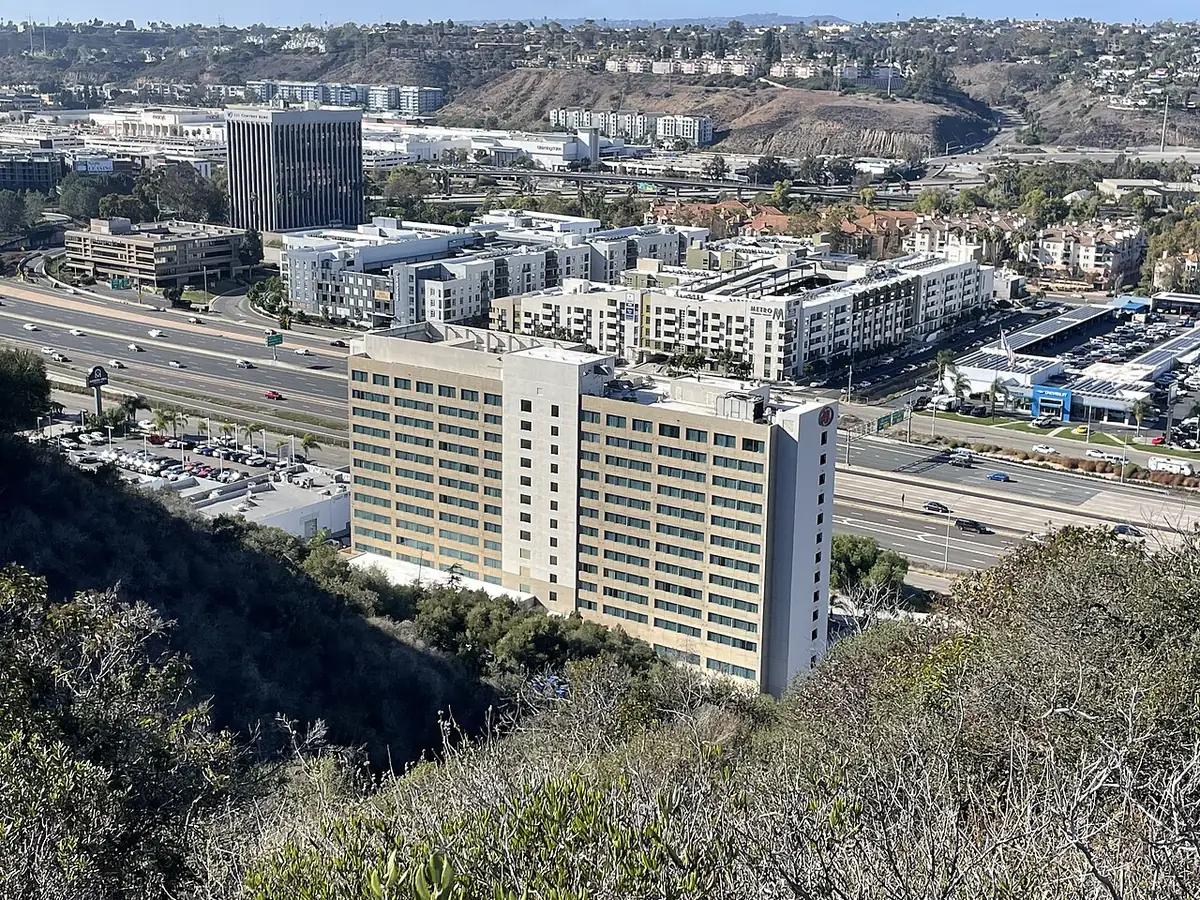
Mission Valley's mid-rise buildings, framed by hills and highway — Photo: Blervis · CC0 · Wikimedia Commons
Once you have absorbed those differences, the next step is identifying the area that matches what you are after.
Moving a life plan from abroad to San Diego confronts a buyer with administrative, contractual and planning practices that are entirely unfamiliar. Legal guarantees, the structure of hidden costs and the very idea of property ownership rest on common-law foundations you need to master to avoid expensive mistakes. The absence of certain safeguards you may be used to is offset by different but equally rigid protections.
From abroad
A buyer-protection system built around a single public officer overseeing the deed
San Diego
Escrow and title companies acting as the specialist intermediaries
In the United States the transaction rests on an independent title company and an escrow holder rather than one public official, which calls for much closer attention to the contract clauses.
From abroad
Centralized administration and tightly regulated planning
San Diego
The local power of homeowners associations and zoning rules
Changing the exterior of your house or extending it is subject to approval by strict local committees that keep a permanent right of review over what you do.
From abroad
Moderate service charges on shared buildings
San Diego
High property taxes and HOA dues that can be substantial
The recurring cost of holding a property in California includes local taxes pegged to the purchase value plus association dues, and both have to go into your annual budget from the start.
From abroad
Traditional construction in stone or reinforced concrete
San Diego
Timber framing almost everywhere and seismic requirements
Local building methods favor wood and drywall, which changes sound insulation, thermal performance and the regular upkeep of facades and foundations.
Which San Diego neighborhood should you target?
Studying the neighborhoods has to be followed by a clear-eyed look at the financial reality of the market.
San Diego's patchwork of neighborhoods offers radically different atmospheres, from coastal bustle to the absolute quiet of the inland valleys. Each area has its own identity, its own traffic constraints and its own market dynamic. Weighing the advantages and compromises of each is essential if you are not to regret your choice six months after moving in.
La Jolla and the north coast
A prestigious maritime atmosphere set by ocean views and the constant flow of visitors.
Suits
Buyers after an exceptional setting, immediate proximity to the sea and high-end finishes.
Trade-off
An extremely high purchase price and heavy traffic on summer weekends.
North Park and the central neighborhoods
A creative urban energy driven by independent coffee shops, craft breweries and cultural life.
Suits
Energetic buyers who value a social mix, walkable streets and quick access to the business district.
Trade-off
High building density, parking that can be awkward and small lot sizes.
Carmel Valley and the northern suburbs
Modern, orderly residential districts with strong schools and well-kept green space.
Suits
Families with children who want safety, quiet and recent houses with generous proportions.
Trade-off
A more uniform, standardized setting, well away from the historic life of the city.
Kensington and the historic districts
Preserved architectural charm, streets lined with mature trees and a village feel inside the city.
Suits
Buyers who love period character, authenticity and close-knit, participatory local communities.
Trade-off
A scarce housing stock, firm prices and renovation costs that are often needed on the systems.
What does buying and holding a property here really cost?
A landmark corner in San Diego's historic Gaslamp Quarter — Photo: Roman Eugeniusz · CC BY-SA 3.0 · Wikimedia Commons
Beyond the purely financial side, the legal nature of your ownership rights deserves particular attention.
The price shown on the listing portals is only a fraction of the real cost of owning a house in San Diego. Between the specific local taxes, the mandatory insurance against natural hazards and the maintenance of the building's systems, the finances need to be modeled carefully over several years. Anticipating those recurring charges keeps your budget from being knocked off balance after closing.
san-diegoFor saleHouseestimate
Median price / m²US$5,297Half the apartments sell below this
Median priceUS$898kthe average is 14% higher — a few very large properties pull it up
Most common2 bedrooms68 % of listings
Average size161 m²
By number of bedrooms
Bedrooms
Share of market
Avg price
Price / m²
Avg size
2most common
68 %
US$927k
US$5,576
166 m²
3
27 %
US$1.15m
US$5,241 −6 %
219 m²
4
5 %
US$1.41m
US$5,018best value / m²
280 m²
Each row is an average, compared against the area average of US$5,576 / m². These are indicative estimates of a typical local market, not a measured sample of live listings. Check current listings before relying on them.
What you can actually own: understanding property rights
Once you have settled on the type of property, the purchase itself follows a strict sequence that should never be rushed.
Under California law, the distinction between forms of ownership has direct consequences for how freely you can manage your home and for your legal responsibilities. Between outright ownership of the land and shared-community arrangements, the compromises are not only financial: they reach into the exercise of your rights as an owner. Knowing exactly what belongs to you and what falls to the community heads off disputes with the neighbors.
You own the building and the lot it stands on, with no shared walls. This gives you maximum freedom over the exterior and over architectural changes, subject to the City of San Diego planning rules and to any recorded subdivision covenants. In return you carry the whole financial burden of maintaining the roof, the foundations and the utility connections.
What it changesYou set the pace of works and upkeep, but you alone absorb the budget risk when major structural work comes up.
Ownership in a managed community (planned unit development)
You own your house and the land immediately around it, but you share ownership and use of common infrastructure with everyone else in the development. That arrangement is run by a homeowners association with wide-ranging regulatory powers. The dues collected pay for maintaining the landscaping, the private roads and sometimes leisure facilities such as pools or tennis courts.
What it changesYou get good shared services, but you have to submit to strict rules on appearance and behavior.
The fundamental rule to grasp before you put money down
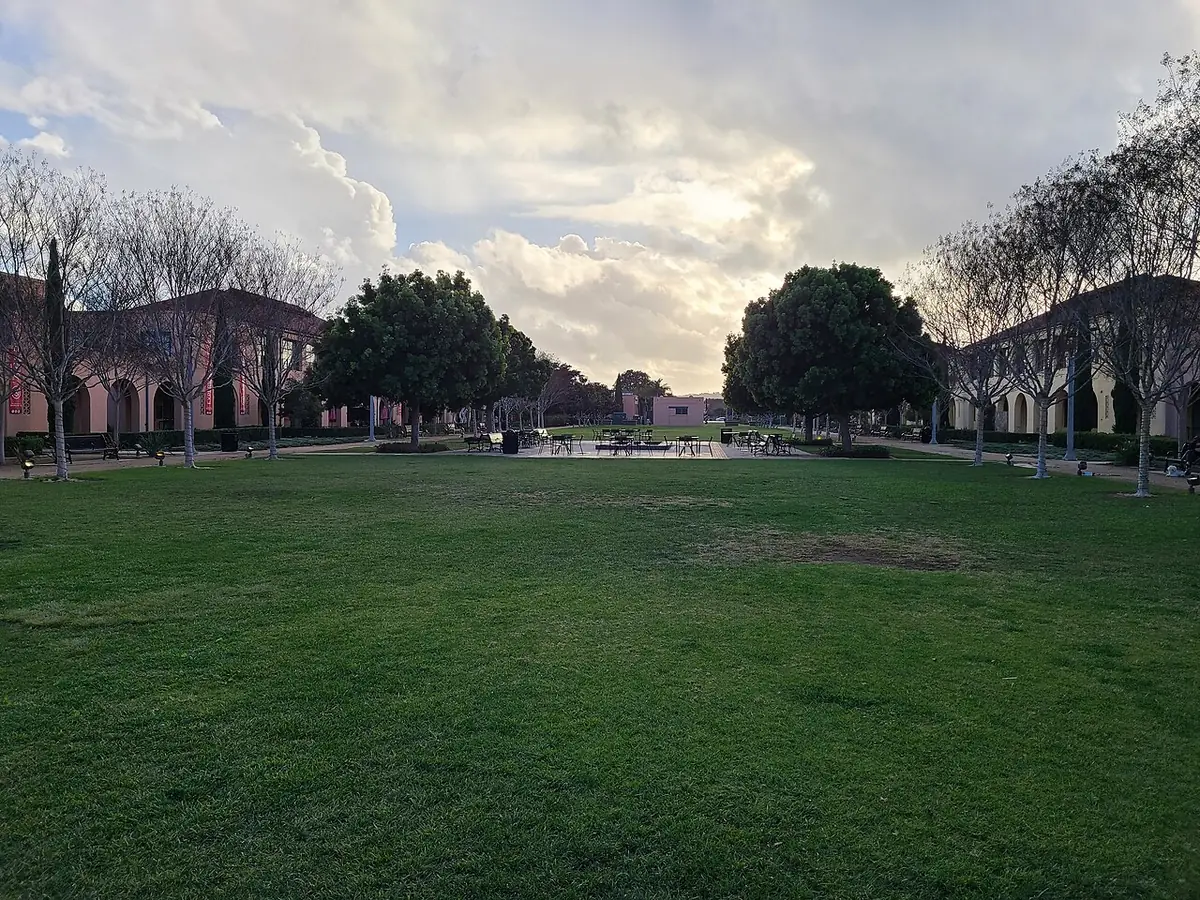
A grand green promenade at Liberty Station — Photo: Alan Islas · CC BY-SA 4.0 · Wikimedia Commons
To approach that complex sequence calmly, here is how the process actually unfolds from the buyer's side.
The California transaction system rests on inspection and cancellation windows tightly framed by standard contracts. Putting down a first deposit without having measured the reach of the contingencies exposes a buyer to losing that money outright if they withdraw too late. Every stage of the technical review should be handled by independent certified professionals.
Signing the initial purchase agreement
The earnest money deposit, usually set at around 3% of the sale price, places the funds in a secure third-party escrow account.
The opening of the physical inspection period (due diligence), during which specialists examine the structure, the plumbing and the foundations.
Review of the HOA disclosures for the association or the development, revealing its financial health and any litigation under way.
The lender's formal appraisal, confirming the market value of the property against the mortgage amount you have applied for.
Removal of the contingencies and the final transfer of title.
How a purchase unfolds, step by step
Reaching the end of that path lets you settle in for the long run and build a future within this community.
Carrying a purchase through from overseas calls for a disciplined method involving several specialists. From confirming your borrowing capacity with an American lender through to the handover of keys once the title company has done its work, each participant plays a precise role that has to be coordinated without haste.
The buyerGetting financially qualified firstObtain a pre-approval letter from a local lender before you even start viewing properties on the market.
The real estate agentTargeted selection of propertiesTour the shortlisted neighborhoods and study recent comparable sales to calibrate your offer strategy.
The buyer and their agentDrafting and negotiating the offerSubmit the purchase agreement with the essential protective contingencies covering inspections and financing.
The home inspectorA full audit of the propertyCommission a thorough inspection to identify hidden defects, roof problems or seismic vulnerabilities.
The title companyLegal verification of titleConfirm the property is sold free of any debt, undisclosed lien or disputed easement.
The escrow companyClosing the transactionSign the official documents, transfer the remaining funds and record the deed with the county.
House or condo in San Diego: which suits your daily life?
Once that first choice between house and condo is made, the wider financial reality of settling in this sought-after region deserves a look.
Buying property in San Diego means deciding early between a detached house and an urban condominium. That choice shapes not only your purchase budget but the texture of your daily life. Coastal neighborhoods such as La Jolla or Pacific Beach lean heavily toward condos and small attached buildings, while inland areas such as Clairemont, Mission Valley or the eastern hills offer broad tracts of single-family housing with private yards. A detached house guarantees complete autonomy and greater architectural freedom, but it puts the whole burden of structural maintenance on the owner. A condo, by contrast, spreads the pool, the security and the roof across the community, while imposing monthly association dues that rise predictably over the years.
San Diego's exceptional climate naturally pushes many buyers outdoors, which makes a private yard or a large patio almost irresistible. Yet maintaining outdoor space in Southern California takes constant attention, particularly given chronic drought and the watering restrictions the city imposes. A house with a garden means either a significant personal investment of time or hiring professionals whose local rates are high. A condo in a well-run complex, by comparison, gives immediate access to good facilities without the chore of mowing or repairing outdoor pipework. It is a direct trade between free time and outright independence over your own asset.
In purely financial terms, a detached house generally behaves as the better long-term store of value, because buildable land in San Diego County is genuinely scarce. The value of the lot often accounts for most of the purchase price, which protects a buyer more effectively against wider economic swings. Condos, on the other hand, can face tougher resale conditions when the market turns, because similar units within the same building compete with each other. The entry ticket for a condo remains far more accessible, though, letting younger professionals or families early in their housing path establish themselves in lively central neighborhoods without borrowing beyond reason.
Finally, the question of neighbors and local governance should never be brushed aside in this decision. Living in a condo means submitting to the strict rules of the homeowners association, the well-known HOA, which governs everything from the color of your blinds to the hours the pool is open. Some residents welcome that discipline as a guarantee of tidiness and preserved value, while others experience it as an intolerable intrusion into their private life. In a detached house you are your own board, for better and for worse. Your final decision will therefore depend as much on your temperament in the face of collective rules as on your ability to absorb a major repair bill.
What overall budget do you need to live comfortably in San Diego?
Those budget estimates make more sense set against how an ordinary week in the city actually unfolds.
Buying a property in San Diego does not end with the monthly mortgage payment. You have to build in a particularly heavy fixed-cost structure, dominated by local property tax, reinforced homeowner insurance against climate risks and, where applicable, association dues. Leaving those out of your initial calculations almost inevitably leads to cash-flow strain in the first year of ownership. The table below sets out the unavoidable spending lines for a resident owner in the city.
Monthly and annual spending lines for a resident owner
Spending line
Estimated average amount
Frequency
What makes it vary
Property tax
1.1% to 1.2% of the purchase value
Annual
Initial assessment and local ballot measures
Homeowner insurance
$150 to $350
Monthly
Proximity to wildfire risk zones
HOA fees
$300 to $800
Monthly
Community amenities and elevators
Energy and air conditioning (SDG&E)
$200 to $450
Monthly
Floor area and solar exposure of the property
Energy rates from San Diego Gas & Electric are among the highest in the United States, which weighs heavily on the running budget.
What does an owner's ordinary day in San Diego look like?
Hillside homes above the bay, a classic San Diego view — Photo: A Guy Named Nyal · CC BY-SA 2.0 · Wikimedia Commons
Behind that sunny rhythm sit administrative and technical realities the brochures never mention.
Grasping what a San Diego purchase really means calls for picturing the daily rhythm imposed by local geography and transport. Between morning runs on the interstate highways, everyday errands and time in the open air, each day follows a well-drilled choreography. An ordinary Tuesday illustrates the constraints and the quiet pleasures of owning a home in the county.
07:30Leaving the residential neighborhoodAn early start avoids the heavy congestion on Interstate 5 or Highway 805, the arteries linking the residential suburbs to the job centers downtown and in Sorrento Valley.
08:30Arriving at work or at the home officeNewer houses increasingly build in a dedicated remote-work space, essential for reconciling a career with the demands of flexibility.
12:30Lunch break in the neighborhoodNearby parks and small neighborhood shopping centers put a varied and decent choice of food within quick reach.
17:30End-of-day grocery runLocal markets and neighborhood stores let you pick up fresh California produce without crossing the whole metro area at rush hour.
18:45Time outdoors on the propertyThe Mediterranean climate makes the terrace or yard usable every day, turning outdoor space into a genuine extra room.
20:30Checking the household logisticsTracking water and electricity use through connected apps is part of the domestic routine here, and it is how owners keep the bills under control.
What do the listings leave out?
Those technical subtleties lead straight to the misjudgments buyers in a hurry make most often.
The San Diego market has technical and regulatory quirks that can throw an unprepared buyer. Between utility easements, strict water conservation rules and building issues tied to clay soils, several major factors escape the marketing copy. Taking their measure protects a buyer from heavy financial surprises after the sale has closed.
Strict limits on water use
The city imposes firm quotas and bans watering during the hottest hours. Replacing a natural lawn with drought-tolerant landscaping (xeriscaping) costs several thousand dollars up front.
The complexity of access easements and rights of way
Many properties carry portions of land burdened by rights of way for the utility companies or for neighbors, which sharply restricts the scope for an extension or a pool.
The true condition of foundations on sloping ground
San Diego's hilly topography produces seasonal ground movement. A careful inspection of the load-bearing structure by an independent geotechnical engineer is essential before you commit.
Planning rules tied to wildfire
If the property sits close to brush-covered canyons, the law imposes drastic defensible-space clearance obligations and the use of fire-resistant building materials that are extremely expensive.
Infrastructure projects coming to the area
Expansion of public transport lines, or the densification allowed under the city's zoning plan, can transform the quiet of a residential neighborhood within a few years.
Which mistakes leave buyers regretting the purchase six months later?
Given how easy it is to take a wrong turn, it is just as important to know whether buying in San Diego genuinely suits your own profile.
Looked likeA magnificent view over an untouched canyon, promising absolute quiet and total privacy.
Turned outA protected zone exposed to major wildfire risk and to local pests that are hard to keep under control.
Would have caught itAlways consult the official California hazard maps and ask long-standing neighbors about the local wildlife before you make an offer.
Looked likeA perfectly reasonable daily drive, as estimated during weekend viewings.
Turned outDaily traffic misery at peak hours on the freeways linking the residential suburbs to the employment zones.
Would have caught itDrive the actual commute at the exact peak times on a Tuesday or Wednesday before you sign the purchase agreement.
Looked likeA condo with modest dues and superb leisure facilities.
Turned outEmergency structural repairs voted through, bringing enormous special assessments.
Would have caught itInsist on a full review of the association's board meeting minutes for the past three years to spot arrears and deferred work.
Looked likeA charming older house needing nothing more than a fresh coat of paint.
Turned outExtensive aging cast-iron pipework and obsolete electrical panels amounting to a fire hazard.
Would have caught itBring in an independent building specialist who knows California construction from the 1960s and 1970s to price a full renovation.
For which buyers is a San Diego purchase a strategic mistake?
With those safeguards in place, it is time to take a final view of how ready you are for this purchase.
The energy of the California market and the permanent draw of San Diego's climate sometimes push unsuitable buyers into heavy commitments. The financial rigidity of the local market and the upkeep it demands call for real personal and professional stability. Some buyers would clearly do better to postpone, or to rent long-term and keep their freedom to move.
The young professional still moving between international postings
→Insisting on buying in their first year of work in the region.
High transaction costs on both the purchase and the resale in California (agency commissions and transfer taxes in particular) require a holding horizon of at least five years to absorb. A quick relocation almost always ends in a net loss.
The household with just enough for the down payment and no emergency savings
→Committing every last dollar of cash to the down payment and the closing costs.
With no financial cushion, the household is exposed to the smallest setback, whether a major air conditioning failure or an unforeseen rise in association dues, turning the dream into a budget nightmare.
The investor with no patience for rules and paperwork
→Buying with an Airbnb-style seasonal rental in mind without checking the city's zoning rules.
The City of San Diego enforces an extremely strict and punitive short-term rental regime, with quotas by neighborhood and rigorous automated monitoring that can wipe out the returns you were counting on.
The buyer who cannot tolerate any urban noise
→Settling in a dense neighborhood close to the transport corridors or the airport approach paths.
The shape of the metro area, hemmed in between the ocean, the canyons and the military bases, produces regular aircraft and road noise that no standard soundproofing fully removes.
So are you really ready to buy in San Diego?
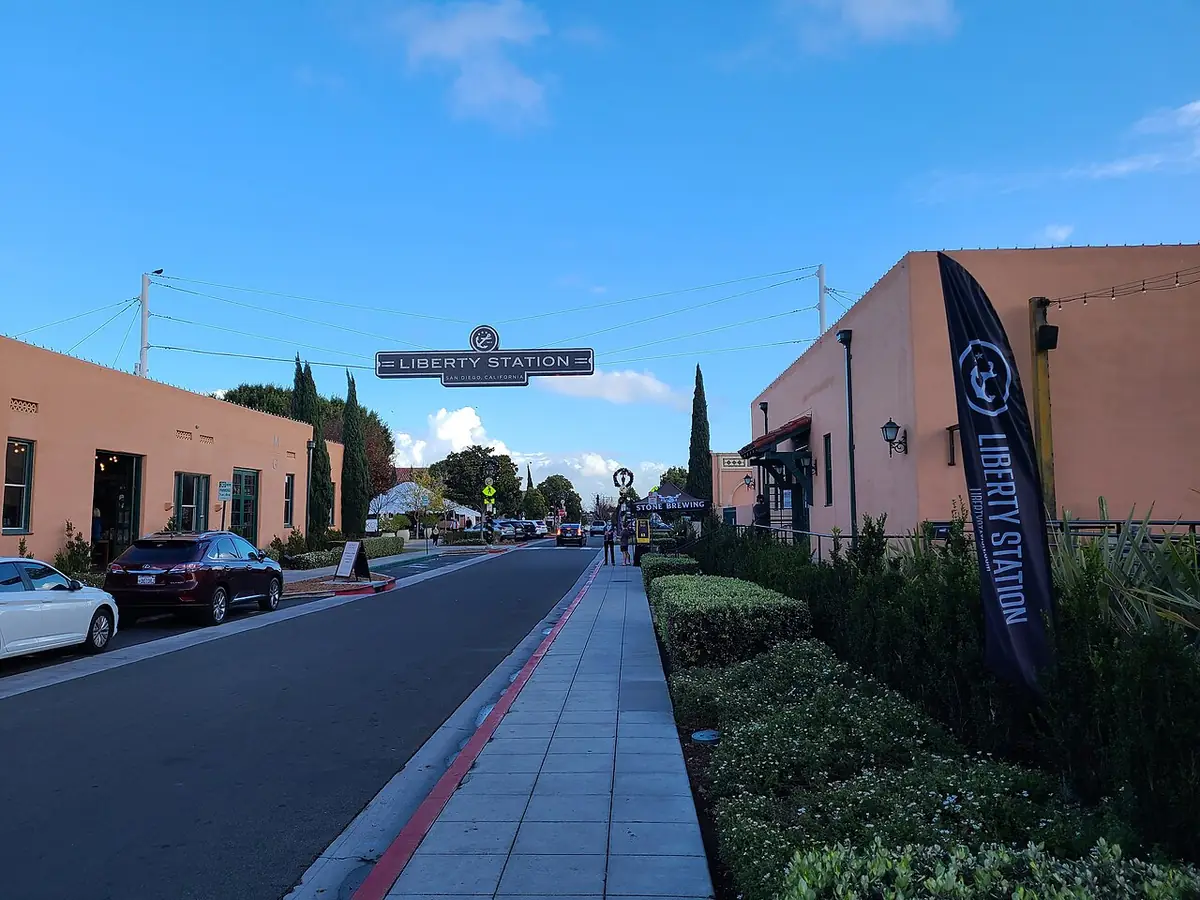
A relaxed shopping street at Liberty Station — Photo: Alan Islas · CC BY-SA 4.0 · Wikimedia Commons
Deciding to buy property in San Diego is not a simple piece of arithmetic or a matter of timing Federal Reserve interest rates perfectly. It is above all a decisive choice about where your life happens, a commitment to putting down roots in one of the most dynamic urban and natural settings on the American west coast. If you have measured the hidden costs, accepted the constraints of the local climate and confirmed that your professional situation will hold for several years, then ownership makes real sense and becomes a solid defense against rising rents in the region.
The San Diego market invariably rewards patience, rigor in the technical assessment of a property and financial clear-headedness. The buyers who do best are those who approach a purchase not as a short-term speculative play but as the methodical building of lasting family assets. By putting quality of location, structural soundness and the fit with your own way of living first, you turn the complexities of the California market into genuine opportunities.
So it is time to move from theory to method. Meet independent local brokers, audit the finances of any association whose property has caught your eye, walk your target neighborhoods at different hours of the day, and refuse the artificial urgency that conventional real estate marketing tries to instill. Your future in San Diego deserves that discipline, because what is at stake in every signature is your daily setting and your long-term financial security.
Related questions
How large a down payment do lenders in San Diego usually expect?
Local lenders generally look for a minimum down payment of between 10% and 20% of the purchase price to offer competitive rates. Federally backed FHA loans still allow a 3.5% down payment, but that comes with mandatory mortgage insurance costs carried for the life of the loan.
How does property tax actually work in California?
Under Proposition 13, approved by California voters, the base property tax is set at roughly 1% of the original acquisition value of the property. That taxable base cannot rise by more than 2% a year, which effectively shields long-standing owners from sudden surges in property prices.
Is a home inspection compulsory before you buy?
The law does not formally require one, but a full physical inspection by a certified professional is a standard and indispensable contingency in any California purchase contract. It uncovers hidden defects, roof problems and the condition of the electrical and plumbing systems.
Which San Diego neighborhoods are most sought after for buying a house?
The most prized areas include La Jolla, Del Mar and Coronado for high-end coastal living, along with lively inland neighborhoods such as North Park, South Park and Mission Hills for buyers who want period character and an active street life.
Can you easily rent out part of your house on Airbnb in San Diego?
The city regulates short-term rentals very tightly through a paid licensing system and quotas by geographic zone. Renting a second home out that way year-round without prior administrative approval is strictly forbidden.
How long does it typically take to close a purchase in the county?
Once the seller accepts your offer, the standard escrow closing process usually runs between 30 and 45 days. That window allows the various contingencies to be cleared, the technical inspections to be completed and the financing to be finalized with the lender.
How much do public schools influence residential property prices?
The quality of public school districts has a direct and powerful effect on property values. Homes in the highest-rated school attendance areas, particularly in the north of the county around Carmel Valley or Poway, command noticeably higher prices per square meter.
What natural hazards should you weigh up before buying?
The main recorded risks in the region are wildfire in areas close to the canyons, seismic activity along local faults and, to a lesser degree, coastal erosion on certain seaside bluffs. Specific insurance cover is often required.
Are closing costs in California as heavy as they are in Europe?
The system works differently: there is no single public officer overseeing the deed. Instead, independent escrow companies hold the funds and title companies guarantee ownership. Total closing costs generally represent between 1% and 2% of the purchase price.
For a first purchase, is a condo or a house the better choice?
The answer depends mainly on your entry budget and your tolerance for collective rules. A condo gives easier access to central neighborhoods with shared running costs, while a detached house offers better long-term land appreciation but demands a serious maintenance budget.