Valuing a property in San Diego means looking past the sunny cliches and reading the concrete realities of the local market. Between arriving at a fair figure for what you own, understanding which neighbourhood the property sits in and following California procedure, every judgement shapes how well the exercise holds up.
Get the app
What nobody tells you.
Real prices, hidden costs and the traps to check before you commit.
What valuing a house in San Diego really tells you about the property
Scroll
What valuing a house in San Diego really tells you about the property
Valuing a property in San Diego means looking past the sunny cliches and reading the concrete realities of the local market. Between arriving at a fair figure for what you own, understanding which neighbourhood the property sits in and following California procedure, every judgement shapes how well the exercise holds up.
Written by the ting.ad editorial team ·
San Diego in Street View: drag to look around.
Beyond the raw figures, how the property suits the way its occupants actually live is the real test of whether a valuation holds.
Valuing a house in San Diego is not a matter of applying a simple formula based on floor area or bedroom count. The California market responds to extremely powerful micro-local dynamics that dictate what a property is genuinely worth. Between a plot within immediate reach of the coast and one sitting further inland, the valuation gap can double for exactly the same amount of living space. Understanding that gap is what keeps an owner clear of an overvaluation that would stall a sale, or an undervaluation that would give away decades of financial effort. Every neighbourhood has its own pressure indicators, its own demand and its own typical buyer profile, which turns a simple estimate into a strategic exercise.
Living area and room countvsThe actual shape of the lot and the way it faces
In San Diego, the land and its aspect often count for more than interior square metres. An open outlook or a back yard laid out for the local climate shifts the figure sharply compared with a larger house sitting hemmed in.
Recent comparable sales in the neighbourhoodvsThe record of work done and the energy upgrades made
Looking only at past sales on the same street ignores the real state of the insulation, the presence of solar panels or work on the foundations. Two houses that look identical from outside can sit a long way apart on price once their technical condition is read.
The asking price an agency advertisesvsThe transactions actually recorded with the county
Prices sellers put up express an opening ambition, not a market value. Only completed transactions support an estimate consistent with what buyers can currently afford.
The promise of permanent sunshinevsThe real constraints of the coastal micro-climates
Morning marine layer and salt-laden humidity change how materials wear and shift the rating of a property according to its exact distance from the ocean. A house a few miles from the beach carries specific erosion and upkeep costs that weigh on the valuation.
Whose life the house suits, and why that shapes the figure
This search for the right fit matters all the more when the reference points you brought with you were set somewhere else entirely.
The pull of the San Diego climate sometimes hides the practical realities that assert themselves within the first month of living somewhere, and those realities are exactly what a valuation has to weigh. Between commuting on the major freeway corridors, managing outdoor space and fitting into a very active local community, daily life demands a methodical adjustment. Whether the property reads as a quiet family base near the natural parks or as a lively anchor point turned towards coastal activity, the practical requirements diverge completely, and so does the pool of buyers. Reading your own property through the prism of these local constraints is what stops an estimate drifting away from the people who would actually bid on it.
Remote work and nature
Working remotely from San Diego offers exceptional comfort in climate terms, but it puts real weight on digital connectivity and on how well the working space is insulated from noise. Neighbourhoods up on the higher ground or set back from the coast offer the quiet that concentrated days need, along with more generous interior volumes. The distance from the main centres of activity, however, means longer trips for daily shopping and for specialist health services. A valuation has to weigh the calm of the immediate setting against the logistical self-sufficiency this kind of residential life demands.
Owners settled in these areas value being able to lay out a study filled with natural light and opening straight onto a landscaped garden. That configuration supports a remarkable balance, provided you accept a marked dependence on the car for any trip outside the subdivision. Valuing such a property means pricing in that exclusivity and the quiet that a particular kind of buyer is looking for.
Family and schooling
Where a San Diego house sits is read first through school districts and through how close it is to sports and cultural facilities. Families weigh available living area against the reputation of the public or private schools reachable from the area in question. A property in a sector highly rated for its schools holds its value remarkably well through market downturns, and any credible estimate has to reflect that. The entry price is correspondingly higher, which makes a rigorous assessment of the figure all the more necessary.
Daily life here is built around sports training, outdoor activity and school runs at the busiest hours on the road network. A secure yard and living spaces that open outwards become non-negotiable for absorbing the energy of children all year round. Valuers measure precisely how much these features contribute to the long-term appeal, and therefore the value, of a family property.
Retirement and single-storey living
As retirement approaches, what matters in a San Diego house is single-storey layout and a drastic reduction in outdoor upkeep. The large sloping lots characteristic of some of the city's hillsides, appealing as the views are, represent a considerable burden of work and watering. Flatter parcels within immediate reach of neighbourhood shops and medical centres protect independence over the long run. That shift towards a more functional home changes the valuation approach, putting weight on geographic convenience rather than on architectural scale.
Coastal and semi-urban neighbourhoods let residents keep a rich social life and do without the car for small daily errands, which is an inestimable luxury in the California context. Mid-sized houses there are particularly sought after by an older population wanting to simplify daily life without giving up the local ease. A well-judged valuation takes account of that constant, targeted demand and positions the property accordingly.
Valuing a house here when your reference points came from somewhere else
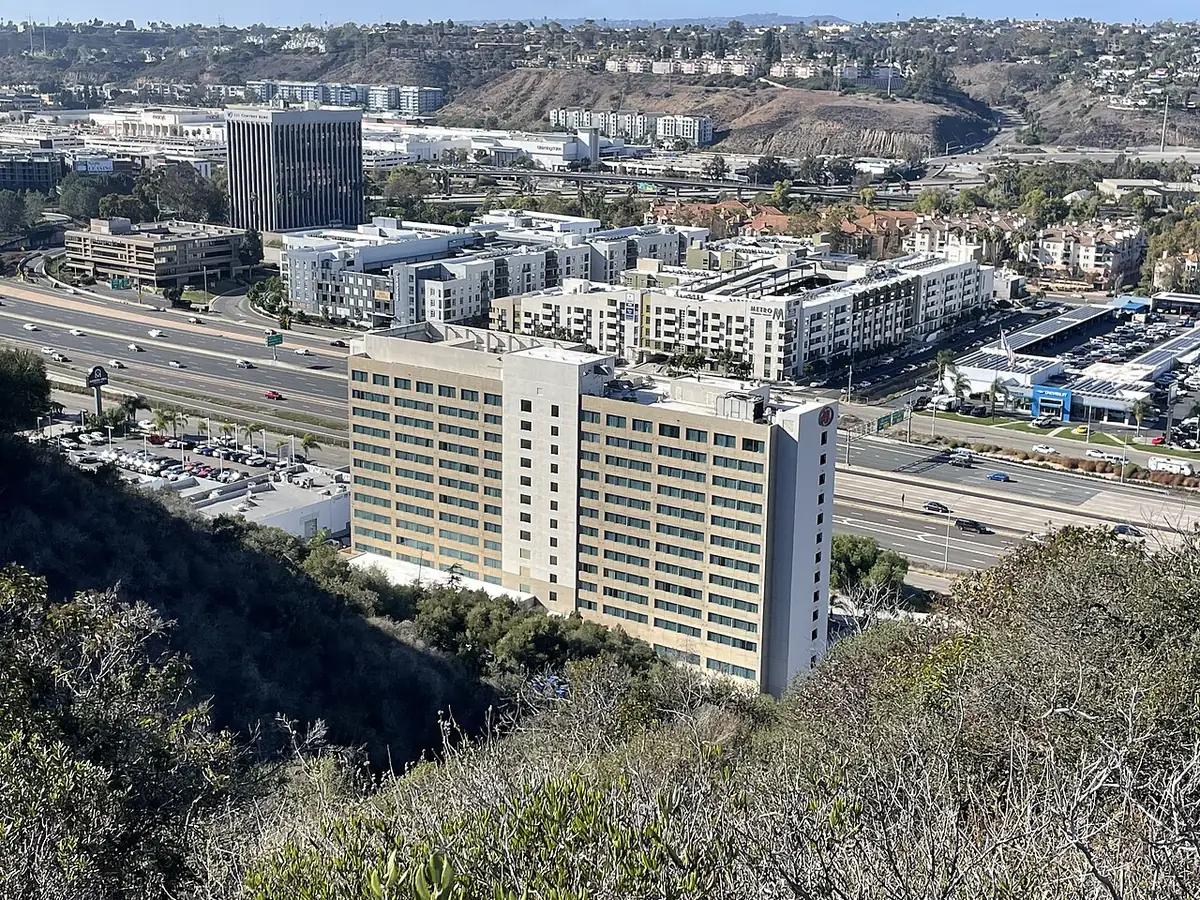
Mission Valley's mid-rise buildings, framed by hills and highway — Photo: Blervis · CC0 · Wikimedia Commons
Once those reference points are reset, the map of San Diego neighbourhoods offers contrasting options that have to be separated methodically.
Coming to San Diego with the instincts of an owner formed in another housing market exposes you to deep cultural and regulatory mismatches. The American property market runs on rules of disclosure, contractual speed and administration that often unsettle newcomers. The very notion of ownership, the weight of neighbourhood association dues and the way homes are built differ sharply from what many arrivals take as standard. Grasping these structural divergences is what secures a valuation, by keeping it clear of misjudgements built on hasty comparisons.
From abroad
Shared walls and vertical multi-owner buildings in the city centre
San Diego
An overwhelming predominance of the detached house on its own private lot
Maintenance of the exterior, the roof and the foundations falls entirely on the owner, with no managing body to spread the cost of large unplanned works, so the condition of those elements sits squarely inside the valuation.
From abroad
Tightly regulated rents and slow, traditional sale procedures
San Diego
A market driven by supply and demand, with standardised contracts and short timescales
Transactions close far faster than many arrivals expect, so a figure has to be ready and defensible before the property goes to market rather than argued over afterwards.
From abroad
Reinforced thermal insulation set by national energy-performance ratings
San Diego
Timber-frame construction favouring natural ventilation over thermal mass
Energy bills and the demand for cooling or light heating follow a completely different logic, one that feeds into the running cost a buyer weighs alongside the price.
From abroad
A single neutral public official presiding over the transfer
San Diego
A title company and specialist agents handling the legal side, with an escrow officer holding the funds
Checking easements, liens and the chain of ownership rests on private title insurance and on deeds recorded at county level, and anything that surfaces there can move the figure.
From abroad
Urban public transport and rail as the centre of gravity
San Diego
A near-absolute dependence on the freeway network and on daily car use
Where a property sits relative to the main road corridors counts for more than proximity to a shopping street, which completely redefines how location is valued.
Which San Diego neighbourhood is your property being measured against?
Reading these areas leads naturally to the question of what transactions actually settle at and how prices are structured.
Placing a value on a San Diego property means mapping carefully the diversity of urban character and the micro-markets that make up the city. Each sector offers a unique compromise between beach proximity, cultural energy, school quality and the level of local property taxes. An owner or a valuer has to read the daily experience of a street rather than its surface appeal. The cards below compare the major options to help you work out which set of comparables your property genuinely belongs to.
La Jolla and the northern coastline
A prestigious maritime atmosphere, paced by ocean views and walkers passing along the cliffs.
Suits
Properties valued as first-rank assets, within immediate reach of the most spectacular beaches.
Trade-off
Some of the highest prices per square metre in the region, and local taxation that tracks the high value of the properties.
North Park and the creative neighbourhoods
A vibrant urban energy, driven by independent cafes, art galleries and a young, active population.
Suits
Properties whose value rests on neighbourhood cultural life, renovated period architecture and a more walkable way of living.
Trade-off
Lots are often smaller and parking can be tight near the commercial streets, both of which pull on the figure.
Carmel Valley and the northern residential suburbs
Controlled planning, recent subdivisions kept immaculately and a calm suited to family life.
Suits
Properties whose value leans on school performance and modern shared facilities.
Trade-off
A more uniform setting and a marked dependence on the main road corridors to reach the historic centre.
South Park and the historic sectors
An old-fashioned charm of preserved period homes, tree-lined streets and strong neighbourly cohesion.
Suits
Properties carrying authentic architectural character within a close-knit community of human scale.
Trade-off
An extremely restricted stock of comparable sales, and potentially high renovation costs on older structures.
What houses in San Diego actually reach, sector by sector
A landmark corner in San Diego's historic Gaslamp Quarter — Photo: Roman Eugeniusz · CC BY-SA 3.0 · Wikimedia Commons
Beyond the headline value of a property, what you legally hold deserves close examination, because it moves the figure too.
Putting a figure on a San Diego house rests on rigorous analysis of the transactions recorded in each micro-market across the metropolitan area. With no single price, the market segments according to distance from the ocean, the age of the building stock and the size of the lots. The tables below set out the orders of magnitude observed, to anchor your thinking without giving way to speculative headlines. These reference figures are the indispensable base for preparing a realistic estimate of your own property.
san-diegoFor saleHouseestimate
Median price / m²US$5,297Half the apartments sell below this
Median priceUS$898kthe average is 14% higher — a few very large properties pull it up
Most common2 bedrooms68 % of listings
Average size161 m²
By number of bedrooms
Bedrooms
Share of market
Avg price
Price / m²
Avg size
2most common
68 %
US$927k
US$5,576
166 m²
3
27 %
US$1.15m
US$5,241 −6 %
219 m²
4
5 %
US$1.41m
US$5,018best value / m²
280 m²
Each row is an average, compared against the area average of US$5,576 / m². These are indicative estimates of a typical local market, not a measured sample of live listings. Check current listings before relying on them.
What you actually hold: outright ownership, association rules and local easements
Getting these legal aspects straight prepares the ground for the sequence in which a figure is tested.
The legal structure of property ownership in California carries subtleties that bear directly on freedom to alter a house and on long-term financial charges, and both show up in a valuation. Between a house held outright on its own lot and a property subject to the strict rules of a homeowners association, the day-to-day constraints differ completely. Understanding these mechanisms lets you read a figure knowing what sits behind it, and avoids regulatory surprises. The two perspectives below set out the legal realities facing any owner in the San Diego area.
The independent house held outright (Single-Family Detached)
You own both the building and the whole of the lot it stands on, with no compulsory dues owed to a neighbourhood association. This configuration offers maximum freedom to extend, to change the landscaping or to install solar generation equipment as you see fit, and that flexibility is something a valuation can credit.
What it changesYou carry the full weight of structural maintenance and site security, and remain subject to the strict planning rules of the City of San Diego, so condition and permit history do much of the work in setting the figure.
The house inside a managed community (Planned Unit Development / HOA)
The property sits within a shared residential development where a homeowners association regulates the external appearance, manages the common green space, the leisure facilities and sometimes the private roads. That arrangement guarantees consistent upkeep of the immediate setting and protects the aesthetic coherence of the neighbourhood over the years.
What it changesYou owe compulsory monthly dues and must follow rules that are often very restrictive on paint colours, parking or pets, and both the dues and the association's reserves feed into what a buyer will pay.
The moment a San Diego valuation stops being an opinion and gets tested
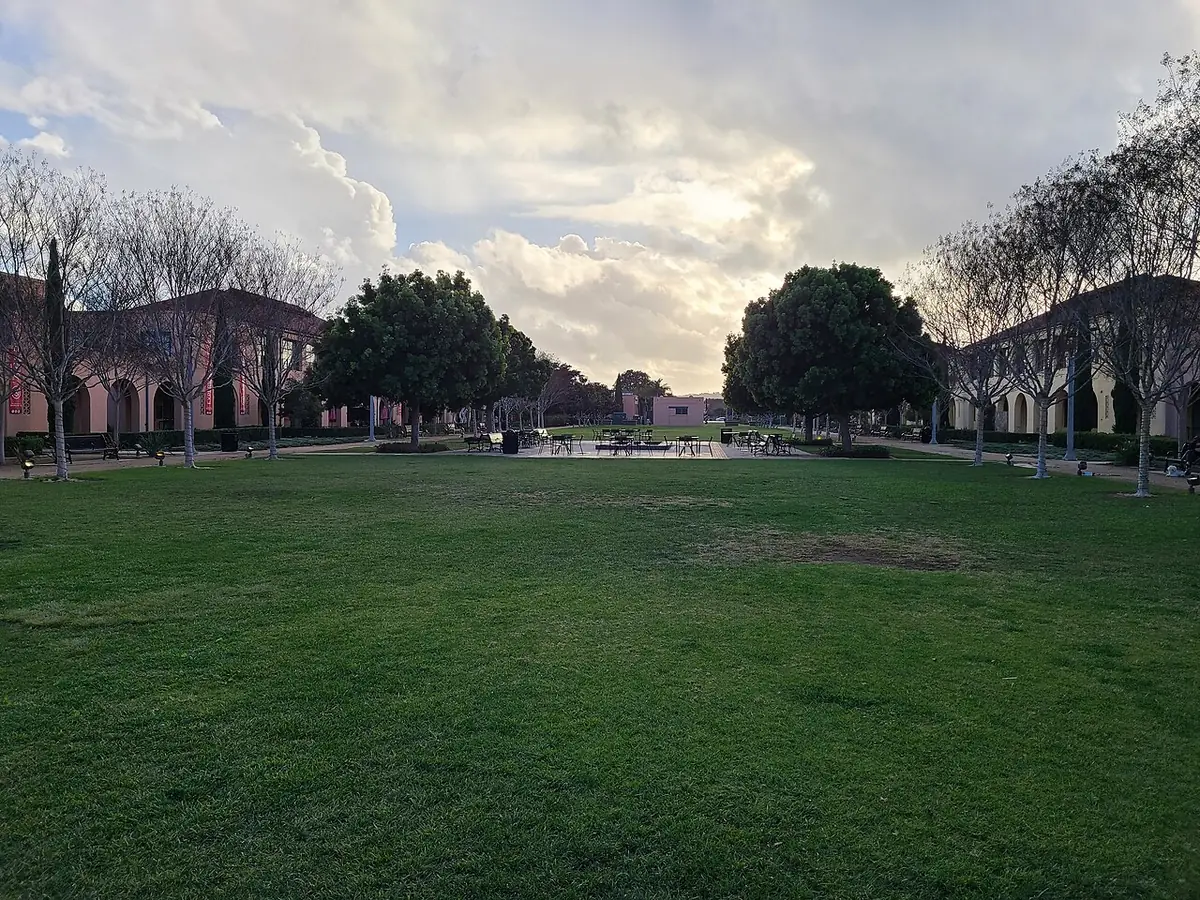
A grand green promenade at Liberty Station — Photo: Alan Islas · CC BY-SA 4.0 · Wikimedia Commons
That sequence sits inside a wider process in which each professional plays a clearly defined part in setting and verifying value.
A figure put on a San Diego house only becomes real when it passes through the procedural calendar that California law sets out. Unlike markets where an agreed price becomes irrevocable the moment an offer is signed, the local system builds in fundamental pause periods known as contingencies. Those conditional clauses let the buyer verify the technical state of the property, secure final financing and validate the ownership history, and each of those checks can move the number. An owner who does not understand this mechanism is guessing at what their estimate will survive.
Acceptance of the offer sets the working figure and opens an escrow account with a specialist company.
A good-faith deposit (generally around one to three per cent of the price) goes into the secured escrow account within days of the agreement, which is the first real market test of the number.
The contingency period opens for a thorough physical inspection of the house by an independent certified professional, whose findings translate into condition adjustments.
The lender's formal appraisal confirms whether the value of the property matches the agreed transaction amount, which is the point where an owner's estimate meets a licensed appraiser's own comparables.
The conditions are released one by one as the technical and financial audits come back clear, and any shortfall against the appraisal has to be renegotiated or funded.
The transfer document (Grant Deed) is signed and formally recorded with San Diego County, at which point the figure becomes a comparable for everyone else.
Who puts a number on a San Diego house, step by step
In short, arriving at a defensible figure in San Diego means marrying a realistic reading of the market with absolute methodological rigour.
Valuing a property in San Diego means coordinating several specialists who between them carry the legal and financial responsibility for the number. From the first scan of comparable properties through to the recorded sale, each participant plays a precise part in establishing and verifying value. Understanding this chain lets an owner anticipate the administrative timescales and approach each phase calmly. The table below sets out the sequence and the people involved.
The estate agent (Realtor)Comparative market analysis and pricing strategyThe agent builds a comparative market analysis from recent local sales, sets the opening figure, drafts the paperwork on the state's standard forms and negotiates the financial terms.
The building inspectorFull technical auditThe inspector examines the structure, plumbing, electrics and roof in detail to identify hidden defects or urgent work, each of which becomes a deduction from the headline figure.
The title companySecuring the legal titleIt checks for undisclosed liens and disputed easements and confirms the seller has full legal capacity to transfer the property, since anything unresolved there directly discounts the value.
The independent appraiserLicensed appraisal for the lenderInstructed by the lender, the licensed appraiser validates the market value of the property to confirm it covers the mortgage amount requested, applying lot, age and condition adjustments to the comparables.
The escrow officerFinancial and administrative centreThe escrow officer holds the buyer's funds, works out the property tax prorations and orchestrates the final signing of every legal document, which is where the agreed figure is finally settled.
House or apartment in San Diego: which holds its value, and why
Weighing a detached house against an apartment in San Diego means looking hard at daily habits, maintenance burden and the way the California city is laid out, because all three end up inside the figure. The residential neighbourhoods of San Diego, whether Clairemont, Normal Heights or the hillsides of La Mesa, offer a rare privacy with private lots and direct contact with the outdoors, but in exchange they demand constant involvement in the upkeep of the building and the grounds. Every single-family property is a self-contained system whose roof, foundations and garden rest entirely on the owner's shoulders, which turns every storm or dry spell into a proactive management of technical and financial risk, and turns condition into the single largest adjustment a valuer makes.
An apartment, often run under the local co-ownership arrangements known as an HOA, or Homeowners Association, shifts the balance towards pooled services and peace of mind on external maintenance. Living in a residential complex Downtown, in Hillcrest or along the coastal corridor of La Jolla relieves you of mowing, facade work and pool supervision, and puts you inside a lively vertical community. That freedom comes with monthly dues that are sometimes high, strict neighbourly rules set by the association and a living area that is often more compact for an equivalent or higher price per square metre, all of which a valuation has to net off.
Parking and access weigh heavily in the balance too, once you have driven across the San Diego metropolitan area at peak hours. Houses generally come with a closed two-car garage and a private driveway that makes loading easy, while urban apartments sometimes impose tight assigned basement spaces or leave you contending with scarce street parking in the denser sectors. Families with children or large dogs lean naturally towards the house for its enclosed garden and the absence of immediate shared walls, while people working near the technology hubs of Sorrento Valley or drawn by the activity of North Park find in an apartment an ideal compromise for cutting daily travel time. Both preferences show up as measurable demand in the comparables.
On the asset side, the value of a house with land in San Diego has historically followed a more robust path, because of the absolute scarcity of land on the coast and in the sought-after valleys of the county. Apartments, more accessible at the point of entry into the California market, are sometimes more exposed to market swings and depend closely on the overall financial health of the association and on how well its reserve funds for major works are managed, a factor any serious valuation of an apartment has to examine. Your reading of the two therefore comes down to a careful weighting between tolerance for maintenance obligations and attachment to an independent private plot in Southern California.
The running costs and price bands that sit behind a San Diego valuation
Working out what a San Diego house is worth to a buyer goes well beyond the mortgage repayment, because buyers price the cost of holding the property as well as the price of acquiring it. Between California's specific local taxation, home insurance against natural hazards and unavoidable maintenance, the total cost of ownership needs careful anticipation, and it discounts what anyone will bid. Our tables set out the unavoidable expense lines observed in the current market, and the price bands the county divides into, so you can sanity-check any figure you are given.
Monthly and annual cost lines for a single-family house in San Diego
Cost line
Estimated amount
Frequency
Explanatory comment
Property tax
About 1.1% to 1.2% of the value
Annual
Based on the initial purchase price under Proposition 13, with a capped annual uplift, so the assessed value can sit well below a current market valuation.
Home insurance
$150 to $300
Monthly
Varies with the exact location, exposure to wildfire risk and the year the house was built.
Maintenance and repairs
1% to 2% of the property value
Annual
An essential provision covering air conditioning, roofing, plumbing and exterior paint, and the first thing a valuer marks down when it has been skipped.
Water, electricity and gas
$250 to $500
Monthly
Strongly influenced by air conditioning use over the summer months and by local energy pricing.
These estimates assume a standard three-bedroom single-family house in a mid-range residential area of San Diego County.
Value bands by major sector of the county
Geographic zone
Median value of a house
Market trend
Profile of the zone
Coastal corridor (La Jolla, Del Mar)
$1,500,000 to $2,500,000+
Under heavy pressure
Immediate beach access, ocean views, strong international and local demand.
Urban and inland centres (Mission Valley, Clairemont)
$850,000 to $1,200,000
Stable
Established residential neighbourhoods, parks, excellent road connections to the employment centres.
Eastern and southern zones (El Cajon, Chula Vista)
$650,000 to $850,000
Moderate growth
More generous floor areas, hotter summers, greater accessibility for first-time buyers.
Median values shift with prevailing interest rates and with the level of stock available on the local MLS at the moment you are valuing.
Health, schools and transport: what an ordinary Tuesday looks like here
Hillside homes above the bay, a classic San Diego view — Photo: A Guy Named Nyal · CC BY-SA 2.0 · Wikimedia Commons
To judge whether a valuation of a San Diego house makes sense, nothing replaces walking through an ordinary weekday hour by hour, because that is what a buyer is really buying. Between morning journeys on the I-5 or I-15 freeways, managing the children's schooling and reaching first-rate medical facilities, each neighbourhood reveals its own rhythm and its own logistical constraints. This chronological account of a typical Tuesday puts you inside the reality lived by residents across the California metropolitan area.
07:00Residential neighbourhood (for example Clairemont)Waking to California sunlight. A quick start and out of the garage to stay ahead of the first waves of traffic on the main road corridors.
08:00Local schoolDropping the children at a San Diego Unified district public school or a local charter school, a valued moment of contact with other parents, and the kind of catchment that shows up in comparable sales.
09:00Coworking space or office at UTC / Sorrento ValleyArriving at work after a smooth run if the hours were planned well, or settling into remote work from the study set up at home.
12:30Neighbourhood shopping centreA quick lunch at a local outlet or a fast trip to an organic supermarket to prepare the family dinner.
17:30Medical centre or paediatric practice affiliated with UCSD HealthA routine appointment or a quick consultation, drawing on the density and quality of the county's world-class health infrastructure.
19:00Home again and unwindingDinner on the terrace or in the living room, enjoying the legendary mildness of San Diego evenings before preparing for the next day.
What no listing will tell you about the value of a San Diego house
The superb wide-angle photographs and polished virtual tours put online by San Diego agencies routinely leave out structural and environmental realities that bear directly on value. Behind the repainted facade and the immaculate staging sit local specifics that only long-standing residents or neutral experts will point out. Here are the four things to audit before you accept any figure, whether it came from an agent or an automated tool.
The real exposure to wind and direct sun
A full western aspect without reinforced insulation turns a living room into a furnace on summer afternoons and sends the electricity bill for air conditioning up dramatically, which buyers discount even when no listing mentions it.
Proximity to the international airport's flight paths
Some picturesque neighbourhoods sitting under the approach paths into San Diego airport take regular noise that considerably reduces the comfort of outdoor space, and comparables from a street two blocks away will not reflect it.
The true state of the pipework and sewer connections
In many subdivisions built in the middle of the twentieth century, the cast iron or clay underground drainage was never replaced, exposing an owner to costly backups and giving an inspector grounds for a substantial deduction.
Municipal planning and densification projects
The City of San Diego actively encourages dense housing and accessory dwelling units (ADUs), which can change both the quiet of a lot and its development potential, in either direction, in ways today's comparables have not yet caught up with.
The classic misjudgements owners only spot six months later
Looked likeA charming wooded hillside offering a commanding panoramic view over the surrounding canyons and the city, and priced for that view.
Turned outA very high wildfire risk zone (brush fire zone), demanding exorbitant insurance premiums and stringent legally required brush clearance, both of which cut what buyers will pay.
Would have caught itAlways consulting the official CAL FIRE fire hazard maps and obtaining precise insurance quotes before treating any figure as settled.
Looked likeAn authentic older neighbourhood full of character, with huge mature trees and a unique period feel.
Turned outWorn-out water pipes, concrete foundations cracked by roots and an electrical system unable to carry modern equipment, none of it visible in the comparables.
Would have caught itInstructing a building inspector who specialises in local historic construction to run a camera survey of the buried services before you fix a figure.
Looked likeA calm, peaceful street, ideal for letting children play safely in front of the house.
Turned outA busy cut-through used at peak hours by drivers avoiding congestion on the adjacent main boulevards, which quietly depresses the value against otherwise identical comparables.
Would have caught itVisiting the neighbourhood at different times of day, particularly the morning and evening rush, to see how traffic really behaves.
Looked likeA large, lush green lawn apparently needing little initial landscaping work.
Turned outA monthly financial drain in drinking water use, against strict restrictions and the tiered pricing imposed by the San Diego water district, a running cost buyers deduct.
Would have caught itFavouring drought-tolerant landscaping with native plants and an optimised drip irrigation system, which reads better in a valuation as well as in the water bill.
Who should not act on a San Diego valuation right now
Owning property in San Diego is often presented as the natural end point of a housing journey in California, and a rising valuation as a reason to act. Yet current economic conditions and the specifics of the local market mean that acting on an estimate is not the right move for every profile. If one of the profiles below fits, prudence suggests treating the figure as information rather than as a signal, and deferring the decision to preserve your financial balance and your freedom of movement.
The young professional still moving between jobs
→Flexible renting of an urban apartment
High transaction costs on the way in and the way out in California mean a holding period of at least five to seven years is needed to absorb the initial outlay, so a favourable valuation today does not translate into a gain.
The household whose deposit is only just sufficient
→Keeping a robust emergency reserve
A single-family house in San Diego exposes an owner to major unplanned expenses, such as replacing a roof or an air conditioning system, which a headline valuation never shows and which a thin cushion cannot absorb.
The investor looking for immediate rental yield
→Other asset classes or regional markets
The ratio between the high values houses reach in San Diego and the rents actually achieved produces relatively weak gross yields compared with other American metropolitan areas, whatever the capital figure says.
So, do you actually trust the number on your San Diego house?
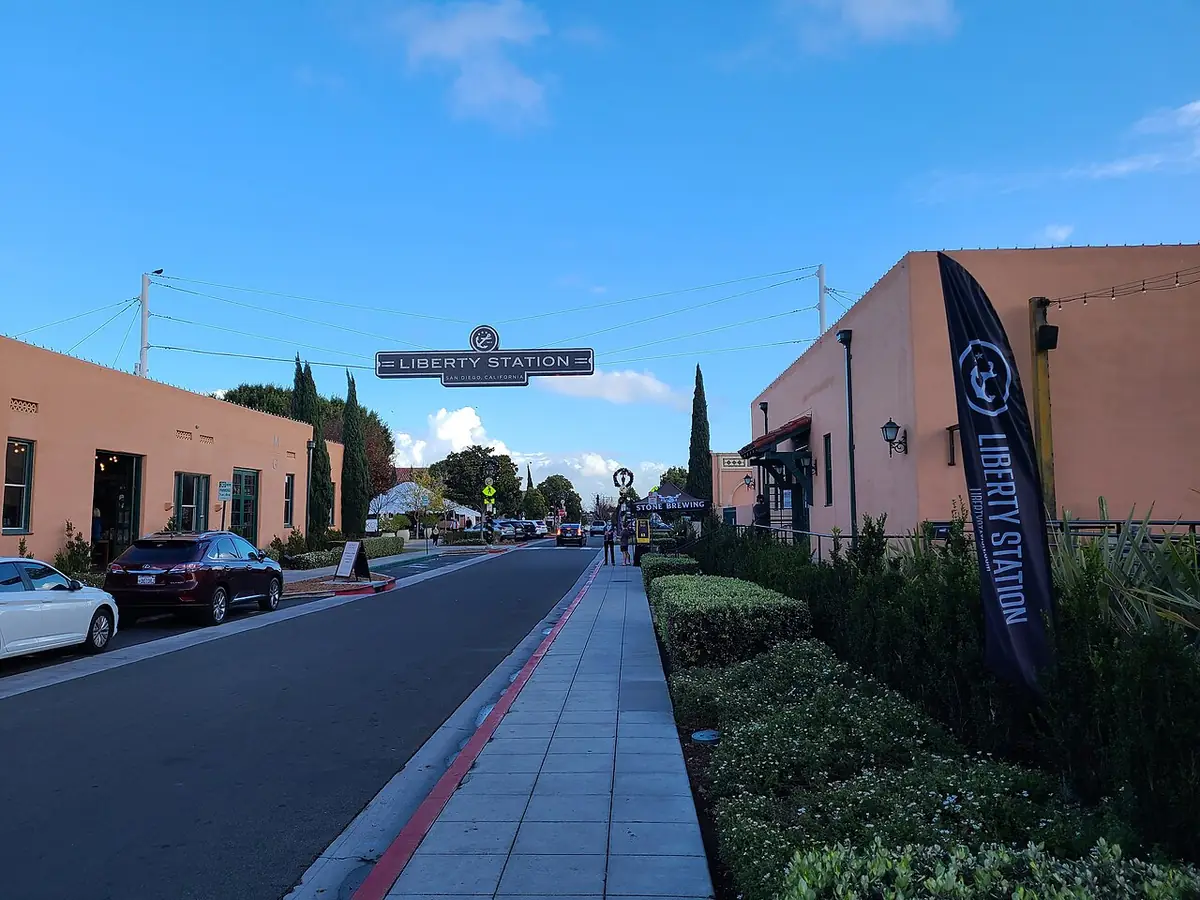
A relaxed shopping street at Liberty Station — Photo: Alan Islas · CC BY-SA 4.0 · Wikimedia Commons
Settling on a value for a San Diego house is not a simple arithmetic exercise or a reading of a passing market opportunity. It is a judgement made inside an exceptional but demanding natural and economic environment, and it has to hold up over time. If you have measured the reality of the hidden costs, accepted the maintenance obligations that come with individual ownership and confirmed how the property fits the region's employment geography, then the San Diego market offers a remarkably stable base against which a figure can be tested.
Before you accept any number, take the time to check each element of it with recognised, independent local professionals: an agent's comparative market analysis and a licensed appraiser's report are not the same document and will not always agree. Read the inspection reports closely, visit the neighbourhood at different times of day and make sure the figure you carry forward serves your own decision rather than someone else's sales pitch. San Diego rewards those who approach it with method, clear sight and a long-term view.
Related questions
How much property tax does a house in San Diego carry, and does it affect the valuation?
The base property tax runs at roughly 1.1% to 1.2% of the purchase value, under the terms of Proposition 13 in California. It is reassessed each year within a cap for as long as the property does not change hands, so an owner's current tax bill can sit far below what a new valuation would imply.
Should air conditioning costs be factored into what a San Diego house is worth?
Yes. Electricity bills rise noticeably over the summer months, particularly in inland neighbourhoods such as El Cajon or Santee where temperatures run higher than on the coast, and buyers price that running cost in.
Which neighbourhoods hold their value best for a family house?
Areas such as Clairemont, Mission Valley, Carmel Valley and the residential parts of La Mesa are particularly sought after for the quality of their public schools and their access to the main road corridors, which supports the figures agents put on them.
Does wildfire risk have to be reflected in a valuation?
If the house sits in a zone CAL FIRE has mapped as hazardous, a lender will require specific home insurance covering fire risk, and the premiums can run well above average. That cost feeds straight into what a buyer is willing to pay.
How long does it take to move from an agreed figure to a completed sale in California?
The standard process, from acceptance of the offer through to handover of the keys and recording of the deed (closing), usually takes between thirty and forty-five days, which is the window in which a valuation is tested.
Do solar panels raise the value of a San Diego house?
More and more single-family homes carry photovoltaic solar panels, either owned outright or under lease or energy resale contracts, and which of the two applies has to be examined carefully because it changes how the panels are treated in a valuation.
What transaction costs should an owner allow for when working back from a valuation?
In California, closing costs cover the title company's fees, transfer taxes and administrative charges, generally running to between 1% and 2% of the total purchase price of the property.
How do you check the work history of an older house before valuing it?
You can consult the building permit records held by the City of San Diego planning department and ask the seller for the full set of mandatory legal disclosures (the Transfer Disclosure Statement).
Does the scope to add an accessory dwelling unit (ADU) change the figure?
The City of San Diego actively encourages ADU construction to increase housing supply, subject to local planning, zoning and utility connection rules, so a lot with that potential reads differently to a buyer.
How have property values in San Diego County moved historically?
Through fluctuating economic cycles, the San Diego property market has shown strong historical resilience, supported by sustained demographic demand and a structural scarcity of land.