Buying a house well in Bangalore means looking past first impressions to understand how the local market really works. This guide sets out the essentials for weighing up neighbourhoods, securing your property rights and planning your move with peace of mind.
Get the app
What nobody tells you.
Real prices, hidden costs and the traps to check before you commit.
Why the floor area promised in Bangalore never quite matches the space you live in
Scroll
Why the floor area promised in Bangalore never quite matches the space you live in
Buying a house well in Bangalore means looking past first impressions to understand how the local market really works. This guide sets out the essentials for weighing up neighbourhoods, securing your property rights and planning your move with peace of mind.
Written by the ting.ad editorial team ·
Valuation House Bangalore in Street View: drag to look around.
Beyond the raw floor area, it is your everyday way of life that gets tested against local reality.
Valuing a house in Bangalore relies on very specific notions of floor area that can surprise a buyer from abroad. Between the net carpet area, the super built-up area that includes walls and common spaces, and the actual footprint on the ground, the gaps often exceed thirty per cent. Understanding this distinction is the essential first step to judging the real value of the property you have your eye on in the Indian metropolis.
The total built-up area shown in listingsvsThe space that is genuinely private and liveable day to day
Developers routinely include shares of corridors, stairwells and shared terraces in the official figures. So you pay for common areas that you can neither fit out nor keep for yourself.
The promise of an independent plotvsThe reality of easements and shared boundaries in the city
Even in quiet residential areas, the space between properties is often kept to a bare minimum. A private garden frequently comes with neighbouring buildings looking straight in.
The appeal of luxury finishes shown in the brochurevsThe real quality of the structural materials underneath
Visible fittings catch the eye on viewings, but waterproofing and foundations sometimes call for extra vigilance, particularly because of the intense swings in weather during the monsoon.
How does daily life take shape depending on where you settle in Bangalore?
This lifestyle choice marks a clear break from the reference points you are used to back home.
How smoothly your days run in Bangalore depends almost entirely on where your house sits in relation to where you work and spend your time. The city sprawls organically, turning every journey into a tricky trade-off between residential calm and being close to work. Looking honestly at your daily routine helps you avoid the classic mistake of buying on floor area alone at the expense of commuting time.
Close to the tech zones
Living right next to the big tech campuses drastically cuts your exposure to daily traffic jams. You win back precious time in the mornings, even though the price per square metre is noticeably higher. In return, the area is busy around the clock, with a dense concentration of modern services and secure residential complexes.
Established, tree-lined neighbourhoods
Choosing the established residential areas gives you beautiful tree-lined avenues and a village feel in the heart of the metropolis. Houses there often have real character and a more mature garden. You will, however, have to accept narrower access roads at times and a longer distance from the high-tech business districts.
Developing outskirts
The new outlying neighbourhoods offer larger plots for the same budget, with planned infrastructure in the form of gated communities. It is a sensible choice if you accept a transitional phase while local shops and transport links gradually develop around your new home.
Which cultural and practical reference points change when you move to Bangalore?
Once these reference points are in place, choosing the right neighbourhood becomes your strategic priority.
Settling for the long term in a house in Bangalore means unlearning some habits from back home and adopting the local rhythm and ways of doing things. From water management to organising household staff, every detail of domestic life follows its own codes. Anticipating these structural changes spares you disappointment in the first few months.
From abroad
A constant, regulated public water network with drinkable water straight from the tap.
Bangalore
A mixed supply combining municipal water, borewells and tanker deliveries in the dry season.
You absolutely need efficient multi-stage filtration systems and storage tanks sized to keep your household self-sufficient.
From abroad
Centralised, automated waste collection and street upkeep handled by the municipality.
Bangalore
Waste sorting managed at community or street level, with daily collections by dedicated contractors.
Keeping your immediate surroundings clean takes personal involvement and close coordination with your neighbours or your neighbourhood association.
From abroad
Near-total self-reliance for household chores with no regular outside help.
Bangalore
A household that commonly relies on regular domestic help for cleaning and cooking.
Your role shifts towards managing a household team, which changes how you use your free time and how the service areas of the house are organised.
From abroad
Administrative procedures handled strictly online or by post.
Bangalore
A system where direct personal contact and knowing local networks make formalities much easier to resolve.
It is advisable to surround yourself with trusted professionals to validate every legal and tax step of your property purchase.
How do you choose between Bangalore's residential areas for your house?
These differences in location feed straight through into market prices.
Each major area of Bangalore has its own identity, shaped by its history, its population and its level of infrastructure. Your choice of neighbourhood determines not only the long-term value of your property but also the quality of your daily journeys. Here are profiles of the main areas to guide your buying decision.
The historic central neighbourhoods
A calm atmosphere under tall century-old trees, with traditional markets and cafés within walking distance.
Suits
Those who value architectural charm, walking and being right next to cultural institutions.
Trade-off
Properties are scarce, often old, and require substantial purchase or renovation budgets.
The secure residential enclaves of the north
Wide streets, an orderly layout and quick access to the international airport and business districts.
Suits
Families looking for large modern spaces, security and an open, airy environment.
Trade-off
The relative distance from the historic centre means long journeys at rush hour.
The lively hubs of the east and south-east
Constant urban buzz, a large international community and a wide range of modern services.
Suits
People working in tech who want to keep their commute as short as possible.
Trade-off
Very heavy traffic and a price per square metre among the highest in the metropolis.
What budget ranges should you expect when buying property in Bangalore?
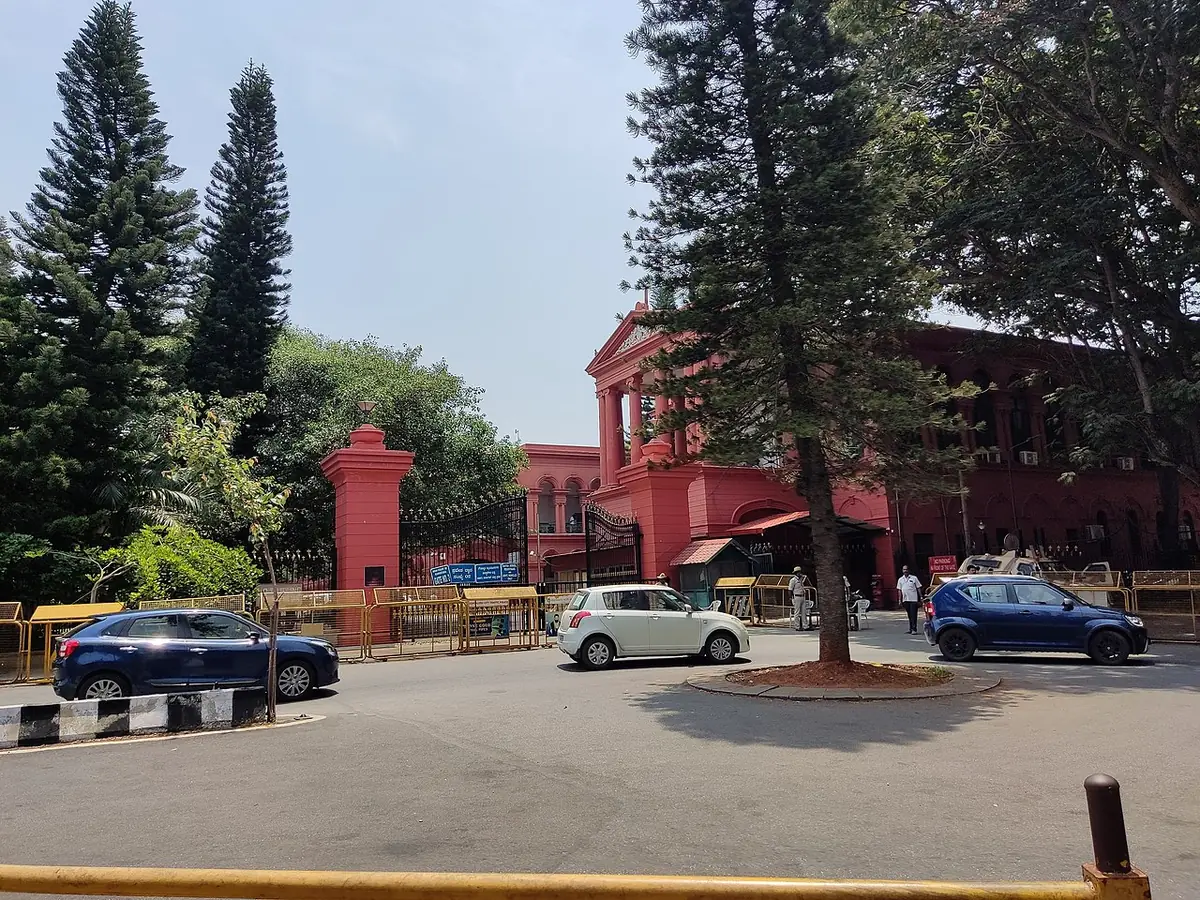
The red High Court building among the trees of central Bengaluru — Photo: Quantumtunneling · CC BY-SA 4.0 · Wikimedia Commons
Beyond the purchase price, the legal structure of ownership deserves your closest attention.
Valuing a house in Bangalore goes well beyond the headline price per square metre. It has to include local registration taxes, legal fees and any costs of bringing the property up to energy and security standards. Looking at price ranges by major area lets you set realistic expectations for your project before you start viewings.
BangaloreFor saleHouseestimate
Median price / m²₹74,005Half the apartments sell below this
Median price₹15mthe average is 14% higher — a few very large properties pull it up
Most common2 bedrooms50 % of listings
Average size193 m²
By number of bedrooms
Bedrooms
Share of market
Avg price
Price / m²
Avg size
2most common
50 %
₹13.6m
₹77,900
175 m²
3
38 %
₹18.1m
₹74,005 −5 %
245 m²
4
13 %
₹23.8m
₹71,668best value / m²
333 m²
Each row is an average, compared against the area average of ₹77,900 / m². These are indicative estimates of a typical local market, not a measured sample of live listings. Check current listings before relying on them.
What exactly are the ownership rights you can acquire as a buyer in Bangalore?
This legal security depends on following every step of the transaction rigorously.
Legal ownership of property in India is governed by strict rules for foreign investors and non-residents. It is essential to distinguish outright freehold ownership of land from shared ownership in a residential complex or gated community. This legal clarity protects your assets over the long term.
Direct freehold ownership of the land
It gives you full title to the land and the building on it, provided you meet the tax residency requirements or obtain the approvals required by India's financial regulators.
What it changesThis format gives you complete freedom to alter and pass on the property, but involves thorough legal checks on the history of the title deeds.
Ownership within a gated community
You own your house and an undivided share of the overall plot, while belonging to an owners' association that manages shared infrastructure, security and upkeep of green spaces.
What it changesThis set-up makes day-to-day management and upkeep of your surroundings much simpler, while imposing strict house rules on exterior changes.
Which steps must be cleared before you pay a deposit on your house in Bangalore?
Once these steps are cleared, the practical side of the transaction gets under way methodically.
Securing a property transaction in Bangalore follows a formal process in which every document should be reviewed by an independent lawyer. Grasping the order of these checks protects you against title defects and potential land disputes. Here is the path you need to follow, from the initial agreement to the final deed.
Identifying the property and checking initially that it fits your life plans.
A thorough audit of previous title deeds covering at least thirty years, carried out by a specialist lawyer.
Confirmation that the building permits issued by the relevant municipal authorities are in order.
Signing the sale agreement, with a deposit paid into a secure escrow account.
Tax processing and official registration of the transaction with the land registry office.
Handover of the keys and formal transfer of ownership in the official registers.
How do the different professionals fit together when your purchase is finalised?
By taking the measure of these requirements, you would approach your property project in Bangalore with the best chances of success.
Buying property successfully in Bangalore means coordinating several specialist professionals. From the accountant to the legal adviser and the local registration officer, each plays a precise role in validating your investment. Understanding who does what lets you steer your project efficiently.
The specialist property lawyerAudit of titles and encumbrancesReviews the property's legal history in detail to make sure there are no pending disputes or hidden mortgages.
The independent technical surveyorStructural inspection of the buildingAssesses the condition of the foundations, plumbing and electrical installation to price any upgrade work.
The tax adviserValidation of the money flowsMakes sure international fund transfers comply with the regulations in force for foreign investors.
The notary or registration officerFormalising the sale deedOversees the final signing and legally registers the transfer of ownership with the government authorities.
You, the buyerFinal sign-off and moving inYou take possession of the property, making sure the service and management contracts for your new home are activated.
Apartment or detached house in Bangalore: which should you choose?
Once this fundamental choice is made, it is time to look closely at the overall budget needed to bring your property project to life in this metropolis.
Choosing between a detached house and an apartment in a serviced complex in Bangalore goes far beyond architectural taste. The city spreads over dozens of square kilometres, combining old neighbourhoods with narrow lanes and ultra-modern tech zones lined with vast secure residential complexes known as gated communities. For a buyer from abroad used to the property reference points back home, this distinction shapes the whole purchase, because day-to-day management, extra costs and legal security vary radically from one type of property to the other.
Apartments in residential complexes, particularly in lively areas such as Whitefield, Electronic City or Hebbal, come with substantial shared facilities. A swimming pool, gym, 24-hour security, backup generators that are indispensable during power cuts and built-in maintenance services make daily life much simpler. In return, you buy a share of the land and have to deal with an owners' association that can be rigid, monthly upkeep fees known as maintenance charges that rise regularly, and noise from neighbours that can be hard to bear depending on the developer's original build quality.
Conversely, choosing a detached house or independent villa in quieter residential areas such as Sadashivanagar, Indiranagar or Jayanagar gives you complete independence over your land. You own the plot and the walls, carry out your own renovation work without needing an association's approval and enjoy private outdoor space. This freedom comes at a high price, however: security depends entirely on your own installations, upkeep of the roof, pipes and façade falls directly to you, and the water supply, often complicated in Bangalore, requires deep borewells and sophisticated filtration systems that you manage yourself.
The financial assessment of these two options has to factor in medium-term resale and the liquidity of the local market. Apartments built by reputable developers generally resell faster thanks to steady rental demand from tech-sector professionals. Detached houses, rarer and often more expensive, appeal to a very targeted pool of wealthy buyers or investors looking to capitalise on the intrinsic value of land in a fast-growing metropolis. Your final decision will therefore depend fundamentally on how well you tolerate the constraints of a shared complex and how able you are to manage the technical upkeep of an independent property.
What total budget should you plan for living and settling in Bangalore?
To understand what daily life will really look like on this budget, let us walk through a typical day in the city.
Setting a property budget in Bangalore goes beyond the purchase price quoted by the seller or developer. You need to include all local taxes, registration fees, legal fees and the recurring costs of the residential complex or the upkeep of the property. A realistic estimate protects your investment against unpleasant financial surprises and ensures a smooth move to India's technology capital.
Upfront purchase costs and mandatory taxes
Cost item
Estimated rate or amount
Impact on the overall budget
Stamp duty and registration fees
Around 5.6% to 6.5% of the market value
Tax collected by the Karnataka state government on transfer of ownership.
Legal and title verification fees
0.5% to 1% of the purchase price
Fees for the specialist lawyer who audits the property's land history.
Bank processing and brokerage fees
0.5% to 1% of the loan amount
Administrative fees charged by local financial institutions.
These costs always come on top of the net price paid to the seller and must be set aside in cash before the final deed is signed.
Recurring expenses and monthly maintenance costs
Type of charge
Indicative monthly range
Services included
Complex fees (maintenance)
INR 3 to 6 per square foot (around €0.03 to €0.07/sq ft)
Security, upkeep of green spaces, lifts and cleaning of common areas.
Electricity and backup generators
INR 3,000 to INR 8,000 (depending on air conditioning)
Tiered billing by BESCOM, including fuel for the shared generators.
Municipal property tax (BBMP)
INR 5,000 to INR 20,000 per year
Annual contribution payable to the Greater Bangalore Municipal Corporation.
Complex fees generally rise by 5% to 10% each year to keep pace with rising labour and maintenance costs.
Health, schools and transport: what does an ordinary Tuesday look like in Bangalore?
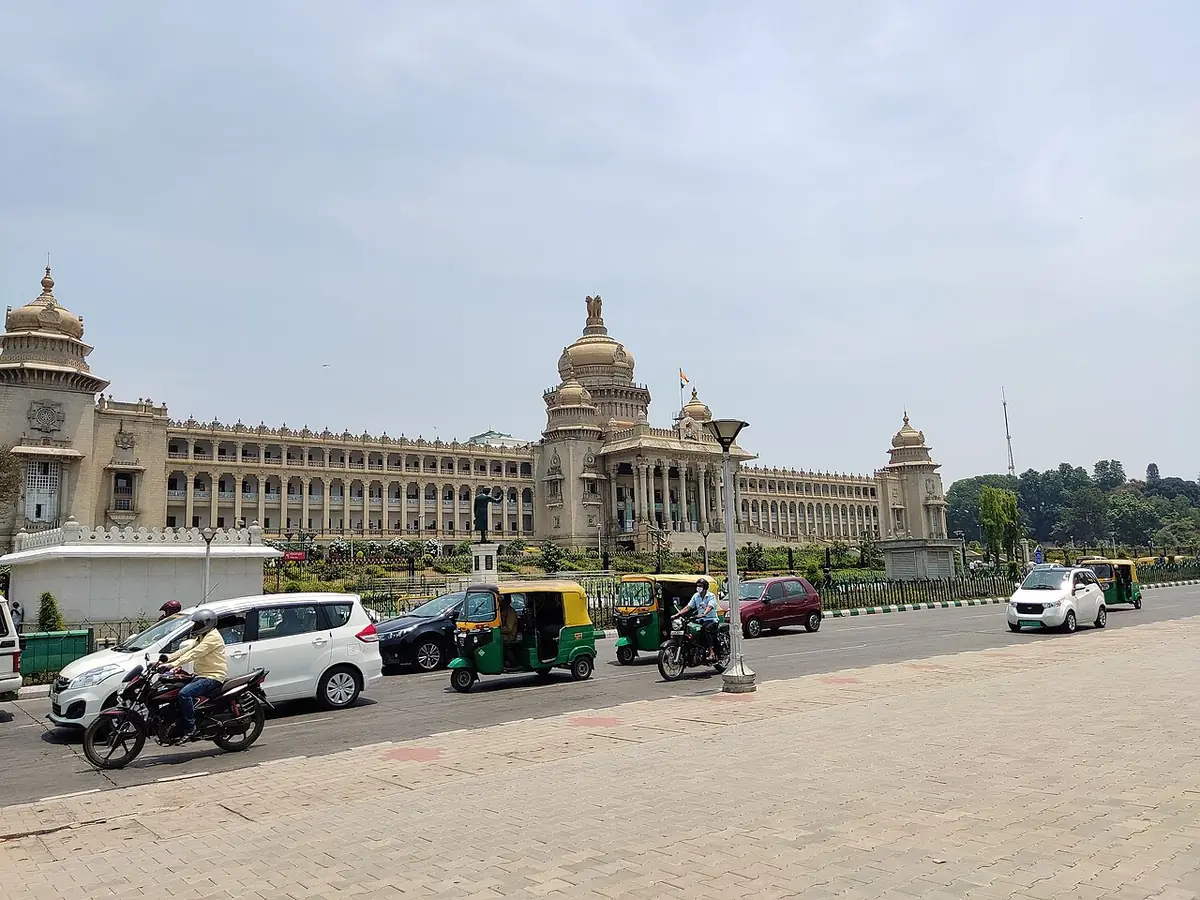
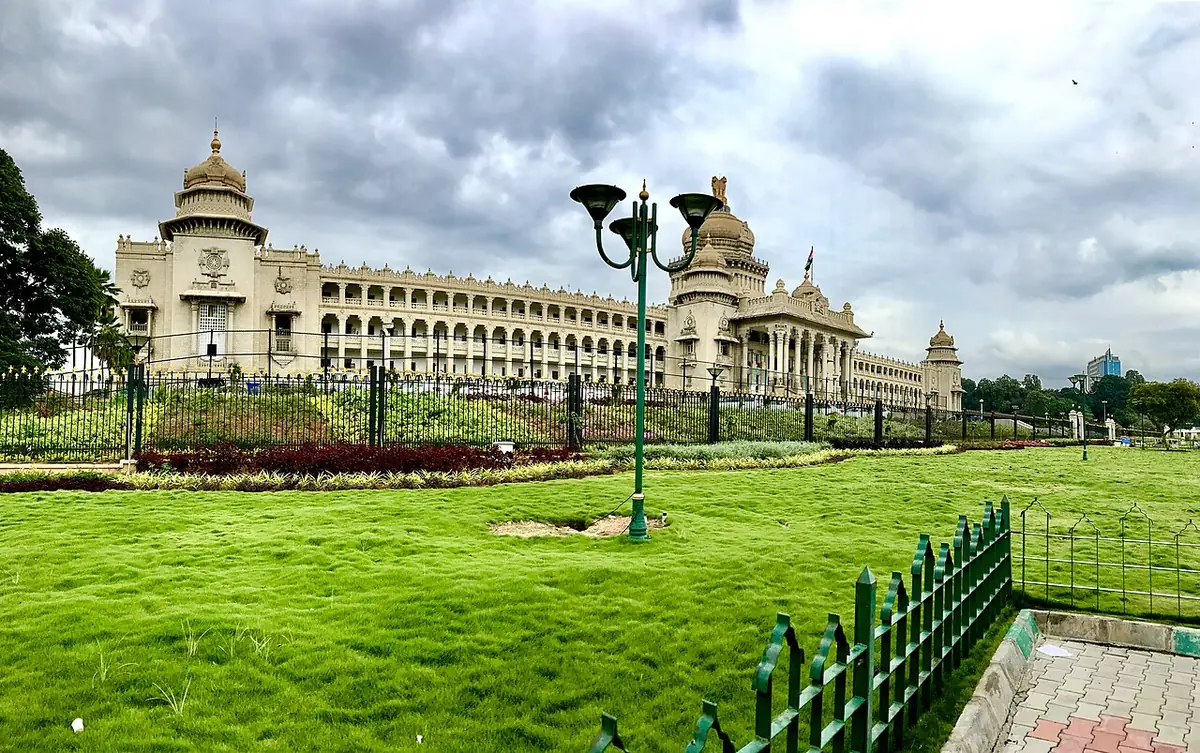
The Vidhana Soudha and its gardens in central Bengaluru — Photo: IM3847 · CC BY-SA 4.0 · Wikimedia Commons
Beyond this well-oiled routine, many crucial aspects never make it into developers' marketing brochures.
Living in Bangalore means planning your schedule around heavy city traffic and the way key infrastructure is spread across the city. An ordinary Tuesday shows how residents balance work, children's schooling and access to top-tier medical care. Walking through the day hour by hour helps you anticipate journey times and choose your neighbourhood wisely according to your daily priorities.
07:30 - 08:30Leaving home and the school runSchool buses or private shuttles pick children up early to beat the first morning traffic jams on the way to international schools.
09:00 - 10:30Commute to the tech hub or officeTravel to business zones such as Manyata Tech Park or Electronic City, often shaped by rush-hour traffic.
13:00 - 14:00Lunch break and neighbourhood lifeA good moment to try local cafés or pick up a few things at the well-stocked neighbourhood supermarkets.
17:00 - 18:30After-school activities and healthcareVisits to well-known medical centres such as Manipal Hospital or Fortis when needed, or taking the children to their sports activities.
20:00 - 21:30Back home and unwindingBack in the secure complex or the villa, enjoying the relative calm of the evening to have dinner as a family or order in through local apps.
What sales brochures and agencies will never tell you about Bangalore
These grey areas explain why some buyers have bitter regrets a few months after moving in.
Bangalore's property market has its own unwritten rules that developers are careful not to spell out during showroom visits. Understanding these hidden realities will spare you major financial and practical setbacks after the sale deed is signed. Here are the four critical points every foreign buyer or expat must factor into their thinking.
The complicated management of the water supply
Many neighbourhoods are not continuously connected to the BWSSB public network. Residents often have to rely on water tankers (tanker water) during the dry season, which creates significant recurring costs and logistical friction within residential complexes.
The legal subtleties of land title deeds
Land history in India can be complex. Properties built on filled-in lake beds or on agricultural land not converted under the BDA's strict rules risk major administrative disputes or demolition to make way for public infrastructure.
Waste management and local sanitation
Despite the BBMP municipality's efforts, wastewater treatment and solid waste collection vary considerably from one neighbourhood to another. Poor management by the owners' association can quickly affect the property's hygiene and value.
The real impact of infrastructure projects on the neighbourhood
The ongoing expansion of the metro (Namma Metro) and the construction of flyovers permanently change the peace and quiet, road access and rental value of properties right next to the building sites.
The buying traps and mistakes you only discover six months after moving in
Faced with these technical and practical demands, it is fair to ask whether this market suits every kind of buyer.
Looked likeA stunning panoramic view from the upper floors of a tower under construction
Turned outA vacant plot opposite turned into the building site for another high-rise, blocking the view for good and bringing daily noise.
Would have caught itAlways check the land-use plan with the Bangalore Development Authority (BDA) to find out which future projects are approved in the immediate vicinity.
Looked likeComplex fees that were very attractive at first and below the market average
Turned outThe reserve fund turned out to be too small to pay for the imminent renovation of the lifts and waterproofing of the roof, leading to a sudden, steep rise in contributions.
Would have caught itGo through the minutes of the general meetings for the last three years in detail to assess the complex's real financial health and the works that have been voted on.
Looked likeQuick access to the business district via a major road that flowed freely on the day of the viewing
Turned outAt rush hour, that same road becomes a major bottleneck, turning a twenty-minute journey into a daily ordeal of nearly two hours.
Would have caught itTest journey times yourself at the critical morning and evening hours before signing the sale agreement or paying the deposit.
Looked likeA standard electricity connection with no visible outages during viewings of the apartment
Turned outFrequent micro-outages and an undersized local transformer meant buying an expensive high-capacity inverter and relying permanently on the diesel generator.
Would have caught itAsk current residents of the building how reliable the power supply really is and how good the developer's backup system is.
Who should definitely not buy property in Bangalore right now?
If you have got past these obstacles and are weighing every factor calmly, it is time to make a final decision.
Property investment in Bangalore is not a universal solution that suits every life plan or financial goal. Some types of buyer face disproportionate risks or near-certain disappointment because of the administrative complexity and the particular features of the local market. Clearly identifying these warning signs helps you avoid heavy financial commitments that do not fit your personal situation.
The expat on a short assignment (less than 3 years)
→Buying an apartment quickly to avoid paying rent that brings no return.
The upfront purchase costs (around 7% in taxes and legal fees), combined with the time it takes to resell on the secondary market, make it impossible to recoup the costs over such a short period.
The investor looking for an immediate, high rental yield
→Buying luxury villas or large high-end apartments.
Gross rental yields in Bangalore generally range between 2% and 4% a year, which makes the investment unattractive unless you are mainly counting on long-term capital growth.
The buyer who cannot tolerate administrative and technical uncertainty
→An older property outside the large residential complexes run by top-tier developers.
Checking title deeds and managing water and electricity services demand a mental flexibility and patience that not every foreign investor necessarily has.
So, are you ready to go ahead with your property project in Bangalore?
Reaching the end of this analysis shows that buying property in Bangalore is neither a romantic impulse nor a simple, standardised financial transaction. It is a carefully considered commitment that demands absolute legal rigour, a fine understanding of local urban dynamics and a clear-eyed acceptance of the constraints that come with living in a booming Indian megacity. If you have taken on board the need to check every land title, plan ahead for water management and set aside money for the extra taxes, you now hold the keys you need to succeed.
Bangalore's property market rewards buyers who are patient, methodical and well advised by trustworthy professionals. Whether you are targeting a modern apartment in a secure community in Whitefield or an independent villa in an established neighbourhood, the value of your investment will rest on how well you prepare beforehand. Never let yourself be rushed by sales pressure or a supposedly time-limited offer. Take the time to visit, test the commutes and validate every legal document with an independent lawyer.
Your final decision should line up perfectly with your time horizon and your ability to live at the pace of this fascinating city. If your plans are long term, you enjoy Bangalore's technological and cultural energy and you fully appreciate the effort involved in settling in, then taking the step of buying property will turn the process into a particularly rewarding and lasting life adventure.
Related questions
Which legal documents must be checked before buying a property in Bangalore?
You should insist on the original title deed, the occupancy certificate (OC), the no-objection certificates (NOC) from the various authorities, and the record of property tax receipts paid to the BBMP over recent years.
Can a foreign national or a non-resident Indian (NRI) easily buy property in Bangalore?
Non-resident foreign nationals face strict restrictions set by the Reserve Bank of India and generally cannot buy residential or commercial property directly, unlike persons of Indian origin (PIO) or NRIs, who benefit from more relaxed rules.
What exactly does the BDA (Bangalore Development Authority) do in property matters?
The BDA is the government body responsible for urban planning, laying out new neighbourhoods and approving development plans. Making sure a property is BDA-approved confirms that it is legally compliant and avoids the risk of demolition for violations.
How does bank financing work for a property purchase in Bangalore?
The main Indian and international banks offer home loans to residents and NRIs, usually covering up to 75% or 80% of the property's value, subject to solid proof of income and a thorough check of the property's history by their own experts.
What is the 'Khata' and why does it matter so much in a transaction?
The Khata is a key municipal tax document that identifies the legal owner of a property and serves as the reference for paying property tax. A valid 'A Khata' is essential to obtain a bank loan and to make the purchase legally secure.
Which Bangalore neighbourhoods are most sought after by international buyers?
Executives and expats generally favour quiet, leafy residential areas such as Indiranagar, Jayanagar and Sadashivanagar, as well as areas close to the tech hubs such as Whitefield, Hebbal and Electronic City to keep commuting times down.
What are the most common hidden costs when buying an apartment in a residential complex?
On top of the price per square foot, budget for water and electricity connection fees (BESCOM/BWSSB), deposits for the complex's maintenance fund, and the goods and services tax (GST) that applies to properties under construction.
Is it better to buy a completed property or one still under construction (off-plan)?
Buying a completed property with an occupancy certificate removes the risk of the developer delivering late, while a property under construction often has a more attractive entry price but comes with uncertainty over completion dates.
How can you make sure the water quality is good in a new home in Bangalore?
Check that the complex has a working sewage treatment plant (STP), ask how often water is delivered by tanker in the dry season, and install a reverse osmosis (RO) filtration system for drinking water.
How long does it usually take to complete a property transaction?
The full process, from signing the initial Agreement to Sell to the final registration of the sale deed with the sub-registrar, generally takes between four and eight weeks, depending on how quickly the legal checks are done and the loan is approved.