Investing in a house in Bangalore calls for a close understanding of the local dynamics, the particularities of urban planning and the legal rules specific to Karnataka. This guide walks you step by step through structuring your purchase, finding the neighbourhood that suits the way you live and securing your investment without falling for received ideas.
Get the app
What nobody tells you.
Real prices, hidden costs and the traps to check before you commit.
What you really get when you buy a house in Bangalore
Scroll
What you really get when you buy a house in Bangalore
Investing in a house in Bangalore calls for a close understanding of the local dynamics, the particularities of urban planning and the legal rules specific to Karnataka. This guide walks you step by step through structuring your purchase, finding the neighbourhood that suits the way you live and securing your investment without falling for received ideas.
Written by the ting.ad editorial team ·
Bangalore in Street View: drag to look around.
Beyond the big economic picture, your day-to-day life will depend above all on how well your real lifestyle fits the shape of the neighbourhoods.
Investing in bricks and mortar in the heart of India's Silicon Valley is about more than acquiring residential square metres. It is a bet on a dynamic market where space is negotiated at the edge of constantly expanding tech zones. Between the promise of long-term growth driven by an influx of senior professionals and the reality of sometimes complex urban management, every decision calls for a careful weighing of the advantages and the structural constraints of this Karnataka metropolis.
Space and independencevsDistance from the business hubs
Buying a detached house lets you escape the constraints of high-rise condominiums and gives you a private plot. In return, the residential neighbourhoods offering that peace and quiet are often on the outskirts, so you need to plan your daily commute very carefully.
A dynamic local economyvsPressure on infrastructure
The ongoing presence of the tech giants guarantees rental demand and steady liquidity for well-located properties. However, that appeal creates permanent challenges for traffic flow and for water availability in some areas.
Architectural freedomvsHandling upkeep and security yourself
Unlike apartments run by a central management company, owning a villa means directly overseeing maintenance, the backup generators and the security systems, which demands constant logistical involvement.
Does this place fit the way you live day to day?
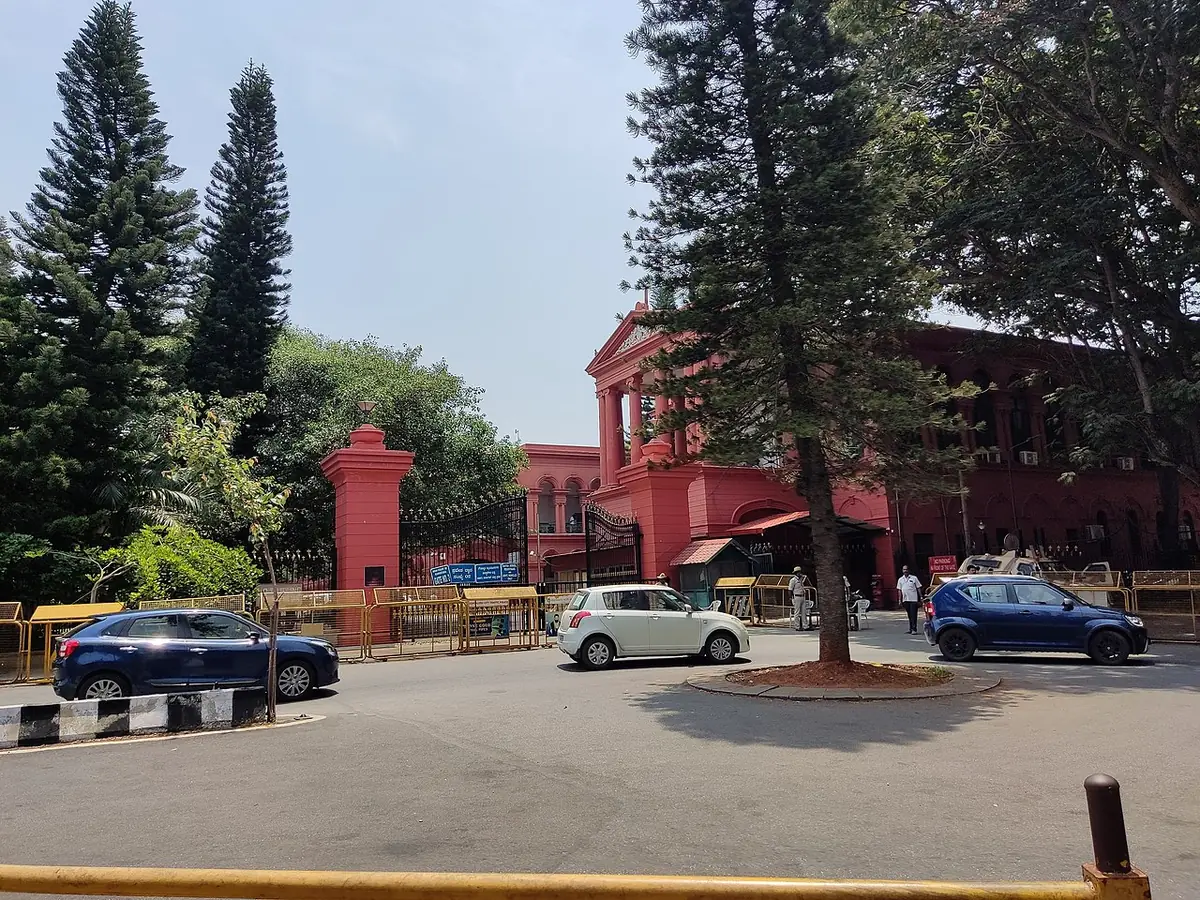
The red High Court building among the trees of central Bengaluru — Photo: Quantumtunneling · CC BY-SA 4.0 · Wikimedia Commons
Moving country and settling in this megacity means accepting administrative, cultural and climatic reference points that are completely different from the ones you know.
The success of a residential property project in Bangalore rests on a careful analysis of your journeys and your family priorities. Whether you work remotely for international organisations, manage teams on site in the tech parks or are looking for a stable setting to school your children, the location radically changes the nature of your investment.
Close to the tech zones
If your days are split between the campuses of Whitefield or the Outer Ring Road, targeting a house along these corridors is essential to protect your sanity from the city's legendary traffic jams. The properties available there are often part of secure gated communities, offering a welcome compromise between private space and shared services. You keep your commute to a strict minimum, even if the price per square metre carries an obvious premium due to the scarcity of land.
Quiet neighbourhoods in the north or west
For those who value tree-lined streets, cultural venues and long-established schools, areas such as Malleshwaram or Sadashivanagar are first-rate choices. The houses there have unique character, often rooted in the history of the garden city, but buying one demands quick reactions and a substantial budget. Life there is more walkable and anchored in local traditions, while staying connected to the main arteries through the expanding metro network.
University and residential hubs
Buyers focused on gross yield and reliable rent collection will turn to intermediate areas that are well served by public transport and close to leading medical facilities. In these areas, houses that can be divided or small semi-detached villas find tenants very quickly among a young, mobile working population. Letting management is made easier by the strong structural demand from digital-sector professionals and international consultants.
Living here when you come from abroad: what really changes
Once these reference points are absorbed, the central question becomes choosing the exact area within the patchwork of neighbourhoods.
Settling for the long term in a house in Bangalore as an expatriate or foreign investor means unlearning many habits. Your relationship with domestic space, managing household staff and dealing with public services all follow specific codes that you need to absorb quickly to avoid administrative or personal disappointment.
From abroad
Near-exclusive reliance on centralised, automated public services
Bangalore
A household organisation that relies on a network of regular service providers and domestic help
You have to delegate and coordinate multiple people for upkeep, gardening and security, which turns the role of owner into that of the manager of a small operation.
From abroad
Centralised building standards and unified land registry plans
Bangalore
Title deeds and planning certifications (Khata) that vary widely
Carefully checking the legal origin of the property and its compliance with local regulations matters more than looks alone, and always requires the support of an independent specialist lawyer.
From abroad
Central heating and standardised temperature control
Bangalore
Natural ventilation supplemented by air conditioning depending on the season
Bangalore's climate, known for being relatively mild thanks to its altitude, still calls for particular attention to sound insulation and monsoon handling when assessing the structure of the building.
From abroad
A largely walkable lifestyle centred on shops right on your doorstep
Bangalore
Dependence on major roads and home deliveries for shopping
Where your house sits in relation to the main roads and shopping centres determines how self-sufficient your household really is and how exposed you are to traffic noise.
Which Bangalore neighbourhood should you choose to put down roots?
Analysing these micro-markets leads straight to a realistic look at purchase budgets and current price trends.
Bangalore is not a uniform whole but a constellation of neighbourhoods with very distinct identities, from tech-driven buzz to historic residential enclaves. Each area strikes its own balance between land cost, access to transport, air quality and the liveliness of neighbourhood life.
Whitefield & Electronic City
An intense pace set by the nearby tech parks, gated residential complexes and modern shopping centres.
Suits
Professionals and investors looking for strong rental demand and jobs right on the doorstep.
Trade-off
Long journeys to reach the historic centre and occasional gridlock on the main roads.
Indiranagar & Koramangala
A vibrant, cosmopolitan atmosphere, dotted with trendy cafés, well-known restaurants and very lively shopping streets.
Suits
Those who enjoy a dynamic urban lifestyle, walkable at times, with a very rich choice of leisure options.
Trade-off
Extremely strong pressure on land, which means high purchase prices and few detached houses.
Jayanagar & Malleshwaram
The calm of large tree-lined spaces, a carefully planned grid of blocks and a strong attachment to local traditions.
Suits
Families and buyers who put residential quality of life, parks and proximity to renowned schools first.
Trade-off
A very closed property market where available homes often change hands privately.
Beyond the face value of the property, the legal nature of the ownership rights you acquire is the real test of your investment.
Bangalore's residential property market shows wide price differences driven by the precise location, the size of the private plot and the standard of the construction. Far from the fanciful figures sometimes passed around without any basis, recorded transactions reflect a steady rise in the value of land with secure title, carried by the city's economic vitality.
BangaloreFor saleHouseestimate
Median price / m²₹74,005Half the apartments sell below this
Median price₹15mthe average is 14% higher — a few very large properties pull it up
Most common2 bedrooms50 % of listings
Average size193 m²
By number of bedrooms
Bedrooms
Share of market
Avg price
Price / m²
Avg size
2most common
50 %
₹13.6m
₹77,900
175 m²
3
38 %
₹18.1m
₹74,005 −5 %
245 m²
4
13 %
₹23.8m
₹71,668best value / m²
333 m²
Each row is an average, compared against the area average of ₹77,900 / m². These are indicative estimates of a typical local market, not a measured sample of live listings. Check current listings before relying on them.
What you can actually own: titles and regulations
Once the legal framework is confirmed and the property identified, the transaction follows a precise timeline that must be respected step by step.
The safety of a property purchase in India depends not on the quality of the finishes but on the absolute clarity of the chain of title. Understanding the distinction between the different types of administrative approval protects you against potential land disputes and ensures you can resell your asset smoothly in the future.
Rigorous checks on the titles and the Khata status
The Khata document certifies that the property is registered for tax with the municipal authorities and that the owner is the legitimate party liable for property taxes. A missing or unclear Khata, or a status still being regularised, is an absolute red flag that should immediately halt any intention you have of committing money.
What it changesAlways insist on the full history of transfer deeds over the last thirty years and have them analysed by an independent local lawyer you appoint yourself.
Restrictions for foreign investors (NRI / PIO)
Indian foreign exchange and investment rules (FEMA) strictly govern the purchase of property by non-residents and foreign nationals. While citizens of Indian origin enjoy some flexibility, foreigners with no direct family tie to the country are barred from buying undeveloped land, which limits their options to completed buildings.
What it changesConfirm your exact legal status beforehand with a tax adviser specialising in cross-border flows before signing any preliminary sale agreement.
The rule to understand before paying a deposit
To complete the purchase by the book, the practical course of the transaction requires careful coordination between everyone involved.
Committing money to property in Bangalore follows a strict sequential process in which each step determines whether the next one is valid. Skipping steps or rushing because another potential buyer has appeared exposes the buyer to irreversible financial risks.
Finding a property that matches your brief and making an initial check on the agent or the owner selling directly.
An in-depth legal audit of all the title deeds, the building permits (BDA / BMRDA) and the validity of the Khata certificate.
Negotiating the financial terms and drafting a preliminary Agreement to Sell setting out the conditions precedent.
Paying the deposit into escrow (usually 10% of the total price), held until all the conditions precedent have been met.
Finalising the Sale Deed before the competent registration officer and paying the stamp duty.
The titles are formally transferred in the municipal register and you officially take possession, with the utility accounts updated.
How a property transaction works, step by step
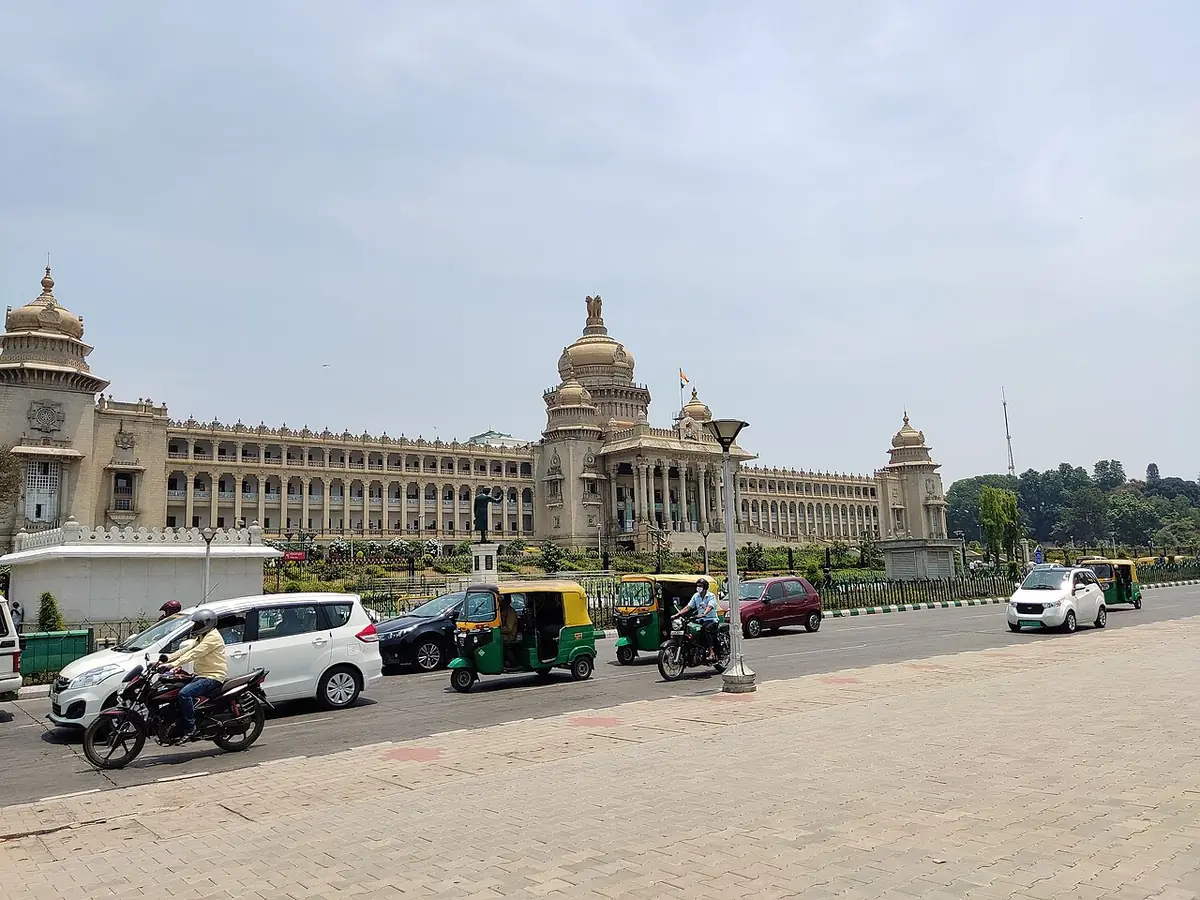
The Vidhana Soudha and its gardens in central Bengaluru — Photo: IM3847 · CC BY-SA 4.0 · Wikimedia Commons
A successful property transaction in Bangalore relies on the coordinated work of specialist professionals: lawyers, valuers, bankers and local notaries. Knowing the exact role of each party lets you stay fully in control of the process at every stage of the timeline.
The buyerSetting the budget and choosing the criteriaYou set your maximum budget, including registration taxes, and pick the areas that suit the way you live.
The advising lawyerLegal due diligence and title checksThey verify that the chain of title is genuine, that there are no hidden mortgages and that the building complies with the planning rules in force.
The approved valuerTechnical survey and market value estimateThey inspect the structure, assess the condition of the roof, the electrics and the water supply, and put a figure on any work needed to bring it up to standard.
The seller and the buyerSigning the sale agreement and paying the depositA written agreement sets out the agreed price, the payment deadlines and the penalties that apply if either party pulls out without justification.
The registration officerOfficial registration of the Sale DeedThe final signature is registered with the local sub-registrar once the stamp duty and applicable government taxes have been paid.
The municipal servicesKhata transfer and transfer of utility accountsThe last administrative step, in which the water, electricity and local tax accounts are officially switched into your name.
Buying a house or an apartment in Bangalore: which should you choose?
Once this fundamental choice between land and height is made, it is time to analyse the financial reality of your project in Karnataka's capital.
Buying property in Bangalore means choosing between two radically different ways of life: the independence of a detached house, often called a villa in the outlying residential neighbourhoods, or the collective security of an apartment within a gated complex, the well-known gated communities. This decision does not rest solely on your initial budget, but on how much you can tolerate local constraints every day, particularly water, electricity and getting around in a constantly expanding metropolis.
Apartments in modern complexes offer shared infrastructure that is essential for keeping a steady level of comfort despite supply cuts. They include powerful backup generators, wastewater treatment plants and underground reserves that make up for the chronic shortages in the municipal supply. This collective self-sufficiency greatly reduces the mental load on owners, who do not have to personally oversee the maintenance of heavy equipment or the night-time security of the site.
On the other hand, choosing a house in Bangalore, whether in Indiranagar, Jayanagar or the developing suburbs towards Whitefield, gives you complete architectural freedom and private space that no apartment can match. You own the land, you avoid the often costly management fees of large complexes and you have your own outdoor space. However, that independence comes at a high logistical cost: you have to deal yourself with road problems, possible flooding during the monsoon season and securing the perimeter of your property.
In terms of wealth building, a detached house generally appreciates more because buildable plots are becoming scarce in Bangalore's established areas. Nevertheless, a well-located apartment is far more liquid, making it much easier to resell or to let quickly to expatriates or senior professionals working in the tech sector. Your final decision should therefore weigh the operational peace of mind offered by shared living against the long-term growth potential of bricks, mortar and land.
What real budget do you need to live and buy in Bangalore?
Once the financial framework is settled, it is crucial to understand how a typical day actually plays out given the local realities.
Buying a home in Bangalore is not just about the price per square metre advertised by developers or agencies. You must factor in all the local taxes, especially stamp duty and registration fees, which weigh heavily on the initial budget. On top of that, monthly maintenance charges for the upkeep of common areas, the pool and security vary considerably depending on the standard of the complex. Finally, everyday living costs, including domestic staff, electricity and transport, complete the financial equation you need to assess your long-term ability to pay in this fast-growing Indian metropolis.
Purchase costs and property taxes in Bangalore
Cost item
Estimated range (INR)
Impact on the overall budget
Stamp duty
5% to 6% of the market value
Mandatory tax paid to the state government when the sale deed is registered.
Registration fees
1% of the market value
Administrative fees for officially recording the title deed in the land register.
Legal and due diligence fees
INR 25,000 to 75,000
The fee for the lawyer who checks the 30-year history of the title deeds.
Estate agent commission
1% to 2% of the sale price
Standard brokerage fees shared between buyer and seller according to local custom.
Stamp duty rates can vary slightly depending on the buyer's gender or the type of property in Bangalore's urban areas.
Recurring charges and monthly living budget
Type of charge
Average monthly amount (INR)
What is included
Complex maintenance (Maintenance Fee)
INR 3,500 to 15,000
Lift maintenance, 24/7 security, upkeep of green spaces and waste management.
Electricity (BESCOM) and generator
INR 4,000 to 12,000
Standard household consumption including air conditioning and diesel for the generator.
Domestic staff (cleaner / cook)
INR 8,000 to 25,000
Pay for daily help depending on the hours worked and skills.
High-speed internet and subscriptions
INR 1,500 to 3,500
Unlimited fibre connection and streaming services essential for working from home.
These amounts are for a standard household living in a three-bedroom apartment in an established residential neighbourhood of Bangalore.
Healthcare, schools, transport: what does an ordinary Tuesday look like in Bangalore?
Beyond this well-oiled routine, many aspects you will never see in the sales brochures deserve your full attention before you sign.
Time management in Bangalore is dictated by how freely the traffic moves and by where the key infrastructure is located. Planning work and school journeys ahead avoids the daily exhaustion of urban congestion. Residents quickly learn to structure their schedules around rush hour to protect their work-life balance. This timeline of an ordinary Tuesday illustrates the logistical trade-offs needed to live calmly in India's Silicon Valley.
07:30 - 08:30School run to the international schoolsAn early start is essential to avoid the gridlock on the main roads leading to Whitefield or Electronic City. Private school buses or the complex's own shuttles make this daily pick-up reliable.
09:00 - 13:00Settling in at the office or a coworking spaceThe tech hubs of Manyata Tech Park or the Outer Ring Road host the working population. Internet connectivity and air conditioning provide excellent working conditions comparable to international standards.
13:00 - 14:00Lunch break and local shoppingThe shopping districts make it easy to stock up on fresh organic produce in specialist stores such as Nature's Basket or at traditional neighbourhood markets.
14:30 - 17:30Business meetings and paperworkThe afternoon is given over to follow-up meetings and dealing with local banks or land authorities to finalise purchase files in progress.
18:00 - 20:00Heading home and after-school activitiesThe evening traffic peak calls for patience. Families favour sports or cultural activities inside their gated complex to avoid the traffic altogether.
20:30 - 22:00Dinner and planning household maintenanceThe evening is used to check the water reserves, schedule the next day's deliveries and chat with neighbours about life in the complex.
What brochures and estate agencies will never tell you
With these precautions taken, let us look at the regrets buyers most often express six months after moving in.
Bangalore's property market has regulatory and technical specifics that developers carefully leave out of their marketing brochures. Understanding these grey areas protects you against complex land disputes, chronic delivery delays and surprises over how the land is serviced. Here are the key points every foreign or local buyer should go through with their legal adviser before committing.
The validity of colonial-era and ancestral title deeds
Many plots in Bangalore rest on complex chains of title going back several decades. A thorough check by an independent lawyer is essential to rule out any risk of a double sale or a later inheritance challenge.
Encroachments on stormwater drains (Rajakaluves)
Several housing projects built too close to the old stormwater channels have been hit with partial demolition orders from the municipal authorities during episodes of severe flooding.
Delays in connecting to the official water and sewerage networks
Some residential projects are not linked to the main BWSSB (Bangalore Water Supply and Sewerage Board) network. They rely on water tankers, whose costs soar in the dry season.
Unauthorised changes to the land-use plan
Developers frequently exceed the permitted floor area ratio or build extra floors without final approval from the BDA (Bangalore Development Authority), which blocks the issue of the occupancy certificate.
The buying mistakes you only discover after six months of living here
Despite these avoidable traps, this market does not suit every kind of investor or expatriate.
Looked likeA very quiet outlying location with direct access via an unpaved side road.
Turned outThe side road was turned into a relief route for heavy goods vehicles, causing constant noise and unbearable fine-particle pollution from daybreak.
Would have caught itConsult the BDA's long-term planning documents to identify road projects and future light metro routes planned around the area.
Turned outThe developer underestimated the cost of maintaining the high-end facilities, leading to a sudden 100% rise in charges at the very first owners' general meeting.
Would have caught itAsk for five-year management forecasts and check the financial soundness of the volunteer or professional association running the complex.
Looked likeAn apartment flooded with natural light thanks to large west-facing windows with no buildings directly opposite.
Turned outThe tropical heat builds up dramatically in the living areas in the afternoon, sending the electricity bill for constant air conditioning through the roof.
Would have caught itFavour a north or east orientation, or make sure there is insulating double glazing and architectural sun shading suited to the local climate.
Looked likeA peaceful residential neighbourhood with small local shops a few minutes' walk away.
Turned outThe lack of proper pavements and the heavy traffic make any walk dangerous, turning every outing into a journey you have to make by car.
Would have caught itWalk around the neighbourhood at different times of the day and night to test how accessible and safe the immediate surroundings really are on foot.
Who should definitely not buy property in Bangalore?
Now is the time to take stock of your deeper motivations and decide whether you are able to take the plunge.
Buying property is never a universal solution, and Bangalore's dynamic market has structural demands that can collide head-on with your short- or medium-term life plans. The rigidity of property investment in India, combined with local tax and administrative specifics, means you need to know when to walk away if your personal situation shows signs of fragility or uncertainty about where you will live.
The professional on a short assignment or with uncertain international mobility
→Flexible renting rather than buying outright
Buying and selling costs in India (stamp duty, agency commissions, short-term capital gains tax) wipe out any financial return if the property is sold before a minimum of five to seven years.
The investor who cannot stand red tape and court delays
→More liquid alternative financial investments (index funds, shares, bonds)
In a dispute with a developer, a tenant or a neighbour, the Indian civil justice system is known for its endemic slowness, tying up capital for years in endless proceedings.
The individual looking for a high, immediate gross rental yield
→The rental market of major European cities or other asset classes
In Bangalore, gross rental yields have traditionally hovered around 2.5% to 3.5% a year, which covers neither real inflation nor the opportunity cost of the capital tied up, without counting on a hypothetical capital gain.
The buyer who cannot tolerate urban noise, power cuts and infrastructure hiccups
→A rural lifestyle or countries with perfectly predictable public services
Despite the rapid modernisation of the city's infrastructure, Bangalore remains a megacity in transition where noise, constant roadworks and road disruptions are an unavoidable part of daily life.
So, are you really ready to go ahead with your property project in Bangalore?
Buying an apartment or a house in Bangalore is a long-term commitment that demands clear thinking, method and full acceptance of local realities. If you have gauged the complexity of the title deeds, factored in the real cost of maintenance charges and accepted the distinctive pace of this tech metropolis, your project rests on solid foundations. The decision should not be driven by fear of missing a price rise, but by a genuine wish to put down lasting roots in Karnataka's urban landscape.
Take the time to validate every step with independent professionals, whether a lawyer specialising in land law or a neutral financial adviser. Visit the properties you are targeting at different times of day to assess the noise level, the traffic and the quality of the water supply. Do not sign any preliminary agreement without checking that the project fully complies with planning rules with the city's relevant authorities.
In the end, succeeding with a property purchase in Bangalore means accepting that perfection does not exist in this fast-changing market, but that opportunities reward patient, well-prepared buyers. If your time horizon is longer than seven years and you want to be part of this dynamic community, your investment will help build lasting wealth while giving you a stimulating place to live in the heart of modern India.
Related questions
Which documents must be checked before buying a property in Bangalore?
You must check the original Sale Deed, the Encumbrance Certificate covering a 30-year period to prove there are no charges or mortgages, the BDA or BBMP approval, and the official occupancy certificate.
Can a foreigner or a non-resident Indian (NRI) buy property in Bangalore?
Yes, non-resident Indian citizens (NRIs) and Persons of Indian Origin (PIOs) can acquire residential and commercial property in India without major restrictions, with the exception of agricultural land. Foreign nationals living in India also have certain options, subject to conditions.
What is the Khata and why does it matter so much for an owner in Bangalore?
The Khata is an essential tax and administrative document confirming that a property is registered with the BBMP and that its owner is liable for property tax. Without a valid Khata (A-Khata), it is impossible to get a bank loan or to resell the property with peace of mind.
Which neighbourhoods are most sought after for buying property in Bangalore?
Established neighbourhoods such as Indiranagar, Jayanagar and Koramangala are highly prized for their central location and green spaces, while outlying areas such as Whitefield, Electronic City and Sarjapur Road attract tech professionals because they are close to the IT parks.
How do Indian banks assess creditworthiness for a home loan?
Lenders look closely at your regular income, your credit score (CIBIL score), your job stability and the official market value of the property as assessed by their own approved valuers before granting any financing.
How long does it usually take to complete a property transaction in Bangalore?
A transaction generally takes between four and eight weeks, the time needed to carry out a full legal audit of the titles, negotiate the terms of the sale agreement and schedule the official registration with the sub-registrar.
Which annual taxes do you pay after buying a home?
Every year the owner has to pay municipal property tax to the BBMP, calculated on the basis of the floor area, the location and the indicative rental value of the property.
Are off-plan (under-construction) projects risky?
Yes. Although the RERA regulatory law protects buyers against unjustified delivery delays, risks remain around the developer's financial health. It is therefore advisable to favour builders with a spotless track record.
How is security handled in large gated residential complexes?
Gated communities generally have round-the-clock security staff, strict access control for visitors through badges or mobile apps, and a full network of CCTV cameras covering the common areas.
Should you hire a specialist lawyer to secure your purchase?
Absolutely. An independent lawyer specialising in land law in Bangalore is the only effective safeguard for checking that title deeds are genuine, spotting pending disputes and drafting a sale agreement that protects your interests as a buyer.