Moving to Bangalore to rent an apartment calls for methodical preparation, given how varied the neighbourhoods are and how particular the local market can be. This guide takes you step by step through the real costs, choosing the right area and securing your lease with complete peace of mind.
Get the app
What nobody tells you.
Real prices, hidden costs and the traps to check before you commit.
What do you really get when you rent an apartment in Bangalore?
Scroll
What do you really get when you rent an apartment in Bangalore?
Moving to Bangalore to rent an apartment calls for methodical preparation, given how varied the neighbourhoods are and how particular the local market can be. This guide takes you step by step through the real costs, choosing the right area and securing your lease with complete peace of mind.
Written by the ting.ad editorial team ·
Bangalore in Street View: drag to look around.
Beyond the physical amenities, your whole way of life has to fit with how the city is laid out.
Renting an apartment in Bangalore is about more than finding four walls and a roof in the heart of India's Silicon Valley. Gated complexes often offer remarkable shared amenities that completely reshape daily life for newcomers. Yet the reality of the city's infrastructure forces constant trade-offs between the quality of the interior and access to the outside world.
Ultra-modern, air-conditioned interiorsvsFrequent power cuts and noisy generators
Upmarket residential complexes have backup generators, but switching over from the public grid still causes regular brief outages that you need to plan for.
Round-the-clock security and shared green spacesvsSometimes oppressive closeness to neighbours and strict society rules
Life in a gated community shields you well from street noise and guarantees good sports facilities, at the cost of a freedom that is sometimes curtailed by fussy management committees.
Very competitive rents compared with European standardsvsHigh maintenance charges and huge security deposits
The headline rent may look affordable, but the advance demanded by local landlords and the monthly maintenance fees weigh heavily on your initial budget.
Does Bangalore really suit your working and personal life?
Leaving your home country to settle here upends all the administrative and social reference points you were used to.
The metropolis sprawls across dozens of square kilometres, and each area has its own rhythm, its own notorious traffic jams and its own typical residents. Choosing where to live depends above all on how well your daily commute fits with the micro-culture of the neighbourhood you are considering.
The tech hub option
Living close to the big business parks such as Electronic City or the Outer Ring Road will save you hours of travel every day. Apartments there are practical, often recent and designed for an international working population. On the other hand, cultural life feels more artificial and local life fades behind the corporate campuses.
The historic neighbourhood option
Areas like Indiranagar or Jayanagar offer a rare walkable character, with tree-lined streets, local shops and a very dense choice of places to eat. Homes there are older and sometimes less well soundproofed, but the charm of neighbourhood life more than makes up for these small practical drawbacks day to day.
The residential, family option
The northern areas and the residential east offer spacious apartments in housing societies, with good schools and first-rate medical facilities close by. Life there is calmer and more predictable, but getting to the historic city centre becomes a real logistical challenge as soon as you venture out outside off-peak hours.
Living here when you arrive from abroad: what changes radically in your daily life
The success of your move then depends directly on choosing the neighbourhood where you will settle.
Moving from a tightly regulated rental market like the one you may know back home to Bangalore's contractually flexible but demanding one surprises every newcomer. Local customs around neighbours, maintenance and managing contracts rest on entirely unfamiliar social codes.
From abroad
A rental contract strictly governed by law and public authorities
Bangalore
A private rental agreement negotiated on customary terms, with eleven-month leases
The rules on renewal and rent increases depend much more on the relationship of trust you build with the landlord than on national legal scales.
From abroad
Centralised administrative procedures and standardised rent receipts
Bangalore
Plenty of local paperwork, a central role for the security deposit and multiple supporting documents
Be ready to provide numerous employment letters and to pay large sums as a deposit as soon as you sign the initial lease.
From abroad
Routinely calling in professional tradespeople for repairs
Bangalore
Easy but informal help from the complex's maintenance staff
Small everyday hassles are often sorted out faster thanks to on-site staff, provided you know how to communicate diplomatically.
From abroad
Waste sorting and services run by the local council
Bangalore
Rubbish collection organised by the housing society, with precise local requirements
Environmental good citizenship takes very concrete forms here, and it is worth picking them up in your first few days so you fit in smoothly.
Which Bangalore neighbourhood should you choose for your priorities?
Once you have identified the ideal area, you need to take a cool-headed look at the rents actually being charged there.
Bangalore's geography means choosing where to live according to your work constraints and your personal aspirations. Each neighbourhood has its own identity, a distinct demographic profile and clear comparative advantages.
Indiranagar
Constant energy, a successful mix of quiet residential streets and very lively shopping streets.
Suits
Young professionals, expats looking for a rich social life and lovers of good restaurants.
Trade-off
Some of the highest rents in the city and gridlocked traffic at rush hour.
Jayanagar
A traditional, orderly atmosphere, laid out in clearly defined blocks with superb tree-filled parks.
Suits
Families who value calm, greenery and a more authentically local way of life.
Trade-off
Housing stock that is sometimes ageing, and a real distance from the big tech hubs in the north.
Koramangala
An ultra-trendy cosmopolitan hub, a hotspot for innovation, start-ups and urban dining.
Suits
People who want to do everything on foot and live at the pace of the local business buzz.
Trade-off
Intense pressure on property that makes finding spacious homes difficult and expensive.
Whitefield
A vast cluster of gated complexes and modern towers backing onto the IT parks.
Suits
Employees of multinationals in the sector looking for standardised comfort.
Trade-off
Marked geographical isolation from the historic centre and roads that are often congested.
How much does it really cost to rent an apartment in Bangalore?
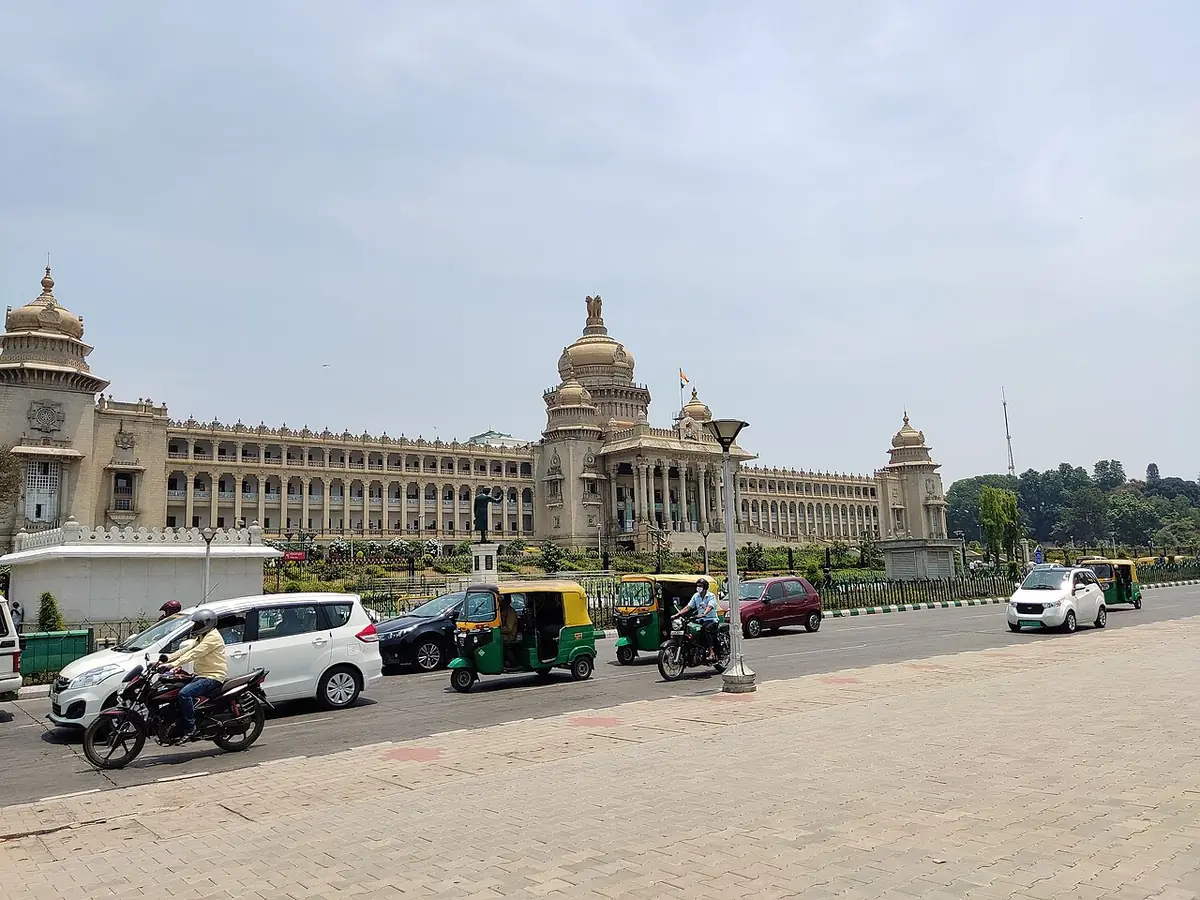
The Vidhana Soudha and its gardens in central Bengaluru — Photo: IM3847 · CC BY-SA 4.0 · Wikimedia Commons
Understanding ownership structures and lease types will help you avoid the classic contractual pitfalls.
Bangalore's rental market is marked by wide price differences depending on the standard of the complex and how central the neighbourhood is. Beyond the headline rent, the overall budget includes fixed charges and substantial financial guarantees that you need to factor in from the outset.
BangaloreTo rentApartmentestimate
Median price / m²₹304Half the apartments sell below this
Median price₹32kthe average is 14% higher — a few very large properties pull it up
Most common2 bedrooms40 % of listings
Average size110 m²
By number of bedrooms
Bedrooms
Share of market
Avg price
Price / m²
Avg size
1
20 %
₹20.7k
₹346 +8 %
60 m²
2most common
40 %
₹32k
₹320
100 m²
3
30 %
₹42.6k
₹304 −5 %
140 m²
4
10 %
₹55.9k
₹294best value / m²
190 m²
Each row is an average, compared against the area average of ₹320 / m². These are indicative estimates of a typical local market, not a measured sample of live listings. Check current listings before relying on them.
What you can really sign and hold as an expat tenant
Each stage of the transaction follows a precise order that you should respect to secure your move.
Residential tenancy in India rests on very specific customary practices that protect the landlord as much as the tenant, provided every agreement is put in writing. It is essential to distinguish what is merely tolerated verbally from what is a solid contractual commitment.
The renewable eleven-month lease
The vast majority of residential lettings are built around eleven-month contracts, renewed by tacit agreement or by addendum. This format avoids compulsory registration with the local tax authorities while giving newcomers welcome flexibility if they need to leave.
What it changesYou should expect a possible rent review at each annual renewal and put all the conditions for returning the security deposit in writing.
The security deposit and rent advances
Landlords traditionally require a sum equal to several months' rent, sometimes as much as six months, held for the entire tenancy. This local practice makes up for the lack of institutional rent guarantee schemes comparable to those found in Europe.
What it changesThis large amount of tied-up cash must be built carefully into your initial financing plan before you commit to your move abroad.
The golden rule to understand before paying a first deposit
To see this process through without stress, here is the exact order of steps to follow on the ground.
Committing to a property in India without following the right order of checks exposes you to avoidable financial setbacks. Every supporting document must be verified before making any payment, even a partial one.
Spotting an apartment you love in a complex you have shortlisted
Careful verification of the original title documents presented by the owner or their representative
Detailed physical inspection of the condition of the fittings, the plumbing and the backup power supply
Written confirmation from the management committee of the exact maintenance charges and the rules for using common areas
Drafting and signing a Holding Deposit Agreement that clearly states the refund conditions
Signing the final eleven-month lease and paying the full security deposit
How a rental transaction in Bangalore unfolds, step by step
A successful move into a home in Bangalore comes from a rigorous process involving several coordinated local players. By following this roadmap, you drastically reduce the risk of misunderstandings with your landlord.
The property consultantShortlisting suitable propertiesThey filter listings against your strict criteria and organise grouped viewings, taking traffic constraints into account.
YouViewing and negotiating the termsYou inspect the surroundings, test the fittings and negotiate the specific clauses of the future lease.
The landlordTitle checks and initial agreementThey provide proof of ownership and formally accept your conditions for moving in.
Both partiesPaying the reservation depositA sum is held in escrow to secure the property while the contract is formally drafted.
The property managerDrafting and signing the leaseThe official eleven-month document is initialled by both parties together with a full inventory of the furnishings.
The complex's caretakerCheck-in inspection and handing over the keysYou officially move in after a final joint check of the general condition of the home.
Apartment or villa in Bangalore: weighing the security of a housing society against residential independence
Once the type of property is settled, the central question of the overall budget and hidden charges comes straight to the fore.
Choosing between an apartment in a huge gated community and a detached villa in Bangalore depends above all on how you relate to time, daily commuting and handling unexpected technical problems. Modern apartments, often grouped in high-rise towers in neighbourhoods such as Indiranagar, Koramangala or along the Outer Ring Road, offer a complete ecosystem. You will find diesel backup generators, permanent security, swimming pools and green spaces maintained by a professional management company. It is the ideal option for families where both partners work and cannot take on the upkeep of a roof or a water pump.
Conversely, buying a villa or independent house in quieter residential areas such as Jayanagar, Malleshwaram or certain enclaves in the north of the city gives you unrivalled freedom of space. You have your own plot, complete independence from the decisions of an owners' association and living space that is often more generous, for a price per square metre that can be comparable if you move slightly away from the central tech hubs. However, this independence carries a direct operating cost: you have to hire your own guards, maintain the external plumbing, cope with power cuts by buying your own inverters and personally coordinate repairs to the facade.
Financially, resale and liquidity strongly favour well-located apartments. Large developments built by recognised national developers sell faster because they reassure institutional buyers and young professionals, whether expat or local. Detached villas, although they generally gain value well over the long term thanks to the scarcity of land, need a buyer with a specific profile and a substantial maintenance budget. So you have to weigh the operational peace of mind of an apartment against the lasting asset value of a house with a private garden in the heart of Karnataka's capital.
Finally, daily life is transformed radically either way. Living in an apartment encourages children to make friends spontaneously in secure play areas and gives easy access to on-site gyms. Living in a villa, even on a quiet street, means dealing with the realities of municipal roads, stray dogs and street dust, while offering the rare privilege of parking several vehicles and creating an entirely private outdoor space. Your final decision should therefore come from your tolerance for communal constraints set against your deep attachment to having your own space.
What total budget and monthly charges should you expect to live comfortably in an apartment in Bangalore?
With these amounts set, it is worth picturing a typical day in concrete terms to gauge the impact of your location.
Buying an apartment in Bangalore is about more than the purchase price advertised by the developer or the seller on property portals. You must factor in the property registration tax set by the State of Karnataka, the quarterly or annual housing society charge, and provisions for water and backup electricity. Failing to budget for these recurring expenses quickly leads to unexpected financial strain in your very first year in the metropolis.
Initial purchase costs and mandatory taxes
Expense item
Estimated amount or rate
Frequency and method
Stamp duty and registration
Roughly 5.6% to 6.5% of the declared value
Paid once, when the sale deed is executed
Legal and conveyancing fees
0.5% to 1% of the property price
Paid during verification of the title documents
Transfer fees and initial society charges
Between INR 50,000 and INR 150,000
One-off contribution to the housing society's corpus fund
Standard estate agency commission
1% to 2% of the total transaction amount
Paid by both parties when the sale agreement is signed
These costs always come on top of the net price to the seller and must be set aside in cash from the start of your search.
Running costs and monthly operating expenses
Type of charge
Monthly budget range
What is included
Housing society charges (maintenance)
INR 3 to INR 6 per square foot
Lift maintenance, 24-hour security, cleaning of common areas and the pool
Electricity bill (BESCOM + diesel)
INR 3,000 to INR 8,000
Personal consumption and fuel for the backup generator
Water supply (BWSSB + tanker)
INR 1,500 to INR 4,000
Municipal running water and top-up purchases from tanker lorries in the dry season
Broadband internet and other subscriptions
INR 1,000 to INR 2,500
High-speed fibre connection, essential for working from home
Housing society charges generally rise by 5 to 10% each year to keep up with inflation in labour and energy costs.
Healthcare, schools and transport: what does an ordinary Tuesday look like living in an apartment in Bangalore?
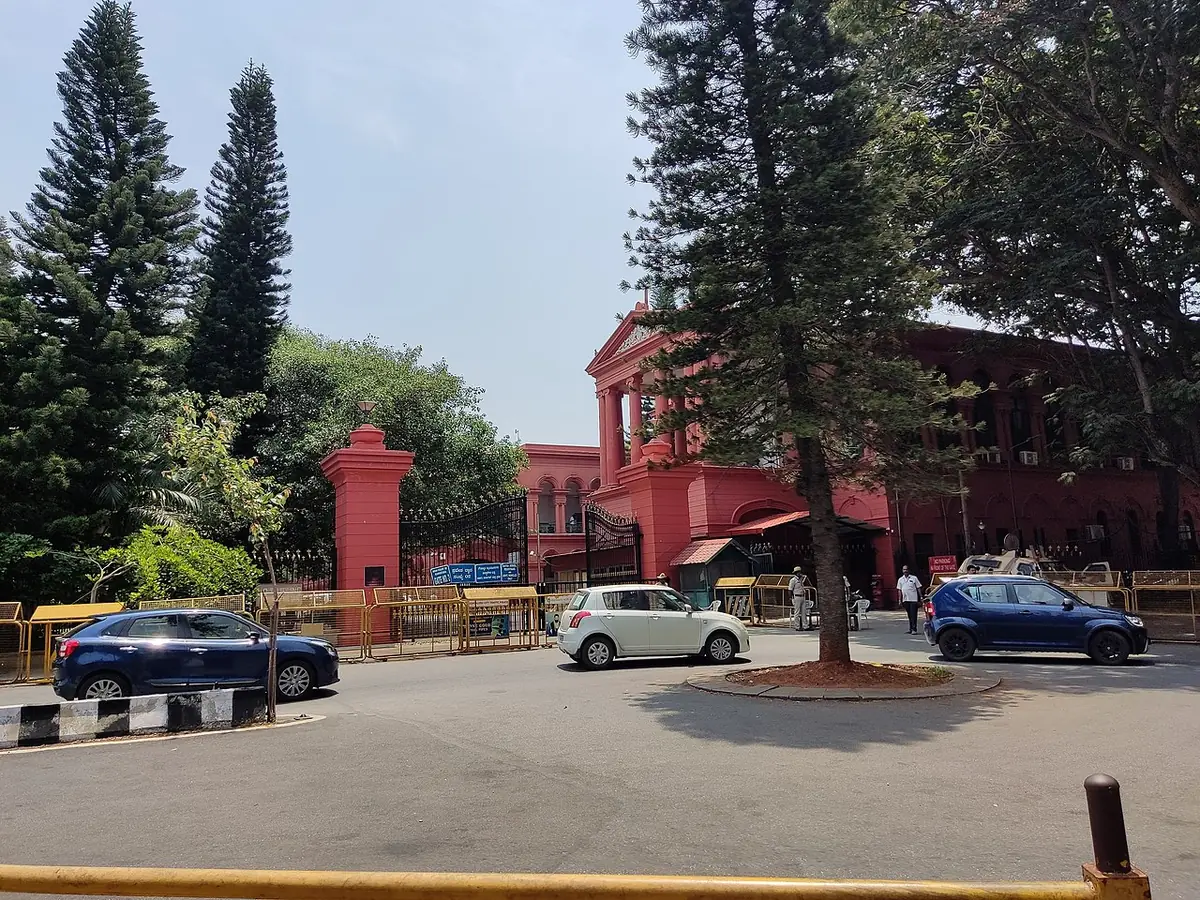
The red High Court building among the trees of central Bengaluru — Photo: Quantumtunneling · CC BY-SA 4.0 · Wikimedia Commons
Beyond this well-oiled routine, many aspects you will never see in sales brochures deserve your full attention.
Organising a working day and family life in Bangalore is dictated by how smoothly the traffic flows and how close the essential facilities are. Living in a well-connected neighbourhood lets you avoid hours lost in the jams on the Outer Ring Road or at Silk Board Junction. Every part of the day needs planning to balance work demands with the children's wellbeing and quick access to healthcare in an emergency.
07:30HomeAn early start and a check that there is water in the housing society's tanks before the family's day gets going.
08:30International or local schoolDropping the children off by the complex's school bus or a neighbourhood car pool to avoid the morning traffic peak.
09:30Office, coworking space or homeArriving at work, often in the tech parks of Whitefield, Electronic City or Manyata Embassy Business Park.
13:00Neighbourhood restaurant or canteenA business lunch or local lunch break serving Karnataka or Kerala cuisine at moderate prices.
17:30Supermarket or fresh vegetable marketBuying the day's fresh produce from street vendors or in modern chains such as Nature's Basket or Spar.
19:00Local hospital or clinicA routine medical check-up or a trip to the pharmacy if needed, with major hospitals such as Manipal or Apollo always within reach.
20:30Back homeA quiet family dinner in the secure apartment, away from the bustle of the city's main roads.
What the property listing won't tell you: the hidden realities of Bangalore's residential market
In hindsight, these overlooked practical and legal issues often lead to bitter regrets among unprepared buyers.
Developers' marketing photos and glowing descriptions always present an idyllic, sanitised picture of life in Bangalore. Dig into the reality on the ground and you find recurring structural problems linked to water management, the legality of land titles and the overloaded public infrastructure around. Knowing about these issues before you sign a purchase commitment will spare you heavy financial setbacks and intractable disputes with neighbours.
Water shortages and the quality of running water
Many outlying neighbourhoods are not connected to the BWSSB public network and rely entirely on deep borewells or private tanker lorries whose prices soar in summer. It is vital to check exactly where the housing society gets its water.
Disputes over storm-water drains (Rajakaluves)
Several developments built near former dried-up lakes or storm-water channels face recurring flood risks during the monsoon and the threat of official demolition for encroaching on public land.
Strict compliance with planning approvals (Khata)
A property in Bangalore must have an 'A-Khata' issued by the BBMP to guarantee its full legality and make it easier to obtain a mortgage from national banks. Properties with a 'B-Khata' carry major legal risks.
Noise and dust from neighbouring building sites
Bangalore's economic momentum means constant construction. An empty plot opposite your future balcony can become the site of a twenty-storey residential tower the following year, destroying your view and creating considerable noise.
The buying mistakes you only discover after six months in your new Bangalore apartment
Given these specific demands and risks, not everyone has the right profile to invest with confidence in the tech capital.
Looked likeA peaceful, leafy and perfectly quiet residential neighbourhood during a viewing on a Sunday morning.
Turned outA road clogged with commuter traffic avoiding the main routes from Monday rush hour onwards, making it hard to get around on foot.
Would have caught itVisit the property at three key moments in the week: a Monday at 8:30am, a Friday evening at 7pm and a Sunday afternoon, to compare the real atmosphere.
Looked likeA developer's promise of fast delivery of new roads and the metro, to boost the area's future capital gains.
Turned outEnormous administrative delays on public works, leaving residents cut off on damaged, unpaved roads for several years.
Would have caught itNever base a purchase decision on future infrastructure projects that have not started, and stick strictly to the actual, current state of the access roads.
Looked likeA dynamic, friendly volunteer management committee that seemed fully on top of the building's finances and upkeep.
Turned outFierce disputes between owners over the level of charges, opaque budgets and a chronic inability to recover unpaid dues.
Would have caught itRead the minutes of the housing society's last three general meetings and speak directly to several long-standing residents.
Looked likeModern sound and thermal insulation promising optimal comfort against the tropical climate and outside bustle.
Turned outConstruction defects invisible to the naked eye, causing serious water seepage with the first heavy monsoon rains.
Would have caught itAlways hire an independent technical survey firm to carry out a full building audit before signing the final deed.
Risky profiles: who really should not buy an apartment in Bangalore right now?
If you have worked through all these stages and your profile fits, the final question of commitment comes into clear focus.
Investing in property in a fast-growing metropolis like Bangalore demands financial flexibility, a high tolerance for administrative setbacks and a long-term horizon. Some buyers put themselves needlessly at risk by entering complex transactions without appreciating how rigid the local resale market is or how complicated legal procedures in India can be.
The young professional on a short contract or with uncertain international mobility
→Buying a large apartment on arrival so as to 'stop throwing money away on rent'.
Initial purchase costs (taxes, legal fees, agency) come to nearly 8% of the property's value. If you sell the apartment within five years, any capital gain is wiped out entirely by these transaction costs and the pre-EMI interest on the bank loan.
The foreign or non-resident investor badly advised on tax
→Buying a prestige property without properly structuring their money flows and RBI approvals.
Repatriating the proceeds of a property sale in India as a non-resident is subject to strict exchange control rules and significant tax deducted at source (TDS), which requires help from a specialist accountant.
The impatient buyer who cannot stand administrative delays
→Committing to an older property whose title documents need complex regularisation.
Checking the title history (Chain of Title) over thirty years in Bangalore can reveal procedural flaws or disputed inheritances that hold up the sale for months, sorely testing the nerves of buyers in a hurry.
So, are you ready to take the plunge and buy property in Bangalore?
Buying an apartment or a house in Bangalore is a decision that shapes your financial path for the next ten or twenty years. It should never be driven by the fear of missing out on a supposed bargain or by pressure from developers touting spectacular price rises in the tech districts. Bangalore's strength lies in its constant economic and demographic vitality, but that very appeal creates major challenges around infrastructure, traffic and water supply that you must be willing to build into your daily life.
If you have a solid deposit covering not only the purchase price but also all registration taxes and a contingency fund, and if you plan to live in the city for at least five to seven years, then the Bangalore property market offers remarkable opportunities. Well-managed large residential complexes in established areas guarantee a secure, cosmopolitan setting connected to the best schools and medical facilities in the State of Karnataka.
Take the time to view several properties at different times of day, insist on full transparency about the legal compliance of the titles (A-Khata) and make no compromise on the quality of the housing society's management. Support from an independent local lawyer specialising in property law and a neutral financial adviser is the best investment you can make to protect your capital and turn your plans into a lasting success in the heart of India's Silicon Valley.
Related questions
Which neighbourhoods are most sought after for buying an apartment in Bangalore?
The most popular areas include Indiranagar, Koramangala, Jayanagar and Malleshwaram for their charm and central location, along with Whitefield and Electronic City for their immediate proximity to the big tech parks and multinational corporate campuses.
Can a foreign national or a non-resident Indian (NRI) buy property in Bangalore?
Yes. People of Indian origin (PIO/OCI) and non-resident Indians (NRI) can acquire residential and commercial property in India without major restrictions, with the exception of agricultural land. Foreign nationals with no Indian family connection, on the other hand, must meet very strict residency conditions.
What is the Khata, and why does it matter so much when buying in Bangalore?
The Khata is an official tax and administrative document issued by the BBMP that identifies the legal owner of a property and certifies that the building complies with planning rules. Holding an 'A-Khata' is essential to obtain a bank loan and to resell the property without trouble.
What additional costs should you budget for on top of the advertised purchase price?
You must add stamp duty (roughly 5.6% to 6.5%), registration fees, the estate agent's commission (1% to 2%), plus transfer fees and the contribution to the housing society's corpus fund.
How does water supply work in large residential complexes?
Most large buildings combine municipal water supplied by the BWSSB with underground borewells. In the dry season, when groundwater levels drop, complexes often turn to paid tanker lorries to top up their daily needs.
Is it possible to get a home loan from an Indian bank as a buyer?
Yes. The main public and private Indian banks (such as SBI, HDFC or ICICI) offer home loans to residents and NRIs, generally covering up to 75% or 80% of the property's value, provided you can show proof of stable income.
What impact does the monsoon have on property in Bangalore?
Torrential monsoon rains can expose water seepage problems in older buildings and highlight shortcomings in urban drainage in some low-lying areas or areas built close to former lakes.
What are the average monthly maintenance charges in a housing society?
Maintenance charges generally range from INR 3 to INR 6 per square foot per month. They pay for 24-hour security, upkeep of the common areas, running the lifts and electricity for the backup generators.
Should you favour a new off-plan apartment or a completed property?
Buying a completed property with clear title removes the risk of handover delays that comes with off-plan projects, even if the latter sometimes offer more flexible payment schedules granted by developers.
How does reselling an apartment bought in Bangalore work?
Reselling involves posting listings on specialist portals or going through local agents. You will need to give the buyer the full title history, receipts for maintenance charges paid and tax no-dues certificates.