Investing in residential property at the heart of India's technology capital calls for method and good judgement. This guide unpacks the realities of the local market, from the most sought-after neighbourhoods to the legal subtleties you need to understand to secure your purchase.
Get the app
What nobody tells you.
Real prices, hidden costs and the traps to check before you commit.
What you really get when you buy a house in Bangalore
Scroll
What you really get when you buy a house in Bangalore
Investing in residential property at the heart of India's technology capital calls for method and good judgement. This guide unpacks the realities of the local market, from the most sought-after neighbourhoods to the legal subtleties you need to understand to secure your purchase.
Written by the ting.ad editorial team ·
Sale House Bangalore in Street View: drag to look around.
Beyond these broad dynamics, your personal profile and daily habits will decide whether settling here makes sense.
Buying a house in the capital of India's Silicon Valley is about far more than a roof over your head. It is a bet on a city in constant transformation, where the tradition of gated estates sits alongside a buzzing digital economy. Buyers quickly discover that real value lies not only in the living space but in how the estate is managed and how secure the land title is. Between the promises of big developers and the reality of local infrastructure, the balance often tips towards demanding compromises. The market is best read not as an instant goldmine but as a long-term anchor for your wealth in a unique technology ecosystem.
The mirage of a large, leafy estate on the outskirtsvsThe reality of daily commuting times
The large villas to the north or south of the city offer an idyllic setting and plenty of space, but they mean hours of travel to reach the business districts of Koramangala or Indiranagar. That peace and quiet comes at the price of total dependence on roads that are often gridlocked.
The appeal of ultra-modern gated estatesvsThe constraints of strict association rules
Gated communities guarantee their own water supply, backup generators and permanent security, all essential in the region. In return, management fees rise regularly and the rules on exterior changes sharply limit how much you can personalise the architecture.
Investing in an older house to renovatevsThe complexity of checking land titles
Buying in historic neighbourhoods such as Jayanagar or Malleshwaram brings undeniable charm and a valuable central location. The legal history of the plots, however, demands absolute vigilance to avoid inheritance disputes or planning irregularities.
The promise of a quick capital gain driven by techvsThe cyclical nature of the local property market
While the steady influx of engineers and senior professionals supports rental demand and prestige purchases, shocks in the global economy feed straight through to the liquidity of high-end properties. Patience remains the shrewd investor's best ally.
How well you adapt to the local rhythm also depends on the culture you come from and the reference points you are used to.
Life in Bangalore demands a radical adjustment to tropical rhythms and to the particular urban character of this megacity. Whether you work remotely for international clients, manage a team on site or are looking for a peaceful retirement, the impact of such a purchase varies enormously. The city's infrastructure calls for careful thought about how you will get around and what services you need close by. Every buyer profile has to measure the expectations they bring from back home against the realities of an Indian daily life that never stops moving.
Close to the tech hubs
If you have to travel every day to the tech parks of Whitefield or Electronic City, living right next to them becomes vital for your mental health. Commuting can easily eat up two to three hours a day if you choose the wrong location. A well soundproofed house in a well-connected area will let you balance professional performance with proper rest.
Immersion and a balanced neighbourhood life
For families, access to international schools and top-tier healthcare dictates the choice of district. Settling in established residential areas guarantees a network of quality schools and after-school activities. The local cost of living makes a high level of domestic comfort possible, often including household staff, which completely changes how daily life is organised.
Asset management and peace of mind
Buyers looking for a rental investment or a base for winter stays should prioritise ease of management. Estates run by reputable developers offer complete peace of mind while the owner is away. Reselling or letting is easier in residential complexes with a strong reputation and impeccably maintained common areas.
Living here when you come from abroad: what changes day to day
Once these reference points have sunk in, choosing the precise location becomes the crucial step to a successful move.
The gap between home and the capital of Karnataka is not just about climate or food; it completely redefines your relationship with domestic space and services. Back home, administration and urban planning often follow centralised, predictable standards that are all too easily taken for granted. In Bangalore, daily life runs on local support networks, ever-present service providers and a pragmatic approach to technical hiccups. Understanding these mechanisms saves a great deal of frustration in the first months after you move in.
From abroad
Water and energy managed centrally by public utilities
Bangalore
Self-sufficient systems (borewells, rooftop tanks, inverters and generators)
You must check the capacity of the house's water tanks and the quality of its backup power systems, because occasional outages are part of city life.
From abroad
The do-it-yourself model or regulated tradespeople
Bangalore
Fast, daily and affordable help from dedicated service and maintenance staff
Looking after a house becomes much smoother and less time-consuming, letting you hand over almost all routine cleaning and minor repairs.
From abroad
Walkable planning and the continuous pavements of city centres back home
Bangalore
Dense traffic where a car with a driver or ride-hailing apps replace walking
Your choice of home has to factor in shops within walking distance, or accept that every trip will be planned by car.
From abroad
The regulated calm of residential buildings and strict respect for quiet hours
Bangalore
The lively, festive and colourful soundscape of Indian neighbourhoods through the seasons and celebrations
Soundproofed windows and the orientation of your property relative to busy roads or places of worship become decisive for your acoustic comfort.
Which neighbourhood should you target for the life you want?
These geographic aspirations translate into strict budget realities that need to be examined methodically.
Bangalore's property map breaks down into micro-markets with sharply distinct identities. Between the artistic and commercial buzz of the central areas and the sanitised calm of the large outlying estates, each area appeals to a very particular crowd. Looking at who lives there, the surrounding greenery and access to the main roads helps you avoid heading in the wrong direction. Your investment will reach its full value if the neighbourhood you choose fits your lifestyle for the long term.
Indiranagar and Koramangala
A cosmopolitan, trendy and lively atmosphere, set to the rhythm of literary cafés, fine-dining restaurants and local designer boutiques.
Suits
Buyers looking for a fast-paced urban life, a strong social mix and immediate access to the international community.
Trade-off
Some of the highest prices per square metre in the city, and small residential streets that are chronically jammed at rush hour.
Whitefield and Electronic City
A modern tech hub dominated by vast secure complexes, giant shopping centres and international corporate infrastructure.
Suits
Digital sector professionals and families working for multinationals who want to cut their commuting times drastically.
Trade-off
A sometimes uniform environment, heavily reliant on the main roads and congested during the daily commute towards the centre.
Jayanagar and Malleshwaram
The timeless charm of old Bangalore, with its huge century-old banyan trees, traditional flower markets and low-rise family houses.
Suits
Those who value cultural authenticity, residential tranquillity and the more spacious layout inherited from the city's original plan.
Trade-off
A rare and highly coveted stock of detached houses, often requiring large renovation budgets to bring them up to modern standards.
Hebbal and North Bangalore
Booming around the airport hub, this area offers a striking balance of landscaped lakes, free-flowing main roads and new prestige developments.
Suits
Forward-looking investors betting on the future growth of the northern corridor, and frequent flyers wanting quick access to the international airport.
Trade-off
Plenty of construction still under way in some pockets, and a sometimes abrupt shift in landscape between ultra-modern zones and isolated villages.
How much does a property really cost here?
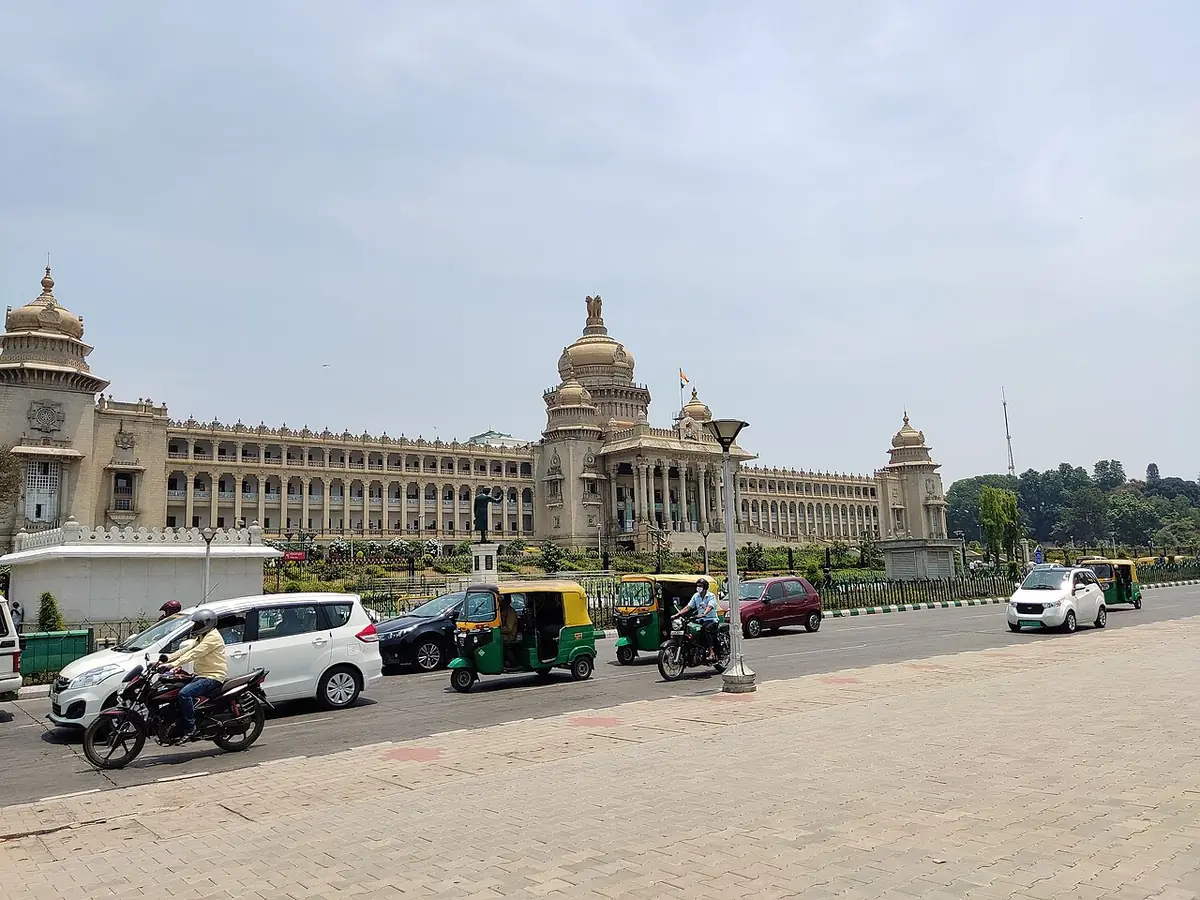
The Vidhana Soudha and its gardens in central Bengaluru — Photo: IM3847 · CC BY-SA 4.0 · Wikimedia Commons
Beyond the raw price tag, the legal structure of ownership deserves very close attention.
Bangalore's property market shows a wide spread of prices, driven by the scarcity of individual plots compared with high-rise apartments. Transactions are assessed either on the overall cost of the plot and its construction, or through turnkey units inside secure gated estates. Additional costs, including registration taxes and legal fees, need to be built into the overall budget from the outset. The tables below summarise the orders of magnitude seen on the ground, with no illusory promises.
BangaloreFor saleHouseestimate
Median price / m²₹74,005Half the apartments sell below this
Median price₹15mthe average is 14% higher — a few very large properties pull it up
Most common2 bedrooms50 % of listings
Average size193 m²
By number of bedrooms
Bedrooms
Share of market
Avg price
Price / m²
Avg size
2most common
50 %
₹13.6m
₹77,900
175 m²
3
38 %
₹18.1m
₹74,005 −5 %
245 m²
4
13 %
₹23.8m
₹71,668best value / m²
333 m²
Each row is an average, compared against the area average of ₹77,900 / m². These are indicative estimates of a typical local market, not a measured sample of live listings. Check current listings before relying on them.
What you can actually own, legally speaking
The same legal rigour applies to how the transaction unfolds, from the first offer through to moving in.
Buying property in India as a foreign national or non-resident is governed by a strict regulatory framework laid down by the Reserve Bank of India and federal law. It is essential to distinguish full freehold ownership of land from a share in a managed residential estate. Clear title is the absolute foundation of any secure transaction in the country. Rigorous due diligence by an independent lawyer is indispensable to validate the chain of successive transfers.
Freehold ownership for eligible citizens and residents
For people with resident status or Overseas Citizens of India (OCI), buying a freehold house confers full and complete rights over the land and the building. This legal security allows clear inheritance and complete freedom to resell on the open market without prior approval from the monetary authorities.
What it changesYou have full control over the asset, provided the title history (often going back 30 years) has been audited without the slightest reservation by a specialist lawyer.
Restrictions and specific frameworks for non-resident foreign investors
Foreign nationals without special status cannot freely acquire residential or commercial property in India, as the law on property acquisitions reserves these rights for tax residents or holders of specific visas. Indirect investments or the use of special-purpose structures must be cleared by federal regulators to avoid any compliance dispute.
What it changesIt is essential to consult an international tax adviser before committing any cross-border funds to your purchase.
The rule to understand before paying a deposit
To manage this timeline calmly, here is a detailed look at the people involved and the actions to take on the ground.
Buying property in Bangalore follows a precise administrative choreography in which each step irrevocably commits the parties. Unlike markets where a verbal offer is enough, local practice relies on signing a preliminary sale agreement backed by a deposit held in escrow. Mastering this sequence protects the buyer against hidden defects in the land title or bad-faith withdrawals. Patience and respect for formal procedures are your best defences against the unpredictable.
Finding the property you love and having an independent expert carry out a preliminary check of the original documents.
Signing a Memorandum of Understanding that sets out the agreed price and the conditions precedent of the sale.
Paying an initial deposit (usually 10% of the total amount) under the supervision of each party's legal advisers.
The in-depth due diligence period, including checking tax receipts, building permits and confirming there are no outstanding charges or mortgages.
Signing the final Sale Deed before the official sub-registrar of the relevant Bangalore jurisdiction.
The official registration of the transfer of ownership and the handover of the keys.
In short, buying a house in Bangalore rewards the methodical investor who combines legal rigour with cultural immersion.
A successful property transaction in Bangalore brings together an ecosystem of experts with clearly defined roles. From the local estate agent to the legal adviser and the state registrar, each one secures a specific aspect of the deal. Knowing who is responsible for what stops you delegating decisions that call for your own vigilance as a buyer. This well-marked path ensures the transparency and durability of your investment over time.
The local estate agentShortlisting and initial negotiationIdentifies properties matching your criteria across the neighbourhoods you are targeting and acts as intermediary to set the price basis for negotiations with the seller.
The property lawyerTitle audit (Due Diligence)Goes through the history of the title deeds over several decades to make sure no joint-ownership dispute or registration defect hangs over the plot.
The technical surveyorStructural inspection of the buildingExamines the condition of the foundations, the waterproofing of the roofs, the electrical installations and the rainwater drainage systems suited to the monsoon climate.
The tax adviserOptimising the financial flowsConfirms that international fund transfers are compliant and calculates the impact of local taxes on your wealth structure in the short and long term.
The state sub-registrarRegistration of the final deedAuthenticates the transfer of ownership, collects the stamp duty and officially records the Sale Deed in the public registers of the city of Bangalore.
Detached house or apartment in a gated complex: which should you choose in Bangalore?
Now that the type of your future home is clearer, let's look at the financial reality of settling in this fast-growing metropolis.
Choosing between a detached house and an apartment in a gated complex in Bangalore completely reshapes your daily life at home and how you manage your assets over the long term. On one side, the detached house, often located in established residential neighbourhoods such as Indiranagar or Jayanagar, offers complete independence, no exorbitant monthly management fees and a direct connection to the land. You decide on renovations, on adding a storey and on how to lay out your own private garden, without answering to an owners' general meeting that is often hard to steer. That freedom, however, comes at a considerable financial and logistical cost, particularly for perimeter security and structural upkeep, which you have to shoulder alone.
By contrast, Bangalore's property market is dominated by huge residential complexes built by leading developers such as Prestige, Brigade or Sobha. These high-rise estates offer built-in services that simplify everyday life: security guards twenty-four hours a day, backup generators to cover frequent power cuts, sports facilities, pools and green spaces maintained collectively. For an expat or senior professional working in tech, this turnkey formula removes the mental load of managing water, pumps and night watchmen, even if it means accepting sometimes strict association rules and paying fixed monthly charges.
In terms of capital growth and liquidity, the dynamics diverge clearly depending on the type of property you choose in the capital of Karnataka. Apartments sell and let faster to a young, mobile population drawn by proximity to the tech hubs of Electronic City, Outer Ring Road or Whitefield. Plots and detached houses in well-connected areas, on the other hand, are becoming scarce quickly, which has historically guaranteed stronger appreciation on the land itself, even though the entry price is much higher and requires a substantial deposit or a complex financing arrangement.
Your final decision in Bangalore should therefore weigh the operational peace of mind offered by secure high-rise estates against the scarcity and long-term independence that come with owning a house on its own land. If you value logistical simplicity for your family's daily life, an apartment in a gated complex is the natural choice. If you are after an asset you can pass on, free of management constraints, looking for a detached house in the city's mature neighbourhoods will be the wisest option.
What budget should you plan to settle in Bangalore for the long term?
Once the budget is settled, it is worth picturing concretely how a typical day unfolds in Bangalore's urban environment.
Drawing up a realistic budget for buying and living in Bangalore means crunching the numbers well beyond developers' advertised prices. Costs vary considerably with location, the age of the building and the level of service included in the estate. This financial breakdown sets out the unavoidable expense items so you avoid unpleasant surprises after signing the final deed of sale.
Estimated purchase price ranges by area of Bangalore
Neighbourhood or area
Property type
Average price per square foot (INR)
Indicative total budget (INR)
Indiranagar / Koramangala
Detached house / Villa
INR 12,000 to 18,000
30 to 60 crore
Whitefield / Outer Ring Road
Upmarket apartment
INR 7,000 to 11,000
1.5 to 3.5 crore
North Bangalore (Hebbal / Devanahalli)
Villa in a gated community
INR 8,000 to 14,000
2.5 to 5 crore
South Bangalore (Jayanagar / Banashankari)
Established apartment
INR 9,000 to 15,000
1.8 to 4 crore
Prices exclude local registration taxes and legal fees, which usually come to around six to seven per cent of the declared transaction value.
Typical monthly outgoings for a household in Bangalore
Expense item
Estimated monthly amount (INR)
Explanatory comment
Maintenance charges
INR 5,000 to 15,000
Varies with floor area and the shared facilities available.
Electricity and air conditioning
INR 4,000 to 10,000
Rises noticeably in the hot season when air conditioning is in use.
Water supply (tank / tanker)
INR 2,000 to 6,000
Needed in some neighbourhoods during periods of water stress.
Household staff (cleaning / cooking help)
INR 15,000 to 30,000
A standard necessity for the regular upkeep of large homes.
These estimates reflect an upper-middle to upper-class lifestyle, in line with the standards of foreign buyers and affluent local buyers.
What does an ordinary Tuesday actually look like in daily life in Bangalore?
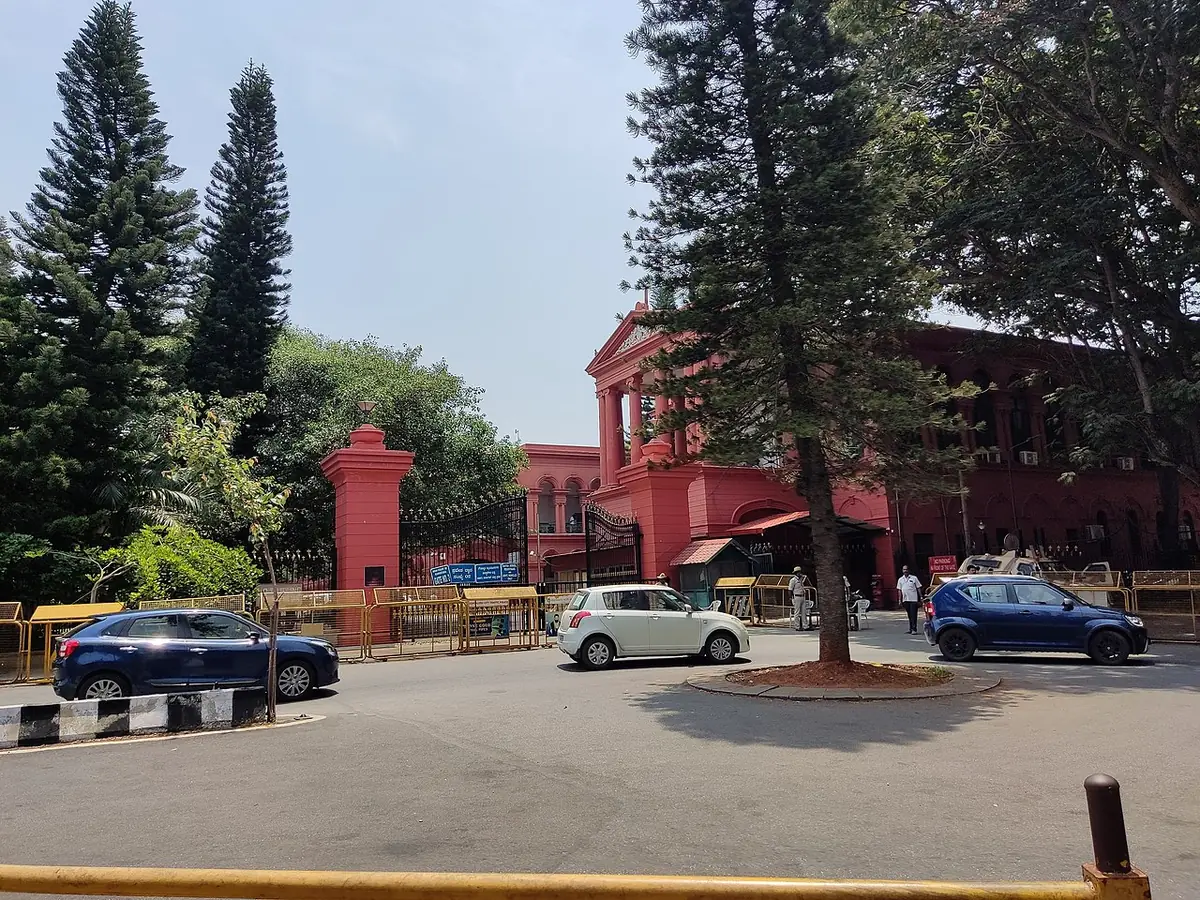
The red High Court building among the trees of central Bengaluru — Photo: Quantumtunneling · CC BY-SA 4.0 · Wikimedia Commons
Beyond this well-oiled routine, many aspects you will never see in the brochures deserve your full attention before you commit.
Getting a feel for how Bangalore really works means breaking down an ordinary weekday hour by hour. Between the commute, taking the children to school and work commitments in the tech parks, each hour has its own rhythm. This timeline lets you gauge the direct impact of your future home's location on your quality of life.
07:30Residential neighbourhood (early start)Waking up and getting ready in the relative calm of the morning, before traffic builds up on the city's main roads.
08:30School run to the international schoolsBy school bus or private car to international schools, which are often on the northern or eastern edges of the city.
09:45Arriving at the office in a Tech ParkSettling into workspaces in the large tech hubs, after a journey whose smoothness depends entirely on the distance.
13:00Business lunch or local breakA time for work conversations or a breather in the in-house canteens of the business parks or in neighbourhood restaurants.
17:30Heading home through the evening traffic jamsCrossing major arterial roads under heavy congestion, which calls for patience and working remotely where possible.
19:30Local shopping and back homeA stop at local supermarkets (Nature Basket or Spar) for fresh produce before returning to the secure estate.
21:00Quiet family timeA peaceful evening within the estate or at home, enjoying the relative night-time cool of the Mysore plateau.
What developer brochures and property listings never mention
These administrative and practical grey areas often lead to bitter regrets that only surface after several months of living there.
Bangalore's property market has its own codes, subtleties and grey areas that polished sales brochures take care not to reveal to foreign buyers. Understanding these hidden realities saves you major administrative, legal or environmental setbacks after the keys are handed over. Here are the critical points no estate agent will volunteer on the first viewing.
The complex management of running water
Many Bangalore neighbourhoods are not permanently connected to the municipal BWSSB network, forcing residents to rely on deep borewells or paid water tankers in the dry season. This dependence creates recurring extra costs and uncertainty about the quality of the water coming out of the tap.
The subtleties of title deeds and BDA/BMRDA approvals
A property whose planning permissions do not fully comply with local authority requirements can face legal challenges, or insurmountable difficulties when you later try to sell to a buyer who needs a bank loan.
The impact of transport infrastructure under construction
The colossal metro works (Namma Metro) and road extensions create noise and monstrous traffic jams for years, temporarily degrading day-to-day quality of life while adding to property values in the long run.
The reality of hidden or rising maintenance charges
Maintenance fees quoted low by the developer at handover inevitably rise after a few years, once the owners' association takes over full management of ageing infrastructure.
The buyer regrets that usually surface six months after moving in
Faced with these demands and potential pitfalls, it is just as crucial to decide objectively whether this market is really right for you.
Looked likeA very quiet location on the outskirts with a large green plot and extremely attractive prices per square foot for young families.
Turned outComplete geographic isolation that turned every school run or commute into a daily ordeal in the face of road congestion.
Would have caught itCarefully check real journey times at rush hour on a Tuesday morning before signing any final sale agreement.
Looked likeAn ultra-modern apartment in a gleaming tower promising high-end concierge and leisure services.
Turned outConstruction defects invisible on the first viewing, combined with recurring breakdowns of lifts and undersized generators.
Would have caught itInsist on a full technical audit of the building by an independent engineering firm and ask current residents how responsive the management is.
Looked likeAn ideal rental investment backed by a gross yield that local developers advertised as exceptional.
Turned outProlonged vacancies due to an oversupply of similar properties in the same area, with maintenance charges producing negative cash flow.
Would have caught itTake an objective look at actual rental demand over the last three years and model cash flows net of all taxes and fees.
Looked likeA quick purchase without a specialist lawyer, to save on legal fees for checking the deeds.
Turned outThe late discovery of inheritance disputes over the original plot, blocking any possibility of resale or a later bank mortgage.
Would have caught itAlways instruct an independent law firm specialising in Indian property law to audit the property's full legal history.
Which type of buyer should firmly steer clear of buying property in Bangalore?
For those who meet the conditions and accept these rules of the game, it is time to make a final call on your project.
Property investment in India's Silicon Valley does not suit every kind of expat or international investor. The Reserve Bank of India's strict regulatory constraints, combined with local cultural and logistical specifics, demand complete clarity before committing significant capital. Here are the profiles who would do better to hold back from buying in this metropolis.
The investor seeking immediate liquidity and short-term rental returns
→Goes for off-plan new apartments with the aim of flipping them quickly for a hoped-for speculative gain.
Bangalore's resale market often involves long selling times and high transaction costs that penalise any quick-exit or short-term speculative strategy.
The buyer who cannot tolerate logistical hiccups and service outages
→Expects Western-style administrative smoothness and flawless, rigorous operation of public infrastructure.
The city's breakneck growth puts constant strain on water, electricity and road networks, which calls for a great deal of psychological flexibility day to day.
The non-resident subject to strict limits on repatriating funds
→Invests without checking the regulatory limits imposed by India's FEMA legislation on transferring capital abroad.
Repatriating the proceeds of a property sale in India to a bank account abroad is subject to rigorous administrative procedures and strict caps.
So, are you ready to take the plunge and buy property in Bangalore?
At the end of this in-depth analysis, the decision to buy property in Bangalore is no longer a matter of a passing crush but of a carefully considered strategy. If you plan to settle for the long term in India's technology capital, have an investment horizon of more than seven to ten years and accept the local logistical quirks, buying a well-chosen property is a powerful and meaningful choice for your wealth.
Take the time to validate every legal step with independent professionals, visit properties at rush hour to test real journey times, and never overlook the crucial importance of the quality of the estate or the land title. The Bangalore market rewards patience, rigorous paperwork and detailed knowledge of the neighbourhoods, far from the advertising mirages of developers chasing quick pre-sales.
If your professional or family plans carry some uncertainty in the short term, renting a well-chosen home in an upmarket estate will remain the wisest option to keep your finances flexible. If, on the other hand, your roots in India's Silicon Valley are settled, now is a good time to secure an exceptional asset at the heart of one of the most dynamic cities on the Asian subcontinent.
Related questions
Can non-resident foreigners (PIO or OCI) buy property in Bangalore?
Persons of Indian Origin (PIO) and Overseas Citizen of India (OCI) cardholders enjoy the same purchase rights as local residents for residential and commercial property. Foreign nationals with no Indian family connection, however, cannot own property outright in India without the express prior permission of the Reserve Bank of India.
What legal fees and registration taxes apply in Bangalore?
In Bangalore, in the state of Karnataka, stamp duty and registration charges come to roughly six to seven per cent of either the transaction value or the government's reference value (the Guidance Value), whichever is higher.
What is the Guidance Value and why does it matter?
The Guidance Value is the minimum price per square foot set by the Karnataka tax authorities for every street and neighbourhood. A property transaction cannot legally be registered below this official value, and part of the real price (the 'black money') was historically paid in cash, although the law has become much stricter.
How does the water supply work in Bangalore apartments?
Most large modern residential complexes combine municipal water (supplied by the BWSSB) with deep borewells and, when summer shortages hit, deliveries by water tanker. The cost of those tankers is shared through the monthly maintenance charges managed by the residents' association.
Can you get a mortgage from an Indian bank as an expat?
Yes, the major Indian banks (such as SBI, HDFC or ICICI) offer home loans to residents and to OCI or PIO cardholders, provided they can show proof of stable income and a deposit usually between twenty and thirty per cent of the total amount.
What is a 'Gated Community' in Bangalore?
A Gated Community is a fully enclosed residential estate with round-the-clock security guards, bringing together several apartment blocks or villas with shared facilities built in, such as a clubhouse, pool, gym, convenience store and private green spaces.
Which neighbourhoods are most sought after by senior professionals and expats?
Indiranagar, Koramangala and Jayanagar are highly prized for their mature, leafy neighbourhood life, while Whitefield and Outer Ring Road concentrate the demand from employees who work in the cutting-edge tech parks and want modern residential complexes.
How long does it usually take to resell a property in Bangalore?
Resale typically takes three to nine months, depending on the liquidity of the micro-market, the quality of the title documents and how competitive the asking price is against recent transactions in the same building or neighbourhood.
How much does Vaastu Shastra compliance matter when buying property in India?
Vaastu Shastra is the traditional Indian system of architecture governing the orientation of rooms, doors and water points to attract positive energy. Many local buyers give these criteria great importance, which can significantly affect a property's resale value if it does not follow these principles.
Which legal documents must you check before signing?
You need to audit the original Sale Deed, the property tax payment receipts (Khata certificate and Khata extract), the approvals from the planning authorities (BDA or BMRDA), and confirm there are no outstanding mortgages or pending disputes before the civil courts.