Buying an apartment in Los Angeles is a major undertaking that calls for a close reading of local dynamics, the rules that govern shared ownership and the particular habits of the California market. This guide sets out the essentials you need to structure your search and make informed decisions, well away from received wisdom and empty promises.
Get the app
What nobody tells you.
Real prices, hidden costs and the traps to check before you commit.
What you are really getting when you buy an apartment in Los Angeles
Scroll
What you are really getting when you buy an apartment in Los Angeles
Buying an apartment in Los Angeles is a major undertaking that calls for a close reading of local dynamics, the rules that govern shared ownership and the particular habits of the California market. This guide sets out the essentials you need to structure your search and make informed decisions, well away from received wisdom and empty promises.
Written by the ting.ad editorial team ·
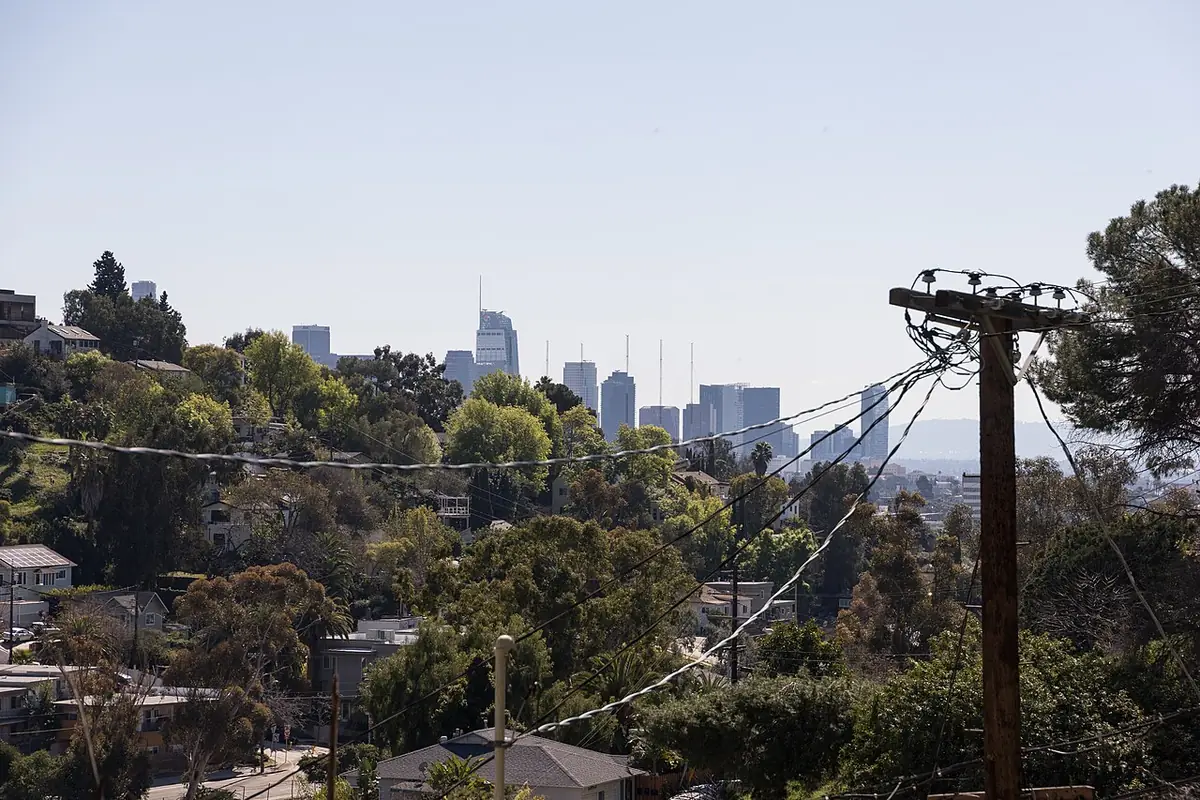
West 1st Street, Los Angeles in Street View: drag to look around.
Understanding these fundamentals lets you judge objectively whether this kind of investment really matches your way of life and your expectations.
Buying an apartment in Los Angeles is not simply a matter of acquiring square meters of living space in a sunny megacity. You are buying a strategic position inside a fragmented urban whole, where each neighborhood works as a self-contained enclave with its own traffic patterns, its own market dynamics and its own cultural micro-climate. Promises of instant returns quickly run into the reality of HOA dues, local property taxes and the strict regulatory constraints that govern residential property in Los Angeles County.
The promise of a quick capital gain carried by the enduring appeal of Southern California and the broad economic energy of the region.vsThe reality of a mature market where capital growth depends closely on local infrastructure and long-term urban planning policy.
Buyers who count on a short-term resale systematically underestimate transaction costs, agency commissions and the relatively slow pace of property cycles in the mid-range segments.
The illusion of a permanent beach lifestyle waiting for you the moment you step out of your building, with direct access to the coast's landmark beaches.vsThe daily constraint of travel times, chronic road congestion and the absolute need to plan every trip by car.
The geography of the city forces a constant trade-off between being close to the main employment centers and finding a quieter, greener residential setting.
The received idea of a uniform market in which metro-wide trends apply evenly to every geographic sector.vsThe truth of an archipelago of independent neighborhoods where prices, rental demand and the profile of owners change completely from one street to the next.
Working out what a property is worth means studying transaction history at the micro-local level rather than relying on broad county-wide economic indicators.
The simplified view of easy, highly profitable rental management thanks to steady tourist and business demand.vsThe complex regulatory framework around short-term furnished rentals and the strict requirements homeowner associations impose on subletting.
City legislation imposes severe restrictions that sharply limit any investment strategy built solely on seasonal rental yield.
Does this place fit your way of life and your daily routine?
To gauge the full extent of the change this purchase brings, it helps to set your usual reference points against conditions on the ground in California.
Daily organization in Los Angeles differs radically from the standards of dense large cities elsewhere. The urban structure, built around the car and vast horizontal spread, transforms your relationship with space, time and neighbors. Depending on your working situation and your personal priorities, the residential experience will vary enormously, whether you favor the cultural buzz of the urban centers or the relative calm of the residential hills.
The mobile, creative profile
Dense, well-connected neighborhoods give you immediate access to shared workspaces, specialty coffee shops and a lively cultural scene. You get a stimulating urban atmosphere and a varied range of services close at hand. In exchange, you have to accept high noise levels, heavy traffic and the frequent absence of generous private outdoor space in shared buildings.
The active, mobile profile
Being close to the main freeway corridors or to the transit stations now under development becomes the decisive criterion when selecting your apartment. Cutting the time spent behind the wheel directly shapes your quality of life and your personal balance. Properties within immediate reach of the business districts save precious time, but demand a distinctly higher purchase budget for comparable floor areas.
The long-term investor profile
Your attention will go first to the financial health of the association, the build quality of the building and the consistency of local rental demand. Established residential sectors offer better preservation of capital over the long term, even if headline gross yields are often held down by the level of dues and the property taxes that apply in the region.
Living here when you arrive from abroad: what changes radically in your daily life
Once these reference points are in place, the central question becomes which geographic sector best suits what you are looking for.
Moving from a property market abroad to the California system, and to the Los Angeles version of it in particular, unsettles every habit a buyer arrives with. From contract negotiation to the structure of shared-ownership charges, by way of the central role of homeowner associations, the rules of the game are profoundly different. Anticipating these cultural and legal gaps avoids financial disappointment and makes the whole buying process far simpler.
From abroad
A market governed by uniform national law and mandatory technical surveys tightly framed by the public authorities.
Los Angeles
A contractual framework grounded in California law, with exhaustive seller disclosures and freedom of contract shaped by local case law.
You need an experienced real estate agent and legal counsel around you to go through each technical document before you commit for good.
From abroad
Shared buildings with charges that are often predictable, run by professional managing agents under strictly regulated procedures.
Los Angeles
Homeowner associations (HOAs) with wide-ranging powers, whose dues can rise quickly when major work comes up or reserves fall short.
A careful review of past accounts and of the HOA's meeting minutes is an absolutely unavoidable step before any firm offer.
From abroad
An urban center where shops, schools and essential services sit a few minutes' walk from your front door.
Los Angeles
A dispersed territorial layout where the car remains the indispensable tool for running the smallest errand or reaching a business meeting.
Choosing where your apartment sits has to include a rigorous simulation of your real journeys at peak times, not a simple estimate of distance.
From abroad
Bank lending practices built around often fixed interest rates and uniform approval conditions across the country.
Los Angeles
A complex mortgage system, negotiated case by case, with strict requirements on borrower profile and down payment.
Obtaining a pre-approval letter from a local lender is essential if your offer is to carry weight with sellers and their agents.
Which neighborhood should you target to settle in and invest for the long run?
These geographic distinctions translate straight into financial terms, with considerable gaps in value from one sector to another.
Choosing the neighborhood is the single most decisive decision when buying an apartment in Los Angeles. Each sector has its own identity, its own pace of life, its own advantages in terms of amenities and its own unavoidable compromises on budget and traffic. Analyzing local dynamics lets you identify the environment that best matches your personal expectations and your long-term financial plans.
The coastal and beachside sectors
A relaxed atmosphere, set to the rhythm of sea breezes, outdoor activity and heavy visitor numbers through the summer.
Suits
Water sports enthusiasts and anyone drawn to bright surroundings and a permanent holiday feel.
Trade-off
Some of the highest prices per square meter in the metro area, frequent morning humidity and very heavy summer traffic.
The central, high-energy neighborhoods
A constant cultural buzz, architecture that mixes modern and historic buildings, and a dense offering of restaurants and shops.
Suits
Working city dwellers who value being close to entertainment and a rich cultural life day to day.
Trade-off
High noise levels, a scarcity of private green space and recurring parking difficulties for visitors.
The leafy residential enclaves
Welcome quiet, streets lined with mature trees, a stronger sense of safety and the feel of a preserved village.
Suits
Buyers looking for calm, a setting suited to family life and a recognized stability in property values.
Trade-off
A marked distance from the main business centers and complete dependence on the car for the smallest trip.
What does an apartment in Los Angeles really cost today?
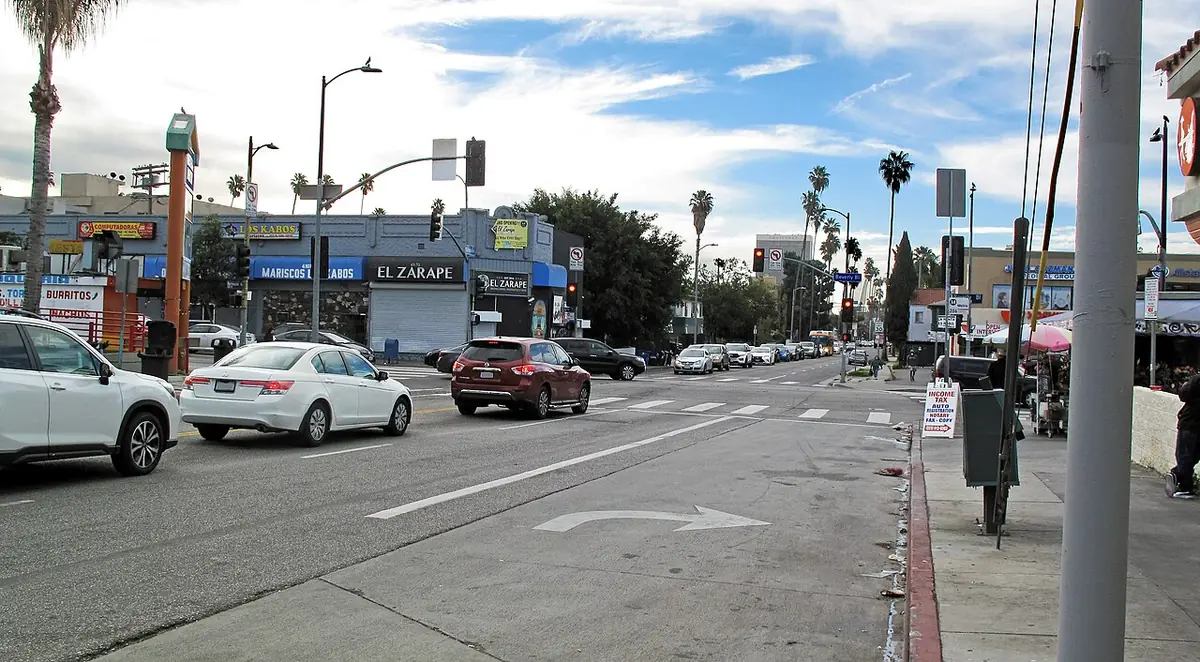
A lively corner of Los Angeles, shops and traffic side by side — Photo: Downtowngal · CC BY-SA 4.0 · Wikimedia Commons
Beyond the purely budgetary side, the legal nature of what you own deserves particular attention.
Working out the budget you need to buy an apartment in Los Angeles goes well beyond the asking price shown on the property portals. You have to build in all the related costs, including local property taxes, the monthly dues of homeowner associations and regular maintenance charges. Price ranges vary considerably with the precise location, the floor area, the age of the building and the quality of the shared amenities on offer.
los-angelesFor saleApartmentestimate
Median price / m²US$6,175Half the apartments sell below this
Median priceUS$620kthe average is 14% higher — a few very large properties pull it up
Most common2 bedrooms40 % of listings
Average size95 m²
By number of bedrooms
Bedrooms
Share of market
Avg price
Price / m²
Avg size
1
32 %
US$473k
US$7,280 +12 %
65 m²
2most common
40 %
US$618k
US$6,500
95 m²
3
22 %
US$772k
US$6,175best value / m²
125 m²
4
6 %
US$988k
US$6,175best value / m²
160 m²
Each row is an average, compared against the area average of US$6,500 / m². These are indicative estimates of a typical local market, not a measured sample of live listings. Check current listings before relying on them.
What you can actually own: shared ownership and the rights that come with it
Once the legal form is settled, the transaction follows a timetable and a set of steps that have to be observed to the letter.
The American legal system offers several ownership structures for shared residential property, and the rules that govern them differ noticeably from practice elsewhere. Understanding the distinction between conventional shared ownership (a condominium) and a housing cooperative (a co-op) is essential if you want to avoid surprises when you come to resell or let your apartment.
The conventional shared ownership model (condominium)
You buy outright ownership of your own unit along with an undivided share of the common areas and of the land the building stands on. Management is handled by an elected homeowner association, which oversees the upkeep of the structure and compliance with the CC&Rs and house rules.
What it changesThis status offers a great deal of flexibility for resale and letting, while giving you direct control over the management of your asset.
The collective structure model (co-op or corporation)
You are not buying real property directly but shares in a corporation that owns the whole building, coupled with a proprietary lease giving you exclusive occupancy of your home. Admission criteria for new buyers are often extremely strict and are decided by a board of directors.
What it changesThis form of ownership, rarer in Los Angeles than in New York but present in certain older segments, imposes rigorous constraints yet guarantees strong consistency within the building.
The rule to understand before you put a deposit on a property
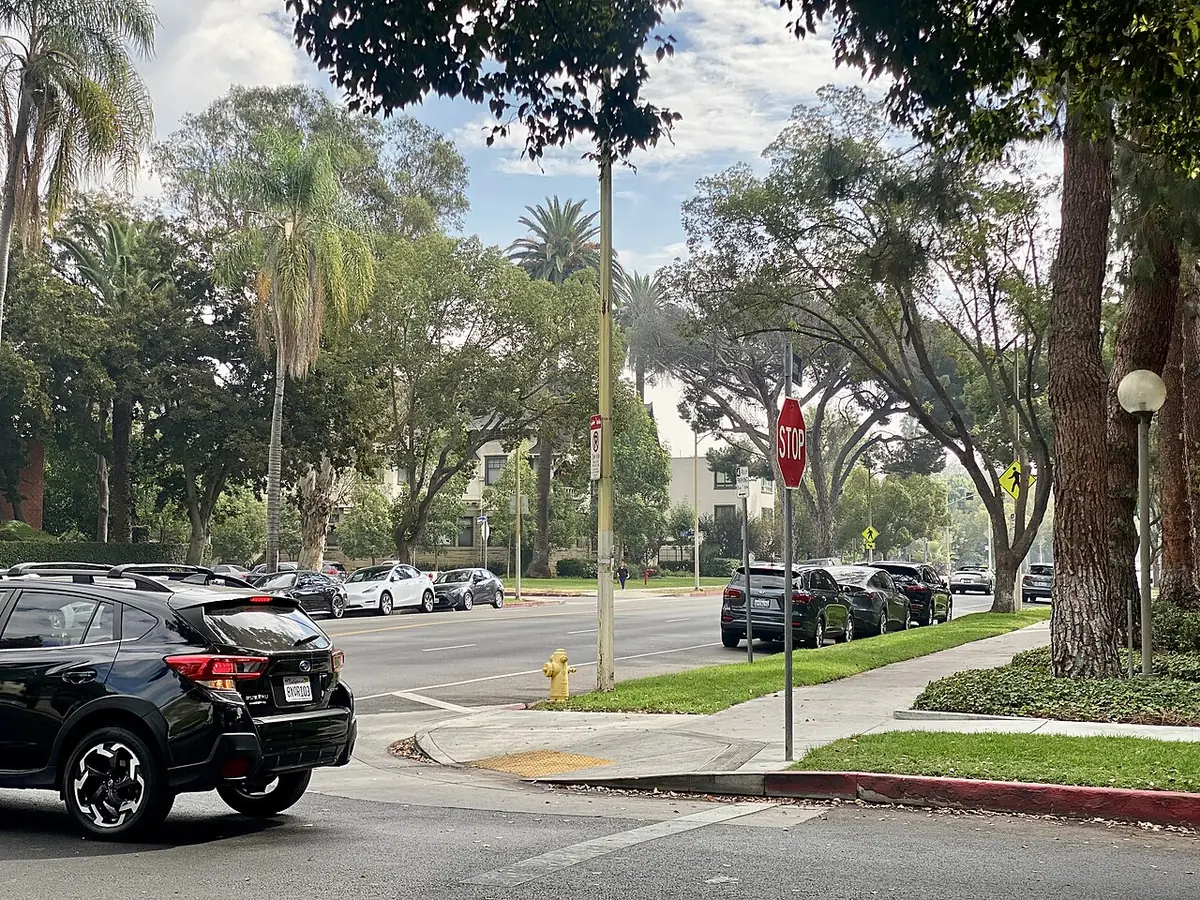
A quiet, palm-lined street in the University Park neighbourhood — Photo: EEJCC · CC0 · Wikimedia Commons
That procedural discipline sits inside a wider transaction sequence that is worth mapping out precisely.
Buying property in California runs through a series of specific contractual mechanisms that protect the buyer, provided the buyer exercises the right to verify within the time allowed. The financial commitment becomes firm and final the moment the contingencies are removed. Neglecting this phase of technical and financial due diligence exposes the buyer to losing the earnest money deposit outright in the event of a late withdrawal.
Drafting the initial offer to purchase and setting the amount of the earnest money deposit (typically 3% of the price of the property).
Opening escrow with a neutral company charged with overseeing the transfer of funds and of title.
The physical inspection period (the home inspection), during which an appointed specialist examines the structural and technical condition of the apartment.
A thorough review of the association's documents, including the financial reports, the forecast budget and the house rules.
The lender's formal appraisal, intended to confirm that the market value of the property does indeed match the amount of the accepted offer.
The formal removal of contingencies, marking the buyer's irrevocable commitment ahead of final signature.
How a property transaction unfolds, step by step
In closing, seeing a purchase through in this metropolis takes method, clear-headedness and sound professional support.
Buying an apartment in Los Angeles follows a formal timetable, generally spread over 30 to 45 days between acceptance of the offer and final signature. Each party to the transaction (the agent, the escrow and title companies, the building inspector and the financial adviser) plays a precise role at each stage to secure the transfer of ownership.
The buyer and their adviserFinancial preparation and targeted searchObtaining the lender's pre-approval letter and selecting target neighborhoods according to the way of life you are after.
The real estate agentViewings and drafting the offerSelecting relevant properties, running a comparative market analysis and submitting a formal offer framed by California law.
The escrow companyOpening the escrow account and lodging the depositSecuring the deposit funds and centralizing all the legal and administrative documents in the transaction.
The building inspectorTechnical inspections and auditsChecking the condition of the apartment, the electrical installations and the plumbing, and reviewing the association's documents.
The lenderAppraisal and finalizing the loanCarrying out the independent valuation and giving final approval to the mortgage file.
All partiesClosing the sale and recordingSigning the final documents, transferring the remaining funds and officially recording title with the county.
Apartment or house in Los Angeles: weighing the city view against day-to-day upkeep
Once that fundamental choice between shared and single-family living is settled, it is worth mapping out precisely the financial reality of your future home in Los Angeles.
Choosing between an apartment in a shared building, usually called a condo in local terminology, and a single-family house in Los Angeles is not a matter of simple aesthetic preference but a complex calculation taking in time management, structural upkeep and control of recurring charges. In a metropolis where urban sprawl constantly redefines distances, an apartment in a dense neighborhood such as Downtown, Koreatown or West Hollywood offers immediate immersion in city life while freeing you from the heavy obligations that come with owning land. Condominium associations collectively handle the pool, security, the roof and the common areas, pooling costs that in a single-family house would fall entirely on one owner. That formula appeals to buyers who want a smooth transition into California life without the logistical burden of a garden and a roof to inspect after every seismic or heatwave episode.
A single-family house, whether mid-century modern in the Hills or a historic craftsman in Pasadena or parts of the Eastside, is the classic embodiment of the American dream but brings considerable operational responsibility. Owning the land means handling for yourself the watering of green space within city water quotas, the maintenance of often ageing foundations and the seismic upgrades that local insurers increasingly require. Home insurance premiums for single-family houses have risen dramatically because of the greater wildfire risk in areas close to Griffith Park or the Santa Monica Mountains, a financial factor many buyers underestimate on a first viewing under the bright California summer sun.
In terms of long-term value, the land beneath a single-family house has historically held a scarcity premium above the simple share of a shared building. That said, the higher entry cost and property taxes indexed to the original purchase value under the well-known Proposition 13 mean the annual tax burden of a house weighs far more heavily on a family budget. Buyers therefore need to assess their tolerance for the unexpected: water damage in a shared building is often resolved through the association and the building's master policy, whereas a leak in the underground sewer line of a single-family house calls for immediate and costly work borne by the owner alone.
The final choice comes down to your professional and personal rhythm. If your weeks are shaped by frequent travel and long days in the business hubs of Century City or Silicon Beach, the security and freedom from maintenance of a secure apartment with concierge service logically win out. If instead you want private space to raise a family, grow a garden and enjoy complete architectural independence without submitting renovation plans to a fussy association board, the single-family house remains the unbeaten option, on condition that you stay especially watchful about the hidden costs of upkeep and insurance.
What overall budget do you need to live in and maintain a property in Los Angeles?
These financial charges translate concretely into how your days are organized in the heart of the megacity.
Buying property in Los Angeles comes with a particularly dense structure of recurring costs that frequently surprises buyers arriving from abroad. Beyond the mortgage repayment, the annual budget must take in the base property tax set at around one percent of the purchase value, increased by voter-approved local obligations. On top of that come HOA dues for apartments, or the homeowner insurance policies whose prices are climbing across Southern California. Overlooking these secondary lines in your financial planning exposes the household to a rapid budget imbalance in the very first year of occupancy.
Recurring cost lines for an apartment or a house in Los Angeles
Budget line
Estimated average monthly amount
Drivers of variation and impact
Property tax
Between $600 and $1,500
Calculated on the original purchase price under Proposition 13, with additional local levies (Mello-Roos or school bonds) that vary widely by neighborhood.
HOA dues
Between $400 and $1,200
For apartments and condos only; covers the upkeep of common areas, security, water and sometimes gas, but rises steadily as the building ages.
Homeowner insurance
Between $150 and $500
A steep general increase across California; major surcharges for houses in wildfire risk zones or needing a specific rider for earthquake risk.
Maintenance and preventive repairs
Between $200 and $600
An essential provision to cover heavy air conditioning use, small plumbing jobs and the regular upkeep of outdoor space or shared equipment.
The figures shown are indicative orders of magnitude for standard properties in the medium and high density residential areas of Los Angeles.
What does an ordinary Tuesday look like between work, schools and city logistics in Los Angeles?
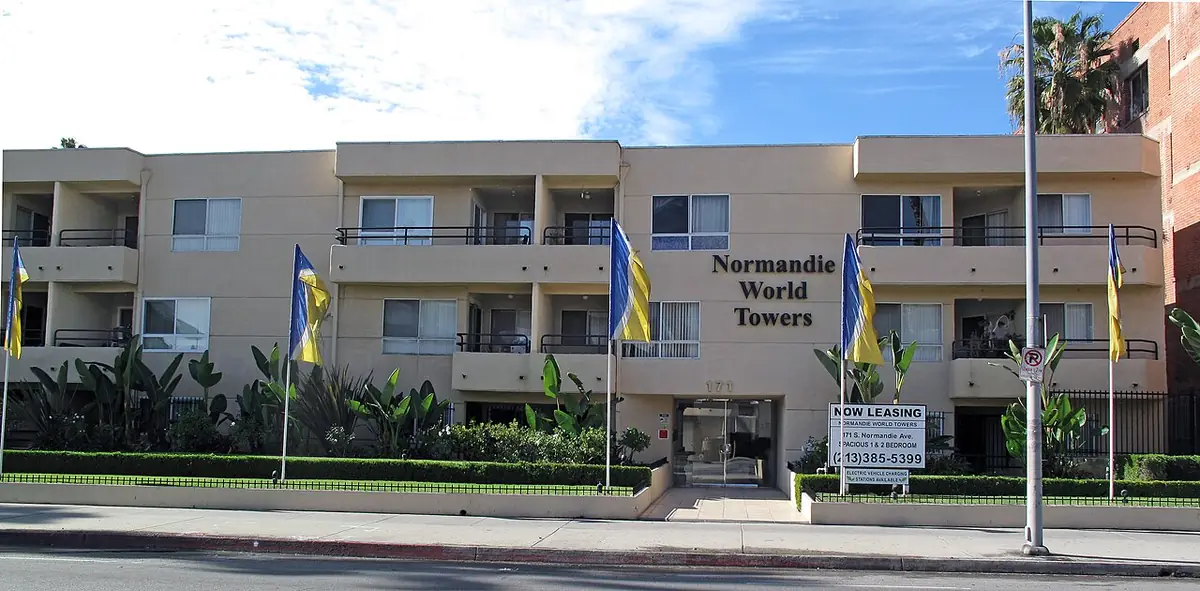
An apartment tower typical of Koreatown's housing stock — Photo: Downtowngal · CC BY-SA 4.0 · Wikimedia Commons
Behind the sunny postcard and this well-oiled routine lie technical realities that property listings carefully omit.
Managing time in Los Angeles is inseparable from the geography of getting around and the structure of local infrastructure. An ordinary Tuesday starts very early to avoid the saturation of major freeway corridors such as Interstate 405 or the 10 Freeway, the vital artery linking the coastal west to the inland neighborhoods. Between school runs to Los Angeles Unified campuses or private schools, in-person work meetings and the grocery shopping at local chains, the typical day resembles a strict logistical choreography in which every spare minute counts if you are not to be caught out by the city's legendary traffic jams.
07:15Home and the early departureChecking live traffic conditions on mobile apps before leaving the garage or the secure parking space, because the smallest incident on the freeway pushes the whole morning schedule back.
08:00School or daycareDropping the children off at neighborhood public schools or independent ones, often marked by a dense flow of vehicles around the school zones that calls for exemplary patience.
09:00Arrival at work or the coworking spaceSettling in at the desk, whether that is an office tower in Century City, a creative studio in Culver City or a shared workspace Downtown, and starting the work sessions and video calls.
12:30A local lunch breakA trip on foot or by light vehicle for lunch at one of the many food counters or urban food markets that reflect the cultural and culinary diversity of the metropolis.
17:00Back on the road and end-of-day errandsA quick stop at a local supermarket to pick up dinner, trying to get ahead of or ride out the late-afternoon traffic peak on the main city boulevards.
19:00Home again and winding downArriving at the building, parking the car and taking a quiet moment to enjoy the outdoor space of the condominium or the house before getting ready for the next day.
What the polished listing photos will never tell you about the real condition of properties in Los Angeles
Ignoring these invisible factors leads straight to the financial and emotional disappointments many buyers report six months after moving in.
The Los Angeles property market is known for the visual quality of its photographic staging and its three-dimensional virtual tours. Yet that formal perfection frequently conceals major technical issues inherent to the region's housing stock. Between period cast iron or galvanized steel plumbing reaching the end of its life, the absence of effective insulation in 1950s construction and the subtleties of local planning rules, an alert buyer has to investigate well beyond a simple appreciation of how the interior looks.
The condition of the drainage and water supply pipework
Many houses and buildings put up in the middle of the twentieth century still have their original pipes, which scale up or crack, leading to plumbing renovation bills running into tens of thousands of dollars if they fail after the purchase.
Thermal insulation and the performance of the air conditioning
With summer heatwaves growing more frequent in the Los Angeles basin, an obsolete central air conditioning system or poorly insulated roof space translates immediately into punishing electricity bills from the local supplier, LADWP.
The constraints of easements and party-wall rules
The layout of California lots often includes rights of way for public utilities or strict party-wall agreements that rule out any future change to the fence or the addition of an undeclared extension.
The strict restrictions attached to historic neighborhoods (HPOZ)
If you fall for an older house inside a historic preservation zone, the smallest change to exterior paint color, joinery or roofing requires formal approval from a local planning commission, with very long waiting times.
The traps and disappointments buyers discover six months after moving to Los Angeles
These disappointments lead naturally to the question of whether buying in Los Angeles genuinely suits your profile and your way of life.
Looked likeA calm, peaceful neighborhood during a Sunday afternoon viewing under a bright sun.
Turned outA very noisy traffic route on weekdays from seven in the morning, turned into a relief road for drivers avoiding the jams on the neighboring boulevards.
Would have caught itAlways visiting the surroundings of the property at different peak times on weekdays and consulting the city's traffic data before signing the final offer.
Looked likeA perfectly maintained building with moderate, stable monthly dues.
Turned outAn ageing building facing major emergency work on the foundations or the roof, voting a special assessment of several thousand dollars per owner.
Would have caught itInsisting on full access to the minutes of the last three years of association meetings to identify ongoing disputes and the true state of the association's reserves.
Looked likeA sunny, green outdoor space that appeared to need little upkeep.
Turned outA thirsty tropical garden whose faulty automatic irrigation, or irrigation subject to city restrictions, generates unexpected water bills and fines.
Would have caught itHaving the irrigation system audited by an independent professional and checking that native drought-resistant planting (xeriscaping) has been used.
Looked likeA reasonable commute to work, estimated quickly on a road map.
Turned outA daily ordeal of more than an hour and a half each way because of the way the freeway junctions are configured and the permanent roadworks on the main corridors.
Would have caught itDriving the real route at the exact peak hours on a Tuesday or a Thursday before committing to the purchase.
Atypical profiles: who should firmly hold off buying property in Los Angeles right now?
If your own situation falls outside these major contraindications, the time has come to formalize your decision to buy with your eyes open.
Owning property in Los Angeles, for all its undeniable cultural and financial appeal, is not a universal solution suited to every stage of life. Current market conditions, marked by high mortgage interest rates and particularly firm median prices, demand absolute professional and geographic stability. For certain buyer profiles, committing to a purchase in this California metropolis represents a disproportionate financial risk that is worth identifying clearly before you commit your savings.
The young professional on an international posting or in a short-term career transition
→Postponing the purchase and opting for a flexible furnished rental.
Transaction costs on the way in and the way out in California (notably agency commissions and transfer taxes) require a minimum holding period of five to seven years to be recovered, which makes an early departure financially destructive.
The household with a down payment that is only just sufficient and no emergency savings
→Continuing to rent while building a financial cushion over several years.
The structural surprises inherent to California properties (roof repairs, seismic upgrades, air conditioning failures) call for immediate cash that owners without savings cannot absorb.
The investor looking for immediate, high rental yields
→Turning to other American property markets with more favorable price-to-rent ratios.
High purchase prices in Los Angeles combined with strongly tenant-protective legislation (the Tenant Protection Act) sharply limit gross rental profitability in the short term.
So, are you ready to take the step and buy property in Los Angeles this year?
Deciding to buy property in Los Angeles means reconciling an ambition to live in the sun with absolute financial discipline. The city rewards those who approach the market methodically, factoring in from the outset all the hidden costs, the transport constraints and the technical particularities of California construction. This guide has not tried to prettify reality or to dramatize the obstacles, but to give you the factual reference points you need to turn a visual crush into a solid, lasting asset decision.
If your working horizon is firmly anchored in the region for the next few years, if your emergency savings comfortably exceed the down payment alone and if you accept the logistical compromises that come with life in a large American metropolis, then your plan has every foundation it needs to succeed. Take the time to visit your target neighborhoods at peak hours, insist on full transparency about the technical and financial condition of the properties, and surround yourself with independent local professionals to validate each legal step of the transaction.
The Los Angeles property market will always be demanding, changeable and highly competitive, but it remains one of the most dynamic places in the world to build lasting family wealth. By avoiding the traps of impulsiveness and keeping your real priorities in view, you now have everything you need to decide calmly whether your next address will be written under the sky of the City of Angels.
Related questions
How much property tax should I expect on an apartment in Los Angeles?
The base property tax rate in California is roughly one percent of the value at which the property was acquired, assessed at the time of purchase under the terms of Proposition 13. On top of that base rate sit various local obligations and voter-approved district levies, which usually push the overall effective rate to between 1.1 and 1.3 percent of assessed value per year.
What is an HOA fee and what exactly does it cover?
Homeowner Association fees are monthly dues paid by the owners of apartments or townhouses. They fund the upkeep of common areas, building security, the management of outdoor space, the pool and sometimes water or waste collection, while also feeding a reserve fund for major work in the future.
Is earthquake insurance compulsory in Los Angeles?
Earthquake cover is not strictly required by law in order to own property, but it is very strongly recommended and is often demanded by the banks that issue the mortgage, given the tectonic activity along the San Andreas fault and the local fault lines.
How does Proposition 13 work when it comes to California property taxes?
Proposition 13 caps the annual increase in a property's taxable value at a maximum of two percent for as long as the property is not resold. That protects long-standing owners from runaway property taxes, but it also means new buyers face an immediate reassessment of the tax based on their purchase price.
How long does it usually take to complete a purchase in Los Angeles?
Once the seller has accepted the offer, the standard transaction process, known in California as escrow, generally takes between thirty and forty-five days. That window allows all the technical inspections to be carried out, the contingencies to be removed and the funds to be finally released by the lender.
Should I budget separately for technical inspections before buying?
Yes. It is strongly advised to appoint independent specialists for a general building inspection, a roof check, a foundation review and a camera inspection of the drains. These reports typically cost several hundred dollars each and help you avoid very expensive hidden defects.
What are the main differences between a condo and a townhouse in Los Angeles?
A condo generally means an apartment in a shared building where you own the interior walls and a share of the common areas. A townhouse is closer to a terraced house over several levels with a small private plot or patio, and often gives a sense of independence nearer to that of a single-family home.
How do water restrictions affect garden upkeep in Los Angeles?
Los Angeles city authorities regularly impose restrictions on the days and hours when lawns may be watered, in order to protect the water supply during drought. Many owners therefore turn to xeriscaping, a landscaping approach built on local drought-resistant plants that need very little irrigation.
What is a Historic Preservation Overlay Zone (HPOZ) and what is its impact?
A Historic Preservation Overlay Zone is a neighborhood whose older architectural character is strictly protected by city regulations. Any visible change to the exterior of a building inside such a zone must first be approved by a local planning commission, which limits what you can do with a renovation.
What closing costs should I plan for when buying in California?
In California the transaction does not go through a European-style civil-law notary but through an escrow company and a title company. Closing costs, which include transfer taxes, title search fees and escrow charges, generally come to between one and two percent of the purchase price.