Moving into a rented house in Los Angeles means reading the local market, the neighbourhoods and the paperwork with clear eyes. This guide sets out the criteria that decide whether your search works, without the received wisdom.
Get the app
What nobody tells you.
Real prices, hidden costs and the traps to check before you commit.
What renting a house in Los Angeles actually involves day to day, beyond the postcard
Scroll
What renting a house in Los Angeles actually involves day to day, beyond the postcard
Moving into a rented house in Los Angeles means reading the local market, the neighbourhoods and the paperwork with clear eyes. This guide sets out the criteria that decide whether your search works, without the received wisdom.
Written by the ting.ad editorial team ·
West 1st Street, Los Angeles in Street View: drag to look around.
This first reality check sets the terms for what waits for you when you move into the city of angels.
Renting a house in Los Angeles is not simply a matter of enjoying constant sunshine and an idealised Californian way of living. Behind the facade sits an administrative, logistical and cultural reality that asks a lot of any newcomer. You have to get to grips with distance, with how utilities and upkeep are paid for, and with the specific rules of the local rental market before you sign. The gap between the collective image and the situation on the ground shows up in your first few weeks. Understanding how it works is what keeps the most common disappointments out of your search.
The appeal of space and leafy residential streetsvsTotal dependence on a car and the management of daily journeys
The promise of an outdoor quality of life runs quickly into the reality of traffic and the time spent on the main road corridors for even the smallest work or personal errand.
The apparent flexibility of the American rental marketvsThe severity of credit files and background checks
Landlords demand strict financial guarantees, often including proof of very high income and a local credit history that a newcomer finds hard to establish.
The independence of a detached house with a yardvsFull responsibility for the outdoor space and the equipment in it
Unlike a managed apartment building, renting a single-family house often puts watering, mowing and basic maintenance of the installations on the tenant.
What kind of daily life are you looking for in a rented house in Los Angeles?
Once you have identified your profile, it is worth measuring the concrete changes against the reference points you arrive with.
The sheer size of Los Angeles forces you to pick your area around how you actually live rather than on looks alone. Each neighbourhood works as its own ecosystem, with its own traffic constraints, amenities and atmosphere. Whether you put the priority on being near the main employment centres, on residential quiet or on direct beach access, the renting experience will be radically different. So it pays to look hard at your habits and identify the area that fits your days best.
The coastal and west-side option
This choice puts the ocean close and points daily life outdoors. Rents here are the highest in the metro area, reflecting heavy demand for places like Santa Monica or Venice. You get a climate tempered by the sea breeze and easy access to bike paths and beaches. In exchange, local traffic is dense and parking is a genuine daily problem.
The valleys or inland hills option
Settling in the San Fernando Valley or up in the hills buys you more living space for the same budget. These neighbourhoods have quiet residential streets, local parks and a comfortable suburban feel that families look for. Summers are hotter, though, which means effective air conditioning and an energy budget to match. Journey times into the centre stretch out considerably at peak hours.
The central, urban option
Living in central neighbourhoods such as Silver Lake or Echo Park gives you a walkable local life, with independent coffee shops and cultural venues within reach. Houses there are rarer and often attached, with smaller lots but real architectural character. It suits people who refuse to spend hours behind the wheel just to go out or eat in the evening. The trade-off is higher density and older properties that need closer attention.
What are the major changes to plan for when you arrive from abroad and rent here?
With those markers in place, choosing the right area becomes the cornerstone of your plan.
Moving from a dense city elsewhere to the Californian reality unsettles a lot of daily assumptions. Rental contracts, the way homes are built and the place of the car answer to different legal and practical logics. Anticipating these differences, cultural and administrative alike, is what makes the first weeks work. It is not just a change of scenery but a deep adjustment to local housing customs.
From abroad
Strong statutory tenant protection and tightly controlled rents, common in many large cities elsewhere
Los Angeles
A highly competitive Californian rental market run on standardised lease forms with specific termination clauses
The tenant has to read every line of the lease to spot the restrictions on pets, on short-term subletting and on annual rent increases.
From abroad
Public transport at the centre of things and compact neighbourhoods you can cross on foot
Los Angeles
A sprawling urban layout built around the car and the major freeway corridors
Distance is measured in minutes of driving rather than in kilometres, which turns the garage and easy road access into absolute criteria.
From abroad
Familiar institutional guarantees such as a family guarantor or a state-backed scheme
Los Angeles
A requirement for United States credit history and proof of income sometimes equal to three times the monthly rent
You need to prepare a very solid financial file and sometimes negotiate a larger security deposit in the absence of local credit history.
From abroad
Shared upkeep of the building and common parts handled by a professional managing agent
Los Angeles
Direct responsibility for outdoor maintenance on single-family houses and a direct relationship with the landlord or their property manager
You become the first line of care for the property, including keeping an eye on the irrigation system and the air conditioning.
How do you choose between the residential areas when it comes to putting the bags down?
Looking at neighbourhoods leads naturally to the central question of budget and running costs.
Picking the right neighbourhood in Los Angeles decides the quality of your daily life and the balance of your budget. Between the green hills, the busy coastal strips and the quieter inland areas, the supply answers very different expectations. Every option has real advantages but imposes financial or logistical trade-offs you have to weigh honestly. Here is a comparison grid to point your decision towards the area that genuinely suits you.
Santa Monica / Venice
An active, bright, outward-facing seaside atmosphere, paced by the ocean and by pedestrian space.
Suits
People after a lively setting by the water and immediate access to the beaches.
Trade-off
Extremely high rents for often smaller floor areas, and very congested car traffic.
Pasadena / San Fernando Valley
A calmer pace, tree-lined streets, large lots and the feel of a comfortable residential suburb.
Suits
Families and anyone looking for space, quiet and houses with generous private yards.
Trade-off
Sharper summer temperatures and long journey times to reach the centre or the west side.
Silver Lake / Echo Park
Creative energy, a hip village feel around the reservoirs, and eclectic residential architecture.
Suits
People who want cultural life on their doorstep, independent coffee shops and streets with historic character.
Trade-off
Very few detached houses come up for rent, and prices are under heavy pressure.
What budget order of magnitude should you plan for to rent a house here?
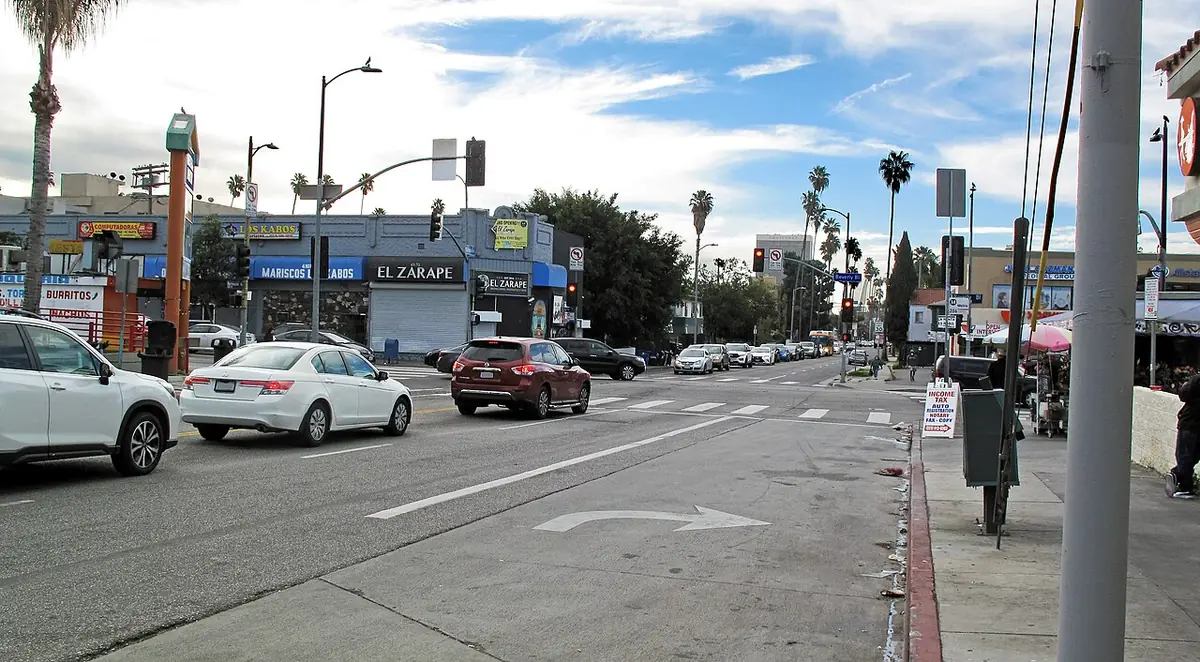
A lively corner of Los Angeles, shops and traffic side by side — Photo: Downtowngal · CC BY-SA 4.0 · Wikimedia Commons
With the budget framed, the next thing is the legal nature of the property you are about to occupy.
The Los Angeles rental market is marked by wide price variation depending on location and on what the property offers. Beyond the headline rent in the listing, the overall budget has to take in specific items such as yard upkeep, air conditioning and the insurance landlords require. The ranges given here reflect what is observed on the ground for single-family houses in good condition. Working these cash flows out carefully avoids nasty surprises in the first months of the tenancy.
los-angelesTo rentHouseestimate
Median price / m²US$23Half the apartments sell below this
Median priceUS$4.09kthe average is 14% higher — a few very large properties pull it up
Most common2 bedrooms59 % of listings
Average size166 m²
By number of bedrooms
Bedrooms
Share of market
Avg price
Price / m²
Avg size
2most common
59 %
US$4.09k
US$25
166 m²
3
32 %
US$5.11k
US$23best value / m²
219 m²
4
9 %
US$6.54k
US$23best value / m²
280 m²
Each row is an average, compared against the area average of US$25 / m². These are indicative estimates of a typical local market, not a measured sample of live listings. Check current listings before relying on them.
Detached house or managed community: which type of rental fits what you want?
Understanding these structural distinctions prepares you for the critical stage of the lease itself and the guarantees around it.
The type of property you rent in Los Angeles directly shapes your day-to-day freedom and your maintenance responsibilities. On one side, the single-family house gives complete privacy and a private lot, but expects you to be personally involved in upkeep. On the other, homes inside managed complexes or planned communities offer shared services but come with strict rules. Looking at both models lets you calibrate the time and money you are prepared to put in.
The stand-alone single-family house
This kind of rental guarantees complete independence from immediate neighbours, private outdoor space that is often planted, and a freer hand with the interior. In exchange, you take on watching over the property directly, dealing with what the weather does to the yard, and coordinating maintenance visits with the landlord.
What it changesYou get a genuinely Californian way of living but have to accept a heavier organisational load day to day.
The house in a gated or managed community (HOA)
Renting inside a homeowners association gives you access to shared amenities such as a pool, tennis courts or extra security, with the common areas maintained for you. Against that, the rules impose strict requirements on appearance, limit vehicle parking and add monthly charges.
What it changesYou gain the comfort of shared services but lose some freedom in how you use your immediate surroundings day to day.
Which steps and requirements have to be cleared before you hand over any money?
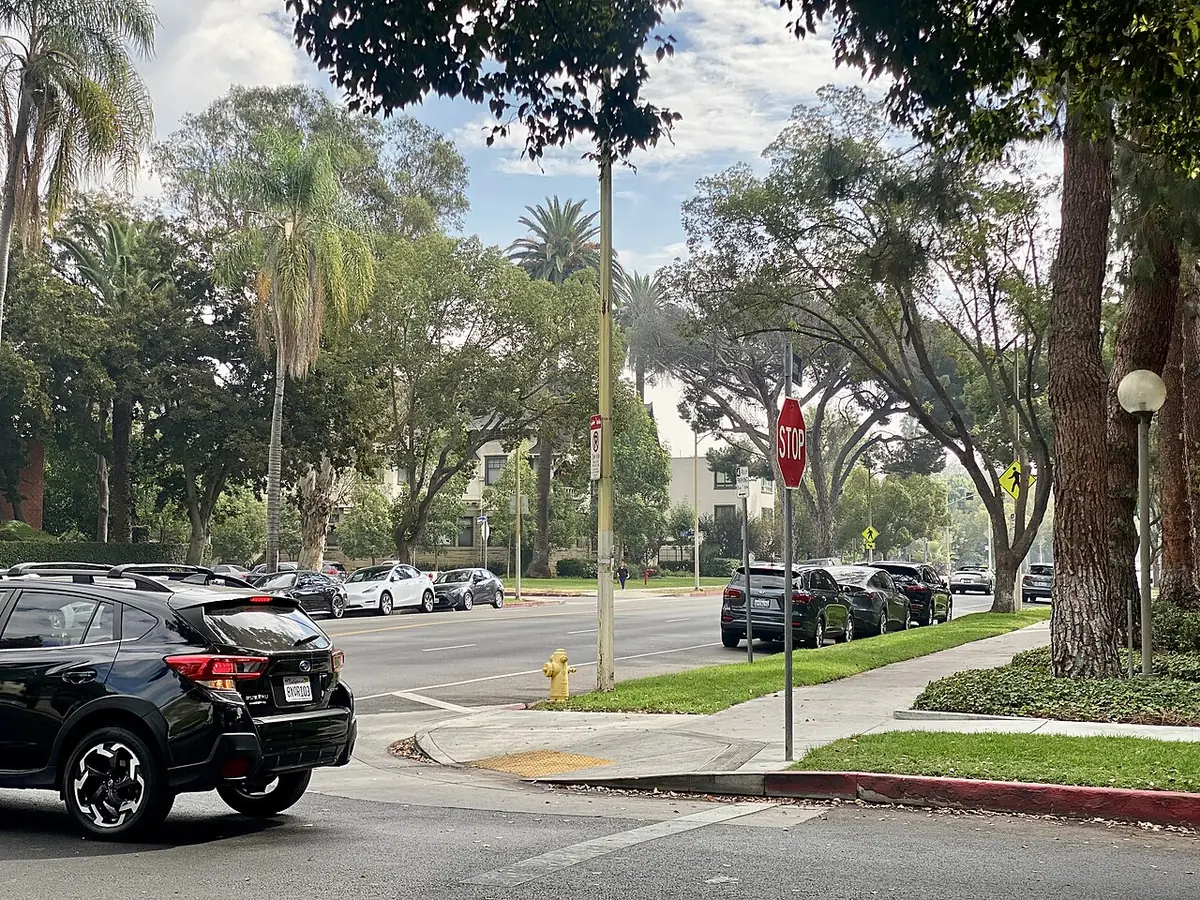
A quiet, palm-lined street in the University Park neighbourhood — Photo: EEJCC · CC0 · Wikimedia Commons
Once the paperwork is under control, the chronology of the transaction turns the plan into a move.
Signing a residential lease in California follows strict procedural rules that repay careful attention. Every document you submit is examined closely by the agency or by the landlord's representative. Anticipating what will be asked of you financially, and understanding the order in which things happen, protects your position as a tenant. Here is the sequence of steps to clear so that the move goes through calmly.
The initial shortlisting of the property and a thorough look around the neighbourhood
Assemble a complete application file including proof of income, professional references and identity documents, translated if necessary
Submit the file with the background check charges (application fees) allowed under local rules
Go through the clauses of the standard lease in detail, in particular the term, the conditions for raising the rent and the maintenance responsibilities
Pay the security deposit into a secure escrow account once both parties have signed the lease
The joint move-in inspection and the official handover of the keys
How does the operating calendar of a successful move to Los Angeles fit together?
This methodical structure gives you everything you need to approach your Californian housing search calmly.
Renting successfully in Los Angeles takes careful coordination between several local players. From the first choice of agent through to actually taking possession, each one has a precise role you need to identify. Following this sequence is what makes the transition to your new home smooth and secure. Here is the map of the roles and stages along the rental route.
The future tenantSetting criteria and scoutingWorking out what you need in terms of floor area, overall budget and location, given your work and personal constraints.
The local real estate agentShortlisting properties and viewingsArranging in-person or virtual viewings and presenting a selection of houses that match the brief closely.
The property managerScreening and selectionCareful review of the financial file, background checks and validation of the guarantees the applicant puts forward.
The landlordApproval and lease signatureFinal approval of the terms, electronic or paper signature of the lease, and agreement on the dates.
The utility providersConnections and energy accountsOpening electricity, gas, water and internet accounts in the tenant's name so that everything works from day one.
The tenant and the property managerMove-in inspection and handover of keysJoint record of the condition of the property, noting any observations, and official taking of possession.
Renting a detached house or an apartment in Los Angeles: making the right call
Once you have settled on the type of property, the financial reality of the move deserves a close look.
Choosing between a detached house and an apartment in Los Angeles is not simply a matter of taste or square footage. In this city, the type of property you rent redefines your whole relationship with the place: your daily journey times and your sense of neighbourhood. Renting a single-family house in areas such as Silver Lake, Culver City or the foothills of Pasadena buys privacy, private outdoor space that is often precious if you have pets, and a welcome distance from the noise that comes with large residential complexes. That autonomy has a real cost, though, in money and in logistics, including yard upkeep and dealing directly with the household problems a landlord of an apartment building would usually handle.
An apartment, by contrast, whether in a modern serviced building in Downtown LA or in a smaller condominium in Santa Monica, makes daily life a good deal simpler for a newcomer. The shared charges often cover the pool, the gym, round-the-clock security and maintenance of the common areas, which frees up a lot of time for someone starting a job in California. On the other hand, living close to many neighbours, the sometimes awkward business of parking on nearby streets and the absence of any real private yard can wear on people who came a long way for the Californian promise of space and quiet in the sun.
It also pays to read the rental market through the lens of flexibility and local regulation. Houses in Los Angeles are often older in their construction, sometimes full of character but needing a closer eye on insulation and air conditioning, both critical during summer heat peaks. Newer apartments tend to perform better on energy and integrate modern systems more neatly, but come with strict building rules that can limit what you do on a balcony or which appliances you install. Your final decision has to weigh how much you value independence of space against the operational comfort of having management handled for you.
Finally, the type of property shapes how you fit into local life. A detached house roots you in a quiet residential neighbourhood, good for street-level acquaintance but potentially cut off from what is going on in the city. An apartment drops you into the middle of the metropolitan rhythm, which makes chance encounters easier but leaves less personal space to decompress in. Weighing your work priorities, your tolerance for traffic and the way you like to live is what will identify the format that makes your move to Los Angeles a lasting success rather than a permanent source of friction.
What overall budget do you need to live comfortably in a rented house in Los Angeles?
With the financial frame set, let us look at how an ordinary day is actually organised in this vast city.
Building a forward budget for renting a house in Los Angeles calls for real discipline, given the particular structure of Californian costs. The headline rent is only part of monthly spending; on top of it come unavoidable items such as renters insurance, the energy bills that come with air conditioning, and subscriptions to essential services. Working these out from day one will keep you out of financial trouble in one of the most demanding rental markets in the United States. The figures below reflect the averages observed for standard properties in the current market.
Recurring monthly costs of renting a house
Cost item
Budget range (USD)
Comment and what moves it
Monthly rent (2 to 3 bedroom house)
$3,500 - $6,500
Varies considerably with distance from the ocean and the quality of the school district.
Electricity and air conditioning (LADWP)
$200 - $450
A sharp peak in summer and autumn because the air conditioning runs hard.
Broadband and phone
$100 - $180
Main providers include Spectrum and AT&T Fiber depending on the area.
Renters insurance
$30 - $70
Required in almost every Californian lease, covering the tenancy risks.
These amounts can rise by 15% to 25% in the most sought-after parts of the Westside or the Hills.
Up-front and move-in costs
Type of cost
Estimated amount (USD)
How it is paid
Security deposit
$3,500 - $13,000
Capped by law at two months' rent for an unfurnished property in California.
Agency or application fees
$0 - $50 per adult
Charges for the background check and the credit check on your file.
Utility connections and deposits
$150 - $400
Account opening charges with the city and the energy providers.
Plan on a cash reserve equal to three full months' rent to get through the move-in phase without strain.
What does an ordinary Tuesday actually look like between work and getting around the city?
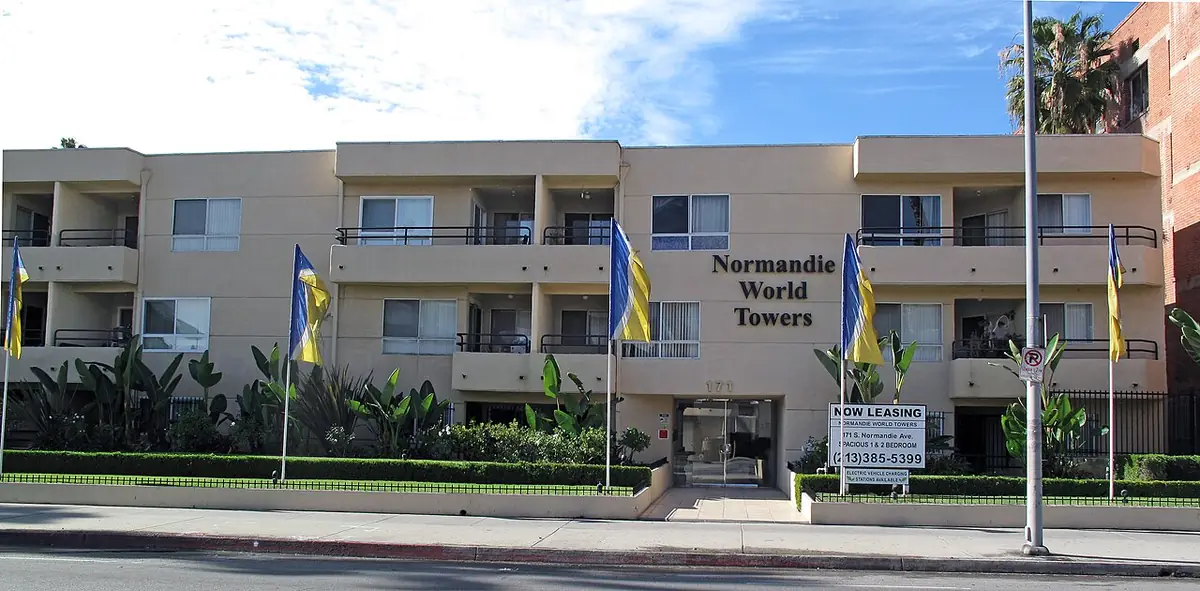
An apartment tower typical of Koreatown's housing stock — Photo: Downtowngal · CC BY-SA 4.0 · Wikimedia Commons
Beyond this well-worn routine, plenty of hidden aspects of the rental market deserve your attention.
Living in Los Angeles means coming to terms with the geographic scale of the city and the reality of its road network. To get a feel for your future quality of life, it helps to follow an ordinary day from dawn through to the evening. The route shows how much the location of your house matters relative to your workplace and to the amenities you cannot do without. Each stop illustrates the ease or the friction built into the Californian rhythm.
07:00Residential neighbourhood (for example Sherman Oaks)Waking in the quiet of your suburban street, making coffee and taking a first look at the traffic app to plan the morning drive.
08:15Commute on the freewayDriving the main corridors such as the US-101 or the I-405, a stretch of podcasts or local radio while dealing with the volume of traffic.
09:30Workspace or office (Downtown LA / Century City)Arriving after a smooth or a grinding run depending on the route taken, settling at the desk and starting the day's meetings.
13:00Lunch break nearbyA quick lunch in a local cafe or a strip mall, making the most of the fusion cooking the region is known for.
17:30Grocery shopping (Trader Joe's or Whole Foods)A strategic stop on the way home to restock on fresh food, dodging the worst of the peak hours if the schedule allows.
19:00Home and downtimeParking in the driveway, then time in the yard or on the terrace to enjoy the mildness of the Californian end of day.
What the polished listing photos leave out about Los Angeles
These technical subtleties lead straight to the classic mistakes newcomers make in their first months.
The online rental platforms are full of bright photographs and glowing descriptions that paint an idyllic picture of life in Los Angeles. A careful look at the ground, though, reveals operational and structural realities that landlords and agents are in no hurry to advertise. Understanding what goes unsaid will spare you expensive disillusion and let you sign a lease knowing exactly what you are taking on. Here are the decisive things people usually only discover after moving in.
Poor sound and thermal insulation in older construction
Many single-family houses built in the middle of the twentieth century have single glazing and minimal insulation. That means punishing energy bills in summer and cold nights in winter, while street noise comes straight through.
The strict and complicated rules on street parking
If your house has no double garage or adequate driveway, finding a space in the evening can become a genuine ordeal. Street sweeping restrictions produce regular tickets if you forget to move the vehicle on the posted days.
Dealing with local pests (ants, rodents and coyotes)
The Mediterranean climate and the proximity of semi-wild land and canyons mean frequent contact with local wildlife. Ant invasions in spring or coyotes around the yard mean signing up quickly for a regular pest control contract.
The complexity of subletting and alteration rules (HOA and rent stabilisation)
Some parts of Los Angeles fall under the Rent Stabilization Ordinance (RSO), while others sit under homeowners associations with drastic rules. Any change to the space, or hosting someone else long term, can breach your lease and lead to a dispute.
The misjudgements you only discover after six months in the new house
Given all these demands, it is fair to ask whether this way of living really suits everyone.
Looked likeChoosing a neighbourhood purely for its cultural buzz and its closeness to the fashionable places.
Turned outA daily ordeal because of constant road traffic and no quiet at all in which to recover after long working days.
Would have caught itDriving the commute at peak hours on a weekday before signing the lease, and putting residential calm ahead of a neighbourhood's hype.
Looked likeSkimming the clauses on the return of the security deposit and on who pays for minor repairs.
Turned outAn unfair deduction from the deposit on the way out, justified by exorbitant restoration charges for wear that was already there on move-in day.
Would have caught itDoing an extremely detailed move-in inspection with dozens of time-stamped photographs, and insisting that the exact condition of every appliance is written down.
Looked likeUnderestimating what electricity and water bills do to the budget in the Californian climate.
Turned outA monthly imbalance in the household budget, with summer air conditioning bills well beyond what the agent said verbally.
Would have caught itAsking the landlord for the full history of energy bills over the last twelve months before committing.
Looked likeAssuming a large personal vehicle is no real handicap for parking day to day.
Turned outRepeatedly not being able to fit the car into a period garage that is simply too narrow, leaving the vehicle out on the street.
Would have caught itMeasuring the garage or parking space precisely and comparing it with the exact dimensions of your car.
Who is renting a house in Los Angeles really for, and who should walk away?
It is time to bring these threads together so you can make the final call with confidence.
Moving into a rented house in Los Angeles is a logistical and financial commitment that does not suit every newcomer. The fantasy of a house with a yard under the Californian sun is instantly appealing, but the daily reality can be punishing for anyone unprepared for local specifics. Looking honestly at your own situation will keep you out of a housing arrangement that does not match what you actually want or how flexible your work allows you to be.
The mobile young professional or single person after immediate urban energy
→An apartment downtown or in a lively building rather than a suburban house.
Looking after a house and its relative isolation work against the social spontaneity they are after, while urban buildings put networks and nearby services within direct reach.
The professional who travels frequently and unpredictably
→A short-term furnished rental or an apartment with a concierge service built in.
Yard upkeep, letting maintenance people in and keeping an eye on a detached house all demand a physical presence and an availability that a heavy travel schedule rules out.
The household on a tight budget with no financial margin
→A compact apartment or a better-connected outlying neighbourhood.
The unexpected costs that come with a detached house (an air conditioning failure, a burst pipe, yard maintenance) can quickly break a budget that has no slack in it.
So, are you ready to take the step and rent a house in Los Angeles?
At the end of this look at the rental market and at life in Los Angeles, the final decision is yours. Renting a house here is an extraordinary undertaking that redefines your daily life, offering a setting made of light, space and freedom that is hard to match. It does, though, demand methodical preparation, a sharp awareness of the financial realities and full acceptance of what the city's logistics ask of you. If you have measured the effect of traffic, worked out the real costs beyond the headline rent and accepted the geographic compromises involved, you have what you need to make the move work.
Whether your search succeeds rests on your ability to line your expectations up with the Californian reality. Do not go looking for absolute perfection or for the ideal neighbourhood that combines every superlative with no drawbacks. Aim instead for a balance between calm at home, efficient work journeys and the quality of your connection to the local area. By working step by step, checking every clause of your lease and surrounding yourself with the right people, you will turn your arrival in Los Angeles into a smooth and durable transition.
Take the time to see several properties, to test journey times at peak hours and to check your forward budget with a comfortable safety margin. California rewards those who approach its housing market with clear eyes, pragmatism and preparation. If those conditions are met, all that is left is to finish your application file and get ready for one of the most stimulating places you will ever live.
Related questions
What does a house typically rent for in Los Angeles?
Rent on a single-family house in Los Angeles usually runs from $3,500 to more than $7,000 a month, depending on floor area, the general condition of the property and above all where it sits relative to the ocean and the main employment centres.
What documents do you need to rent a house in California?
Landlords expect a complete file: photo ID, proof of income for the last three months (paystubs), federal tax returns, references from previous landlords and a credit report.
What is the security deposit and how much can it be?
It is the deposit paid when the lease is signed. In California, state and local rules generally cap it at two months' rent for an unfurnished home, returned after the move-out inspection.
Is renters insurance compulsory?
In practice yes: almost every landlord and property management company requires a renters policy covering personal liability and damage to your own belongings before the keys are handed over.
How does air conditioning work and what does it do to the bills?
Houses have either separate wall units (mini-splits) or a central system. Given the summer heat, running the air conditioning for long stretches can add several hundred dollars a month to the electricity bill.
What are the rules on pets in rentals?
Many landlords accept pets, but they often charge a monthly supplement (pet rent) plus an additional deposit (pet deposit) to cover any damage.
How are utilities handled (water, electricity, gas)?
Apart from charges that are sometimes included in managed communities, the tenant has to open accounts in their own name with the local providers, such as LADWP for electricity and water or SoCalGas for gas.
What is the Rent Stabilization Ordinance (RSO) in Los Angeles?
The Rent Stabilization Ordinance (RSO) limits how much and how often rent can be raised on certain types of housing built before October 1978, giving those tenants stronger legal protection.
Can you change the interior layout or paint the walls?
Any structural or cosmetic change, painting the walls included, needs the landlord's written permission in advance. The property normally has to be returned in its original state at the end of the lease.
How do you go about a house search if you have just arrived from overseas?
Use the established platforms (Zillow, Westside Rentals), work with a local agent (a realtor), and plan on a short-term furnished rental for your first few weeks on the ground.