Finding a flat to rent in Glasgow means getting to grips with what makes the Scottish rental market its own thing, from its landmark neighbourhoods to the running costs that sit alongside the rent. This guide walks you through it step by step so you can settle in with clear eyes, from choosing the address to picking up the keys.
Get the app
What nobody tells you.
Real prices, hidden costs and the traps to check before you commit.
What you actually get when you rent a flat in Glasgow
Scroll
What you actually get when you rent a flat in Glasgow
Finding a flat to rent in Glasgow means getting to grips with what makes the Scottish rental market its own thing, from its landmark neighbourhoods to the running costs that sit alongside the rent. This guide walks you through it step by step so you can settle in with clear eyes, from choosing the address to picking up the keys.
Written by the ting.ad editorial team ·
Chalmers Gate, Glasgow in Street View: drag to look around.
Understanding those basic trade-offs lets you approach the move with the right expectations.
Renting a flat in Glasgow is not simply a matter of finding a roof among the Victorian architecture. Behind the promise of a lively cultural city sit real structural compromises on warmth and on the upkeep of the common parts of the building. Tenants discover quickly that the charm of old stone comes with very particular insulation demands and with shared-ownership rules that can feel dated. You have to weigh precisely what the Scottish market offers in floor space against the real cost of energy and running charges. That reality changes the usual approach to city living and calls for a clear head from the first viewing.
The architectural character of red sandstone buildings from the Victorian and Edwardian erasvsPotentially high energy bills and the damp problems that come with older stock
The handsome facades of the central neighbourhoods often hide poorly insulated flats that are hard to heat through the long Scottish winter months.
A dense cultural life, accessible transport and the universities right on the doorstepvsFierce competition for lets, which leaves applicants very little room to negotiate
Demand is driven above all by students and young professionals, so you have to react very quickly the moment a listing goes up.
Common parts and roofs managed collectively by the owners in the buildingvsFrequent deadlock over shared repairs when one of the owners cannot or will not pay
The Scottish tenement system creates a practical interdependence for the upkeep of the fabric that can hold up even urgent work, and as a tenant you live with the delay while the owners settle it.
Does this place really fit the way you live day to day?
The neighbourhood you choose sets not just your rent but your whole cultural relationship with the city.
Life in Glasgow varies sharply depending on whether you want the buzz of the city centre, the residential calm of the outskirts or the bohemian mood of the western neighbourhoods. Every tenant has to be honest about their priorities on commuting, local services and how much space they need. The city offers marked contrasts between its different areas, and they are worth identifying before you sign a tenancy you intend to keep. Here is how your daily routine will actually look under each option.
Choosing the city centre or Merchant City
You get complete access on foot or by public transport to wherever you need to be, with shops and restaurants open late. In exchange you give up large private green space, and you accept city noise along with floor areas that are often smaller for the same rent. This way of living suits mobile people who value cultural activity and want to cut their daily commute to almost nothing.
Choosing the West End
You settle near the parks, the museums and the independent cafes along Great Western Road. It is a sought-after area with a remarkable quality of life, but rents there reach the top of the local market. Competition is ferocious at the start of each academic year, and available properties rarely last more than a few days on the letting portals.
Choosing the outer residential neighbourhoods
You gain valuable square metres and direct access to wilder parkland, well away from the bustle of the centre. In exchange your daily journeys get longer and depend on a good connection to the suburban rail or bus network. This suits tenants who put domestic comfort and quiet nights at the top of their list.
Renting here when you arrive from abroad: what really changes in practice
A striking sandstone building with matching gothic-style gables in Glasgow — Photo: Michal Klajban · CC BY-SA 4.0 · Wikimedia Commons
With those administrative differences under control, the next job is to target the right area precisely.
Moving to Glasgow from another country brings a number of administrative and cultural surprises that are better anticipated than discovered. The British rental market runs on its own codes, from rigorous checks on your financial history to the way utilities are handled. Whatever your usual reference points are for leases, deposits and condition reports, they will not map cleanly onto the Scottish system. Here is a plain comparison of the fundamental differences that will shape your first months on the ground.
From abroad
A rental framework you may be used to that is heavily weighted towards the tenant, often with open-ended leases
Glasgow
A market governed by modern tenancy contracts (the Private Residential Tenancy) with no fixed minimum term but with regulated rules on rent increases
You get real flexibility to leave the property while still being protected against unreasonable rent rises during the tenancy.
From abroad
A deposit paid straight to the landlord and sometimes hard to get back when you move out
Glasgow
A mandatory independent holding system (an approved tenancy deposit scheme) where the money is lodged with a regulated third party
Your money is fully secured in the event of a dispute, and any disagreement over what is returned goes to neutral, reasonably quick adjudication.
From abroad
Service charges often bundled into a flat monthly figure or reconciled once a year by a building manager
Glasgow
Council Tax and energy bills handled individually and paid by the tenant alone
You need to budget those fixed items precisely from the day you arrive, because the amounts swing widely with the energy rating of the property.
From abroad
An application judged mainly on payslips and on a named personal guarantor
Glasgow
A thorough affordability and credit check (referencing) covering credit history, income and sometimes references from previous landlords
It is essential to prepare a flawless file with clear supporting documents, especially if you are arriving directly from abroad with no UK history.
Which Glasgow neighbourhood should you target for your budget and expectations?
Once the neighbourhood is settled, the decisive question of budget and real running costs takes over.
Glasgow is a mosaic of neighbourhoods with very distinct identities, running from the commercial centre to leafy residential districts. Where you choose to live depends not only on how close you are to work but on how you live and how much city noise you can take. Every area has undeniable advantages balanced by financial or logistical trade-offs you should know about in advance. Here is a comparison to point your search in the right direction.
Merchant City
A fashionable quarter where old warehouse courtyards have been converted into lofts, galleries and serious restaurants.
Suits
City professionals who want to do everything on foot and enjoy having cultural activity on all the time.
Trade-off
Rents among the highest in the city, and nightlife that gets genuinely noisy at weekends.
West End
A bohemian, studious atmosphere set by green parks, bookshops and independent cafes.
Suits
Academics, families and anyone who loves Victorian architecture and generous room sizes.
Trade-off
Extreme pressure on lets at the start of term, and scarce properties that force an immediate decision.
Southside (Shawlands and Strathbungo)
An area on the rise, valued for its family parks, its local food scene and its village spirit.
Suits
Anyone after excellent value for money and an active, creative local community.
Trade-off
Slightly longer journeys into the strict city centre at peak times.
What does a flat in Glasgow really cost to rent?
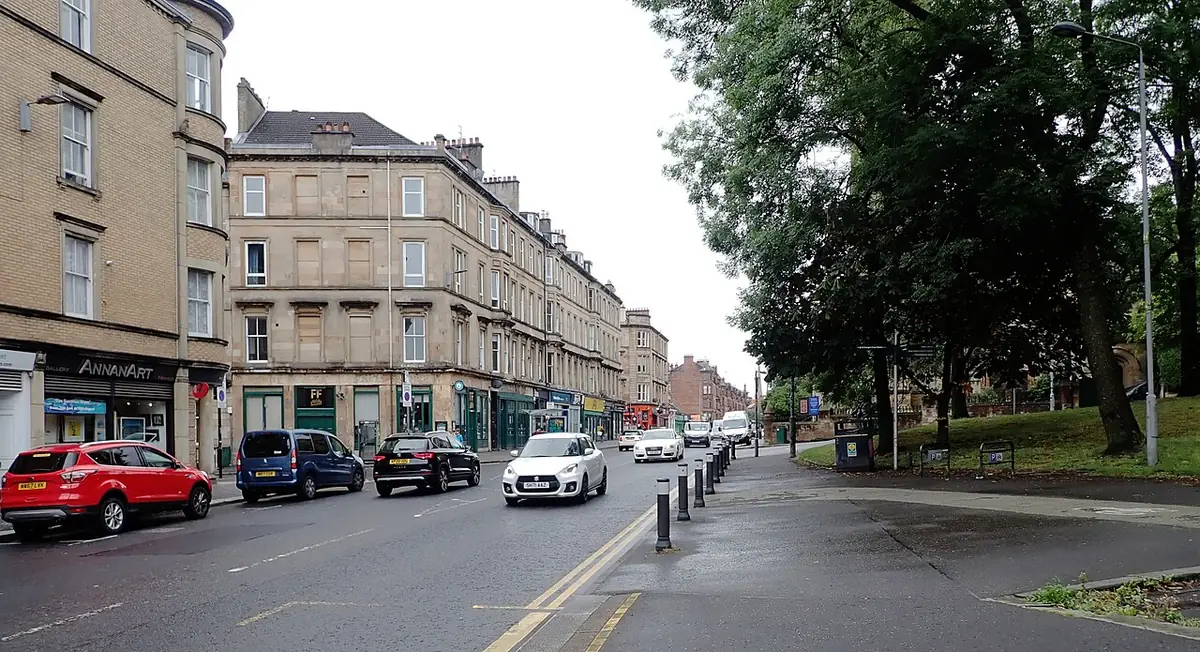
Streets like this, tenements over shops, are everyday Glasgow — Photo: habiloid · CC BY-SA 2.0 · Wikimedia Commons
Beyond the money, the legal shape of the properties on offer deserves a careful look.
Working out the cost of a home in Glasgow should never stop at the headline rent shown on the listing. You have to fold in all the unavoidable outgoings that make up a Scottish tenant's real monthly budget. Council Tax, energy contracts and building charges weigh heavily in the balance. The figures below set out the ranges seen on the market so you can size up your plans transparently.
glasgowTo rentApartmentestimate
Median price / m²£15Half the apartments sell below this
Median price£1.12kthe average is 14% higher — a few very large properties pull it up
Most common2 bedrooms45 % of listings
Average size70 m²
By number of bedrooms
Bedrooms
Share of market
Avg price
Price / m²
Avg size
1
25 %
£830
£18 +13 %
45 m²
2most common
45 %
£1.06k
£16
65 m²
3
25 %
£1.35k
£15 −6 %
90 m²
4
5 %
£1.66k
£14best value / m²
115 m²
Each row is an average, compared against the area average of £16 / m². These are indicative estimates of a typical local market, not a measured sample of live listings. Check current listings before relying on them.
What you can actually rent: the trade-off between space and age
Knowing those property types makes it much easier to face the formalities of signing a tenancy.
Glasgow's rental stock is dominated by the traditional tenements, the stone-built blocks of flats put up in the nineteenth and twentieth centuries. Renting in those buildings gives you generous volumes and fine ceiling heights, but it forces compromises on the interior layout and on how modern the fittings are. New-build schemes along the Clyde, by contrast, offer excellent warmth and comfort but sometimes lack the period character tenants come looking for. So the real choice is between the authentic charm of the stone and the technical performance of the new.
The Victorian tenement flat
These homes have spacious living rooms, big bright windows and preserved period details such as cornicing and decorative fireplaces. In exchange the kitchen is sometimes cramped, sound insulation between floors can be limited, and the heating system needs constant attention.
What it changesYou get a home with real architectural personality at the price of staying alert to energy efficiency.
The modern or refurbished flat
These recent or fully renovated properties come with effective thermal insulation, proper double glazing and open-plan spaces suited to how people live now. Parking is usually simpler and overall energy costs stay far better under control.
What it changesYou get immediate modern comfort and lighter bills, usually at the cost of the historic character the city is known for.
The rule to understand before you pay any money towards a flat in Glasgow
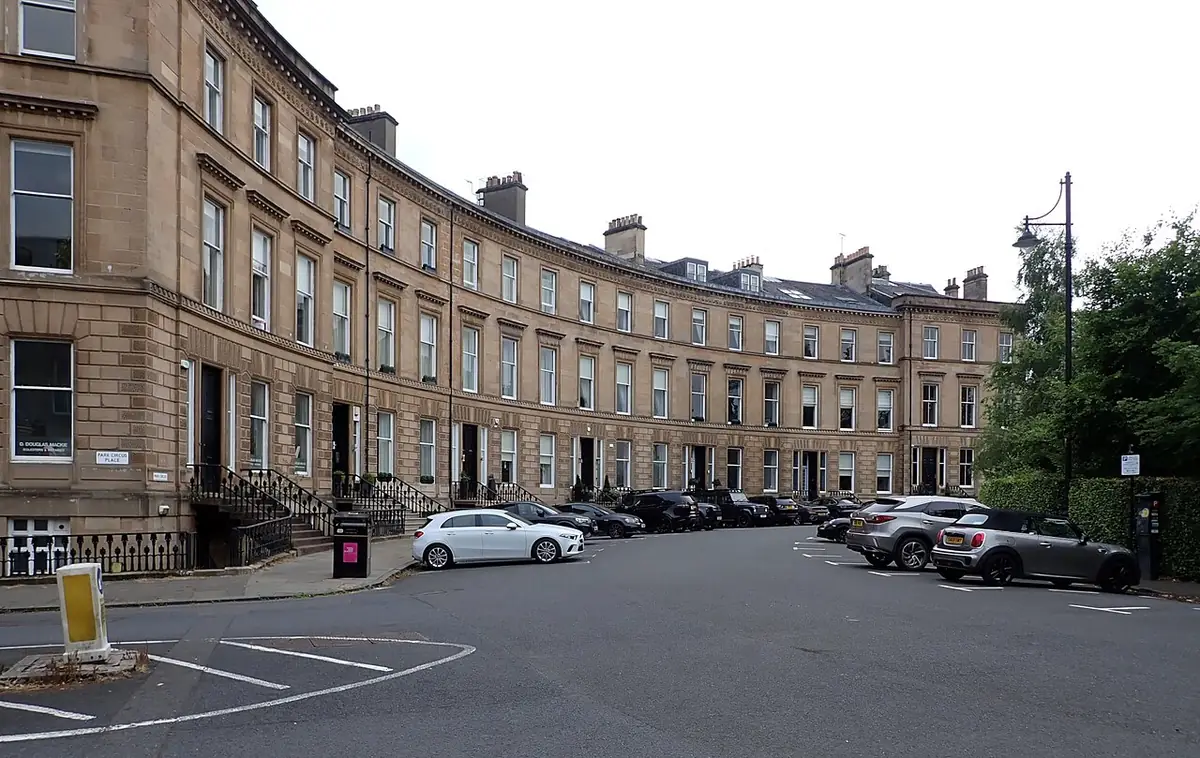
Terraces like this crescent are some of Glasgow's most sought-after streets — Photo: habiloid · CC BY-SA 2.0 · Wikimedia Commons
To run the move without a false note, let us walk through the sequence of a successful let in order.
Renting in the UK runs on strict procedures where each stage carries legal and financial weight for the applicant. Unlike markets where a verbal agreement counts for something, everything here rests on formal checks and standardised written documents. Understanding how those checks follow one another will spare you unpleasant surprises and let you secure the flat you want without rushing. Here is the chain of steps that leads to the keys.
Viewing the property and submitting a formal application to the letting agent or the landlord.
A rigorous check on your ability to pay, with calls to your professional and personal references.
Confirmation of your right to live and rent in the UK (Right to Rent checks).
Issue and electronic signature of the tenancy contract (the Private Residential Tenancy agreement).
Payment of the first month of rent and of the deposit into the approved tenancy deposit scheme.
The check-in inventory recording the condition of the property, and the formal handover of the keys to your new home.
How renting in Glasgow unfolds, step by step
Renting successfully in Glasgow takes method and a lot of speed in a tight market. From the first online search to the day you actually move in, every party to the transaction has a precise role you can plan around. Meeting the administrative deadlines keeps the move flowing and protects your rights as a tenant. Here is the typical path of a let carried through properly in Scotland's largest city.
The tenantSearching and watching the market activelySpotting available properties on the specialist portals and booking viewings as fast as possible, given how strong demand is.
The letting agentRunning viewings and collecting applicationsShowing the property, gathering files from interested applicants and passing the proposals on to the landlord.
The referencing serviceAffordability and background checksReviewing payslips, contacting previous landlords and verifying the financial history of the chosen applicant.
The landlordFinal approval and signature of the tenancyApproving the completed file and signing the standard tenancy contract that sets out the rights and duties on both sides.
The deposit schemeSecuring the tenancy depositReceiving and holding the deposit in an official independent account in line with Scottish law.
The tenant and the inspectorCheck-in inventory and handover of the keysGoing through the condition of the property room by room before you formally take possession.
Flat or house in Glasgow: weighing a tenement against a Victorian villa when you rent
Once the type of property is settled, the central question of what it really costs each month arrives immediately.
In Glasgow the choice between a flat and a house comes up most often in the central neighbourhoods such as the West End or Finnieston, where the famous red sandstone tenements and Georgian terraces dominate the streetscape. Those older buildings offer remarkable ceiling heights, generous volumes and an architectural character that wins tenants over on sight. What they also mean, though, is living in a building under shared management, the tenement management scheme, which requires constant agreement between neighbours on the upkeep of the roof, the close and the common parts. Your landlord carries the share of those costs, but the consequences land on you: delayed scaffolding, an unrepaired stair light, a leak that takes weeks to resolve because one owner in the building has not agreed the quote.
Renting a detached or terraced house instead, usually in the more residential outer areas such as Shawlands to the south or Bearsden to the north, removes the constraint of collective decisions but introduces different day-to-day responsibilities. There is no shared stair and no factor, so maintenance questions go straight to your landlord, and looking after a private garden becomes part of your routine unless the tenancy says otherwise. The choice of property type therefore comes down to how you want to spend your time, bearing in mind that hard Scottish winters test the thermal envelope of older construction whether it is a flat or a house.
On the money, the Glasgow market shows contrasting dynamics: the rent per square metre for a flat in a sought-after neighbourhood can sometimes exceed that of a house a little further from the transport routes. Upper-floor flats also get welcome daylight in a city where autumn and winter weather cuts direct sun, while ground-floor properties sometimes suffer damp and look straight onto the street. Houses, for their part, come with direct outdoor access, which is a real advantage for families with children or tenants with pets, even though keeping a garden takes regular physical work. Your decision should be anchored in how you actually live, weighing precisely how much time you are willing to give to the practical side of a home rather than to its looks alone.
What should you budget overall to rent a flat in Glasgow and live in it?
To see how that budget works in practice, look at how an ordinary day in the city unfolds.
Renting a home in Glasgow does not stop at the monthly figure advertised on the letting portals, and you need to fold in the money that has to be found before you get the keys as well as the running costs that follow. The first month of rent and the tenancy deposit are both due up front, and the deposit is lodged with an approved scheme rather than kept by the landlord. After that, the recurring items do most of the damage: Council Tax varies sharply with the band assigned to the property, and energy is billed directly to you in a city where much of the stock is old and poorly insulated. Budget both halves before you commit, because a rent you can afford in isolation can still be unaffordable once the bills are attached to it.
What you need up front, based on the monthly rents shown in the market data above
Property size
Typical monthly rent
What it means before you move in
One-bedroom flat
GBP 830 a month
Expect to have this amount available twice over at signature: one month of rent in advance plus the tenancy deposit lodged with an approved scheme.
Two-bedroom flat
GBP 1,060 a month
The most heavily supplied size in the city, and also the one where competition between applicants is most visible at viewings.
Three-bedroom flat
GBP 1,350 a month
Usually a larger tenement flat, so factor in that the heating bill scales with the volume you are renting, not just the rent.
Four-bedroom flat
GBP 1,660 a month
A thin part of the market, often shared between several tenants, which makes the referencing checks on each occupant slower to complete.
These monthly figures are the averages set out in the market data on this page. The deposit is not an extra fee to the landlord: it is held by an independent scheme for the length of the tenancy and returned, subject to adjudication if there is any disagreement.
Recurring costs and the annual running budget
Type of cost
Estimated range
What makes it vary
Council Tax
GBP 1,200 to GBP 3,500 a year
The property is placed in a valuation band from A to H, set by the local authority on the estimated value in 1991, and the tenant normally pays it.
Factoring fees (common charges)
GBP 50 to GBP 150 a month
Management of the common parts, cleaning and building insurance. Usually the owner's bill rather than the tenant's, and absent altogether for a house, but worth asking about since it decides how well the close is maintained.
Energy (gas and electricity)
GBP 1,400 to GBP 2,600 a year
Heavily dependent on the energy rating (EPC) and on the floor area of an older property, and paid directly by the tenant.
Contents insurance
GBP 300 to GBP 600 a year
Your landlord insures the structure of the building. Your own cover is for your belongings, and premiums run higher in areas exposed to bad weather.
Energy is the most volatile item, because regulated tariffs move and the insulation of old buildings varies enormously from one flat to the next.
Health, transport and services: what does an ordinary Tuesday look like in Glasgow?
Detached villas like this show the grander end of Glasgow's housing stock — Photo: Michal Klajban · CC BY-SA 4.0 · Wikimedia Commons
Beyond that well-oiled routine, plenty of hidden aspects of the rental market deserve close attention.
Daily life in Glasgow revolves around a dense if imperfect public transport network, combining the circular subway, city buses and the suburban rail lines. An ordinary Tuesday usually starts with a morning journey into the city centre or towards one of the activity hubs such as the university campus or the business districts. Access to health services, whether a GP practice or one of the large teaching hospitals, is organised by the area you register in. How smoothly your day runs depends directly on how close you are to a rail or subway station, since buses are exposed to peak-hour traffic on the main arteries such as Argyle Street or Great Western Road.
08:15Local subway station or bus stopThe morning commute begins, often set by the rhythm of the oldest underground network in the city or by the frequent bus routes.
09:00Arrival at work or at a central coworking spaceSettling into the business or university quarter, with good connectivity and nearby places to stop for coffee.
12:30Local GP surgery or pharmacyDealing with routine health matters and repeat prescriptions through the local public health service, NHS Scotland.
15:30School or council nurseryCollecting children from neighbourhood education settings, whose quality and reputation vary noticeably from one part of the city to another.
17:30Local shops and the neighbourhood supermarketEnd-of-day food shopping in local chains or small neighbourhood markets to put dinner together.
19:00Public park or council sports centreTime outdoors in one of the city's many green spaces, such as Kelvingrove Park or Pollok Country Park, weather permitting.
What the letting listings and the agents will never tell you about Glasgow
Ignoring these realities is what turns a promising let into a disappointment within months.
The marketing copy on the letting portals consistently plays up the light, the character and the ideal location of the flats on offer in Glasgow. What it leaves out, routinely, are the structural and contextual facts that weigh most on how liveable a place is over a full tenancy. Whether it is the real condition of the building's roof, the planning schemes coming to the immediate neighbourhood or how much you will hear of the neighbours upstairs, the tenant has to do their own checking beyond the official marketing pack the agency hands over.
The real condition of the roofs and the red sandstone facades
The sandstone typical of Glasgow needs repointing and repair on a regular cycle, which produces very large one-off bills for the owners. As a tenant you do not pay them, but you do live with the scaffolding, the disruption and the months of delay when the money is not there.
The poor sound insulation of old timber floors
In older flats the absence of modern acoustic insulation between storeys means you hear a great deal every time a neighbour walks across the room or moves furniture above you.
Saturated and paid-for residential parking
Keeping a car in the central and semi-central parts of Glasgow means buying an expensive residential permit, and holding the permit does not guarantee you will find a free space in the evening.
Planned development and future building sites
New residential schemes or transport works starting nearby can disturb the peace of a street for a long stretch of your tenancy, with no reduction in the rent to match.
Badly run property factoring in some buildings
An absent or incompetent factor lets the common parts decay and slows down emergency call-outs when there is a water leak or a serious roof problem, and the tenant is the one living with it while the owners argue.
The regrets tenants discover six months after moving into Glasgow
Those accounts lead naturally to the question of who should think twice about this market altogether.
Looked likeA charming old top-floor flat bathed in light, right under the roof.
Turned outA furnace in summer and an energy sieve in winter, with astronomical heating bills and a leaking roof that the owners in the building could not agree to repair.
Would have caught itAsking for the EPC rating and for what the property actually cost to heat over the last three years, and asking the agent directly when the roof was last repaired and who the factor is.
Looked likeA lively, fashionable neighbourhood two minutes from the bars and late-night restaurants.
Turned outRelentless noise from Thursday to Saturday night, disturbance from people coming home late and no realistic chance of parking after an evening out.
Would have caught itVisiting the street at different times, including a Friday and a Saturday evening, to judge what the place is really like after dark.
Looked likeA bargain rent on a flat that supposedly just needed a coat of paint.
Turned outDamp hidden behind fresh plaster, dated electrical installations that were not up to standard, and sagging floors that no one had mentioned at the viewing.
Would have caught itInspecting carefully at the viewing, photographing every defect and getting all of it written into the check-in inventory before you sign anything.
Looked likeA supposedly quiet location that was also very close to the transport routes.
Turned outA flat immediately beside a busy road, with constant traffic and high levels of air pollution.
Would have caught itChecking the city's official noise maps and looking for bus corridors or main roads hidden behind the trees.
Who should not be renting a flat in Glasgow right now?
It is time to pull all of this together and decide whether your move to Glasgow is ready.
Renting in Scotland's largest city asks for readiness to move fast, a degree of financial slack and a tolerance for living in old buildings that not everyone has. Some tenants come unstuck because they approach the market with the wrong criteria or an unrealistic timetable. Faced with fierce competition for the best addresses, the constraints of shared tenement living and a demanding local climate, it is sometimes better to widen the search, wait for a quieter month or accept a different part of the city than to sign the wrong tenancy.
The applicant who needs a home within a few days and cannot act quickly
→To search the West End at the start of the academic year with their documents still unprepared.
Desirable properties there stay on the portals only a few days, and an application that arrives after the referencing file is complete for someone else simply does not get looked at.
The tenant who cannot tolerate noise or shared decisions about the building
→To move into a large old tenement with timber floors and a lot of neighbours.
Communal living in these buildings brings unavoidable noise through the floors, and repairs to the common parts depend on owners' agreement rather than on your own urgency.
The tenant on an extremely tight budget with no reserve at all
→To take a flat at the very top of what they can pay, counting only the rent.
Council Tax and the winter energy bills of a poorly rated older flat land on top of the rent, and a budget with no slack breaks the first cold month.
The tenant who has to keep a car and park it near home
→To rent in a central or semi-central neighbourhood without checking parking first.
Residential permits in those areas are expensive and do not guarantee a space, so the car becomes a nightly problem rather than a convenience.
So, are you ready to sign a tenancy in Glasgow?
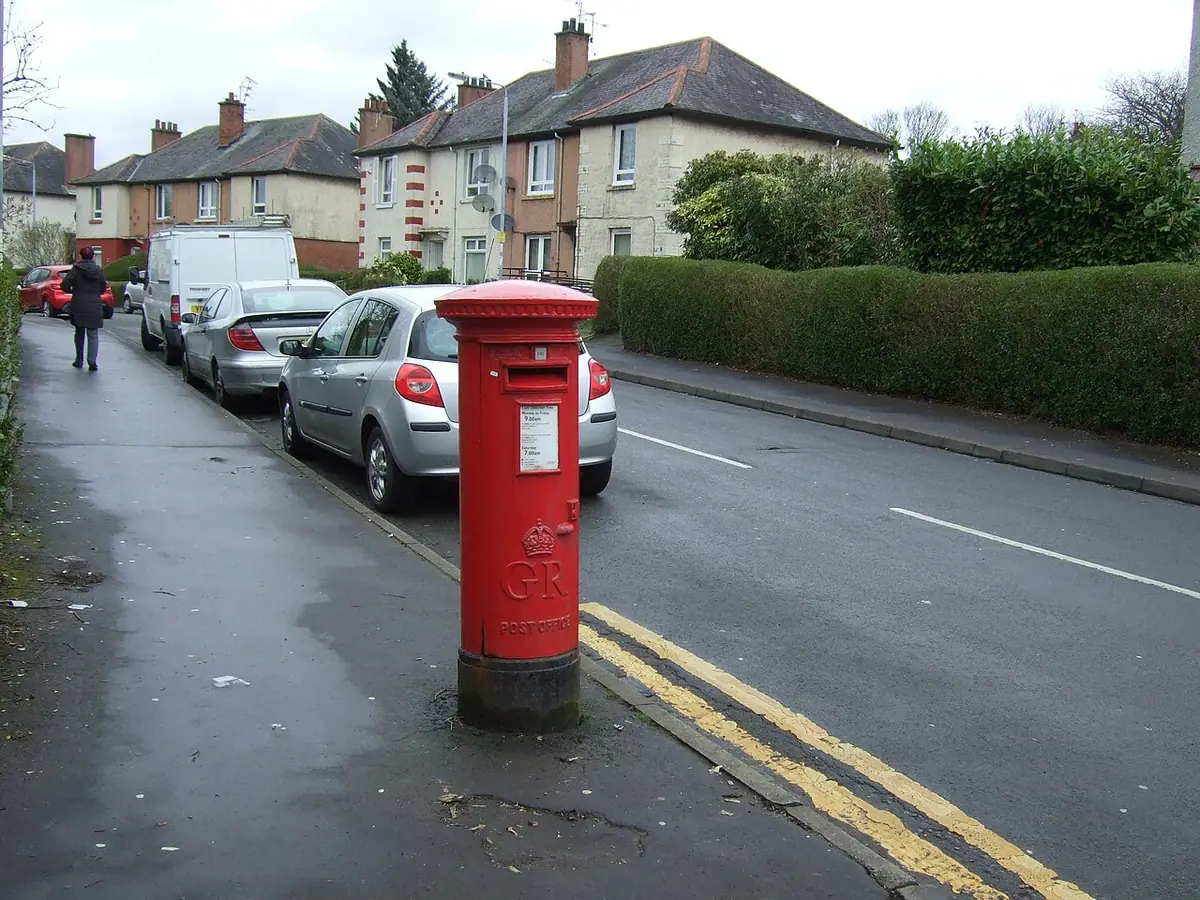
Quiet residential streets like this sit just off Glasgow's main roads — Photo: JThomas · CC BY-SA 2.0 · Wikimedia Commons
Deciding to rent a flat or a house in Glasgow means looking squarely at how the local market works instead of being carried away by the romance of old Scottish stone. If you have accepted that living in an older building means shared decisions between owners you never meet, occasional disruption while common repairs are argued over, and real discipline on the monthly budget, then the foundations of your move are sound. The city offers a stimulating cultural and economic life, provided you are willing to put down roots in the neighbourhood you choose.
The Scottish letting process, with its formal application, its referencing checks and its standard Private Residential Tenancy agreement, forgives neither improvisation nor last-minute hesitation. Going down this road means having not only the first month of rent and the deposit ready, but also a reserve for the running costs the listing did not mention. Careful viewings, a close reading of the energy rating and an honest reckoning with the local climate and the transport network are your best defence against later regret.
In the end, renting here should not be driven by panic or by the fear of missing out on a listing, but by a genuine fit between the way you live and what this city is actually like. Take the time to test the different neighbourhoods, weigh up each type of building, and get everything you were promised written into the tenancy agreement and the check-in inventory. If all of those boxes are ticked, Glasgow will give you a rich, authentic and deeply likeable place to live for the years ahead.
Related questions
How does applying for a rented flat actually work in Scotland?
Almost everything is done in writing and to a set order. You view the property, submit a formal application to the letting agent or the landlord, and your file then goes through referencing before anything is agreed. Once the Private Residential Tenancy agreement is signed by both sides it is a binding contract, so nothing should be treated as settled on the strength of a verbal understanding at the viewing.
What documents should a landlord give you before you move in?
Expect an energy performance certificate (EPC) for the property, the written Private Residential Tenancy agreement itself, and the check-in inventory recording the condition of each room on the day you take the keys. Landlords letting in Scotland also have to be registered with the local authority, so it is reasonable to ask the agent to confirm that before you commit any money.
Which Glasgow neighbourhoods are most in demand with tenants?
The West End has long been one of the most sought-after areas for its cultural energy, its green space and its Victorian architecture, and rents there sit at the top of the local market. The Southside, particularly around Shawlands, also attracts strong interest from young professionals and families for its momentum and its village-like quality of neighbourhood life.
Can you rent in Glasgow if you are arriving from another country?
There is no legal bar to renting as a foreign national, but the referencing stage is where arrivals from abroad usually feel the friction. Without a UK credit history you may be asked for extra proof of income, references from previous landlords or a guarantor, so it pays to arrive with a clear, complete file rather than assembling it once you are already competing for a flat.
How much does the EPC rating matter when you are renting rather than buying?
It matters directly to what you pay each month, because energy is billed to the tenant. Older, poorly rated flats are expensive to heat through a long Scottish winter, and no amount of charm in the mouldings offsets a badly insulated tenement in January. Ask for the rating and, where you can, for a sense of what the previous occupant actually spent on heating.
Who pays for roof repairs in a tenement when you are the tenant?
Repairs to the common parts, such as the roof or the close and stairwell, are the collective responsibility of the owners under the terms of the title deeds. A property factor, whether professional or a volunteer among the owners, coordinates the quotes, but every owner has to agree and be able to pay before work starts. As a tenant you report the problem to your landlord or agent and the delay, if there is one, sits between the owners rather than with you.
What money do you have to hand over before you get the keys?
The standard pattern is the first month of rent plus the tenancy deposit, both paid before move-in. The deposit does not stay with the landlord: it is lodged with an approved tenancy deposit scheme, an independent third party that holds the money for the length of the tenancy and handles any dispute over what is returned at the end.
Do rented flats in Glasgow usually come with any outdoor space?
Detached and terraced houses almost always have a private garden, while city-centre flats more often give access to a shared back garden used by everyone in the building. Some ground-floor properties, the so-called garden flats, come with an exclusive portion of ground of their own, and those are worth looking for if outdoor space is a priority.
How do you check the quality of the state schools near a flat you are considering?
Inspection reports and performance information for state schools are published by the local education authorities and by the bodies that regulate education in Scotland. Families frequently narrow their search to the catchment of a particular secondary school, which is worth confirming address by address before you commit to a tenancy.
How quickly do you need to move once a flat is advertised?
Faster than most newcomers expect. Demand from students and young professionals is strong enough that desirable properties in the West End rarely stay on the letting portals more than a few days, and the pressure peaks at the start of the academic year. In practice that means having your documents ready before you start viewing, so you can apply the same day rather than the following week.
Property review of ting
No ting properties in Glasgow yet
Be the first — share it on ting and it shows up right here.
Sources
Registers of Scotland Official data on title registration and on how the Scottish property market is moving.
Revenue Scotland Official rates and calculators for the Land and Buildings Transaction Tax (LBTT).
Glasgow City Council Information on Council Tax, city services and local planning rules.