Putting a credible value on a house in Glasgow means understanding a market with centuries of building tradition behind it and a legal framework of its own. This guide sets out what actually drives the figure: the realities of solid stone construction, how the surveyor's valuation inside the Home Report works, and the district evidence that decides what a property is really worth.
Get the app
What nobody tells you.
Real prices, hidden costs and the traps to check before you commit.
Why the sandstone floor area of a Glasgow house carries structural upkeep costs that no valuation should ignore
Scroll
Why the sandstone floor area of a Glasgow house carries structural upkeep costs that no valuation should ignore
Putting a credible value on a house in Glasgow means understanding a market with centuries of building tradition behind it and a legal framework of its own. This guide sets out what actually drives the figure: the realities of solid stone construction, how the surveyor's valuation inside the Home Report works, and the district evidence that decides what a property is really worth.
Written by the ting.ad editorial team ·
Chalmers Gate, Glasgow in Street View: drag to look around.
Beyond the technical picture, the figure also depends on which pool of comparable properties your house actually belongs to.
Valuing a traditional house in Glasgow runs straight into the physical reality of the local sandstone and the demands of a west of Scotland climate. Exposed stone facades are genuinely attractive, and their apparent resilience against Atlantic weather reads well in a listing. That aesthetic durability hides strict upkeep requirements that owners regularly underestimate, and a surveyor does not. Between heritage planning rules and constant ambient damp, every intervention on the fabric needs specialist technical work, and that is what separates the price a district average suggests from the figure a house will actually support.
The timeless appeal of dressed stonevsThe requirement for a breathable lime mortar
Owners often discover too late that modern cement on sandstone walls blocks the natural evaporation of moisture. The internal damage that follows needs highly specialised and expensive remedial work, and evidence of cement pointing is one of the fastest ways to see a valuation marked down.
Generous, light filled interior volumesvsThermal performance that is hard to improve
High ceilings and large original windows give the rooms a real elegance, and they also let heat escape faster. Improving efficiency demands bespoke solutions to preserve the visual integrity of the building, so the valuer weighs the character premium against a poor energy rating rather than simply adding the two together.
A central position in a historic districtvsStrict heritage restrictions on alterations
Owning in a protected area means every external change, from replacing window frames to renewing the roof, needs local authority approval and period appropriate materials. That constrains what a future buyer can do with the property, and a valuation has to reflect the ceiling those rules place on improvement.
Which kind of Glasgow house are you actually having valued?
Understanding those market segments makes it easier to see what changes for an owner arriving from another country.
The Glasgow residential market covers a wide range of house types, from suburban cottages on green edges to the large Victorian properties of the inner West End. The figure a valuation produces depends far less on raw floor area than on which pool of comparable sales your property sits in, and each of those pools behaves differently. Every geographical sector sets its own pace and its own accessibility constraints, and those are exactly the adjustments a surveyor applies before signing off a number.
Terraced house with a garden in the western residential districts
These properties are valued on a deep pool of comparables, because the same streets hold many similar houses, so the range around the figure stays narrow. Private outdoor space and a few minutes on foot to public transport are both priced in explicitly, and the modest upkeep burden of this type supports the number rather than eroding it. The counterweight is that the ceiling is set by the district itself: however well presented the house is, the price per square metre is capped by what the surrounding street evidence will bear.
Large Victorian or Edwardian house in an established suburb
Multiple bedrooms, formal reception space and often a garage or private driveway all read strongly in a valuation, and the school catchment adds a premium that shows up clearly in recorded sales. These districts also carry active residents associations, which supports demand. Against that, heating and preventive maintenance on a building of this size are substantial and continuous, and a surveyor will discount for deferred work, so the condition report matters more here than anywhere else in the city.
Compact townhouse or renovatable cottage near the central arteries
Properties of this kind are scarcer on the market, which makes comparables thinner and the plausible range around a valuation wider. Being able to reach galleries, restaurants and workplaces without a car is a real and measurable premium in these streets. Pulling the other way, many of these houses need interior modernisation to meet current comfort standards, and the cost of that work is deducted from the figure rather than being treated as future upside.
Valuing a Glasgow property when you have come from abroad: what genuinely changes
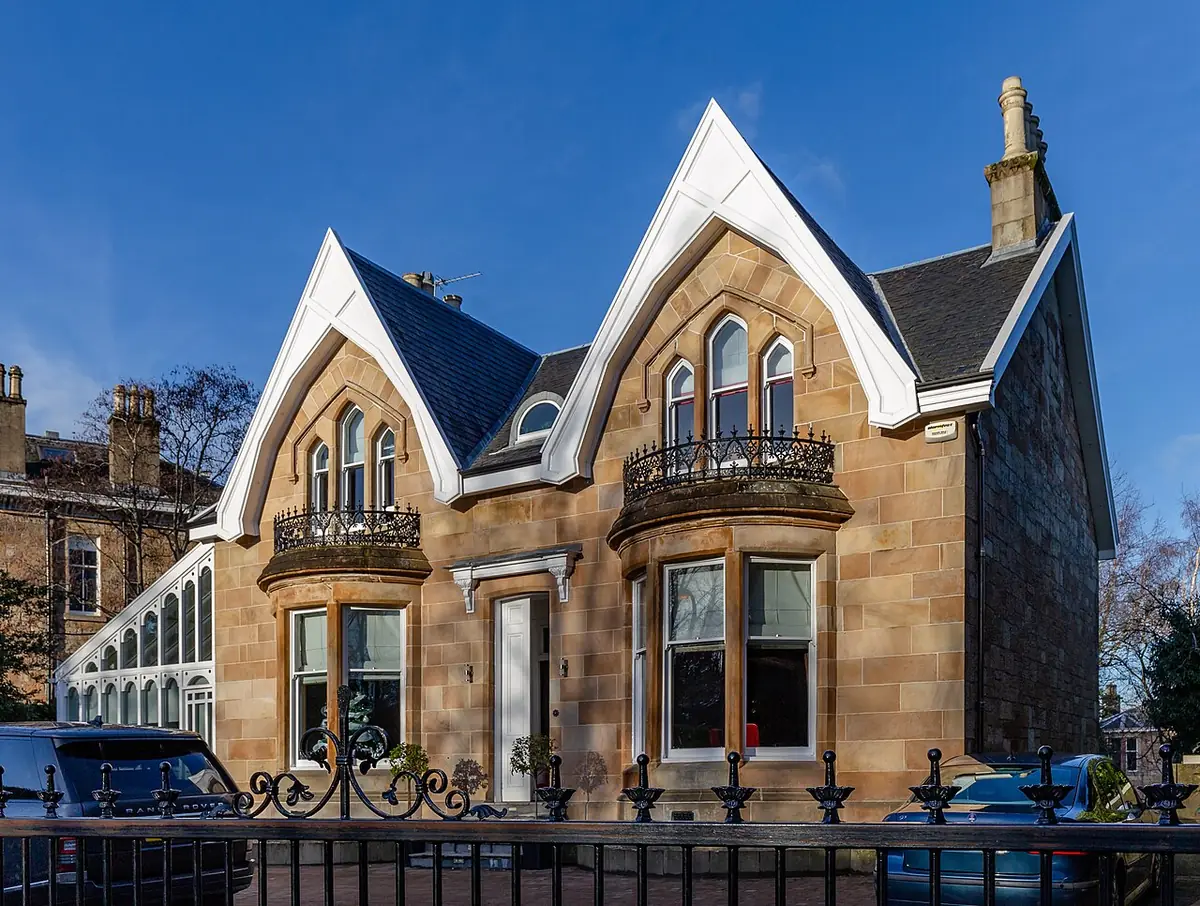
A striking sandstone building with matching gothic-style gables in Glasgow — Photo: Michal Klajban · CC BY-SA 4.0 · Wikimedia Commons
Once those rules are absorbed, the next step is identifying which district evidence your own property should be measured against.
Reading a Scottish valuation after working in almost any other property market means dropping some familiar reference points and picking up new ones. The Scottish system turns on the solicitor, who handles the legal side and the formal offers, and on a highly codified sequence of bids that makes the official value and the recorded sale price two different numbers. Common repair obligations, thermal performance and local taxation all follow their own logic here, and each of them moves the figure.
From abroad
A preliminary sale contract signed at an agency, with funds held in escrow
Glasgow
A system of formal binding offers submitted by a solicitor
In Scotland, once an offer is formally accepted through your solicitor, the agreement becomes binding quickly and commits both parties. That shortens the period of uncertainty, and it means the price fixed at that moment is the number that goes on record and values the next comparable house on the street.
From abroad
A market where energy ratings and standardised modern insulation drive the assessment
Glasgow
A compulsory Home Report containing a detailed energy assessment
Every house put on the market comes with a full pack assessing the physical state of the building and its energy performance. That document is the base for negotiation, and it exposes the short term work needed, which is the single largest downward adjustment applied to older Glasgow stock.
From abroad
A single unified property tax and conventional shared building charges
Glasgow
Council Tax bands and enforceable collective maintenance duties
The local tax amount depends on the property's assessed value as at 1991, and for attached properties the common repair rules mean close coordination with neighbours over the roof and shared foundations. An outstanding common repair is a liability a valuer will price against the house.
From abroad
Free form haggling from an advertised price, with a protected cooling off period
Glasgow
The offers over convention and the gap between the listed and the real market figure
Many properties carry a deliberately low guide price designed to stimulate competition. Reading a valuation here means analysing recent comparable transactions to work out what the local market will actually validate, rather than treating the advertised number as the value.
Which Glasgow district your house sits in, and what that does to its value
Knowing what each district contributes makes the underlying price figures far easier to read.
Glasgow is organised into sectors with strongly defined identities, each offering a different balance of accessibility, green space and cultural energy. From the artistic buzz of the West End to the leafy family areas of the Southside, the district decides not only daily life but also how liquid the property is and how tightly a surveyor can evidence a figure. Reading infrastructure, journey times and local demographic movement is what turns a citywide average into a defensible number for one address.
West End (Hillhead, Dowanhill)
A cosmopolitan feel set by the nearby university, wooded parks such as Kelvingrove and a dense offer of independent cafes.
Suits
Owners of fine Victorian architecture, where cultural pull and an elegant setting support the strongest evidence in the city.
Trade-off
An extremely competitive market where the price per square metre is among the highest in Glasgow, so the entry level and the valuation both sit high.
Southside (Shawlands, Strathbungo)
A dynamic and creative village spirit, with exceptional green space such as Queen's Park and a strong local community.
Suits
Family houses, where a lively neighbourhood and a more measured price level combine into a well supported valuation.
Trade-off
Sharply rising demand that thins the pool of available properties and speeds up transactions, which makes recent comparables age quickly.
North West (Kelvindale, towards the Bearsden boundary)
A pronounced residential calm, tree lined streets and an immediate sense of safety and quiet.
Suits
Larger living space and generous private gardens, where plot size carries much of the valuation.
Trade-off
Relative distance from the city centre, which means regular reliance on transport or a car and caps the premium walkability would otherwise add.
What houses in Glasgow actually value at, sector by sector
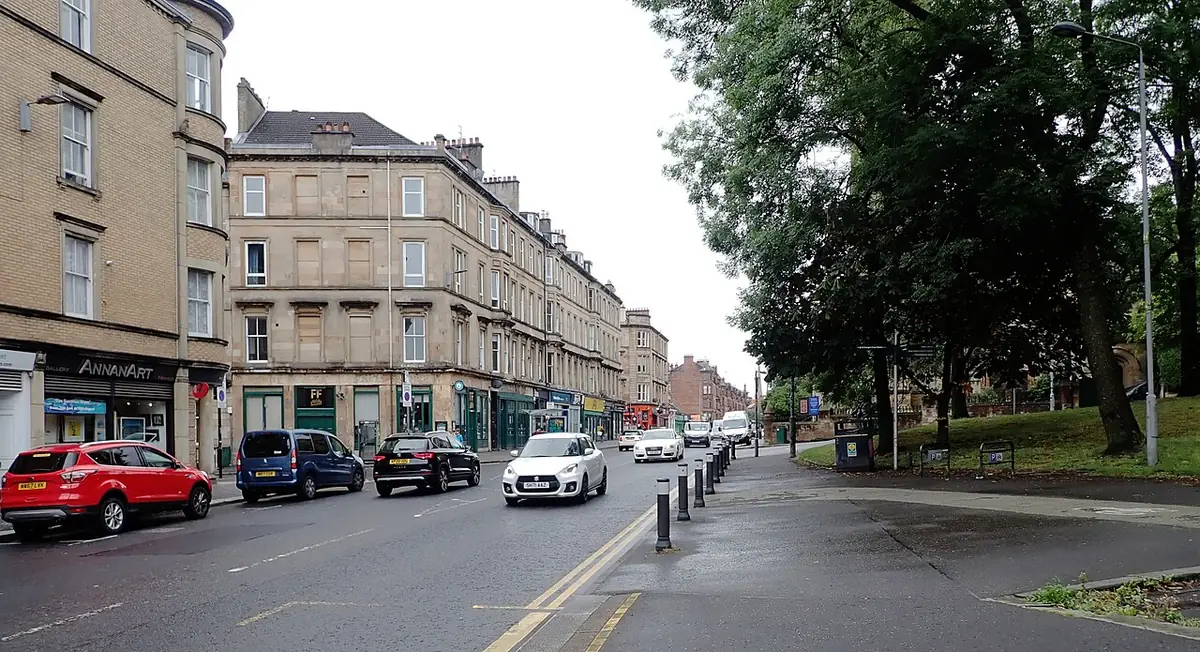
Streets like this, tenements over shops, are everyday Glasgow — Photo: habiloid · CC BY-SA 2.0 · Wikimedia Commons
Beyond the headline figure, the exact nature of the ownership you hold deserves particular attention.
Reading a valuation on a Glasgow house means separating the headline figure from the compulsory costs attached to a transaction, including Scottish transaction tax (LBTT) and legal fees. The ranges vary considerably with proximity to the main transport arteries and with the popularity of school catchments. A careful examination of registered transactions is what turns a broad range into a realistic figure for each property type.
glasgowFor saleHouseestimate
Median price / m²£1,792Half the apartments sell below this
Median price£231kthe average is 14% higher — a few very large properties pull it up
Most common2 bedrooms60 % of listings
Average size123 m²
By number of bedrooms
Bedrooms
Share of market
Avg price
Price / m²
Avg size
2most common
60 %
£219k
£1,924
114 m²
3
33 %
£279k
£1,773 −6 %
158 m²
4
7 %
£342k
£1,697best value / m²
201 m²
Each row is an average, compared against the area average of £1,886 / m². These are indicative estimates of a typical local market, not a measured sample of live listings. Check current listings before relying on them.
What you actually own, and why it changes the figure: land tenure in Scotland
With the legal picture in place, the point at which a price becomes a fixed, recorded value follows a very strict protocol.
Scottish land law carries historical features that bear directly on how a property is held, maintained and passed on, and a valuation has to account for them. Scotland reformed its land law deeply to remove the old feudal burdens, while keeping firm rules on the responsibilities shared between owners in historic buildings. Two properties of identical size can therefore support very different figures depending on which of these regimes they sit under.
Outright ownership (heritable, the Scottish equivalent of freehold)
For a detached or semi detached house with its own ground, from the soil to the roof, you hold outright ownership of both building and plot. No third party retains residual rights over the land, which greatly simplifies any decision to alter or improve the property in future.
What it changesValuations on this basis are the cleanest in the city: you retain full autonomy over renovation choices, subject only to local planning rules and any heritage protection, so improvement potential can be credited to the figure rather than discounted from it.
Shared walls and horizontal common ownership obligations
Where houses have been subdivided or traditional tenement blocks converted, the tenement and mutuality rules apply. The owners in the building share legal responsibility for maintaining the roof, the rainwater goods and the structural foundations, set out precisely in the registered title deeds.
What it changesAny figure here has to be read alongside the title and the recent history among the neighbours, to identify sinking funds or outstanding collective works, because an unfunded common repair is deducted from the value rather than treated as a future problem.
The legal rule that decides when a Glasgow price stops being an estimate
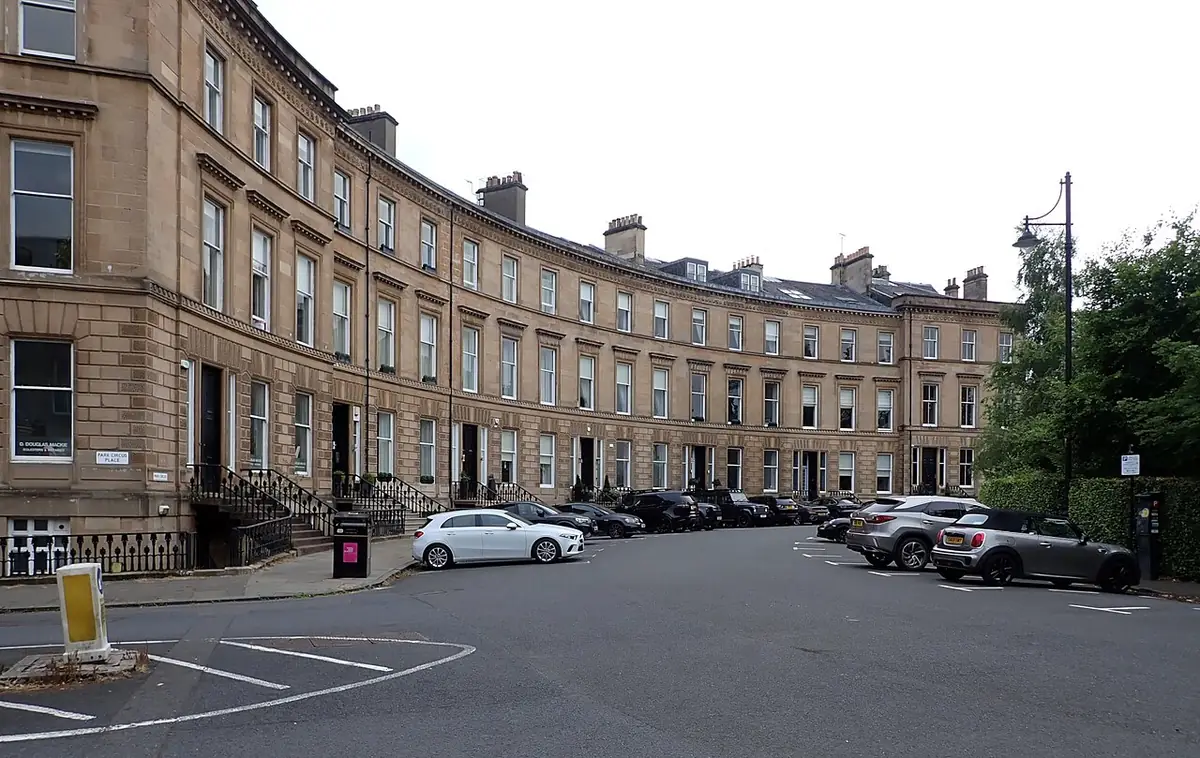
Terraces like this crescent are some of Glasgow's most sought-after streets — Photo: habiloid · CC BY-SA 2.0 · Wikimedia Commons
To follow that through, it helps to see clearly who does what along the valuation chain.
A Scottish property transaction runs on a formal exchange of letters between solicitors, known as the conclusion of missives. Unlike systems where a cooling off period follows a preliminary contract, Scottish law binds the parties definitively at the end of a written sequence of offers and counter offers handled by their legal representatives. For anyone valuing a property, that is the moment that matters: it is when a negotiated number turns into hard evidence that will be used to value the neighbouring houses.
You identify a property that matches your criteria and read the valuation in the Home Report supplied by the seller.
Your solicitor puts forward a formal written offer, with any conditions attached and a proposed date of entry, pitched against the surveyor's figure and the recent street evidence.
The seller, through their own adviser, issues a qualified acceptance that alters or clarifies certain terms of the transaction.
The two legal advisers negotiate the remaining technical points, often around the works flagged in the condition survey, until the terms are mutually accepted.
The conclusion of missives is declared, marking the exact moment the agreement becomes legally binding and the agreed price becomes the definitive value on record.
On the settlement date, the funds are transferred, the keys are handed over, and the price is registered as the comparable that will anchor the next valuation on the street.
How a Glasgow house gets valued, step by step
Valuing a house in Glasgow sits inside a tightly regulated professional framework where each party plays a defined role in producing a figure that will stand up legally and financially. From gathering your own paperwork through to the price being registered, understanding the order of those interventions is what lets you anticipate the timings and avoid the sequencing errors that undermine an otherwise sound estimate.
YouGather the paperwork and set the baselineAssemble the title, any previous survey reports, records of works carried out and the Council Tax band, and establish what the recent recorded sales on your street actually were before anyone gives you a number.
Estate agentMarket appraisal and reading the comparablesAn agent will give a marketing figure drawn from current demand and recent local sales. Treat it as one input: it reflects what the agent believes the property can attract, not a formal assessment of the building.
Chartered surveyorThe Home Report valuation and condition surveyThe independent surveyor produces the official market value alongside the technical condition report and the energy performance rating, and the adjustments made here for repairs and insulation are usually the largest single move away from the agent's figure.
Solicitor and lenderTesting the figure against what will actually be lentThe lender relies on the surveyor's valuation rather than the asking price, and the solicitor checks the title and any shared repair obligations that could bear on the number before commitments are made.
SolicitorRegistration and the figure entering the recordSettlement of the price, payment of the applicable taxes (LBTT) and official registration of title with the Scottish land register, at which point the number becomes public evidence for every valuation that follows nearby.
House or flat in Glasgow: how the two are valued differently
Once the property type is settled, the running costs behind the figure come immediately into view.
Valuing a red sandstone Victorian house and valuing a modern flat in central Glasgow are two different exercises, and treating them as one is the most common way an owner ends up with a number that does not survive contact with a surveyor. The urban form of this city forces sharp distinctions between historic districts with generous but energy hungry volumes and newer developments with strong thermal performance. Each property type sits in its own pool of comparables, whether that is the buzz of Merchant City or the residential calm of Pollokshields, and mixing the pools is what produces a misleading figure.
A detached or semi detached house in Glasgow offers a freedom of layout and a relationship to the ground that flats cannot match, frequently including a private garden, and all of that reads positively in a valuation. That autonomy comes with total responsibility for the roof, the structural timbers and the insulation, which are substantial budget lines against the local climate. A surveyor prices deferred maintenance directly, so houses whose owners have kept up regular upkeep against the Atlantic weather of the Strathclyde region hold their assessed value markedly better than those that have not.
A flat, known locally as a tenement flat, brings the management of a collective building into the assessment. These historic dressed stone buildings are attractive for their ceiling heights and period detail, and both support the figure, but they need close coordination between owners for facade and roof repairs. The factoring fee system, the building management charges, is a financial parameter that has to be read from the listing stage onwards in the central districts, because an unfunded major repair is a straight deduction from what any individual flat is worth.
On the investment side, family houses in sought after school catchments traditionally show greater liquidity and more resistance to market swings, which narrows the range a valuer will quote. Urban flats, heavily favoured by young professionals and rental investors, offer an attractive gross yield but face stiffer competition on resale, which widens that range. Your own figure will therefore depend on how the property is held and maintained: an independent older building whose upkeep you carry, or a flat inside a well administered collective where the external work is delegated.
The running costs and transaction charges any Glasgow valuation has to account for
Beyond the pure financial balance, it is the shape of an ordinary week that shows what a location is really worth.
The value of a Glasgow house is never just the figure on the mortgage offer. The total cost of holding the property takes in local taxes, energy bills driven by the age of the fabric and regular maintenance, and every one of those lines is something a buyer subtracts mentally from what they are willing to pay. Reading them carefully is what stops an owner from mistaking a headline district average for the figure their own house will support.
Estimated monthly and annual holding costs for a house in Glasgow
Cost line
Typical amount observed
Frequency
What makes it vary
Council Tax (Bands D to F)
1,400 to 2,200 GBP
Annual
Depends on the exact location and on the municipal assessment band.
Home insurance (buildings and contents)
350 to 650 GBP
Annual
Varies with floor area, potential flood zone and claims history.
Heating and electricity (3 to 4 bedroom house)
180 to 280 GBP
Monthly
Directly tied to the energy performance rating and the heating system.
Maintenance and structural repairs
1,000 to 2,500 GBP
Annual
Essential to prevent water ingress and to keep older roofs sound.
The amounts shown are averages observed in the Glasgow market for standard family properties and can move with energy price inflation.
Costs attached to establishing and recording a value in Scotland
Charge
Reference rate or amount
How it is calculated
Land and Buildings Transaction Tax (LBTT)
Scottish progressive scale
Charged on the slice of the price above the exemption threshold in force, so a valuation near a band edge changes what a buyer will bid.
Solicitor fees and legal formalities
1,200 to 2,500 GBP
Variable fixed fee depending on the complexity of the title and of the transaction.
Home Report and technical survey
500 to 900 GBP
Compulsory document supplied by the seller, containing the valuation and the condition assessment.
The Scottish legal system requires specialist solicitors to conclude a sale, and their fees sit on top of the government taxes.
Health, schools and transport: what an ordinary Tuesday in Glasgow tells a valuer
Detached villas like this show the grander end of Glasgow's housing stock — Photo: Michal Klajban · CC BY-SA 4.0 · Wikimedia Commons
If those daily markers set a reassuring frame, a close look at the property itself reveals subtleties a quick viewing never catches.
Judging what a Glasgow district adds to a property's value rests on observing daily flows and how reachable public infrastructure really is. An ordinary Tuesday tests the reliability of the transport network, whether that is the circular metro or the city bus routes. Proximity to strong schools and to local health services shapes residents' timetables, and it is one of the clearest reasons two houses of identical size on nearby streets are valued differently.
07:45Leaving home and the walk to the local schoolFamilies prefer to travel on foot or by bike when the school sits in the same residential sector, avoiding the morning traffic. Catchment and walking distance are among the most reliable premiums in a Glasgow valuation.
08:30Reaching the transport network (Subway or First Bus)The local metro station or main bus stop puts the central business district within twenty minutes, with dependable frequency. That reliability is priced directly into recorded sale evidence.
12:30Midday break and local servicesIndependent shops, pharmacies and medical practices within walking distance make health appointments easy to fit into a working day, and a thin local offer is a visible drag on values.
17:00The return home and the evening food shopNeighbourhood supermarkets and local grocers allow an easy stop on the way back without a major detour by car, which is one of the practical tests buyers apply before bidding.
19:30Time in the city's parks or cultural venuesMunicipal parks such as Kelvingrove or Queen's Park give an ideal setting for outdoor time in the evening, and proximity to them is a measurable component of the value of surrounding streets.
What a Glasgow listing will not tell you about the value of the property
Those documented blind spots lead directly to the classic errors owners make when they read a figure.
Sales copy on property portals highlights the light in the rooms and the quality of recent refurbishment, while staying quiet about technical constraints that decide the figure. Reading the Home Report closely and inspecting the fabric independently is what brings out the structural characteristics specific to Glasgow's housing stock. Ignoring what is invisible at first glance is how an owner arrives at a number that the first autumn rains, and the first serious buyer, will both correct.
The true condition of roof flashings and cast iron rainwater goods
Roofs on older houses suffer chronic water ingress that damages timber structures. A thorough check by a qualified roofer before you settle on a figure is the difference between a valuation that holds and one that is renegotiated downwards.
The real effectiveness of the insulation and the thermal bridges
Many traditional stone buildings lose a great deal of heat despite double glazing being fitted. The energy performance certificate rating has to be read rigorously, because a poor band is one of the most consistently applied deductions in the city.
The planning rules applying in designated conservation areas
Owning in a protected zone sharply restricts the freedom to change windows, facades or the roof. Every cosmetic intervention needs prior approval, which caps the improvement upside a valuation can credit to the property.
The real level of noise and traffic at peak hours
Some secondary roads become busy rat runs morning and evening, which radically changes the impression of quiet formed during a midday viewing and shows up as a discount against otherwise comparable streets.
The history of works voted by the owners in subdivided buildings
Minutes of recent owners meetings reveal upcoming expenditure and any disputes between owners over common area upkeep. An outstanding levy is subtracted from the value of every flat in the building.
The valuation mistakes Glasgow owners only discover six months later
Against those avoidable disappointments, it is worth deciding honestly whether now is the right moment to act on a figure at all.
Looked likeA charming older house with original floorboards and a decorative fireplace in every room, all of which felt like value.
Turned outA property that is hard to heat evenly, with gas and electricity bills far above expectations, and an energy rating that pulled the surveyor's figure well below the agent's appraisal.
Would have caught itCommission a full thermal assessment and check the real depth of loft and underfloor insulation before you fix any expectation of what the house is worth.
Looked likeA quiet, leafy residential district that seemed certain to hold its value for family buyers.
Turned outA sector poorly served by public transport, which narrowed the buyer pool sharply and left recorded sales below comparable houses closer to a station.
Would have caught itWalk and time the commute yourself at peak hours on a weekday and check the real frequency of local bus routes before treating a district average as your figure.
Looked likeAn attractive assessed value that appeared to leave a comfortable margin over the price paid.
Turned outElectrical and plumbing compliance work that had been underestimated, wiping out the apparent margin and more.
Would have caught itHave the works costed by an independent contractor against the qualifications recorded in the technical survey report, and deduct that total from the figure.
Looked likeA discreet attachment to a single immediate neighbour in a quiet residential street on the edge of the city.
Turned outPoor acoustic separation between the attached properties, generating regular noise and a discount that appeared only when serious buyers came through.
Would have caught itVisit at different times of day, especially in the evening, to judge the real level of sound insulation between adjoining properties before you commit to a number.
Looked likeA north facing garden offering easy to maintain private outdoor space with no demanding lawn.
Turned outAlmost no direct sun in the garden for most of the year, because of the height of the surrounding buildings and trees, which weakened the property against its comparables.
Would have caught itCheck the exact orientation of the plot with a sun path app and watch how the shadows fall during the viewing, since aspect is one of the adjustments a surveyor applies without discussion.
Who should not act on a Glasgow valuation right now?
With those warnings on the table, it is time to take stock and settle the question clearly.
Acting on a property valuation is not always the right move, particularly in an uncertain economic climate and against the specific demands of the Scottish market. Some owners expose themselves to disproportionate financial risk by committing to a figure too quickly, whether that means selling into a thin market or borrowing against an optimistic number. Recognising those situations allows a reassessment of priorities before any savings are committed.
Owners whose professional mobility over the next few years is uncertain
→Hold off on acting on the figure and keep the position flexible
Solicitor fees, the transaction taxes (LBTT) and the costs of selling absorb any paper gain quickly if the property changes hands less than five years after it was bought, so a favourable valuation on its own does not make the move worthwhile.
Households without an adequate contingency reserve
→Build a solid financial cushion before relying on the number
An older Glasgow house needs available cash to deal immediately with unforeseen repairs such as a roof leak or a boiler failure, and any of those will change what the property is actually worth.
Owners looking for immediate rental returns without experience
→Look at other asset classes, or take professional advice before acting
Scottish letting regulation and the strict framework around the market demand rigorous management and specific legal knowledge, and a yield based valuation that ignores voids and arrears will read far too high.
People with no appetite for maintenance and hands on upkeep
→Favour a modern managed property where the external work is delegated
Owning a detached house means constant personal availability to supervise trades and keep the grounds in order against the local weather, and neglecting that is what erodes an assessed value fastest.
So, are you ready to put a number on your Glasgow property?
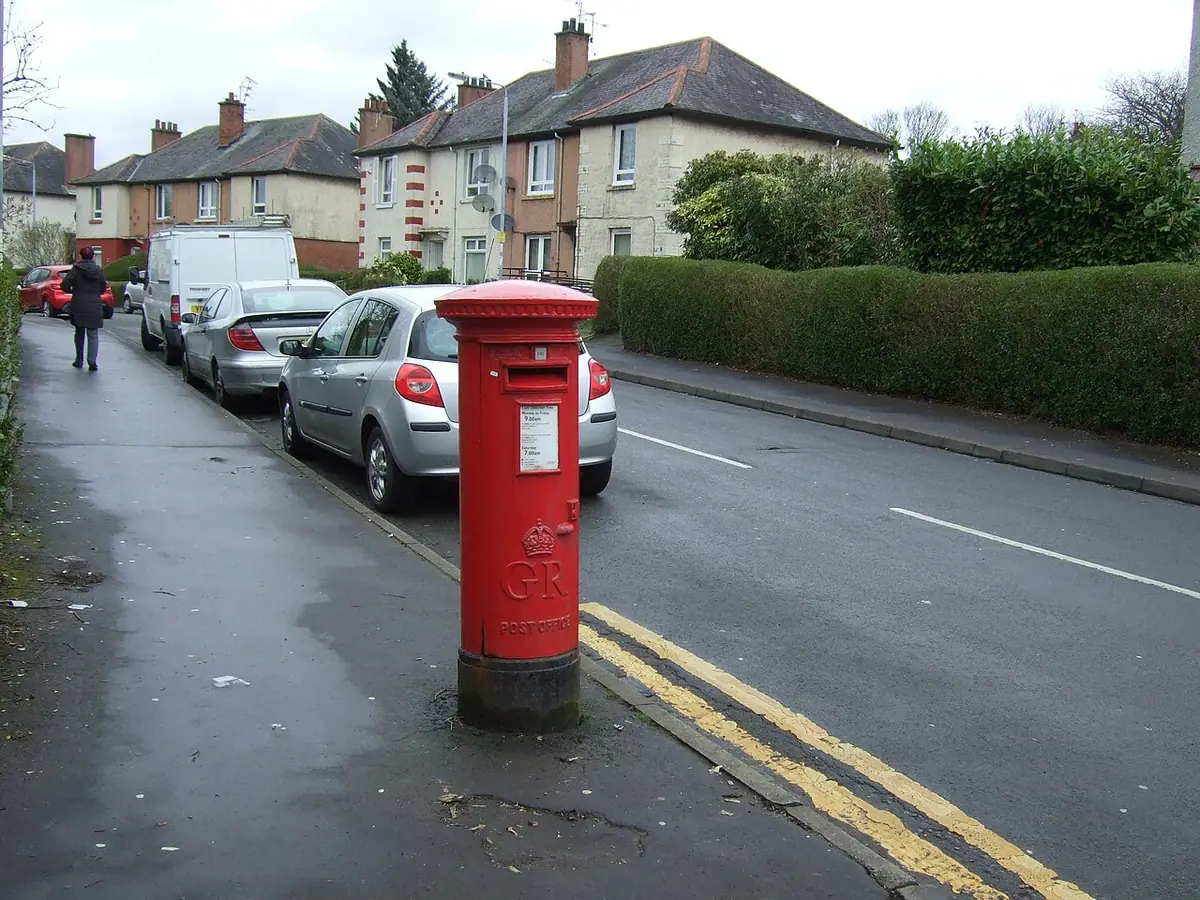
Quiet residential streets like this sit just off Glasgow's main roads — Photo: JThomas · CC BY-SA 2.0 · Wikimedia Commons
You now have the factual material needed to read the Glasgow property market with judgement. Between the property type, an accurate assessment of the real common repair and structural liabilities, and an understanding of how the Scottish legal system works, every one of those elements moves the figure your house will support. Valuing a house or a flat in this city owes nothing to chance and nothing to the impression a good photograph leaves.
The next step is to test your figure against the numbers that professionals will actually use, taking in the local taxes, notably Land and Buildings Transaction Tax, and solicitor fees. Do not hesitate to seek independent technical opinions when reading a Home Report, so that structural defects and disproportionate renovation needs are priced in rather than discovered later by somebody else.
Take the time to walk the target districts at different points in the week, to watch the traffic flows, the proximity of transport and the vitality of the local shops. A valuation that holds in Glasgow rests on the match between how the property is actually lived in and the intrinsic characteristics of the micro district it sits in, because that is precisely what the comparable evidence measures.
If your situation is stable, your contingency reserve is solid and you are looking at a five to ten year horizon, the conditions are there to move forward with confidence. The Glasgow market rewards owners who are patient, informed and methodical, and who know how to look past the marketing language in the listings to the evidence underneath.
Related questions
What is the Home Report in Scotland, and where does the valuation sit inside it?
The Home Report is a compulsory pack supplied by the seller. It brings together a valuation of the property's worth, an energy performance report and a technical condition survey carried out by an independent chartered surveyor. That valuation is the official market figure for the house: it is what a lender will lend against, and it gives any owner a documented starting point before a formal offer is submitted through a solicitor.
What is the solicitor's role, and why does it matter for what a Glasgow house is worth?
In Scotland the solicitor is the legal party who runs the whole transaction, from the formal written offer through to the final registration of title with the official registers. That registration is also what turns an agreed price into a public record, which means the solicitor's work is what eventually produces the comparable evidence the next valuation on your street will be built from.
How is LBTT calculated, and does it affect the figure a house sells for?
Land and Buildings Transaction Tax is a progressive tax charged by the Scottish administration on property purchases above the exemption thresholds in force. The rates apply by price band, and separately for a main residence or for a rental investment subject to the additional supplement. Because it is banded, a valuation that lands just either side of a threshold changes what a buyer is willing to bid.
Is there room to negotiate against the valuation figure on a Glasgow house?
That depends directly on how tight the local market is and on the valuation recorded in the Home Report. Sought after properties in prized districts routinely sell above the advertised figure under an offers over listing, while other areas leave real room for discussion downwards, based on the works flagged in the technical survey.
How do the running costs of a tenement flat feed into a valuation?
Owners of flats in older tenement buildings pay regular management charges, known as factoring fees, covering common area upkeep, cleaning and the building's collective insurance. Exceptional levies can also be voted for roof renewal or facade repair. A valuer treats a building with an unresolved common repair as a weaker proposition than an identical one with the work already paid for.
Which Glasgow districts are most in demand with families, and how does that show in values?
Residential areas such as the West End, Shawlands, Pollokshields and Hyndland are among the most prized, thanks to the quality of their state schools, the proximity of green space and the vitality of their local shops. Those districts carry price levels above the city average, and that premium is one of the first adjustments any valuation makes.
How do you assess the energy performance of an older Glasgow house before a valuation?
The assessment rests on the energy performance certificate included in the Home Report, which carries an A to G letter rating. It is also worth checking loft insulation, whether the glazing is double or triple, and the type of boiler, because those are the details that shape winter heating bills and, through them, what a buyer will pay for the house.
How long does a Scottish transaction take, and when does a price become usable evidence?
Once the seller accepts an offer, completing the legal formalities and handing over the keys generally takes between six and eight weeks. That period can stretch depending on how complex the title is and how quickly the two solicitors exchange. Only at the end of it does the price become a recorded figure that supports the next valuation nearby.
Should renovation work be priced into the valuation of an older Glasgow property?
A large share of Glasgow's housing stock is made up of historic stone buildings, so it is strongly advisable to set a figure aside for compliance work, insulation and plumbing. The recommendations in the technical survey report are a reliable base for costing those interventions, and the total is what separates a headline district average from what your own house is worth.
How much does public transport access change what a property is worth?
Glasgow has a varied transport network: an underground circular metro known as the Subway, an extensive city bus network operated by First Bus, and efficient regional rail links. Quick access to that infrastructure is one of the strongest single factors in what a residential property is valued at, and it can separate two otherwise identical houses.
Property review of ting
No ting properties in Glasgow yet
Be the first — share it on ting and it shows up right here.