Valuing a house in Paris demands a rigorous method, because buildable land is scarce and the market has to be read street by street rather than city-wide. This guide sets out the financial, legal and practical realities that decide the figure, so you can arrive at a number you are able to defend.
Get the app
What nobody tells you.
Real prices, hidden costs and the traps to check before you commit.
What a valuation is really measuring in a Paris house
Scroll
What a valuation is really measuring in a Paris house
Valuing a house in Paris demands a rigorous method, because buildable land is scarce and the market has to be read street by street rather than city-wide. This guide sets out the financial, legal and practical realities that decide the figure, so you can arrive at a number you are able to defend.
Written by the ting.ad editorial team ·
Rue de Rivoli, Paris in Street View: drag to look around.
That structural scarcity changes the exercise depending on the situation you are valuing from.
Putting a figure on a house in the French capital does not follow ordinary residential logic. Between the absolute scarcity of individual houses and the historic density of the city, every square metre is priced against criteria that sit outside normal metropolitan benchmarks. Valuing a Paris house means weighing the calm of a protected pocket against the structural reality of an extremely tight market. Owners discover quickly that the real value does not live in the habitable area alone, but in the scarcity of the land and the exact legal nature of what is owned.
An optimised living area in the heart of the cityvsA rare and heavily sought-after piece of land
The gross floor area quoted in listings never reflects the usable volume. Unusual layouts, inherited from historic conversions, force a valuer to work through ceiling heights and sloped-roof zones before any figure is credible; the Carrez-law floor area is the only measure a buyer will argue from.
The promise of complete residential autonomyvsThe permanent constraint of strict planning rules
Unlike a flat, a house frees you from co-ownership decisions but leaves you alone in front of the Architectes des Batiments de France and local regulation. A property whose facade or roof cannot legally be altered is valued differently from one that can be extended.
A highly secure long-term store of valuevsLiquidity that varies sharply by arrondissement
Demand for this kind of property stays structurally above the available supply. The narrowness of the buyer pool, however, lengthens resale times in a weak market, and a valuation that ignores time-to-sell is only half a valuation.
An intimate, sheltered settingvsA structurally high cost of upkeep and renovation
The absence of communal areas does not remove charges; it moves them onto the building envelope, the roof and the foundations, where bringing a Paris property up to standard demands substantial budgets that come straight off the estimate.
Why are you having the property valued, and what does that change?
These trade-offs take on a particular weight when you arrive with benchmarks formed in another market.
A valuation is not a single objective number, and the purpose behind it shapes which method carries the most weight. A sale within the year, a family arrangement and a long-horizon estate decision each demand a different tolerance for optimism. Traffic constraints, the handling of outdoor space and proximity to services all feed the figure differently depending on who will act on it, and it is worth settling that before the first professional walks through the door.
Owner selling in the short term
Your figure has to be anchored on comparable sales completed in the last six to twelve months in the same few streets, not on asking prices still sitting on the portals. In central and semi-peripheral arrondissements a house is compared against a very small pool, so a valuer will lean on adjustments for floor area, aspect, condition and noise rather than on a district average. Expect the honest number to be a range rather than a point, and expect the quiet, well-lit end of a street to be worth measurably more than the traffic end. If you price at the top of the range, plan for a longer marketing period and a negotiation.
Family or estate arrangement
Here the valuation has to be defensible to people who did not choose it, which raises the standard of evidence. Private outdoor space, extremely rare in the capital, is the single item most often over-credited in family estimates, and proximity to well-regarded schools and sports facilities is the item most often under-credited. Document each adjustment, keep the notaires' published price statistics alongside the agent's opinion, and record the condition of the property on the day it was assessed. A written trail is what stops the figure being re-argued later.
Long-term holder or senior owner
Your attention goes to durability rather than to this quarter's asking prices: the intrinsic quality of the construction, the level of the co-ownership charges and the state of the building envelope. A Paris house free of collective constraints carries a liberty premium, but that premium erodes fast where technical upkeep has been deferred. Multiple staircases, a layout over several floors and the absence of a concierge to take deliveries all narrow the future buyer pool, and a valuer who ignores that will hand you a figure that only works today.
Reading a Paris figure when your benchmarks come from abroad
These structural gaps feed directly into which part of the city the figure applies to.
Arriving from another housing market and trying to read a Paris valuation unsettles every spatial and cultural reference point. What is taken for granted elsewhere, easy parking, generous volumes, tradespeople who turn up next week, is here a measured and hotly contested luxury. Understanding these divergences is what stops you from applying a foreign rule of thumb to a market that does not obey it, and from being surprised in the first months of ownership.
From abroad
A large living area with a private garden on one level
Paris
Constrained vertical floor area and hard-surfaced urban courtyards
The floor-area-to-price ratio forces you to re-price interior layout entirely: surplus volume earns nothing here, and pure functionality earns a premium.
From abroad
Tradespeople available at short notice and easy parking for works
Paris
Chronic logistical difficulty for building sites and deliveries
Every renovation line in your estimate has to be planned weeks ahead and carry the extra cost of moving materials through a dense city, so foreign works costings understate the deduction.
From abroad
Distant but predictable neighbour relations on a suburban plot
Paris
Close cohabitation in a dense and varied urban fabric
Acoustics and the rules of the co-ownership or of a party wall shape what a buyer will pay, which means noise and neighbour constraints are valuation items, not lifestyle footnotes.
From abroad
A cost of living tracking national averages
Paris
Local tax pressure and service costs specific to the capital
The net figure has to absorb high property taxes and insurance premiums priced for particular urban risks, all of which sit below the headline value.
Which comparables apply, and where does your property actually sit?
Once the comparable set is settled, the question of the figures themselves takes over.
The map of Paris is not read in arrondissements but in micro-territories with radically opposed atmospheres and trajectories. Between the preserved villages of the east and the residential quarters of the west, each sector produces its own price per square metre, its own liquidity and its own buyer profile. Choosing the wrong comparable set is the most common way a valuation goes wrong, because a property is not worth the average of its arrondissement.
The villages of the east and north-east
The atmosphere of a market town, animated by neighbourhood markets and a young population.
Suits
Valuations resting on families seeking space, social mix and everyday cultural energy.
Trade-off
Sectors in transformation, where fast gentrification still sits beside rougher pockets, so comparables age quickly and a figure more than a few months old is unreliable.
The residential quarters of the west
Complete calm, tree-lined streets and immediate proximity to the large parks of the capital.
Suits
Valuations resting on buyers who pay for security, architectural standing and absolute residential quiet.
Trade-off
An extremely high entry ticket and quiet evenings that some buyers reject outright, which thins the pool and widens the credible range around any single figure.
The central and historic arrondissements
A permanent flow of pedestrians, monuments at the door and first-rank cultural amenities.
Suits
Valuations resting on lovers of history, intense city life and holders treating the property as a store of value.
Trade-off
Individual houses are almost non-existent, prices are at record levels and heritage constraints are severe, so there may be no true comparable and the figure has to be built by adjustment.
What does this kind of property actually fetch here?
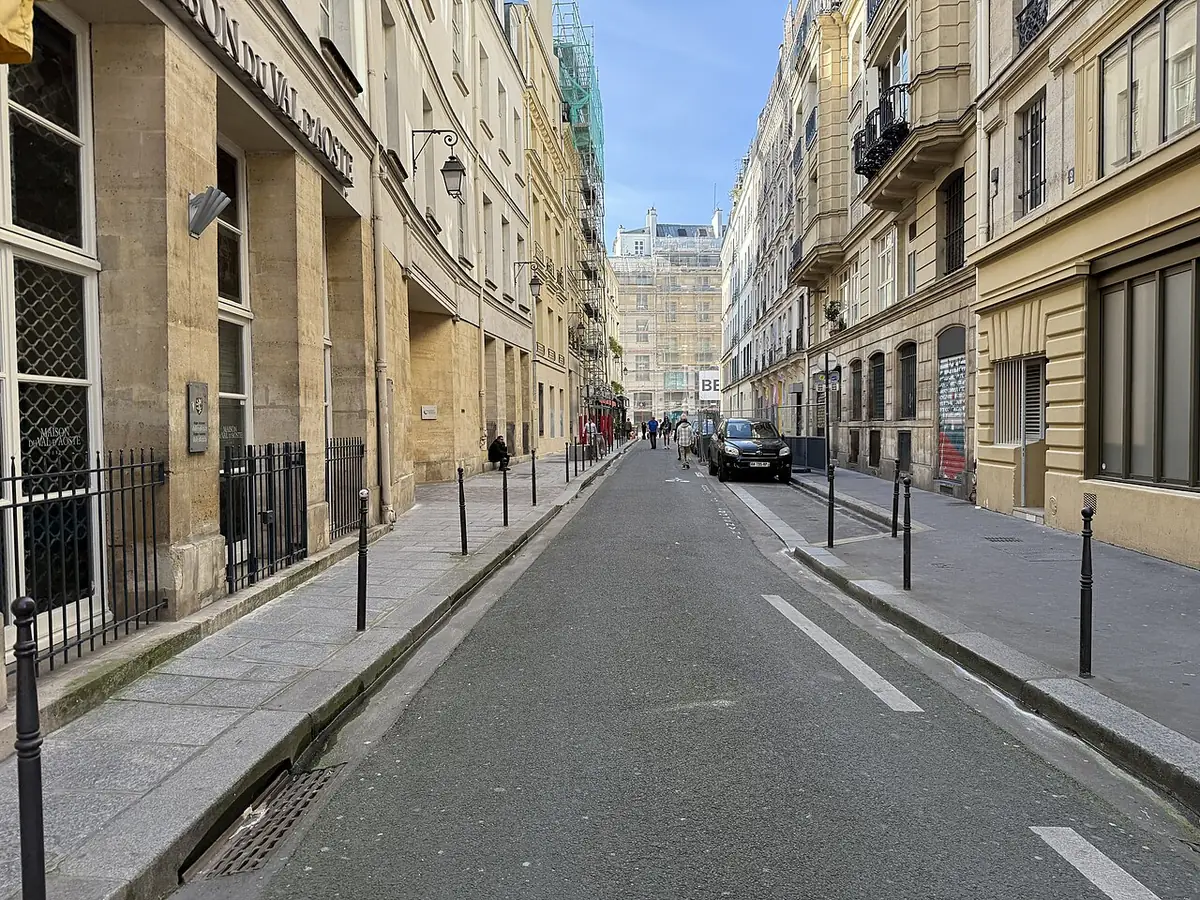
A quiet Haussmannian street in central Paris — Photo: Chabe01 · CC BY-SA 4.0 · Wikimedia Commons
Beyond the numbers themselves, the legal nature of what you own deserves close attention.
Valuing a house in Paris runs into market rules where scarcity inflates what sellers ask. Published prices do not always reflect the technical complexity of a property or the work needed to meet current energy standards. Working from observed ranges lets you calibrate a figure and then adjust it deliberately, taking in the associated costs, from local taxation to structural renovation, rather than quoting an average and hoping.
parisFor saleHouseestimate
Median price / m²€8,180Half the apartments sell below this
Median price€784kthe average is 14% higher — a few very large properties pull it up
Most common2 bedrooms57 % of listings
Average size91 m²
By number of bedrooms
Bedrooms
Share of market
Avg price
Price / m²
Avg size
2most common
57 %
€934k
€8,610
109 m²
3
29 %
€1.27m
€8,266
154 m²
4
14 %
€1.7m
€8,093best value / m²
210 m²
Each row is an average, compared against the area average of €8,610 / m². These are indicative estimates of a typical local market, not a measured sample of live listings. Check current listings before relying on them.
What you legally own, and what that does to the figure
Once the legal position is clear, the checks that make a figure defensible can be worked through in order.
Owning a house in Paris does not automatically mean full legal autonomy. Depending on the history of the plot, you may hold outright freehold or sit inside a horizontal co-ownership with rules that bind you. Establishing which of the two applies before any figure is issued avoids a valuation that quietly ignores hidden easements or collective costs, both of which a buyer's notaire will find and price.
Outright ownership of both the land and the building
You own the ground and everything built on it, with no third party in the decision. No owners' general meeting has to approve your facade or landscaping work, subject only to strict compliance with the local planning rules. That complete freedom comes with sole financial responsibility for the roof, the load-bearing walls and the drainage, which is exactly why a valuer inspects those elements before signing off on a number.
What it changesThe figure carries a freedom premium, but it also carries the full deferred-maintenance deduction, since nobody shares the cost of the envelope with you.
Horizontal or integrated co-ownership
The property sits inside a shared development, which means shared items such as an access courtyard, a gate or underground services. Maintenance decisions require a vote at the owners' general meeting and the payment of regular charges, even for a detached house. That framework protects the architectural coherence of the whole but slows your response to a technical emergency, and it makes the building's accounts part of your property's value.
What it changesYou have to read the owners' general meeting minutes for the last three years to identify live disputes and works already voted, then take both off the figure.
The checks that turn an opinion into a defensible figure
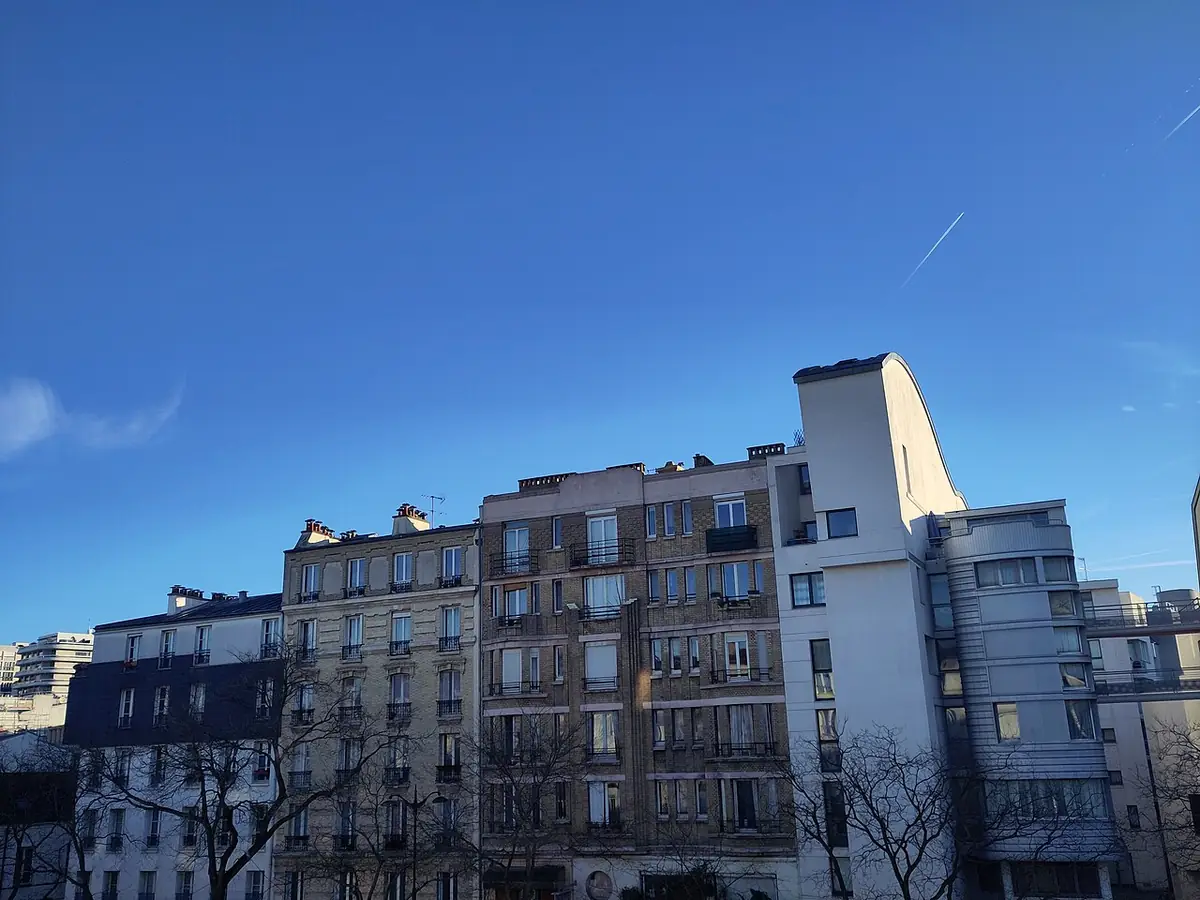
A repurposed neighborhood building near Marché Lenoir — Photo: Artvill · CC BY-SA 4.0 · Wikimedia Commons
Once those checks are done, the figure moves through a defined sequence of hands.
Haste is the enemy of anyone putting a price on a Paris property. Scarcity pushes owners to accept the first flattering number and buyers to commit before the compulsory technical diagnostics and public easements have been read. Working through the verifications in order protects the figure against hidden defects and against the expensive surprises that surface far too late in the process.
A thorough inspection of the property with an independent building professional
A full reading of the technical diagnostics (asbestos, lead, termites, energy performance), each of which carries its own deduction
Careful verification of the applicable planning rules with the Mairie de Paris, since what can and cannot be built changes the land value
Cross-checking earlier title deeds to identify any rights of way or easements that reduce what a buyer will pay
Measuring the Carrez-law floor area and reconciling it against the area quoted, before any price per square metre is calculated
A figure signed off against the notaires' published price statistics and your own legal adviser or notaire, not against a single agent's opinion
How a valuation becomes a confirmed price, step by step
Following that sequence is what keeps a Paris figure standing up over time.
A Paris estimate is only an opinion until several independent parties have tested it. From the first written offer to the handing over of the keys before the notaire, each participant checks a different part of the number, and the process is laid down by French law with deadlines that protect both sides. Knowing who verifies what tells you which parts of your valuation are most likely to be challenged.
The buyerThe written offer that first tests the asking figureThe offer sets a price and financing conditions. The gap between it and your valuation is the first real market signal you receive, and it becomes binding once the seller countersigns.
The notairesDrafting and signing the preliminary sale agreement (compromis de vente)This document records the conditions precedent and opens the ten-day statutory cooling-off period given to a non-professional buyer, during which a weak valuation is most often re-opened.
The lenderProcessing the loan file and issuing the formal loan offerThe lender values the property in its own right before releasing funds, mobilising mortgage guarantees and borrower insurance, which often takes several weeks and can cap the price at less than the agreed figure.
The public bodiesClearing existing mortgages and the exercise of pre-emption rightsThe City of Paris holds an urban pre-emption right, formally cleared through the notaire's office handling the file, and the price declared there enters the statistics that will value the next property in the street.
The notaireSigning the final deed and transferring ownershipOn the day, the funds are transferred to the notaire's account, the keys change hands, and the recorded price becomes the comparable that everyone else will argue from.
House or apartment in Paris: why the two are valued by different rules
Beyond the property type, the structure of the surrounding costs deserves the same rigour.
Valuing a house in Paris is an exercise in scarcity, because the capital's housing stock has always been dominated by the shared apartment building. The few suburban villas absorbed late into the city, the hidden villas of the 14e arrondissement and the converted artists' studios of the 11e are objects of such rarity that they trade on dynamics disconnected from the general co-ownership market. A valuer working on a house therefore has almost no direct comparable, and has to build the figure from adjusted apartment evidence plus a premium for escaping the co-ownership rules and the recurring charges of a lift or a concierge.
The Paris apartment, whether a through-facing Haussmann flat or an optimised studio under the roof, is valued against a deep and legible comparable set, but its figure is hostage to the collective: the decisions of the owners' general meeting and the sound and thermal insulation work voted in common. Facade renovation or roof replacement are heavy commitments that have to be priced into the initial estimate, because a buyer who reads the minutes will deduct them line by line.
Usable floor area is also priced differently by type. The square metre inside a co-ownership follows interest rates and the effects of rent control, while the Paris house benefits from a structural store-of-value effect that shelters it more effectively from the cyclical falls seen on small investment flats. That difference in volatility is itself a valuation input: it decides how wide the credible range around your figure should be.
In the end, the gap between the two comes down to how much of the value depends on other people. An apartment's worth is bound up with a building's accounts and its collective decisions, while a house's worth rests on the condition of a structure you alone maintain and on a spatial independence that is nearly unobtainable inside the city boundary. Value each on its own logic and the two figures stop looking contradictory.
Which costs stand between the valuation and the money that changes hands?
To test a Paris figure properly, you also have to feel the daily rhythm of the place: the journeys, the services, the noise.
A Paris valuation is not the net figure that reaches anyone's account. Notaire's fees and transfer duties, local taxes, running co-ownership charges and provisions for future works all sit between the headline number and reality, and a plan that omits them is not a plan. Failing to anticipate these lines is the single most common reason a household's finances come under strain after a purchase in the capital, and the most common reason an owner's own estimate proves optimistic.
Initial and recurring cost lines to set against a Paris valuation
Cost line
Estimated amount or range
Effect on the real figure
Notaire's fees (transfer duties)
7.5% to 8% on existing housing, 2% to 3% on new build
Comes straight off the funds available, so it separates the valuation from the buying power behind it.
Running co-ownership charges
3 to 5 EUR per square metre per month
An unavoidable monthly line that a buyer prices in, and that therefore caps what your property fetches.
Paris property tax (taxe fonciere)
Varies with floor area and the cadastral coefficient
Significant increases recorded at municipal level in recent years, which buyers now factor into their offers.
These figures are indicative and should be confirmed with your notaire or your broker before any preliminary sale agreement is signed.
Health, schools and transport: what an ordinary Tuesday says about value in Paris
A classic Haussmannian apartment building in Paris — Photo: Exilexi · CC BY 4.0 · Wikimedia Commons
Beyond the visible amenities, some fundamentals never appear in the sales material at all.
Daily life in Paris is set by the density of transport flows, the proximity of schools and access to first-rank health services, and each of those is a measurable valuation input. Walking a property's day, from the morning departure to the evening return, is the cheapest way to test whether an estimate reflects the address or only the arrondissement. The metro lines and cycle routes available within a few minutes' walk explain more price variation than the decor ever will.
08:00Leaving the building, and the nearest metro or bike stationThe morning departure decides how easy the commute is, whether by crowded public transport lines or by the cycle infrastructure now present across every arrondissement. Distance to a station is one of the largest single adjustments a valuer applies.
08:30The school run to the local state schoolParis school catchment rules mean the assigned schools, from nursery to lower secondary, have to be checked carefully, because the disparity from one sector to the next feeds directly into what the property is worth.
12:30Food shops and neighbourhood lifeThe midday break is when you can measure the vitality of local trade, from the artisan bakery to the neighbourhood market. A living high street supports value; a run of shuttered units drags it down within a few streets.
19:00Home again, and the paperwork of the buildingComing home often coincides with the post from the managing agent (syndic), deliveries, and preparation for the next owners' general meeting. Those documents are where the works liabilities that adjust a valuation are actually recorded.
21:00Cultural and health services close at handThe evening shows what the immediate area offers: duty pharmacies, advanced medical facilities and cultural venues. This service depth is a large part of what justifies central Paris values against the outer suburbs.
What no listing, and no automated estimate, will tell you about a Paris property
Knowing where the shadows fall is what stops a flattering estimate turning into a financial hole.
Paris listings are practised at foregrounding light, ceiling height and period charm while saying nothing about the structural constraints of the building. Those invisible elements, missed in a thirty-minute viewing and entirely invisible to an automated tool, end up weighing heavily on daily comfort and on future resale value. Learning to read the owners' general meeting minutes is what turns an average price per square metre into an estimate specific to this property.
The true state of works votes in the co-ownership minutes
A facade renovation or a boiler replacement that has been voted but not yet paid for is an immediate call for funds of several thousand EUR, and it has to be subtracted from any valuation of the flat rather than discovered afterwards.
Night-time noise and planning projects nearby
A cafe terrace opening at the foot of the building, or the pedestrianisation of an adjoining street, changes the quiet of the home and how future buyers price it, in either direction and often by more than a cosmetic renovation would.
Real thermal performance and the constraints attached to the energy performance diagnostic (DPE)
Homes rated F or G face tightening bans on being let and need heavy investment in internal or external insulation, which the Haussmann-era layout sometimes makes difficult, so the deduction is larger than a simple works quote suggests.
The real proportion of owner-occupiers against buy-to-let investors
A building with high tenant turnover or many short-term lets usually shows weaker involvement in maintaining the communal areas and a faster decline in overall standing, which shows up as a discount long before it shows up in the accounts.
The valuation mistakes owners only spot six months later in Paris
These outcomes are a reminder that a Paris figure demands complete clear-sightedness rather than optimism.
Looked likeA bright ground floor with a small private courtyard full of charm at the heart of the neighbourhood, valued at the top of the street's range
Turned outPersistent damp, permanent overlooking from passers-by and unbearable night-time noise from the street, all of which buyers priced in immediately
Would have caught itVisiting at different times of day, insisting on dry rot and damp diagnostics, and measuring the real level of direct sunlight before the figure is set.
Looked likeA studio under the roof with exposed beams and an unobstructed view over the rooftops of Paris, priced on the view
Turned outAn unbreathable furnace in summer, bitter cold in winter and no lift at all for six floors, which halved the buyer pool
Would have caught itChecking the insulation under the roof, calculating charges against the Carrez-law floor area rather than the advertised area, and testing how many buyers will accept the stairs.
Looked likeA large family apartment ideally placed at the foot of a busy metro station, valued on its transport access alone
Turned outPermanent vibration from trains below and unrelenting commercial noise from first light, which produced offers well under the estimate
Would have caught itOpening the windows wide on a second viewing to hear the real sound environment, and consulting the city's local planning document before fixing a price.
Looked likeA period property valued in its current state on the strength of an attractive renovation opportunity
Turned outObsolete electrical systems, sagging floors and asbestos-containing partitions that doubled the works budget and wiped out the assumed uplift
Would have caught itBringing in a project manager or an architect before the preliminary sale agreement is signed, so every compliance item is costed and deducted from the figure.
Who should not be acting on a Paris valuation right now?
With every constraint, cost and trap measured, you can judge how much weight your own figure will carry.
A Paris valuation is not a universal call to act. For some households, or in uncertain professional circumstances, converting a figure into a long-term mortgage is a risk out of proportion to the flexibility that renting preserves. Knowing when to set an estimate aside, or to re-run it in a year, is sometimes the most rational use of the number you have just paid for.
The young professional in a probation period or an uncertain career change
→Short-term furnished renting or co-living in the heart of the capital
No valuation, however careful, offsets the absence of visibility on income over three years, and geographic mobility remains a condition of career progression.
The household planning a move to the outer suburbs or another region in the short term
→Staying in rented accommodation despite rising Paris rents
The notaire's fees and loan guarantee costs cannot be recovered over a period shorter than five or six years, so even an accurate valuation turns into a loss on a quick resale.
The investor looking for an immediate, high net rental return
→Diversified financial investments or commercial property in the regions
Paris purchase prices per square metre mechanically compress gross rental yield below the 3% to 4% mark, before local taxation and co-ownership charges, so an income-based valuation will never justify the price.
So how much confidence should you place in your Paris figure?
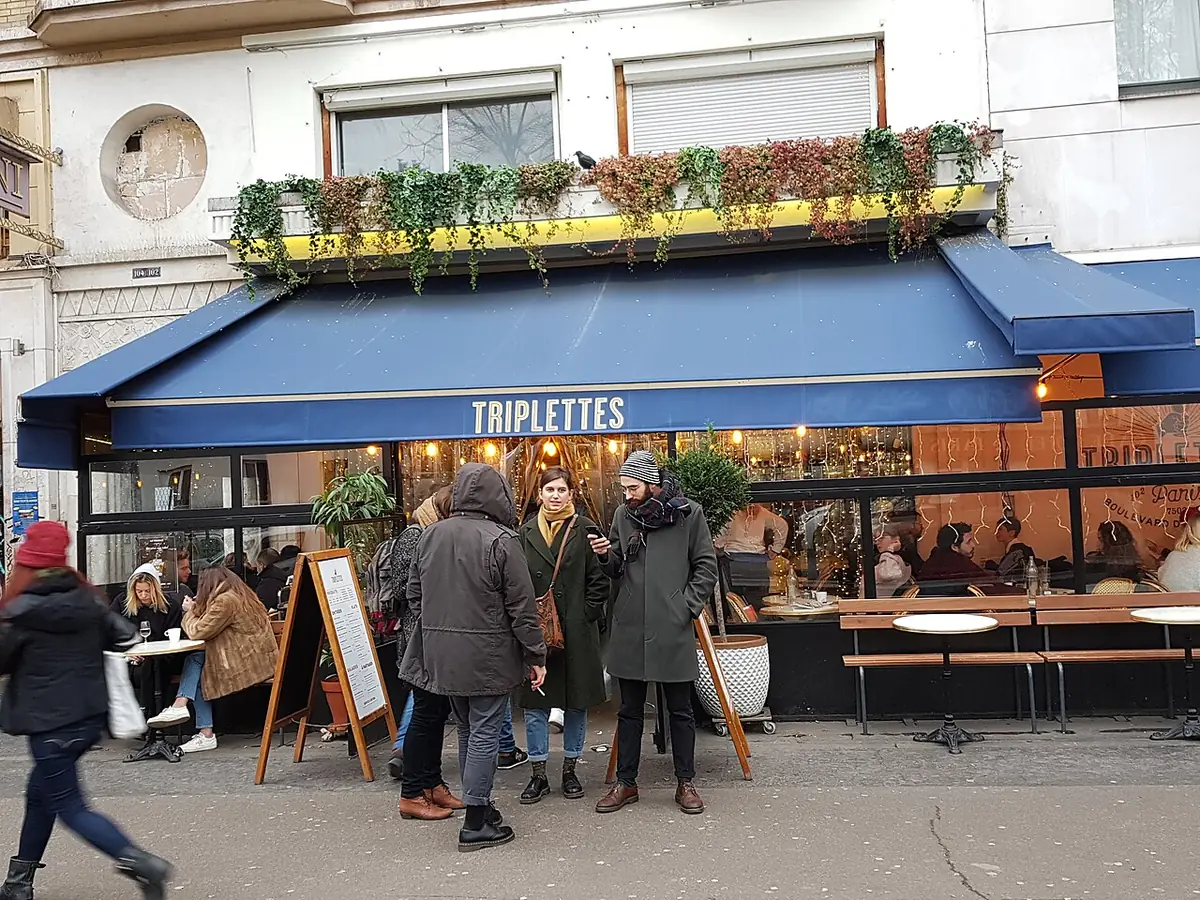
A brasserie terrace bringing life to the boulevard — Photo: Dhehz · CC BY-SA 4.0 · Wikimedia Commons
Settling on a value for a Paris property means balancing the legitimate wish for a good number against the cold reality of the indicators. If your figure is built on completed sales rather than asking prices, if it survives the deduction of the notaire's fees and the outstanding works, and if it holds over a horizon longer than seven years, then it is a figure you can act on rather than merely hope for.
The current Paris market rewards patience and selectivity. Properties with significant defects take substantial discounts that informed buyers know how to argue for, which means an owner's estimate has to be built defect by defect rather than by applying a district average. Never give in to the urgency, or to the alarmist talk of intermediaries who want a signature before the co-ownership accounts have been read.
Keep in mind that the figure is only as good as the property's liquidity. A well-arranged flat with a decent energy rating a short walk from a metro station will always resell quickly, whatever the future swings of the national market, and that speed is itself part of what it is worth. A property that only sells to one buyer in fifty deserves a wider range and a more cautious number.
Take the time to view at least ten properties in the target neighbourhood to calibrate your criteria and sharpen your sense of the true prices being paid street by street. Then trust the facts, the recent sale figures and the building's legal documents, rather than the warm atmosphere of a viewing arranged to trigger a decision you have not reasoned through.
Related questions
Which extra costs sit between a Paris valuation and the money that actually changes hands?
A valuation figure is a gross number. Between it and the cash outcome sit the transfer duties commonly called the notaire's fees, at roughly 7.5% to 8% on existing housing, bank guarantee costs, any buying agent's commission, and the first instalments of co-ownership charges. Reading a valuation without them overstates what the deal is worth.
How is the taxe fonciere on a Paris apartment calculated, and does it affect value?
The Paris property tax is set by the tax administration on the cadastral rental value of the property, multiplied by the rates voted each year by the Conseil de Paris, which have risen notably in recent years. A high recurring charge weighs on what a buyer will offer, so it belongs in any honest valuation.
Can rental yield be used to sanity-check a valuation in Paris?
Gross rental yield in Paris generally sits between 2.5% and 3.5%. That band is a weak income test, so a Paris figure is built on long-term capital value and comparable sales rather than on income, and a yield calculation is best used only to flag a price that has drifted far from the market.
What does rent control in Paris change for a valuation?
Rent control fixes an increased reference rent per square metre that cannot be exceeded, set by neighbourhood, year of construction and number of rooms. It caps the income a property can generate, which puts a ceiling on any value derived from rent and pushes the valuation back onto comparables.
How long does a valuation figure need to hold good?
Roughly two and a half to three months usually pass between signing the preliminary sale agreement (compromis de vente) or the unilateral promise of sale before the notaire and the final deed, the time needed for the loan to be processed and pre-emption rights to be cleared. Your figure has to survive that window without a re-negotiation.
How do you read the financial health of a Paris building before valuing a flat in it?
The analysis rests on a careful reading of the last three sets of owners' general meeting minutes, the building's maintenance log, the size of the ALUR works fund, and the absence of significant unpaid charges within the co-ownership. Each of these can move a valuation by a visible margin.
How does the energy performance diagnostic (DPE) feed into the figure?
The energy performance diagnostic (DPE) is compulsory. Homes rated G, then F, face progressive bans on being let, so the cost of insulation work has to be deducted from the headline value rather than treated as an optional improvement.
Should an owner use an estate agent, a notaire's statistics or an automated online tool?
An automated tool prices from averages and cannot see condition, floor, aspect or noise. An agent's valuation reflects real buyer behaviour but is written by someone who wants the mandate. The notaires' published price statistics are neutral but coarse. Reading all three against each other is the reliable method.
Which arrondissements show the most accessible floor-area-to-price ratio?
It depends on the budget available, but the arrondissements of eastern Paris such as the 11e, the 12e and the 20e have traditionally offered a more accessible ratio of floor area to price while still being served by very dense school and transport networks.
How much do noise and traffic move a Paris valuation?
Noise is one of the major nuisances in Paris. A flat facing a quiet inner courtyard often trades at a significant premium over an identical property looking onto a busy road, which is why aspect is one of the first adjustments a valuer makes.