Putting a credible figure on a house in Liverpool means understanding what a valuer actually reads: sold-price evidence rather than asking prices, the plot and the age and the condition of the fabric, and the tenure written into the title. This guide walks through what drives the estimate, how agents and automated tools differ, and how to sanity-check the number you are given.
Get the app
What nobody tells you.
Real prices, hidden costs and the traps to check before you commit.
What a Liverpool house valuation really measures, once you look past the headline figure
Scroll
What a Liverpool house valuation really measures, once you look past the headline figure
Putting a credible figure on a house in Liverpool means understanding what a valuer actually reads: sold-price evidence rather than asking prices, the plot and the age and the condition of the fabric, and the tenure written into the title. This guide walks through what drives the estimate, how agents and automated tools differ, and how to sanity-check the number you are given.
Written by the ting.ad editorial team ·
High Street, Liverpool in Street View: drag to look around.
Getting past those appearances means matching your own reason for valuing against the specific realities of the ground here.
Valuing a house in this large northern English city is not a matter of reading an average off a portal. Between the marketing promise of a spectacular urban revival and the reality of neighbourhoods still waiting for it, the gap can be brutal for an owner working from headline numbers. The structure of the local market has to be read coldly before any figure is trusted. Yields and the discount against London hide maintenance liabilities that owners routinely leave out of their own estimates.
The idea that a famous, culturally busy city carries every address up with it.vsA fragmented market in which some sectors have been flat for years despite council-led projects, so sold-price evidence has to be drawn street by street.
International recognition built on musical and maritime heritage does not translate evenly into prices on every residential road. A valuation has to rest on real local movement rather than on the city's overall visibility.
The apparent comfort of a low price per m2 compared with the south of England.vsThe need to deduct, immediately, the cost of bringing an older building up to current energy standards.
Victorian and Edwardian houses often need heavy spending on insulation and plumbing. A headline figure that ignores that never reflects what the property is worth to a buyer who has read the EPC and the survey.
The assumption that a whole neighbourhood values at one consistent rate.vsRenewed streets sitting directly alongside blocks still in economic transition, which pulls comparables apart within a few hundred metres.
The social make-up changes very quickly from one street to the next in this port city. A daytime visit is no substitute for watching the immediate surroundings at different hours of the week before settling on a figure.
The promise that an owner abroad can arrive at a reliable number remotely.vsThe reality that tenure, title and condition all sit in documents that have to be pulled and read before the estimate means anything.
The conveyancing process demands absolute rigour and responsive local professionals, and the same paperwork that unblocks a sale is what a valuer needs in order to defend a figure.
Which kind of valuation does your situation actually call for?
How you read that figure also depends on the property conventions you arrived with.
A valuation only means something when it is fitted to the decision it has to support. The number an owner needs before listing is not the number a lender needs, and neither is the number an executor or a divorcing couple needs. Each situation should set its own tolerance for error, its own evidence base and its own willingness to pay for a qualified opinion rather than a free one.
Selling a family home
For you, the figure has to survive contact with buyers who will check the same sold-price records you did. Invite three estate agents, note that their appraisals are free because they are competing for the instruction, and treat the highest of the three as a pitch rather than a valuation. Ask each one which specific completed sales they used and how they adjusted for your plot, your extension and your EPC rating. Your decision should rest on the evidence behind the number, not on the number that flatters you most.
A formal, evidenced valuation
Your priority is a document that a third party will accept, which means a RICS Red Book valuation from a chartered surveyor rather than an agent appraisal. Expect to pay for it, expect it to arrive one to two weeks later, and expect it to be more conservative than the marketing figure because it is written to be defended. A lender's own mortgage valuation is narrower still: it assesses their security, not what an enthusiastic buyer might pay. Where the two figures diverge, it is the evidenced one that governs the transaction.
Monitoring value over time
You favour cheap, repeatable checks: the HM Land Registry sold-price record for your street, the UK House Price Index for the Liverpool area, and the free automated estimates offered by the portals. Understand what each one misses. Automated tools work from postcode averages and the last recorded sale, so they cannot see your new roof, your damp, your loft conversion or the fact that your neighbour's identical house has a garden twice the size. Treat their output as a trend line and never as a figure to act on.
Valuing here when you have owned property elsewhere: what genuinely changes
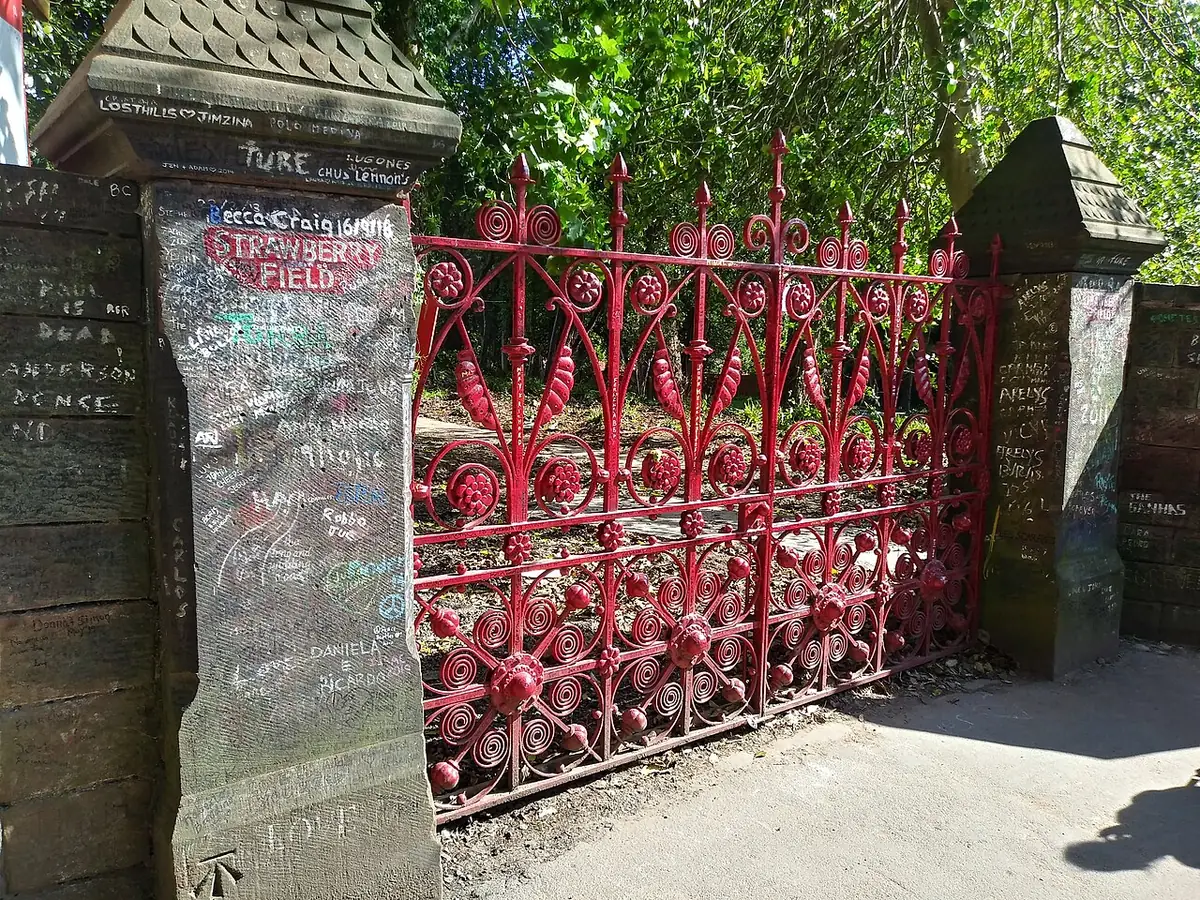
Strawberry Field's gates are one of Liverpool's best-known landmarks — Photo: Robertoalonsomen · CC BY-SA 4.0 · Wikimedia Commons
Once those reference points are in place, the neighbourhood becomes the single biggest variable in the figure.
The British property system runs on historic rules that regularly surprise owners arriving from elsewhere. Who holds the file, what form of ownership is actually being valued, and how prices behave between offer and completion all work differently here. Understanding those mechanisms is what stops an owner from applying a foreign rule of thumb and arriving at a figure that nobody local recognises.
From abroad
In many systems a single neutral official centralises the checks and the value is settled once, on the record.
Liverpool
Conveyancing runs through separate solicitors acting for each side, and the value is argued between them rather than certified by anyone neutral.
A valuation has to be built to be challenged: keep the comparables, the survey and the EPC to hand, because the other side's solicitor will test every assumption behind your number.
From abroad
Outright ownership of both the land and the building is treated as the normal case.
Liverpool
Leasehold is common, meaning you own the building but hold the land from a freeholder.
The remaining lease term and the annual costs, ground rent and service charges, have to be checked and priced in, because both can rise sharply and both pull the valuation down.
From abroad
An accepted offer is a firm reference point that the eventual price stays close to.
Liverpool
Under 'subject to contract' neither side is legally bound until exchange of contracts, which leaves room for a higher bid to displace yours (gazumping).
Asking prices and accepted offers are therefore weak evidence. Value from completed sales at HM Land Registry, which are the only figures that record what was actually paid.
From abroad
Local property tax tends to be a moderate charge based on old cadastral values.
Liverpool
Council Tax places every home in a band, A to H, set against its assessed 1991 value, and produces an annual bill that is often high.
The band is a 1991 snapshot, useful only as a coarse cross-check, while the recurring cost itself is a real deduction a buyer will make from what they are willing to pay.
Which Liverpool neighbourhood is your property being valued against?
Those neighbourhood dynamics feed straight into price ranges that deserve a methodical reading.
The city is made up of micro-markets with sharply distinct identities, running from the leafy residential edges to the sectors still converting out of industrial use near the docks. Selecting the right comparable set is not a matter of reading the advertised price per m2, but of matching demographic pull and the quality of schooling and transport. Each sector strikes its own balance between quiet, accessibility and medium-term growth, and each therefore carries its own multiplier.
Aigburth and Sefton Park
A sought-after residential atmosphere, dominated by green space and superb Victorian houses.
Suits
Valuations resting on family demand, where large plots and period detail carry a clear premium.
Trade-off
Figures sit well above the city average, so a comparable drawn from anywhere else will understate the property badly.
Wavertree and Smithdown
A busy, popular sector, in strong demand with students and young working households.
Suits
Valuations argued on yield, where constant rental demand supports the figure more than condition does.
Trade-off
Rapid turnover of occupants and streets where the general state of repair varies house by house, which widens the range around any estimate.
Waterfront and Baltic Triangle
A fashionable urban hub, marked by creative industry, converted warehouses and modern schemes.
Suits
Valuations driven by newness and location, where the EPC rating and the specification do real work on the figure.
Trade-off
Very few houses to compare against, since apartments and lofts dominate and private outdoor space is scarce, which makes house comparables thin here.
Woolton and Childwall
The complete quiet of the well-off suburbs, with tree-lined streets and a strong sense of local self-sufficiency.
Suits
Valuations of larger, low-turnover family houses where scarcity of stock holds the figure firm.
Trade-off
Distance from the major cultural draws and a greater reliance on transport for daily journeys, both of which shave the premium for some buyers.
What the recorded numbers say a house here is worth
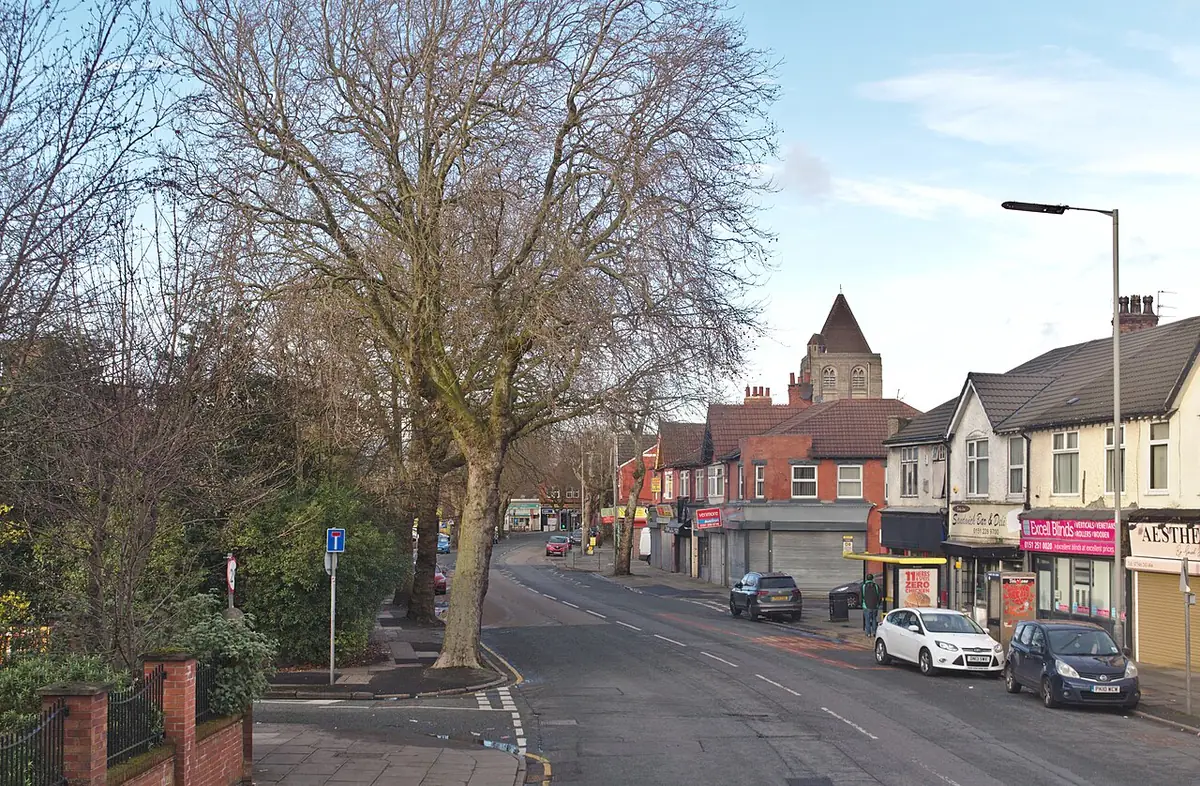
Streets like this mix shops and terraced homes under the trees — Photo: Rodhullandemu · CC BY-SA 4.0 · Wikimedia Commons
Beyond the raw figures, the legal nature of what is being valued deserves close examination.
Working out what a British property is worth means going past the advertised price to take in the whole tax and cost picture that a buyer will net off. Stamp Duty Land Tax, legal fees and survey costs form a substantial sum that any realistic estimate has to acknowledge. The transparency of recorded sales data is what makes reliable ranges possible at all, without giving way to marketing illusions.
liverpoolFor saleHouseestimate
Median price / m²£1,870Half the apartments sell below this
Median price£241kthe average is 14% higher — a few very large properties pull it up
Most common2 bedrooms63 % of listings
Average size123 m²
By number of bedrooms
Bedrooms
Share of market
Avg price
Price / m²
Avg size
2most common
63 %
£241k
£1,968
123 m²
3
28 %
£304k
£1,830 −7 %
166 m²
4
9 %
£387k
£1,771best value / m²
219 m²
Each row is an average, compared against the area average of £1,968 / m². These are indicative estimates of a typical local market, not a measured sample of live listings. Check current listings before relying on them.
Freehold against Leasehold: what is actually being valued
That same legal rigour shows up at every stage of the process, which follows a strict order.
The legal structure of British property ownership carries subtleties that international owners often miss, and they land squarely on the valuation. Between absolute ownership and a long lease of the ground, the long-run financial consequences diverge sharply. Ignoring the distinction can turn an apparently sound figure into one that collapses the moment a buyer's solicitor reads the title.
Freehold (full and outright ownership)
You own both the building and the parcel of land it stands on, with no periodic ground payment to any third party. It is the most secure and most sought-after form of ownership for standard detached and terraced houses, and it is the baseline against which a valuer works.
What it changesThe figure carries no lease deduction, and the freedom to extend or alter, subject only to local planning permission, supports the value rather than eroding it.
Leasehold (a long lease of the ground)
You own the right to occupy the house for a fixed term, often 125, 250 or 999 years, while a freeholder retains ownership of the land. You pay an annual ground rent, and service charges to the managing agent where there are shared parts.
What it changesIf the remaining term falls below 80 years the value drops quickly and extending the lease becomes a complex and expensive process, so the term has to be read off the title before any figure is quoted.
The rule to grasp before you trust any number on your house
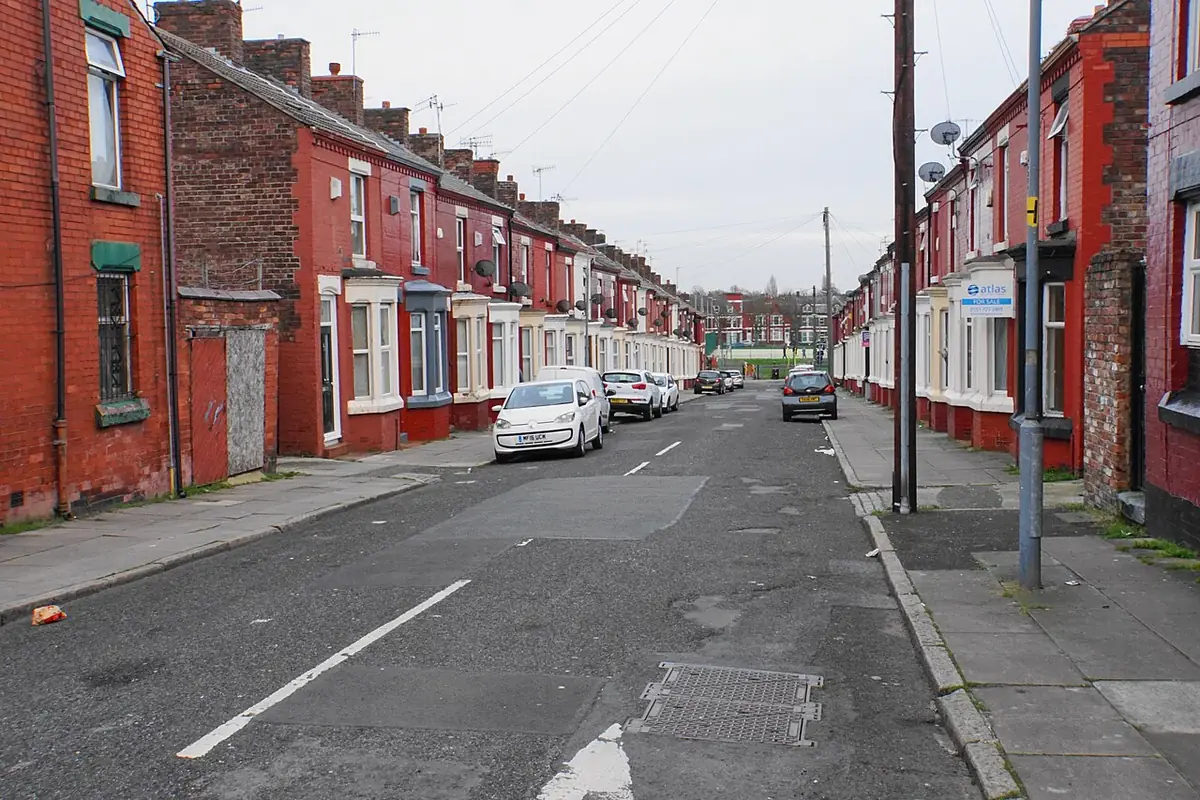
Terraced rows like this are the backbone of Liverpool's housing — Photo: Bill Boaden · CC BY-SA 2.0 · Wikimedia Commons
To work through that sequence you need to see every professional involved and what each of them actually contributes.
A British valuation is governed by a principle of evidence: every figure has to trace back to a document or a completed sale. From the first rough estimate to the lender's own report, the chain has weak points that only method can close. Understanding the order of these steps is what protects an owner from a number that is either flattering and useless or conservative and unchallenged.
You pull the completed sales for your own street and the streets immediately around it from the HM Land Registry record, and note the date of each.
You gather the property's own documents: the title showing freehold or leasehold and any remaining lease term, the current EPC, the Council Tax band, and any planning consents or building regulations sign-offs for past work.
You adjust the comparables for what makes your house different: plot size, floor area, the age and condition of the fabric, the number of bedrooms, and whether the extension or loft conversion was consented.
You invite two or three estate agents for a free appraisal and ask each to name the specific sales behind their figure, discarding any number that arrives without evidence.
Where the figure has to be defended to a lender, an executor or a court, you commission a RICS valuation, and you accept that a lender's own mortgage valuation may still come in lower because it is assessing their security rather than the market.
You settle on a range rather than a single number, with the low end supported by the weakest comparable and the high end justified by a specific, documented advantage.
Who produces which figure, and in what order?
Followed with that discipline, a valuation in Liverpool becomes a figure you can stand behind rather than one you hope for.
A sound valuation rests on rigorous coordination between several professionals with strictly separate roles. Unlike systems where one neutral official centralises the whole operation, the British approach splits responsibility between the estate agent, the solicitors, the surveyors and the lender, and each of them produces a different number for a different purpose. Knowing the order in which those numbers appear lets an owner steer the process instead of reacting to it.
The ownerAssembling the evidence basePulling completed sales from HM Land Registry, the title and lease term, the current EPC and the Council Tax band before anyone is invited to inspect.
The estate agentMarket appraisal and asking priceA free appraisal built on local demand and recent instructions, useful for positioning but written to win the instruction, so it should always be asked to show its comparables.
The conveyancing solicitorTitle, tenure and legal deductionsCareful reading of the title, local searches and the sale contract, which is where restrictive covenants, short leases or missing consents surface as real reductions in value.
The independent surveyorCondition assessmentA RICS Home Survey covering the roof, the timbers and the foundations and identifying any damp problems, each defect converting into a costed adjustment to the figure.
The bank or lenderMortgage valuationThe lender's own assessment of what the property is worth as security against the amount being borrowed, deliberately cautious and capable of forcing a renegotiation.
Both partiesReconciling the figuresSetting the agent's appraisal, the survey deductions and the lender's valuation against each other to arrive at the price the sale actually completes at.
House or apartment in Liverpool: which property type is easier to value accurately, and why the answer matters
With the property type settled, the question of the full cost picture behind the figure imposes itself on any methodical owner.
Valuing a traditional Victorian house with a garden and valuing an apartment in one of the newer residential schemes along the Liverpool docks are two different exercises, and confusing them is one of the most common ways an estimate goes wrong. Historic neighbourhoods such as Sefton Park or Wavertree offer red brick terraced houses whose floor area and private outdoor space hold lasting appeal for local families and first-time buyers. These properties show remarkable resilience against economic swings, because demand in those sought-after residential zones is structurally greater than the supply available, and that scarcity is what a valuer leans on. Against that, the upkeep of an old roof, the management of rising damp and the cost of energy retrofit all have to be deducted from any headline figure, and over a ten-year view they are the difference between a plausible estimate and a fantasy.
An apartment in the city centre or in the regenerated dock areas, such as Royal Albert Dock or the Ropewalks sector, changes both the lifestyle and the shape of the cost base, and therefore the shape of the valuation. Recent schemes offer modern specification, strong energy performance rated at the top of the EPC scale, and no private or shared outdoor space to maintain. The valuer, however, has to net off service charges that are often high, the restrictions that building rules impose on any architectural change, and a liquidity that can be more volatile through fast resale cycles. The composition of rental demand and the trajectory of the surrounding streets directly govern the gross and net return an investor can expect, and that expected return is precisely what sets the figure on an investment-grade apartment.
Comparative analysis of past returns shows that large family houses capture long-run growth more readily, because developable land in well-connected residential neighbourhoods is scarce. Urban apartments, by contrast, attract younger occupants, healthcare professionals and staff working in the fast-growing service sector of the Merseyside metropolitan area, which guarantees quick rental turnover but a heightened sensitivity to interest rate movements. Valuing one against the other therefore means weighing the durability of family demand, with its regular maintenance obligations, against a flexible, turnkey product exposed to the collective decisions of a building managed by third parties. It is a clear-eyed reading of your own holding period that determines which set of comparables is the right one to value against in Liverpool.
Which figures should sit behind a Liverpool house valuation?
With the figures in place, it helps to understand how an ordinary day works in this city, because the practical texture of a location is part of what it is worth.
The value of a house in Liverpool is not the price displayed on the property portals or in local agency windows. A defensible figure has to take in the acquisition costs, the local taxes in force and the recurring maintenance a buyer will face across the Merseyside housing stock. The tables below set out the whole financial structure so you can calibrate an estimate without a blind spot.
Value drivers and one-off costs for a house in Liverpool
Line item
Estimated range
Effect on the valuation
Average value (house)
GBP 180,000 to GBP 280,000
Swings sharply with proximity to the parks and to good schools.
Transfer tax and legal fees
GBP 2,500 to GBP 8,000
Covers conveyancing fees and Stamp Duty Land Tax, both netted off by a buyer.
Annual Council Tax (Bands B to D)
GBP 1,400 to GBP 2,100 per year
The band is a 1991 assessment, a coarse cross-check on value rather than evidence of it.
Renovation and compliance budget
GBP 5,000 to GBP 25,000
The main deduction on older stock needing thermal insulation.
The figures given rest on averages observed in the Liverpool property market for standard three-bedroom properties.
Running costs that a buyer deducts from what they will pay
Type of charge
Average annual cost
How it moves the figure
Home insurance (buildings and contents)
GBP 350 to GBP 650
Essential cover for maritime weather risk, and a standing cost priced into any offer.
Energy bills (gas and electricity)
GBP 1,800 to GBP 2,600
Tracks the EPC rating closely, so a poor rating shows up directly as a lower valuation.
Structural and roof maintenance
1% to 1.5% of value
The provision that keeps older fabric from degrading, and the first thing a survey will price.
A monthly provision set aside for the unexpected keeps a valuation honest, because deferred repairs are simply value borrowed from the future sale.
Health, schools, transport: the ordinary Tuesday that quietly sets the value
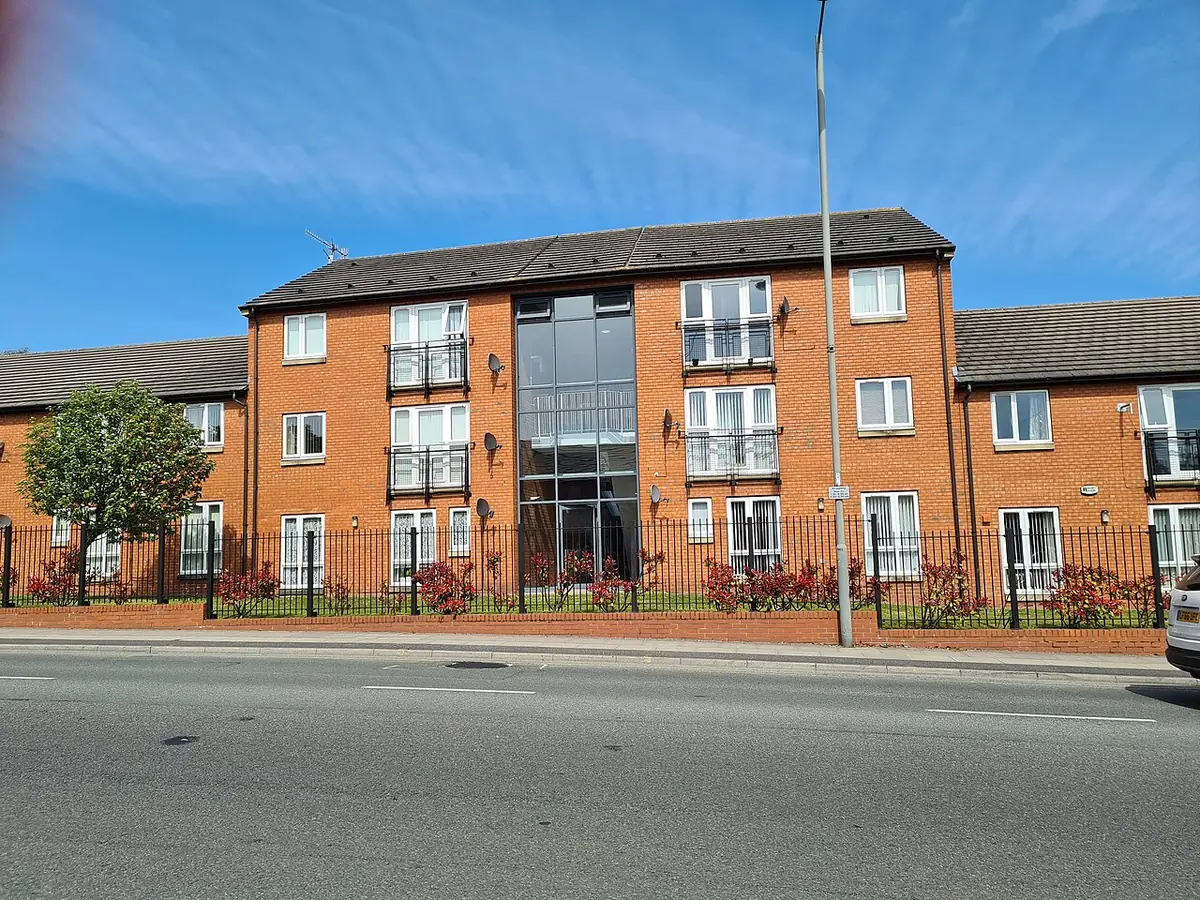
Newer apartment blocks like this add to Liverpool's housing mix — Photo: Frombowen · CC BY-SA 4.0 · Wikimedia Commons
Beyond the practicalities and the well-oiled schedules, some realities of the local market deserve to be brought into the light.
Assessing what a property is worth means reading traffic flows, school access and the proximity of healthcare with the same seriousness as floor area, because those are the things a buyer prices. An ordinary Tuesday in Liverpool shows how the public transport network really performs, whether by Merseyrail or by the major road links. Here is the chronological run of a typical day, read as a valuer would read it.
07:45Residential neighbourhood (for example Mossley Hill or Aigburth)An early start taking children to local schools with a good academic reputation, and catchment is one of the strongest single premiums in the city.
08:30Merseyrail station (for example Mossley Hill Station)A quick commute into the business district at Liverpool Central or Moorfields, avoiding peak road congestion; walking distance to a station is a measurable uplift.
12:30City centre offices and shopsA lunch break using the cultural offer and the local services a few minutes' walk from the transport hubs, which is what sustains central apartment values.
17:00Neighbourhood medical centre (GP surgery)Routine health appointments at practices attached to the public National Health Service network, an amenity buyers check for and valuers note.
18:15Local supermarket (Tesco Extra or Sainsbury's)End-of-day shopping at the out-of-centre stores with easy parking for residents with cars, a reminder that parking provision itself carries value here.
19:30Home again, and the green space nearbyWinding down with quick access to the banks of the Mersey or the Victorian parks for a walk, and proximity to those parks is one of the clearest premiums in the sold-price record.
What the listing will never tell you about the real condition behind a Liverpool figure
Knowing about these hidden factors is what prevents the classic errors, which usually surface several months later.
Sales particulars naturally concentrate on the attractive features of a house, pushing the technical constraints of the regional building stock into the background. To get a valuation right and avoid disappointment after exchange, you have to examine the things that never appear in a brochure but decide what the property is genuinely worth.
Exposure to sea winds and damp in the external walls
The immediate proximity of the Mersey and the Irish Sea exposes red brick facings to salt erosion and to damp penetration where the mortar joints have not been repointed recently. Regular water-repellent treatment is a real running cost, and evidence of neglect is a straightforward deduction from any figure you are quoted.
The state of the drainage in older areas
Many Victorian and Edwardian houses still run on aged cast iron or salt-glazed underground pipes. A camera inspection during the survey phase is essential, because defects or ground settlement discovered afterwards are expensive to repair and would have justified a materially lower valuation had they been known.
Conservation Area rules and their effect on future work
If the property sits in a protected sector, the smallest change to windows, roof or facade requires strict planning consent. Those constraints limit external thermal improvement and force the use of costly traditional materials, which caps the value uplift any refurbishment can deliver.
Residential parking and saturated streets
Several highly sought-after streets suffer a chronic shortage of parking, obliging owners to buy paid permits from the council. That daily friction feeds directly into resale value for buyers running more than one vehicle, and it is rarely reflected in an automated estimate.
The valuation mistakes owners only discover six months after the fact in Liverpool
These experiences lead naturally to the question of which owners this market simply does not suit.
Looked likeA charming period house full of character, with original floorboards and decorative fireplaces in every room, valued on its looks.
Turned outAn energy sieve with an exorbitant heating bill through the damp, windy Mersey winters, which knocked the figure down the moment a buyer read the paperwork.
Would have caught itAlways obtaining an up-to-date EPC and commissioning an independent surveyor for a level 3 RICS Home Survey before settling on any figure.
Looked likeAn extremely quiet, peaceful residential neighbourhood on the sunny Sunday morning the valuation visit happened to fall on.
Turned outA congested through route at peak times for the rest of the week, generating constant noise and daily access difficulties that buyers priced in and the valuation had not.
Would have caught itVisiting the property at different times, including a Tuesday at 08:00 and a Friday evening, to see the real traffic and the atmosphere before fixing a number.
Looked likeAn affordable-looking property said to need only superficial refreshing of paint and wallpaper, valued as if it were sound.
Turned outDry rot concealed behind the partitions, requiring complete replacement of the timber structure and a five-figure correction to the estimate.
Would have caught itChecking for persistent mould in the low corners of rooms and questioning sellers precisely about the history of water damage before the figure is finalised.
Looked likeMinimal maintenance charges for the shared parts or the street's communal areas, taken at face value in the estimate.
Turned outAn exceptional levy voted by the owners' association to resurface the private road or renew the shared drains, a liability that transfers with the property.
Would have caught itRequesting the full record of the last three years of owners' meetings and reviewing the reserve fund accounts held by the managing agent before relying on the figure.
Who should not rely on a Liverpool valuation to justify a purchase? Profiles at risk
Once those contra-indications have been examined honestly, it is time to decide whether you are ready to act on the number.
The pull of the Merseyside market should not disguise the mismatch between certain owner profiles and local reality. A valuation can be perfectly well evidenced and still be a poor basis for a decision, because it describes the property rather than your circumstances. These are the profiles who would do better to postpone or abandon a project in this city, whatever the figure says.
The investor looking for immediate liquidity and a short-term resale
→To buy an older property to refurbish and resell inside eighteen months on the strength of a favourable valuation.
High conveyancing solicitor fees, the relative slowness of the British legal transfer process and volatile labour costs wipe out the margin the valuation implied over such a short period.
The owner with no appetite for maintaining older fabric
→To buy a Victorian house on a headline figure, with no reserve budget and no experience of managing building work.
Liverpool's housing stock demands constant attention to counter the combined effects of atmospheric damp and the age of the materials, and every deferred repair the valuation quietly assumed you would make becomes a bill from an expensive contractor.
The household facing significant professional or geographic uncertainty
→To commit to a twenty-five year mortgage against a current valuation when a move abroad is likely in the medium term.
The unfurnished rental market can be demanding to run at a distance, and selling in a hurry exposes you to a discount below the valuation if local conditions slow even temporarily.
So, are you ready to act on what your Liverpool property is worth?
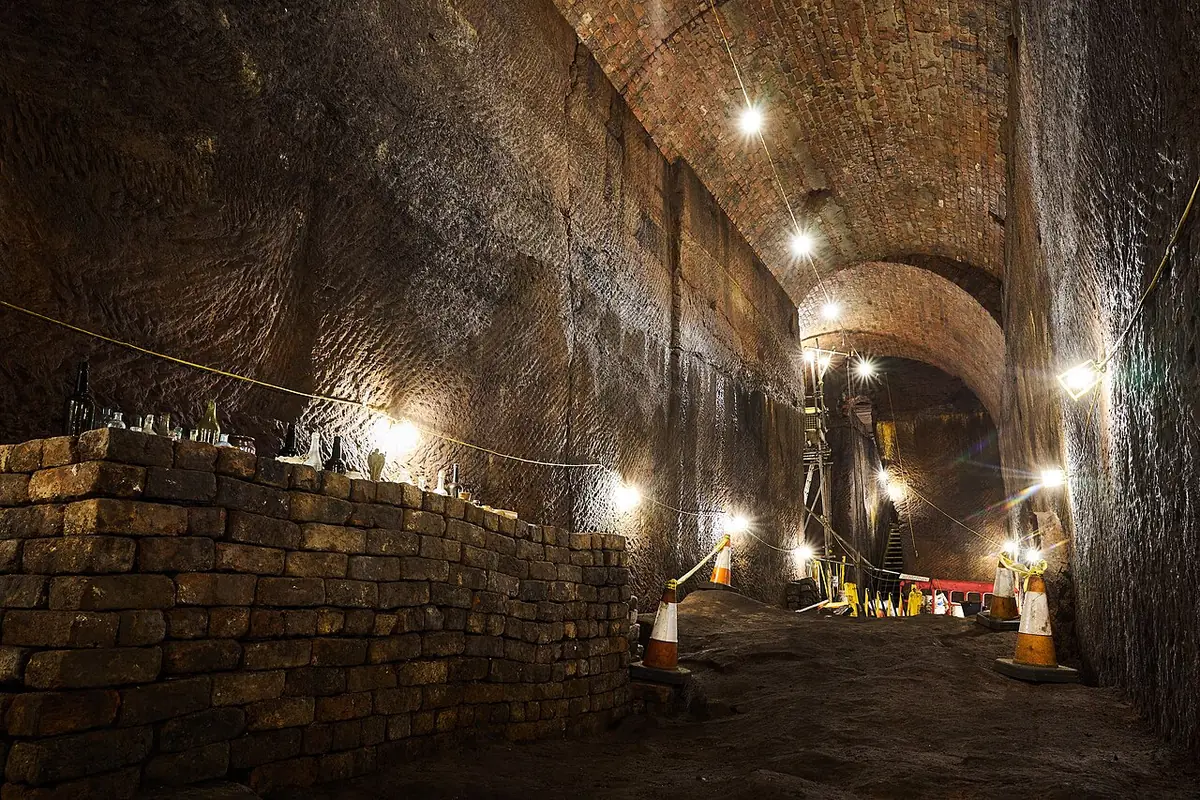
The Williamson Tunnels' brick passage, mid-restoration — Photo: Kyle J May · CC BY-SA 4.0 · Wikimedia Commons
Trusting a valuation in Liverpool means looking past the cultural energy of this port city and taking a clear-eyed view of the evidence behind the figure. Rigorous analysis of price per m2, honest inclusion of the unavoidable associated costs and awareness of what older fabric actually demands form the necessary foundation. If your holding period runs beyond seven to ten years and you have provisioned a safety margin for unforeseen maintenance, the local market supports figures you can genuinely rely on.
It is just as important to accept that a valuation is a range, not a verdict, and that walking away remains a perfectly rational response when your professional or personal situation lacks short-term visibility. No figure, however well evidenced, should be acted on out of urgency or fear of missing out, but only when the property and your circumstances line up. Take the time to compare several neighbourhoods, to test journey times at peak hours and to commission independent experts to audit the structure of any property whose number you intend to trust.
In the end, a valuation is only as good as the preparation behind it and your refusal to accept hidden compromises. By working with competent professionals for the conveyancing and the technical inspections, you turn an anxious guess into a controlled and durable decision. If every indicator is green after reading this guide, you now have what you need to test any figure put in front of you with confidence.
Related questions
What is the average value of a house in Liverpool, and what range should an owner expect?
A standard three-bedroom house in Liverpool generally values between GBP 180,000 and GBP 280,000 depending on the neighbourhood. Residential areas in the south of the city, such as Aigburth or Mossley Hill, come out above the metropolitan average because of school quality and proximity to the parks, and a valuation that ignores that split will be wrong by tens of thousands.
What costs sit around a valuation and the transaction it leads to in the United Kingdom?
Estate agent valuations are normally free because they are a pitch for the instruction. A paid figure means a RICS Home Survey or a formal RICS valuation report. Beyond that, an owner selling should budget for Stamp Duty Land Tax on the onward purchase, conveyancing solicitor fees, building survey costs and any mortgage brokerage, together roughly 3% to 6% of the purchase price.
How long does a valuation take, and how long does it stay reliable in Liverpool?
An estate agent appointment takes under an hour and the figure arrives within a day or two; a RICS report takes one to two weeks. The number itself should be treated as fresh for about three months, because the sale it supports, from accepted offer to completion, typically runs three to five months in the United Kingdom and the market underneath it moves.
How do Leasehold and Freehold change what a Liverpool property is worth?
Freehold means you own both the building and the land it stands on, which is the case for most houses, and it values at full market rate. Leasehold, more common for apartments, means you own the right to occupy for a fixed term while paying ground rent and service charges, and both the remaining term and those charges are deducted from the figure a valuer arrives at.
How does Council Tax banding relate to a valuation in Liverpool?
Council Tax is a local levy collected by Liverpool City Council to fund local public services. The amount depends on the band, A to H, assigned to the property on the basis of its assessed value in 1991, and it is normally paid over ten months a year. The band is a snapshot of a 1991 valuation, not a current one, so it is a rough sanity-check at best and never a substitute for present-day evidence.
Is a RICS survey required in order to establish a value?
British law does not formally require a survey to validate a sale, but a qualified RICS surveyor is strongly recommended when the figure matters. A survey identifies hidden defects, damp problems or roof timber faults before anyone commits, and each of those findings is a concrete deduction that turns a broad estimate into a defensible number.
Which Liverpool neighbourhoods hold their value best for a family house?
Mossley Hill, Aigburth, Woolton and Childwall are among the most sought-after for families because of their quiet, their remarkable green space and the quality of their state and private schooling. That demand is what keeps valuations in those postcodes firm, and it is why comparables must be drawn from the same streets rather than the city-wide average.
How does a lender's mortgage valuation differ from the figure an agent gives?
A buyer's finance normally rests on a mortgage from a British bank or through a mortgage broker. Lenders require a personal deposit, often set between 10% and 25% of the value of the property, plus a thorough check of income and creditworthiness. Their own valuation is a risk assessment of their security, deliberately conservative, and it can come in below the agreed price, which is what forces a renegotiation.
How do planning constraints in Liverpool's historic areas affect the estimate?
Properties in Conservation Areas or listed as Listed Buildings are subject to extremely strict planning rules. Any work on the facade, the roof or the external joinery needs prior consent from the council and compliant materials. A valuer treats that both ways: the character supports the price, while the restricted scope for extension or external insulation caps it.
Which climate factors should a Liverpool valuation account for?
Because of its coastal position along the Mersey estuary, Liverpool is exposed to sustained sea winds and frequent rainfall. Checking the watertightness of roofs, the state of the gutters and the absence of damp penetration in the external walls of older properties is therefore essential, and any failure found there translates directly into a deduction from the value.
Property review of ting
No ting properties in Liverpool yet
Be the first — share it on ting and it shows up right here.