Investing in property in Liverpool means understanding legal and financial rules that differ sharply from what most overseas buyers are used to. This guide sets out how the local market actually works, from the structure of leases to the choice of neighbourhood, so you can complete your purchase with your eyes open.
Get the app
What nobody tells you.
Real prices, hidden costs and the traps to check before you commit.
Why the promise of buying property in Liverpool means letting go of the assumptions you arrive with
Scroll
Why the promise of buying property in Liverpool means letting go of the assumptions you arrive with
Investing in property in Liverpool means understanding legal and financial rules that differ sharply from what most overseas buyers are used to. This guide sets out how the local market actually works, from the structure of leases to the choice of neighbourhood, so you can complete your purchase with your eyes open.
Written by the ting.ad editorial team ·
High Street, Liverpool in Street View: drag to look around.
That tension between financial opportunity and legal complexity shows up the moment you look hard at your own buyer profile.
Investing in bricks and mortar in Liverpool is not a matter of signing a deed and collecting passive rent. The British market demands a radically different reading of value, in which raw floor area gives way to legal structure and the real condition of the Victorian building fabric. What looks like an excellent deal on paper often conceals complicated service charges and strict energy retrofit obligations. You have to weigh the appeal of an immediate gross yield against the reality of local liquidity hemmed in by rigorous planning rules.
A gross rental yield among the highest of the major British regional citiesvsPotential structural wear in older blocks calling for substantial provisions for works
The figures agents quote rarely reflect the true cost of maintaining roofs and listed facades. A theoretical yield of eight per cent can melt away fast once the building managers set out their requirements.
A route to ownership made easier by the absence of heavy continental deed formalitiesvsA leasehold tenure system that turns every owner into a long-term tenant of the land
The distinction between freehold and leasehold completely redefines what ownership means. You own the walls but not the ground, which brings lease extension costs and ground rents that are sometimes unpredictable.
International cultural pull carried by the city's maritime and university heritagevsA marked gap between the micro-markets of urban regeneration and the steadier residential areas
Buying near the refurbished docks or out in the suburbs does not follow the same resale logic. A district's momentum can reverse from one street to the next depending on the public investment that has landed there.
Fast, transparent purchase formalities handled by specialist solicitorsvsA fragile sale chain in which one withdrawal further down the line can collapse the whole transaction within days
The buying process rests on the good faith of the parties right up to exchange of contracts. Until that precise moment, nothing penalises a party who walks away, which demands constant vigilance from your adviser.
Does this place really match your way of life and your long-term financial goals?
Once your profile is clear, setting it against the buying habits you bring from home reveals some striking contrasts.
Whether a property project fits your daily reality is not measured by how enthusiastic you feel on the first viewing. Depending on whether you want a city base, a purely financial investment or a future permanent home, the criteria for location and property type diverge completely. Fast-changing districts demand tolerance for noise and building sites, while the quiet areas ask for a higher initial outlay in return for more gradual capital growth.
Remote investor chasing yield
Your absolute priority is how easily the property lets and how steady the monthly cash flow is. You should target recent schemes or office conversions ideally placed near the university campuses or the business district. In this scenario, managed letting becomes essential but eats into your net margin, so you have to work out your break-even thresholds with real rigour from the outset.
Service charges and concierge fees weigh heavily on small units. It is worth favouring buildings with exemplary energy efficiency in order to attract reliable tenants and avoid long void periods between academic-year lets.
Future resident looking for a central base
Your approach is closer to a life project, where day-to-day comfort matters more than short-term gross yield. You put closeness to transport, cultural venues and healthcare within walking distance first. That naturally leads you towards the converted dockside warehouses or new-build schemes in the city centre, even if it means accepting a cost per square metre noticeably above the regional average.
Sound insulation and natural light then become decisive criteria for avoiding a discount at resale. Living in the heart of the city means accepting the parking constraints and the night-time buzz of the liveliest districts.
Cautious long-horizon capital builder
You are looking to protect your savings against inflation by backing the gradual gentrification of outlying districts on the way back up. Your strategy rests on carefully picking locations with revaluation potential over ten or fifteen years. You accept modest rental income at the start in exchange for structural capital growth driven by the council's urban development plans.
This option calls for excellent knowledge of the local fabric so as to avoid isolated pockets of deprivation where the market stagnates for years. Guidance from an independent expert is essential here to make the location decision safe.
Living here when you arrive from abroad: what changes radically in practice
Strawberry Field's gates are one of Liverpool's best-known landmarks — Photo: Robertoalonsomen · CC BY-SA 4.0 · Wikimedia Commons
That cultural and legal gap translates very concretely on the ground when you pick your future neighbourhood.
The British property system shares almost none of its conventions with the systems most overseas buyers grew up with. Where many jurisdictions protect the buyer through strict cooling-off periods and binding technical reports, English law rests on the principle of caveat emptor, that is, it is for the buyer to find out. That culture of due diligence turns a purchase into a technical and legal audit run by professionals whose role differs fundamentally from the notary-style officials found elsewhere.
From abroad
A mutually binding preliminary sale agreement signed at the agency or before a public official, with a deposit held in escrow
Liverpool
A formal exchange of contracts through the parties' solicitors, with no immediate blocked deposit beforehand
The interim phase carries the risk that the seller abandons the sale before exchange actually happens, which demands total responsiveness from your legal advisers.
From abroad
A block of flats governed by statute, with a professional managing body and a standardised maintenance log
Liverpool
A management company arrangement, or a collective freehold run by the owners themselves
The involvement expected of you in running the building bears no comparison to passive co-ownership elsewhere, with meetings where every vote genuinely counts.
From abroad
Habitable floor area measured to a precise statutory standard that the buyer can rely on in law
Liverpool
Floor area quoted in square feet with no absolute legal guarantee on the marketing plans
You need to instruct your own surveyor to confirm the real floor area before you commit financially, or risk an unpleasant surprise when you move in.
From abroad
Transfer duties and conveyancing costs of roughly seven to eight per cent of the price
Liverpool
Payment of Stamp Duty Land Tax calculated in progressive bands according to the value of the property
The tax due on purchase can be optimised depending on whether you are resident or an international investor, but it adds significantly to the initial budget.
Which district should you target, given your rhythm of life and your investment ambitions?
These district dynamics translate into budget realities that deserve a methodical look.
Liverpool is a mosaic of districts with sharply drawn identities, running from the regenerated former dock areas to the leafy residential inner suburbs. Choosing a location depends not only on the price per square metre but on who lives there and how strong the local economy is. A successful investment rests on a fine-grained understanding of population flows and of the regeneration schemes the city is backing.
The Docks & Baltic Triangle
A constant buzz mixing technology hubs, fashionable cafes and spectacular industrial conversions along the waterfront.
Suits
Young professionals, investors targeting short or medium-term lets, and anyone who wants intense city living.
Trade-off
A higher cost per square metre, substantial service charges tied to the building's amenities, and night-time noise.
Georgian Quarter & Hope Street
The hushed calm of superb Georgian frontages, punctuated by theatres, universities and tree-lined open space.
Suits
Those after historic architectural character, stable long-term value and closeness to the major cultural institutions.
Trade-off
Properties that rarely come to market, strict heritage protection rules that limit alterations, and prices at the high end.
The Baltic Creative & Ropewalks
A studio-and-workshop spirit of urban creativity, where red brick warehouses house coworking spaces and galleries.
Suits
Bold buyers willing to bet on the continued gentrification of areas in full cultural and commercial transition.
Trade-off
Architecture that is still markedly uneven between the refurbished blocks and the plots awaiting redevelopment.
What does an apartment in Liverpool really cost to buy and to run?
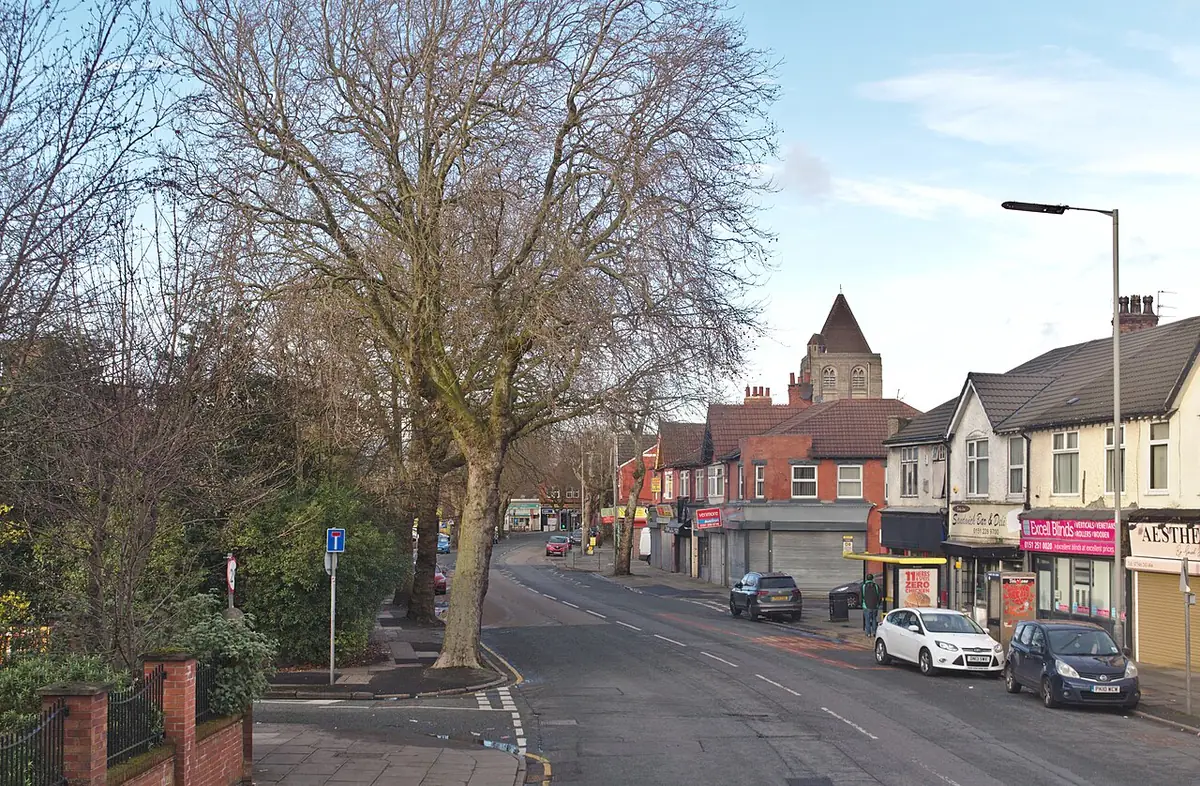
Streets like this mix shops and terraced homes under the trees — Photo: Rodhullandemu · CC BY-SA 4.0 · Wikimedia Commons
Beyond the budget figures, the very nature of what you are buying deserves a close legal look.
Liverpool's relative affordability compared with London or the big cities of southern England should not hide the real structure of the spending. Beyond the headline purchase price, the total cost of ownership takes in Stamp Duty, legal fees, agency fees and above all the building's annual service charges. Managing those items carefully is what stops an apparent bargain becoming a recurring financial drain.
liverpoolFor saleApartmentestimate
Median price / m²£2,280Half the apartments sell below this
Median price£168kthe average is 14% higher — a few very large properties pull it up
Most common2 bedrooms43 % of listings
Average size70 m²
By number of bedrooms
Bedrooms
Share of market
Avg price
Price / m²
Avg size
1
32 %
£130k
£2,712 +13 %
48 m²
2most common
43 %
£168k
£2,400
70 m²
3
19 %
£212k
£2,232 −7 %
95 m²
4
6 %
£270k
£2,160best value / m²
125 m²
Each row is an average, compared against the area average of £2,400 / m². These are indicative estimates of a typical local market, not a measured sample of live listings. Check current listings before relying on them.
What you can actually own: understanding the divide between freehold and leasehold
Getting on top of these legal subtleties leads straight to securing the timetable for your purchase.
In England, owning an apartment is almost never expressed as outright ownership of the land and the building. Nearly all apartments are held on leasehold, meaning you buy the right to occupy the home for a fixed period while a third party owns the land and the common parts. That fundamental distinction redefines your rights, your financial obligations and the potential discount attaching to your property as time passes.
Leasehold tenure under a long lease
You buy a right of use whose original term usually runs between 125 and 999 years. Every year that passes shortens the remaining term, and below 80 years the cost of extending the lease with the freeholder rises exponentially. You also have to pay an annual ground rent and service charges set unilaterally by the company managing the building.
What it changesYou must have your solicitor check the unexpired lease term before making any offer, or you risk buying a property whose value will erode mechanically.
Share of freehold
Some smaller or reorganised buildings let the apartment owners collectively hold the company that owns the land, through a shared structure. Under that arrangement, the residents control management decisions, choose their own contractors and do away with abusive ground rent charges while keeping maintenance budgets under control.
What it changesThis option offers markedly better legal and financial security, but it requires the owners to get along well enough to steer the upkeep of the building.
The one rule to grasp before you pay a penny of deposit
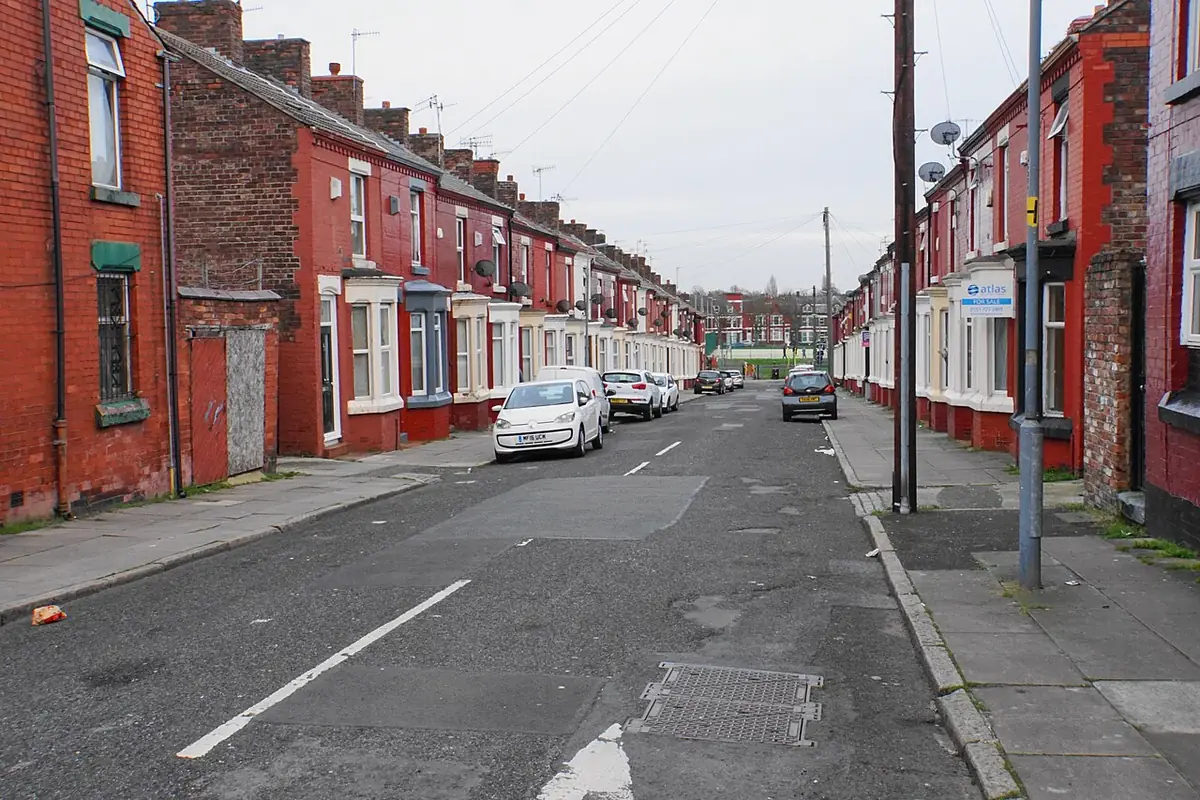
Terraced rows like this are the backbone of Liverpool's housing — Photo: Bill Boaden · CC BY-SA 2.0 · Wikimedia Commons
Once those stages are cleared, the practical timetable of your purchase follows a well marked-out calendar.
The British property transaction system rests on complete freedom to walk away right up to the precise moment of exchange of contracts. No official draws up a binding preliminary agreement at the first viewing. The parties agree a price through the agents, then instruct their respective solicitors to run the legal enquiries. Throughout that investigation phase, the seller can accept a higher competing offer, a practice known as gazumping, or withdraw without any financial penalty.
The seller accepts your offer subject to legal checks (under offer).
Your solicitor orders the full set of official searches covering title, easements and planning schemes in the surrounding area.
An independent surveyor you instruct yourself carries out a thorough inspection of the property to uncover any hidden defects or structural faults.
The reports are reviewed so that, where warranted, you can negotiate the price down to reflect the works identified.
Formal exchange of contracts takes place: at that precise moment the transaction becomes legally irrevocable and a ten per cent deposit is paid.
Final signature and transfer of ownership (completion) follow a few weeks later.
How a property transaction in Liverpool unfolds, step by step
To take your thinking further, consult the official sources and our further analysis of the British market.
Buying an apartment in Liverpool calls for careful coordination between the various players in the chain. From choosing the estate agent through to handover of the keys, each party has a precise role you need to anticipate if you want to avoid administrative hold-ups. A complete transaction usually takes between two and four months, subject to how quickly the parties respond.
BuyerConfirming finance and choosing a solicitorGet a mortgage agreement in principle and instruct a conveyancing solicitor before you even start viewing, so that your offer carries weight with sellers.
Estate agentTargeted viewings and submitting the offerPut your offer in writing with proof of funds and your solicitor's details attached, so the seller is reassured straight away.
Buyer's solicitorLegal enquiries and searchesClose examination of title, the lease, service charges and local environmental risks.
SurveyorPhysical inspection of the building (survey)A HomeBuyer Report or a full building survey to establish the condition of the roof, the foundations and the insulation.
Both parties' solicitorsExchange of contractsSimultaneous signature of binding contracts and payment of the non-refundable deposit. The sale can no longer be cancelled.
All partiesCompletion and moving inPayment of the balance of the price, registration of ownership with HM Land Registry and handover of the keys.
Apartment or house in Liverpool: choosing between Victorian stock and new build by the docks
Once you have settled on the type of property, it is worth looking closely at the structure of your running costs for a comfortable life in this city.
The property choice in Liverpool often comes down to a cultural and architectural face-off between two worlds with almost nothing in common. On one side, the superb Victorian and Edwardian houses of residential districts such as Wavertree, Sefton Park and Aigburth offer impressive volumes, soaring ceiling heights and undeniable historic character. On the other, the new-build schemes and conversions of former dock warehouses along the Mersey and around the Albert Dock offer modern specifications, energy performance that is often far better, and no immediate works for the incoming buyer to worry about.
Yet that surface opposition hides financial and practical realities far more nuanced than the sales brochures suggest. An older house in Liverpool takes considerable time and capital to bring up to current thermal standards, quite apart from the classic structural traps of English red brick, such as rising damp and worn slate roofs. Maintenance never really stops and demands constant attention to preserve the value of the property over the decades, which sometimes puts off first-time buyers looking for complete peace of mind.
Conversely, an apartment in a managed block in the centre or near the waterfront frees you from that exterior upkeep but introduces a financial variable that unwary investors often underestimate: the service charges. These amounts can climb sharply from one year to the next, particularly in buildings with concierge services or complex lifts, steadily eroding rental returns or an owner-occupier's day-to-day budget. The choice therefore comes down above all to your tolerance for building-works risk versus your aversion to recurring collective costs.
You also need to build location and long-term resale into the equation. Family houses with gardens in the suburbs well served by commuter trains keep a powerful structural demand behind them, driven by local families and first-time buyers looking to trade up. City apartments, while highly attractive to young professionals and well-funded students, sometimes face fierce competition when the market turns, because the volume of new construction can drift out of step with the city's real demographics.
Your final decision should therefore rest on how you actually live and on your ability to manage local trades to renovate or maintain the property. If you hate unpredictable collective costs and dream of a private space with a patch of garden, head without hesitation for Victorian brick in the better districts. If instead you value pure convenience, the security of a managed block and immediate closeness to Liverpool's cultural life, the city apartment is the more coherent solution.
What overall budget do you need to live comfortably in an apartment in Liverpool?
With those financial markers in place, let us look concretely at what daily life is like on the city's streets.
Setting a realistic budget for buying and running an apartment in Liverpool cannot stop at the mortgage repayment you owe your lender. You have to build in all the local taxes, the compulsory insurance and the service charges if you want to avoid an unpleasant financial surprise in your first year. This overall picture lets you see the unavoidable spending items that shape life as a resident owner in the Merseyside city.
Monthly and annual spending items for a standard apartment
Spending item
Estimated amount
Frequency
Context
Council tax (bands B to D)
120 GBP to 180 GBP
Monthly
Compulsory local tax due from the occupier, varying with the property's assessed value.
Service charges
100 GBP to 250 GBP
Monthly
Covers upkeep of the common parts, the block insurance and sometimes the management fee.
Ground rent (historic land charge)
150 GBP to 400 GBP
Annual
Sum paid to the freeholder of the land under long leasehold titles.
Home insurance (buildings and contents)
25 GBP to 50 GBP
Monthly
Essential to cover the structure and your possessions against major losses.
The amounts shown apply to a standard one or two bedroom apartment in the middle or central areas of Liverpool.
Upfront purchase costs to anticipate
Type of cost
Reference rate or amount
Effect on your cash deposit
Stamp Duty Land Tax (transfer duty)
0% to 5% depending on your profile
Progressive scale applying to main residence buyers in England.
Conveyancing solicitor's fees
1,200 GBP to 2,500 GBP
Essential fees to secure the legal transfer of title.
Home survey report
400 GBP to 900 GBP
Recommended to identify hidden defects or structural damp problems.
Always keep a safety margin of around ten per cent of your available cash for unforeseen incidental costs.
Health, schools and transport: what does an ordinary Tuesday look like for a Liverpool resident?
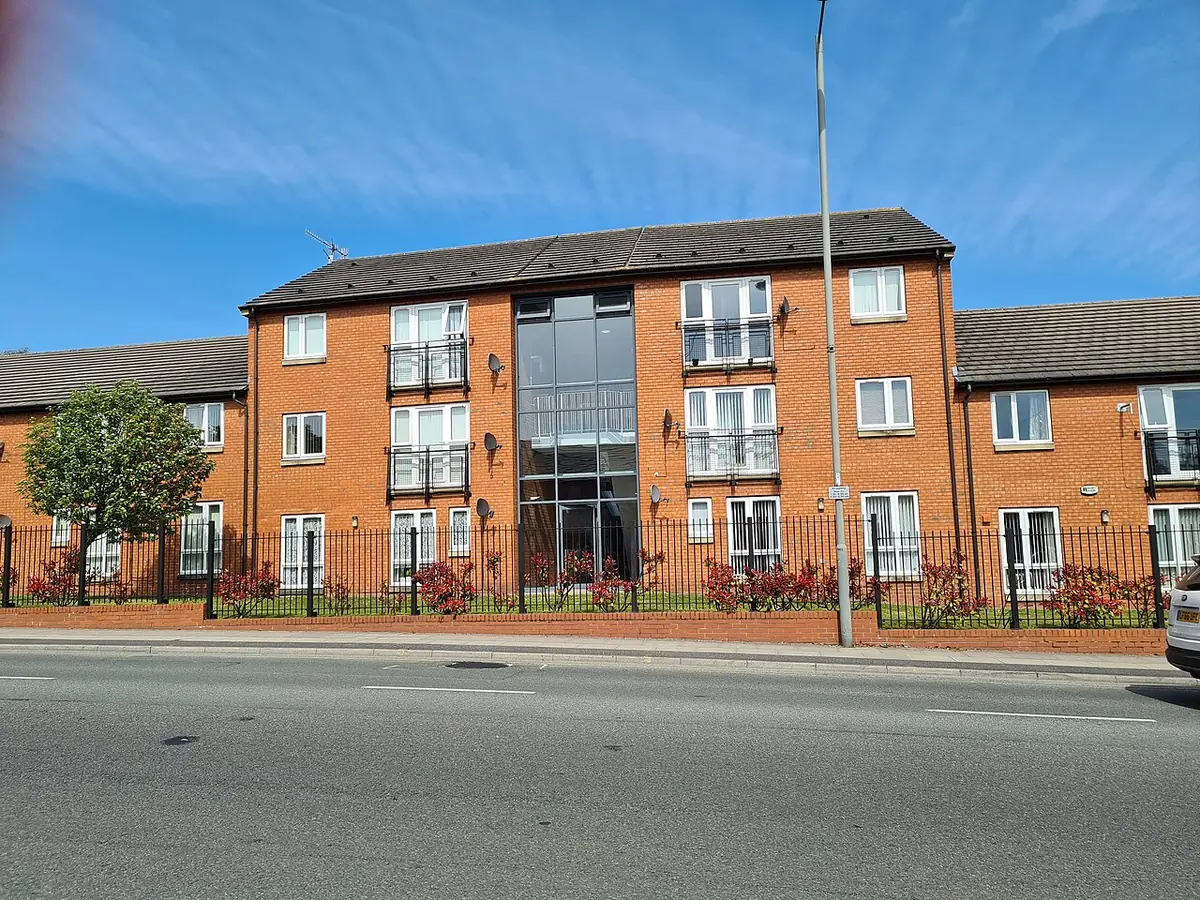
Newer apartment blocks like this add to Liverpool's housing mix — Photo: Frombowen · CC BY-SA 4.0 · Wikimedia Commons
Beyond the practicalities you can see, some crucial details escape the usual viewings arranged by the agents.
To judge whether a property investment in Liverpool makes sense, nothing beats walking through a typical weekday hour by hour as an established resident would live it. Between the commute into the business district, getting children to local schools and access to NHS services, each district reveals its strengths and its practical constraints. This hour-by-hour run through shows how effective the transport network really is and how smoothly neighbourhood life flows.
07:30Moorfields or Lime Street stationThe working day starts with a smooth flow of commuters towards the regional economic hubs. Merseyrail connections let you cross the city quickly without the chronic city-centre traffic jams.
08:45Local primary schools (Ofsted Good)Dropping the children at neighbourhood schools. Being close to a well-rated school is the first selection criterion for families settling in the area for the long term.
12:30Neighbourhood GP surgeryRoutine health appointments within the local public health network. Registering promptly with the GP practice for your area is a priority as soon as you move in.
17:30Local shops (Bold Street or Lark Lane)Food shopping and a moment to unwind on the busy shopping streets. These lively strips concentrate the independent restaurants and neighbourhood shops that give local life its charm.
19:00City parks (Sefton Park or Princes Park)Ending the day outdoors in one of the city's many Victorian green spaces. These structuring green lungs offer a valued setting that more than offsets the hard density of the centre.
What the listing will never tell you about the reality of property in Liverpool
Knowing these blind spots is what stops a heart-over-head purchase turning into a financial drain six months later.
The British property market has its own conventions and blind spots, which the sales copy is skilled at prettifying to win over would-be buyers. Behind superlatives such as 'up and coming area' or 'fantastic potential' there are sometimes technical or planning realities with heavy financial consequences. Here are the factual points professionals too often leave out of the first viewing of an apartment or a house.
The true condition of the roof and the rainwater drainage
Given the maritime climate and frequent rainfall in the North West of England, the watertightness of slate roofs on older blocks is critical. A roof renewal voted through at an owners' meeting can easily produce an unexpected bill of several thousand pounds per unit.
The hidden legal complexity of long leasehold titles
Many apartments in Liverpool are not sold freehold but on a long lease with a third-party freeholder. Ground rent review clauses can add substantially to your fixed costs over the long run.
The original thermal insulation and the EPC rating
Many older buildings show mediocre energy performance, rated E, F or G on the official British scale. Heating a large, poorly insulated volume produces punishing monthly energy bills through the long Merseyside winter.
Planning schemes nearby and night-time noise
An area that is quiet by day can turn into a very noisy going-out zone at weekends once new late-night venues open. It is essential to check the council's planning register to anticipate building work in the surrounding streets.
The misjudgements buyers only discover six months after settling in Liverpool
These hard-won lessons show that not every buyer profile finds what they need in this demanding market.
Looked likeAn ideal investment opportunity, with service charges presented as very moderate in the sales brochure.
Turned outA sharp rise in service charges imposed by the managing agent to absorb the rising cost of maintaining the lifts.
Would have caught itInsisting on the full three-year history of service charge demands from the managing agent before you commit to the contract.
Looked likeA perfectly peaceful, leafy residential area, seen on a sunny Sunday morning viewing.
Turned outA saturated traffic route at morning and evening peak, making access to the garage extremely difficult and stressful.
Would have caught itVisiting the area at different times of the week and testing the real journey time during the commuting peaks.
Looked likeAn older property with authentic Victorian character, apparently needing no more than a fresh coat of paint in the living rooms.
Turned outPersistent damp problems cleverly hidden behind recent plasterboard during the viewings the sellers arranged.
Would have caught itAlways instructing an independent surveyor for a thorough Level 3 home survey before confirming your offer.
Looked likeUltra-fast internet available all along the street, ideal for working from home.
Turned outAgeing cabling in the building limiting the real speed to a fraction of what the local provider promised.
Would have caught itChecking the line's technical eligibility precisely through independent online test tools before committing.
The buyer profiles who make a mistake by investing in Liverpool property
If you recognise yourself in these at-risk profiles, it is probably wiser to wait before taking the plunge.
Buying in a large regional city such as Liverpool is not a universal answer suited to every professional or personal situation. Wanting to buy at all costs, without the visibility you need on where you will be living or what your finances will look like, often leads into a dead end. Looking at the profiles of buyers who ran into trouble makes it clear where long-term renting remains the far more sensible strategy.
The mobile young professional in the middle of an international career move
→Buying a small city apartment to house themselves quickly on arrival, without studying how liquid the local market is.
If work moves them to another part of the United Kingdom after eighteen months, the conveyancing costs and Stamp Duty, the agency fees and the early repayment charges on the mortgage wipe out the deposit they put in.
The remote investor chasing an immediate gross yield with no management
→Agreeing to buy into a complicated managed block with high charges, placing blind trust in the agents' estimates.
The regulatory complexity of English landlord and tenant law and the difficulty of chasing arrears from a distance quickly turn the project into a financial drain unless local support is rigorously organised.
The first-time buyer on an ultra-tight budget with no emergency savings
→Borrowing the maximum permitted while cutting back the essential allowance for bringing the home up to standard.
The slightest unforeseen failure of the heating system or the roof immediately leaves the household unable to meet its monthly mortgage payments in the face of inflation.
So, are you really ready to go ahead with your Liverpool property project?
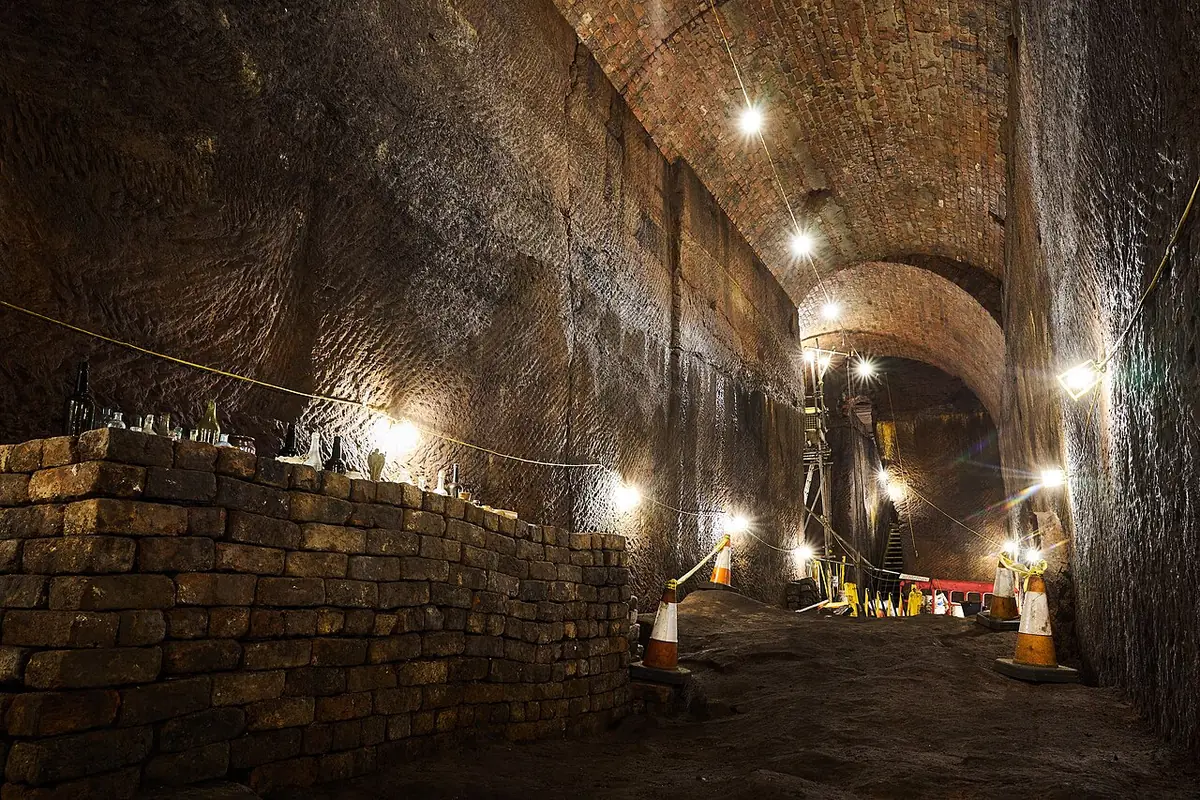
The Williamson Tunnels' brick passage, mid-restoration — Photo: Kyle J May · CC BY-SA 4.0 · Wikimedia Commons
At the end of this close look at the Liverpool property market, the final decision no longer belongs to abstract figures but to your own view of the future. Buying an apartment or a house in this British city calls for clear-eyed commitment, a long way from the simplistic marketing promises of agencies in a hurry to close. Liverpool's strength lies in its cultural vitality and its singular working and maritime history, but that comes with structural constraints you have to be willing to shoulder as a responsible owner.
If your plans stretch beyond five years, if your deposit leaves a comfortable safety margin for the surprises a managed block can throw at you, and if you have checked every technical detail through a rigorous survey, then the Liverpool market offers remarkable opportunities. Districts in transition and settled residential areas continue to attract an energetic population looking for a balance between urban buzz and the large green spaces laid out along the Mersey.
Take the time to view your shortlisted properties more than once, to talk directly to the future neighbours so you catch the real feel of the streets, and to have every clause of the lease checked by an independent specialist solicitor before you commit. A successful purchase in Liverpool is not a matter of luck or of a punt on the market, but of a rigorous method and a thorough grasp of the local rules that govern property ownership in England.
Related questions
Which neighbourhoods are most sought after for buying an apartment in Liverpool?
The most desirable areas for residential purchases include the City Centre for modern apartments, along with the leafy residential districts of the south of the city such as Aigburth, Sefton Park and Mossley Hill, prized for their handsome Victorian houses and their closeness to the parks.
What does leasehold tenure mean for an apartment in Liverpool?
Leasehold means you buy the right to occupy the home for a fixed period set by a long lease, often several decades or even centuries, while the land belongs to a third-party freeholder to whom you pay an annual charge known as ground rent.
How is council tax calculated in Liverpool?
Council tax is a compulsory local tax due from the occupier of the home. The amount is set by the local authority according to the assessed value of the property on the reference valuation date, split into bands running from band A to band H.
Is a technical survey compulsory before buying in England?
English law does not formally require a home survey, but it is strongly advised to instruct a RICS qualified surveyor to identify hidden defects, damp problems and the true condition of the roof.
What legal fees should you budget for on a Liverpool property transaction?
The legal costs of transferring ownership, known as conveyancing, generally run between 1,200 and 2,500 pounds sterling depending on the complexity of the file, the type of property and the compulsory searches carried out with the council.
What effect does the EPC rating have on a purchase in Liverpool?
The Energy Performance Certificate (EPC) rates homes from A to G. In older refurbished stock in Liverpool, a poor energy rating means high heating bills in winter and can restrict access to some of the better mortgage terms.
How do service charges work for an apartment?
Service charges are paid periodically to the building's managing agent to cover the upkeep of common parts, cleaning, the block insurance policy and the running of shared equipment such as lifts and gates.
How long does it typically take to complete a property purchase in England?
The full purchase process, from the seller accepting your offer through to final signature and handover of the keys (completion), usually takes between two and four months, because of the thorough legal checks carried out by the solicitors.
Is the Liverpool market open to non-resident foreign investors?
Yes, non-resident foreign investors can buy property in the United Kingdom. That said, specific tax surcharges on transfer duties apply, along with stricter requirements on evidencing the source of your funds.
What transport is available for getting around Liverpool?
Liverpool has an effective transport network including the Merseyrail urban and suburban rail system, a dense web of bus routes, and ferry crossings over the Mersey estuary to the Wirral peninsula.
Property review of ting
No ting properties in Liverpool yet
Be the first — share it on ting and it shows up right here.