Finding and buying a townhouse or an unusual property in the 15e arrondissement of Paris means going beyond the first aesthetic rush. Between the scarcity of land, the legal subtleties of privately owned dead-end lanes and the constraints of the local planning code (the Plan Local d'Urbanisme), this guide gives you what you need to make the investment with your eyes open.
Get the app
What nobody tells you.
Real prices, hidden costs and the traps to check before you commit.
What you are really getting when you buy a house in the 15e arrondissement
Scroll
What you are really getting when you buy a house in the 15e arrondissement
Finding and buying a townhouse or an unusual property in the 15e arrondissement of Paris means going beyond the first aesthetic rush. Between the scarcity of land, the legal subtleties of privately owned dead-end lanes and the constraints of the local planning code (the Plan Local d'Urbanisme), this guide gives you what you need to make the investment with your eyes open.
Written by the ting.ad editorial team ·
Rue de Rivoli, Paris in Street View: drag to look around.
That structural scarcity completely redefines the way you will occupy space day to day.
Buying a detached or terraced house in the 15e arrondissement of Paris is a rare and demanding exception in this market. Behind the wide boulevards and the ranks of Haussmann-era blocks sits a discreet fabric of private villas, converted former workshops and preserved cobbled passages. This market resembles no other in the capital, because it combines the density of a busy, family-minded shopping district with the intimacy of horizontal living. Understanding what you are buying here means accepting that you give up outer-suburban standards in favour of intense urban use paired with the absolute calm of an inner courtyard or a dead-end lane.
Floor area and independencevsUrban insularity
Owning a house in the 15e gives you single-level square metres and a freedom of movement that is rare in Paris, but it can cut you off from the usual co-ownership dynamics and from certain shared services. It is a choice of total autonomy in the middle of a dense city.
Heritage exclusivityvsTechnical complexity
These properties hold an absolute scarcity value that protects your investment against market downturns. In exchange, maintaining an independent structure with its own roof and facade demands rigorous technical follow-up and a dedicated management budget.
Residential calmvsDiscreet access
You get unexpected silence a couple of minutes from busy arteries such as rue de Vaugirard or rue du Commerce, but reaching these properties often runs through rights of way, carriage doors or narrow lanes that force real compromises on car parking.
Value to pass onvsRestricted liquidity
A detached house inside the Paris city limits is an exceptional asset to hand down, and it never loses its pool of wealthy buyers. Even so, the small number of potential buyers at resale can stretch transaction times compared with a standard apartment.
Does this place really match your life now and the life you are planning?
Moving here from another country or another kind of home will unsettle your usual reference points.
Choosing a house in the 15e arrondissement is not a simple aesthetic preference for period buildings or greenery. It commits you to a way of life anchored in neighbourhood logic, where the closeness of schools, of parks such as Georges-Brassens and of small food shops sets the rhythm of the week. Whether you work in person in central Paris, work from home for much of the week, or are looking for a haven for a family with teenagers, the equation changes radically. Analysing how you actually live should come before you sign any offer, so that the physical constraints of these unusual properties do not catch you out.
Neighbourhood life and family life
You are looking for a balance between an intense working life and a calmer domestic setting. The 15e offers an excellent school network, safe green spaces and a lively shopping culture around rue de la Convention. Having a house lets you carve out an office on the ground floor or in a converted loft space, while keeping the children within easy reach of the well-regarded secondary schools in the sector.
Professional independence at home
You need a workspace completely separated from the living rooms so you can practise without disrupting the household. Townhouses with their own street entrance, or a large ground-floor workshop, are an ideal configuration for reconciling client visits with private life. You get a prestigious and accessible Paris address while escaping the strict rules that grander co-ownerships impose on professional activity.
A horizontal base in Paris
You are leaving a large property on the edge of a city to be closer to theatres, museums and the cultural life of the capital, but you do not want to live in a partitioned apartment. A single-storey house, or one over two levels with a small private patio, gives you the comfort of an intimate volume without the burden of a large garden to maintain. It is the perfect compromise between the buzz of Paris and a home sheltered from shared noise.
Living here when you are arriving from abroad: what really changes
To settle in successfully, the choice of micro-neighbourhood within the 15e itself is decisive.
Leaving a large house in a spacious market abroad for a house in the 15e arrondissement of Paris brings a radical change of scale and of constraints. The reflexes you built around the car, around available space and around storage collapse within the first few months. That gap is not an obstacle if you anticipate it, but it does require you to redefine what domestic comfort even means. Here, luxury is no longer measured in raw square metres or in the size of a private plot, but in journey times, in the density of services you can reach on foot, and in your ability to do without a car for everything daily life demands.
From abroad
The car everywhere, and easy parking right outside the door
Paris
Walking, cycling and interconnected public transport across Paris
You have to accept selling your vehicle or parking it long term in a paid secure garage. On-street residential parking becomes a permanent source of stress, and the house almost never comes with a double garage or direct vehicle access.
From abroad
Generous storage volumes, basements and outdoor sheds
Paris
Millimetre-perfect cupboards and material restraint
Cellars are often damp and loft spaces cramped. You have to give up accumulating furniture or bulky seasonal equipment and learn to live with a rationalised footprint, usually rethought by an interior architect.
From abroad
Natural seclusion and a large private garden with trees and no overlooking
Paris
Privacy protected by cobbled courtyards, patios and party walls
Neighbouring buildings almost always overlook you, even in the dead-end villas. You learn to work with overhead light and to shield your private sphere with planting or with made-to-measure joinery.
From abroad
The absolute quiet of the countryside or a residential subdivision
Paris
The distant hum of a metropolis, muffled by inner courtyards
Silence is no longer absolute, but it is replaced by a muffled urban calm. You hear the city at a distance, which produces the sense of a protective bubble that is highly prized in the most densely populated part of Paris.
Which micro-neighbourhood of the 15e should you target for your priorities?
Once you have identified the sector, the central question of budget and value takes over.
The 15e arrondissement is large, varied and gathers sharply contrasting atmospheres from one end of its territory to the other. Between the busy surroundings of Gare Montparnasse, the wide residential avenues around Boucicaut, the village feel of Saint-Lambert and the renewed modernity of the Beaugrenelle sector, each micro-neighbourhood has its own property identity. Detached houses and small independent structures nest mostly in the old market-garden lanes or the rehabilitated workers' estates in the south of the arrondissement. Weighing the strengths and the trade-offs of these sectors keeps you from targeting an area that does not suit your budget or your expectations of quiet.
Saint-Lambert and Convention
Constant retail energy, a lively neighbourhood market and a very active village life around the pedestrian streets.
Suits
Families with school-age children who want to do everything on foot and never take transport for the daily shopping.
Trade-off
Heavy pedestrian and car density at peak times, and prices per square metre among the highest in the arrondissement.
Georges-Brassens and Brancion
A more residential, airy and calm atmosphere, paced by the large landscaped park and its exhibition pavilions.
Suits
Those looking for greenery, a slower rhythm of life and a higher concentration of small older houses with a garden or courtyard.
Trade-off
Relative distance from the major metro interchanges, offset mainly by the tram and the bus routes.
Javel and Beaugrenelle
A striking contrast between the contemporary architecture of modernised towers, the landscaped Seine embankments and preserved pockets of older building.
Suits
Admirers of modern architecture, of wide spaces opening onto the river, and of immediate proximity to the big business centres to the west.
Trade-off
Detached houses are extremely rare here, limited to a few hidden villas at almost unreachable prices.
Necker and Falguiere
A central, dense sector, marked by the immediate proximity of Gare Montparnasse and a very hard-surfaced urban fabric.
Suits
Hyperactive professionals who travel a lot by train and need a strategic position at the heart of the transport network.
Trade-off
A higher urban noise level, almost no private greenery, and properties that are heavily contested the moment they go on sale.
What does buying a house in the 15e arrondissement really cost?
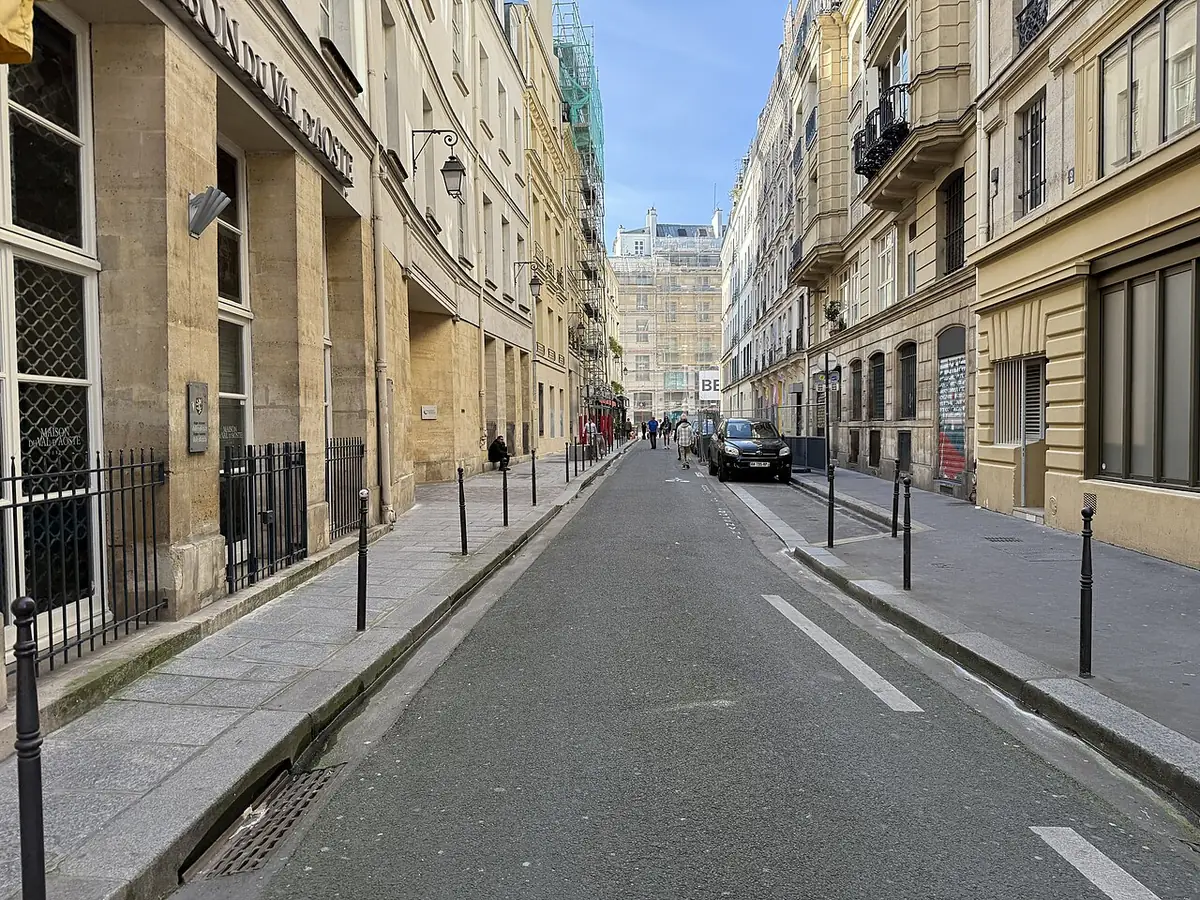
A quiet Haussmannian street in central Paris — Photo: Chabe01 · CC BY-SA 4.0 · Wikimedia Commons
Behind these valuations sits a legal and physical reality you absolutely have to examine.
The market for houses in the 15e arrondissement follows its own valuation rules, which often disconnect their prices from the averages quoted for ordinary apartments in the same area. Because they are absolutely scarce and carry no heavy co-ownership charges, these properties enjoy a strong premium among wealthy buyers. Prices vary considerably with the presence of private outdoor space, the structural condition of the building, and how quiet the street or the lane is. The tables below summarise the price ranges observed in the market, to help you calibrate your financing plan rather than trusting the illusions of general listings.
parisFor saleHouseestimate
Median price / m²€8,180Half the apartments sell below this
Median price€784kthe average is 14% higher — a few very large properties pull it up
Most common2 bedrooms57 % of listings
Average size91 m²
By number of bedrooms
Bedrooms
Share of market
Avg price
Price / m²
Avg size
2most common
57 %
€934k
€8,610
109 m²
3
29 %
€1.27m
€8,266
154 m²
4
14 %
€1.7m
€8,093best value / m²
210 m²
Each row is an average, compared against the area average of €8,610 / m². These are indicative estimates of a typical local market, not a measured sample of live listings. Check current listings before relying on them.
What you can actually own: the illusion of outright freehold against the Paris reality
These legal subtleties call for a rigorous method when the time comes to formalise your commitment.
Buying a house in Paris does not always guarantee complete legal independence, whatever the popular image suggests. Many so-called independent houses turn out to sit inside the perimeter of a larger building's co-ownership, sharing foundations, drainage networks or adjoining roofs. Others depend on a free syndicate association for the management of their private lane. Knowing precisely what you own and what you are responsible for avoids neighbour disputes and financial surprises when structural maintenance works come up for a vote.
The house inside a co-ownership
Many properties presented as detached houses in the 15e are in fact lots within a horizontal co-ownership. That means you own the walls and the exclusive use of a patch of land, but the external structure, the roof and the main pipework remain common parts governed by the building's managing agent (the syndic). You therefore have to put certain plans to alter the exterior to the owners' general meeting of the main building.
What it changesYou keep the constraints of a classic co-ownership (the rules, shared charges, meetings) while living with the isolation of an individual dwelling. Read the minutes of the last three owners' general meetings scrupulously before you commit.
Full freehold on a private lane or under an ASL
In the villas and passages in the south of the arrondissement, you buy complete freehold of the land and the building on it. Access to your property, however, runs along a private way owned collectively by all the residents, grouped into a free syndicate association (Association Syndicale Libre, or ASL). Maintenance of the cobbles, the outdoor lighting and the access gates is handled collectively, with compulsory annual contributions.
What it changesYou have total architectural freedom over your own building (subject to the rules of the Paris planning code), but you are bound by the financial decisions your neighbours take on maintaining the shared spaces.
The rule to understand before you put down a deposit on a Paris house
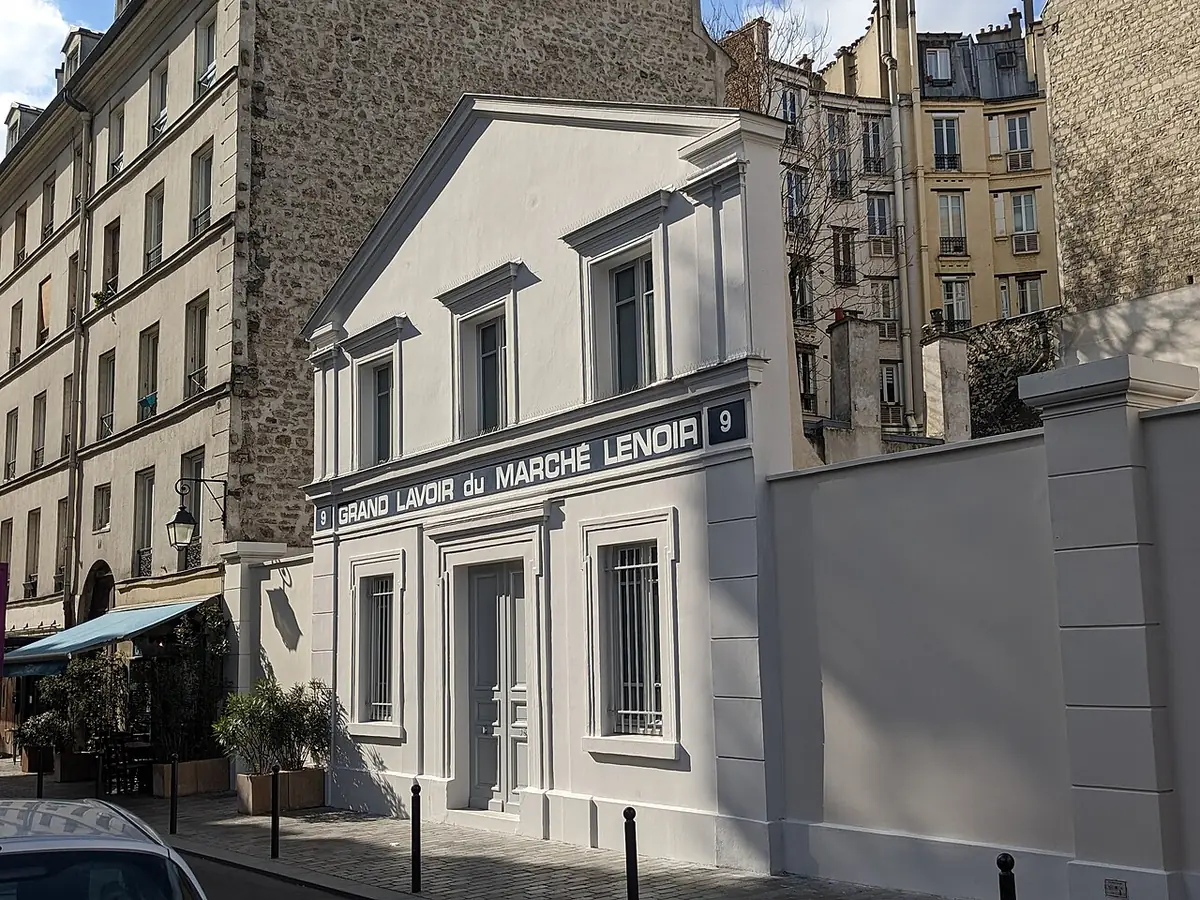
A repurposed neighborhood building near Marché Lenoir — Photo: Artvill · CC BY-SA 4.0 · Wikimedia Commons
To get through that complexity unscathed, every stage of the transaction has to be run methodically.
In older Paris stock, and especially for houses and former workshops, the most destructive mistake buyers make is to underestimate how technically and legally complicated energy and structural renovation will be. A characterful, unusual property often hides problems with thermal insulation, rising damp or non-compliant drainage that no amount of fresh paint will cure. The bioclimatic Paris planning code (PLU) imposes severe constraints on altering facades, cutting roof openings or installing heat pumps. Committing without having an independent professional validate the technical feasibility before the conditions precedent are lifted exposes you to a financial pit.
You spot a rare house in a courtyard in the 15e, and the immediate aesthetic rush wins out over technical analysis.
You sign a preliminary sale agreement (compromis de vente) at the asking price, trusting the look of the interior renovation the owner carried out.
You commission an architect or a design office to price up converting the loft space or adding a glazed roof section.
The professional discovers that the roof frame needs heavy structural work and that the Paris planning code forbids any change to the exterior appearance visible from the street.
The real cost of the works overshoots your initial budget by 40%, while the energy performance diagnostic (DPE) blocks any future letting without massive investment.
You end up trapped in an overpriced property whose compliance works exceed what you can afford, with no way back once the cooling-off period has passed.
How a house purchase in the 15e unfolds, step by step
Buying an unusual property in Paris mobilises an ecosystem of people you have to coordinate rigorously: notaires (the public officers who draw up and register the transfer), diagnostic surveyors who specialise in older buildings, architects and sometimes chartered surveyors where party walls are complicated. How smoothly the transaction runs depends on your ability to anticipate the technical checks from the very first viewings. From the first contact with the agent or the seller to the handover of keys at the notaire's office, the process generally spans three to four months. The table below sets out who does what at each key moment, so your investment is secured.
You and your adviserPreliminary analysis and checking the planning codeExamine the Paris planning code, ask the planning department at the Mairie du 15e about construction projects on the block, and audit the party-wall rules before you even draft an offer.
The seller and their agentHandover of the complete technical diagnostic fileInsist on the full set of mandatory diagnostics (asbestos, lead, termites, electricity, gas, DPE) plus the latest owners' general meeting minutes if the property depends on a co-ownership or an ASL.
The technical expert or architectAn in-depth structural audit during the cooling-off periodHave an independent professional inspect the foundations, the roof, the drainage and the absence of damp in the lower parts before the ten-day window closes.
The drafting notaireDrafting and signing the promise or the preliminary sale agreementThe notaire clears the urban pre-emption rights (notably the City of Paris's own) and secures the conditions precedent covering the mortgage offer and the technical audits.
Your bank or brokerFinal underwriting and issue of the mortgage offerSend over every priced works quotation so the bank folds the energy renovation budget into the overall financing plan for the project.
The notaire and the partiesSigning the deed and handing over the keysFinal meter readings, payment of the funds by escrow transfer, electronic or paper signature of the definitive deed, and formal entry into possession of your new house.
House or apartment in the 15e arrondissement: which way of living should you choose?
Once that fundamental choice between the vertical and the horizontal is settled, the unavoidable question of financing and real prices arrives.
Buying a house in the 15e arrondissement of Paris is a rare quest. This urban fabric, heavily densified through the nineteenth and twentieth centuries, yields only a handful of those horizontal sanctuaries with a private garden, like the discreet villas tucked around the Petite Ceinture or certain confidential dead-end lanes over towards Brassens. Choosing the house here means accepting an extreme structural scarcity that concentrates demand on a few properties at often elite prices, while giving yourself the independence of a roof with no neighbour above you and a direct relationship with Paris ground that transforms daily life.
The apartment, by contrast, is the functional obvious choice in this sector. Whether it is a well-kept Haussmann building along the great boulevards such as Grenelle, or a post-war co-ownership with excellent caretaking and spacious lifts over towards Front de Seine, the apartment offers incomparable liquidity and shared maintenance. It is the sensible solution for anyone who wants a base that works immediately, is secure, and is plugged into the whole transport network without carrying the full weight of the roof or of monumental facade restoration.
The balance between these two types therefore turns less on interior comfort than on your relationship with time and public space. The house demands acceptance of compromises on floor area or location, because the rare specimens available often sit back from the main shopping streets, requiring a longer daily walk to the metro. The apartment plunges you instantly into the busy rhythm of the neighbourhood, with bakeries on the corner, lively markets such as the one on rue de Dantzig, and a clear view over the zinc rooftops from the middle floors upward.
Choosing one or the other in the 15e also commits your financial and long-term flexibility. Houses here show almost no discount in a tight market and remarkable value retention, precisely because they are impervious to broad cyclical swings. Apartments, more sensitive to transaction volumes and to new energy standards for co-ownerships, call for a careful reading of the owners' general meeting minutes so you can anticipate building-wide insulation works and avoid nasty surprises on running charges.
In the end, your decision has to be rooted in your own vision of urban life in Paris. If you want a cocoon sheltered from the noise, able to host lunches outdoors without being overlooked while staying anchored in the largest residential arrondissement in the capital, hunting for the rare house will be a demanding but rewarding path. If you value efficiency, immediate proximity to parks such as Georges-Brassens or Andre-Citroen, and the simplicity of a well-run collective building, the apartment makes itself the ideal way into a settled Paris life.
What budget should you realistically plan for buying in the 15e?
With the budget on the table, it is time to understand what a typical week in this arrondissement actually looks like, so you can check it matches what you want from life.
Working out a budget in the 15e arrondissement is not just a matter of multiplying the price per square metre by the floor area you want. You have to factor in the marked disparity between micro-neighbourhoods, running from the quiet edges of Convention through to the more highly rated sectors of La Motte-Picquet and Sevres-Lecourbe. Notarial data and recent market trends trace out precise ranges that deserve to be analysed without financial wishful thinking, so your overall financing plan holds up.
Indicative price ranges by property type in the 15e arrondissement
Property type
Observed price range
Local market trend
Family apartment (3-4 rooms, 70-90 m2)
EUR 650,000 to EUR 950,000
Strong demand, discount for upper floors with no lift
Rare house / urban villa / loft
EUR 1,200,000 to EUR 2,500,000+
Extreme scarcity, confidential supply and firm prices
Average annual co-ownership charges
EUR 2,500 to EUR 5,500
Rising steadily as energy works are voted through
These amounts exclude the notaire's fees and transfer duties, plus loan guarantee costs, which traditionally come to 7% to 8% of the net price to the seller for older property.
How micro-location shifts the overall budget
Sector of the 15e arrondissement
Relative price level
Decisive value driver
Dupleix / La Motte-Picquet
High (+10% to +15% against the average)
Immediate proximity to the 7e, prestigious avenues and food shops
Convention / Vaugirard
Mid-range and stable
Lively neighbourhood life, covered market, excellent family amenities
Javel / Front de Seine
Uneven, tower by tower
Panoramic views over the Seine, large architectural complexes from the 1970s
Discounts show up mainly beyond the ring road, or on very busy streets without effective double glazing.
What does an ordinary Tuesday in the 15e actually look like?
A classic Haussmannian apartment building in Paris — Photo: Exilexi · CC BY 4.0 · Wikimedia Commons
But beyond that reassuring fluidity, each neighbourhood hides technical realities that ordinary viewings never mention.
Living in the 15e arrondissement of Paris means experiencing a singular balance between the efficiency of a major residential hub and the calm of its airy avenues. Far from the tourist frenzy of the city centre, daily life is built around a dense network of public services, generous green spaces and an authentic neighbourhood culture. Following the thread of an ordinary Tuesday is the best way to gauge how well this arrondissement really works for a household settling in.
08:15A local primary school in the Convention areaThe morning starts with dense but unhurried pedestrian traffic, as parents drop children at schools known for their rigorous teaching and modern facilities.
09:00Convention or Pasteur metro station (lines 8 and 12)The trip to the main Paris business districts runs on regular trains. Quick access to Gare Montparnasse and Gare Saint-Lazare also simplifies work travel to the outer suburbs or the regions.
12:30Rue du Commerce or around the Mairie du 15eLunch happens in an extremely rich retail environment, alternating between friendly neighbourhood tables, national chains and quiet breaks on the well-kept lawns of place Adolphe-Cherioux.
17:30Parc Georges-Brassens or Parc Andre-CitroenLate afternoon invites you outdoors. Children use the safe playgrounds while runners work the tree-lined paths to unwind after the working day.
19:15The Grenelle covered market or the shops on rue LecourbeLast-minute shopping happens without stress at loyal local traders, whose stalls have built this arrondissement's lasting reputation over decades.
21:00Your future living room in the 15eCalm settles over the residential streets. Effective double glazing gives you full sound insulation against the daytime bustle, so you can enjoy the quiet of a Paris night.
What hidden details do property listings forget to mention?
Knowing these technical subtleties is how you avoid the classic traps that some first-time buyers bitterly regret six months after signing.
Marketing photographs show off the flattering light of a freshly painted living room or the character of carefully restored period mouldings. Buying in the 15e arrondissement, though, means digging well beyond the immediate look to identify the structural and regulatory constraints particular to this territory. Here are the main things to watch for, the ones only a thorough technical file and careful observation on site will reveal before you sign.
The true state of the rising water and electrical risers
Many co-ownerships built in the 1960s or 1970s still run on ageing networks that have never been fully replaced. Voting those works through at a general meeting represents a substantial cost for every owner, and you have to build it into your acquisition budget or face unplanned calls for funds.
The strict planning rules on adding storeys to a roof
If you have your eye on a top floor with loft conversion potential, or a townhouse that could be extended, the Paris planning code (PLU) imposes drastic restrictions on height, on overlooking and on respect for architectural heritage. Permissions from the City and from the national heritage architects can turn an extension project into an administrative obstacle course.
The real noise level on busy through routes
Major arteries such as rue de Vaugirard or boulevard de Grenelle carry dense car and delivery traffic from Monday to Saturday. A quick midday viewing will not necessarily reflect the noise at peak hours or when the bin lorries pass at dawn, which makes a rigorous check of the sound insulation and the window joinery indispensable.
How bin stores and bulky waste are handled in a co-ownership
In the large residential complexes of the 15e, the cleanliness of the common parts and the handling of waste depend entirely on how involved the owners' council is and how conscientious the caretaker is. A badly kept or undersized bin area is the leading cause of friction between neighbours and can lastingly damage the perceived value of your property at resale.
The constraints tied to future transport lines and building sites
The arrondissement is regularly subject to works modernising underground networks, extending tram lines or redesigning public squares. Asking the arrondissement town hall about upcoming works on your immediate street will spare you major construction disturbance during your first years there.
Which misjudgements do people discover six months after moving in?
With those disappointments avoided, it is just as crucial to work out whether this arrondissement fundamentally suits you, or whether you are heading the wrong way.
Looked likeA charming ground floor with direct access onto a courtyard with trees
Turned outA north-facing aspect producing permanent gloom, and a constant lack of privacy facing the neighbours' windows.
Would have caught itViewing the property at several times of day to gauge the real sunlight, and checking the thickness of the glazing as well as how the other residents actually use the shared courtyard.
Looked likeAn apartment ideally placed a couple of minutes from the metro and the main boulevards
Turned outAn unbearable source of night-time noise in summer, made worse by the absence of air conditioning and the impossibility of sleeping with a window open.
Would have caught itInsisting on acoustic tests with the windows open and consulting the building's maintenance log to check whether discreet cooling systems can be installed.
Looked likeA co-ownership whose charges were presented as very low at signing
Turned outA managing agent (syndic) that had artificially frozen running costs, leading to an abrupt catch-up and an immediate vote on emergency facade restoration.
Would have caught itGoing carefully through the minutes of the last three owners' general meetings to identify deferred works and the true state of the ALUR-law works fund.
Looked likeA calm, family neighbourhood, perfect for raising young children
Turned outA sector badly short of public nursery places and of local cultural activities for teenagers, forcing long daily journeys.
Would have caught itAsking the Mairie du 15e directly about means-tested rates, the exact school catchment and the local club and association offering before you formalise your offer.
Looked likeA property needing only a quick coat of paint to be perfect
Turned outThe discovery of non-load-bearing partitions containing asbestos, and an electrical installation that had to be entirely redone to current standards.
Would have caught itBringing in a project manager or a qualified tradesperson to price each renovation item precisely before you put a firm offer to the seller.
Which buyer profile should treat a purchase in the 15e as a false good idea?
Now that the limits are clearly set out, the final decision is yours to make with your eyes open.
No Paris sector is a universal cure-all, and the 15e arrondissement is no exception. Its sheer size, its comfortable and family-minded social profile and its structured urban planning make it a demanding territory that can quickly frustrate anyone looking for a different kind of urban energy. Identifying clearly the profiles for whom this investment would be a poor fit avoids serious mistakes of direction, financial and personal alike.
The investor chasing high gross rental yields
→Going for small, cheap older units in this sector
Purchase prices per square metre are structurally high here, and rents capped by Paris legislation limit the net return, which makes yield-driven investments far more attractive in the outer suburbs or in other regional cities.
The lover of frantic nightlife and underground scenes
→Looking for a party base at the foot of the fashionable bars of the 15e
The arrondissement is residential, family-minded and quiet above all. The night-time offering is markedly more measured than in the 11e or the 18e, and co-ownerships here have extremely low tolerance for night-time noise.
The buyer allergic to co-ownership rules and meetings
→Buying a large apartment in a high-end building run by a rigid managing agent
Communal life in large Paris buildings means permanently negotiating collective rules, shared budgets and neighbourly trade-offs, which does not suit personalities attached to absolute architectural freedom.
The first-time buyer on an ultra-tight budget with no deposit
→Trying to buy a three-room family property with no financial room to manoeuvre
The slightest setback on co-ownership charges or a less favourable interest rate can wreck the budget of a household moving in without a safety cushion, in an arrondissement where the daily cost of living stays high.
So, are you ready to take the step and buy in the 15e?
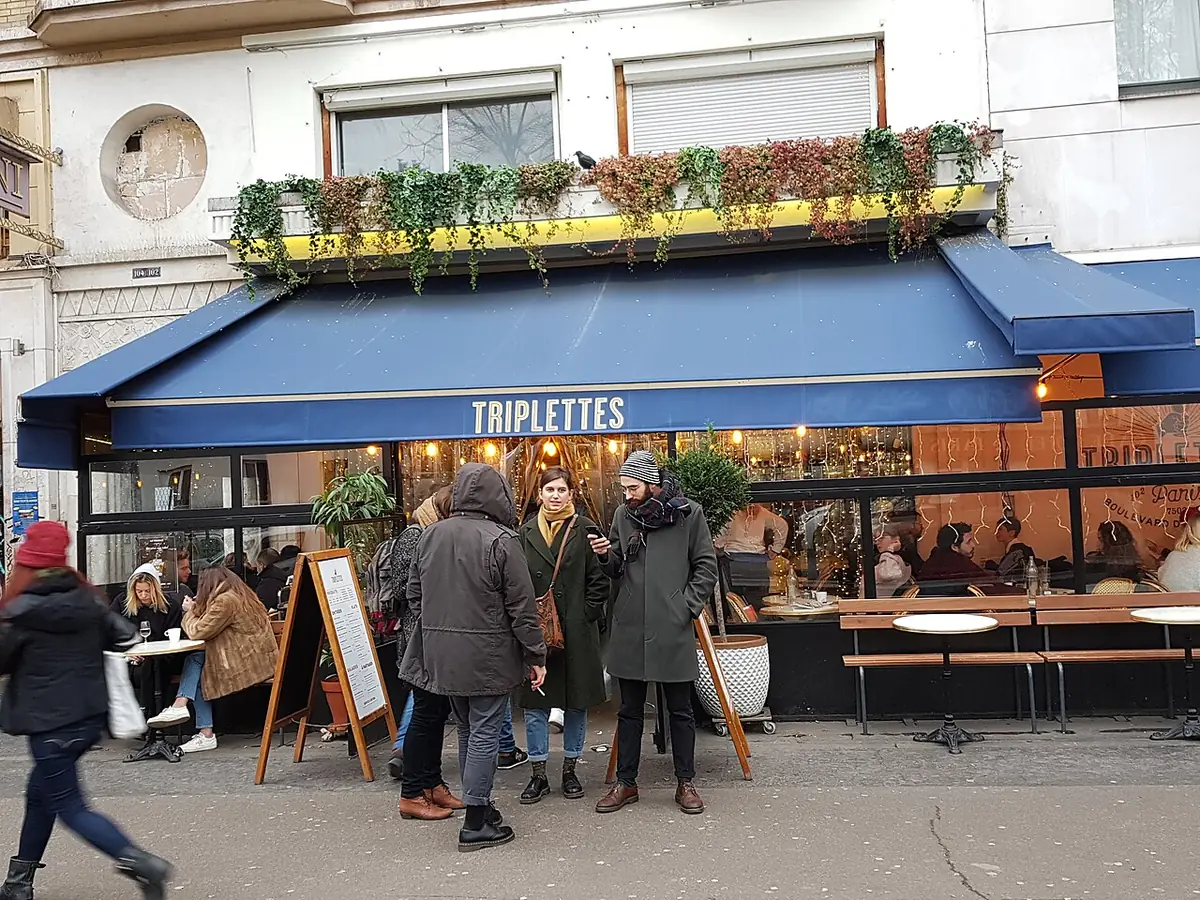
A brasserie terrace bringing life to the boulevard — Photo: Dhehz · CC BY-SA 4.0 · Wikimedia Commons
Buying a house or an apartment in the 15e arrondissement of Paris is not something you order up on impulse. It is a long-term commitment that requires reconciling what you can actually afford with the demands of an urban, calm and structured way of living. If you have measured how scarce detached houses are, accepted the constraints of a well-run co-ownership and factored in the real cost of daily life in this large Paris neighbourhood, you now have what you need to carry the project through without second thoughts.
The current market offers a rare chance to negotiate with sellers who have become more realistic, provided you turn up with watertight financing and a fine-grained knowledge of the micro-neighbourhoods you are targeting. Whether you settle near the Parc Georges-Brassens, enjoy the retail bustle of rue du Commerce or savour the calm of a residential dead-end lane, every euro invested here is anchored in the safest store of value there is, Paris stone.
Take the time to revisit the property you have picked at peak hours, talk to the building's caretaker, go through the owners' general meeting minutes with a critical eye, and price every renovation item with professionals. When all those boxes are ticked and fear gives way to practical certainty, that is the moment to formalise your offer and make this corner of the 15e your new home.
Related questions
What is the average price per square metre for an apartment in the 15e arrondissement?
Prices per square metre in the 15e arrondissement generally sit between EUR 8,500 and EUR 10,500 depending on the exact address, the overall condition of the property, whether there is a lift, and how the building performs on its energy rating.
Is it easy to find a house with a garden in the 15e?
Finding a house with a garden is an exceptional quest in the 15e arrondissement. Supply is extremely confidential, concentrated mainly in a handful of micro-neighbourhoods or private villas, which keeps prices at very high levels.
Which neighbourhoods are most sought after by family buyers?
The areas around rue du Commerce, rue de la Convention, La Motte-Picquet and the Mairie du 15e are particularly prized by families, because well-regarded schools, parks and food shops are all immediately to hand.
How are co-ownership charges calculated in the 15e?
Charges in a co-ownership depend on the floor area of the property, the shared equipment in the building such as the lift or central heating, and whether there is a resident caretaker. They are generally assessed in euros per year and per thousandth share of the co-ownership.
Which parks and green spaces are within reach in the arrondissement?
The 15e has two major green lungs, the Parc Georges-Brassens to the south and the Parc Andre-Citroen beside the Seine, offering playgrounds, botanical glasshouses and wide lawns that residents make heavy use of.
Is public transport good in the 15e?
The arrondissement is one of the best served in Paris thanks to metro lines 6, 8, 10 and 12, the T3a tram along the outer boulevards, and the immediate proximity of Gare Montparnasse for national rail connections.
What does the local planning code say about renovations?
The Paris planning code (PLU) imposes strict constraints on external thermal insulation, on altering facades visible from the street, on preserving heritage features, and on any roof extension or added storey.
Should you budget heavily for works in an older property?
In older Paris stock it is strongly advised to set aside an extra envelope for bringing the electrics up to code, for acoustic and thermal insulation, and for renovating kitchens and bathrooms that are often dated.
How do you find out about future planning projects in the neighbourhood?
The Mairie du 15e arrondissement makes public meetings, public-inquiry registers and local information bulletins available to residents, so you can follow urban development and roadworks projects as they happen.
Which mandatory diagnostics must the seller provide with the preliminary sale agreement?
The technical diagnostic file includes the energy performance diagnostic (DPE), the asbestos report, the lead exposure risk assessment, the risks and pollution statement, plus gas and electricity diagnostics if those installations are more than fifteen years old.