Settling in Glasgow or investing in property here calls for a close understanding of local specifics, of the neighbourhoods and of Scots law. This guide sets out the groundwork you need to go into a purchase clear-eyed, with no false promises and no vague approximations.
Get the app
What nobody tells you.
Real prices, hidden costs and the traps to check before you commit.
What you really get when you buy an apartment in Glasgow
Scroll
What you really get when you buy an apartment in Glasgow
Settling in Glasgow or investing in property here calls for a close understanding of local specifics, of the neighbourhoods and of Scots law. This guide sets out the groundwork you need to go into a purchase clear-eyed, with no false promises and no vague approximations.
Written by the ting.ad editorial team ·
Chalmers Gate, Glasgow in Street View: drag to look around.
Beyond these physical features, it is your everyday way of life that will decide whether the choice makes sense.
Buying a home in this Scottish city is not just a matter of floor area or of a location on a map. Between the heritage charm of red sandstone facades and the upkeep an older building demands, the local property market calls for a nuanced reading of real value. What you gain in architectural character and generous interior volumes is often paid for in closer attention to shared parts of the building and to thermal efficiency. Understanding that basic trade-off saves you disappointment from the very first viewings and helps you target the properties that will hold their appeal across the city in the long run.
The architectural character of older sandstone tenement buildingsvsStructural wear on roofs, shared stairwells and the stone itself
The ceiling heights and large windows win buyers over straight away. Yet the Scottish system of shared ownership, often self-managed by the residents, demands constant financial and personal involvement to keep these historic buildings in good order.
The central position of lively neighbourhoods and services right on the doorstepvsUrban density, persistent noise and the near-systematic absence of private parking
Living as close as possible to the cultural buzz and the transport routes simplifies daily life, but it rules out the comfort of a garage or a private garden. You have to weigh easy movement around the city against residential quiet further out.
Prices per square metre that have historically been more affordable than in other large British citiesvsEnergy retrofit costs that are often underestimated when the first offer goes in
The apparent moderation of purchase prices sometimes hides steep bills to bring a property up to standard. The local energy assessment reveals significant insulation needs that should be built into the overall budget from the outset, so the deal does not go off balance.
Strong rental demand carried by a steady student and working populationvsSharper competition for good properties and fast-moving purchase procedures
The fluidity of the rental market means high occupancy rates for well-advised investors. In return, the speed of transactions demands absolute responsiveness and impeccable financial preparation before you put in an offer.
Does this place really match your way of life and what you expect from it?
For anyone arriving from abroad, the move into Scottish property holds a few notable surprises.
Every housing path answers to precise constraints, and none of them is served by a one-size-fits-all solution. Whether it is a first purchase to put down roots in working life, a buy-to-let investment held for the long term, or a change of life from another region, the fit between your habits and the reality of the city decides whether the plan works. Different buyer profiles look for neither the same neighbourhoods nor the same kinds of property, and they weigh interior space against immediate surroundings in very different ways.
Young professional or first-time buyer
Your absolute priority is being close to public transport, local shops and places to meet people. You favour compact but functional apartments in lively areas where a car becomes unnecessary day to day. The activity around you more than makes up for the lack of private outdoor space, and you value the cultural life on your immediate doorstep.
Long-term property investor
You examine how steady rental demand is, and how close the property sits to universities and to the big hospital or technology employers. Your attention goes to the management of shared charges, the property's energy rating and its ability to attract careful tenants over the long term. Gross yield matters less to you than how liquid the market is and how well the capital invested is preserved.
Buyer making a life change, or a family
You are leaving a saturated big city to find more generous living areas here at a more reasonable cost per unit. You look closely at the quality of schools, at green parks within walking distance and at how safe residential neighbourhoods feel. The compromise usually comes down to accepting slightly longer journeys into the centre.
Retirement plan or second base
You want a home that is easy to maintain, on one level or served by a reliable lift, with direct access to health services and to laid-out walking routes. You steer clear of buildings whose shared management is overly complex or badly run, and you attach real importance to sound insulation and to quiet neighbours.
Living here when you come from abroad: what really changes day to day
A striking sandstone building with matching gothic-style gables in Glasgow — Photo: Michal Klajban · CC BY-SA 4.0 · Wikimedia Commons
Once these institutional bearings are in place, choosing the right area becomes the central question of your search.
The British property system, and the Scottish one in particular, follows legal and cultural rules that sit a long way from what buyers arriving from abroad are used to. Discovering these mechanisms in advance saves a good deal of misunderstanding when offers are drafted or when shared building matters come up. From the way prices are set through an official valuation to the legal structure of blocks of flats, the local framework imposes a particular administrative rigour that redefines the buyer's role.
From abroad
In many countries, the asking price is there to be negotiated down and often carries a margin the seller expects to give up.
Glasgow
Here, properties frequently show a guide price (Offers Over) or an official valuation (Home Report Valuation) that the market treats as the reference point.
Negotiation does not work the same way: bidding slightly above, or offering exactly the figure an independent surveyor has assessed, is often what it takes to win a contested property against other candidates.
From abroad
In many countries, a block of flats is run strictly by a professional managing agent who handles every decision and every repair.
Glasgow
Here, a great many older buildings run under a scheme of collective self-management between owners (Tenement Management Scheme).
You have to get involved directly in decisions about the roof or the facades, build a constructive dialogue with your neighbours and contribute your share without a heavy intermediary structure.
From abroad
In many countries, individual gas central heating or recent electric radiators are the urban norm.
Glasgow
Here, the layout of older homes takes in a variety of heating arrangements, sometimes combined with uneven levels of thermal insulation.
Reading the property's energy performance certificate closely becomes an absolute must if you are to judge your future energy bills and plan any improvement work.
From abroad
In many countries, a notary drafts the formal deed and secures every financial and mortgage aspect of the sale.
Glasgow
Here, it is specialist law firms (solicitors) that carry the transaction from end to end under a distinct body of property law (Scottish conveyancing).
The legal adviser's role is central from the very first offer, because every written commitment carries binding contractual force that cannot be undone without penalties.
Which neighbourhood to choose, given your pace of life and your priorities?
That geographical variety feeds straight through into the price ranges you see on the ground.
The urban geography of the Scottish city is built around areas with strong identities, running from the cultural buzz of student districts to the calm of more well-heeled residential boulevards. Each neighbourhood sets the rhythm of its residents' days, changing journey times, access to green space and the kind of property on offer. Knowing the specifics of these micro-markets stops you applying unsuitable criteria to a city of marked contrasts.
West End
A lively, studious atmosphere, set by independent cafes, green parks and Victorian architecture.
Suits
Lovers of cultural life, academics and professionals after a prestigious and energetic setting.
Trade-off
Prices per square metre among the highest in the city and strong competition for every property that comes up.
Merchant City
An urban, sophisticated spirit in the heart of the old trading quarter, mixing industrial lofts and galleries.
Suits
People who want to do everything on foot, enjoy the fashionable restaurants and live in a contemporary apartment.
Trade-off
Nightlife that can get noisy and a real shortage of green space right at the foot of the buildings.
Southside (Shawlands and around)
A sought-after balance between village feel, spacious parks and a fast-growing community scene.
Suits
Families and first-time buyers after an excellent space-to-price ratio and a close-knit local life.
Trade-off
Slightly longer journeys into the business district at peak times.
Finnieston
A fashionable, buzzing crossroads between the centre and the west, known for its lively food scene.
Suits
Young professionals who put social life and closeness to music venues at the top of their list.
Trade-off
A housing stock made up mostly of compact apartments and a very tight market.
What does an apartment in Glasgow really cost today?
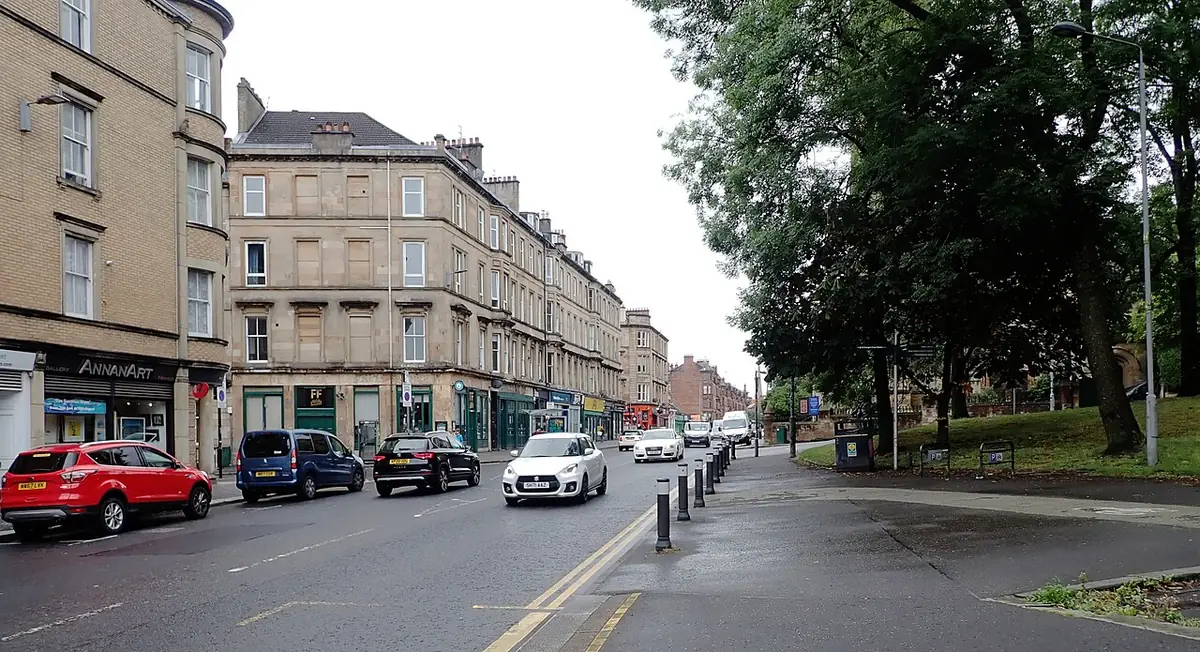
Streets like this, tenements over shops, are everyday Glasgow — Photo: habiloid · CC BY-SA 2.0 · Wikimedia Commons
Beyond the raw figures, the legal nature of the properties on offer deserves close examination.
Working out the budget your purchase needs rests on market data documented by official reports and recent transactions. Far from the speculative surges seen in other European capitals, Glasgow offers price ranges that vary sharply with the type of property, its general state of repair and the area you are targeting. Anticipating the additional costs, such as local taxes and legal fees, keeps your plan financially viable from start to finish.
glasgowFor saleApartmentestimate
Median price / m²£2,185Half the apartments sell below this
Median price£160kthe average is 14% higher — a few very large properties pull it up
Most common2 bedrooms45 % of listings
Average size70 m²
By number of bedrooms
Bedrooms
Share of market
Avg price
Price / m²
Avg size
1
25 %
£119k
£2,645 +15 %
45 m²
2most common
45 %
£152k
£2,346
65 m²
3
25 %
£195k
£2,162 −6 %
90 m²
4
5 %
£238k
£2,070best value / m²
115 m²
Each row is an average, compared against the area average of £2,300 / m². These are indicative estimates of a typical local market, not a measured sample of live listings. Check current listings before relying on them.
What you can actually own: outright ownership or long leases
That same legal rigour applies to the chronology of the transaction, which follows strict stages.
The security of your investment rests on the clarity of the title your solicitor hands over. In Scotland, the great majority of apartments are bought outright (heritable title), which makes things far simpler than the long-lease (leasehold) system prevailing in other parts of the United Kingdom. Even so, a few subtleties remain in the management of shared parts, and they are worth analysing before you sign the final commitment.
Outright ownership (heritable title)
You own your home along with an undivided share of the ground and of the structure of the building. No third-party owner turns up to claim a hidden ground rent or a fixed-term lease renewal, which secures your family's assets for the long term.
What it changesYou have full control over your property and complete freedom to sell it on or pass it down, subject to respecting the collective rules of the building.
The shared management framework (tenement regulations)
Even with outright ownership, Scots law sets a precise framework for managing shared parts and emergency repairs. The owners have to agree on structural works according to majority rules written into national legislation.
What it changesReading the Home Report properly tells you straight away what work has been done and what is planned in the building, removing nasty financial surprises after you move in.
The legal rule to understand before you part with a single penny
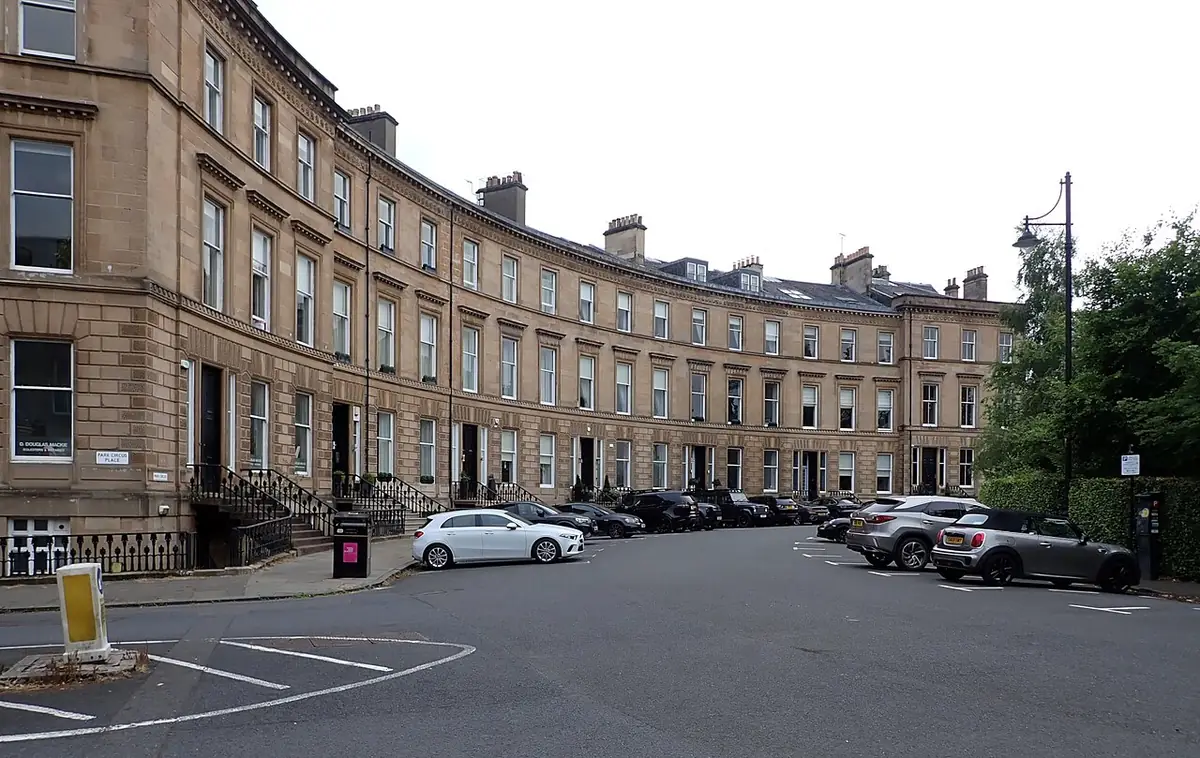
Terraces like this crescent are some of Glasgow's most sought-after streets — Photo: habiloid · CC BY-SA 2.0 · Wikimedia Commons
To orchestrate that sequence without a wrong note, it helps to picture the role of each party in the process.
Scottish property law stands out for a formal commitment mechanism that is highly protective but unforgiving of the careless. Unlike systems where suspensive conditions leave room for manoeuvre well after a preliminary sale agreement, the local procedure formalises the deal through an exchange of official letters between solicitors (concluding missives). Once that stage is passed, breaking the contract brings heavy and immediate financial penalties for whichever party walks away.
The first read of the Home Report supplied by the seller, to assess the technical condition of the property and its official valuation.
Your solicitor puts in a formal written offer (qualified offer) that sets the price and the legal conditions of the transaction.
The seller issues a letter of conditional acceptance (qualified acceptance) that adjusts certain minor details of the sale.
The solicitors on both sides negotiate the last technical points until they reach full agreement on every term of the contract.
The final exchange of letters (conclusion of missives) locks the sale down for good: the agreement becomes legally irrevocable for buyer and seller alike.
The date of entry (settlement day), when the funds are transferred and the keys handed to the new owner.
How a property transaction unfolds, step by step
Anticipating each milestone of your property plan lets you get through the search and the purchase calmly. From putting your initial financing file together to the keys being handed over by your solicitor, the timeline follows well-established professional standards that are worth respecting to the letter if you want to stay ahead of the competition on the most sought-after properties.
YouConfirming your borrowing capacityGet a solid mortgage agreement in principle from a broker or a lender before you even view your first apartment.
Your solicitorClose reading of the Home ReportWork through the survey, the energy certificate and the official valuation to spot any hidden works.
YouTargeted viewings and second visitsVisit the property at different times of day to judge the light, the noise level and the general feel of the neighbourhood.
Your solicitorRegistering formal interest (note of interest)Flag your interest quickly through your adviser so you are alerted if a rival offer comes in or a closing date is set.
The solicitorsConclusion of missives (binding contract)Settle all the contractual conditions so the purchase becomes legally firm and final before the funds move.
Your solicitorFinal settlement and registrationTransfer the funds on the day you move in (settlement day) and let your adviser register the title with the Scottish land register.
Go for an apartment in Glasgow or aim for a detached house further out?
Once that basic choice is settled, it is worth looking precisely at the budget reality of the plan.
The decision between buying an apartment in the heart of Glasgow and buying a house further out comes down largely to your relationship with time and your tolerance for maintenance costs. City apartments, whether they are homes in traditional red sandstone tenements or contemporary builds along the Clyde, concentrate working life within walking distance of everything you need. You get an immediate connection to transport and an energy bill that is often easier to control thanks to shared walls, but you have to accept the constraints of shared ownership and the collective management of common parts.
Moving out to the residential areas of the wider commuter belt or the neighbouring councils, by contrast, gives you access to more living space and, in most cases, a private garden. That option appeals particularly to households with children who need room, but it carries a logistical cost that is far from negligible. The daily journey into the business district gets longer, and looking after the exterior structure falls entirely on your shoulders, without the cushioning of a reserve fund shared between owners.
Financially, buying an apartment in Glasgow often means a more accessible entry point per square metre, although you should look very carefully at the annual shared charges, the well-known factoring fees. These cover upkeep of the roof, the stairwells and sometimes the green space around the building. In a detached house those costs do not show up as a flat monthly bill, but they appear as unforeseen capital spending the moment a roof has to be redone or a boiler starts showing its age.
In the end, everyday life dictates the final call. Living in an apartment in Glasgow means embracing the cultural buzz of neighbourhoods like Finnieston or the West End, where the cafes, the galleries and the parks are at the end of your street. Choosing the house means accepting a more settled rhythm, rooted in the quiet of a suburban street, at the price of leaning more heavily on the car for the smallest everyday errand. Your choice should therefore reflect your real priorities and not an idealised picture of the perfect home.
What overall budget do you need to live comfortably in an apartment in Glasgow?
To get a concrete sense of what living here means, let us follow a typical day in a resident's life.
Buying an apartment in Glasgow is not just the purchase price shown on the property portals. You have to take in all the local taxes, the transaction costs particular to the Scottish system and the everyday running charges if you are to judge how viable the plan is over the long term. The figures below pull together the unavoidable spending lines every buyer faces from their first year in the city.
Structure of the up-front and recurring costs for an apartment in Glasgow
Cost line
Estimated amount or range
Frequency and terms
Legal fees and registration tax (LBTT)
Varies with the purchase price
Payable in cash at settlement, when the transfer of title is completed
Shared building charges (factoring fees)
GBP 800 to GBP 1,800 a year
Payable quarterly or monthly depending on the property factor
Local property tax (Council Tax band)
GBP 1,200 to GBP 3,000 a year
Spread over ten monthly instalments to Glasgow City Council
Comprehensive home insurance
GBP 250 to GBP 600 a year
Annual premium indexed to the floor area and the rebuild value of the property
The amounts shown are based on the averages observed on the Glaswegian property market for a standard apartment.
Energy costs and forward maintenance spending
Type of cost
Average annual budget
Factors that move it
Heating and electricity
GBP 1,400 to GBP 2,400
The energy band on the EPC, insulation, and whether heating is communal or individual
Reserve fund for shared building works
GBP 500 to GBP 1,500
One-off calls for funds voted at owners' meetings for facade or roof work
Everyday interior maintenance
GBP 400 to GBP 900
Small plumbing and painting jobs and upkeep of white goods
These lines call for a disciplined monthly provision so that an urgent technical intervention does not squeeze your cash flow.
What does an ordinary Tuesday actually look like living in an apartment in Glasgow?
Detached villas like this show the grander end of Glasgow's housing stock — Photo: Michal Klajban · CC BY-SA 4.0 · Wikimedia Commons
Behind that apparent ease lie technical realities that property listings often leave out.
Living in an apartment in Glasgow means a daily rhythm shaped by how well urban transport works and how much life there is in the central neighbourhoods. This hour-by-hour run-through shows how easily you move around and how close the essential services are, whether you are getting to work or making the most of the city's public spaces.
07:45Apartment, DennistounWaking up in a bright home inside a renovated older building. The double glazing shuts out the noise of the street completely while still letting in the morning light.
08:30Duke Street railway stationA short walk to the local station for the direct train towards Glasgow Queen Street. The suburban network keeps remarkable time at peak hours.
09:00Business district, George SquareArriving at an office in the heart of the city. The multi-modal connections let you cross the city in under twenty minutes without the constraints of a car.
12:30Lunch break, Merchant CityA quick dip into the historic quarter for lunch in an independent cafe. The choice of places to eat close by is one of the great pleasures of dense urban living.
17:30Local supermarket, Argyle StreetLast-minute shopping on the way home. Local convenience stores and neighbourhood chains make daily supplies easy without having to stock up heavily.
18:30City park, Glasgow GreenUnwinding at the end of the day in one of the city's green lungs. Having natural spaces within walking distance of the residential areas noticeably improves quality of life.
19:30Home, an evening in the neighbourhoodBack to the quiet of the apartment. Not having outdoor space to look after leaves the free time you need to enjoy local cultural and community activities.
What do the survey reports really reveal about older apartments in Glasgow?
These points to watch shed direct light on the most common mistakes inexperienced buyers make.
The marketing photographs of a Glasgow apartment show off the varnished floorboards and the ceiling height, but they hide the structural issues that come with traditional Scottish building. To avoid financial disillusion at the moment you take possession, you have to examine the invisible elements that determine the long-term health of your investment.
The condition of the roof and the lead flashings
In older tenement buildings, keeping the roof watertight is a responsibility shared by all the owners. Past neglect turns into devastating water ingress in the top-floor flats, bringing considerable repair costs.
How the property factor is performing
A factor who is inactive or failing blocks the upkeep of the shared parts. When owners stop communicating, decisions on urgent works stall and the buildings slowly deteriorate.
The presence of rising damp and condensation
The oceanic climate of western Scotland tests porous stone walls hard. Without suitable ventilation and regular upkeep of the facades, chronic mould problems appear quickly inside the living rooms.
The age of the vertical drainage stacks
Original waste stacks and cast iron or lead pipework often need complete replacement. Renewing this shared infrastructure means heavy work that disrupts residents' lives for a long stretch.
Sound insulation between the intermediate floors
The traditional timber structures of Glaswegian buildings carry impact noise easily. Where interior renovations have skipped modern acoustic treatment, daily life can turn into a permanent source of noise nuisance.
Which misjudgements show up six months after buying in Glasgow?
These classic traps are a reminder that home ownership does not suit every kind of buyer.
Looked likeA charming older building with monthly shared charges advertised as very low.
Turned outA complete lack of cash reserves for major works, leading to a one-off call for funds of several thousand pounds to repair the facade.
Would have caught itInsisting on all the minutes of owners' meetings from the past three years to check the history of works voted through and works refused.
Looked likeA fast-improving neighbourhood with very appealing nightlife on the Saturday evening viewing.
Turned outUnbearable night-time noise during the week, generated by bars and restaurants right next door with poor soundproofing.
Would have caught itVisiting the property at different times, in particular on a weeknight and at the closing time of the venues around it.
Looked likeAn individual gas heating system, old but working when the property was inspected.
Turned outAn obsolete boiler with dismal efficiency, driving energy bills through the roof from the first cold spell of the Scottish winter.
Would have caught itCommissioning a thorough heating assessment and asking for the safety certificate along with the record of the compulsory annual services.
Looked likeAn on-street parking space that was easy to get to when the offer was accepted.
Turned outResidential parking completely saturated once evening comes, making the daily return home stressful and time-consuming.
Would have caught itTesting the parking conditions around the building yourself at the hour when residents get back from work.
Looked likeAn acceptable energy performance certificate, suggesting you could move in without major insulation work.
Turned outSignificant undetected thermal bridging around the large period windows, generating persistent condensation on the frames.
Would have caught itAppointing an independent expert to inspect the external joinery and confirm how well the openings really seal.
Who should definitely postpone or drop the idea of buying property in Glasgow?
At the end of this analysis, the moment of decision has arrived for your property plan.
Buying property in Glasgow is often presented as an unavoidable step, but for certain ways of life it is a strategic mistake. Looking at the situations where it does not fit helps avoid premature financial commitments that would weigh heavily on a buyer's personal stability.
The young professional in a phase of international job mobility
→Committing to buy a small apartment in central Glasgow.
Transfer taxes, transaction fees and the time it takes to resell in the Scottish market absorb any potential gain if the property is sold before a minimum period of five to seven years. Renting offers the flexibility this stage of a career demands.
The household that wants nothing to do with collective management
→Buying a flat in a large older building run by a remote professional factor.
Shared ownership demands constant compromise, votes on shared budgets and acceptance of decisions taken by majority. Anyone who refuses to talk to their neighbours or rejects collective maintenance obligations will quickly find themselves in breach.
The investor whose emergency savings are too thin
→Putting every last bit of cash into the deposit and buying a property needing renovation.
With no financial cushion, the buyer is exposed to the slightest technical surprise, whether that is a major boiler failure or a compulsory contribution to roof works voted through urgently by the other owners.
The worker after absolute silence and the countryside
→Moving into a dense city apartment to be close to the cultural scene.
The rhythm of an energetic city like Glasgow generates traffic noise, streams of pedestrians and constant activity that sit badly with a pressing need for calm and complete seclusion.
So, are you ready to take the step and buy property in Glasgow?
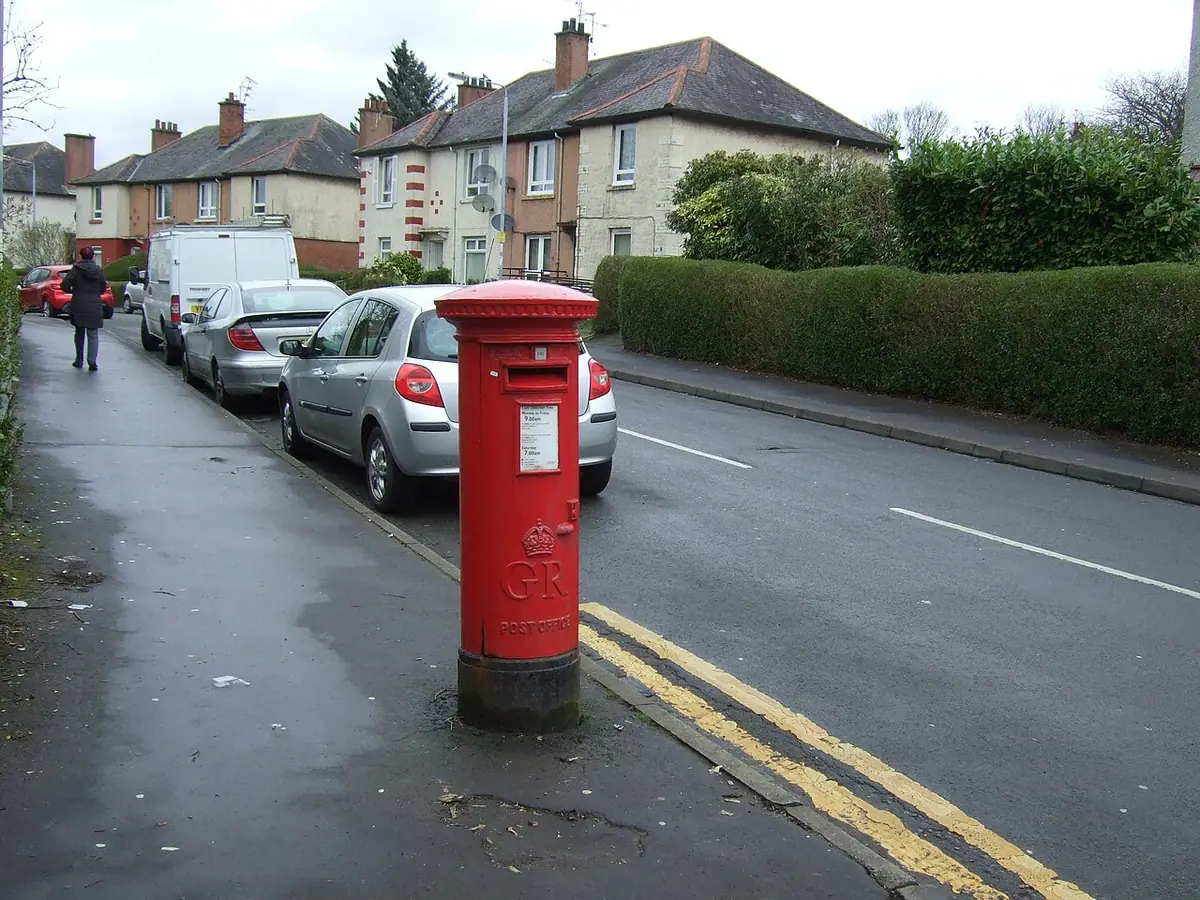
Quiet residential streets like this sit just off Glasgow's main roads — Photo: JThomas · CC BY-SA 2.0 · Wikimedia Commons
Deciding to buy an apartment in Glasgow is not an impulse but a carefully weighed calculation between what you want from life and the local economic reality. If you have measured the weight of the shared building charges, taken in the particularities of the Scottish market and accepted the constraints that come with city living, you now hold all the keys to move ahead calmly with your purchase.
The Glaswegian market rewards buyers who are patient, methodical and rigorous in their technical analysis of a property. By putting the quality of the location and the structural soundness of the building ahead of a simple aesthetic infatuation, you protect your assets against nasty surprises and lay solid foundations for putting down roots in the heart of the Scottish city.
Take the time to validate your financing plan with lenders familiar with the local legal specifics, and surround yourself with professionals you trust to audit every document before you sign any commitment at all. Your future home in Glasgow should be the product of a deep conviction, carried by a clear view of what you will need in the years ahead.
Related questions
What legal and registration costs apply when you buy an apartment in Glasgow?
In Scotland, a property transaction does not run through a traditional notary but through a solicitor. The registration tax, called Land and Buildings Transaction Tax (LBTT), varies with the price bands of the property bought and applies from the first pound sterling above the exemption threshold in force.
How does the Offers Over system work in Glasgow?
The Scottish market rests on a sealed-bid mechanism in which buyers submit an offer above the reference price set by the seller in the Home Report. The seller keeps the offer that looks strongest to them, combining the amount on the table with certainty of funding.
What is the Home Report and why is it compulsory?
The Home Report is a complete file required by Scots law before any property is put up for sale. It contains a market valuation by a chartered surveyor, a detailed survey flagging the building's defects, and an energy performance certificate.
What running costs should you budget for on top of the mortgage repayment?
Beyond your monthly payment to the bank, you need to budget for the local property tax (Council Tax), the building management charges (factoring fees), home insurance, and everyday electricity, gas and water use.
Can you buy an apartment in Glasgow as a non-resident?
Yes, international investors and non-residents can buy property in Scotland. That said, specific tax surcharges on transfer duty may apply if the property bought is not your single main residence.
Which Glasgow neighbourhoods offer the best balance between price and quality of life?
Areas such as Dennistoun, Shawlands or parts of Partick appeal through their cultural energy, the quality of their older building stock and their affordability compared with the ultra-central parts of the West End or Merchant City.
How do you check that a building's shared finances are healthy before buying?
It is essential to go through the minutes of the most recent owners' meetings, passed on through the Home Report. That is how you spot unpaid charges within the building and any major works that have been voted through but not yet paid for.
How long does it usually take between the offer being accepted and the keys being handed over?
The Scottish legal process, run by solicitors, generally takes between four and eight weeks from formal acceptance of the offer (conclusion of missives) to the date of entry on the property.
Do older tenement buildings need specific maintenance?
Absolutely. Red sandstone tenements demand constant attention to facades, rainwater drainage and slate roofs. Regular preventive maintenance avoids emergency work that is extremely expensive for all the owners together.
Is everyday life good in the central neighbourhoods of Glasgow?
Glasgow offers a way of life residents rate highly, thanks to its abundant urban parks, a dense cultural programme and a varied public transport offer that more than makes up for the ups and downs of a changeable oceanic climate.
Property review of ting
No ting properties in Glasgow yet
Be the first — share it on ting and it shows up right here.