Buying an apartment in Birmingham means getting to grips with a British market in the middle of real change, part urban momentum, part legal quirk. This decision guide sets out the actual prices, how leasehold works and which neighbourhoods suit which kind of plan.
Get the app
What nobody tells you.
Real prices, hidden costs and the traps to check before you commit.
What you are really buying with an apartment in Birmingham
Scroll
What you are really buying with an apartment in Birmingham
Buying an apartment in Birmingham means getting to grips with a British market in the middle of real change, part urban momentum, part legal quirk. This decision guide sets out the actual prices, how leasehold works and which neighbourhoods suit which kind of plan.
Written by the ting.ad editorial team ·
Avenue Road, Birmingham in Street View: drag to look around.
That tension between yield potential and the demands of management shows up immediately when you weigh the available stock against the way you actually live.
Investing in an apartment in Birmingham is not simply a matter of buying square metres in Britain's largest city after London. Behind the promise of a lively market and better affordability sits a mixed urban reality where the old sits alongside the new. Looking at yields and at real running costs is what tells you the exact value of a property in a city that keeps reinventing itself. Every part of the transaction has to be weighed if you want to avoid the disappointments that come with extra fees and with letting management. The true nature of Birmingham's housing stock reveals itself in how well blocks are maintained and in the prospects for regenerating former industrial districts. Understanding that basic mechanism stops you judging a property on floor area alone, or on how close it happens to be to a transport route.
A promise of high gross yields, driven by strong student demand and the energy of local employment hubs.vsA reality of service charges that can be heavy, covering the communal areas and the mandatory reserve funds.
First-time investors often forget that the net yield depends closely on these structural costs, which eat into rental profitability year after year. A careful reading of the block's accounts is therefore essential before signing any offer.
The appeal of Victorian architecture, full of character and generous proportions, in the established residential districts.vsThe need to plan for major energy retrofit works to meet the insulation and thermal performance standards now in force.
Older buildings need a substantial works budget to reach an energy rating the British market will accept. Leaving that out of your initial estimate almost always leads to overspending that is hard to claw back.
The certainty of a city centre on the rise, thanks to large transport projects and the redevelopment of industrial brownfield sites.vsThe risk of swings in value depending on how quickly the public infrastructure promised by the council is actually delivered.
Speculation around new transport lines can push some areas above their worth well before anything is finished. It is worth watching how local shops and services are really doing rather than trusting the council's planning documents alone.
The flexibility of an extremely fluid and varied rental market, suited to young professionals and families alike.vsSharper competition from high-end new-build schemes, which attract the tenants with the most comfortable budgets first.
With so much on offer, older unmodernised property struggles to let at full price without real work on what it provides. Location then becomes the first line of defence against long void periods.
Does this place really suit the way you live day to day?
Beyond your own profile, moving from one country's way of life to the way a British city is organised brings cultural and practical adjustments you cannot avoid.
Choosing to settle or to invest in Birmingham means testing your daily habits against the reality of getting around and of local services. The city offers radically different moods depending on whether you go for the cultural buzz of the centre or the relative quiet of the outer residential areas. Every kind of occupier needs to weigh travel time against the need for space in order to find the neighbourhood that will not become a frustration six months in. Public transport is dense, but it still calls for careful planning at peak times if you need to cross the conurbation. Let us look at how your particular situation matches the housing that is genuinely on offer in this British city.
The city core and the regenerated former industrial quarters.
You get immediate access to the technology and finance hubs without a long daily commute. Recent apartments and industrial lofts offer the modern comfort people look for, though this is where the price per square metre peaks. In return, you have to accept a lively night-time scene and, for the same budget, a generally more compact home. This suits anyone who puts cutting travel time at the very top of their priorities.
The streets close to the campuses and the major health centres.
You are betting on constant demand, which keeps turnover quick and limits voids between tenancies. Property in these areas benefits from excellent public transport and a very dense mix of shops and services. Competition between landlords is fierce, though, so the interior finish has to be faultless if you want to stand out. Managing the expectations of this active tenant group carefully becomes the keystone of your long-term returns.
The residential rings and the surrounding parks.
You get more generous floor areas and a setting that suits family life or quiet home working. Rail links and buses bring you into the heart of the city in under half an hour during office hours. The trade-off is giving up spur-of-the-moment nights out on foot and accepting a greater reliance on local amenities. It is the ideal compromise for anyone who values air quality and living space over being in the thick of things.
Living here when you are arriving from abroad: what actually changes
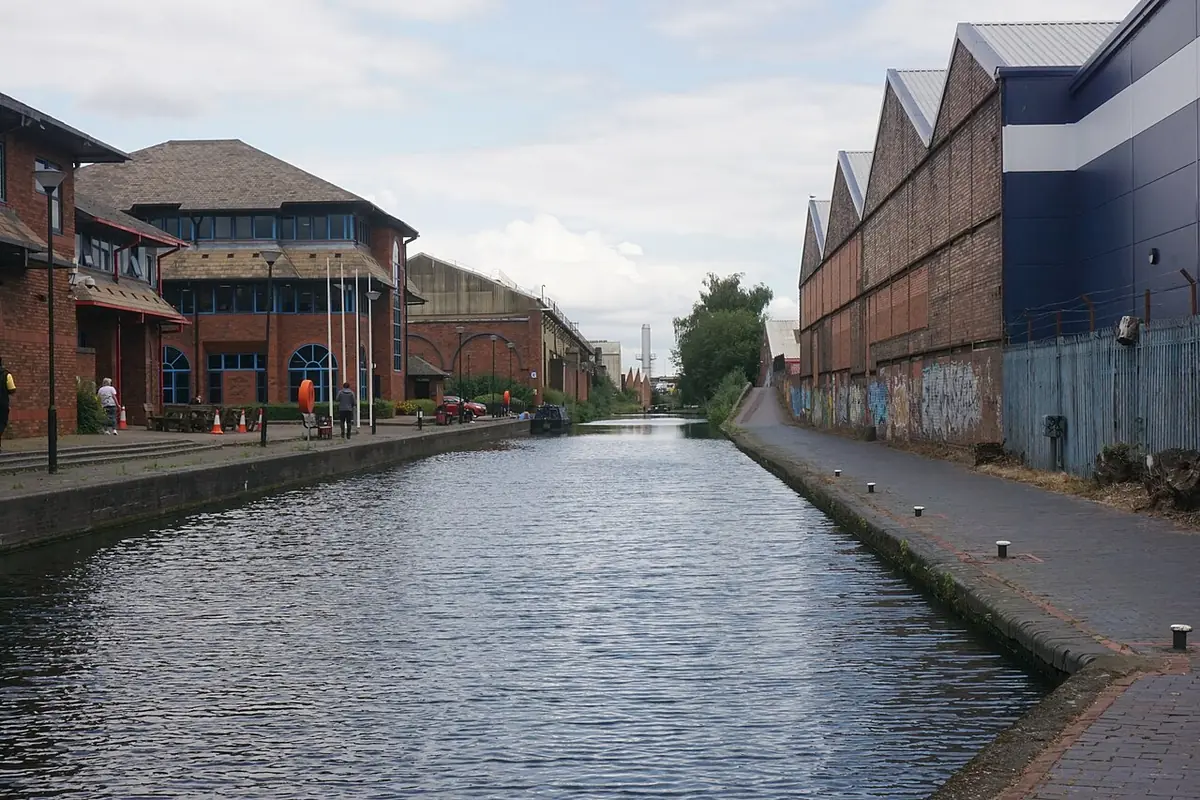
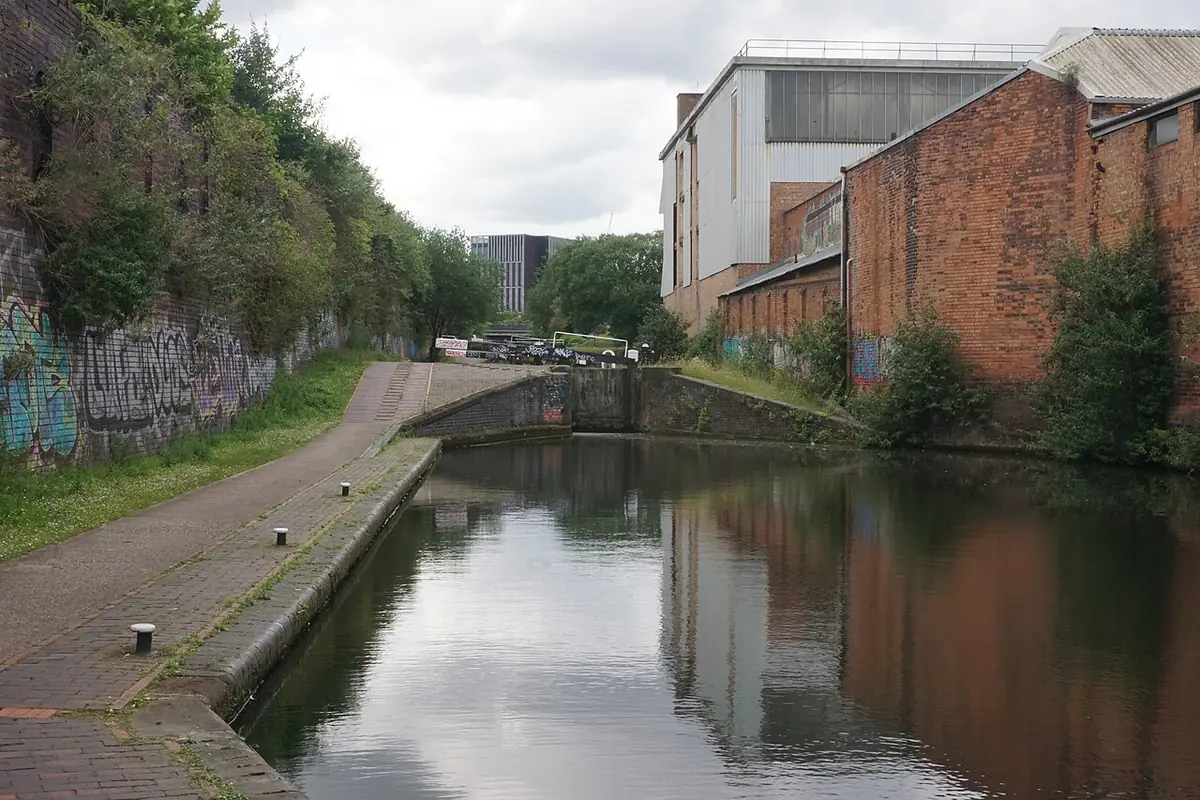
The canal towpath near Aston, part of daily life around the city's waterways — Photo: Bill Boaden · CC BY-SA 2.0 · Wikimedia Commons
Once those administrative particulars are clear, the choice of neighbourhood becomes the decision that shapes the rest of your project.
Moving abroad to buy, or investing across a border, is not just a currency conversion and a change of language. The British system of land tenure, the rules governing blocks of flats and even the way homes are designed differ deeply from what buyers arriving from elsewhere are used to. Understanding those cultural and administrative differences keeps you from missteps during the negotiation and at the point of signing. From how leases work to the structure of the charges, every administrative detail has its own logic, and it pays to pick it up quickly. Here are the main points of friction and adjustment between the way things work where you come from and the reality on the ground in Birmingham.
From abroad
In many countries, flats in a shared building are governed by a single national statute and run by professional managing agents whose fees are regulated.
Birmingham
In the United Kingdom, the system usually turns on the distinction between freehold and leasehold, with management companies holding wide-ranging powers.
You must check how many years are left on the lease and the annual ground rent and service charges, or you risk watching the value of the property melt away.
From abroad
Elsewhere, technical reports (energy performance, asbestos, lead) are commonly gathered into a single pack supplied by the seller before any offer is made.
Birmingham
In Birmingham, the doctrine of caveat emptor (let the buyer beware) applies, so you have to commission your own detailed surveys.
Your opening budget has to include the cost of independent surveys to pick up structural damp or a worn-out roof before you are finally committed.
From abroad
In many systems, signing the preliminary sale agreement binds both parties firmly, subject only to conditions such as obtaining a mortgage.
Birmingham
In the United Kingdom, the initial agreement (subject to contract) stays changeable and non-binding until exchange of contracts.
The risk of a last-minute higher bid, or of the seller pulling out, remains until the funds are legally secured by the conveyancers.
From abroad
In many countries, kitchens come fully fitted when you buy or rent an apartment.
Birmingham
In Birmingham, older apartments are frequently sold without a working fitted kitchen, leaving the whole installation to the buyer.
You have to budget for buying and fitting the units and the appliances within the overall funding plan for your purchase.
Which part of Birmingham should you target, and for what?
That variety of neighbourhoods translates into a very tiered price structure, which is worth reading methodically.
Birmingham's urban geography is built around districts with strong identities, from converted former wharf areas to leafy residential suburbs. Each one offers its own balance of accessibility, commercial life and the kind of property that comes to market. Picking the right area depends as much on your overall budget as on your investment horizon or your plans for your own life. A close look at the micro-markets stops you buying into a saturated pocket or, the other way round, somewhere cut off from where the growth is. Here are the main options open to you for getting your Birmingham move right.
Colmore Business District & Core
A busy business atmosphere by day, set by senior professionals, that quietens noticeably once the weekend comes.
Suits
Investors after strong rental liquidity, and professionals who want to live two minutes from the office.
Trade-off
Some of the highest prices per square metre in the city, and very little family-sized stock.
Brindleyplace & Canal Quarter
A modern, pedestrian setting along the canals, mixing lively terraces, cultural venues and contemporary blocks.
Suits
Those who want a smart, modern setting plugged straight into the city's leisure scene.
Trade-off
High service charges to maintain the landscaped areas and the elaborate communal parts.
Jewellery Quarter
A preserved historic village feel, marked by jewellers' workshops converted into lofts and by independent pubs.
Suits
Anyone drawn to industrial architectural character, art galleries and an authentic, creative neighbourhood life.
Trade-off
An uneven urban mix in places, and strict heritage restrictions that complicate any heavy refurbishment.
Edgbaston
A green, residential haven, known for its mature trees, its well-regarded schools and its sports clubs.
Suits
Families and buyers looking for good proportions, greenery and lasting quiet close to the centre.
Trade-off
A more exclusive market where smaller apartments rarely come up and are keenly contested.
What does an apartment in Birmingham really cost?
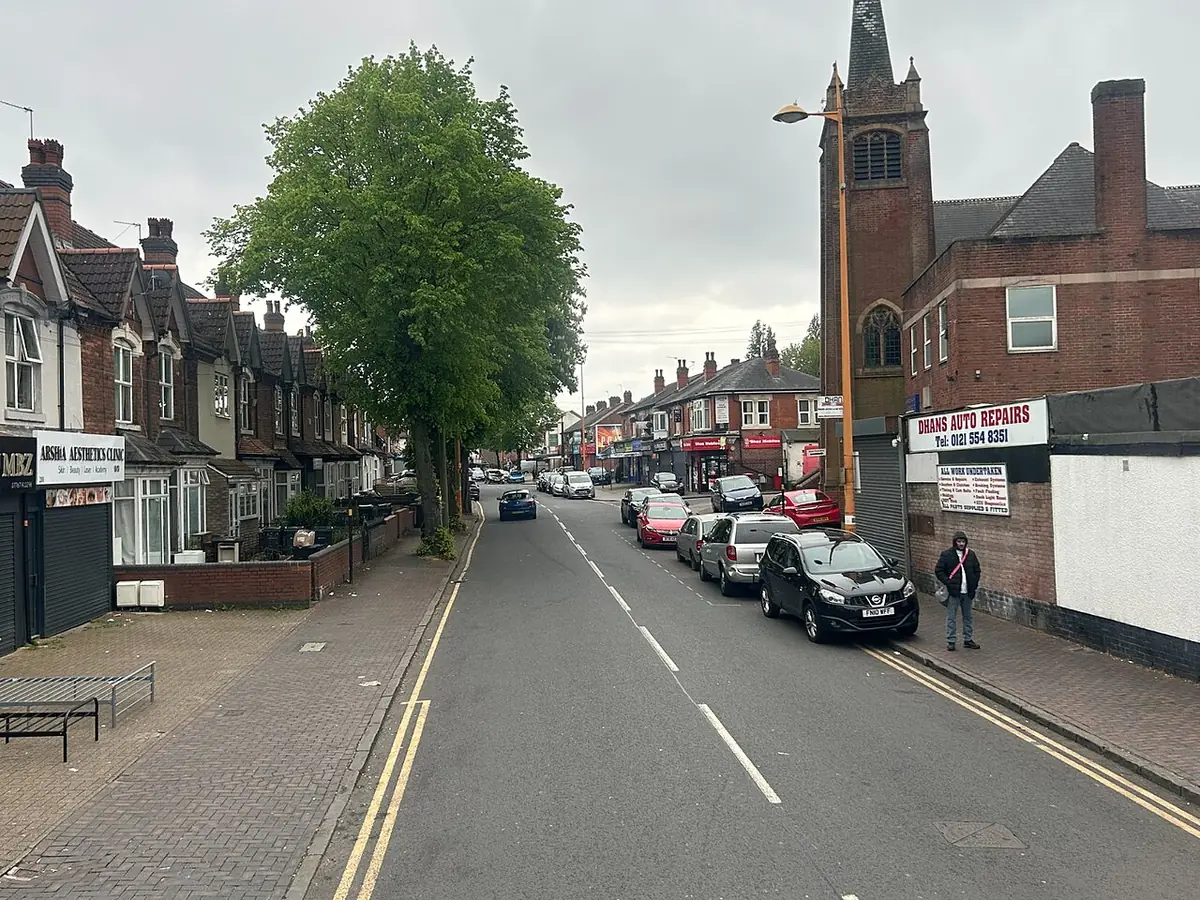
A typical Handsworth high street, shops below flats and houses nearby — Photo: Philip Halling · CC BY-SA 2.0 · Wikimedia Commons
Beyond the headline purchase price, the exact legal nature of what you own deserves your full attention.
Working out the budget for a purchase in Birmingham means going past the simple average price per square metre shown on the big listing portals. Prices vary considerably with the building's energy performance, the nature of the lease and the quality of the management. On top of that, extra costs such as Stamp Duty Land Tax and conveyancing fees have a real effect on the overall figure. Setting out realistic ranges lets you match your financial ambitions to the economic reality of the city. Here are the reference points you need to build a funding plan without nasty surprises.
birminghamFor saleApartmentestimate
Median price / m²£2,850Half the apartments sell below this
Median price£195kthe average is 14% higher — a few very large properties pull it up
Most common2 bedrooms48 % of listings
Average size65 m²
By number of bedrooms
Bedrooms
Share of market
Avg price
Price / m²
Avg size
1
30 %
£146k
£3,240 +8 %
45 m²
2most common
48 %
£195k
£3,000
65 m²
3
18 %
£248k
£2,820 −6 %
88 m²
4
4 %
£317k
£2,760best value / m²
115 m²
Each row is an average, compared against the area average of £3,000 / m². These are indicative estimates of a typical local market, not a measured sample of live listings. Check current listings before relying on them.
What you can actually own: the subtlety of leasehold
That legal rigour carries straight through into the chronology of the transaction, from the first agreement to the release of the funds.
One of the most disorienting features for a buyer arriving from abroad is the split between owning the building and owning the ground. In Birmingham the great majority of apartments are sold leasehold, which means you are buying the right to occupy the home for a fixed period. The owner of the land (the freeholder or landlord) collects an annual ground rent and delegates management to a third-party company. Ignoring the rules of this legal mechanism exposes a buyer to sharp falls in value over time. Let us look at both sides of this form of tenure so that your investment is secure for the long run.
Leasehold with a short unexpired term
A lease with fewer than 80 years left becomes extremely hard to sell on and to finance with an ordinary mortgage. British banks are very reluctant to commit money to property whose value falls faster as the end of the term approaches. The cost of a lease extension from the freeholder can then run to a considerable sum, often underestimated by buyers in a hurry.
What it changesYou should insist that your legal adviser audits the length of the lease in full before you make a firm offer, and build the potential cost of extending it into your financial plan.
Share of freehold, or collective management
Some blocks in Birmingham are set up so that the flat owners jointly hold a share in the company that owns the freehold. This structure gives markedly more freedom in management and removes the conflicts that come with unilateral ground rent increases imposed by an absent investor. It does, though, require neighbours to get along well enough to vote through works and handle maintenance emergencies without a professional manager.
What it changesYou gain control and remove the risk of unreasonable charges, provided you take an active part in the owners' meetings for the building.
The legal rule to understand before you part with a penny
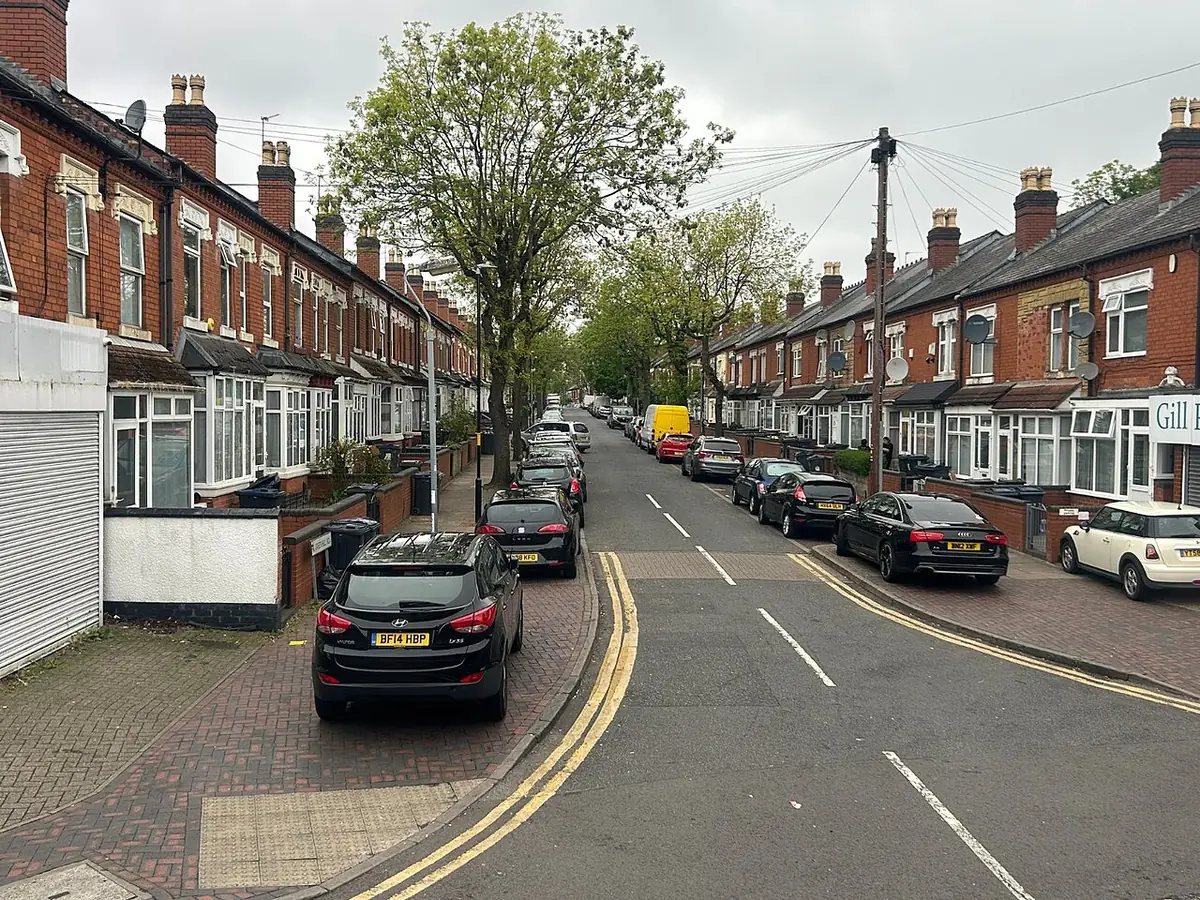
Terraced streets like this are the everyday housing stock across Birmingham — Photo: Philip Halling · CC BY-SA 2.0 · Wikimedia Commons
Once that legal mechanism is clear, it is worth following the operational course of a successful transaction step by step.
Buying property in the United Kingdom follows a very particular legal sequence, one that often surprises buyers used to a continental system. Making an offer and having it accepted (subject to contract) is in no way a firm, binding commitment. Either party can pull out at any moment, with no financial penalty, right up to the crucial stage of exchange of contracts. That unsettled period, sometimes a long one, calls for constant vigilance if you want to avoid a last-minute withdrawal. Here is the chain of steps that turns an intention to buy into actual ownership.
Putting your initial offer to the estate agent, formally made subject to contract.
The seller accepting the offer, which starts the legal searches carried out by your conveyancers.
Commissioning independent technical surveys (a building survey) to identify hidden defects or damp problems.
Final confirmation of your funding plan and receipt of a formal mortgage offer from the lender.
The key stage of exchange of contracts, the precise moment when the deposit (usually 10 %) is paid and the commitment becomes irrevocable.
Completion day, when the balance is paid and the keys to your new apartment are handed over.
How a property transaction unfolds, step by step
Getting a Birmingham purchase right means coordinating several professionals with strictly separate roles. Unlike systems where a single notary handles most of the process, the British market keeps the selling agent, the specialist lawyer and the technical surveyor firmly apart. Each one plays a precise part in making the transaction safe and confirming that the title is sound. Knowing how this is organised lets you steer your project efficiently and avoid costly delays. Here is the detailed order of the interventions that mark out your purchase.
The estate agentFinding property and the initial negotiationThey present what is available, arrange the viewings and collect the offers. They act for the seller and play no legal role in drafting the documents.
The mortgage brokerPutting the funding togetherThey review your financial position and negotiate with British or international lenders to obtain the credit terms best suited to your profile.
The conveyancer or solicitorLegal due diligence and checking the titleThey carry out all the land searches, confirm there are no hidden easements, review the lease and draft the contractual terms of the sale.
The chartered surveyorThe technical survey and the state of the buildingThey inspect the structure, assess the roof, look for signs of damp and put a precise figure on the urgent works to expect.
The conveyancerExchange of contracts and the depositThey orchestrate the formal exchange of signed contracts with the other side's lawyer and hold the deposit securely.
The conveyancer and the lenderCompletion day and the transfer of fundsThey send the balance of the purchase price to the seller, settle the tax due (SDLT) and register your title officially with the Land Registry.
Apartment or house in Birmingham: how do you choose for the way you live?
Choosing between an apartment in the heart of Birmingham and a house out on the edge decides most of what your daily life will feel like. The new-build schemes and industrial conversions of the city core, particularly around Brindleyplace and the Jewellery Quarter, appeal because you can walk straight to the big employment centres and the stations. That urban formula removes the worry of maintaining a roof or a garden, but it brings service charges that can be substantial and strict management of the communal parts. Residents there are after the ease of vertical living, where the whole city acts as an extension of the sitting room, with its cafes, its venues and its canal towpaths for getting around under your own steam.
Going instead for a detached or terraced house in residential districts such as Harborne, Moseley or Sutton Coldfield changes the spatial picture completely. You get private outdoor space, parking at the door and full freedom over extensions or insulation work, subject to local planning rules. That option does come with direct financial responsibility for any major structural work, and a longer daily journey into the business district. The trade-off therefore rests entirely on weighing centrality against the living space the same budget will buy.
Birmingham's property market has shown distinct patterns of value growth by property type over recent years. Recent apartments benefit from strong rental demand from young professionals and students at the large local universities, which makes them reasonably easy to sell on in the medium term. Their gross capital growth potential is nonetheless often lower than that of a house with its own land in a sought-after area, since plots become scarcer as the city densifies. Your final decision therefore has to take in your investment horizon and your tolerance for the constraints of shared ownership.
Finally, working out the hidden costs is the decisive step, and the one most often underestimated at a first viewing. In an apartment, communal services, lifts and security weigh on the monthly budget for as long as you own it, while in a house, thermal insulation and bringing the energy performance (EPC) up to standard call for a significant upfront investment. Looking honestly at how you travel, how much you dislike unplanned works and how much privacy you need will let you rule out the wrong option straight away and home in on the kind of property that matches your real financial position in Birmingham.
What overall budget should you allow to own comfortably in Birmingham?
Buying an apartment in Birmingham is not just the monthly mortgage payment. You have to build in all the local taxes, the service charges and the unavoidable energy costs if you want to avoid a budget shock. Current market figures make it possible to draw a realistic financial map of the everyday spending to expect from the day you move into the main city of the West Midlands.
Monthly and annual outgoings for a standard apartment in Birmingham
Item of spending
Estimated amount (range)
Frequency
What drives it
Council Tax (Band D)
GBP 150 to GBP 190
Monthly
Energy rating and the exact neighbourhood
Service charge
GBP 120 to GBP 250
Monthly
Whether there is a concierge, a lift, a gym
Home insurance (buildings and contents)
GBP 25 to GBP 50
Monthly
Value of the contents and the claims history
Energy bills (electricity and heating)
GBP 130 to GBP 220
Monthly
Energy performance (EPC rating) and floor area
These estimates assume a standard two-bedroom apartment and will vary with actual consumption as well as with the decisions taken by Birmingham City Council.
Upfront purchase costs and taxes
Type of cost
Basis of calculation
Typical amount observed
Whether it is compulsory
Stamp Duty Land Tax (SDLT)
Bands of the purchase price
Varies with the thresholds in force
Compulsory
Legal and conveyancing fees
Fixed fee or percentage
GBP 1,200 to GBP 2,500
Compulsory
Survey report (Home Survey)
Level of detail chosen
GBP 400 to GBP 900
Strongly recommended
Always keep a cash reserve separate from your deposit to cover all of these unavoidable administrative costs.
Health, schools, transport: what does an ordinary Tuesday look like for a resident?
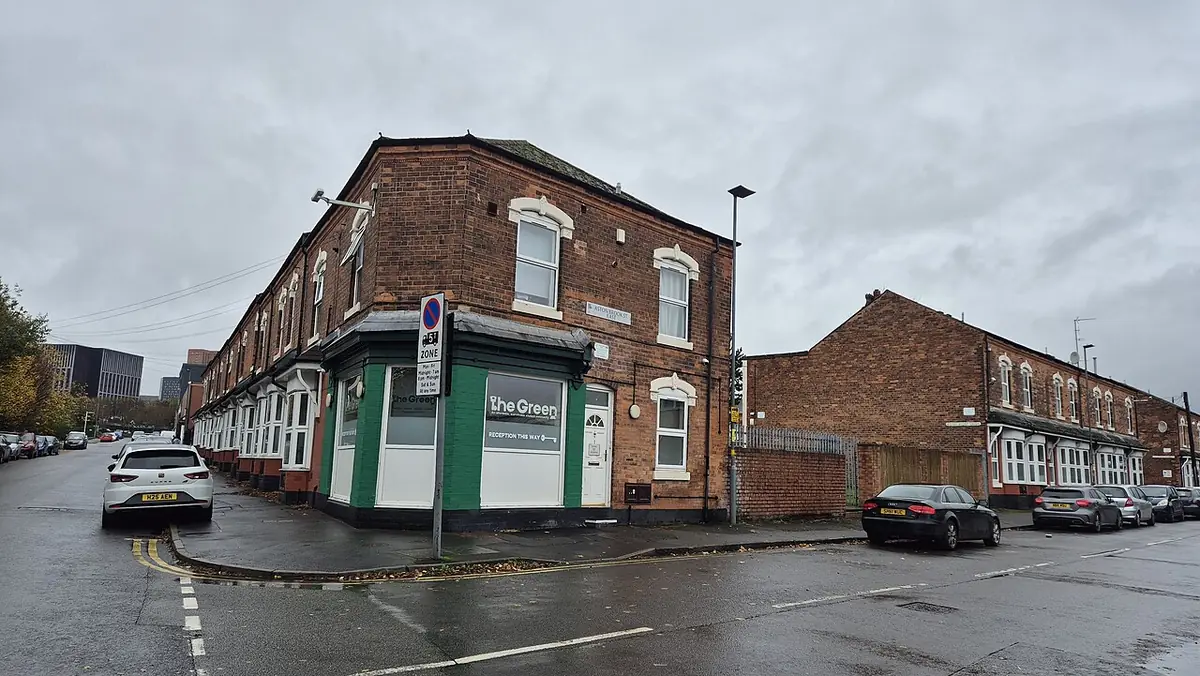
Corner pubs and terraced rows like this define Aston's streets — Photo: Paul Collins · CC BY-SA 2.0 · Wikimedia Commons
To judge whether a move makes sense, nothing beats walking through a typical weekday hour by hour. Between the morning trip to the business districts, the local services and the demands of health appointments, each neighbourhood offers its own logistical balance. This hour-by-hour account shows the practical reality of daily life in Birmingham, well away from the marketing promises of the sales brochures.
07:30Local station or tram stop (Midlands Metro)An early start to miss the worst of the car congestion on the main routes into the city centre.
08:30Arrival at the office (Colmore Row or Brindleyplace)A direct public transport link, or a walk, from the central residential schemes.
12:30Lunch break and local shopsPicking up essentials or a quick lunch in the covered markets and the pedestrian streets nearby.
17:30GP surgery or local pharmacyRoutine health appointments at practices registered with the local NHS.
19:00Home again, and the communal areasSecure parcel collection and time to unwind in the residential streets or the city parks.
What the listing will not tell you about your future building in Birmingham
Online listings always play up the light, the floor area and how close the transport is. Yet plenty of crucial structural and regulatory points never appear in that polished sales copy. Here are the checks you cannot skip before signing a binding offer in Birmingham.
The history of service charge increases
Charges that look flat over the last two years sometimes hide deferred structural works that will send future demands soaring. It is essential to ask for the minutes of the last three owners' meetings.
How good the sound insulation between floors really is
Many conversions of former industrial buildings have undeniable charm but fall down on original timber floors that do too little against impact and airborne noise.
Planning and construction proposals on the neighbouring plot
A vacant site or a car park next to your future home can quickly become a tall building site, permanently changing your daylight and your peace and quiet.
The strict rules on short-term letting
If you are thinking of letting occasionally on platforms such as Airbnb, the lease very often forbids it outright, with financial penalties for breaching it.
How far fibre has actually been rolled out in the building
Some older blocks, and certain pockets of Birmingham, still depend on ageing copper networks, which severely limits the internet speeds modern home working needs.
The buying mistakes you only discover six months into your new home
Looked likeAn exceptional financial opportunity, with a price per square metre advertised well below the local market average.
Turned outPunishing service charges and a reserve fund that was completely empty, forcing the new owners to vote through large one-off levies within months.
Would have caught itAlways asking for a detailed breakdown of the charges over the previous three financial years, along with the certified accounts, before you put in a firm offer.
Looked likeA quiet, peaceful neighbourhood on a viewing the agent had arranged for a Sunday morning.
Turned outA major traffic route or a night-time delivery bay right next door, making open windows unbearable in summer.
Would have caught itGoing back to the neighbourhood several times at telling hours, in particular the weekday morning and evening peaks, to judge the real noise level.
Looked likeAn apartment ready to move into, with no visible painting or decorating to do.
Turned outDamp problems hidden under a coat of fresh paint, and not enough natural ventilation in the bathrooms and the kitchen.
Would have caught itInstructing an independent expert to produce a full inspection report (a Level 2 or Level 3 Home Survey) focused on the walls and the joinery.
Looked likeExcellent connections into central Birmingham, with a station a few minutes' walk away.
Turned outA local rail line with very thin frequencies outside office hours and no service at all on a Sunday evening.
Would have caught itChecking the operators' actual timetables and travelling the route yourself at the times you genuinely expect to use it.
Poor fits: who really should not buy an apartment in Birmingham?
Buying in Birmingham is a decision with long consequences, and it does not suit every life path or every professional situation. A poor match between short-term plans and the inherent rigidity of ownership can turn an investment into a serious source of stress. Here are the profiles for whom renting, or postponing the purchase, is strongly advisable.
Professionals whose geographical mobility is very uncertain over the next two years
→Buying an apartment quickly, on the grounds of no longer throwing money away on rent
Legal fees, purchase taxes and resale commission absorb the whole of any potential gain if the property is sold before a minimum holding period of five to seven years.
People with no patience for rules and for collective decisions among neighbours
→A leasehold apartment, without checking how flexible the terms of the lease are
Shared management of the communal parts, the ban on altering certain external features and the duty to pay for works voted through at meetings breed chronic frustration.
Households with no emergency savings separate from their deposit
→Committing every penny of available cash to the purchase price and the legal fees
The slightest failure of major equipment (a boiler, the building's roof, water ingress) or a sudden change in interest rates immediately puts the household budget at risk.
So, are you ready to take the step and buy in Birmingham?
Canal walks like this are part of daily routines near Aston — Photo: Bill Boaden · CC BY-SA 2.0 · Wikimedia Commons
Deciding to buy an apartment in Birmingham means getting past the excitement of a viewing that went well and looking coolly at your finances and your own prospects. If you have checked that your overall budget holds together, local taxes and service charges included, and if your investment horizon reaches well beyond the short term, then the fundamentals of the local market give you a solid frame in which to go ahead.
Birmingham's momentum rests on its continuing urban transformation, the development of its transport infrastructure and its durable economic pull at the heart of the West Midlands. Every neighbourhood, though, has its own rules, its own legal subtleties and its own hidden traps, and no online listing will reveal them for you. The rigour you bring to your own investigation remains your best protection against financial disappointment once the deed is signed.
Take the time to visit the properties you have shortlisted at different times of day, insist on clear access to the block's accounts and surround yourself with independent professionals to audit the technical state of the building. A successful purchase is not measured by how quickly you sign, but by how calmly you live in your new home month after month, in step with what you want from life.
Related questions
Which neighbourhoods are most sought after for buying an apartment in Birmingham?
The most prized areas include the city core around Brindleyplace, the Jewellery Quarter for its historic character and its lofts, and well-regarded outer residential districts such as Harborne and Moseley for their green setting and their local shops.
What does the leasehold system mean for an apartment in Birmingham?
Leasehold means you are buying the right to occupy the property for a fixed period (a lease of 125 to 999 years), while the land itself belongs to the freeholder. You therefore have to pay an annual charge known as ground rent.
How much is Council Tax on average for an apartment in Birmingham?
Council Tax depends on the band assigned to your home, running from band A to band H. For a standard two-bedroom apartment, the monthly amounts generally sit between GBP 150 and GBP 190, payable over ten months of the year.
Can you let your apartment on Airbnb in Birmingham?
In the great majority of cases, the leases governing blocks of flats in Birmingham expressly forbid short-term letting, to protect the peace of permanent residents and limit wear on the communal parts.
What extra costs should you allow for when buying a property?
On top of the purchase price, you need to budget for conveyancing fees, the cost of a technical survey (Home Survey), compulsory home insurance and Stamp Duty Land Tax (SDLT) at the rates in force at the time of the transaction.
How long does a property transaction take on average in Birmingham?
The average time between an offer being accepted and completion is generally three to five months, because of the thorough legal checks carried out by each side's conveyancers.
How does the NHS work for newly arrived owners?
As soon as you have settled permanently in Birmingham and have proof of address, you should register with a GP practice in your neighbourhood in order to access health services covered by the NHS.
Can service charges go up unexpectedly?
Yes, service charges are reviewed every year to keep pace with rising maintenance costs, lift servicing contracts and the block's collective insurance premiums, which is why it matters to check the last three years of history.
What are the advantages of new-build schemes in Birmingham?
New-build schemes generally offer better energy performance (a high EPC rating), ten-year builder guarantees (a New Build Warranty) and no immediate renovation costs, although the price per square metre is often higher.
Is a technical survey (Home Survey) compulsory before buying?
Although the law does not formally require an independent technical survey, commissioning a Level 2 or Level 3 report is strongly recommended in order to spot hidden defects, damp problems or structural faults before you are committed.
Property review of ting
No ting properties in Birmingham Gb yet
Be the first — share it on ting and it shows up right here.