Putting a defensible figure on a house in Chicago takes more than a glance at what the neighbours are asking. Value here is set by the parcel as much as by the building, by the age and condition of a structure that has to survive Midwest winters, and by a property tax bill among the heaviest in the country. This guide sets out what actually drives an estimate in Chicago, what to gather before an appraisal, and how to sanity-check any number you are handed.
Get the app
What nobody tells you.
Real prices, hidden costs and the traps to check before you commit.
What a Chicago house valuation is really measuring
Scroll
What a Chicago house valuation is really measuring
Putting a defensible figure on a house in Chicago takes more than a glance at what the neighbours are asking. Value here is set by the parcel as much as by the building, by the age and condition of a structure that has to survive Midwest winters, and by a property tax bill among the heaviest in the country. This guide sets out what actually drives an estimate in Chicago, what to gather before an appraisal, and how to sanity-check any number you are handed.
Written by the ting.ad editorial team ·
South State Street, Chicago in Street View: drag to look around.
Once you can see what really moves the number, the next question is which kind of valuation you actually need.
Valuing a house in the Chicago metro is not arithmetic on habitable square metres. Between the quirks of older structures and the demands of Midwest winters, every apparent strength on a listing sheet hides a specific architectural and thermal reality that a buyer, an inspector or a lender will eventually price. You have to work out what the visible floor area conceals in terms of renovation work and energy upgrades. The real value of a property here depends as much on where it sits as on how its foundations hold up against extreme swings in climate.
The visible habitable floor areavsHow well the envelope is actually insulated
A spacious house without modern insulation runs up considerable heating bills through the winter months. The cost of bringing it up to standard usually swallows the discount that made the price look attractive, and an informed buyer will subtract it from your figure.
The charm of period woodworkvsWhether the electrical installation meets current code
Chicago's older housing stock has undeniable character but frequently needs the wiring redone from end to end. Current standards demand expensive upgrades, and an estimate that ignores that gap will not survive the inspection.
Being a short walk from a transit linevsExposure to noise and vibration
Living close to the urban rail lines makes daily journeys far easier, but it also exposes occupants to constant noise. Both effects are real and they pull the number in opposite directions, so weigh the convenience against the quiet rather than counting only the first.
A finished basement counted as living spacevsThe underlying risk of water getting in
Basements add significantly to usable area, yet they are vulnerable during heavy spring rain. Where the drainage is weak, that added area is worth far less than the same metres upstairs, and a serious valuation treats it that way.
Which kind of valuation do you actually need?
Whichever route you take, the instincts you arrived with may not travel well, so it helps to know which ones to set aside.
Not every number serves the same purpose, and commissioning the wrong one costs time and money. What you need depends on who will read the figure: a buyer, a lender, or the Cook County Assessor. Each of those audiences tests a valuation differently and accepts a different kind of evidence, so decide what the number is for before you pay anyone to produce it.
A market estimate from a local agent
An agent working the same streets produces a comparative view of value from recent sales, and it is the quickest route to a defensible asking price. Ask which comparables were used and why, because an analysis built on the wrong four sales is worth nothing at all. Treat the result as a position you can hold in negotiation rather than a guarantee, since the buyer's inspection can still move it.
A lender's appraisal
The lender orders its own appraisal, and that number, not yours, decides how much can be borrowed against the property. It follows a formal methodology and is far less forgiving of optimistic adjustments for finishes and fittings. If it lands below your figure, the gap has to be closed in cash or the price has to move, which is a problem worth anticipating rather than discovering at closing.
Assessed value, which is not market value
The Cook County Assessor sets an assessed value on a triennial cycle, and it drives your tax bill rather than your sale price. The two are related but they are not the same, and a reassessment can lift your annual cost sharply without any change in what a buyer would pay. If the assessed value looks out of line with comparable homes on your block, the evidence you would assemble for an appeal is largely the evidence you would use for a sale.
What changes when your instincts about value were formed somewhere else
The Chicago skyline rising beyond the lakefront Adler Planetarium — Photo: Sea Cow · CC BY-SA 4.0 · Wikimedia Commons
Once those reference points are reset, the question of which part of the city you are in comes sharply into focus.
The American market runs on legal and cultural conventions that sit a long way from the ones most owners arriving from abroad grew up with. From what land ownership means to who carries the burden of maintenance, the gap is real for anyone valuing property here for the first time. Absorbing those differences is what stops an estimate from quietly building in assumptions that do not apply in Illinois.
From abroad
Value anchored in dense city-centre apartment living
Chicago
Urban sprawl and the dominance of the detached single-family house
You have to reprice your relationship to space, to the car and to the distance from local shops, because all three feed directly into what a Chicago house is worth.
From abroad
Condominium ownership framed by a single strict national code
Chicago
Owners' associations and local subdivision rules that vary block by block
Neighbourhood rules and monthly dues can differ completely from one street to the next, so two otherwise identical houses can carry very different obligations and very different values.
From abroad
A regulated technical survey supplied by the seller
Chicago
An independent inspection commissioned and paid for by the buyer
The final price rests entirely on the quality and precision of the inspection report, which means the condition evidence behind your figure is something you have to produce rather than receive.
From abroad
A neutral public officer drafting the deed
Chicago
Title companies and specialist attorneys securing the transfer and the money
Legal oversight is split across several providers, so nobody hands you one consolidated view of the property and you have to assemble the file supporting your number yourself.
How the district shapes the number, and what evidence it gives you
These geographic distinctions translate into hard financial realities that have to be examined without flinching.
Chicago is made up of a great many neighbourhoods with sharply drawn cultural and economic identities. Where a property sits determines not only daily life but the durability of its value, and each area offers a different quantity and quality of comparable sales to work from. Every sector has its own trajectory and its own buyer profile, and both have to be read methodically before a figure means anything.
The north side (Lincoln Park, Lakeview)
A lively atmosphere driven by the immediate closeness of the parks and the Lake Michigan shoreline, with unusually strong public transport access.
Suits
Owners whose case rests on walkability, well-regarded schools and a very active urban setting, all of which buyers here pay for explicitly.
Trade-off
Prices per square metre reach the top of the city and detached houses are scarce, so comparable sales are thin and each one carries a great deal of weight in the estimate.
The west side (Logan Square, Wicker Park)
A creative, fashionable feel, marked by tree-lined streets, independent cafes and eclectic architecture.
Suits
Those whose value case rests on alternative cultural life, varied places to eat and a village-in-the-city atmosphere.
Trade-off
Pressure on the housing stock is strong and rapid gentrification keeps changing who lives on the street, so sales more than a few months old can already be stale as evidence.
Established residential areas (North Center, Edison Park)
Genuine quiet, streets where parking is easy and a strong sense of local community.
Suits
Families looking for large floor areas, private gardens and a suburban setting inside the city, which makes the lot itself a bigger part of the number here.
Trade-off
The relative distance from downtown means longer daily journeys for anyone working in the Loop, and that discount shows up plainly in the price.
Benchmarks and price ranges for a house in Chicago
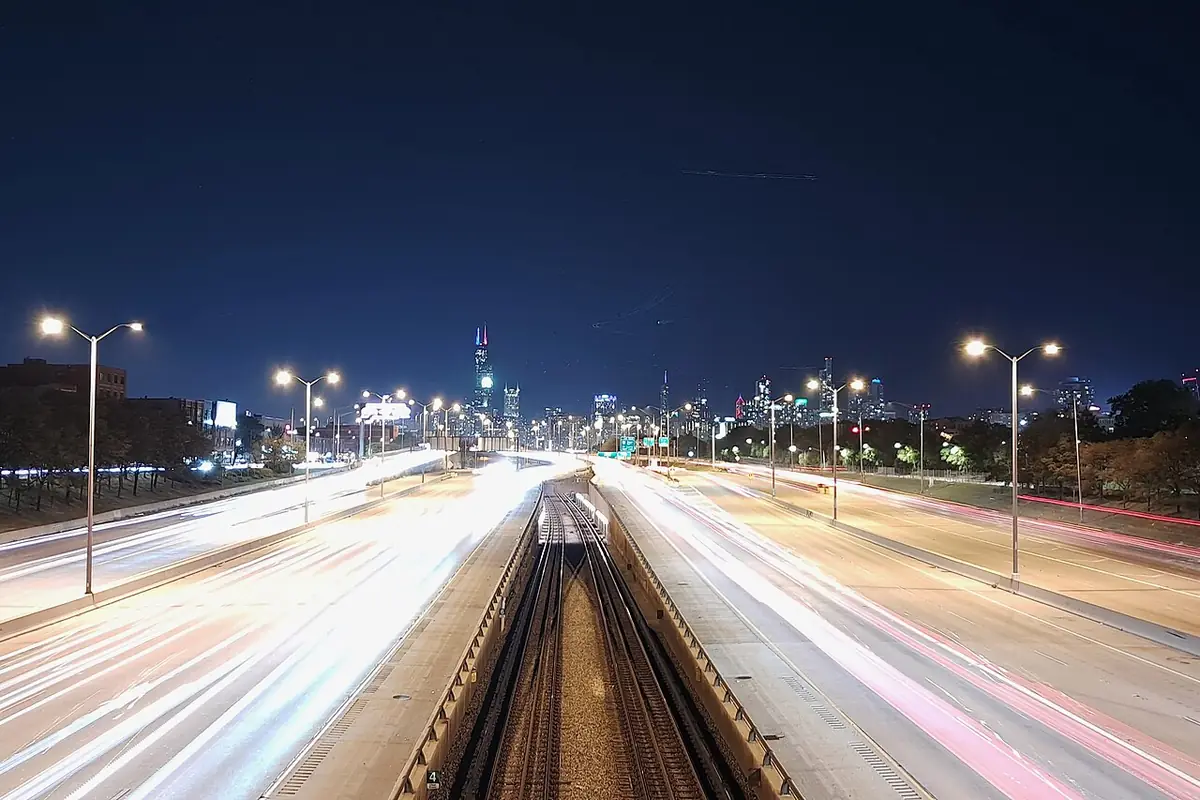
Chicago's expressways stay busy well into the night — Photo: AlphaBeta135 · CC BY 4.0 · Wikimedia Commons
Beyond the raw figures, the legal nature of what you own deserves particular attention.
The total cost of owning a house in Chicago goes well beyond the price shown on the listing portals, and any valuation has to hold that in view. Local property taxes, particularly heavy in Illinois, weigh on an owner's recurring budget and therefore on what a buyer can afford to offer. The benchmarks below are the starting point for a figure, not a substitute for comparable sales on your own block.
chicagoFor saleHouseestimate
Median price / m²US$2,804Half the apartments sell below this
Median priceUS$460kthe average is 14% higher — a few very large properties pull it up
Most common2 bedrooms61 % of listings
Average size156 m²
By number of bedrooms
Bedrooms
Share of market
Avg price
Price / m²
Avg size
2most common
61 %
US$465k
US$2,952
158 m²
3
32 %
US$613k
US$2,804best value / m²
219 m²
4
8 %
US$878k
US$2,952
298 m²
Each row is an average, compared against the area average of US$2,952 / m². These are indicative estimates of a typical local market, not a measured sample of live listings. Check current listings before relying on them.
What you actually own: the ownership form sitting behind the figure
Knowing exactly what is being valued, the next thing to understand is how a figure gets tested step by step.
Property ownership in the United States carries legal subtleties that catch out anyone valuing a house here for the first time. When you price a house you have to look closely at easements, party-wall rights and local zoning restrictions. Those elements define precisely how freely the property can be altered, and therefore what a buyer can do with it and what they will pay for the chance.
Fee simple ownership of the land
You own both the structure and the parcel it stands on, which gives you complete freedom of decision over external work. No condominium meeting has to approve your choices on the facade, subject only to the City of Chicago building and zoning codes.
What it changesThe value includes the land itself, which is the part that tends to hold up over time, but you alone carry the whole financial responsibility for structural damage, and a valuation will price the condition of the envelope accordingly.
Restrictions imposed by neighbourhood associations
Some residential sectors and newer subdivisions are governed by strict internal rules set by owners' associations. These bodies impose precise requirements on exterior paint colours, landscaping and where vehicles may be parked.
What it changesRead those rules before you settle on any figure: restrictions that rule out an obvious extension or conversion cap what the property can ever become, and informed buyers price that ceiling in.
The sequence that turns an accepted price into a figure that holds
A landmark corner in Chicago's Ukrainian Village neighbourhood — Photo: w_lemay · CC BY-SA 2.0 · Wikimedia Commons
For that sequence to run cleanly, it helps to know who produces which part of the number.
Committing funds to a Chicago transaction without measuring the reach of the contingency clauses exposes a buyer to straight financial loss, and it exposes a seller to a figure that collapses late. The American system formalises the commitment very early through an escrowed deposit, and the window that follows is precisely where an estimate is confirmed or corrected. Treat that window as the audit of your number rather than a formality, because it is the last point at which the figure can move without cost.
The signed offer, which formalises the price both sides are willing to put to the test.
An earnest money deposit placed into escrow, often within 48 to 72 hours of the offer being accepted.
The building inspection period, carried out by an independent certified professional you appoint yourself.
Any renegotiation of price or repairs, based on the major defects the inspection report brings to light.
Formal removal of the inspection contingency, which locks the figure and your commitment to it.
The closing, where the number becomes a recorded fact, legal title passes and the escrowed funds are released.
Who produces which number in a Chicago valuation
Establishing what a house is worth in Chicago means drawing on several specialists whose roles are tightly framed by Illinois practice. Each produces a different part of the answer, from proof that money can be borrowed at all through to a close technical reading of the structure, and no single one of them owns the whole figure.
The buyerMortgage pre-approvalThis financial confirmation sets the ceiling on what can realistically be paid, and it is worth having before any viewing. A seller weighing two offers will discount the one that no lender has tested.
The real estate agentComparable sales and targeted viewingsYour representative on the ground selects the houses that match your criteria and organises viewings across neighbourhoods. The same groundwork produces the comparables, so ask which sales the figure rests on and how close they really are.
The real estate attorneyContract and title reviewIn Illinois the attorney plays a central role in reviewing and amending the clauses of the preliminary contract. They also confirm what is genuinely included in the sale, which is what defines the asset being valued in the first place.
The home inspectorThe condition evidenceThey examine the roof, the foundations, the plumbing and the electrics to identify hidden defects and put a cost on the work. That written figure is what justifies moving a price up or down.
The title companyVerifying the title is clear to transferIt confirms the property is free of any mortgage or undisclosed debt before validating the legal transfer. An encumbrance found late does not merely delay a sale, it changes what the property is worth.
All parties togetherFinal signature and closingThe last funds move, the official documents are signed and the keys are handed over. The recorded price then becomes a comparable for everyone else on the street.
House or condominium in Chicago: two assets valued on entirely different evidence
Once the type of asset is settled, the central question becomes the full running cost that any figure has to absorb.
Valuing a detached house and valuing a condominium unit in Chicago are two different exercises, and treating them as one is the most common way an estimate goes wrong. The ownership structure imposes radically different financial responsibilities and maintenance obligations depending on whether you are looking at a period cottage on the north side or a unit in a tower along Lake Michigan. Owners regularly underestimate what severe winters do to an independent structure, where every centimetre of roof and every foundation wall is a cost falling on one household alone. A condominium spreads those heavy costs across an association, but it exposes the value of the unit to collective decisions that can turn contentious, and to monthly dues that keep climbing as ageing urban infrastructure catches up with the building.
For a detached house, the value rests largely on the independence of the parcel and on the strength of the surrounding school catchment, whether that is Lincoln Park, Lakeview or a changing area such as Logan Square. Scarce land in those tight markets generally supports solid appreciation over time, even if a higher entry price makes the property slower to sell when you need to. The single-family market also reacts sharply to changes in local property taxes: Illinois carries one of the heaviest effective rates in the country, which weighs on the annual cost of ownership and quietly shifts the arithmetic against a comparable condominium.
Condominium units, by contrast, offer a lower entry point into sought-after districts such as the Loop, River North or the Gold Coast, where owning land outright is beyond most households. But the financial management of the building becomes a decisive factor in the value of any individual unit. A poorly run or underfunded association facing major facade or roof work will levy special assessments, and a buyer who reads the accounts will subtract that expected cost from your asking price in full. Analysing the reserves in depth before naming a figure is not optional, because the visible comfort of a staffed lobby sometimes sits on top of serious structural weakness.
In practice the two asset types answer to different evidence. A house is valued on its land, its condition and the tax burden attached to it, so the file you assemble is a survey of the structure and the parcel. A unit is valued on the health of the association as much as on its own four walls, so the file is a set of accounts, minutes and reserve studies. Deciding which body of evidence applies to you is the first step towards a figure that will hold up when somebody else tests it.
The carrying costs any Chicago valuation has to account for
These financial burdens sit inside a daily routine shaped by the logistics and the climate of the city.
A Chicago housing budget is not just the monthly mortgage payment, and neither is a Chicago valuation. Between some of the heaviest property taxes in the United States, insurance premiums driven up by the harshness of the climate and any condominium dues, the real total demands careful modelling. The tables below set out the unavoidable cost lines and the ranges observed in the city's residential market, because every one of them is money a buyer deducts from what they are prepared to offer.
Monthly and annual cost lines for an owner in Chicago
Cost line
Estimated range
Frequency
What moves it
Property taxes
1.8% to 2.5% of assessed value
Annual
Varies sharply by township and with Cook County reassessments.
Homeowner insurance
$1,500 to $3,200
Annual
Sensitive to winter storm and snow risk and to water damage.
Condominium dues (HOA fees)
$300 to $1,200
Monthly
Depends on the size and age of the building and the amenities on offer.
Preventive maintenance and repairs
1% to 2% of the value of the property
Annual
Crucial to offset the accelerated wear caused by freeze and thaw cycles.
The amounts shown are indicative and vary with the exact location and the floor area of the property.
Estimated one-off costs at the point of purchase
Type of cost
Indicative percentage or amount
What triggers it
Transfer taxes
About 1.05% to 1.5% of the sale price
Shared or negotiated between buyer and seller according to local custom.
Closing costs
2% to 4% of the loan amount
Includes the attorney's fees, title insurance and the appraisal.
Full building inspection
$400 to $800
Essential for identifying hidden defects and the condition of the roof.
Using an attorney who specialises in real estate law is the standard and expected practice in Illinois for any transaction.
An ordinary Tuesday in Chicago, read the way a valuer reads it
Navy Pier, a lakefront gathering spot minutes from downtown — Photo: Moses8910 · CC BY-SA 4.0 · Wikimedia Commons
Beyond that visible routine, the Chicago market holds subtleties that sales material leaves out as a matter of course.
Reading the value of a Chicago address means measuring what the urban geography and the transport network do to an ordinary day. From the morning trip on the CTA (Chicago Transit Authority) to the snow clearing constraints of winter, each hour in the city follows an established rhythm, and each one leaves a mark on what a buyer will pay to live at that particular address.
07:30The CTA station (L train) or the bus stopThe morning departure tests the efficiency of the elevated rail network. Immediate proximity to a station is one of the clearest single drivers of value in the city, and it is worth measuring in walking minutes rather than in blocks.
08:45Arrival at the office in the Loop or River NorthThe economic core of the city concentrates office employment. Pedestrian and rail flows peak here, and the journey time from your address to this point works as a price signal in its own right.
12:30Lunch and local errands in the neighbourhoodNeighbourhood life is organised around independent retail and local supermarkets, reachable on foot across the great majority of residential areas. What is genuinely walkable, rather than nominally nearby, is what buyers pay for.
17:30The trip home and the residential parking questionFinding an evening space in dense areas such as Wicker Park or Lakeview is a permanent tactical exercise. A deeded space or a garage is a separate asset and should never be valued as though it came free with the house.
19:00Local downtime or household errandsThe cultural and food offer close at hand is what gives Chicago's residential districts their international reputation, and much of why otherwise comparable houses in different neighbourhoods do not fetch comparable prices.
21:30Checking the forecast and settling in for the nightWatching for winter snow clearing alerts or the abrupt temperature swings typical of the Illinois continental climate. How well a house handles those swings shows up in its heating bills and, in the end, in its price.
What the sales material never tells you, and what it does to the value
Ignoring these technical realities leads reliably to financial disappointment a few months after the closing.
Listings highlight the light, the modern finishes and the closeness of the lakefront parks. Yet a number of structural and regulatory factors bear directly on future quality of life and on resale, without ever appearing in the flattering copy. These are the lines to audit before you settle on a figure, whether you are setting a price or checking one.
The history of basement flooding
Because the combined sewer network saturates during violent storms, many ground floors and basements take in water repeatedly. A sump pump is often essential and needs careful maintenance, and a documented flooding history cuts both the usable area and the price a buyer will pay for it.
Zone by zone residential permit parking rules
Owning a vehicle without a garage or a private space written into the deed turns every arrival home into a source of stress. Permits are rationed and subject to strict city approval, so a house with off-street parking and one without are not comparable properties even on the same block.
The impact of planned transport and infrastructure projects
Modernising transit lines or redeveloping former industrial land changes the quiet, the traffic and the value of adjacent streets for good, sometimes unpredictably. A figure built only on past sales can miss a shift that is already under way.
Architectural restrictions in historic districts
Buying in a protected district sharply limits your freedom to alter the exterior. Every change to a facade, to windows or to the roof needs the approval of preservation commissions with demanding procedures, and that ceiling on what the house can become is priced in by any informed buyer.
How the insulation really performs against extreme winters
Many older buildings, charming as they are, perform poorly on energy. Heating bills through January and February can unbalance a monthly budget for years, and buyers increasingly deduct the cost of putting that right from their offer.
The valuation mistakes owners discover six months after the keys change hands
Those disappointments lead naturally to the question of whose figures deserve the most suspicion.
Looked likeAn ideal chance to pick up a spacious property cheaply in a neighbourhood gentrifying fast.
Turned outAn area where public infrastructure is struggling to keep up, with volatile crime figures and appreciation far slower than the price had assumed.
Would have caught itWalking the ground at different hours of the day and reading the official public safety statistics block by block before accepting any figure, whether you are the one offering or the one asking.
Looked likeA condominium with monthly dues noticeably below everything comparable nearby.
Turned outClear evidence of a drained reserve fund, followed almost immediately by a vote on a large special assessment to replace the building's roof.
Would have caught itInsisting on the full minutes of the last three years of association meetings and on the building's reserve study, then adjusting the figure by the work those documents imply.
Looked likeUnmistakable period character from original woodwork and old floors in a hundred-year-old building.
Turned outA financial hole made of electrical upgrades, ageing lead plumbing and no sound insulation at all between floors.
Would have caught itAlways appointing a certified inspector who specialises in older Illinois housing stock, and building the cost of compliance work into your number from the start rather than after an offer is on the table.
Looked likeVery direct road access, with the interstates (I-90, I-94 or I-290) only moments away.
Turned outConstant noise from unbroken motorway traffic and a measurable, daily drop in air quality.
Would have caught itViewing with the windows open at rush hour to judge the noise honestly, and treating anything within two blocks of a major artery as a property that needs a discount rather than a premium.
Whose valuation assumptions break down in Chicago
If you recognise yourself in these profiles the conclusion follows on its own; if not, it is time to take stock.
Ownership is presented as a financial article of faith. Yet the structure of fixed costs in Chicago, the tax burden and the transaction costs above all, quietly invalidates the arithmetic behind certain estimates. Identifying these cases is how you avoid carrying a number that only works on paper.
The young professional whose work is likely to move them, nationally or internationally, within a few years.
→To value the property net of exit costs, or to rent flexibly in an active district such as River North or the West Loop instead.
Closing costs, transfer taxes and resale commissions absorb almost the whole of any paper gain if the property is sold before a minimum holding period of five to seven years, so a headline figure that ignores them is not the figure they will realise.
The household with just enough for a down payment and no emergency savings behind it.
→To hold their figure at a level that leaves cash in reserve rather than stretching to the top of what a lender will approve.
Faced with Chicago winters, a boiler, a roof or a foundation can fail without warning and demand immediate cash, and an owner with no reserve is forced to sell into whatever market exists that month rather than the one their estimate assumed.
The investor working from a headline gross yield and expecting no management burden.
→To rework the figure net of Illinois property taxes, or to point the capital at American markets with more favourable price to rent ratios than the established Chicago neighbourhoods offer.
The high level of property taxes in Illinois cuts significantly into the net rental return, which turns the investment into a pure bet on long-term capital appreciation and makes any valuation built on gross yield misleading.
So how much weight should you put on the figure you are holding?
A quiet close to the day at the Chicago Harbor Lighthouse — Photo: Dicklyon · CC BY-SA 4.0 · Wikimedia Commons
Settling on a value for a house or an apartment in Chicago means looking past the aesthetic pull of a good viewing. The city offers an exceptional cultural setting, bold architecture and a range of neighbourhoods with no real equivalent, but it imposes strict economic rules in return. Between demanding property taxes, an unforgiving continental climate and local administrative particularities, every figure has to be weighed against your time horizon and the strength of your budget.
If your number is built on recent comparables from your own block, if it carries the full running costs of ownership and if it survives an independent inspection, it is a number you can defend line by line. Take the time to read association accounts, to check the history of the ground and the basement, and to work with independent professionals, attorneys and inspectors, who know Illinois practice intimately. A valuation is only ever as good as the file behind it, and that file is built before you need it rather than after.
Related questions
What are the usual closing costs when buying a property in Chicago?
Closing costs generally run between 2% and 4% of the total loan amount for the buyer. They cover the fees of the attorney required in Illinois, title insurance, the appraisal and various local and state administrative charges. They do not change what a property is worth, but they do change what a sale actually nets, so account for them before treating a headline figure as your return.
How do property taxes work in Cook County?
Property taxes in the Chicago area are among the highest in the United States, with effective rates often between 1.8% and 2.5% of the assessed value of the property. They are calculated by the Cook County Assessor and revised on a triennial cycle, which can cause significant swings in your annual bill and, through the cost of ownership, in what buyers are willing to pay.
Is it compulsory to appoint an attorney for a real estate transaction in Illinois?
Yes. Legal practice in Illinois requires a real estate attorney for each party in a residential sale. The attorney drafts and reviews the preliminary contract, examines title and handles the complex legal aspects through to the day of final signature. They also confirm exactly what is included in the sale, which is what defines the asset being valued.
Which Chicago neighbourhoods hold their value best for a first family home?
Areas such as Lincoln Square, Lakeview, North Center and parts of Andersonville are particularly sought after by families because of the quality of their public schools and their access to parks. Prices there are firmly supported and demand a substantial budget, which is also why estimates in those areas tend to hold up better than in areas with thinner demand.
What are the risks of basement flooding in Chicago homes?
Because the combined sewer system saturates during heavy storms, many ground floors and basements suffer water backing up into them. Checking for a sump pump and a backflow valve during the building inspection is essential, and a property without either should not be valued as though its basement were fully usable space.
How does residential parking work in the dense neighbourhoods of the city?
Street parking in densely populated residential areas is governed by a neighbourhood permit system (Residential Permit Parking). Getting a space means registering your vehicle at the address of the property, and availability is often limited in the evening. Off-street parking written into the deed is a genuinely separate asset and should be valued as one.
How important are reserve funds in a Chicago condominium?
Well-funded reserves mean the owners' association can meet major repairs without imposing large special assessments. Reviewing three years of accounts is essential to avoid buying into an underfunded building, and it is one of the few checks that can move a valuation substantially on its own.
What restrictions apply to a property in a Chicago historic district?
Buying a property listed in a historic district subjects any exterior alteration to approval by strict preservation commissions. That limits your freedom on energy retrofits, window replacement and roof work, and the ceiling it places on what the building can become is reflected in the price.
How long should I allow between an accepted offer and the handover of the keys?
The usual interval between acceptance of an offer and final closing runs between 30 and 45 days. That period allows for the full inspection, the removal of the financing contingency and the legal checks carried out by the attorneys. It is also the window in which a figure is confirmed or corrected, so treat it as part of the valuation rather than as administration.
Is an older house or a modern apartment the better proposition in Chicago?
It depends on your appetite for work and for architectural character. Older houses and apartments offer remarkable floors and woodwork but demand a high maintenance budget, while newer construction offers better energy performance and less immediate upkeep. The two are valued on different evidence, so compare like with like before concluding that one is cheaper than the other.
Property review of ting
No ting properties in Chicago yet
Be the first — share it on ting and it shows up right here.