Becoming the owner of a house in Los Angeles takes careful preparation and a solid grasp of how things are done locally. Between choosing a neighbourhood, the legal fine print and the budget reality, this guide walks you step by step through your buying decision with clear eyes.
Get the app
What nobody tells you.
Real prices, hidden costs and the traps to check before you commit.
What owning a house in Los Angeles actually involves day to day
Scroll
What owning a house in Los Angeles actually involves day to day
Becoming the owner of a house in Los Angeles takes careful preparation and a solid grasp of how things are done locally. Between choosing a neighbourhood, the legal fine print and the budget reality, this guide walks you step by step through your buying decision with clear eyes.
Written by the ting.ad editorial team ·
West 1st Street, Los Angeles in Street View: drag to look around.
The independence you are buying also translates into very concrete lifestyle choices, depending on your working situation.
Buying a detached house in Los Angeles profoundly changes your relationship with space, with maintenance and with the city itself. Behind the postcard image of a private garden under the California sun sits a demanding administrative and material reality. Between the upkeep the climate demands and the management of the grounds, every owner quickly discovers that property independence carries an invisible cost. You have to weigh the charm of a leafy area against the constraint of the daily commute. Thinking clearly about those trade-offs is the essential first step to settling in well.
The myth of the big California gardenvsThe reality of irrigation and water regulations
Water restrictions imposed by the city change how outdoor space is maintained. A handsome lawn takes a substantial budget and careful tracking of water allowances during drought periods.
Total architectural independencevsSole responsibility for the roof and the foundations
Unlike a condominium, you carry every structural repair alone. The cost of seismic retrofits or energy upgrades is shared with no neighbour.
Space and residential quietvsRelative isolation and absolute dependence on the car
Owning a house often means moving away from the dense corridors, which mechanically lengthens the time spent travelling for even the smallest daily errand.
Which kind of buyer are you, faced with the Angeleno reality?
That local adjustment is sharper still when you arrive with reference points from another country.
The Los Angeles housing market does not forgive a mistargeted search. Whether you are arriving fully remote, need to reach a central office, or are looking for a second base, the location and the type of property dictate your quality of life. A poor fit translates immediately into hours lost in traffic or a home that does not match your family's needs. Here is how your everyday profile should guide your purchase, without giving in to fashion.
The hills and the canyons
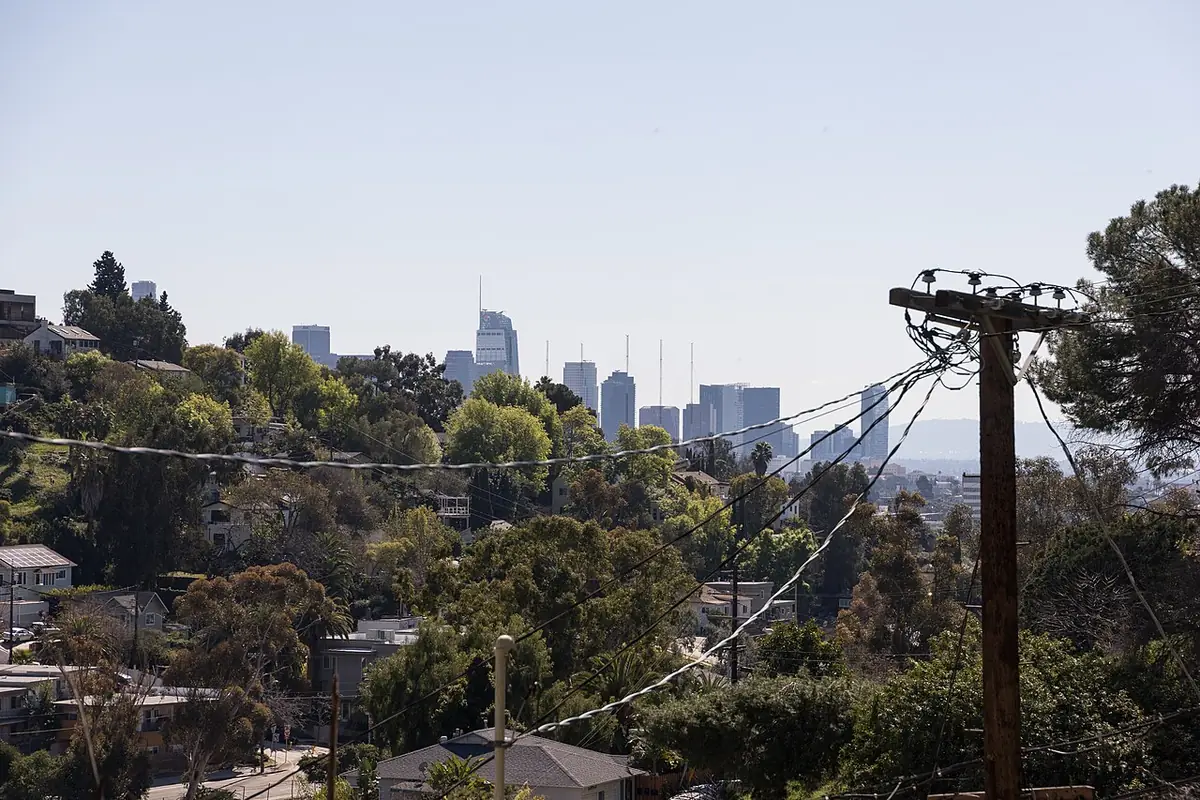
If your work does not require a daily trip to the major business centres, you can target hillside areas such as Silver Lake or the edges of the canyons. You will gain an exceptional setting, surrounded by greenery and far from the urban clamour. In exchange, the winding roads and the distance from large shops call for rigorous logistical planning around every trip.
Central, well-connected neighbourhoods
For workers whose physical presence is required on site, proximity to the freeways or to the main transit lines comes first. Choosing a house in these areas often means smaller lots and higher budgets per square metre. That is the price of protecting your sleep and limiting commuter fatigue.
Residential suburbs and school districts
Settling a family in Los Angeles is inseparable from the quality of the public school districts or the private school options. Areas known for their quiet and their family services show strong price stability. Even if the atmosphere is more residential and sometimes judged less lively, the safety and everyday comfort more than make up for the distance from the nightlife districts.
Living here when you arrive from abroad: what changes radically
Once those differences are absorbed, everything comes down to the precise choice of area.
The American property system, and the Californian one in particular, works by rules that often disorient buyers arriving from elsewhere. Far from many other countries' standards on consumer protection or contract standardisation, the transaction rests on strict local practice. Understanding these divergences helps you avoid financial surprises and misjudgements while viewing properties. Here are the essential pivot points between where you are coming from and your new life in Los Angeles.
From abroad
Strict rent control and long-standing tenant protection in many countries
Los Angeles
A very liberal private-property culture and local zoning rules
Planning or neighbouring construction decisions can move quickly around you, changing the perceived value of your property over time.
From abroad
Attachment to a dense, historic city centre
Los Angeles
A polycentric sprawl in which each neighbourhood works like a self-contained town
There is no single centre in Los Angeles, but a constellation of hubs. Your social life will depend entirely on the neighbourhood you choose to live in.
From abroad
A single, regulated technical survey of the building
Los Angeles
A whole range of specific inspections (termites, foundations, roof, asbestos)
The cost of the up-front reports is higher, and reading them calls for the support of an agent or a specialist lawyer to identify hidden risks.
From abroad
A centralised system in which one public officer secures the sale from start to finish
Los Angeles
The escrow system and the involvement of title insurance companies
The legal security of the transaction rests on standardised contracts negotiated by the agents and validated by specialist third parties rather than by a single official.
How to find your way among the main residential areas of Los Angeles
These location choices translate directly into budget realities worth examining methodically.
Every part of Los Angeles has its own identity, its own microclimate and its own market dynamic. There is no perfect neighbourhood in the abstract, only geographic trade-offs that match your budget and your tolerance for driving. Price variations per square metre from one hillside to the next, or from inland out towards the ocean, are considerable. Studying these micro-markets will stop you regretting your purchase after a few months of living in the city day to day.
East Los Angeles (Silver Lake, Echo Park)
A creative, lively feel, with green hills and a high density of cafes and neighbourhood shops.
Suits
Buyers looking for a relatively walkable lifestyle, an energetic community and architecture with character.
Trade-off
High prices for often more modest floor areas, and particularly difficult street parking.
The San Fernando Valley (Studio City, Sherman Oaks)
A more residential setting, more generous lots and the atmosphere of a comfortable suburb.
Suits
Families looking for space, private pools and relative quiet away from the bustle of the coast.
Trade-off
Distinctly higher summer temperatures and total dependence on the car for the slightest trip.
The Westside and coastal areas (Mar Vista, near Santa Monica)
Ocean coolness, constant sea air and a mood oriented towards wellbeing and the outdoors.
Suits
Those who put being near the sea and an active, outdoor life first.
Trade-off
An extremely tight market with entry prices among the highest in the metropolitan area.
What buying and holding a house here really costs
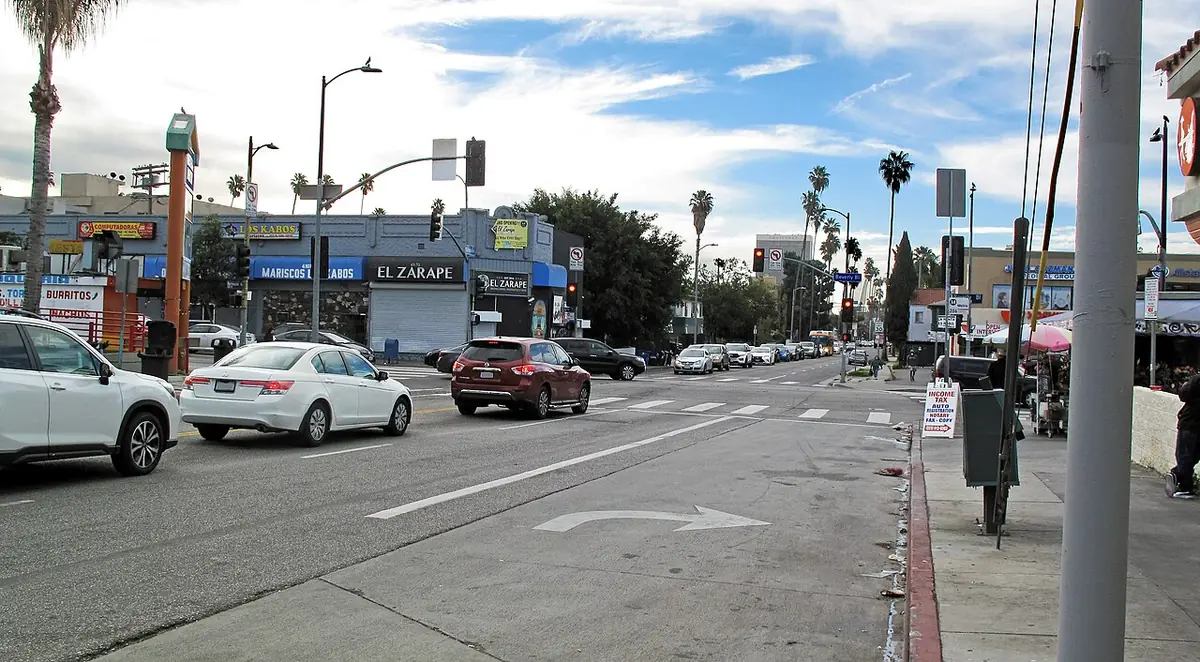
A lively corner of Los Angeles, shops and traffic side by side — Photo: Downtowngal · CC BY-SA 4.0 · Wikimedia Commons
Beyond the raw figures, the legal nature of what you are buying deserves particular attention.
The price shown on the listing portals is only a fraction of the financial equation. In Los Angeles, local property tax, the multi-risk insurance you need against natural hazards and the transaction costs all weigh heavily on the true cost of ownership. Anticipating those recurring charges is the only way to make your purchase sustainable over the long term. The figures below summarise the orders of magnitude observed in the current residential market.
los-angelesFor saleHouseestimate
Median price / m²US$5,064Half the apartments sell below this
Median priceUS$886kthe average is 14% higher — a few very large properties pull it up
Most common2 bedrooms59 % of listings
Average size166 m²
By number of bedrooms
Bedrooms
Share of market
Avg price
Price / m²
Avg size
2most common
59 %
US$886k
US$5,330
166 m²
3
32 %
US$1.11m
US$5,064best value / m²
219 m²
4
9 %
US$1.42m
US$5,064best value / m²
280 m²
Each row is an average, compared against the area average of US$5,330 / m². These are indicative estimates of a typical local market, not a measured sample of live listings. Check current listings before relying on them.
Land ownership and legal framework: what you can actually hold
That legal caution carries straight through into how the transaction itself unfolds.
Contrary to a common assumption, not all detached houses are equal when it comes to outright ownership of the land. Some subdivisions and residential structures come with collective rules that govern your rights of use and alteration. Knowing how to tell a freely held property from one subject to community regulation is essential to protecting your freedom as an owner. Here are the two main regimes that shape single-family housing in Los Angeles.
The independently owned house (single-family residence)
You own both the building and the plot it stands on, with no compulsory collective dues. You alone decide the exterior look, any extensions allowed under local zoning, and how you manage your grounds.
What it changesYou carry the full weight of the risks and of bringing the property up to code, with no way to share a single infrastructure cost with a group of neighbours.
The house inside a planned development or HOA (homeowners association)
The property forms part of a residential development run by an owners association that maintains the common areas, the shared green space and sometimes the exterior envelope of the buildings. Mandatory monthly dues fund those services.
What it changesYou have to abide by strict rules that may ban certain paint colours, limit street parking or regulate short-term rentals.
The critical timeline once an offer is accepted in California
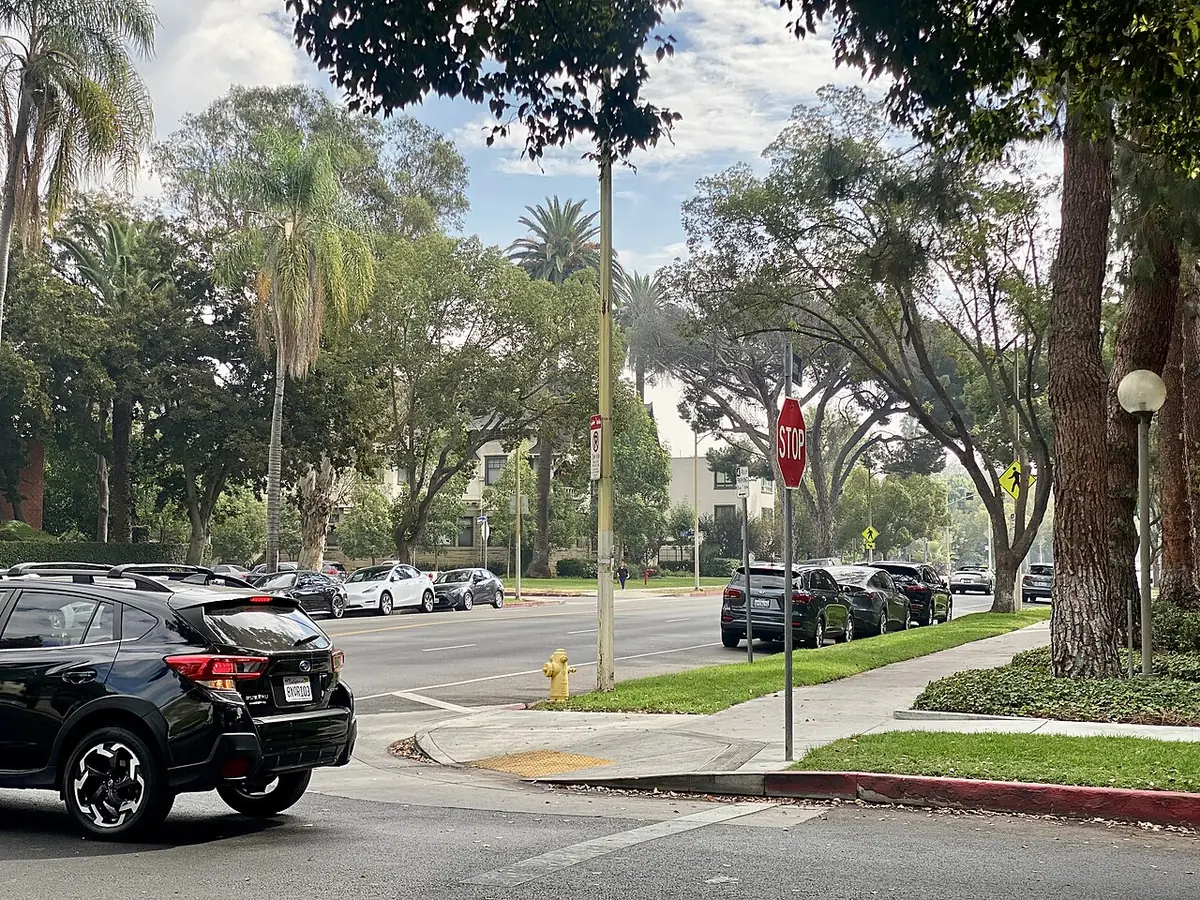
A quiet, palm-lined street in the University Park neighbourhood — Photo: EEJCC · CC0 · Wikimedia Commons
To get through that journey smoothly, it helps to picture where each of the players comes in.
Buying property in Los Angeles follows a tightly standardised calendar in which every day counts. Once the seller accepts your offer, a period known as escrow opens, during which many technical and financial checks have to be completed. Missing those deadlines or misreading the contingency clauses can cost a buyer the good-faith deposit. Here is the logical chain of events that leads to final signature.
Both parties sign the purchase agreement
The earnest money deposit is paid into the escrow company's account within the contractual deadline.
The in-depth technical inspections are carried out (home inspection, termite searches and foundation analysis).
The contingencies are formally released once the inspection reports are accepted and the loan is definitively approved.
The title company runs its final check on the title to guarantee there is no dispute or hidden lien.
The transfer documents are signed and ownership is publicly recorded in the buyer's name.
Who does what in your Los Angeles purchase
Buying well in Los Angeles means surrounding yourself with a competent, neutral local team. The American system rests on a clear division of roles in which each participant protects one specific part of your financial or legal interests. Going without one of these specialists on a first purchase exposes you to costly misjudgements. Here is the order in which those professionals come into your project.
The buyer's agentRepresentation and negotiationThey guide your choice of properties, analyse recent comparable sales and negotiate the terms of your offer against the listing agent.
The independent home inspectorFull survey of the buildingThey go over the structure, plumbing, electrics and roof in detail and write up a report of every defect found.
The mortgage brokerFinancing and loan structureThey compare offers from different lenders to get you the best loan terms for your profile, whether you are a newcomer or an established resident.
The escrow officerNeutrality and holding of fundsThey centralise the money, orchestrate the transfers and make sure every condition of the contract is strictly met before the final payment.
The title officerLegal security of the ownershipThey check the full history of the deeds to certify that the property is sold free of hidden debt or any claim by an heir.
Apartment or detached house in Los Angeles: which suits your daily life?
Once the type of property is settled, the central question of financing and real prices arrives immediately.
Buying property in Los Angeles means deciding straight away between a condominium, horizontal or vertical, and a detached house with land. That decision shapes not only your initial purchase budget but also the way you live in the city, where space and distance dictate daily life. On one side, condos in dense areas such as West Hollywood or Downtown put you close to where things happen, pool the maintenance costs and often come with generous shared amenities such as pools and gyms. On the other, the detached house embodies the California ideal, with its private garden, nobody living directly above you and complete freedom to alter the place, usually at the price of longer daily drives and sole financial responsibility for every repair.
Maintenance weighs heavily in the long-term financial balance. In a condominium, the monthly HOA (homeowners association) dues cover the upkeep of the common areas, the roof and sometimes even water or security services. Those dues rise steadily, though, and are largely outside your direct control, on top of the local property taxes. Owning a house in Los Angeles, by contrast, means every intervention on the plumbing, the central air conditioning or the roof falls entirely on your own budget, which calls for a substantial contingency fund. Buyers often underestimate the impact of strict local regulation, whether seismic standards or restrictions on water use for lawns.
Urban versus suburban living also redefines your relationship with travel and free time. Choosing an apartment in a central district sharply cuts the time spent in the city's legendary traffic and lets you live on foot or by bike in lively neighbourhoods. In exchange, you have to accept traffic noise, the lack of private outdoor space and the potential difficulty of parking for your visitors. The detached house generally sits in quieter, greener residential areas, but it ties you inevitably to daily car use for the smallest errand, whether that is picking up bread or getting to work.
In terms of capital growth and liquidity, the two types of property behave differently across California's economic cycles. Detached houses on their own land in Los Angeles have historically shown more robust and sustained capital appreciation, because land here is a scarce and finite resource. Apartments and townhouses offer a more accessible entry ticket into the local market, but they can face trickier resale periods when new developments flood the market or association dues jump sharply. Your final choice should therefore rest on a clear-eyed reading of your risk tolerance, your working situation and how long you expect to hold the property.
What budget do you really need to buy and live in Los Angeles?
Understanding these figures makes it easier to face the concrete reality of a week of life in the metropolis.
Buying property in Los Angeles is not just the asking price shown on the listing portals. You have to build in all the recurring charges and the taxes specific to California to avoid a financial squeeze. The tables below set out the ranges of initial investment by area and the structure of the unavoidable monthly spending for a household settling into a detached house.
Purchase price ranges for a house in Los Angeles
Area
Median price observed
Estimated property taxes (annual)
Closing costs and transfer taxes
Westside (Santa Monica, Brentwood)
$1,800,000 - $3,500,000 +
1.2% to 1.5% of value
2% to 3% of the purchase price
Eastside / Silver Lake / Echo Park
$1,100,000 - $1,900,000
1.2% to 1.4% of value
2% to 3% of the purchase price
San Fernando Valley (Studio City, Sherman Oaks)
$900,000 - $1,600,000
1.2% to 1.3% of value
2% to 3% of the purchase price
South LA / more affordable outskirts
$650,000 - $950,000
1.2% to 1.3% of value
2% to 3% of the purchase price
The amounts include the city transfer tax and the standard mortgage origination charges currently in force.
Monthly running costs for a single-family house
Main cost item
Low monthly range
High monthly range
Main factors behind the variation
Homeowner insurance
$150
$400
Fire risk and designated seismic zones
Electricity, gas and water (DWP)
$250
$600
Air conditioning use in summer and outdoor irrigation
Routine upkeep (garden, pool, small jobs)
$200
$700
Whether there is a pool, and how complex the planting is
HOA dues (where applicable)
$0
$500
Gated communities or shared services
These estimates exclude the mortgage repayment itself as well as heavy structural work.
What does an ordinary Tuesday in Los Angeles actually look like?
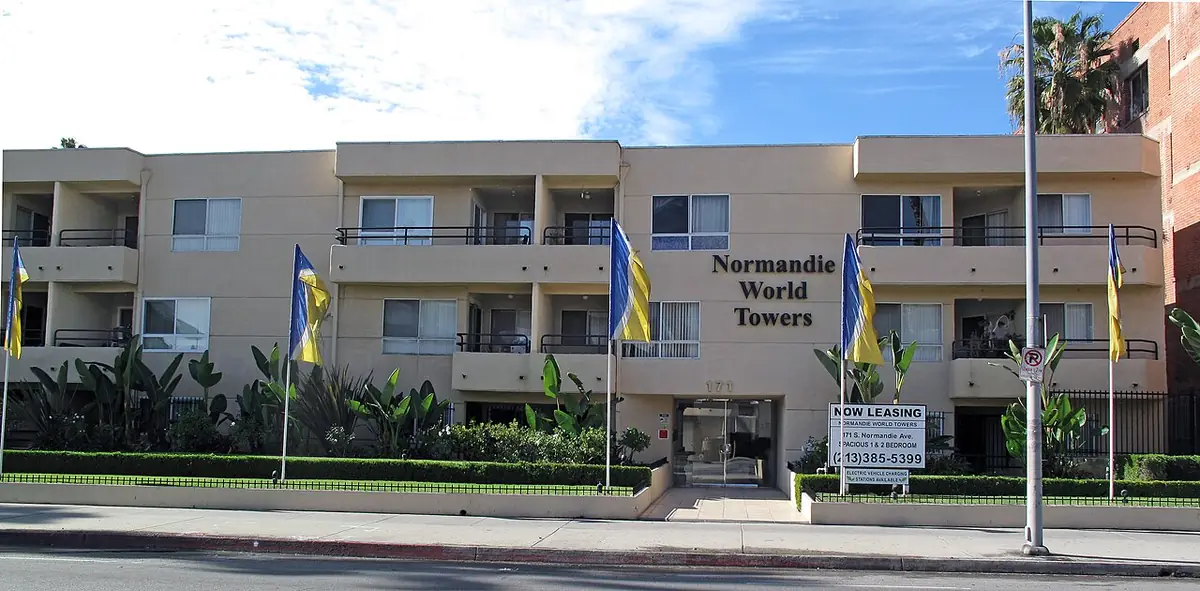
An apartment tower typical of Koreatown's housing stock — Photo: Downtowngal · CC BY-SA 4.0 · Wikimedia Commons
Beyond these well-rehearsed routines, plenty of things invisible in the listings deserve your attention.
To judge whether a move makes sense, you have to picture how a typical day unfolds hour by hour. Between managing trips on the main freeways, organising the children's schooling and reaching healthcare, every hour is set by the sheer geographic scale of the city. This sample schedule reflects the daily trade-offs that settled residents accept.
07:30A residential neighbourhood (for example Sherman Oaks)Waking and leaving early to get ahead of the traffic on the route down into the Los Angeles basin or towards the business districts.
08:30The local school or a charter schoolDropping the children at whichever school you have chosen, whether the assigned public school or an alternative.
09:15A coworking space or officeArriving at work after crossing the main arteries, settling in and starting the morning's meetings.
12:30A neighbourhood mall or Whole FoodsA quick lunch on site, often combined with a small top-up grocery run for the household.
17:30A doctor's office or network clinic (Kaiser Permanente)A routine health appointment or specialist consultation, booked in advance to fit the end-of-day slot.
19:00HomeBack at the house, making dinner and unwinding in the garden or the living room, far from the noise of the main roads.
What the beautiful listing photos leave out
These blind spots explain why some buyers sour on their purchase within months of moving in.
California estate agencies excel at showing off bright volumes and sunlit outdoor space. Yet many physical and regulatory local factors escape virtual tours and photo galleries entirely. Knowing these realities up front spares you financial surprises and irreversible frustration after the sale closes.
The true orientation and thermal insulation of older buildings
Many houses built in the mid twentieth century have rudimentary insulation and single-glazed windows. In summer the air conditioning bills soar, while winter nights can surprise you with their chill in interiors that have no effective central heating.
Rights of way and strict boundary rules (easements)
An apparently large lot may carry underground or overhead easements granted to the power or water utilities. That formally bars you from putting in a pool, building an extension or even planting large trees over parts of your own land.
Persistent noise from flight paths and through traffic
The topography of the Los Angeles basin and the flight corridors of major airports such as LAX and Van Nuys generate intermittent but regular noise. A viewing on a sunny Sunday morning tells you nothing about the din of a Thursday afternoon at peak hour.
The administrative complexity of renovation projects (permits)
Moving the smallest partition wall, adding a bathroom or rewiring means going through the City of Los Angeles building department (LADBS). Permit timelines can stretch over several months, adding considerably to the overall cost of your works.
The regrets people discover six months after signing
Given these demands and risks, it matters just as much to know whether this market is genuinely right for you.
Looked likeA charming house set apart in perfect quiet at the bottom of a green canyon.
Turned outA single winding access road entirely blocked by the smallest incident, with no mobile coverage at all.
Would have caught itDriving the route yourself at peak hours and after dark, and checking the brush fire hazard zone listings.
Looked likeA central, lively neighbourhood where you can walk everywhere for a night out.
Turned outConstant night-time noise, chronic parking difficulties for friends and uneven street cleanliness.
Would have caught itSpending several consecutive evenings on the actual street, on a Friday and a Saturday, to judge the real atmosphere and footfall.
Looked likeAn ideal investment with strong potential to add a storey quickly.
Turned outZoning laws and heritage restrictions barring any change to the roof line or the building footprint.
Would have caught itConsulting an independent local planning specialist or working through the city's official zoning report before making an offer.
Looked likeA big gleaming pool ready to use for the California summers.
Turned outA monthly money pit in electricity for the pump, unforeseen waterproofing repairs and stringent safety requirements.
Would have caught itInsisting on a full inspection of the pool by an independent professional and pricing the installation's current power consumption precisely.
Which buyers is Los Angeles simply wrong for?
With those warnings set out, it is time to sum up what you are committing to.
Buying in this vast metropolis demands psychological and financial compromises that not everyone can or should accept. Certain investor and buyer profiles are heading for disappointment if they come to this market with expectations that do not match the California reality. Here are the profiles that would do better to hold off or look at other regions.
The buyer chasing an immediate, high rental yield with no effort
→Goes for low-end investment properties in outlying areas.
Property taxes, the Rent Stabilization Ordinance and the weight of maintenance costs cut net returns sharply compared with other American metropolitan areas.
The city dweller who is allergic to cars and attached to dense public transport
→Hopes to live in Los Angeles the way they would in Paris, London or New York, without owning a car.
The dispersed shape of the city makes walking and public transport insufficient for a smooth daily routine, turning every trip into a logistical expedition.
The owner on a tight budget with no safety savings at all
→Puts every last dollar of liquidity into the down payment and the closing costs.
A single unforeseen structural repair, such as redoing the foundations or bringing the plumbing up to code, can push them into default almost immediately.
So, are you ready to take the step and buy in Los Angeles?
Committing to a property purchase in Los Angeles means going beyond aesthetics to take a clear-eyed view of the California way of life. This market forgives neither improvisation nor financial approximation. Every neighbourhood in the city has its own DNA, its microclimates, its traffic constraints and its growth prospects, all of which demand careful investigation before you sign anything.
The success of your project rests on your ability to accept the compromises inherent in a global metropolis: accepting time on the roads in exchange for a sunlit setting, accepting the regular upkeep an older house needs to keep its character, and structuring your budget to take in every local tax. If you approach this with a long-term view and solid finances, buying a house in Los Angeles remains one of the most powerful and rewarding ways to put down roots.
Take the time to visit the areas you are considering at different hours, to talk to residents who are already settled, and to read every inspection report with a critical eye. The Los Angeles property market always rewards patience, rigour and methodical preparation. Your decision should be the product of careful calculation rather than an impulsive reaction to a glossy brochure or a flattering photo.
Related questions
Can a non-resident or a foreign national buy a house in Los Angeles?
Yes. California state law imposes no nationality restriction on the purchase of real estate. Foreign buyers should, however, be ready for specific financing requirements from US banks and pay close attention to international tax treatment of inheritance and capital gains.
How much exactly are property taxes in Los Angeles?
The base property tax rate in Los Angeles County generally runs around 1.2% to 1.3% of the assessed value of the property at the time of purchase, including various local obligations approved by voters. The figure is governed by the well-known Proposition 13, which caps the annual increase in the assessed base for as long as the property does not change hands.
How long does a California home purchase usually take?
Once a purchase agreement is accepted by the seller, a standard transaction generally takes 30 to 45 days to reach closing. That window allows all the technical inspections to be carried out, any contingencies to be released and the mortgage file to be finalised.
Which inspections are essential before buying a house in Los Angeles?
A general home inspection is strongly recommended, along with a specific inspection for termites and wood-destroying pests, which are very common in the region, plus a camera survey of the plumbing and a foundation assessment if the property sits on a sloping lot.
What are HOA fees, and are they mandatory for every house?
HOA (homeowners association) fees are the dues paid to an association of property owners. They do not apply to classic detached single-family homes outside a gated community, but they are mandatory and monthly for all condominiums and townhouses.
Is it possible to negotiate a house's asking price in the Los Angeles market?
It depends entirely on local market dynamics and the neighbourhood you are targeting. In the highly sought-after Westside areas, or for immaculate properties priced correctly, multiple offers above asking remain common. In other areas, or where a property has been sitting on the market, there is genuine room to negotiate.
What about earthquake risk when buying property in California?
Seismic risk is an integral part of the geographic reality of Los Angeles. Recent construction meets extremely rigorous earthquake standards, and buyers systematically receive an official information booklet on geological faults and the insurance precautions to take.
How does the multiple-offer system work in California?
When a property attracts strong interest, buyers submit their offers before a deadline set by the seller. Those offers often include bids above asking, shortened contingency periods and sometimes cash guarantees, which means you need to be extremely well prepared with your mortgage broker.
What closing costs should a buyer plan for?
In California, transaction costs include the fees of the title and escrow company, lender file charges, title insurance and transfer taxes. They generally represent between 2% and 3% of the total purchase amount.
Do you have to use a realtor to buy in Los Angeles?
Although the law does not require you to use an agent, the California property market has very complex contractual and legal specifics. Being represented by your own buyer's agent is essential to navigate negotiations, the standardised contracts of the California Association of Realtors and the protection of the buyer's interests.