Buying property in Bangalore calls for a close understanding of the local dynamics, the legal framework and what sets each neighbourhood apart. This practical guide walks you step by step through structuring your purchase with a clear head, away from received ideas and misleading promises.
Get the app
What nobody tells you.
Real prices, hidden costs and the traps to check before you commit.
What buying an apartment in Bangalore actually involves day to day
Scroll
What buying an apartment in Bangalore actually involves day to day
Buying property in Bangalore calls for a close understanding of the local dynamics, the legal framework and what sets each neighbourhood apart. This practical guide walks you step by step through structuring your purchase with a clear head, away from received ideas and misleading promises.
Written by the ting.ad editorial team ·
Bangalore in Street View: drag to look around.
Beyond the macroeconomic figures, it is your own way of life that will decide whether moving here makes sense.
Investing in India's Silicon Valley is about more than acquiring square metres in a fast-growing metropolis. Between the promise of strong rental returns driven by the technology sector and the realities of urban infrastructure, the local property equation demands a clear-eyed analysis. Investors have to deal with sharply contrasting neighbourhood dynamics, where modern gated complexes sit alongside real problems of access and traffic. Understanding that paradox is the essential first step towards a sound, lasting purchase in this economic capital.
Potential capital growth driven by the expansion of the tech sectorvsConstant pressure on transport and water infrastructure
Population growth and the influx of senior professionals are fuelling demand for modern homes. But that rapid concentration also brings regular congestion and strain on the water supply in some outlying areas.
The secure comfort of gated communitiesvsA certain distance from the city's cultural and historic life
Residential complexes offer international-standard amenities, with guards, swimming pools and green spaces. In return, they often sit back from the traditional thoroughfares, so daily journeys need careful planning.
Strong liquidity for well-located homes near the tech hubsvsUpfront costs and maintenance charges that keep rising
Being right next to the technology parks guarantees steady rental demand from expatriates and local professionals. That appeal shows up in high values per square metre and growing maintenance costs for the common areas.
Does this place suit your lifestyle and your career plans?
To weigh these choices properly, it helps to compare the local reality with the reference points you are used to.
The Bangalore property market serves a very wide range of buyers, from the expatriate professional on a temporary posting to the entrepreneur settling in for good. Each situation involves specific trade-offs on location, services and how you manage the asset. Assessing where you really stand against local conditions will spare you major disappointments when you move in.
Close to the technology hubs
Your top priority is keeping the daily commute to the big business parks, such as Electronic City or the Outer Ring Road, as short as possible. You favour apartments in upmarket gated communities that offer built-in services and maximum security for your family.
This option lets you protect your work-life balance despite the city's traffic, while making resale or letting easy on the day you leave.
Yield and capital growth
You want to build a diversified property portfolio in one of the most dynamic economies on the Indian subcontinent. Your attention turns to established and steadily developing residential neighbourhoods that will benefit from upcoming infrastructure projects such as the metro.
You accept the need for disciplined rental management and hand the technical follow-up to specialist local agencies to secure a regular rental income from demanding tenants.
Quality of life and peace
You are looking for a spacious, bright home away from the noise of the city centre, while staying connected to first-rate medical and cultural facilities. The green, quiet neighbourhoods in the north and east of the city catch your eye.
Your purchase puts the emphasis on build quality, sound insulation and green space inside the complex, to guarantee the best possible comfort from day to day.
Living here when you arrive from abroad: what changes radically in your daily life
Making that transition a success depends heavily on the neighbourhood you choose to settle in.
Settling in an Indian metropolis when you come from abroad calls for deep cultural and practical adjustment. Administrative reference points, the codes between neighbours and the way household services are organised can differ radically from what you know back home. Anticipating those cultural and operational gaps will let you make the move smoothly from the very first months.
From abroad
A centralised administrative system and standardised planning rules back home
Bangalore
A complex, decentralised system with local regulations specific to the state of Karnataka
You absolutely must work with independent local legal experts to audit every title deed and check that building permits are in order before signing anything.
From abroad
Water and energy services run centrally and without interruption
Bangalore
A hybrid system combining the municipal supply, tanker lorries and private generators
Choose a complex on its ability to guarantee independent water and backup power, so you are covered through the regular cuts in the dry season.
From abroad
Tradespeople and services charged at high hourly rates
Bangalore
Plenty of domestic and maintenance staff available at very affordable rates
Daily life naturally includes regular domestic help, which profoundly changes how you manage your time and your home compared with your habits back home.
From abroad
Smooth urban journeys thanks to well-organised public transport
Bangalore
Heavy road traffic that calls for a mix of metro, ride-hailing and walking
Where your apartment sits in relation to your workplace or activities matters more than its floor area if you want to protect your quality of life.
Which Bangalore neighbourhood should you choose for the life you want?
Once you have a neighbourhood in mind, it is time to look at the prices actually being paid on the market.
Bangalore is a mosaic of neighbourhoods with very distinct identities, from ultra-modern business districts to traditional, tree-lined residential enclaves. Each area strikes its own balance between accessibility, atmosphere and investment potential. Knowing the strengths and constraints of each zone will keep you from picking the wrong location.
Indiranagar and Koramangala
A cosmopolitan, trendy and lively atmosphere, set to the rhythm of countless cafes, restaurants and coworking spaces.
Suits
Young professionals, entrepreneurs and investors looking for strong rental demand and a walkable lifestyle.
Trade-off
Prices per square metre among the highest in the city, and parking that fills up in the evenings.
Whitefield and the Outer Ring Road
An intense technology hub dominated by large corporate campuses and international-standard gated communities.
Suits
IT sector employees who want to cut their daily commute drastically and enjoy modern infrastructure.
Trade-off
Long journeys into the historic centre at rush hour and a heavily built-up environment.
Malleshwaram and Jayanagar
Well-preserved traditional charm, tree-lined avenues, authentic local markets and a peaceful neighbourhood life.
Suits
Families and people looking for peace, a strong sense of cultural continuity and an authentically Indian setting.
Trade-off
Housing stock made up largely of older properties that need renovation, and homes that rarely come on the market.
What does an apartment in Bangalore really cost today?
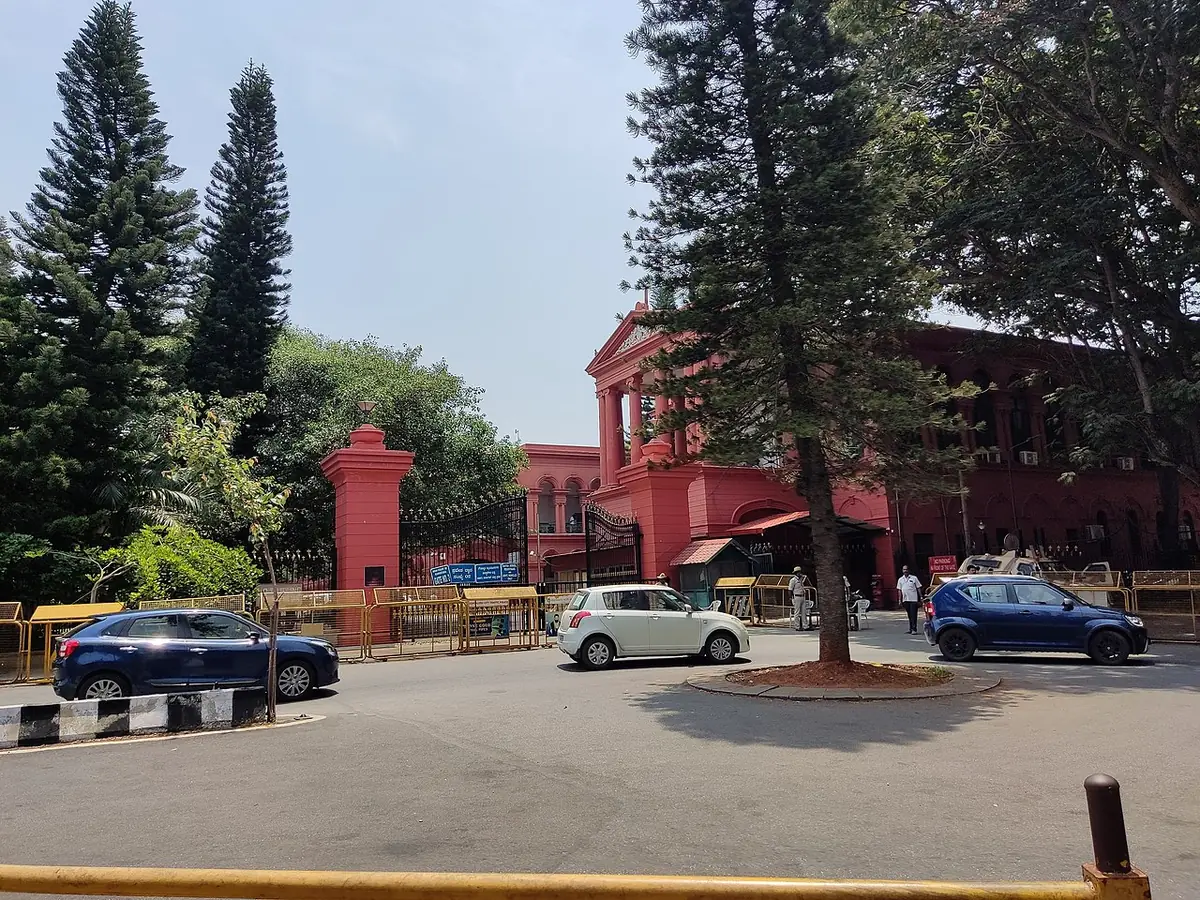
The red High Court building among the trees of central Bengaluru — Photo: Quantumtunneling · CC BY-SA 4.0 · Wikimedia Commons
Beyond the financial outlay, the exact nature of the ownership right deserves your closest attention.
The Bangalore property market shows wide variation in prices depending on the exact location, the age of the building and the amenities included in the complex. The ranges below reflect the trends observed for standard homes, excluding transfer costs and local taxes. Reading these figures carefully will help you size your budget realistically.
BangaloreFor saleApartmentestimate
Median price / m²₹90,250Half the apartments sell below this
Median price₹10.5mthe average is 14% higher — a few very large properties pull it up
Most common2 bedrooms40 % of listings
Average size110 m²
By number of bedrooms
Bedrooms
Share of market
Avg price
Price / m²
Avg size
1
20 %
₹6.16m
₹102,600 +8 %
60 m²
2most common
40 %
₹9.5m
₹95,000
100 m²
3
30 %
₹12.6m
₹90,250 −5 %
140 m²
4
10 %
₹16.6m
₹87,400best value / m²
190 m²
Each row is an average, compared against the area average of ₹95,000 / m². These are indicative estimates of a typical local market, not a measured sample of live listings. Check current listings before relying on them.
What you can actually own: understanding ownership in a residential complex
Once these legal basics are understood, the transaction itself has to be followed step by step with absolute rigour.
Buying an apartment in India follows specific legal rules on how the property and the land are divided. It is essential to distinguish what is your private space from what belongs to the owners collectively. That legal clarity is what keeps your investment secure over the long term.
Your private space and your share of the land (Undivided Share)
You buy the living area of your apartment along with a proportional share of the land (UDS) on which the complex stands. That share of land is a fundamental part of the legal security of your investment if the building is ever rebuilt.
What it changesAlways check that the developer explicitly states how the UDS is calculated in the final sale deed, to avoid any later dispute over your property rights.
The common areas and the owners' association
Shared facilities, green spaces, car parks and security infrastructure are managed by a residents' welfare association (RWA). It handles regular upkeep, pays the shared energy bills and manages the preventive maintenance budget.
What it changesGet involved in the RWA, or follow its management closely, to make sure the complex's reserve fund is well enough stocked for major future works.
The basic rule to understand before you pay any deposit
Let us now look at the full operational timetable of a successful purchase.
Securing a property transaction in Bangalore rests on a chain of rigorous checks that no buyer should skip. From the first review of the title deeds to the final registration with the state authorities, every link in the chain protects your investment against the risk of a land dispute.
Finding the right property and choosing the developer or the individual seller.
Thorough legal due diligence (title search) covering at least 30 years, carried out by an independent lawyer.
Checking that every compliance certificate has been obtained (Khata, the municipal approved plan and environmental clearances).
Signing an Agreement to Sell that sets out the conditions precedent, the payment schedule and the amount of the deposit.
Paying in instalments that follow the actual progress of construction, for new-build homes.
Signing the deed of conveyance (the final sale deed) and officially registering the title.
How does a property transaction unfold in Bangalore, step by step?
In the end, a successful investment in Bangalore comes down to patience, method and the support of recognised professionals.
Seeing a property purchase through in Bangalore means following a well-marked process involving several key players, from the legal expert to the registration office. Each stage comes with its own administrative timescale, which you should build into your personal planning to avoid unnecessary stress.
The specialist lawyerTitle deed audit (due diligence)They examine the full history of the land and the administrative permissions to certify that there are no encumbrances or family disputes.
The buyer and the sellerNegotiating and signing the initial agreementAgreeing the final price and the instalment terms, and paying a deposit held in escrow (usually 10% of the total amount).
The lenderMortgage approval (if applicable)A local partner bank processes the application and carries out its own technical and legal valuation of the property before releasing funds.
The registration officePaying the taxes and stamp dutyCalculating and paying the registration fees and stamp duty at the official counters of the state of Karnataka.
The parties and the witnessesSigning the final Sale DeedBiometric recording of the parties' signatures and photographs at the sub-registrar's office to make the transfer of ownership official.
The residents' welfare association (RWA)Transferring charges and updating utility accountsHanding over the keys, registering your name with the complex management and transferring the utility meters.
Apartment or detached house in Bangalore: weighing a secure complex against a standalone villa
In Bangalore, the housing choice comes down to an apartment in a low-rise or high-rise gated community versus a detached house, often in older residential neighbourhoods or in outlying gated layouts. The decision shapes your whole daily life, setting not only how much space you have but also how you cope with local urban infrastructure, marked by intermittent power cuts and challenges with the water supply. Recent apartment complexes built by leading developers such as Prestige, Brigade or Sobha come with full power backup, sewage treatment plants, rainwater harvesting systems and round-the-clock security run by trained teams. In a megacity where municipal management of shared spaces sometimes shows its limits, these complexes act as self-sufficient islands, delivering a level of comfort and technical predictability that is hard to reproduce in a standalone house.
On the other hand, buying a house or villa in Bangalore, especially in established areas such as Indiranagar, Jayanagar or Sadashivanagar, gives you complete architectural freedom, no monthly management fees that can sometimes be steep, and a direct connection to the land that appeals to many buyers who value independence. That independence, however, carries a direct operating cost that is invisible on the first viewings. The owner of a detached house has to take personal charge of the roof, the borewell pump, waste disposal and actively securing the perimeter with cameras and sophisticated alarm systems. On top of that, the land market for houses in central neighbourhoods is extremely tight, pushing prices to heights out of reach for most first-time buyers, or leaving the affordable options in distant outskirts poorly served by the main roads.
In terms of rental return and liquidity on resale, the apartment in a complex clearly wins in the Bangalore property context. Young professionals, expatriate executives and tech employees, who make up the bulk of rental demand, look first for security, proximity to the IT parks and built-in leisure facilities such as swimming pools, gyms and tennis courts. A well-run apartment lets quickly and finds a buyer on the resale market without the long delays that often come with selling older or unusual properties. A detached house, by contrast, suits a very long-term family plan, driven by a wish to put down roots and a proven tolerance for the day-to-day management constraints of a standalone home in a dense city.
Finally, public transport infrastructure, in particular the ongoing roll-out of Bangalore's Namma Metro, is profoundly changing the financial and geographical equation behind this choice. Apartments within walking distance of a metro station hold and grow their resale value faster than villas in residential enclaves that are quiet, admittedly, but depend entirely on private road transport, which is gridlocked at rush hour. For an investor or a buyer who wants to minimise daily friction, the apartment in a complex is the most rational option, while the house remains the preserve of those with the time and resources to handle the heavy maintenance of an independent building.
What overall budget should you plan for living in and buying an apartment in Bangalore?
Buying an apartment in Bangalore is about more than the price shown by the developer or seller on the property portals. You need to factor in all the local taxes, the administrative registration costs and the recurring running costs to judge whether your plan is financially viable over five to ten years. Prices per square foot vary considerably depending on the exact micro-location, the builder's reputation and the standard of amenities included in the complex.
Purchase costs and upfront taxes for an apartment in Bangalore
Cost item
Indicative rate or amount
Impact on the overall budget
Stamp duty
5% to 6% of market value
A compulsory tax paid to the Karnataka state government when the sale deed is registered.
Registration fee
1% of market value
An administrative fee charged for officially recording the title in the land register.
Goods and services tax (GST)
1% (affordable housing) to 5% (standard housing)
Applies only when buying a new apartment from a developer (under construction); not applicable to resale homes.
Legal and due diligence fees
0.5% to 1%, or a flat fee
Paid to the specialist lawyer who checks the title deeds are clear and there are no land disputes.
Stamp duty rates may be adjusted from time to time by the Karnataka tax authorities.
Estimated monthly and annual running costs
Type of cost
Monthly order of magnitude
What is included
Maintenance charges (Maintenance Fee)
INR 3 to 6 per square foot per month
Covers 24/7 security, upkeep of common areas, and the running of lifts and generators.
Municipal property tax (Property Tax / BBMP)
Varies with size and zone (annual)
Collected by the Bruhat Bengaluru Mahanagara Palike; calculated on zone and usage criteria.
Electricity (BESCOM + generator)
INR 2,500 to 7,000 depending on air conditioning
Includes the BESCOM public grid connection and a pro rata share of the diesel for the backup generator.
Water supply and treatment
INR 1,000 to 3,000
BWSSB municipal water billing combined with the cost of tanker deliveries in the dry season.
These estimates are for a standard 3-bedroom apartment (around 130 to 150 square metres) in a mid-range to upmarket residential neighbourhood.
Health care, schools and transport: what does an ordinary Tuesday in Bangalore look like?
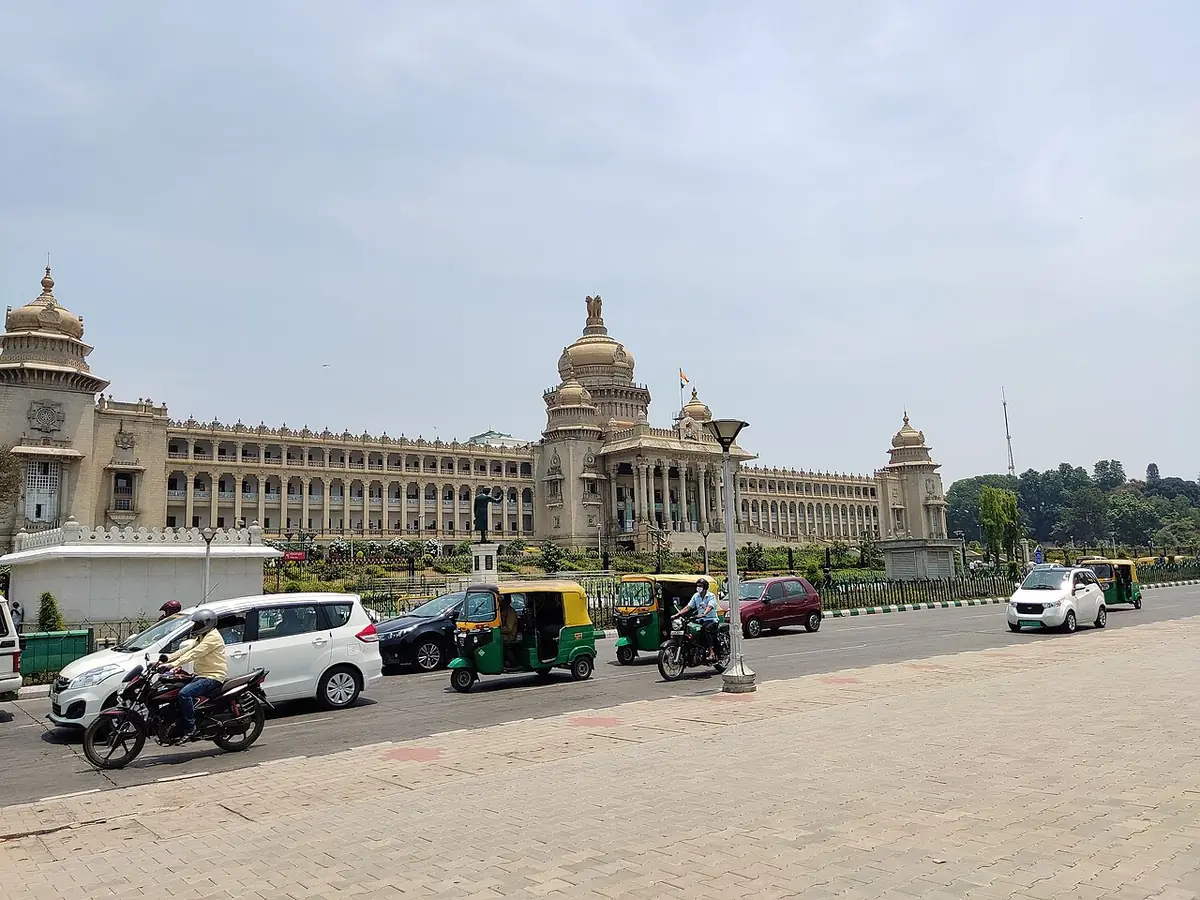
The Vidhana Soudha and its gardens in central Bengaluru — Photo: IM3847 · CC BY-SA 4.0 · Wikimedia Commons
Behind that apparently smooth routine, a close look at the hidden legal and technical side of Bangalore property is essential if you want to avoid the traps.
How a typical day in Bangalore runs depends entirely on the distance between your home and your workplace and on the infrastructure available in your neighbourhood. Getting around at rush hour takes careful planning, while access to health care and top schools is the deciding factor in where families settle.
07:30 - 08:30Leaving home and the school runThe morning trip to international schools or well-regarded CBSE schools. Private school buses or secure shuttles run by the residential complexes help avoid the congestion on the secondary roads.
08:30 - 09:30Commuting to the tech hubHeading to the big business hubs such as Electronic City, Manyata Tech Park or the Outer Ring Road. The metro or ride-hailing services (Ola, Uber, Rapido) are the preferred way to escape the stress of parking.
12:30 - 13:30Lunch break and local servicesAccess to the cafeterias inside the business parks or to neighbourhood restaurants. A good moment to pick up top-up groceries from local convenience stores (Nature's Basket, SPAR or Blinkit).
17:30 - 19:00Heading home and dealing with traffic jamsA period of heavy traffic that calls for flexibility in when you leave the office. Many professionals choose to stay later at work to make the journey home easier.
19:30 - 21:00Unwinding in the complex and local amenitiesUsing the complex's sports facilities (gym, swimming pool, walking track) to decompress. Weekly shopping for fresh vegetables at the neighbourhood markets, or quick home delivery.
What developers' sales brochures will never tell you about property in Bangalore
The Bangalore property market has complex technical and regulatory specifics that often escape unwary buyers. Promotional material showcases the beautiful green spaces and the modern clubhouses, but stays silent on crucial topographical and administrative realities that determine the real value and legal security of your investment in the long term.
Drainage buffer zones and NGT rules
The National Green Tribunal enforces strict rules banning construction right next to lakes and stormwater drains (rajakaluves). A project whose setbacks do not scrupulously respect those distances risks partial demolition or refusal of the final occupancy certificate, even after handover.
Where the water really comes from and dependence on tanker lorries
Many fast-growing outlying neighbourhoods are not yet connected to the BWSSB municipal water network. Residents then depend entirely on deep borewells, where the water table keeps dropping, or on expensive tanker deliveries in the dry season, which weighs heavily on monthly budgets.
Conversion of agricultural land (B Khata vs A Khata)
The land records system distinguishes 'A Khata' titles (regular, compliant with all planning standards) from 'B Khata' titles (being regularised or showing administrative irregularities). Buying a B Khata property makes it considerably harder to get a mortgage from the nationalised banks and limits future resale.
Revised master plans and changes to the road network
An empty plot opposite your future home may be reserved in the BDA (Bangalore Development Authority) master plan for a future road widening or public infrastructure, directly affecting the peace and future value of your property.
The developer's real financial strength and track record
The introduction of the RERA Act in Karnataka has improved transparency, but many projects still suffer major delivery delays caused by developers' cash flow problems. Checking how much of the developer's own funds are committed and the real progress of works on the RERA portal is an absolute must before paying any deposit.
Post-purchase disillusion: what new owners discover six months after moving in to Bangalore
These bitter experiences are a reminder that buying property in Bangalore does not suit every kind of buyer, international or local.
Looked likeA peaceful, green and perfectly quiet residential neighbourhood on the Sunday afternoon viewing.
Turned outA road turned into a traffic-choked diversion route at rush hour from Monday morning onwards, bringing noise and air pollution.
Would have caught itVisiting the area around the property at rush hour (between 8:30 and 10:00, then between 18:00 and 20:00) and asking residents already living in the complex directly.
Looked likeA very attractive, affordable estimate of the maintenance charges from the sales agent.
Turned outA sharp increase in contributions voted through at the general meeting in the very first year to cover the rising cost of maintaining equipment and replacing pumps.
Would have caught itGoing through the minutes of the complex's recent general meetings in detail and checking the state of the reserve fund (sinking fund).
Looked likeQuick, easy access to the main roads and to metro stations under construction.
Turned outChronic delays in completing public infrastructure works, dragging out the daily commuting ordeal for years.
Would have caught itConsulting the official progress reports from BMRCL (Bangalore Metro Rail Corporation Limited) rather than relying on advertising promises.
Looked likeFaultless water pressure during the handover checks on the new apartment.
Turned outA drastic drop in pressure on the upper floors in summer, requiring noisy, power-hungry individual booster pumps.
Would have caught itChecking the capacity of the overhead and underground water tanks and the redundancy of the complex's pumping systems.
Buyer profiles: who should hold off investing in Bangalore property as things stand?
If you recognise yourself in these risk profiles, renting remains the wisest option; if not, bringing your plan to completion calls for a rigorous method.
Investing in property in Karnataka's capital is often presented as an obvious way to build wealth. Yet the rigidity of the resale market, local administrative complexity and the cultural adjustment required make this purchase a false good idea for certain buyers whose personal or professional situation does not lend itself to it.
The investor looking for immediate liquidity and a high net rental yield
→Goes for a quick purchase of a standard apartment in a large outlying development.
Gross rental yields in Bangalore generally hover around 3% to 4% a year. Once local taxes, management fees, void periods and the upfront stamp duty are deducted, the net yield often turns out lower than that of other, more liquid financial instruments.
The expatriate or first-time buyer whose international career moves are uncertain
→Buys a home on arrival to avoid paying rent for nothing.
Selling a property in Bangalore within three years frequently ends in a net financial loss, because of the combined weight of registration taxes, agency commissions and transfer costs.
The buyer who cannot tolerate technical hiccups and a lack of administrative rigour
→Tries to run the renovation or letting of an older property remotely, with nobody on the ground.
Managing a property in India day to day requires an active presence, proven patience with bureaucratic delays and the ability to negotiate directly with local service providers.
Conclusion: are you ready to take the step of buying property in Bangalore?
Buying an apartment in Bangalore is a long-term commitment that tolerates neither improvisation nor haste. At the end of this analysis, you can see that the success of your plan rests on three fundamental pillars: rigorous checking of the title deeds (A Khata), a realistic assessment of running costs and water supply, and a perfect match between the micro-location you choose and your daily transport constraints. If your professional and personal horizons are firmly anchored in this dynamic metropolis, buying property gives you a solid foothold for your wealth and effective protection against rising rents.
Never give in, however, to the siren call of the marketing urgency deployed by developers or local estate agencies. Take the time to visit the properties you are targeting at different times of day, audit the financial health and management of existing complexes, and always bring in an independent specialist lawyer to validate every line of the sale contract. There is no shortage of opportunities in this fast-growing city, but only those that pass the unforgiving filter of legal and technical due diligence deserve your investment.
Ultimately, Bangalore property rewards methodical, patient and well-informed buyers, while severely penalising those who act on impulse or simply follow the crowd. Your decision should come from a balanced financial equation and a lifestyle choice you fully own. If every light is green, you now have all the keys to approach the negotiating table with confidence and make your move to India's Silicon Valley a reality.
Related questions
Which taxes do you have to pay when buying an apartment in Bangalore?
Buying property in Bangalore attracts stamp duty, which generally comes to between 5% and 6% of the market value of the property, plus a flat registration fee of around 1%. If you are buying a new apartment still under construction from a developer, goods and services tax (GST) of 1% to 5% also applies, depending on the category of housing.
What is the fundamental difference between A Khata and B Khata titles in Bangalore?
The Khata certificate is a crucial tax and administrative document. A property with an 'A Khata' complies with all the planning rules and building standards, which makes it easier to get a bank loan. A 'B Khata', by contrast, signals administrative irregularities or exemptions that have not been regularised, which severely limits access to mortgage finance and complicates any future resale.
How does the water supply work in Bangalore residential complexes?
The water supply usually combines the municipal network run by the BWSSB with deep borewells drilled on the complex's own land. In outlying areas not connected to the public network, complexes rely heavily on buying water from tanker lorries during the dry season, a cost that is passed on in the owners' monthly maintenance charges.
What is the RERA Act and how does it protect buyers in Bangalore?
The RERA Act (Real Estate Regulation and Development Act) requires developers in Karnataka to register their projects on an official portal, guaranteeing transparency on plans, delivery dates and the use of the money paid into a dedicated escrow account. It gives buyers stronger legal protection if delivery is delayed.
What average rental yield can you expect in Bangalore?
The gross rental yield on residential apartments in Bangalore generally sits between 3% and 4% a year. Once maintenance charges, municipal property tax and void periods between tenants are taken into account, the net yield is most often around 2% to 2.5%, which makes property an investment geared towards long-term capital growth rather than immediate income.
Can a foreign citizen or a non-resident buy property in Bangalore?
Non-resident Indians (NRIs) and persons of Indian origin (PIOs) enjoy very broad purchasing rights, similar to those of residents, with the exception of agricultural land. Foreign nationals without Overseas Citizen of India (OCI) status, on the other hand, face drastic restrictions set by India's central bank (RBI) and generally cannot buy residential property without special permission.
Which neighbourhoods are the most sought after for buying an apartment in Bangalore?
The most prized and dynamic neighbourhoods include Indiranagar, Jayanagar, Koramangala and Sadashivanagar in the historic centre, along with Whitefield, Electronic City, Hebbal and Sarjapur Road in the outer areas close to the big technology parks and business hubs.
How are maintenance charges (Maintenance Fee) calculated in residential complexes?
Maintenance charges are usually calculated on the size of the apartment, expressed in square feet (super built-up area), multiplied by a monthly rate set by the residents' welfare association (RWA). They cover security, cleaning, lift maintenance and the running of the backup power generators.
Which legal precautions are essential before signing an Agreement to Sell?
It is vital to have an independent specialist lawyer carry out legal due diligence, checking the history of the title deeds over the last thirty years (Encumbrance Certificate), the absence of inheritance disputes, the clarity of the plan approved by the BDA or the BBMP and that property taxes have been properly paid.
What real impact does the Bangalore metro (Namma Metro) have on property prices?
The continuing expansion of the Namma Metro lines has a proven upward effect on the market and rental value of properties within walking distance of a station (generally 500 to 800 metres). These locations benefit from better liquidity on resale and rental demand well above the city average.