Putting a value on a house in Dubai means understanding how neighbourhood dynamics, the real cost of running the property and the local legal framework all feed into the figure. This guide walks through what drives an estimate, how to test it, and what to gather before you ask anyone for a number, so you can judge your property calmly rather than on hearsay.
Get the app
What nobody tells you.
Real prices, hidden costs and the traps to check before you commit.
What a valuation of a Dubai house actually measures
Scroll
What a valuation of a Dubai house actually measures
Putting a value on a house in Dubai means understanding how neighbourhood dynamics, the real cost of running the property and the local legal framework all feed into the figure. This guide walks through what drives an estimate, how to test it, and what to gather before you ask anyone for a number, so you can judge your property calmly rather than on hearsay.
Written by the ting.ad editorial team ·
Dubai in Street View: drag to look around.
Before you take any figure at face value, it is worth checking what you actually want the valuation to answer.
Valuing a house in Dubai is not a matter of applying a headline rate per square metre to a roof under the sun. Behind the image of spectacular towers sits a residential market of villas and detached houses with dynamics all of its own. A credible figure arbitrates between habitable area, distance from the business districts and the real cost of the upkeep the climate imposes. Doing it properly means understanding how the asset value and the day to day enjoyment of a property pull against each other in an environment that keeps expanding.
The promise of generous space and genuine privacy, which lifts the headline figurevsThe reality of demanding upkeep in the local climate, which a careful buyer nets back off
Owning a house means running the air conditioning continuously, maintaining the outdoor areas and sometimes a pool. That commitment of time and maintenance cost weighs on the real budget beyond the purchase figure, and a valuation that ignores it will sit above what the market pays.
The hope of a quick uplift in value on a fast moving marketvsThe long view needed before transaction costs are absorbed
Registration fees and commissions frame the deal. Reading a valuation as money already banked is risky if the liquidity of the chosen community does not keep pace with the new stock being delivered around it.
A lifestyle built around a gated community and its shared amenities, which supports valuevsDependence on private managers and strict community rules, which caps it
Most houses sit inside gated communities. Security and facilities lift what a buyer will pay, but the restrictions on external alterations and the unavoidable service charges set by the owners association pull the other way, and both belong in the estimate.
Which kind of valuation does your situation actually call for?
To judge how far your instincts are from local practice, it helps to set your usual reference points against how value is read here.
Every owner comes to the Dubai market with different reasons for wanting a number. Whether you are settling a family home, holding a seasonal base or measuring one line in a wider portfolio, the useful figure is not the same one. Working out exactly where you stand avoids the disappointment that follows a badly targeted comparison or a poor reading of how the property is genuinely used across the year.
The owner occupier valuation
Your value rests above all on proximity to international schools, parks and the main road corridors, because that is what the buyer bidding against you is paying for. Mature communities hold a reassuring stability here, which is reflected in a higher price per square metre. A walled garden and generous indoor living space that absorbs family life are the features to have measured properly. Local services and the security of the community weigh heavily in the figure, often more than the appeal of newer stock further out.
The income based valuation
Your figure has to be tested against the income it produces as well as against comparable sales. That means analysing the specific rental demand from expatriate families and senior staff. Houses in fast developing areas can show a lower entry price and an interesting uplift potential, but a valuation built only on today's rent is fragile. The projected occupancy rate and the competition from new schemes delivered continuously both have to be folded into the number before you rely on it.
The flexible second home valuation
You spend only a few months a year in Dubai and want a property that is ready to use without heavy management, so the value you care about is the one you could realise at short notice. Houses inside hotel branded schemes or with integrated concierge services naturally suit that. The arrangement makes short term letting easier while you are away, but it carries management fees and service commissions higher than a fully independent property, and those costs sit between the gross figure and what you would actually keep.
Valuing a house here when you come from abroad: what genuinely changes
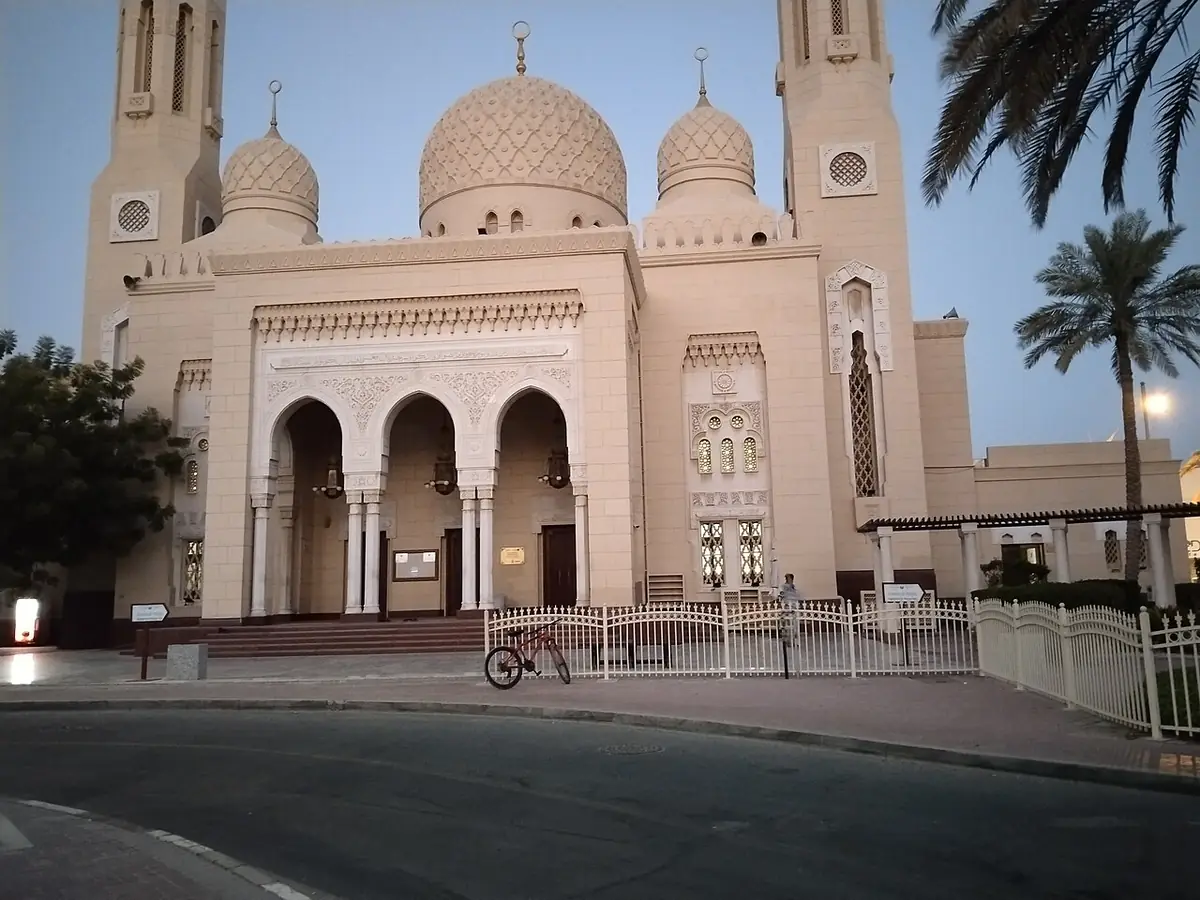
Jumeirah Mosque, a well-known landmark in Dubai — Photo: ZI Jony · CC BY-SA 4.0 · Wikimedia Commons
Once those reference points are in place, the location itself becomes the decisive variable in the figure.
Many property systems abroad rest on long standing notarial traditions, strict planning rules and their own tax treatment, and owners arriving from them carry those habits into their reading of value. On the Dubai market you find a fluid regulatory framework built around speed of transaction and openness to international capital. The comparison is not there to judge either model, but to show which new reflexes you need in order to read a figure correctly and avoid a cultural or legal misstep.
From abroad
Tightly capped rents and heavily protected tenants, common in many home markets
Dubai
A rental market regulated by the local land authority (RERA) with increases indexed to precise official benchmarks
You get clear visibility on how rent, and therefore the income a valuation can rely on, may evolve, though contractual flexibility works differently from what you may be used to.
From abroad
Systematic use of a notary to authenticate the deed and hold the funds
Dubai
Transactions overseen by the Dubai Land Department (DLD) and licensed agents (RERA), with escrow accounts for off plan property
The process is far quicker, but it demands rigorous checks on the credentials of the intermediaries and on the title itself before any figure means anything.
From abroad
Traditional shared building charges apportioned by fractional ownership shares
Dubai
Service charges calculated per square foot and voted through an owners association
The charge varies directly with the quality of what the community provides (pool, security, landscaping, gym), so two similar houses can value differently on that line alone.
From abroad
A dense historic urban fabric with long established rules between neighbouring plots
Dubai
Planned development in themed zones and gated communities raised from the desert within a few decades
The urban setting changes fast, so any valuation should be tested against the construction planned around your plot, which can move the figure in either direction.
How the district sets the baseline for your Dubai house valuation
The district you are in dictates the price band your comparables will come from.
Dubai does not read as a single market, and each district has its own identity, rhythm and resident profile, which is why comparables have to be drawn from the right one. Between established communities with mature trees and brand new ultra modern schemes the gap is considerable. Reading traffic conditions, distance from the employment centres and the quality of school and medical infrastructure tells you which price band your property genuinely belongs in.
Arabian Ranches and the long established communities
A settled residential calm with mature landscaping, cycle paths and a village atmosphere
Suits
Values resting on long term stability, a strong community feel and spacious, well insulated houses
Trade-off
Older stock that sometimes needs renovation, and relative distance from the business districts, both of which pull the figure down
Dubai Hills Estate and the integrated central areas
A managed buzz around a vast central park, a golf course and a leading shopping centre
Suits
Values supported by family living in a detached house within immediate reach of economic hubs such as Downtown
Trade-off
A higher price per square metre and greater build density than the outer edges, so the entry point for comparables is higher
Damac Hills and the fast developing sectors
Modern schemes built around leisure, with artificial lagoons, sports pitches and wide landscaped avenues
Suits
Values expressed as more floor area for the same money, which is what a measured budget is buying here
Trade-off
Longer journey times into the heart of the city at peak hours and active building sites nearby, both of which soften comparables
What the market data says a house in Dubai is worth
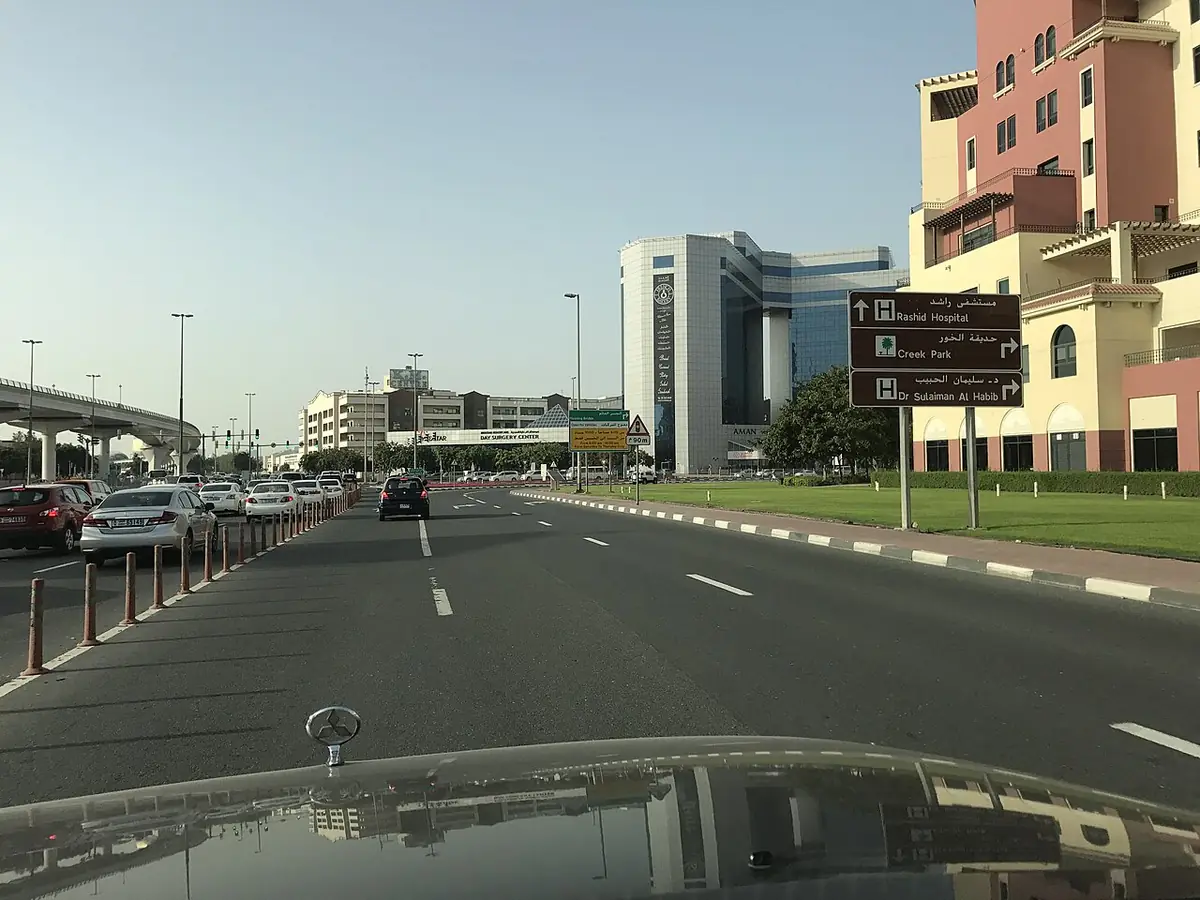
A typical Dubai street, wide and lined with modern buildings — Photo: Darvin.wilson · CC BY-SA 4.0 · Wikimedia Commons
Beyond the raw figures, the legal structure of your ownership deserves particular attention.
Any serious valuation separates the headline price from the unavoidable transaction fees and the recurring cost of ownership. In Dubai there is no traditional annual property tax, but the initial transfer fees and the service charges are budget lines no buyer ignores, and a figure that overlooks them will not survive negotiation. This set of benchmarks gives you a clear view of the ranges observed across property grades and locations, which is where any estimate of your own house should start.
dubaiFor saleHouseestimate
Median price / m²AED 11,685Half the apartments sell below this
Median priceAED 2.26mthe average is 14% higher — a few very large properties pull it up
Most common2 bedrooms58 % of listings
Average size184 m²
By number of bedrooms
Bedrooms
Share of market
Avg price
Price / m²
Avg size
2most common
58 %
AED 2.24m
AED 12,177
184 m²
3
31 %
AED 2.83m
AED 11,562best value / m²
245 m²
4
11 %
AED 4.29m
AED 12,915 +5 %
333 m²
Each row is an average, compared against the area average of AED 12,300 / m². These are indicative estimates of a typical local market, not a measured sample of live listings. Check current listings before relying on them.
What you actually hold, and what that does to the figure
The reliability of your figure also depends on the documents behind it being in order.
Ownership in Dubai follows specific rules that anyone valuing a property from abroad has to grasp before reading a single comparable. The market divides mainly between freehold zones and long lease zones. Understanding that distinction removes any confusion about the exact nature of the right being valued and about how it passes on, which is the first thing that separates two otherwise identical houses.
Freehold zones (outright ownership)
Within these government approved areas, foreign nationals can own the property and the land under it outright, with no time limit. The title deed is issued directly in your name by the Dubai Land Department, giving you the right to sell, let or pass on the property freely under the applicable succession rules.
What it changesYou are valuing a transferable, secure asset, which is the option the great majority of international investors prefer and the one that supports the fullest figure.
Leasehold zones (long leases)
These properties grant you an exclusive right of use under a long lease for a fixed term, generally between 30 and 99 years. Although the property is yours during that period and you can sell or let it, the land belongs legally to a third party or to the state, and the contract has to be renewed when it expires.
What it changesCheck the exact term remaining before you rely on any valuation, because the residual value shrinks as the lease runs down.
The rule to grasp before you trust any figure on your house
Let us look now at how the valuation process itself unfolds, from first enquiry to a figure you can defend.
Valuing property in Dubai is quick, but that speed must never come at the expense of the checks underneath the number. From the intention to sell form (Form F) through to final transfer at the Dubai Land Department, each stage produces evidence that either supports your figure or undermines it. Knowing the exact order in which those safeguards appear protects you against unpaid charges, hidden defects and intermediaries acting without proper authority.
Gathering the property paperwork and briefing an agent licensed by RERA on what the valuation is for
Check the registration of the agent and their agency on the official Government of Dubai register before you accept the figure they produce.
Read the offer forms (Form F / memorandum of understanding) behind recent local deals, since they fix the price, the conditions and the transfer date that make a comparable real.
Note that a security deposit (usually 10 percent) held by the licensed agency or broker until transfer day is what turns an asking price into evidence of value.
Obtain the no objection certificate (NOC) from the developer or community manager confirming that no service charges are outstanding, because arrears come straight off the net figure.
The completed transfer at the Dubai Land Department registry and the new title deed, which becomes the recorded comparable everyone values against next
How a valuation is produced and confirmed, step by step
A sound valuation in Dubai involves several parties working in sequence: the owner, the counterparty, the licensed agents and the regulators. For the figure to hold, it helps to understand what each of them contributes and in what order the formalities fall. This mapped out route takes you from a first estimate to a number recorded by the authorities and beyond dispute.
The ownerSetting the purpose of the valuation and obtaining a bank assessment where a mortgage is involvedThis first step keeps the exercise anchored to reality rather than to hope, and lets you react quickly when an opportunity appears on the market.
The estate agentSelecting comparable properties and arranging a targeted inspectionThe RERA licensed agent filters recent evidence against your precise criteria and works from properties whose legal position has already been verified.
Both partiesNegotiation and signature of Form F (the memorandum of understanding)This standard contract records the agreed figure along with the conditions, the payment schedule and the penalties if either side withdraws without cause.
The developer or community managerIssue of the no objection certificate (NOC)The community manager confirms that the seller is up to date on service charges and formally authorises the transfer, closing off a liability that would otherwise reduce the value.
The Dubai Land DepartmentOfficial transfer of funds and issue of the title deedOn the transfer appointment the final payment is validated and the authority registers the transaction, immediately issuing the new title deed and with it the public record of the price achieved.
House or apartment in Dubai: how the type of property moves the valuation
With the property type settled, what remains is the overall financial envelope behind the figure.
A house in Dubai is valued on a logic of asset and lifestyle that differs radically from that of an apartment held under an owners association. On one side, the villa or townhouse offers freedom of space, a private garden and no neighbour directly above or below, which changes family life profoundly and is priced accordingly. On the other, the apartment in a residential tower or a mid rise building frees the owner entirely from external upkeep, central air conditioning and the management of common areas, which shows up as a lower running cost rather than a higher price. Villa communities such as Arabian Ranches or Dubai Hills Estate promise a residential calm that is rare in a dense urban setting, but they demand constant involvement in maintaining pools, lawns and facades. Valuing a house in Dubai means accepting that service charges, known as maintenance fees, are often high even with no shared lift, because the infrastructure of the private communities is enormous.
An apartment in a district such as Downtown Dubai, Dubai Marina or Jumeirah Village Circle instead places the occupier at the heart of the city's flows. Services are built in: round the clock security, a gym, a shared pool and a concierge simplify life for working residents and for investors seeking rental liquidity, and all of that supports the figure. Density, however, brings parking pressure at peak hours and sometimes awkward dealings with the owners association over works or structural changes. So the central question behind a valuation is not only the price per square metre, but how much time you are willing to give to managing the property day to day in a demanding climate.
Financially, a well located house in a sought after community often benefits on resale from a growing scarcity of land, since the supply of spacious villas close to the centre is structurally limited, and that scarcity is one of the strongest supports a valuation can rest on. Apartments, by contrast, face stronger competition at resale because of the volume of new schemes delivered by local developers such as Emaar or Nakheel. Reading your own profile as an occupier is essential: if you intend to live there as a family all year, the house wins on quality of interior life and the valuation reflects that demand. If you want a flexible base that is easy to lock up and leave, the apartment remains the more rational option and prices as such.
The costs a realistic valuation of a Dubai house has to absorb
Let us look now at how these choices translate into the rhythm of an ordinary week, which is what a buyer is really pricing.
The value of a house in Dubai is not the headline price a developer or a seller quotes on the secondary market. You have to fold in unavoidable transaction fees together with an annual running budget that newcomers routinely underestimate. Community service charges, air conditioning bills and buildings insurance make for a heavy recurring line. Anticipating them at the point you calculate borrowing capacity, or test a valuation, prevents a painful correction in the first years of ownership.
Transaction costs to net off a Dubai house valuation
Cost item
Indicative rate or amount
Practical notes
DLD registration fee
4 percent of the purchase price
Payable to the Dubai Land Department on transfer of ownership, in principle shared between buyer and seller but often borne 100 percent by the buyer on the secondary market.
Agency fee
2 percent of the purchase price
Standard commission paid to the estate agent holding a valid RERA licence when the sale contract is signed.
Mortgage arrangement fee
1 percent of the amount borrowed
Bank processing fee, including the assessment of the property by a valuer approved by the lending bank.
NOC and transfer fees
AED 500 to 5,000
No objection certificate issued by the community developer to authorise the change of ownership.
These costs sit on top of the net figure the seller receives and call for cash on hand, since local banks generally do not fund them within the mortgage, which is why a gross valuation always overstates what an owner walks away with.
Annual running budget for a three bedroom house, and what it does to value
Type of cost
Estimated annual amount
What makes it vary
Community service charges
AED 10,000 to 25,000
Varies with what the community provides: security, landscaping, pool access, golf or a private beach.
Electricity and air conditioning (DEWA)
AED 12,000 to 22,000
Very heavily driven by the summer season from June to September, when the air conditioning runs continuously.
Preventive maintenance and contracts
AED 5,000 to 10,000
Annual air conditioning maintenance contract, upkeep of a small garden and plumbing inspections.
These estimates are based on the rates observed in established residential communities and can rise with habitable area and the age of the property, both of which a valuer adjusts for.
Health, schools, transport: the ordinary Tuesday a valuation is really pricing
Dubai's skyline at sunset, a fitting close to the day — Photo: Lxs · CC BY 4.0 · Wikimedia Commons
Beyond that apparent simplicity, some less visible factors deserve close attention before you settle on a figure.
The location of a house in Dubai shapes the whole organisation of a day, because of the distances between the outer residential zones and the business districts, and that lived experience is exactly what a buyer pays for. An ordinary Tuesday shows the reality of journey times, the use of school and medical infrastructure and the running of a household in a hot climate. Walking through it hour by hour highlights the logistical trade offs families here make daily, and which comparables silently reflect.
06:45Residential community (for example Dubai Hills)Waking in the house, checking that the central air conditioning is working properly and making family breakfast in a kitchen that opens onto the garden.
07:30Community exit and main road corridorsDriving the children to an international school 15 minutes away, using the main roads while they still run freely at that precise early hour.
08:30Business district (DIFC or Business Bay)Arriving at the office after a 25 minute drive. Parking in the building's underground car park and starting the working day.
13:00Local medical centreA quick check up at an approved clinic within the community, health services being distributed across all the major residential hubs of the city.
17:30Neighbourhood shopping centreA practical stop at the community mall to pick up fresh groceries and drop off items at the local dry cleaner before heading home.
19:00The villa gardenFamily time in the private outdoor space, enjoying the cool of the evening and the security offered by the gated community.
What a listing, or an automated estimate, will not tell you about a Dubai house
These blind spots lead directly to the most common valuation mistakes owners make.
Property marketing in Dubai excels at showcasing luxury finishes, open views and infinity pools, and an automated tool reading those listings inherits the same blind spots. Behind the glossy brochures sit technical, regulatory and environmental realities that owners generally discover far too late. Understanding these invisible factors is what separates a figure produced by a model from one that survives an inspection, and it is where an experienced valuer earns their fee.
The real build quality, developer by developer
Communities differ widely in thermal insulation and weather tightness. A second tier developer may leave cracking in external walls or water ingress during the rare but violent episodes of heavy rain, and repair costs on that scale come straight off any estimate.
Construction planned in the surrounding area
The Dubai planning picture moves fast. An open view over the desert or a green space can become the site of a new tower or a motorway within two years of purchase, altering both the calm and the value of your property in a way no current comparable captures.
The actual age of the air conditioning plant (HVAC)
The cooling system is the beating heart of a house in Dubai. If it is more than ten years old, full replacement runs to tens of thousands of dirhams, a figure sellers routinely leave out of the conversation and a straightforward downward adjustment on any valuation.
Strict limits on external alterations
Owning a house inside a master community means signing up to strict master community rules. You cannot repaint your facade, change your boundary wall or remove a wall without formal, chargeable approval from the manager, which narrows the improvements that could otherwise lift the value.
How the access roads really behave at peak hours
Some isolated communities have a single main access route onto major corridors such as Sheikh Zayed Road or Al Khail Road, creating heavy daily congestion despite the closeness shown on marketing maps, and buyers discount for it even when a model does not.
The valuation mistakes owners discover six months later in Dubai
Faced with these practical risks, it is worth asking whether acting on a valuation now really suits your situation.
Looked likeAn excellent case built on a headline gross rental yield above 8 percent in a developing area.
Turned outUnmanaged service charges and chronic void periods caused by the distance from the main employment zones, which cut the real net return, and with it the value, well below the figure quoted.
Would have caught itInsisting on the full history of charges paid over the last three years and testing genuine rental demand with independent professionals before you accept an income based figure.
Looked likeA turnkey villa needing no work at all, according to the photographs on the online portal.
Turned outDamp problems concealed behind fresh paint and defective window seals letting desert dust in during sandstorms, all of which a desktop estimate had silently priced as sound.
Would have caught itAlways commissioning an independent technical survey firm to produce a full condition report before signing the reservation contract (Form F), so that the adjustments are made on evidence.
Looked likeA mortgage easily agreed at the lowest rate thanks to a quick commercial understanding with the bank.
Turned outAn unexpected delay in the bank's own valuation of the property, triggering the late payment penalties owed to the seller set out in the original sale contract.
Would have caught itAllowing an extra thirty days of margin in the timetable set by the memorandum of understanding and working with a broker licensed in Dubai.
Looked likeA fully completed community with all its shops and schools open and working, which justified a premium in the figure.
Turned outRetail and school facilities shown on the masterplan model but pushed back several years by the developer because of slow approvals, so the premium was never actually there.
Would have caught itChecking progress with the Dubai planning department and visiting at different times of the week to see the reality behind the comparables.
Who should not act on a Dubai house valuation right now?
It is time to set out the basis of your final judgement and decide how to proceed.
Owning property in Dubai is often presented as an obvious tax and asset decision, and a strong valuation can make selling or buying look equally obvious, but neither suits every profile. Acting on a figure without long term visibility, or without sufficient savings behind it, exposes you to real losses when the transaction has to happen early. Recognising the situations where renting still beats owning, whatever the estimate says, is a mark of basic prudence.
Someone in Dubai for less than three years
→A flexible long term let of a furnished apartment or villa instead of acting on a purchase valuation.
Initial transaction costs (DLD, agency, arrangement fees) come to around 7 percent of the value of the property. A short stay does not allow those costs to be absorbed through an uplift in value or through rent saved, so a healthy looking valuation still leaves you behind.
An investor with a limited deposit and no cash reserve
→To keep their capital in liquid form, or to wait until they have built a more solid contingency fund.
A house brings unpredictable maintenance costs (air conditioning, water leaks, the pool) that cannot wait for a loan to be approved or for other assets to be sold in a hurry, and none of them appear in a headline valuation.
A professional whose job and geographic stability in the emirate are uncertain
→To rent, keeping full mobility in case of a change of employer or a return home.
Selling under time pressure in Dubai, if departure is forced, can mean cutting the price of the villa well below its valuation to find a solvent buyer within a few weeks.
So, do you now have a figure for your Dubai house that you can actually rely on?
Putting a value on a house or an apartment in Dubai is a considered exercise that mixes financial ambition with a lifestyle choice made in a demanding climate. If you have confirmed you will be here for at least the next five years, if your savings can absorb the transaction costs without straining your day to day cash position, and if you accept the management burden a private property carries, then the Dubai market offers a level of stability and quality of setting that a figure can fairly reflect.
Take the time to visit several communities at different hours, check the reputation of the long established developers and surround yourself with independent experts to audit every document before you sign the memorandum of understanding. The Dubai market rewards patience, financial discipline and a clear view of what you own, far more than it rewards the optimistic numbers put in front of you.
Related questions
What transfer and registration costs sit behind a house valuation in Dubai?
There is no notary in the traditional continental European sense in Dubai. Transactions are handled directly by the Dubai Land Department (DLD), which levies a registration fee of 4 percent of the purchase price of the property, an amount any realistic net figure has to account for.
Can a non-resident own, and therefore have valued, a property in Dubai?
Yes. Non-residents can own property outright (freehold) in the zones designated by the Government of Dubai, with no prior residence visa required, and that ownership status is one of the first things a valuation confirms.
How do service charges work in Dubai and how do they affect a valuation?
Service charges are calculated per square foot of habitable area and are regulated by RERA. They fund the upkeep of common areas, security, pools and the community landscaping, and a high or rising charge weighs directly on what a buyer will pay.
Does a Dubai property valued above a certain figure carry a residence visa?
Yes. A property worth at least one million dirhams (AED) can, under certain conditions, give access to a renewable owner visa issued by the local authorities, which is why a valuation close to that threshold deserves particular care.
How long does it take to turn an agreed valuation into a completed cash sale in Dubai?
A cash transaction can usually be completed in two to four weeks, the time needed to obtain the no objection certificate (NOC) from the developer and to carry out the official transfer at the DLD.
Do banks in Dubai run their own valuation when lending to foreign buyers?
Yes. Several local and international banks offer mortgages to non-residents, generally covering up to 50 or 60 percent of the assessed value of the property, and that assessed value is set by the bank's own valuer rather than by the asking price.
What is the NOC issued by the developer in Dubai?
The no objection certificate is a mandatory document issued by the community developer confirming that the current owner is up to date on service charge payments and authorising the transfer of ownership to the buyer.
Is there tax on the gain when a property in Dubai is sold above its earlier valuation?
There is currently no personal income tax and no capital gains tax on property in Dubai, which is one of the main tax attractions for investors and means an uplift in value is not eroded by a gains charge.
How do I check that the agent giving me a valuation in Dubai is credible?
Every estate agent must be registered with RERA and hold a valid professional broker card, which you can check through the official Dubai REST app before you take their figure seriously.
Which months are best for having a house inspected and valued in Dubai?
The period from October to April brings mild temperatures, ideal for walking the residential communities and assessing outdoor space and condition, although the property market itself stays active all year.