Valuing an apartment in Mumbai means reconciling several figures that do not measure the same thing: the price advertised on the portals, the value set by the Maharashtra ready reckoner, the amount recorded in neighbouring registered deeds and the security value a bank will accept. This guide is for the owner who wants to know what their property is worth before deciding whether to sell, keep it, refinance or divide an estate, whether they live in Mumbai or follow the matter from abroad. It covers floor areas, comparables, title, redevelopment potential and the costs that come off the figure.
Get the app
What nobody tells you.
Real prices, hidden costs and the traps to check before you commit.
What a valuation of a Mumbai apartment is really measuring
Scroll
What a valuation of a Mumbai apartment is really measuring
Valuing an apartment in Mumbai means reconciling several figures that do not measure the same thing: the price advertised on the portals, the value set by the Maharashtra ready reckoner, the amount recorded in neighbouring registered deeds and the security value a bank will accept. This guide is for the owner who wants to know what their property is worth before deciding whether to sell, keep it, refinance or divide an estate, whether they live in Mumbai or follow the matter from abroad. It covers floor areas, comparables, title, redevelopment potential and the costs that come off the figure.
Written by the ting.ad editorial team ·
Valuation Apartment Mumbai in Street View: drag to look around.
These gaps between figures do not carry the same weight depending on what you intend to do with the valuation, and that is the first thing to settle.
The owner of an apartment in Mumbai often hears a single figure, given by a broker or read on a portal, and takes it for the value of the property. In reality that figure mixes floor areas calculated on different bases, asking prices that were never paid, and buildings whose legal position bears no comparison. A serious valuation begins by separating market value, which registered sales confirm, from the administrative value set by the official schedule and from the security value a bank will adopt. In a city where land is scarce, the value of an apartment also depends on the building and the plot beneath it, not only on its finishes. The four contrasts below show where a figure can mislead you.
The price per square foot advertised on the portalsvsThe price actually registered at the sub-registrar's office
Mumbai listings show opening prices that build in room for negotiation and sometimes sit online for months without finding a taker. The amount written into the registered deed is, by contrast, the price a seller and a purchaser actually agreed. A valuation based on listings alone therefore almost always overstates the property, especially in buildings where several units are on the market at once.
The super built-up area quoted by the ownervsThe carpet area that can actually be used
In the resale market an apartment is often presented with a floor area that includes a share of lobbies, staircases and common facilities. Carpet area, as defined under the RERA framework, counts only the net usable space, which can cut the headline figure appreciably. Applying a price per square foot calculated on one basis to an area measured on another creates a gap that the purchaser, for their part, will spot immediately.
The market value a purchaser would acceptvsThe schedule value set by the state of Maharashtra
The ready reckoner gives a reference value by zone that serves as the minimum base for stamp duty and as a marker for the tax authorities. In sought-after areas the market usually runs above that schedule, while in some older or poorly maintained buildings it can come close to it. Knowing both figures avoids setting a price that tax will make expensive or that no purchaser will accept.
The value of the apartment as it stands todayvsThe value of the land and the building's redevelopment potential
In an older building of a few storeys, what the purchaser is assessing is often the area they could obtain in a future tower rebuilt on the same plot. That potential can lift value well beyond the state of the apartment, but it stays uncertain until the society has signed an agreement with a developer. An honest valuation draws a clear line between what is settled and what remains an assumption.
Which reading of value fits what you plan to do with your Mumbai apartment?
Dadar Chowpatty, where the city skyline meets the sea — Photo: Suraj Digrase · CC0 · Wikimedia Commons
Whichever use applies, value in Mumbai is built on benchmarks that surprise an owner used to a European market.
An owner preparing a sale, a landlord who wants to refinance, heirs dividing a property and a member of a society whose building is awaiting redevelopment do not need the same figure. The first is looking for the price a purchaser will pay within a reasonable time, the second for the value a bank will accept as security, the third for a dated and unarguable figure. Each purpose calls for its own method, its own professional and its own standard of proof. Confusing these readings leads to costly decisions, such as selling below market value or borrowing against a value the bank will refuse. The four situations below set out which figure matters in each case.
Realistic market value
If you are thinking of selling, the useful figure is the price at which a comparable apartment has actually sold recently in your building or in the same micro-market, brought back to the same carpet area. Brokers in Mumbai tend to quote the top of the range in order to win the listing, which can lead to a listing that drags on and finally sells below its value. Ask each of them for three precise registered sales, with the floor area, the level and the date.
Then set that figure against the ready reckoner rate for your zone: a price well below the schedule creates tax complications, while a price far above the comparables lengthens the time to sell. Finally deduct the commission, the society-related charges and capital gains tax so that you are reasoning in net terms, the only figure that lets you decide whether it is better to sell or to hold.
Rental value and security value
If you are keeping the apartment, two figures count: the rent it can reasonably produce and the value a bank will adopt for a loan secured on the property. In Mumbai, gross rental yields remain modest against prices, often cited at around two to three per cent a year, so that the value of an apartment rests on land more than on rent. A valuation by yield alone therefore generally understates the property.
The security value is set by a valuer on the bank's panel, who takes prudent comparables and penalises a missing occupation certificate or construction irregularities. Gather the documents before the inspection so that you avoid a discount that comes down to nothing more than an incomplete file. If you are a non-resident, also check with the bank the conditions attached to your status.
A dated and unarguable figure
In an estate or a division, the best valuation is not the highest but the one everyone will accept and that will withstand a challenge. A written report from a certified valuer, stating the date of valuation, the floor area adopted, the registered comparables and the schedule value, serves as a common basis. It also makes it possible to calculate a balancing payment if one of the heirs keeps the apartment and compensates the others.
Regularising title bears directly on value: until the transmission is recorded in the society's register and, where applicable, the will has been admitted to probate, a prospective purchaser will discount the property. Have a local lawyer confirm the applicable formalities before settling on a figure, and bear in mind that heirs living abroad may have reporting obligations on both sides.
Present value and potential value
If your housing society is in discussions about redevelopment, the value of your apartment depends largely on the terms of the deal: additional area promised in the new building, relocation allowance during the works, timetable and the financial standing of the developer. Two identical apartments can be worth very different amounts depending on whether the agreement is signed, under negotiation or merely contemplated.
Ask whoever values the property to present separately the value of the apartment in its current state and the projected value after redevelopment, with the assumptions used. A purchaser will pay only part of the potential until the municipal approvals are in place, because projects in Mumbai can take years. Acting on potential value as though it were settled is one of the most common errors in these buildings.
Valuing a Mumbai apartment from abroad: what works differently here
With those benchmarks in place, the next question is which area supplies the comparables that are relevant to your apartment.
An owner used to a European market expects public sale prices, a floor area standardised by law and a declared price in the deed that reflects the transaction. In Mumbai the data exists, but it is scattered, floor areas are measured in several ways, and an administrative schedule sits between the agreed price and the tax treatment. The professionals do not play the same roles either: the broker gives a commercial opinion, the valuer produces a report and the bank applies its own prudence. Understanding these differences stops you comparing figures that are not comparable. The four gaps below show what they change for your valuation.
From abroad
A public database of sale prices, searchable by address, that serves as the starting point for any valuation
Mumbai
Registered deeds accessible through searches with the registration department, but without a consumer tool as straightforward as that
The comparables exist, but you have to go and find them, often with help from a broker or a lawyer used to Index II extracts. Insist on verifiable sales rather than impressions, because an unsourced figure counts for nothing against a well-advised purchaser or a bank.
From abroad
A private floor area defined by statute, identical whoever you are dealing with
Mumbai
Three competing floor areas, carpet, built-up and super built-up, with prices most often expressed per square foot
Before comparing anything, bring every reference and your own apartment back to carpet area within the meaning of the RERA framework, and convert square feet into square metres if you think in metric terms. Without that step, the difference in area can create a bigger swing in value than the difference between two neighbourhoods.
From abroad
A free opinion of value from the agency, with an expert brought in for contested cases
Mumbai
An opinion of price from a broker, a report from a valuer on a bank's panel and, for formal purposes, a valuer registered with the IBBI
Choose the professional according to the purpose: a broker to position the asking price, a certified valuer for a division, a security or a tax file. State the purpose when you commission the work, because the method and the caution of the report follow directly from it.
From abroad
A price declared in the deed that serves both as a market reference and as the base for transfer duties
Mumbai
A ready reckoner schedule that sets a minimum value for stamp duty and acts as a marker for the tax authorities
Stamp duty is calculated on the higher of the agreed price and the schedule value, and a wide gap between the two can trigger a tax adjustment. Any valuation in Mumbai should therefore state the schedule value for the zone, even where the market sits well above it.
Which part of Mumbai sets the comparables for your apartment?
Once the right pool of comparables is identified, the market figures make sense as a benchmark for value.
In Mumbai, the value of an apartment is decided at the level of the micro-market, sometimes the street or the building, far more than at the level of the city. The same square foot can be worth several times more on Malabar Hill than on the outskirts, and two neighbouring buildings can diverge sharply according to their age, their legal position or their outlook. Choosing the right comparables therefore means identifying the pool in which purchasers of your apartment would genuinely weigh it against others. Each area also has its own valuation traps, from prestige that is hard to quantify to new launches that blur the resale market. The four cards below describe what the purchaser is paying for, the properties whose value reads clearly there, and what distorts comparisons.
South Mumbai (Colaba, Cuffe Parade, Malabar Hill)
The purchaser is paying for a historic address, proximity to the sea and to the financial institutions, and a scarcity of land that almost no new construction comes to relieve.
Suits
Apartments in established buildings where several units have changed hands recently, which supplies direct and credible comparables.
Trade-off
Sales here are few and very mixed, ranging from constrained older buildings to prestige towers, so a single poorly chosen comparable can shift the value by tens of per cent.
Bandra West and Khar
The purchaser is paying for lively street life, closeness to the seafront and quick access to BKC, with a demanding local and international clientele.
Suits
Mid-sized apartments in well-run societies, whose value reads easily thanks to steady demand and frequent transactions.
Trade-off
The high proportion of older buildings awaiting redevelopment blends present value with potential value, which makes comparables hard to interpret without knowing the state of each project.
Lower Parel and Worli
The purchaser is paying for recent serviced towers, closeness to offices and malls, and open views over the sea or the city.
Suits
Apartments in recent towers registered with MahaRERA, whose carpet area is documented and which have plenty of resale references.
Trade-off
Prices for new launches sold by developers, often with payment plans attached, pull expectations upwards and are not direct comparables for a resale apartment.
Andheri West and Powai
The purchaser is paying for more space per rupee, residential complexes with amenities and closeness to the technology and university employment hubs.
Suits
Standardised two- and three-bedroom apartments in large complexes, where numerous similar sales allow a precise valuation.
Trade-off
The abundant supply of comparable stock limits any margin above the market, and the effect of new metro lines or neighbouring construction can move value faster than the comparables reflect.
What an apartment in Mumbai is worth today: reading the figures as a benchmark for value
These numerical benchmarks only make sense once you have established what you actually hold, because title shifts value as much as floor area does.
The figures below are estimates drawn from listings: they show the levels at which apartments in Mumbai are being offered, and should be read as an indicative ceiling rather than as the value of your property. The most useful benchmark is the line matching your number of bedrooms, set against the actual floor area of your apartment, while checking which area basis your own figure was calculated on. Price per square metre falls as size rises, which rules out applying the price of a one-bedroom flat mechanically to a large apartment. Converted into square feet, the unit in everyday use in Mumbai, these levels then have to be tested against registered sales in your building and against the schedule value for your zone. The gap between those three figures is in itself a measure of how much confidence a valuation deserves.
MumbaiFor saleApartmentestimate
Median price / m²₹232,750Half the apartments sell below this
Median price₹19.5mthe average is 14% higher — a few very large properties pull it up
Most common2 bedrooms40 % of listings
Average size80 m²
By number of bedrooms
Bedrooms
Share of market
Avg price
Price / m²
Avg size
1
38 %
₹11.9m
₹264,600 +8 %
45 m²
2most common
40 %
₹17.2m
₹245,000
70 m²
3
17 %
₹24.4m
₹232,750 −5 %
105 m²
4
5 %
₹33.8m
₹225,400best value / m²
150 m²
Each row is an average, compared against the area average of ₹245,000 / m². These are indicative estimates of a typical local market, not a measured sample of live listings. Check current listings before relying on them.
What you actually hold in Mumbai, and what that changes about value
With title clarified, one simple rule tells you when a figure deserves to be treated as a value.
Two apartments of the same size, in the same neighbourhood, can be worth very different amounts depending on what their owner actually holds. In Mumbai many buildings are organised as co-operative housing societies, where you hold shares and a right of occupancy, and the land has not always been formally transferred to the society by the developer. Other buildings sit on land leased from a public authority or a private owner, with transfer conditions of their own. A well-advised purchaser and their bank examine these points before proposing a price, and a valuation that ignores them overstates the property. The two positions below summarise what supports value and what discounts it.
Land conveyed to the society and complete title
Where the developer has executed the conveyance of the land and building in favour of the co-operative society, where the building holds its occupation certificate and where your share certificate is in your name, the chain of title is legible to a purchaser and to a bank. If the developer never carried out that conveyance, Maharashtra legislation provides for a deemed conveyance procedure which the society can initiate with the competent authority. A building where that transfer is complete and where the society's accounts are up to date compares without difficulty against the best references in the area.
What it changesYour apartment can be valued at the level of registered comparables in its micro-market, and a credit-financed purchaser will obtain their loan more easily, which widens the market and supports value.
Leasehold land or conveyance never completed
Where the land is held on lease, from a public authority for instance, transferring the apartment may require the consent of the ground landlord and the payment of a fee or premium, and the unexpired term of the lease forms part of the value. Where the conveyance of the land to the society was never carried out, or where the occupation certificate is missing, banks turn cautious and a share of purchasers withdraws. Future redevelopment rights also become more uncertain, since the society does not have full control of the plot.
What it changesYour valuation has to build in a discount against comparables with complete title, or the cost and the delay of putting matters right, which only a local lawyer can quantify reliably.
The rule before treating a figure as settled in Mumbai: a price only becomes a value once it is verified
With that rule in place, the practical construction of a valuation follows a chain of people it pays to understand.
In Mumbai the figure that travels fastest is rarely the most accurate: a broker chasing a listing, a neighbour announcing the price of their sale, an advertisement that has been online for months. None of those amounts is a value until it has been tested against registered transactions, brought back to a consistent floor area and adjusted for title and the state of the building. Skipping one of those steps means deciding on an opinion, with the risk of selling too low, turning down a fair offer or dividing an estate on a basis that can be challenged. The chain below describes the move from a price you have heard to a value you can defend.
A figure you have heard: a broker's opinion, the asking price of a neighbouring apartment or an amount mentioned by another owner in the building.
Assemble at least three recent registered sales in the same building or in comparable buildings in the micro-market, with their date, their floor level and their declared amount.
Bring every reference and your own apartment back to the same floor area basis, carpet area within the meaning of the RERA framework, so that the prices per square foot are genuinely comparable.
Test the resulting range against the ready reckoner schedule value for the zone, so as to spot any gap that would raise a tax issue or flag an abnormal comparable.
Adjust the value for what the comparables do not share: occupation certificate, conveyance of the land, age and maintenance of the building, floor level, outlook and how far any redevelopment has progressed.
A reasoned range of value that you can defend to a purchaser, to a bank, to co-heirs or to the tax authorities.
How a valuation of a Mumbai apartment is built, step by step
A reliable valuation in Mumbai is not the work of one person but the meeting of several views of the same apartment. The owner brings the documents that drive value, the broker knows recent sales and the mood of purchasers, the official schedule sets an administrative floor, the valuer formalises the method and the bank applies its prudence. Each intervenes at a particular moment and can push the figure up or down. Knowing that sequence tells you whose opinion to seek for the decision you face. The steps below follow the most usual order.
You, the ownerGather the documents that drive valueAssemble the original deed, the society share certificate, the occupation certificate, the plans showing carpet area, the latest maintenance invoices and the property tax notice. A complete file stops a broker or a valuer applying a discount out of simple caution over a missing document.
The brokerOpinion of price and recent sales in the micro-marketThe broker places your apartment against recent sales and against the properties currently competing with it in the area. Ask for precise registered references, and be wary of a figure noticeably higher than those of their peers, which is often designed to win the listing.
The registration departmentSchedule value and registered deedsThe ready reckoner published by the state of Maharashtra gives the reference value for your zone, and searches of registered documents make it possible to check the declared amounts of neighbouring sales. Those two sources turn a commercial opinion into a verifiable range.
The certified valuerInspection, measurement and written reportThe valuer inspects the apartment, checks the floor area and the condition of the building, then writes a report setting out the method, the comparables and the date of valuation. That report is essential for a division, a tax file or a dispute, and useful whenever an important decision turns on it.
The bankSecurity value and the amount that can be financedIf the valuation is for a loan, or if your future purchaser is borrowing, the bank's valuer adopts a prudent value against which the bank lends only a fraction. This stage often reveals the concrete effect of title defects or the age of the building on the value that can actually be raised.
Apartment or house in Mumbai: how each type of property holds its value
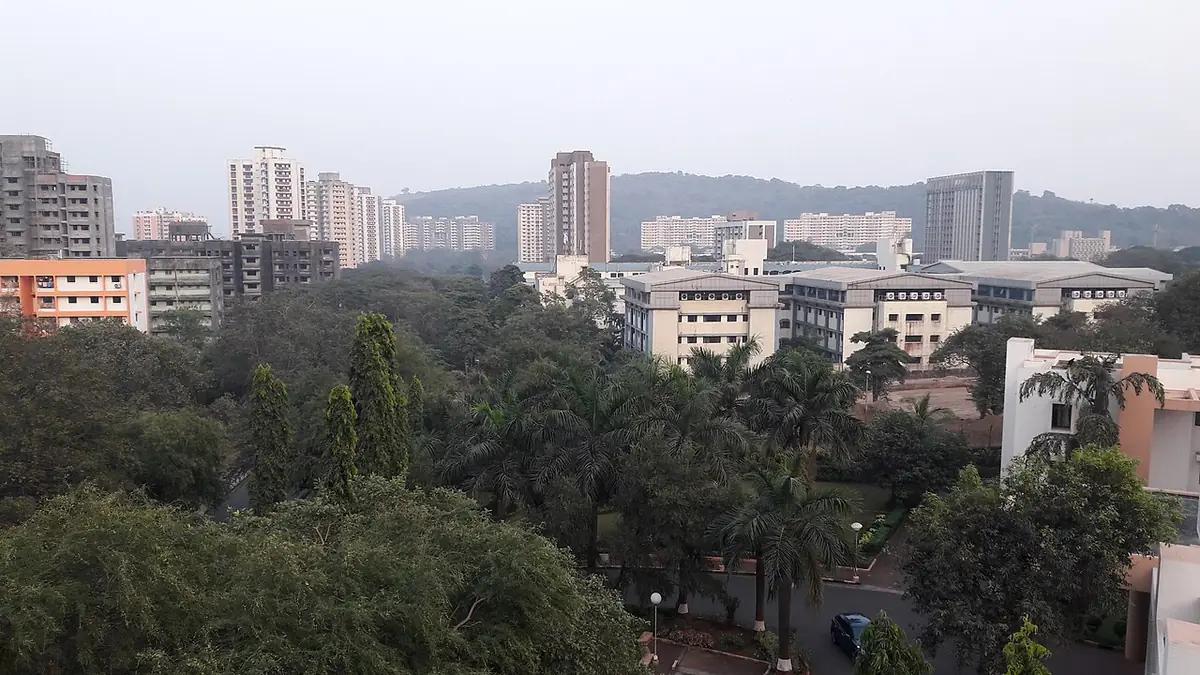
Apartment towers among the trees in Anushakti Nagar — Photo: arunpnair_787 · CC BY-SA 4.0 · Wikimedia Commons
In Mumbai the apartment accounts for most of the residential market, and that is precisely what makes its value easier to establish. In a tower or a complex organised as a co-operative housing society, units of similar size and layout change hands regularly, which supplies direct comparables. The value of an apartment nevertheless depends as much on the building as on the home itself: the age of the structure, the quality of the society's management, the level of the sinking fund, the presence of a generator, the reliability of the water supply and the status of the occupation certificate. Two identical apartments in neighbouring buildings can therefore diverge sharply, and a valuation should always begin with the building before coming down to the unit.
The standalone house, often called a bungalow in areas such as Juhu, Bandra or Malabar Hill, follows a different logic. Its value rests mainly on the land and on what may be built there under the city's planning rules, notably the floor space index applicable to the plot. Sales of houses are rare, highly varied and often tied to estates or to developer projects, so direct comparables are almost always missing. Valuing them generally runs through a land value, adjusted for constraints specific to the plot, such as coastal regulation rules in seafront zones, inheritance disputes or occupation by protected tenants.
Over time, the two types of property do not age in the same way. An apartment in a building that is getting older loses value on account of the structure, but can regain some if the building becomes a candidate for attractive redevelopment. The ready reckoner reflects part of this, since its application rules provide for adjustments, notably by age of construction or by floor level, which should be checked in the instructions for the relevant year. A house, by contrast, holds its value through the scarcity of land, but that value is accessible only to a very small pool of purchasers, which can greatly lengthen the time needed to realise it.
For an owner looking for a reliable valuation, the practical consequence is clear. An apartment is valued mainly by comparison with registered sales in its building and its micro-market, brought back to carpet area, then adjusted for title and the condition of the building. A house calls instead for a valuer's report built on land value and development rights, backed by legal advice on title. In both cases the soundest figure is the one that combines verifiable references, an area established without ambiguity and a clear legal position, because that is exactly what the purchaser and their bank will examine before committing.
What price levels to compare your Mumbai apartment against, and which costs come off the figure
A valuation is only useful if it is read on two levels: the market value of the apartment, set against price levels in its area, and the net amount that would actually remain with the owner after the costs of a transfer. The ranges per square foot below give an order of magnitude by zone, to be tested against registered sales in your own building. The second table lists the items that come off the figure, some of which depend on your tax and residence status. All these amounts are indicative, vary from case to case and should be confirmed by a broker, a valuer and a tax adviser.
Indicative price levels per square foot for comparing an apartment in Mumbai
Area / Zone
Observed price per square foot (INR)
What makes a comparable vary
South Mumbai (Cuffe Parade, Malabar Hill)
45,000 to 75,000 INR
Sea view, floor level, age of the building and status of the land; few sales, so each comparable carries weight.
Bandra West and Juhu (inner western suburbs)
35,000 to 60,000 INR
How far any redevelopment has progressed, distance from the seafront and the quality of the society's management.
Western Suburbs (Andheri West, Goregaon)
18,000 to 32,000 INR
Proximity to the metro and the suburban stations, age of the complex, shared amenities and competition from new launches.
Thane and the extended suburbs
9,000 to 16,000 INR
Abundant supply of similar stock, the standing of the developer and the effect of new transport infrastructure.
These ranges apply to recent or refurbished properties with clear title; always check which floor area basis has been used, and remember that the purchaser adds stamp duty and registration charges calculated on the higher of the price and the schedule value.
Costs that come off market value to reach a net figure
Item
Mechanism or order of magnitude
What it changes about your valuation
Broker's commission
Often in the order of 1 to 2 % of the price, negotiable and best agreed in writing
To be deducted from market value as soon as a sale is contemplated; check whether taxes are added on top.
Society maintenance, arrears and transfer charges
8,000 to 25,000 INR a month in maintenance; transfer charges framed by the society's bye-laws
Arrears have to be cleared to obtain the society's consent, and a live dispute discounts the apartment against its comparables.
Indian capital gains tax
Long-term gain beyond 24 months of ownership, at a reduced rate; short-term gain taxed at income tax slab rates
Rates and transitional options changed in 2024: have an Indian tax adviser compute the exact amount before reasoning in net terms.
Withholding and repatriation for a non-resident
Withholding operated by the purchaser on the gain, with a lower-deduction certificate possible; repatriation framed by the exchange control rules
Part of the proceeds can stay locked up until the return is filed, and the amount available in your home currency also depends on the exchange rate at the time of transfer.
An owner who is tax resident outside India will usually also have to declare the gain on an Indian property at home, under the double tax treaty between the two countries; have the interaction between the two charges confirmed before taking any decision.
Transport, schools, healthcare: the ordinary Tuesday a purchaser pays for in Mumbai
The purchaser of an apartment in Mumbai is not only paying for square feet: they are paying for the day they will be able to live from that address. In a city where journeys can double at peak times, travel time, access to schools and hospitals and the reliability of the building's services capitalise directly into prices. Two identical apartments diverge according to whether or not they allow someone to reach an employment hub without spending an hour in traffic. Following a typical Tuesday from Bandra West helps identify what, in your own surroundings, supports value and what a valuer ought to take into account.
07:30A residential building in Bandra WestThe morning reveals what the building actually guarantees: water supply hours, a generator for power cuts, security staffing and lifts in working order. A society that is well run on these points justifies a value near the top of the range for the area.
08:30The journey to the BKC business districtTravel time to the Bandra-Kurla Complex is one of the first criteria for a working purchaser, and every minute saved shows up in the price. Being close to a suburban railway station or a recent metro station supports the value of an apartment, especially for households without a driver.
09:15Bandra-Kurla Complex (BKC)The large employers, banks and head offices clustered at BKC sustain solvent demand in the surrounding areas, for ownership and for renting alike. That steady demand makes values more stable and comparables more plentiful around employment hubs.
13:00Hospital and clinics in BandraRecognised healthcare facilities nearby, such as Lilavati Hospital in Bandra, matter to families and to older owners. Quick access to care, in a city where distances are measured in time rather than kilometres, is part of what a purchaser accepts to pay for.
17:00Home time at an international schoolThe distance to sought-after schools, and the school bus journey it implies, strongly steers families towards particular micro-markets. A three-bedroom apartment within practical reach of well-regarded schools finds a taker at a fair price more easily.
19:30Local shops and the walk back to the buildingIn the evening, a purchaser gauges how easy daily life is: grocers open late, secure parking and a relatively quiet street. A congested street, or one that floods regularly during the monsoon, weighs on value even when the apartment itself is faultless.
What a headline figure will never tell you about your Mumbai apartment
An average price per square foot, or a schedule value, summarises an area and never a particular apartment. In Mumbai, several elements invisible in a listing or in a statistic shift the value of a property significantly, and they are exactly the ones a purchaser, their lawyer and their bank will check. Ignoring them produces a valuation that looks solid but collapses at the first offer or the first bank report. The five points below deserve examination before you treat a figure as the value of your apartment.
Whether the building holds an occupation certificate, and what it covers
A building without an occupation certificate, or with floors built beyond what the permit allows, makes banks reluctant to finance purchasers. The market then narrows to cash buyers, and the real value of the apartment sits below that of comparables with a complete file.
The floor area basis used in your documents and in the comparables
If your paperwork states a super built-up area while neighbouring sales are expressed in carpet area, or the other way round, the valuation can be far off the mark. Have the carpet area of the apartment measured or verified before applying any price per square foot to it.
How exposed the street and the building are to monsoon flooding
Some low-lying streets in Mumbai flood regularly in heavy rain, which blocks access to buildings and encourages damp on the lower floors. Local purchasers know these pockets and factor them into their offers, even though no statistic reflects it.
The real state of any redevelopment project for the building
Between a bare society resolution, a developer selected, an agreement signed and approvals obtained, the potential value of an older apartment varies considerably. Ask for the minutes and the status of the approvals before building any potential into your valuation.
Infrastructure and construction projects in the immediate vicinity
A new tower on the adjoining plot can remove a sea view that justified a premium, while a metro station or a new expressway can lift an area that was previously poorly served. Multi-year construction sites also weigh temporarily on the value of the most exposed apartments.
The Mumbai valuation mistakes that only surface six months later
Looked likeThe highest of the three brokers' figures, which seemed to confirm the value the owner was hoping for
Turned outA listing that stayed online for months, viewings without an offer, and a sale finally concluded below the level the other brokers had indicated from the start.
Would have caught itAsking each broker for three comparable registered sales, with floor area, level and date, and taking the best-argued figure rather than the most flattering one.
Looked likeThe area's price per square foot applied to the floor area shown in the original deed
Turned outAn area stated in super built-up terms while the comparables were expressed in carpet area, which inflated the value and sank the negotiation as soon as the purchaser's lawyer checked it.
Would have caught itChecking the area basis behind every figure, having the carpet area measured if need be, and applying a price per square foot only to an area of the same nature.
Looked likeThe ready reckoner schedule value adopted to divide an estate without discussion
Turned outOne heir keeping the apartment at a price well below the market, then family tension once the others discovered neighbouring sales.
Would have caught itCommissioning a dated report from a certified valuer, stating both market value and schedule value, and having all the heirs accept it before the division.
Looked likeThe value adopted by the bank for a refinancing, taken as the value of the apartment
Turned outAn asking price set too low on the basis of a prudent figure, when recent sales in the building pointed to a clearly higher market value.
Would have caught itAlways separating the bank's security value from market value, and testing the former against registered transactions before drawing any conclusion about selling.
Who should not act now on a valuation of a Mumbai apartment?
A valuation, however well built, is not always the right foundation for an immediate decision. Some owners of apartments in Mumbai hold a property whose value depends on events that are still uncertain, or find themselves in a position where acting quickly on a figure costs more than waiting. For them, the most useful step is to remove the uncertainty first, then have the property valued again on a settled basis. The three cases below illustrate those situations.
The society member whose building is negotiating a redevelopment
→To sell on the basis of the apartment's present value, without waiting for the agreement with the developer to be signed
Until the redevelopment terms are fixed, a purchaser discounts the potential heavily; depending on how the negotiations end, the value can move appreciably in either direction, and a figure established today risks being overtaken quickly.
Heirs whose transmission has not yet been regularised
→To set a selling price or a balancing payment from a valuation, while the transfer is unrecorded and the estate formalities remain open
A property with unregularised title sells at a discount and sometimes does not sell at all, so the value arrived at is not realisable as things stand; regularising first produces a valuation that matches a property that can genuinely be transferred.
The owner living abroad who relies on an old valuation converted into their home currency
→To take a decision about selling or dividing from a figure several years old and the exchange rate of the day
The Mumbai market moves micro-market by micro-market, the official schedule is revised, and the rupee exchange rate shifts the perceived value while saying nothing about the local market; a recent valuation in rupees, followed by a calculation net of tax, is the only reliable basis.
So how much confidence should you place in the figure you hold for your Mumbai apartment?
A valuation of a Mumbai apartment deserves your confidence when it rests on three matching pillars: recent registered sales in your building or your micro-market, an area established without ambiguity in carpet terms, and a clear legal position, from conveyance of the land to the occupation certificate. If the figure you hold comes from a listing, an unsourced broker's opinion or a bank valuation, treat it as a starting point and not as a value. If the range you arrive at sits far from the schedule value for your zone, find out why before deciding anything.
Confidence also depends on what you will do with the figure. To put a property on the market, reasoned opinions from several brokers tested against registered deeds may be enough; for a division, a tax file or a refinancing, a written and dated report from a certified valuer is called for. In every case, reason in net terms, after commission, society charges, capital gains tax and, for a non-resident, withholding and repatriation.
Finally, a valuation is a snapshot at a given date. The redevelopment of a building, a new construction site next door, a metro line or a revision of the schedule can move it within months. If your decision can wait, have the figure validated again at the moment you act; if it cannot, rely on the best-documented range rather than the highest one, and have the tax and legal points confirmed by local professionals.
Related questions
How do you value an apartment in Mumbai reliably?
A reliable valuation starts from sales actually registered in the same building or in comparable buildings in the same micro-market, not from asking prices on the portals alone. Every comparable has to be brought back to the same floor area basis, ideally the carpet area as defined under the RERA framework, then adjusted for floor level, the age of the building, condition and legal status. The result is then tested against the state's official rate schedule, which sets a minimum reference value for stamp duty. For a decision that commits you, a written report from a certified valuer is a useful complement to the opinion of brokers.
What is the ready reckoner rate and what part does it play in value?
The ready reckoner, or Annual Statement of Rates, is the schedule published by the Maharashtra registration department that sets a reference value per square metre by zone and by property category. Stamp duty is calculated on the higher of the agreed price and that schedule value. On the tax side, a declared price well below the schedule value can be challenged, with consequences for seller and purchaser alike. The schedule remains an administrative floor, however: in many sought-after areas, market value sits above it.
Carpet area, built-up or super built-up: which floor area should a valuation use?
Carpet area is the net usable area of the apartment, measured within the internal walls but excluding external walls, exclusive balconies and terraces, following the RERA definition. Built-up area adds the thickness of the walls and certain balconies, while super built-up area folds in a share of the common parts. Developers now have to state carpet area for registered projects, but resale listings still mix the three notions. Applying a price per square foot derived from one basis to an area measured on another distorts the valuation from the start.
Who can produce a formal valuation of an apartment in Mumbai?
Brokers give a commercial opinion of price, useful for placing the property but carrying no formal standing. Banks use valuers on their own panel, whose report determines the amount of a loan. For certain legal or accounting purposes, you go to a valuer registered with the Insolvency and Bankruptcy Board of India in the land and building category. Always state the purpose of the report when you commission it, because the method and the date of valuation follow from it.
Can you look up the prices of registered sales in Mumbai?
The Maharashtra registration department offers online search services covering registered documents, and extracts of the Index II type state the declared consideration of a transaction. Access, cost and the scope of searches vary by period and by office, and making use of the data often calls for a lawyer or a broker who works with it regularly. A broker active in your building will also know recent sales, but ask for verifiable references rather than recollections. Always set those amounts against the floor area and the level of the properties concerned.
Does the redevelopment potential of an older building change what my apartment is worth?
Yes, and sometimes more than the condition of the apartment itself. In an older low-rise building, purchasers often reason on the area they might receive in the future building, on the relocation allowance during works and on the standing of the developer chosen by the society. Until the redevelopment agreement is signed and the approvals obtained, that value remains an assumption which a purchaser discounts heavily. Ask whoever values the property to separate what is present value from what is potential.
I live abroad: can I have my Mumbai apartment valued remotely?
Yes. A broker can produce an opinion of price and a valuer can inspect the property in your absence, provided someone you trust or the society secretary gives access to the apartment. Prepare the documents that drive value from a distance: the original deed, the society share certificate, the occupation certificate, maintenance invoices and the property tax notice. Bear in mind that Indian rules on holding and transferring property by non-residents depend on your status as an NRI, an OCI or a foreign national. If the valuation is preparing a sale, confirm that status with an adviser before committing to a timetable.
Why is the value a bank adopts often lower than the market price?
The bank is not looking for the highest price a purchaser might pay, but for the amount it would prudently recover on a default. Its valuer therefore takes conservative comparables and applies adjustments for the age of the building, administrative irregularities or a missing occupation certificate. The bank then lends a fraction of that value, within the ratios framed by the Reserve Bank of India. A low bank figure is not a selling price, but it does signal what a credit-financed purchaser will actually be able to raise.
What value should be used for an estate or a division between heirs?
For a division, the key questions are the date of valuation and the method everyone will accept. A dated valuer's report, built on registered comparables and stating the schedule value, limits later challenges. The transmission formalities, whether transfer in the society's records or, in some cases, probate of the will through the court, also bear on value, because a property with unregularised title trades at a discount. Have a local lawyer confirm the steps that apply to your situation.
What gap is there between asking price and registered price in the resale market?
The gap varies with the momentum of the area, how long the property has been on the market and the quality of the title, but professionals often cite negotiation in the order of five to ten per cent off the price initially asked. In buildings where several similar apartments are for sale at the same time, the gap can be wider. A property presented with complete paperwork and a clearly established floor area generally settles closer to its asking price. For a valuation, then, treat registered prices as the benchmark and asking prices as a ceiling.