Valuing a house in Adelaide means putting a figure on two assets stacked on top of each other: a parcel of land, whose worth depends on its size, its shape and what the zoning allows on it, and a building whose condition, orientation and footings matter a great deal in a city built on shifting clay soils. This guide is for the owner who wants to know what their property is worth before deciding whether to sell, keep, refinance, divide an estate or review their insurance. It sets out which figures exist, what each of them actually measures, and how much margin of error to accept before basing a decision on one.
Get the app
What nobody tells you.
Real prices, hidden costs and the traps to check before you commit.
What valuing a house in Adelaide really measures: the land as much as the building
Scroll
What valuing a house in Adelaide really measures: the land as much as the building
Valuing a house in Adelaide means putting a figure on two assets stacked on top of each other: a parcel of land, whose worth depends on its size, its shape and what the zoning allows on it, and a building whose condition, orientation and footings matter a great deal in a city built on shifting clay soils. This guide is for the owner who wants to know what their property is worth before deciding whether to sell, keep, refinance, divide an estate or review their insurance. It sets out which figures exist, what each of them actually measures, and how much margin of error to accept before basing a decision on one.
Written by the ting.ad editorial team ·
Valuation House Adelaide in Street View: drag to look around.
Before comparing figures against each other, you need to know which one matches the use you will make of the value.
The owner of a house in Adelaide instinctively thinks of its value in terms of what they paid, what their renovations cost or the figure a neighbour mentioned. A sound valuation measures something else: the price an informed buyer would accept today, having compared your allotment and your building with recent sales in the same area. That value almost always splits into two blocks, land that carries most of the long-run growth and improvements that age, date and cost money to maintain. Several figures circulate for the same house, from the administrative capital value to a valuer's report by way of an agent's appraisal, and they differ not by mistake but because they answer different questions. Knowing which one you are holding is the first condition for making any use of it.
A single, reassuring number you can remember and quotevsA range of value with an acknowledged margin of uncertainty
Professionals work in ranges because the market for detached houses is made of unique properties. An isolated figure, given without an interval or a date, implies a precision that does not exist.
The value of what you built, renovated and maintained over the yearsvsThe value of the location, the size and the shape of the allotment
The market rarely repays a renovation at what it cost, yet it pays without argument for frontage width or a north-facing garden. On a house, the trade-off between those two components explains most valuation gaps.
A gross value, the sort that appears in a listing or on a reportvsThe amount that would actually remain after commission, fees and tax
Between the two sit the agent's fee, the conveyancer, discharge of any mortgage and capital gains tax. A valuation only becomes actionable once you have done that net calculation.
What your house is worth as it stands today, lived in and furnishedvsWhat the land is worth if a buyer intends to demolish or divide
In some Adelaide suburbs the second reading exceeds the first and sets the price outright. Elsewhere a character overlay or a protected tree removes that potential and brings value back to the existing house.
Selling, keeping, refinancing or dividing: which value are you looking for on your Adelaide house?
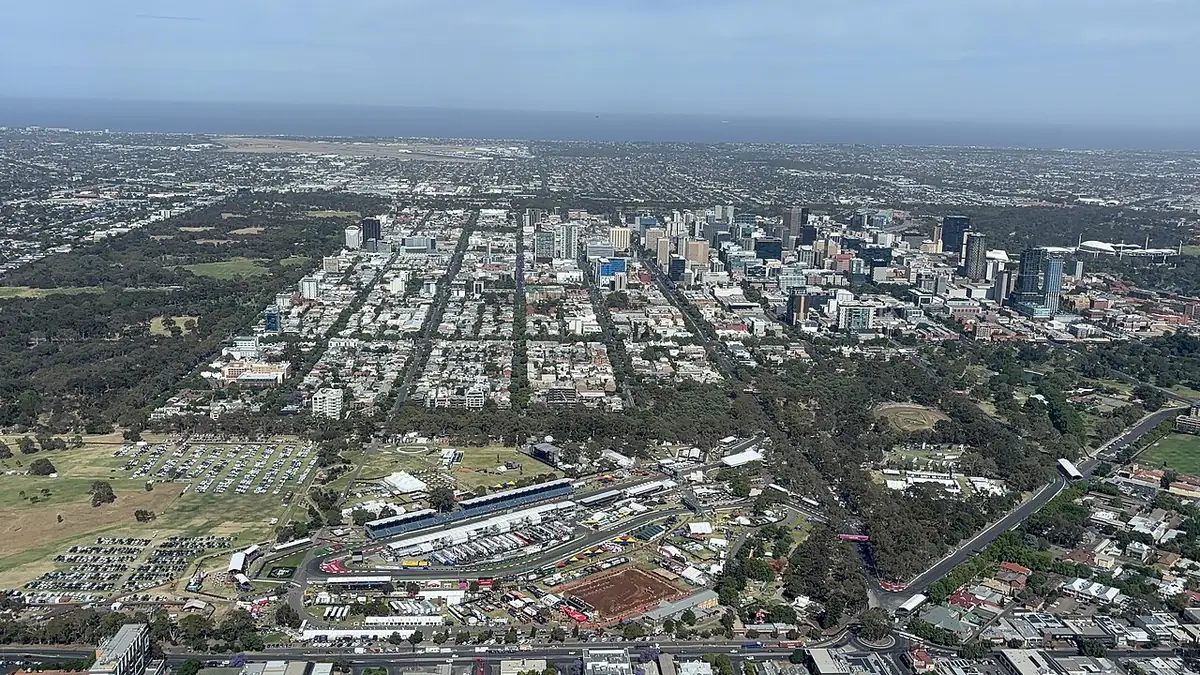
Adelaide from above, a grid city ringed by parklands and suburbs — Photo: Avatar5991 · CC BY-SA 4.0 · Wikimedia Commons
Those uses then run into habits from other markets that do not transfer directly to South Australia.
One house does not have a single value but several, and the use you will make of the figure is what determines which one counts. An owner preparing to go to market wants the price the market would pay within a reasonable selling period, while an heir wants a value that will stand up before a notary or an authority. Refinancing depends on a cautious figure produced for the lender, and insurance is interested in neither, since it reasons in terms of rebuilding cost. Identifying your situation avoids the costliest confusion of all, which is taking a figure produced for one purpose and basing a decision of a quite different kind on it.
The owner preparing to go to market
What matters to you is the achievable price, meaning the amount an informed buyer would accept over a normal selling period for your area. Obtain two or three agent appraisals and always ask for the comparable sales behind them, setting aside any that involve allotments or conditions very different from yours. In Adelaide, auction remains widely used and the advertised price strategy differs from the figure being targeted, which makes agent appraisals harder to read than they first appear. Settle on a range rather than a point, and work out straight away what would remain after commission, legal fees and the tax treatment that applies to your situation.
The owner staying put who needs a solid reference
You do not need the most flattering price but a robust figure, one that will hold up in front of a lender or an insurer. The lender will instruct its own valuer, whose cautious approach often produces a value below the agent's appraisal, without either of them being wrong. If you let the property, also check the site value set by the Valuer-General, since it is the base for land tax, from which a principal place of residence is generally exempt but an investment property is not. A well-documented value also gives you a starting point for measuring, in three or five years, what the area has actually done.
The owner who needs a defensible figure
Here an agent's appraisal will not do: you need a written, dated report from an independent valuer who carries professional responsibility and sets out their method. Specify at the outset the date the value must relate to, because an estate sometimes calls for a retrospective valuation at a past date rather than the day of the inspection. Ask for the report to separate the land component from the improvements explicitly, which is decisive information when the heirs do not share the same plan for the property. Make sure, too, that the document will be readable abroad, where it may have to be produced before a notary or a tax authority.
Valuing an Adelaide house from overseas: the habits that do not transfer
The next question is where the comparables that will actually set your figure come from.
Valuation habits formed in another market rest on an ecosystem of data and conventions that has no exact equivalent in South Australia. Here, value is not read first in internal floor area but in the allotment, and the reference document is produced by a certified valuer rather than by a notary. Auctions, very common in Adelaide, blur the reading of advertised prices, since those serve as bait rather than as a target. Understanding these gaps stops you mapping a familiar grid mechanically onto a market that does not reason in the same units.
From abroad
Value calculated first from internal floor area, compared with the local average
Adelaide
Value that starts from the land, its size, its shape and what the zoning allows on it
Compare allotments with each other first, then adjust for the building: the reverse order produces large errors on a detached house.
From abroad
Consolidated price references published by official bodies and free to consult
Adelaide
Sales recorded with the land registry, plus commercial data sold by subscription
Budget for access or use a local intermediary to obtain reliable comparables, because listing portals only ever show asking prices.
From abroad
A single legal officer as the compulsory step, holding the memory of local prices
Adelaide
A certified valuer for defensible reports, an agent for commercial appraisals
Choose the professional according to the use of the figure, and do not expect an agent to issue a document that carries liability.
From abroad
An administrative value used only for local taxation, with no link to the market
Adelaide
A capital value and a site value reassessed each year, close to a market logic
Those official figures are a usable trend indicator, provided you remember they are dated and ignore the particulars of your own house.
Which parts of Adelaide supply the comparables for your house?
Those local references only make sense once set against the price levels actually being asked across the city.
A valuation is only as good as the sales you compare your house with, and in Adelaide the logic of value changes sharply from one ring of suburbs to the next. In the older eastern and southern suburbs, character protection and the scarcity of allotments hold values up while curbing any division potential. On the western coast, value is read in distance from the beach far more than in floor area, which makes comparables highly sensitive to a few streets of difference. In the northern and southern corridors, where blocks are larger and stock more uniform, comparables are plentiful and the valuation range tightens considerably.
The older eastern and southern suburbs (Unley, Norwood, Burnside)
Streets lined with mature trees, turn-of-the-century stone villas, neighbourhood cafés and immediate access to the park lands ringing the city.
Suits
Comparables here are scarce and highly specific: look for sales of the same architectural period, the same frontage width and the same character overlay as your house.
Trade-off
Division potential is usually blocked, which removes the option value of the land and makes the valuation entirely dependent on the condition of the existing building.
The western coast and beachside suburbs (Glenelg, Henley, Semaphore)
Life turned towards the sea, cycling along the foreshore, and a population that swells considerably between November and March.
Suits
Value falls here in very distinct steps as you move back from the beach: compare only with sales in the same band of distance from the shore.
Trade-off
Exposure to sea air, corrosion and, on some stretches, coastal erosion or inundation risk justify checks that raw comparables simply ignore.
The northern and southern growth corridors (Mawson Lakes, Morphett Vale, Golden Grove)
Planned estates, regular allotments, schools and shopping centres reached by car, and a predictable family rhythm.
Suits
Because stock is uniform, comparables are numerous and the range tightens: a handful of recent sales in the same estate is often enough.
Trade-off
Land value grows more slowly here and depends more heavily on infrastructure announcements and the pace at which new estates are released nearby.
Where do Adelaide houses sit today?
An independent bookshop under a shopfront verandah — Photo: Nick-D · CC BY-SA 4.0 · Wikimedia Commons
These levels say nothing yet about what you legally hold beneath your house, which changes the value all the same.
The figures below come from listings and describe the levels at which Adelaide houses are being offered, not certified values or prices actually signed. Start from the line matching your bedroom count, then treat the price per square metre as a sanity check only: on a house that ratio blends land and building value and distorts as soon as the allotment departs from the average. Adjust the reference by what genuinely makes the difference in Adelaide, namely the size and shape of the block, the frontage width, the orientation of the garden, the state of the footings and whether any division potential exists. Bear in mind that advertised prices include room to negotiate and that overpriced properties stay online longer, which pulls the averages upward. Finally, test that base against sales recorded in your street and your school zone over the past six to twelve months, which remain the strongest evidence.
AdelaideFor saleHouseestimate
Median price / m²A$5,765Half the apartments sell below this
Median priceA$1.12mthe average is 14% higher — a few very large properties pull it up
Most common2 bedrooms42 % of listings
Average size184 m²
By number of bedrooms
Bedrooms
Share of market
Avg price
Price / m²
Avg size
2most common
42 %
A$903k
A$6,068
149 m²
3
39 %
A$1.21m
A$5,765
210 m²
4
20 %
A$1.66m
A$5,583best value / m²
298 m²
Each row is an average, compared against the area average of A$6,068 / m². These are indicative estimates of a typical local market, not a measured sample of live listings. Check current listings before relying on them.
Torrens title or community title: what sits beneath the value of your Adelaide house
With ownership settled, it remains to understand why two serious professionals arrive at two different figures.
South Australia is the birthplace of the Torrens system, where it is registration on the land register that creates the right, not the deed that preceded it. For a house, the decisive question is whether you hold a whole allotment or a lot within a commonly managed scheme, because the two are not valued in the same way. Title also determines what neighbours can require of you, through easements, rights of way and the pipes that sometimes cross the back garden. These details appear on the title and in the Form 1 the seller provides, and a careful valuer reads them before settling on a figure.
The freehold allotment (Torrens Title)
You hold the land and everything on it, with no collective body and no levies, subject only to zoning, any applicable overlays and the easements noted on the title.
What it changesValue is read from the land first: area, frontage, orientation and division potential set the floor, with the building adding a residual value that depreciates with age.
The lot within a scheme (Community or Strata Title)
Your house forms part of a wider scheme with roads, gardens or facilities managed collectively, under a set of by-laws and periodic levies.
What it changesValue then also depends on the financial health of the corporation and the level of the levies, and any prospect of dividing the land is effectively nil.
Why two valuations of the same Adelaide house produce two different figures
The divergence clears up as soon as you follow, in order, who produces which figure and for what purpose.
Receiving two figures tens of thousands of dollars apart for the same house is entirely normal and does not mean a professional has got it wrong. Each valuation starts from a distinct question, selects its comparables accordingly and applies a different degree of caution depending on the liability involved. The rule to remember fits in one sentence: a value exists only in relation to a use, a date and an acknowledged set of comparables. Following the chain from instruction to final figure shows where the gaps sit, and which of them should worry you.
You ask what your Adelaide house is worth, without specifying who the figure is for or what date it should relate to.
The local agent answers with a commercial appraisal based on the sales they know, aiming at the upper end of the plausible range because their objective is to win the listing.
The certified valuer works from a narrower set of comparables, adjusts each difference in allotment and condition, and produces a dated value for which they are professionally answerable.
The valuer instructed by the lender applies a further margin of caution, because they are assessing what could be recovered on a forced resale rather than the best achievable price.
The Valuer-General, meanwhile, has already assigned a capital value by mass appraisal at an earlier reference date, without ever having inspected the inside of your house.
All four figures are consistent with their purpose: the one to rely on is the figure produced for the use you will make of the decision, with the others serving to test how plausible it is.
Who produces the figure: the steps in valuing a house in Adelaide
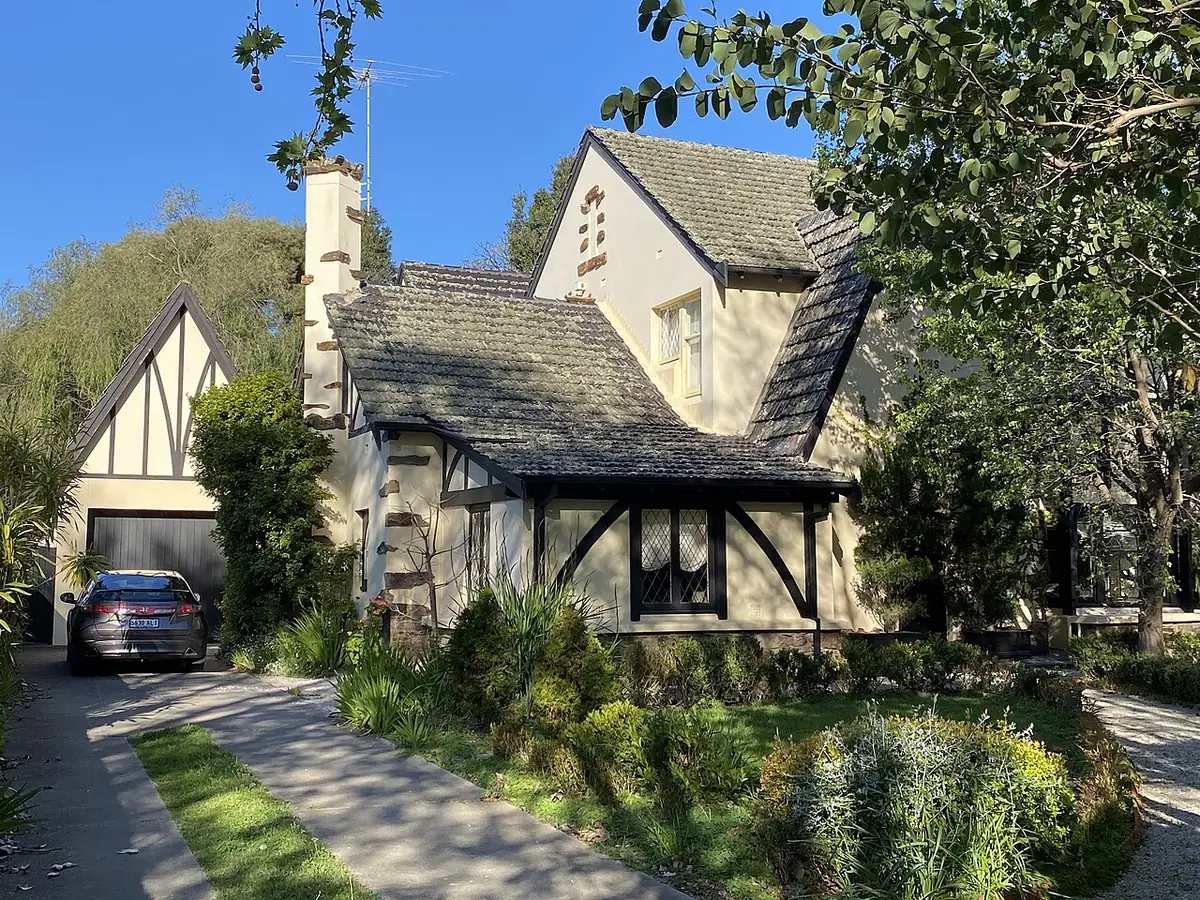
A Tudor Revival home with a leafy front garden in Adelaide — Photo: Ashton 29 · CC BY-SA 4.0 · Wikimedia Commons
Getting a usable value for an Adelaide house means drawing on several sources in a particular order, each correcting the blind spots of the one before. The land registry establishes what you hold, the planning portal says what the land allows, recorded sales supply the comparative material, and only a professional pulls it all together into a defensible figure. Skipping a step saves no time: it simply moves the uncertainty to the moment when a binding decision rests on the figure. This sequence works as well from overseas as it does from Adelaide, provided you allow for the time it takes to obtain documents.
The ownerGather the title, the allotment plan and the property's historyAssemble the certificate of title, the plan showing area, shape and easements, any planning approvals obtained and invoices for structural work carried out.
The land registry (Land Services SA)Check what is recorded on the titleA title search confirms boundaries, easements, rights of way and any notations, all of which bear directly on the value of the land.
The planning authority (PlanSA)Establish what the zoning allows on the allotmentThe zone and any applicable overlays determine what can be built, whether the block can be divided, how character is protected and which trees are regulated.
The Valuer-GeneralNote the current capital value and site valueThese two administrative figures give a trend indicator and, above all, the official reading of how much of the total value is attributed to the bare land.
The local real estate agentObtain two or three documented commercial appraisalsInsist on the list of comparable sales relied upon and the adjustments made, then discard any appraisal that rests on no recent recorded sale at all.
The certified valuerCommission a written, dated and reasoned reportEssential for an estate, a division of assets, a lender or a tax matter, this report states the value, sets out the method and acknowledges a margin of uncertainty.
House or apartment in Adelaide: which holds its value, and on what
A detached house and an apartment hold their value through different mechanisms, and the difference begins with the land. A house combines a building that depreciates, year after year, with an allotment that cannot be reproduced in Adelaide's already built-out suburbs. Over the long run it is almost always the land that carries the growth, which is why a modest house on a large, well-placed block ends up worth more than a recent build on a narrow one. A serious house valuation therefore begins with the value of the land and adds what the improvements still contribute, rather than the other way round.
An apartment follows different mechanics. The share of land is diluted across every lot, so value depends far more on the building itself: the floor, the outlook, the parking, the quality of construction, the level of levies and the state of the sinking fund. Those factors are easier to compare, since several lots in the same building sell regularly, which tightens the valuation range. In exchange, an apartment's value reacts sharply to new developments completed in the same area, which can temporarily saturate supply and weigh on achievable prices.
In Adelaide this contrast is reinforced by a very clear geography. Houses in the inner ring, particularly in suburbs covered by a character overlay, are becoming scarce, and their value rests on steady demand for a stock that no longer grows. Apartments cluster in the city centre, along the tram corridors and around the university campuses, where student rental demand and new supply largely dictate value. Comparing the two segments directly makes little sense: they respond neither to the same signals nor at the same pace.
That leaves liquidity, which matters as much as the value itself once a decision is in prospect. A family house well placed in a sought-after school zone finds a buyer quickly, but unusual, very large or heavily personalised properties appeal to a handful of people and carry a discount for time on market. An apartment, being more standardised, compares quickly but remains exposed to the number of similar lots offered at the same moment in the same building. In both cases a useful valuation carries not only a figure but also an estimate of how long it would take to achieve it.
The price references to test your Adelaide house against, and what comes off them
A valuation becomes usable when it answers two questions: where your house sits against the available references, and what would remain of that value after the costs of a possible sale. The references are not equivalent, because an asking price, a recorded sale, an administrative capital value and a valuer's report do not measure the same thing. The costs, for their part, depend on your tax residence, the use you have made of the property and whether a mortgage has to be discharged. The tables below are indicative, replace neither a quotation nor tax advice, and should be tested against official documents before any decision.
The value references to test your Adelaide house against
Reference
Order of magnitude or nature
How to read it for your house
Asking prices for a standard house
AUD 750,000 to 950,000 for three or four bedrooms in well-served middle-ring suburbs
A ceiling to read against rather than a value: these levels include negotiating room and properties that will not sell at that price.
Comparable recorded sales
Prices actually signed in your street or your area, ideally within the past six to twelve months
The firmest reference: adjust each comparable for land area, frontage width, orientation and the condition of the building.
Valuer-General capital value and site value
Administrative values reviewed each year, the base for council rates, water-related charges and land tax
Useful for the trend and above all for isolating the land component, but produced by mass appraisal at a date earlier than your reading.
A certified valuer's report
Often a few hundred dollars for a standard house, more for a large allotment or an unusual property
The only dated, reasoned document that holds up before a lender, a notary or an authority; an agent's appraisal stays free but commercial.
Figures drawn from listings are estimates taken from the data on this page and must be tested against recorded sales before any decision.
What comes off the gross value of your house
Item deducted from value
Range or mechanism
Effect on the figure you keep
Agent commission and marketing budget
Commission most often in the order of 2 to 3 per cent of the price depending on the agency and the agreement, plus an advertising budget negotiated separately
Deduct from market value to obtain the net proceeds; an auction campaign generally increases the marketing budget.
Legal and settlement costs
AUD 1,500 to 3,000 in conveyancer's fees, plus searches, discharge of any mortgage and the apportionment of local rates
Modest against the price, but worth providing for: it all falls due at settlement, before the balance reaches you.
Capital gains tax and applicable withholding
A main residence exemption may apply for an Australian resident; withholding is taken at settlement where no ATO clearance certificate is produced
The heaviest item for an investment property or a non-resident owner: have your own case costed with the ATO and a tax adviser in your country of residence.
The rules applying to non-resident sellers have been tightened in recent years: check the current arrangements with the ATO before relying on a net figure.
The ordinary Tuesday a buyer of an Adelaide house is paying for
Saint Ignatius Church and its twin towers in Norwood — Photo: Ashton 29 · CC BY-SA 4.0 · Wikimedia Commons
Much of a house's value is built on things no table quantifies directly: the real commute, the school zone, the distance to the supermarket, how cool the garden stays at the end of the day. An informed buyer tests all of that before making an offer, and it is precisely this ordinary Tuesday they are paying for or declining to pay for. Walking through a typical day in your area tells you, concretely, which arguments your valuation can rest on and which ones will be challenged.
07:00The garden and the orientation of the houseGarden orientation and overshadowing decide comfort from the first hours of the day. In Adelaide a northern aspect and mature trees are worth more on resale than a good deal of recent interior work.
08:15The local school runThe school zone is one of the few factors that translate directly into a price gap between two neighbouring streets. Check the exact boundary, because it sometimes runs through the middle of a block.
08:45The commute into central AdelaideReal travel time at peak hour, by car or by bus, tram and train, counts for more than distance as the crow flies. Direct access to a major line supports the value of an area over the long term.
12:30Local shops and servicesA shopping centre, a medical practice and food shops within a few minutes widen the pool of potential buyers. An area without those services compares less well and sells more slowly.
17:30Parking and access to the propertyFrontage width, a garage and room for a second vehicle without manoeuvring all weigh on the value of older suburban houses. Awkward access carries a discount that owners regularly underestimate.
19:00The house in the evening, heat and noiseThermal mass, insulation quality and cooling matter a great deal during summer heatwaves. Noise from a busy road or a flight path only reveals itself at night, and it holds offers back.
What no online estimate will ever see in your Adelaide house
Automated estimators work from suburb averages, a bedroom count and a declared floor area, which are variables that explain the value of a detached house poorly. Everything that makes the real difference in Adelaide comes down to characteristics of land and soil that no algorithm reads without an inspection and a documentary search. These are exactly the points a serious buyer will have checked before confirming an offer, and they open the gap between the figure shown online and the value that is actually realised. Reviewing them tells you which way to correct a figure that looks too smooth.
How the clay soils behave beneath your footings
Much of the Adelaide plain sits on clays that swell and shrink with the seasons, placing heavy demands on footings. Progressive cracking, a slab that has moved or openings that stick attract a discount well above the cost of the repair, because the market is also buying peace of mind. A recent engineer's report, by contrast, secures the figure you are defending.
Zoning and the division potential of the allotment
The option value of land depends on the applicable division rules: minimum area, frontage width, access and where a second dwelling could sit. On a wide block in a well-served corridor, that reading can push value above the worth of the existing house. On a block constrained by an overlay or a protected tree it disappears entirely, and the valuation must reflect that.
Easements and services recorded on the title
A right of way, a sewer main crossing the back garden or an easement over outlook limits where an extension, a shed or a pool can be placed. These entries appear on the title and in the Form 1 provided by the seller, but on no listing portal. They reduce the genuinely usable area and therefore the value, often materially on smaller blocks.
Exposure to local climate hazards
Depending on location, a house may sit within a bushfire risk area, notably on the slopes of the Adelaide Hills, or be exposed to stormwater run-off during heavy rain. Both affect the cost and sometimes the availability of insurance, a line a buyer prices before making an offer. A high premium translates mechanically into a lower offer.
The house valuation mistakes that surface six months later in Adelaide
Looked likeA flattering agent appraisal, well above the other two, taken as the right one.
Turned outA property left online for months, two successive price reductions and a final negotiation below the level the other agents had quoted from the start.
Would have caught itAsking each agent for the comparable sales behind their figure, discarding the highest and the lowest, and working from the documented middle of the range.
Looked likeA full interior renovation costing tens of thousands of dollars, assumed to be recovered in full.
Turned outOnly partial recognition in the price, because the market already assumed a renovated standard in that area and does not pay for highly personal finishes.
Would have caught itComparing, before committing to the work, the prices achieved by renovated and unrenovated houses in the same street, and counting only the gap actually observed.
Looked likeA capital value arriving with the council rates notice, taken for the market value of the house.
Turned outA figure produced by mass appraisal at an earlier reference date, with no interior inspection, which ignored the recent extension and the real condition of the building.
Would have caught itTreating the capital value as a trend indicator and a reading of the land component, then testing it systematically against recent recorded sales.
Looked likeA large allotment assumed to be divisible, valued in the owner's mind as two building blocks.
Turned outA division that proved impossible in practice, for want of sufficient frontage width and because a regulated tree stood exactly on the intended access.
Would have caught itHaving the zoning, the overlays and the division rules checked with the planning authority before building any option value into your figure.
Who would be wrong to act now on an Adelaide valuation
A valuation informs a decision but does not replace it, and some situations leave the figure too fragile to rest on. An unusual property, a local market with no recent transactions or an unresolved tax question all introduce uncertainty that the apparent precision of a number conceals. In those cases the right answer is usually to document further rather than to act quickly on an uncertain value. Recognising these profiles stops a comfortable valuation turning into an expensive decision.
The owner of a very unusual or heavily personalised house
→To commission a valuer's report rather than rely on a suburb average
Automated tools and quick appraisals rest on comparables that do not exist for an atypical property, and the gap between the quoted figure and the achievable value can run to tens of per cent.
The heir who must divide a property between several beneficiaries
→To obtain a dated, reasoned value before any family discussion begins
An approximate figure debated between heirs hardens positions that are hard to unwind later, whereas an independent report tied to the correct date gives everyone a common basis and limits the risk of a later challenge.
The non-resident owner who has not costed their tax position
→To have the net proceeds calculated before committing to anything
Between the Australian treatment of capital gains, the withholding applied at settlement and the tax due where you live under the applicable treaty, the amount that would actually reach you can differ sharply from the gross value you have in mind.
So what is your Adelaide house really worth, and within what margin?
You can reasonably rely on your figure if it meets four conditions: it is dated, it rests on comparable recorded sales you have been able to read, it separates the land component from the improvements, and it is expressed as a range rather than a single amount. Add a check of the title and the zoning and you hold a defensible value, including before a lender or an authority. An isolated round number with no comparables and no date, by contrast, commits you to nothing except disappointment.
Remember, finally, that the gross value is never the one that concerns you. What matters is the net amount, once commission, legal costs and the tax treatment attaching to your residence and to the use you have made of the property have been taken out. Do that calculation before deciding to sell, to keep or to refinance, refresh the figure as soon as it passes six months, and keep in mind that a cautious, well-documented valuation protects you far better than a flattering one.
Related questions
What is the difference between an agent's appraisal and a valuer's report in Adelaide?
A real estate agent offers an appraisal, usually free of charge, based on a comparative analysis of recent sales in the area. It indicates the price the agent believes they can achieve on the market, and because it also serves to win the listing it can lean towards optimism. A valuer, by contrast, is an independent professional paid to produce a written report for which they carry professional responsibility. That report is what is expected for an estate, a settlement between parties, a dispute or certain tax matters, whereas an agent's appraisal is enough to prepare a property for market.
What are the capital value and site value published by the Valuer-General of South Australia worth?
The capital value is an administrative figure assigned to your property each year, land and improvements together, and it underpins council rates, water-related charges and land tax. The site value covers the land alone, as though the house were not there. Both are produced by mass-appraisal methods at an earlier reference date, and neither takes account of the renovation you have just finished. They give you a trend and an order of magnitude, not the market value of your house on the day you read them.
Why does land matter so much in the value of an Adelaide house?
On a detached house the building depreciates year after year, while the land cannot be reproduced in suburbs that are already built out. Two houses with identical internal floor area can therefore be valued very differently if one sits on a wide, regular, well-oriented allotment and the other on a narrow or battle-axe block. The zoning under the Planning and Design Code adds a decisive layer, because it determines whether the allotment could ever be divided or redeveloped. That is why a valuer reasons from land value first, then adds what the improvements still contribute.
Are advertised price-per-square-metre figures enough to value a house?
No, and applied as they stand to a detached house they are actively misleading. A price per square metre blends land value with building value into a single ratio, yet those two components move at different speeds and sometimes in opposite directions. A small house on a large allotment will show a very high ratio without being expensive, and the reverse is just as common. Treat the ratio as a sanity check, never as a valuation method.
How do Adelaide's reactive clay soils affect a house's value?
Much of the Adelaide plain sits on clays that swell in the wet season and shrink in the dry one, placing repeated stress on footings. A house showing progressive cracking, doors that stick or a slab that has moved will lose value by more than the cost of the repair, because the market is also pricing the perceived risk. Conversely, footings matched to the site classification and a recent engineer's report protect the figure you are defending. It is one of the few areas where a few hundred dollars spent on expert advice protects tens of thousands of dollars of value.
Does heritage listing or a Character Area Overlay raise or lower value?
Both effects are present at once and they rarely cancel out. In suburbs such as Unley, Norwood or Prospect, character protection maintains an architectural consistency that buyers willingly pay for, which supports values. It also restricts demolition, controls extensions visible from the street and sharply reduces any prospect of dividing the allotment. A protected house is therefore often worth a great deal as a house and very little as development land, depending entirely on what the buyer intends to do.
Can regulated or significant trees affect the valuation?
Yes, and owners routinely underestimate this. South Australia protects certain trees according to their girth and species, and a protected tree on or near the allotment constrains where an extension, a shed or a pool can go. For a buyer planning to rebuild, a protected tree in the wrong place can wipe out much of the option value of the land. Check the position before settling on a figure that assumes development potential the rules do not allow.
How does a bank valuation differ from what the market would pay?
A lender is not trying to establish what your house is worth at best, but what it could recover if the borrower defaulted. Its valuer therefore adopts cautious assumptions, sets aside unusual comparables and allows for a discount on a forced resale. It is common for a refinance to produce a figure below the one an agent quoted for the same house. Both can be correct within their own terms, because they answer different questions.
How long does a valuation stay valid in Adelaide?
A valuer's report is dated and holds good only at that date, since it reflects the comparables available at the time. In practice a figure more than six months old should be refreshed as soon as a binding decision rests on it, and sooner still if rates, local supply or an infrastructure announcement have moved. For an estate or a tax matter it is sometimes a specific past date that must be valued, which is a distinct retrospective exercise. Ask explicitly what date the figure you are given relates to.
Where can reliable comparable sales for an Adelaide house be found?
Sales actually recorded with the South Australian land registry are the firmest reference, well ahead of asking prices on portals. Favour transactions from the past six to twelve months, in the same street or the same school zone, on allotments of comparable size and shape. Set aside sales between related parties, rushed estate disposals and properties sold with a division approval already granted, since those measure something else. Three to five well-chosen comparables are worth more than a suburb average calculated across dozens of dissimilar properties.
Property review of ting
No ting properties in Adelaide yet
Be the first — share it on ting and it shows up right here.