Valuing an apartment in Sydney means putting a figure on a strata lot in a city where worth depends as much on the building, the outlook and the nearest station as on floor area. This guide is for the owner who wants to know what their property is worth before deciding whether to sell, keep it, refinance, divide an estate or declare an asset to a tax authority, whether they live in New South Wales or manage the apartment from abroad. It covers comparables by suburb, the difference between an agent's appraisal and a certified valuation, the weight of the owners corporation and the costs that come off the headline figure.
Get the app
What nobody tells you.
Real prices, hidden costs and the traps to check before you commit.
What a valuation of a Sydney apartment is really measuring
Scroll
What a valuation of a Sydney apartment is really measuring
Valuing an apartment in Sydney means putting a figure on a strata lot in a city where worth depends as much on the building, the outlook and the nearest station as on floor area. This guide is for the owner who wants to know what their property is worth before deciding whether to sell, keep it, refinance, divide an estate or declare an asset to a tax authority, whether they live in New South Wales or manage the apartment from abroad. It covers comparables by suburb, the difference between an agent's appraisal and a certified valuation, the weight of the owners corporation and the costs that come off the headline figure.
Written by the ting.ad editorial team ·
Valuation Apartment Sydney in Street View: drag to look around.
That figure does not read the same way depending on what you intend to do with the apartment.
Valuing an apartment in Sydney is not a matter of multiplying a floor area by an average price per square metre. The worth of a strata lot depends on a cluster of things a buyer pays for without always naming them: the outlook and the aspect, the floor level, the financial health of the building, the car space written into the title and the walking distance to a station or a ferry wharf. Two apartments of the same size in the same suburb can therefore be worth very different sums. A useful valuation describes what the market would pay for that particular lot, on a given date, and not for a theoretical apartment. Each line below sets what owners think is being measured against what the figure actually contains.
The harbour or ocean outlook you take for grantedvsAn outlook a buyer only pays for if it is protected and durable
A valuer checks whether an approved neighbouring development, or one the zoning would allow, could block it. A threatened outlook fetches markedly less than one made permanent by a park, the water or a heritage-listed building.
The number of square metres printed on the listingvsThe bedrooms, the car space and the outdoor area a buyer actually compares
In Sydney, sales are compared first by bedrooms, bathrooms and parking. A titled car space can count for more in the figure than a few extra square metres.
The city's reputation as a safe store of valuevsThe worth of one specific building, with its levies, its defects and its capital works fund
A rising market does not protect a building whose construction defects are known. Since the widely reported cases of cracked towers in Sydney, buyers discount heavily at any sign of structural trouble.
The comfort of shared facilities, a pool, a gym and a conciergevsFacilities that only add value while their running cost stays bearable
Those services push up the quarterly levies and therefore the cost of holding the apartment. Beyond a certain level of levies they subtract from value instead of supporting it, particularly for investors.
Which reading of value matches what you use your Sydney apartment for?
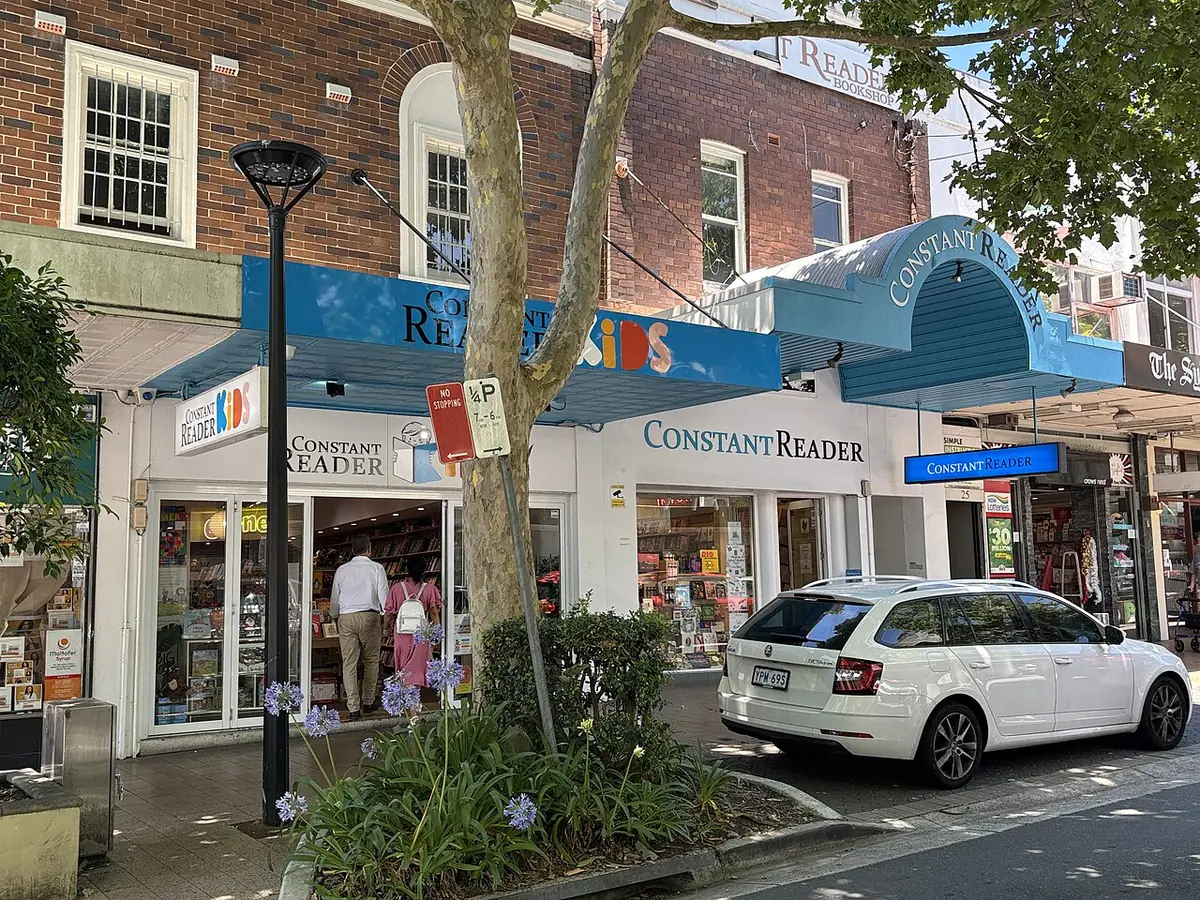
Independent shops like this line many of Sydney's lively local streets — Photo: Nick-D · CC BY-SA 4.0 · Wikimedia Commons
Whatever your position, valuing the property from abroad means letting go of a few habits.
There is no single value in the abstract: the useful figure depends on the decision it has to inform. An owner thinking of selling wants the likely market price over the coming weeks, with all the uncertainty of an auction. An owner who wants to keep the apartment and refinance will meet the more cautious valuation their bank commissions. And an owner who has to divide an estate or declare an asset to a tax authority needs a dated market value that will stand up in front of a third party. Working out which case is yours stops you using the wrong figure for the right decision.
The owner preparing a sale
What matters to you is the price a real buyer would pay today, given recent sales in the building and the street. Agents will give you ranges, and New South Wales regulation requires them to record a reasonable estimate of the selling price in the agency agreement and not to advertise a price below it. Be wary all the same of the agent who quotes the highest number in order to win the listing. Ask each of them for the comparable sales behind their figure, and test those against the ones you can find yourself in the public data.
The owner who keeps and refinances
Your bank will not rely on an agent's opinion: it instructs its own valuer, who adopts a conservative figure intended to protect the lender. That number is often below the price hoped for on the open market, especially for small apartments, very uniform recent buildings or unusual lots. The ratio between the loan amount and that value governs what you can borrow and on what terms. To avoid an unpleasant surprise, plan on a low assumption rather than on the best auction result the building has seen.
The owner who needs a defensible figure
Here the point is not to obtain the highest price but a justifiable figure, dated and documented. An apartment in Sydney forms part of the assets of an estate and, above the applicable threshold, of any wealth or asset tax base in the owner's country of residence, at its market value. A report written by an independent valuer, stating the date and purpose of the assessment, holds up far better than an agent's opinion. Fix the exchange rate at the same date as well, because the value in another currency can move noticeably from one month to the next.
Valuing a Sydney apartment from abroad: what works differently here
Once those differences are clear, the question that remains is which properties actually set the benchmark around yours.
In many markets an owner values a property by consulting published sale prices, asking an agency or a notary for a value opinion, and thinking readily in currency per square metre. In Sydney the tools exist too, but they do not carry the same information and they do not produce the same kind of figure. Public auctions, the absence of a standardised floor-area measurement and the weight of the strata report all change the way a value is built. Understanding those gaps stops you transposing a method onto a market that does not recognise it.
From abroad
Public sale prices drawn from registered deeds, searchable by address, which underpin most valuations
Sydney
Sales data released by the Valuer General and relayed by the portals, completed by the auction results published every weekend
The references exist, but a private treaty sale may surface only once the transfer has been registered: always cross-check several sources before accepting a comparable.
From abroad
A value opinion from an agency or a notary, with a sworn expert's report when the value has to stand up legally
Sydney
A clear split between an agent's free appraisal, aimed at winning a listing, and the written valuation of a qualified valuer, who carries professional liability
To sell, weigh several agents' opinions against each other; for a settlement, a loan or a tax declaration, commission a dated and reasoned valuer's report.
From abroad
An internal floor area guaranteed by statute, which makes a price per square metre directly comparable from one lot to the next
Sydney
No equivalent standardised measure: the area quoted may include a balcony, a car space or a storage cage depending on the strata plan and the agent
Do not compare prices per square metre without knowing what they measure; think instead in bedrooms, parking, floor level and outlook.
From abroad
Prices negotiated after inspections, with no publicity of the price achieved at the time of sale
Sydney
A large share of sought-after properties sold at auction, with knock-down prices announced and a clearance rate tracked every week
An auction result is a fast, public signal, but it reflects the competition of one particular Saturday: a single record in the building does not fix the value of your lot.
Which part of Sydney sets the comparables for your apartment?
Those gaps between areas show up in the orders of magnitude that serve as a price benchmark.
Sydney is a collection of distinct markets, and the value of an apartment is built first from the sales in its own area. Where buildings resemble each other and turn over often, comparables are plentiful and the valuation range tightens. Where the stock is old, varied and rarely offered, every reference calls for adjustment and the range widens. For each broad area, here is what the buyer is paying for, the apartments whose value is easy to establish there, and what muddies the reading of the numbers.
The CBD and Pyrmont
The buyer pays for the abolished commute, direct access to metro, trains and ferries, and constant city life at the foot of the building.
Suits
One and two-bedroom apartments in large towers, where sales in the same building supply recent and numerous comparables.
Trade-off
The abundance of near-identical lots puts your apartment in direct competition with the other listings, and floor level, outlook and levies move the value from one lot to the next.
The Eastern Suburbs (Bondi, Coogee, Randwick)
The buyer pays for the beach on foot, streets of cafes and proximity to the hospital and university precincts at Randwick.
Suits
Apartments close to the beach or with an ocean outlook, where demand stays deep and steady over time.
Trade-off
Many small older blocks in widely varying condition force you to adjust every comparable for the outlook, the work already done and whether or not there is parking.
The Lower North Shore (Mosman, Neutral Bay)
The buyer pays for quiet leafy streets, harbour views, the reputation of the schools and the ferry into the centre.
Suits
Large family apartments and lots with a water outlook, whose value holds up well when the market slows.
Trade-off
Sales are few and the properties rarely alike, so a valuation rests on a handful of references and is worth confirming with a valuer.
The Inner West and Parramatta
The buyer pays for more space per dollar, multicultural energy and neighbourhoods being remade around the stations.
Suits
Recent apartments near a station, where regular sales make it quick to place a value.
Trade-off
Continuing construction of new developments can weigh on the prices of existing lots, and the uneven quality of some recent buildings creates wide swings in value.
What is an apartment in Sydney worth today?
Those benchmarks assume you know exactly what you hold, because the form of ownership weighs on value.
The figures below are orders of magnitude estimated from listings, and should be read as a benchmark for value rather than as the price of your lot. For Sydney the median sits around 1,250,000 AUD and the average around 1,425,000 AUD, for an average floor area of about 95 sq m and a median close to 12,540 AUD per square metre. The breakdown by bedroom count says more: a two-bedroom of roughly 80 sq m averages around 1,056,000 AUD, while a one-bedroom sits near 741,000 AUD at a higher rate per square metre. That rate falls as floor area grows, from about 14,256 AUD for one bedroom to 12,144 AUD for four, which rules out applying a single figure to every lot. Place your apartment in the right line, then adjust for the suburb, the floor level, the outlook, the parking and the condition of the building.
SydneyFor saleApartmentestimate
Median price / m²A$12,540Half the apartments sell below this
Median priceA$1.25mthe average is 14% higher — a few very large properties pull it up
Most common2 bedrooms38 % of listings
Average size95 m²
By number of bedrooms
Bedrooms
Share of market
Avg price
Price / m²
Avg size
1
24 %
A$741k
A$14,256 +8 %
52 m²
2most common
38 %
A$1.06m
A$13,200
80 m²
3
26 %
A$1.4m
A$12,540 −5 %
112 m²
4
12 %
A$1.94m
A$12,144best value / m²
160 m²
Each row is an average, compared against the area average of A$13,200 / m². These are indicative estimates of a typical local market, not a measured sample of live listings. Check current listings before relying on them.
Strata title or company title in Sydney: what you hold and what it does to the value
Sydney's harbour setting makes waterside living part of daily life — Photo: Dicklyon · CC BY-SA 4.0 · Wikimedia Commons
Even with the right title and the right comparables, a figure stays an opinion until one precise step has been passed.
In Sydney the legal title under which you hold your apartment bears directly on the number of possible purchasers, on how easily a loan can be obtained and therefore on value. Most apartments are strata title, a form of community ownership governed by state legislation, but some older blocks, particularly in the east of the city, are still company title. Before you accept a comparable, check that it is held under the same regime as yours. Two apparently identical lots can carry noticeably different values for that reason alone.
Strata title (standard community ownership)
You own your lot, as defined by the strata plan, together with a share of the common property proportional to your unit entitlement. The building is run by an owners corporation that raises levies and maintains a capital works fund. It is the regime banks, resident buyers and investors know best, which gives a broad and readable base of comparables.
What it changesValue is read by direct comparison with sales in the same building and the surrounding area, then adjusted for the levies, the state of the capital works fund, the by-laws and any works already voted.
Company title (share ownership)
The building belongs to a company in which you hold shares, and those shares carry the right to occupy a particular apartment. This historic regime is found mainly in pre-war and Art Deco blocks in eastern Sydney. The board can restrict letting and generally has to approve each incoming owner.
What it changesFewer lenders accept this kind of title and board approval narrows the circle of purchasers, which usually translates into a discount against a comparable strata lot: never compare the two regimes without an adjustment.
The Sydney rule to grasp before you treat a figure as settled
Which raises the question of who touches that figure, and at what stage of its construction.
The most common mistake is to treat the first valuation received as settled, whether it comes from an agent, an online calculator or the memory of a record sale in the building. In Sydney a value passes through several filters before it becomes a price: verified comparables, the cautious eye of a valuer or a bank, the buyer's own scrutiny, then a contract that has become unconditional. Until that chain has run its course, the figure remains a hypothesis. What follows shows how it is confirmed or eroded at each stage.
An agent quotes you a price range for your apartment, often a flattering one while they are trying to win the listing.
You test that range against sales recorded in the same building and the same street over recent months, setting aside prices that were merely advertised.
An independent valuer, or the bank's, inspects the property and adopts a conservative value, adjusted for the floor level, the outlook, the parking and the state of the scheme.
Prospective buyers have the building inspected and read the strata report, then revise their offer if works, defects or heavy levies come to light.
The market decides at auction or on exchange of contracts, and the price only becomes final once any cooling-off period has run.
Only a price written into a contract that has become unconditional, and then registered at settlement, turns an opinion of value into a verifiable fact.
How the value of a Sydney apartment is built, step by step
A reliable valuation in Sydney is the product of several successive viewpoints, each contributing something the others do not have. You hold the documents for the lot and the scheme, the agent knows the buyers who are active right now, the valuer applies a method and takes responsibility for it, the bank sets the value it will lend against, and the public registers supply verifiable facts. Managing the property from abroad, the task is to organise those inputs at a distance without letting a single opinion decide the figure. Here is the order in which they fall into place in practice.
You, the ownerAssemble the file for the lot and the buildingGather the title, the strata plan, the latest levy notices, the minutes of general meetings and the maintenance plan. Without those documents any valuation stays approximate, because the financial state of the building bears directly on value.
The estate agentPrice opinion and choice of comparablesThey propose a range based on recent sales and on their knowledge of local buyers. Speak to at least two or three agents and insist on the addresses and dates of the sales they rely on, so you can separate a sales pitch from a genuine reference.
The independent valuer (Certified Practising Valuer)Inspection and dated valuation reportThey inspect the apartment, check the title and the characteristics of the lot, select comparable sales and justify their adjustments. The report states the date and purpose of the assessment, which makes it usable for a settlement, an estate or a tax declaration.
The bank and its valuerThe value adopted for a loan or a refinanceThe lender instructs its own valuer and adopts a conservative figure, sometimes below the price hoped for. It is that number, not the agent's, that determines the share of the value the bank will lend against.
The Valuer General and the land registerVerifying sales and titleRecorded sales and the land register maintained by NSW Land Registry Services let you confirm the prices actually paid and the legal position of the lot. The land value notified for tax purposes, by contrast, is not a valuation of the built property.
Apartment or house in Sydney: how each type holds its value
To place your apartment precisely, it remains to compare it with concrete price levels and to measure the costs that will reduce the figure.
In Sydney the difference in behaviour between apartments and houses comes first from the share of land in the value. A house sits on a parcel whose scarcity grows as the city densifies, and it is usually that land which carries most of the appreciation over time. An apartment holds only a modest fraction of the building's land: its worth depends more on the structure, its age, its upkeep and competition from new developments. Over long periods, the series published by the main data providers generally show houses rising faster than units.
That does not make an apartment a poor store of value, but it means its value is defended differently. Lots in small, well-built blocks close to the water or a station, with little comparable supply nearby, hold up markedly better than lots in large recent towers where dozens of near-identical apartments can come to market at the same time. Valuing an apartment must therefore always take in the risk of competing supply in the same building or the same area, whereas valuing a house concentrates more on the parcel, the street and the development potential.
Strata ownership also introduces a factor a house does not have: the value of an apartment depends on collective decisions. Major facade, waterproofing or fire compliance works, voted by the owners at a general meeting, can weigh on the value of every lot for several years. Since the cracked towers that made headlines in Sydney, buyers and valuers look closely at the defect history, the capital works fund and any litigation with builders. A poorly maintained house loses value through its owner's actions alone; an apartment can lose value because of the whole building.
To value your apartment realistically, start from sales of comparable lots in buildings of the same generation and the same size, rather than from general Sydney market trends that are often pulled along by houses. Check the competing supply in the building, read the strata report, then adjust for the floor level, the aspect, the outlook and the parking. If your decision is really about whether to keep the apartment or reinvest elsewhere, compare the two on the same basis, using values net of costs and tax, rather than setting an apartment price against a citywide trend.
Which price levels to measure your Sydney apartment against, and what costs to net off
Martin Place sits at the heart of Sydney's financial district — Photo: Klauskazamias · CC0 · Wikimedia Commons
Those price levels are in fact a way of life the buyer pays for, day after day, in the streets around your apartment.
A value figure only means something on two conditions: that you set it against price levels for comparable properties, and that you measure what would actually remain from it on a sale. The first table gives indicative ranges by type of lot and by area, together with the strata levies that shape what a buyer will pay. The second lists the costs that come off a market value when it turns into money received. The amounts are orders of magnitude, to be confirmed against recent sales, written quotes and tax advice.
Indicative value ranges for apartments by area of Sydney
Property type and location
Observed value range
Quarterly strata levies
What moves the value within the range
Studio or one-bedroom - City centre (CBD / Inner West)
650,000 AUD to 950,000 AUD
1,200 AUD to 2,200 AUD
Floor level, outlook, a titled car space and how many comparable lots are on the market in the building at the same time
Water outlook, size of the block, condition of the scheme, outdoor space and whether the title is strata or company title
These ranges are indicative averages and vary with the age of the building and the presence of a lift, a pool or concierge services. They are there to place your lot, not to value it: only recent comparable sales can settle a figure.
Costs that come off the value on a sale
Item
How it is worked out, or order of magnitude
Effect on the net amount
Agent commission, marketing and preparing the sale
A negotiated percentage of the price, often in the order of 1.5 to 2.5 per cent in Sydney, plus a campaign budget of a few thousand dollars
Comes straight off the sale proceeds; the rate, the base it applies to and the campaign costs are negotiated before the agency agreement is signed.
Legal fees, valuation report and capital gains tax
Between 1,500 AUD and 3,000 AUD of conveyancing depending on the file, a few hundred dollars or more for a valuer's report, tax according to your residency
The fees are fixed and modest; capital gains tax, in Australia and where relevant in your country of residence, can by contrast take a heavy share of what you keep.
A vendor who is a foreign resident is in principle subject to a withholding on the price at settlement, unless an Australian resident supplies a clearance certificate from the Australian Taxation Office. Have an Australian accountant and a tax adviser in your country of residence confirm the net value before you base a decision on the gross figure.
Health, schools, transport: the ordinary Tuesday a Sydney apartment buyer pays for
Those visible strengths do not tell the whole story, and several invisible factors weigh just as heavily on the figure.
What a buyer pays for in a Sydney apartment is above all a typical day: the morning commute, the children's school, access to care, the evening shop and how quiet the nights are. Each of those moments shows up in the value, because each determines how many buyers are willing to compete for your lot. An apartment ten minutes on foot from a station, in a sought-after school catchment and near a major hospital, has a base of demand that a poorly served lot will never have. Following an ordinary Tuesday helps you spot the elements of value your valuation has to reflect.
07:30Train station, metro station or ferry wharfThe journey starts with an Opal card on a frequent network, and walking distance to the station is one of the sturdiest drivers of value. An apartment close to a high-frequency line, such as the metro running through the centre, compares favourably with a lot in the same suburb that depends on a bus or a car.
08:45The local public school or employment hubPublic schools enrol on a catchment basis, and sitting inside a sought-after one supports demand from families. For working households, travel time to the CBD, North Sydney or Parramatta counts for more in the value than distance as the crow flies.
12:30Hospital precinct or local parkProximity to major hospitals such as Royal Prince Alfred, St Vincent's, Prince of Wales or Royal North Shore sustains steady demand from healthcare staff and students. A park or a waterfront within walking distance adds something buyers pay for, particularly for apartments without outdoor space.
17:30The local supermarket (Coles or Woolworths)Being able to shop on foot on the way home is part of what a buyer is looking for in an apartment. Neighbourhood shopping centres at the foot of the stations strengthen the appeal of an area and make nearby lots easier to resell.
19:00The apartment and the buildingThe evening reveals what the numbers leave out: noise from a busy street, a flight path or a motorway, and the atmosphere of the scheme itself. Those things often explain why two neighbouring lots of the same size do not sell for the same price.
What a headline figure will never tell you about your Sydney apartment
Ignoring these leads to valuation errors that usually only surface after the figure has been acted on.
A suburb average or an online calculator produces a reassuring number, but it ignores everything that sets your lot apart from the others. In Sydney the value of an apartment is often decided by things absent from the listing: the finances and defects of the building, the legal status of the car space, the zoning of neighbouring parcels or exposure to noise. Those are precisely the points a well-advised buyer or a valuer will examine. Knowing them lets you correct your own figure before a third party does it for you.
The strata report and the capital works fund
It reveals disputes, reported building defects, works voted or under consideration and the level of the capital works fund. A special levy on the way or proceedings against a builder can noticeably reduce the value of every lot, whatever the condition of your own apartment.
Local zoning and neighbouring projects (Local Environmental Plan)
The council planning instrument and the planning certificate set out what can be built around the block, along with constraints such as flood-prone land or heritage listing. An open outlook threatened by the height permitted on the adjoining parcel is worth far less than one that is protected.
The status of the car space and the storage cage
Depending on the strata plan, the car space may form part of your lot, be a separate lot, or amount to nothing more than an exclusive use right. That distinction changes both value and ease of resale, because a buyer and their bank will not pay the same for a revocable right as for a titled space.
Aspect, noise exposure and flight paths
In the southern hemisphere a north-facing living room catches the winter sun and commands a premium. Conversely, areas under the flight paths from Sydney Airport or fronting major roads carry a discount that suburb averages never show.
The Sydney valuation mistakes that surface six months later
Those mistakes also show that, for some owners, acting on a valuation right now is not the right decision.
Looked likeAn agent's appraisal far above the others, which seemed to confirm the value hoped for
Turned outA figure designed to win the listing: the auction failed to reach reserve, the property sat on the market for weeks and the price had to be revised down
Would have caught itAsking each agent for the precise comparable sales behind their figure, discarding opinions with no verifiable references and, in case of doubt, commissioning an independent valuer's report.
Looked likeA value worked out from the suburb's average price per square metre, applied to the area in the listing
Turned outAn overstated value, because the building had works voted and a special levy pending, which buyers deducted from their offers immediately
Would have caught itReading the minutes, the maintenance plan and the strata report before settling on a figure, and comparing first with sales in the same building.
Looked likeA refinance planned on the strength of the best price recently achieved in the building
Turned outA markedly lower bank valuation, which cut the amount that could be borrowed and changed the terms of the loan
Would have caught itAnticipating the caution of the bank's valuer by working on a low assumption, and preparing the closest comparable sales to support the application.
Looked likeA value in Australian dollars used for an estate or a tax declaration, converted at the exchange rate on the day of the valuation
Turned outA mismatch between the date of the report, the date required for tax purposes and the rate applied, which forced the calculation to be redone and the figure justified
Would have caught itHaving the report dated to the relevant date, keeping the source of the exchange rate used, and having the method confirmed by a lawyer or tax adviser.
Who should not act on a Sydney apartment valuation right now?
Which leaves the question of the figure you are holding, and how much confidence it deserves.
A valuation is a decision-making tool, not an obligation to act. For some owners the figure obtained is too fragile, too dated or too far from their real question to justify an immediate sale, refinance or division. The costs of selling in Sydney, capital gains tax and the delays of any new transaction make a decision taken on a poorly established value an expensive one. Here are three situations where it is better to firm up the valuation before acting.
Owners whose building is undergoing major works, a dispute with the builder or a defect rectification order
→Waiting until the works are costed, voted and funded before setting a selling value
While the cost and the outcome are unknown, buyers apply a precautionary discount often larger than the real cost, which produces an artificially low value.
Heirs or former partners basing a division on a simple agent's appraisal or an online estimate
→Commissioning an independent valuer's report, dated and reasoned, accepted by all parties
A commercial figure is easy to challenge, and a division founded on a fragile value invites disagreement, a recalculation or a challenge from a tax authority.
Owners who are tax resident abroad and are considering a sale without knowing the tax due in Australia and at home
→Having the net value after costs and tax established before deciding to bring the property to market
Capital gains tax, any withholding on the price and the cost of currency conversion can sharply reduce what you keep, to the point where holding the property beats selling it.
So how much confidence does the figure you hold for your Sydney apartment deserve?
A figure deserves your confidence if it rests on sales that actually completed, recently, on properties comparable to your lot, ideally in the same building or the same street. If it comes from a single agent, a suburb average or an online calculator, treat it as a starting point. If it is confirmed by several supported opinions and, where appropriate, by an independent valuer's report, you can begin to use it to decide.
Then check that your valuation takes in what actually makes the value of a Sydney apartment: the financial and physical state of the scheme, strata or company title, the status of the parking, the aspect, the outlook and how durable it is, transport access and noise. If any of those has gone unexamined, the figure can still move appreciably, in either direction.
Match the standard you demand to the use the figure is put to. For general thinking about your assets, a range is enough. To set an asking price, you need precise comparables and a marketing strategy. For a refinance, plan for the caution of the bank's valuer. For an estate, a division or a tax declaration, only a dated and reasoned report, together with the exchange rate used, gives you a defensible base.
Finally, always think in net value. Between agent commission, legal fees, capital gains tax in Australia and where relevant at home, and the cost of moving the funds, the amount you would keep can sit well below the market value. If that net amount makes your decision clear, your valuation has done its job; if not, take the time to firm it up before acting.
Related questions
What is the difference between an agent's price opinion and a certified valuation in Sydney?
An estate agent's opinion, known as an appraisal, is free and exists first of all to win a listing: it is a commercial view of what the market might pay. A valuation is a written report, produced by a qualified valuer after an inspection, which carries professional liability and follows a method grounded in comparable sales. To sell, an agent's appraisal can be enough provided it is backed by recent sales; for a property settlement, an estate, a dispute or a tax declaration, an independent valuer's report is far more robust. Nothing stops you obtaining both and comparing where they diverge.
Where can I find the real sale prices of apartments in Sydney?
The Valuer General of New South Wales publishes recorded sales information, which then feeds the property portals and private data providers. Auction results are published every weekend by the major portals, with the price achieved whenever the vendor agrees to disclose it. Part of the private treaty market appears only with a delay, once the transfer has been registered. For a valuation, favour sales completed in the same building or the same street over the last six to twelve months rather than advertised asking prices.
Does the land value notice from the Valuer General tell me what my apartment is worth?
No. The Valuer General sets an annual value for the land, used for state land tax and council rates, not the value of the built property. For a strata apartment, that land value is apportioned between lots according to their unit entitlements, which usually produces a figure well below market price. It says nothing about the outlook, the floor level, the condition of the building or the car space. It should therefore never be the basis for a decision to sell or to divide an estate.
Why does the aspect of an apartment matter so much to value in Sydney?
In the southern hemisphere a north-facing living room catches the winter sun, which Sydney buyers look for and pay for. For the same floor area in the same building, a north-facing lot with an open outlook generally sells better than one facing south or onto a light well. A valuer allows for this by adjusting the comparables, whereas an average price per square metre erases it completely. It is one of the reasons why two neighbouring apartments can carry noticeably different values.
Do the restrictions on foreign buyers change what an established apartment is worth?
They reduce the pool of possible purchasers, which matters for some properties. Foreign persons generally need approval from the Foreign Investment Review Board, and the federal government announced a temporary ban, from April 2025, on most of them acquiring established dwellings, with exceptions. For an older apartment whose natural market included many overseas investors, demand shifts onto residents instead. Check the rule in force with the FIRB before drawing any conclusion about value.
How do strata levies affect the valuation of an apartment?
High quarterly levies reduce what a buyer is prepared to pay, because they weigh on their budget or on their rental yield. The amount alone is not the whole story: a well-funded capital works fund and an up-to-date maintenance plan can justify heavier levies and reassure a purchaser. Conversely, low levies in an older building can signal a special levy on the way, which drags on value. A serious valuer reads the strata report before reaching a figure.
How much does transport count towards the value of a Sydney apartment?
A great deal, because buyers think in travel time to the central business district and the main employment hubs. Being within walking distance of a train station, a metro station or a ferry wharf supports both value and ease of resale. The opening of new lines, such as the metro linking Chatswood to Sydenham through the centre, has changed how several areas are perceived. For your comparables, choose properties that share the same transport access, not merely the same suburb.
Does the cooling-off period on a private treaty sale affect how reliable a comparable price is?
Yes, to a degree. In New South Wales a private treaty sale usually opens a cooling-off period of five business days after contracts are exchanged, during which the purchaser can withdraw by forfeiting a small fraction of the price; a property knocked down at auction carries none. A price is therefore only truly secured once that period has run and the transfer has been registered at settlement. For a valuation, a registered comparable is worth more than a sale announced but not yet completed.
Do the cheaper parts of Sydney give comparables that are easier to read?
Not necessarily. In the Inner West or around Parramatta, recent apartment construction multiplies the number of sales, which supplies plenty of references, but build quality varies widely from one development to the next. In the Eastern Suburbs or on the Lower North Shore, sales are fewer and the stock more varied, which forces more adjustments. In both cases the value of an apartment is read first at the level of the building, then of the street.
Should I engage an independent valuer when I am assessing the property from abroad?
It is not compulsory, but it is often the safest way to obtain a defensible figure at a distance. A valuer who is a member of the Australian Property Institute inspects the property, checks the title and the strata documents and writes a dated report you can put in front of a lawyer, a co-heir or a tax authority. The cost remains modest against the value at stake. Ask in advance what the report is for, because a valuation for a loan, an estate or a family law settlement is not written in the same way.
Property review of ting
No ting properties in Sydney yet
Be the first — share it on ting and it shows up right here.