Valuing an apartment in Adelaide means separating several figures: the price the market would pay, the defensible value an expert would certify, and the value a bank will lend against. This guide explains how to read asking prices, recorded sales and the Valuer-General's capital value, what the strata regime does to the number, and which costs come off the value before you sell, keep, refinance or divide an estate.
Get the app
What nobody tells you.
Real prices, hidden costs and the traps to check before you commit.
What a valuation of an Adelaide apartment actually measures
Scroll
What a valuation of an Adelaide apartment actually measures
Valuing an apartment in Adelaide means separating several figures: the price the market would pay, the defensible value an expert would certify, and the value a bank will lend against. This guide explains how to read asking prices, recorded sales and the Valuer-General's capital value, what the strata regime does to the number, and which costs come off the value before you sell, keep, refinance or divide an estate.
Written by the ting.ad editorial team ·
Valuation Apartment Adelaide in Street View: drag to look around.
Before settling on a figure, you need to know which question it answers in your own situation.
Valuing an apartment in Adelaide is not a matter of reading an average off a portal: it is predicting the price an informed buyer would sign for this particular lot, in this building, on this date. In an apartment market narrower than Sydney's or Melbourne's, where recent sales in a single building can sometimes be counted on one hand, two serious valuations can differ noticeably. Value depends as much on the title, the level of levies and the state of the sinking fund as on floor area or outlook. It also depends on who produces the figure: the agent hoping to win the listing, the bank protecting its loan and the independent expert are not measuring the same thing. The four tensions below show how one apartment can carry two legitimate readings of value.
Market value: the price a buyer would sign today after a normal marketing campaign.vsThe cautious value a bank adopts, often lower because it is thinking about what it would recover in a forced resale.
The gap between the two often surprises owners who refinance. Neither is wrong: they answer different questions, and you need to know which one serves your decision.
A price per square metre historically more moderate than in the other Australian state capitals, which makes valuation feel straightforward.vsA limited number of comparable sales per building and per suburb, which makes each recent transaction highly influential on the figure.
In Adelaide, a single unusual sale in your building can pull the valuation up or down. A rigorous valuer sets those cases aside or weights them rather than applying them mechanically to your lot.
Visible facilities — a pool, a gym, a view over the Park Lands — that appear to add value to the property.vsHigh body corporate levies and special levies to come, which the buyer mentally deducts from the price they will accept.
The value of an apartment is always read net of its levies. Two identical lots can be valued differently if one sits in a building with a well-funded sinking fund and the other in a scheme facing major works.
Rental demand supported by students and health professionals, which reassures investors.vsAn investor buyer base sensitive to interest rates and yields, which can make the value of small apartments more volatile than that of family homes.
For a studio or a one-bedroom near the campuses, value is also read through the rent it produces. Some banks additionally apply stricter lending conditions to very small floor areas, which reduces the pool of buyers and weighs on the figure.
Which reading of value fits the use you make of your Adelaide apartment?
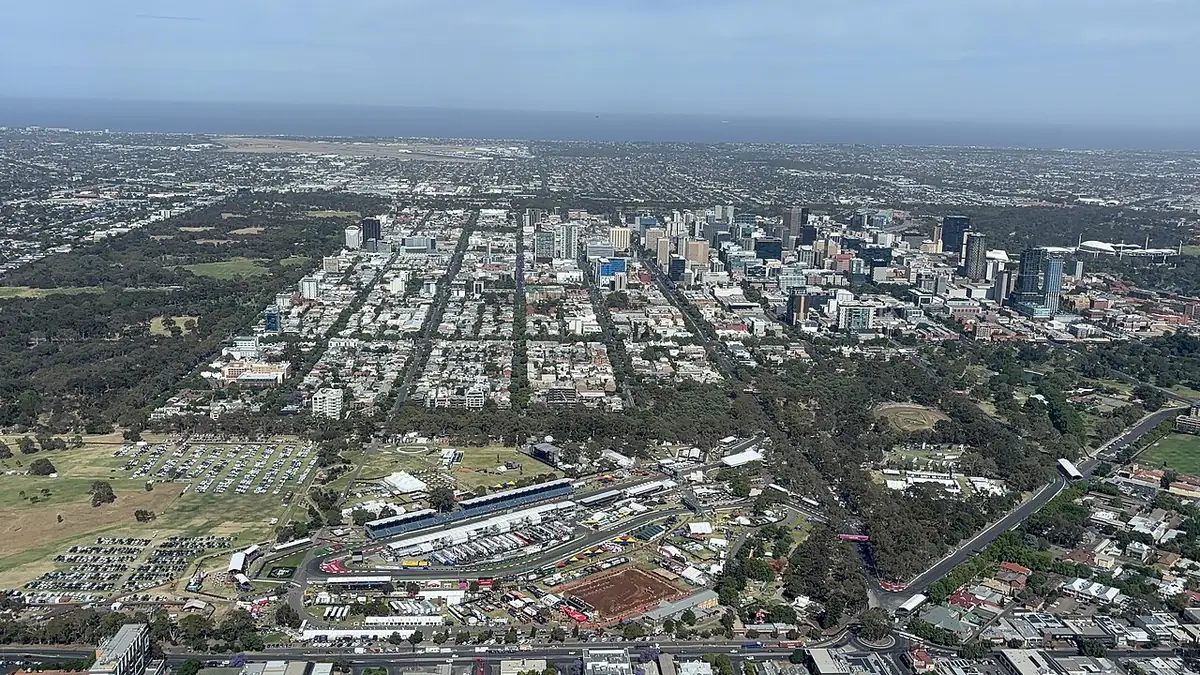
Adelaide from above, a grid city ringed by parklands and suburbs — Photo: Avatar5991 · CC BY-SA 4.0 · Wikimedia Commons
Whether you are valuing from within Australia or from overseas, the tools and the reflexes are not the same.
The same address does not produce the same figure depending on the question asked. An owner considering a sale wants a realistic marketing price, an heir dividing an estate needs a value that can be defended in front of the other beneficiaries and the tax office, and a borrower renegotiating a loan depends on the value the bank adopts. Adelaide is no exception: each use calls for a different type of valuation, a different standard of proof and a different cost. The situations below describe the three most common cases and what each one requires.
The marketing value
The usual tool here is the agent's appraisal, free of charge, based on recent sales and on the properties currently competing with yours in your area. Ask for at least two or three, and for each one insist on the list of comparable sales used, with the date, floor area and level of every one. Be wary of the most flattering figure: an agent may be tempted to quote a high value to win the listing, then recommend a reduction after a few weeks without an offer. The right marketing value is the one that several independent sources confirm.
The value an expert can defend
In these cases, a written report from a certified valuer, a member of a professional body such as the Australian Property Institute, is generally preferable to a simple agent's appraisal. The report fixes market value at a given date, sets out the method and the comparables relied on, and can be produced to a lawyer, a court or the tax office. It has a cost, often a few hundred dollars for a standard apartment, but it limits arguments between heirs or former partners. Tell the valuer exactly what the report is for, because the valuation date and the legal framework follow from it.
The value the bank adopts
The bank commissions its own valuation, sometimes from the file or by an automated model, sometimes from a valuer who inspects the property, and it does not always share the detail with you. That value is deliberately cautious, because it is used to set the amount lent against the security. If the figure looks low, gather recent comparable sales yourself and ask, where possible, for a fresh valuation, or go through a broker who will approach another lender. For simple asset tracking, a range drawn from recorded sales is generally enough.
Valuing an Adelaide apartment from abroad: what works differently here
With those differences settled, the question becomes which suburb supplies the comparables for your lot.
An owner used to another market naturally looks for the familiar building blocks: a price database fed by registered deeds, an agency's written value opinion, a published price per square metre by neighbourhood. In South Australia those blocks exist, but they are assembled differently and they do not carry the same names. Signed prices are widely circulated, auctions give a public signal of the market, and the state sets an annual land value that is not a market valuation in the strict sense. Understanding those differences stops you comparing your apartment with a figure that does not measure what you think it does.
From abroad
In many European markets, sale prices pass through a notary and feed reference databases open to the public.
Adelaide
In Adelaide, signed prices are recorded in the state land register, then widely republished by portals and data providers, with a variable delay.
You can reconstruct the recent sales in your building and your street yourself, provided you check the date, the floor area and the condition of each lot before comparing it with your own.
From abroad
Elsewhere, the asking price is a starting point for negotiation and an agency's value opinion stays an indicative range.
Adelaide
Here, many properties are offered with an indicative price guide or sold at auction, and consumer law prohibits advertising a price that misleads compared with the agent's genuine estimate.
An asking price is not a valuation: it may be deliberately low to attract inspections. To value your apartment, work from the prices finally signed, not from launch prices, and check the precise rules with Consumer and Business Services.
From abroad
In other markets, an administrative rental value is used to calculate local taxes but sits a long way from market prices.
Adelaide
In South Australia, the Valuer-General sets a capital value and a site value each year, which underpin council rates, water charges and land tax.
That administrative value tracks the market more closely than the equivalent figures elsewhere, but it rests on an earlier reference date and on a mass appraisal method: never use it alone to set a price.
From abroad
Elsewhere, technical reports and body corporate documents accompany the sale and inform the buyer.
Adelaide
In Adelaide, the seller provides a Form 1 (Vendor's Statement) setting out levies, easements and information about the scheme, and the buyer often commissions their own inspection.
Everything those documents reveal — special levies, disputes, restrictions on use — will be built into the buyer's price. A serious valuation reads those papers before reaching a conclusion.
Which Adelaide suburb sets the comparables for your apartment?
Those differences between areas then show up in the price levels observed across the city.
In Adelaide, the plan laid out by Colonel Light separates the central business district from the suburbs with an unbroken ring of Park Lands, and that geography shapes apartment values directly. A one-bedroom in the CBD, a converted lot in a period building in North Adelaide and a seafront apartment in Glenelg do not compare with one another: each belongs to a micro-market with its own buyers and its own comparables. The most common mistake is to apply the average of a neighbouring area to your own property. The cards below set out what the buyer is looking for in each area, the type of apartment that holds its value best there and what undermines it.
Adelaide CBD (city centre)
A buyer paying for life on foot: the free city tram, the Central Market, universities, the hospital and offices all minutes away.
Suits
Recent, well-maintained apartments with a car space and reasonable levies, which compare easily with sales in the same building.
Trade-off
A plentiful supply of small apartments and student accommodation, which puts properties in direct competition and holds back the growth in studio values.
North Adelaide
A buyer after quiet, tree-lined streets, Victorian heritage and easy reach of the parks without giving up the centre.
Suits
Apartments in small character buildings or carefully renovated lots, whose scarcity supports value against new construction.
Trade-off
Few comparables, and very varied ones, along with heritage protections that can limit works and therefore the scope to add value.
Glenelg and the coast
A buyer paying for sea air, the beach, the jetty and a direct tram into the centre, often a retiree or someone looking for a base by the water.
Suits
Lots with an open outlook over Gulf St Vincent or a short walk from the beach, where the location premium holds up well.
Trade-off
Value that is highly sensitive to aspect, floor level and the condition of facades exposed to salt, with wide gaps between two lots in the same street.
What an apartment in Adelaide is worth today
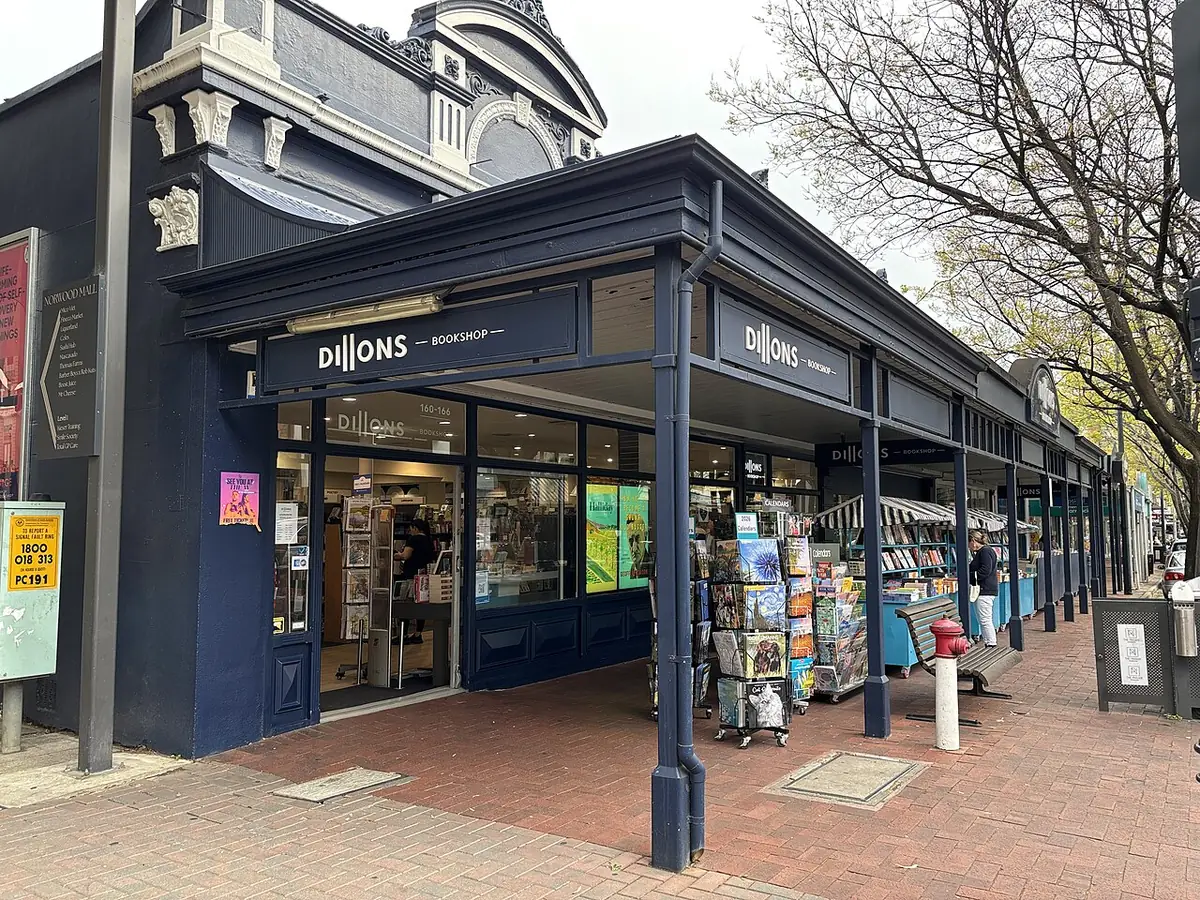
An independent bookshop under a shopfront verandah — Photo: Nick-D · CC BY-SA 4.0 · Wikimedia Commons
Those benchmark figures say nothing, however, about the legal nature of what you hold.
The figures below are estimates drawn from listings: they describe the levels at which Adelaide apartments are being offered, not certified values or signed prices. To value your own property, start from the line matching your number of bedrooms, then apply the price per square metre to the actual floor area of your lot rather than to the average area shown. Then adjust that benchmark for what makes the difference in your building: floor level, outlook, car parking, condition and the level of strata or community levies. Bear in mind that asking prices usually include room for negotiation and that overpriced properties stay online longer, which pulls the averages upwards. Finally, test that base against sales recorded recently in your building and your street, which remain the strongest evidence available.
AdelaideFor saleApartmentestimate
Median price / m²A$7,030Half the apartments sell below this
Median priceA$720kthe average is 14% higher — a few very large properties pull it up
Most common2 bedrooms34 % of listings
Average size105 m²
By number of bedrooms
Bedrooms
Share of market
Avg price
Price / m²
Avg size
1
18 %
A$440k
A$7,992 +8 %
55 m²
2most common
34 %
A$629k
A$7,400
85 m²
3
32 %
A$844k
A$7,030 −5 %
120 m²
4
16 %
A$1.16m
A$6,808best value / m²
170 m²
Each row is an average, compared against the area average of A$7,400 / m². These are indicative estimates of a typical local market, not a measured sample of live listings. Check current listings before relying on them.
Strata or community title: what you hold in Adelaide and what it does to the value
Those legal points lead to the next rule: never treat a figure as settled before testing it against the evidence.
South Australia is the birthplace of the Torrens system of title registration, and every apartment there corresponds to a lot recorded in the land register. But what you actually hold depends on the scheme: strata title or community title, each governed by its own state legislation. That regime determines what belongs to you outright, what is common property, who decides on works and how they are funded. An informed buyer factors it into their price, and a valuation that ignores it compares properties that are not equivalent.
Strata title: a lot and a share of the common property
Under this regime you own the space of your apartment as defined by the strata plan, together with a share of the common property managed by the strata corporation. The by-laws govern works, external appearance and pets, and significant decisions are taken by vote. The financial health of the corporation, the sinking fund and the history in the minutes bear directly on what a buyer will pay.
What it changesA well-run corporation with an adequate sinking fund supports value; facade or waterproofing works that have not been provided for reduce it, sometimes well beyond their actual cost.
Community title: a lot within a larger scheme
More recent, this regime often applies to developments with private roads, gardens or shared facilities, and it is administered by a community corporation with its own by-laws. Contributions fund the upkeep of the shared infrastructure under the rules set out in the community scheme. For value, everything turns on the level of those contributions against the services actually delivered and the long-term obligations built in.
What it changesQuality facilities can justify a premium, but high contributions or restrictive rules on use narrow the pool of buyers and weigh on the figure.
The rule to understand before treating a figure on your Adelaide apartment as settled
What remains is to see who actually takes part in building the figure, and at which moment.
A valuation is only a reasoned opinion until a buyer has signed. In Adelaide as elsewhere in Australia, value passes through several successive states, from a rough order of magnitude to the price recorded in the land register after settlement. Each stage adds evidence and reduces uncertainty, but none replaces the next. The rule is simple: take a committing decision — a listing, a division of assets or a refinance — only on a figure that has passed through enough stages for the use you are making of it.
An order of magnitude drawn from asking prices and published averages for your type of apartment.
A narrower range built from sales recorded recently in your building, your street and your suburb.
One or more agents' appraisals, whose comparables you check against the body corporate documents for consistency.
A written valuation report from a certified valuer, or the bank's valuation, where the purpose calls for a defensible figure.
The test of the market: written offers or auction bidding after a marketing campaign, which reveal what buyers actually pay.
A signed price, recorded after settlement, which in turn becomes a comparable for the valuations that follow.
How the valuation of an Adelaide apartment is built, step by step
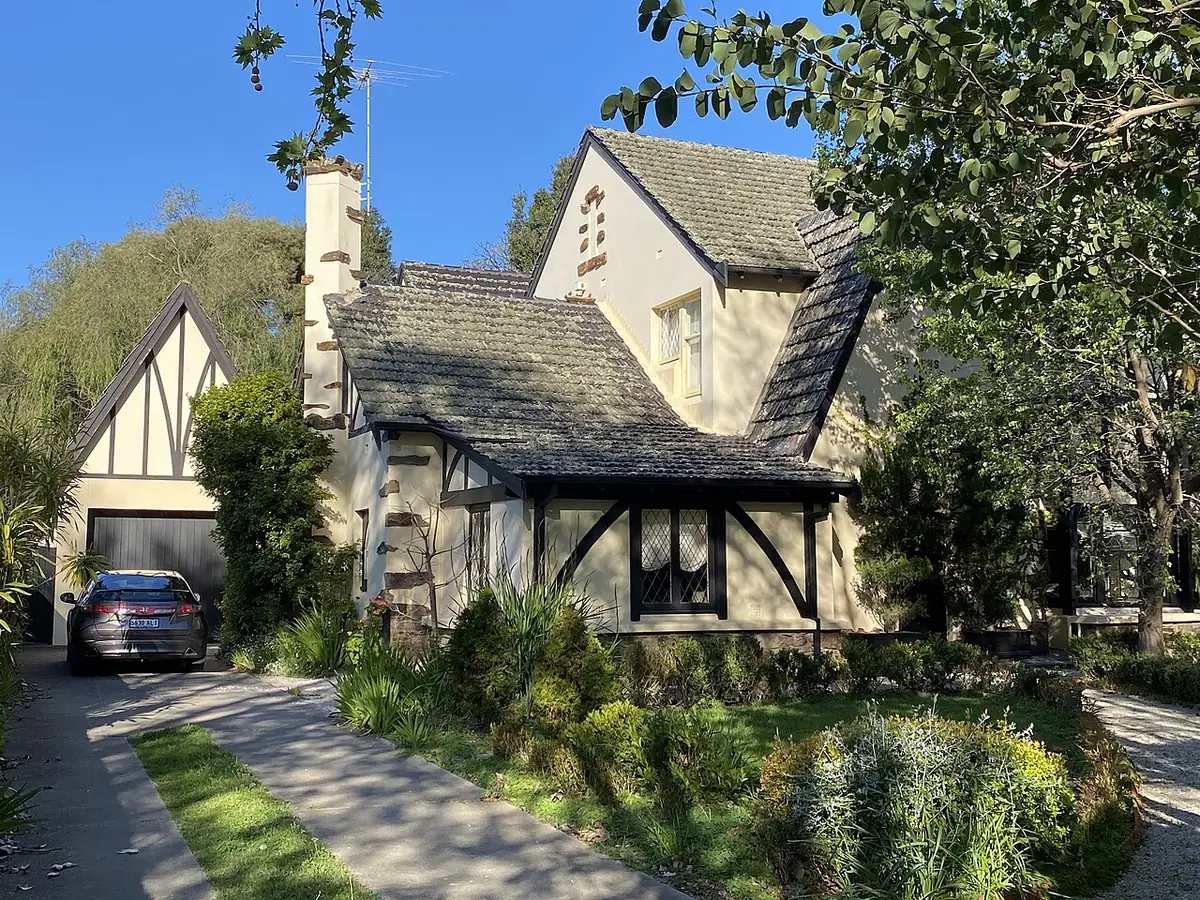
A Tudor Revival home with a leafy front garden in Adelaide — Photo: Ashton 29 · CC BY-SA 4.0 · Wikimedia Commons
No single party produces the value of an apartment in South Australia on their own. The agent knows the active buyers, the valuer applies an independent method, the bank thinks like a cautious lender, while the land register and the Valuer-General supply the public data that ties it all together. Knowing where each figure comes from lets you gauge its bias and avoid confusing an administrative value, a marketing appraisal and a security value. The steps below follow the order in which a figure is usually built.
You, the ownerAssemble the property's papersGather the title, the strata or community plan, the latest minutes, the level of levies and of the sinking fund, and the list of works carried out. Without those, any valuation rests on assumptions that the buyer, for their part, will check.
The land register and the Valuer-GeneralSupply the public dataRecorded sales give the prices actually signed, and the annual capital value offers an administrative benchmark. That data sets the frame, but says nothing about the condition or the floor level of your lot.
The real estate agentPropose a marketing figureThey compare your apartment with recent sales and with the properties competing against it, and they know how deep demand runs in your area. Their appraisal is useful but not neutral, because it also serves to win the listing.
The certified valuerEstablish a defensible valueThey inspect, measure, select and adjust the comparables, then write a dated and reasoned report. That is the document to rely on for an estate, a separation or a tax requirement.
The bankAdopt a security valueIt commissions its own valuation to set the amount it is prepared to lend. That value is deliberately cautious and can sit below the agent's appraisal without either of them being wrong.
Apartment or house in Adelaide: how each type of property holds its value
Those dynamics translate directly into the price levels you should compare your property against, and into the costs that come off the figure.
In Adelaide, the value of a house rests largely on its land, whereas the value of an apartment rests above all on the building, the location and the quality of the scheme. That difference explains why the two types of property do not move at the same pace. In the sought-after inner suburbs such as Unley, Norwood or Burnside, land is scarce and tends to support house values over time, even as the construction ages. An apartment, by contrast, carries only a small share of land: its value follows the condition of the building, competition from new developments and the level of levies. When valuing, then, never transpose to an apartment the growth observed on houses in the same suburb.
Adelaide's apartment market is itself far from uniform. The small blocks of the 1960s and 1970s, common in the inner suburbs, often offer decent floor areas, modest levies and sometimes a garage, which makes them attractive to first-time owners and to retirees reducing their floor space. Recent CBD towers offer modern facilities but compete with every new completion, which can limit growth in value for the most standardised lots. Purpose-built student accommodation is a case apart: very small floor areas and an almost exclusively investor buyer base narrow the pool of interested parties, and therefore the liquidity of the value.
For an apartment, several elements move the valuation more than people expect. A private car space, in a centre where parking is scarce, can weigh noticeably on the price. Aspect and insulation count too, because summer heatwaves in Adelaide can exceed 40 degrees and a home that is hard to keep cool trades lower. Finally, the level of strata or community levies is capitalised directly into value: a buyer paying several thousand dollars a year in levies adjusts their offer accordingly, especially if they are thinking as an investor and working out a net yield.
On the house side, value is more sensitive to the land, to the scope for subdivision or extension and to the condition of the structure, particularly on the reactive clay soils of the region, which cause cracking. On the apartment side, it depends more on collective governance: a well-maintained building with an adequate sinking fund protects the value of every lot, while a struggling corporation degrades it for everyone. If you are valuing an apartment in order to compare it with a house — to decide which to keep and which to let go, for instance — reason in value net of levies, foreseeable works and time to resell, not in headline asking price.
Which price levels to compare your Adelaide apartment against, and which costs come off the figure
Beyond the figures, value is also formed in the daily life the buyer acquires by choosing your address.
A useful valuation answers two questions: where your apartment sits against the available benchmarks, and what is left of that value once the costs of a possible sale are netted off. The benchmarks are not equivalent: an asking price, a recorded sale, an administrative capital value and a valuer's report each measure something different. The costs, for their part, vary with your situation, in particular your tax residence and the use you make of the property. The tables below are indicative, replace neither a quote nor tax advice, and use the same ranges as the rest of this guide.
The value benchmarks to test your Adelaide apartment against
Benchmark
Order of magnitude or nature
How to read it for your property
Asking prices for Adelaide apartments
Around $7,030 per sq m at the median; in the order of $629,000 on average for two bedrooms and $843,600 for three
A ceiling for reading rather than a value: these prices include room for negotiation and cover properties that will not sell at that level.
Comparable recorded sales
Prices signed in your building, your street or your area, ideally within the last six to twelve months
The strongest evidence available, to be adjusted for floor level, area, outlook, car parking and the condition of each lot.
The Valuer-General's capital value
An administrative value revised each year, the basis for council rates, water charges and land tax
A useful guide to the trend, but set by mass appraisal at an earlier date: it ignores everything specific to your apartment.
Agent's appraisal or valuer's report
An agent's appraisal is in principle free; a valuer's report is generally charged at a few hundred dollars for a standard apartment
Compare the two: the agent measures what the market might pay, the valuer establishes a dated and defensible value.
The amounts drawn from listings are estimates taken from the data on this page. They should be tested against recorded sales before any decision.
What comes off the gross value of your apartment
Item netted off the value
Range or mechanism
Effect on the figure you keep
Agent's commission and marketing costs
Commission most often in the order of 1.5 to 3 per cent of the price depending on the agency and the agreement, plus a negotiated marketing budget
To be deducted from market value to arrive at the net proceeds of a sale; conveyancer's fees and the discharge of any mortgage are added at settlement.
Strata or community levies and special levies
From $3,000 to $7,000 a year depending on the facilities, plus any special levies for major works
High levies, or works approved but not provided for, reduce the price a buyer will accept; they belong in the valuation.
Capital gains tax and foreign resident withholding
A gain taxable in Australia outside the main residence exemption; withholding of 15 per cent of the price at settlement without a clearance certificate
For an owner who is not an Australian tax resident, net value can sit well below market value; a gain will usually also have to be declared in your country of residence.
Add council rates, in the order of $1,800 to $3,500 a year, for as long as you hold the property. Have the tax position confirmed by an Australian accountant and an adviser where you live, because it depends on your tax residence at the date of contract and on how long you have held the property.
Health, schools, transport: the ordinary Tuesday a buyer pays for in Adelaide
Saint Ignatius Church and its twin towers in Norwood — Photo: Ashton 29 · CC BY-SA 4.0 · Wikimedia Commons
You still need to know what those averages and typical days fail to say about your apartment in particular.
Part of an apartment's value never shows up in the listing: it is the time saved, the services within reach and the quality of the journeys a buyer acquires by choosing an address. In Adelaide, being near the tram, sought-after schools, the Royal Adelaide Hospital or the Park Lands is capitalised into the price, sometimes more than floor area is. Following an ordinary Tuesday helps identify what supports the value of your lot and what undermines it. Each stop below corresponds to an argument the buyer will weigh, consciously or not, when framing their offer.
07:30The first journey of the dayFrom the centre, the free tram and a short walk are enough; from the inner suburbs, the drive stays short compared with Sydney or Melbourne. An apartment within walking distance of a tram line or a frequent bus route compares favourably with lots that depend on a car.
08:15Schools and catchment zonesSome Adelaide state schools enrol according to the home address, which can support the value of homes inside their zone. For a three-bedroom family apartment, that often matters more than it does for a studio.
09:00Offices, campuses and the hospitalProximity to the CBD employment hubs, the universities and the Royal Adelaide Hospital feeds steady residential and rental demand. It supports in particular the value of the smaller apartments sought by health professionals and students.
12:30A break at the Central Market or on Rundle StreetShops and street life within walking distance are part of what the buyer pays for in the centre. An apartment close to them holds up better in a slower market than an isolated lot.
17:30Shopping and local healthcareA supermarket, a pharmacy and a medical practice minutes away reassure retired buyers reducing their floor space. Their absence rarely shows as a stated discount, but often as a longer time on market.
19:00An evening in the Park LandsThe green belt around the centre offers walks and sports grounds close at hand. An open outlook or direct access to the parks is one of the most stable location premiums for an Adelaide apartment.
What a headline figure will never tell you about your Adelaide apartment
Those blind spots are precisely where the valuation mistakes owners discover too late begin.
Suburb averages and online estimates treat every apartment in a category as interchangeable. Yet in Adelaide, several elements invisible in the data can move the value of a lot well beyond the general range: the financial position of the corporation, heritage protections, the thermal performance of the building, or the lending conditions applied to small apartments. A well-advised buyer will find them in the Form 1 or during their inspection. Better to build them into your valuation before they are used to negotiate against you.
The sinking fund and the works the corporation has planned
A building that has to redo its waterproofing, its facades or its lifts without adequate reserves will sooner or later raise substantial special levies. Buyers read the minutes and cut their offers accordingly, sometimes by more than the works actually cost.
Heritage listings in the older suburbs
In North Adelaide and certain historic areas, heritage protections can limit changes to facades or heavy renovation. They preserve the character of the neighbourhood, but reduce the scope to add value through works, something a valuation based on renovated properties elsewhere will not see.
Lending conditions applied to small apartments
Some banks require a larger deposit or decline to finance very small apartments, particularly below a given internal floor area. Those restrictions reduce the number of people able to bid and can weigh on the value of a studio or a student accommodation lot.
Thermal insulation and the cost of cooling
Many buildings from the 1970s and 1980s are poorly insulated, which makes the homes hard to keep cool during heatwaves. An exposed top floor or single-glazed windows can justify a discount, especially against newer lots that perform better on energy.
The Adelaide valuation mistakes that only surface six months later
Those mistakes also show that, for some owners, acting straight away on a valuation is not the right decision.
Looked likeA flattering appraisal from one agent, clearly above the others, which seemed to confirm the hoped-for value.
Turned outAn apartment left online for months, followed by successive price reductions that ended up weakening the owner's negotiating position.
Would have caught itAsking for several appraisals, insisting on the list of comparable sales behind each, and keeping the figure the evidence supports rather than the highest one.
Looked likeA rising capital value from the Valuer-General, used as proof of the property's current worth.
Turned outAn administrative figure with no direct link to the condition, floor level or levies of the apartment, which distorted the division of an estate between heirs.
Would have caught itKeeping the capital value for reading trends, and commissioning a dated valuer's report as soon as a decision about an estate depends on it.
Looked likeThe suburb average applied as it stood to an apartment in an older scheme.
Turned outAn overstated value, because buyers found in the documents a substantial special levy for renewing the roof and the facade.
Would have caught itReading the minutes, the budget and the sinking fund before valuing, and deducting foreseeable works from the reference price.
Looked likeA record price achieved at auction by a neighbouring lot, presented as the building's new level.
Turned outAn isolated sale driven by two determined bidders, which the bank did not accept at refinance and which was never repeated.
Would have caught itWeighting each sale according to the circumstances of the transaction and relying on several comparables rather than on a single exceptional result.
Who should not act right now on a valuation of an Adelaide apartment?
What remains, at the end of this journey, is how much confidence to place in the figure you are holding.
A valuation is a decision-making tool, not a decision. In some situations, acting immediately on a figure — listing the property, buying out a co-heir's share, refinancing — exposes you to losses that a little time or better evidence would have avoided. In Adelaide, where apartment comparables are sometimes scarce, those cases are more common than they look. The profiles below do better to wait, to dig deeper or to change the tool they are valuing with.
The owner who has only an online estimate or a single agent's opinion
→Gathering recent recorded sales and at least two reasoned appraisals before any listing.
A lone figure, produced without an inspection or a reading of the scheme documents, can depart sharply from the price actually achievable in a building where comparables are few.
The heir or partner who has to share the value of an apartment with other parties
→Commissioning a written report from a certified valuer, at a valuation date all parties agree on.
An agent's appraisal is not designed to be defended in a disagreement, whereas a dated and reasoned report limits challenges and meets what lawyers and the tax office expect.
The owner who is not an Australian tax resident and is considering a quick sale on the gross value
→Having the net value calculated after commission, withholding and capital gains tax before deciding.
The withholding applied at settlement and the tax treatment of foreign residents can materially reduce the proceeds, which sometimes changes whether selling now beats keeping the property.
So how much confidence should you place in the figure you hold for your Adelaide apartment?
A figure earns your confidence when it answers the right question and rests on evidence you can check. For an apartment in Adelaide, that means first knowing which value you are after — marketing value, defensible value or security value — and then checking that the valuation draws on recent recorded sales that are genuinely comparable by building, floor level, area and condition. A figure that cites no comparable, or rests only on asking prices or on the Valuer-General's capital value, remains an order of magnitude. It can guide your thinking, but it cannot support a committing decision.
Confidence grows as the sources converge. If several agents' appraisals, the recent sales in your building and, where relevant, a certified valuer's report all sit in the same range, you are holding a solid value. If they diverge, look for the explanation rather than choosing the figure that suits you: levies, works to come, heritage protections, lending conditions on small apartments or an unusual sale nearby. In Adelaide, where the apartment market is narrower than in the larger capitals, those gaps often reveal something specific to your lot.
Finally, always bring the gross value back to what would actually be left to you. Agent's commission, conveyancer's fees, special levies, capital gains tax in Australia and, for an owner resident elsewhere, a declaration at home: these can change the conclusion, particularly if you manage the property from abroad. A reliable valuation is therefore not just an accurate figure, it is a figure that is understood, dated and placed in your own situation. If you are there, you can decide calmly whether to sell, keep, refinance or divide; if not, the next step is to complete the evidence, not to make the call.
Related questions
What is the difference between an agent's appraisal and a certified valuer's report in Adelaide?
An agent's appraisal is usually free and is meant to indicate the price your apartment could achieve in the current market. It draws on recent sales and on the properties competing with yours, but it is also a commercial tool aimed at winning the listing. A certified valuer, by contrast, is paid to establish an independent market value at a stated date, in a written and reasoned report. That report is the one to rely on for an estate, a separation, a tax requirement or any disagreement between parties.
Does the capital value set by the Valuer-General reflect what my apartment is worth?
Not exactly. The Valuer-General of South Australia sets values each year for properties across the state, and those values underpin council rates, water charges and land tax. They are produced by mass appraisal methods, at a reference date, without an inspection of each individual home. They give a useful sense of the trend, but they take no account of your floor level, the condition of your lot or the levies attached to it.
How do I find recent sale prices for apartments in my own building in Adelaide?
Sales are recorded in the state land register and then picked up by the major property portals and data providers, which publish signed prices after a variable delay. You can also ask an agent for a list of recent sales in your building and your street. For each sale, check the date, the floor area, the level, the car parking and the condition of the lot. An old or unusual sale should be weighted rather than applied to your property as it stands.
How much does a professional valuation of an Adelaide apartment cost?
An agent's appraisal is in principle free, because it forms part of a commercial approach. A certified valuer's report is charged for, generally a few hundred dollars for a standard apartment, and more if the property is unusual or if the report has to satisfy a specific legal framework. Ask for a written quote stating what the report is for, the valuation date you need and the turnaround you expect. For a refinance, the valuation is most often commissioned by the lender itself.
Do strata or community levies affect the value of an apartment?
Yes, and often significantly. Levies, which generally range from 3,000 to 7,000 dollars a year depending on the building's facilities, are built into the buyer's calculation, particularly where they are thinking as an investor. An underfunded reserve, or major works that have been approved but not provided for, reduce the price a buyer will accept. Read the budget, the minutes and the level of the sinking fund before settling on a figure.
Why is my bank's valuation lower than the agent's appraisal?
The bank wants to know the value of the security it is lending against, so it takes a cautious approach. Its valuation may be done from the file, by an automated model or on a brief inspection, and it readily sets aside exceptional sales. The agent, by contrast, is thinking about the best price the market could offer. If the gap matters to your plans, gather recent comparable sales and ask a broker whether another valuation is possible.
Should auction results be used when valuing an apartment in Adelaide?
Auction results are prices actually achieved, so they are valid comparables. But an auction can be driven by two unusually determined bidders, which sometimes produces a price that is hard to repeat. Equally, a property passed in because it did not reach its reserve, and sold later, does not send the same signal. Weight each result according to its circumstances and never build a valuation on a single sale.
How do I value an apartment in Adelaide while living overseas?
From a distance, start by assembling the title, the strata documents and the recent sales in your building and your area. Then ask several agents for written appraisals, each with the list of comparables used, and instruct a certified valuer if the decision has consequences for your estate or your tax position. Factor in the exchange rate when reading the value in your home currency, because it can noticeably change how the result feels. A tax adviser can finally tell you what that value implies in Australia and in your country of residence.
Which taxes should be netted off the value of an apartment if you are considering a sale?
In Australia, a capital gain on a sale is taxable, unless the main residence exemption applies, and foreign tax residents are in principle excluded from it. Without a clearance certificate, which only an Australian tax resident can obtain, the buyer withholds 15 per cent of the price at settlement, an amount later credited against the seller's tax. An owner who is tax resident elsewhere will usually also have to declare the gain at home, with the relevant double tax treaty organising relief. Have the calculation confirmed by an Australian accountant and an adviser in your country of residence before deciding.
How often should the valuation of an Adelaide apartment be refreshed?
A valuation reflects the market at a given date and loses relevance as new sales are recorded. For simple asset tracking, an annual update based on recent sales is generally enough. Before a committing decision such as a listing, a division of assets or a refinance, it is wise to hold a recent, dated figure. A marked move in Reserve Bank of Australia rates, or works approved by your body corporate, also justify a fresh valuation.
Property review of ting
No ting properties in Adelaide yet
Be the first — share it on ting and it shows up right here.