Finding and renting a house in Dubai means getting to grips with rules that are specific to the emirate, from choosing a residential community to paying by cheque. This guide gives you a factual, structured analysis so you can settle into a home here without unpleasant surprises.
Get the app
What nobody tells you.
Real prices, hidden costs and the traps to check before you commit.
What renting a house in Dubai really means for your daily life
Scroll
What renting a house in Dubai really means for your daily life
Finding and renting a house in Dubai means getting to grips with rules that are specific to the emirate, from choosing a residential community to paying by cheque. This guide gives you a factual, structured analysis so you can settle into a home here without unpleasant surprises.
Written by the ting.ad editorial team ·
Dubai in Street View: drag to look around.
Before committing to a particular area, you need to measure your way of life against local realities.
Renting a house in Dubai is not simply a matter of signing a standard lease and moving in under the sun. The emirate's property market imposes specific rules, upfront payment structures and running costs that newcomers routinely underestimate. Between annual contracts paid by cheque and the cost of maintaining a pool or a garden, the financial and logistical reality calls for careful preparation. Understanding these mechanics from the start saves you unpleasant surprises once the boxes are unpacked.
Apparent flexibilityvsA heavy financial commitment
Although the market offers an abundant supply of houses and villas, landlords generally require the year's rent in one, two or four cheques. That practice hits your cash flow from day one, a long way from the smooth monthly instalments common in many other markets.
Villas in gated communities offer high-end finishes, green space and built-in sports facilities. In exchange, centralised air conditioning running all year and the upkeep of outdoor space generate electricity and service bills that are far from trivial.
The local regulatory system protects both landlord and tenant through RERA, but ending a tenancy early almost always triggers financial penalties equivalent to several months of rent. It is an illusion to think you can move out overnight at no cost.
What kind of daily life are you really looking for in the emirate?
Moving to the daily reality of Dubai means analysing precisely which changes lie ahead of you.
Choosing a house in Dubai does not depend on your overall budget alone, but above all on your rhythm of life, the make-up of your household and your daily priorities. Between the ultra-connected districts close to the business centres and the quieter family communities further out, each option completely redefines how you live, how long you travel and what you do with your free time.
The urban compromise
Choosing a house or a large upmarket villa close to the central arteries lets you cut daily commuting time drastically. You are immediately close to restaurants, international schools and coworking spaces, while keeping the private space of a villa.
In exchange, urban density is higher, plots are often smaller and rents reach the top of the local market. It is the ideal option for busy professionals who refuse to spend hours on the motorways every week.
The outlying family community
Settling in the large gated residential developments further inland offers an exceptional environment in which to raise a family. Children can play safely in pedestrian parks, and you get sports clubs, community pools and shopping centres built into your neighbourhood.
This choice does mean accepting longer daily journeys to reach the city centre and the main business zones. The car becomes indispensable for the slightest errand, which puts family logistics at the heart of your organisation.
The exclusive waterfront
Living in a coastal villa or on the man-made islands is the picture-postcard image of life in Dubai. You get an exceptional outlook, a constant sea breeze and a lifestyle built around boating and time spent outdoors.
That unique position brings some of the highest rents in the region, along with greater exposure to the maintenance demands of a salty environment. It is a choice reserved for very comfortable budgets that put the setting above everything else.
Living here when you arrive from abroad: what actually changes
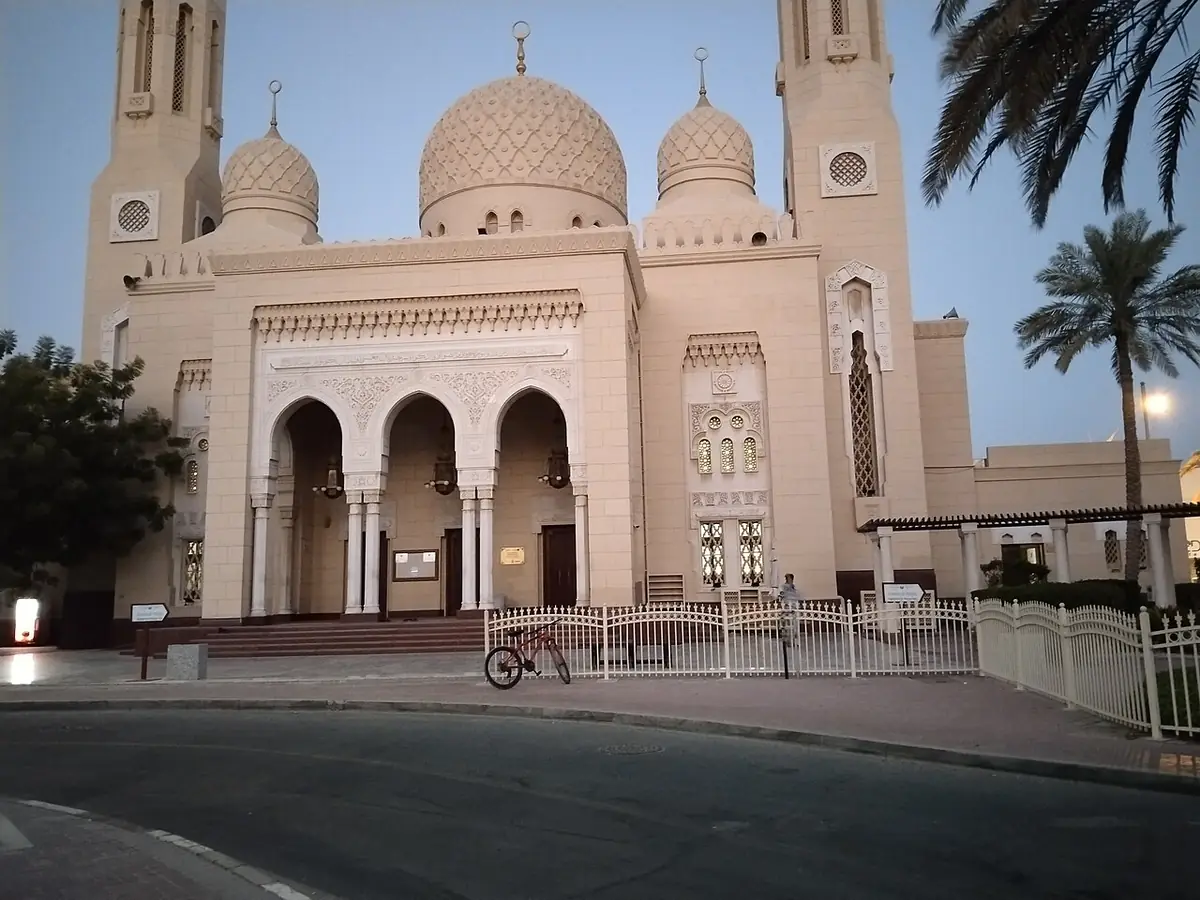
Jumeirah Mosque, a well-known landmark in Dubai — Photo: ZI Jony · CC BY-SA 4.0 · Wikimedia Commons
Once those reference points are clear, the central question becomes which micro-district you settle in.
Moving from abroad into a house in Dubai puts you in front of administrative, climatic and social reference points that are radically different from the ones you know. The way services work, the way housing is managed and the place the car occupies bear no resemblance to life in most established cities. Anticipating these structural gaps spares you the frustration of the first few months and helps you settle more calmly into your new environment.
From abroad
An older, compartmentalised housing stock with regulated multi-year leases
Dubai
Modern communities, recent villas with open volumes, and renewable annual contracts
You gain modern thermal comfort and built-in amenities, but you lose the long-term legal stability of the regulated leases you may be used to.
From abroad
Getting around easily on public transport and on foot
Dubai
Near-total dependence on your own car to cross a vast road network
Your transport budget has to cover buying or long-term leasing a vehicle, plus managing rush hour on the main arteries.
From abroad
Rental management framed by very strict tenant protection laws
Dubai
A dynamic market regulated by RERA, where rent increases follow a precise official index
You must check the property's indexation history before signing, so you are not hit by an unexpected rise at the first renewal.
From abroad
Building service charges shared out and often bundled into advance payments
Dubai
Service charges (HOA fees) paid by the landlord but directly shaping the quality of the common areas
Make sure the community is rigorously maintained, because the quality of your day-to-day surroundings depends on it.
Which district should you choose to set up home in the emirate?
With the geography settled, it is worth examining in detail the budgets you actually need to plan for.
Dubai offers a multitude of residential districts with widely varying atmospheres, architecture and budgets. Picking the right area directly shapes your quality of life, your proximity to schools and your connection to the rest of the city. Each community has its own identity, its logistical advantages and its unavoidable compromises.
Green communities of the Arabian Ranches type
Complete calm, paced by family walks around the artificial lakes and along shaded cycle paths.
Suits
Families with children who want a peaceful, secure residential life with plenty of good schools nearby.
Trade-off
Clear geographical distance from the coastal business districts, which means long journeys at peak times.
Coastal and island areas such as Palm Jumeirah
An exclusive daily life turned towards the sea, the sound of the waves and direct access to private sandy beaches.
Suits
Senior executives and residents who value a prestigious setting and an upmarket seaside way of life.
Trade-off
Extremely high rents and regular traffic bottlenecks entering and leaving the island.
Established central districts such as Jumeirah Village Circle
A lively, multicultural atmosphere with quick access to the city's newer economic hubs.
Suits
Those looking for a reasonable financial compromise while renting a modern, well-placed house.
Trade-off
Building sites still active in places, and higher urban density than in the outlying communities.
How much does renting a house in Dubai really cost?
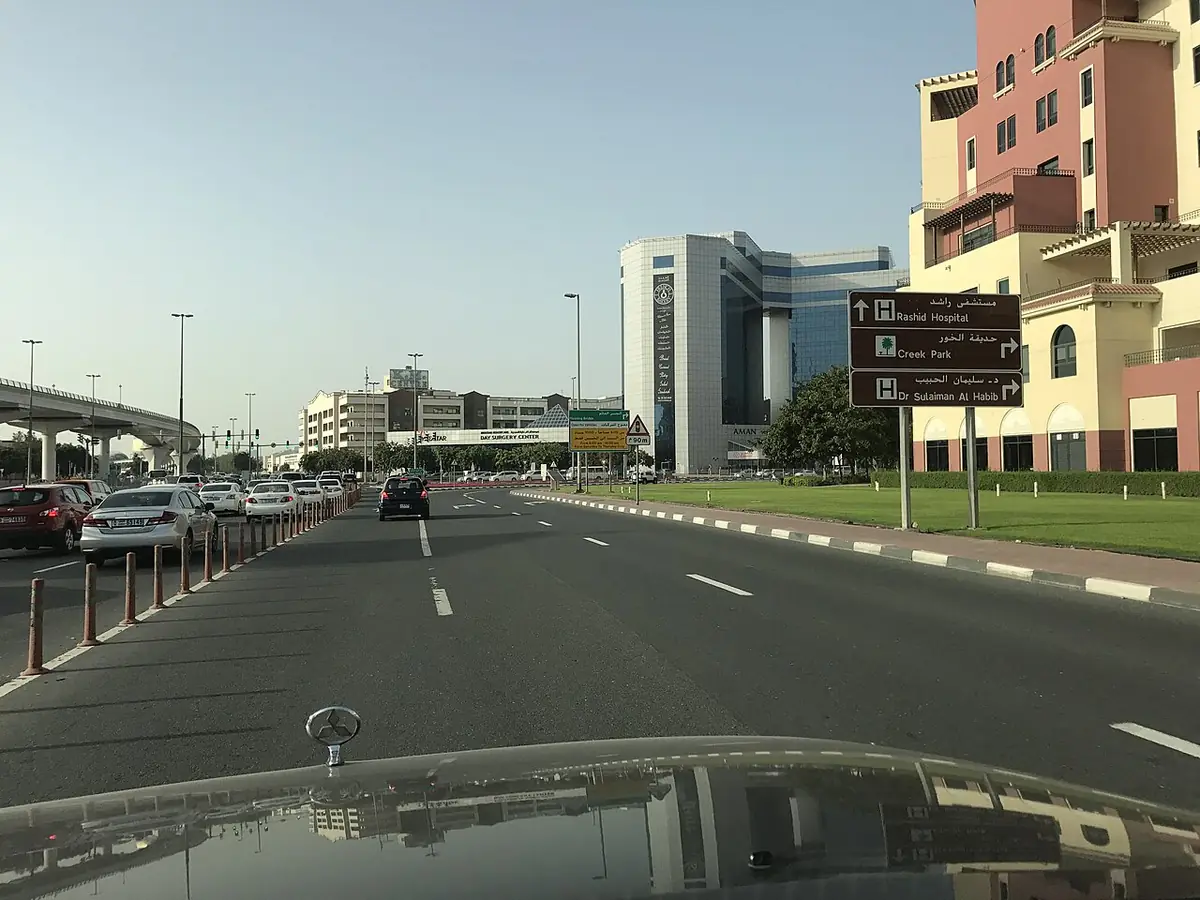
A typical Dubai street, wide and lined with modern buildings — Photo: Darvin.wilson · CC BY-SA 4.0 · Wikimedia Commons
Beyond the purely budgetary questions, the legal framework for holding and renting property deserves particular attention.
Dubai's rental market runs on precise financial standards, and the advertised rent is only one part of the budget equation. Between agency fees, security deposits, municipal charges and utility bills, the initial cash outlay is often substantial. Setting a realistic budget protects you against any risk of running dry during your first year here.
dubaiTo rentHouseestimate
Median price / m²AED 74Half the apartments sell below this
Median priceAED 14.3kthe average is 14% higher — a few very large properties pull it up
Most common2 bedrooms58 % of listings
Average size184 m²
By number of bedrooms
Bedrooms
Share of market
Avg price
Price / m²
Avg size
2most common
58 %
AED 14.2k
AED 77
184 m²
3
31 %
AED 17.9k
AED 73best value / m²
245 m²
4
11 %
AED 27.2k
AED 82 +5 %
333 m²
Each row is an average, compared against the area average of AED 78 / m². These are indicative estimates of a typical local market, not a measured sample of live listings. Check current listings before relying on them.
What you can actually sign and hold as a tenant
To finish your project with peace of mind, follow the rigorous chronology of a successful transaction step by step.
The legal system governing property in Dubai clearly protects the contracting parties, provided local procedures are followed to the letter. Understanding the distinction between simply renting a home and owning it outright saves you any confusion about your legal status in the emirate. The contract registered with the competent authorities is what counts in every circumstance.
The status of resident tenant (Tenancy Agreement)
By signing a tenancy contract registered on the official Ejari platform, you gain clear rights guaranteed by local government regulation. Future rent increases are governed by an official RERA calculator, and the landlord cannot evict you arbitrarily during the lease without a valid legal reason.
What it changesYou enjoy stable residential security, provided you put every agreement in writing and avoid informal verbal arrangements.
The limits and prohibitions of renting
Renting a house gives you no right to make heavy structural alterations without the landlord's prior written consent. Beyond that, subletting your home to third parties on a tourist or seasonal basis (Airbnb style) is strictly regulated and prohibited without the landlord's explicit authorisation and the appropriate licences.
What it changesYou need to treat your house as a personal, long-term home rather than a commercial asset you can run on your own terms.
The rule to understand before you hand over any deposit
Here, finally, is the precise chronological path of settling in, from the search through to moving day.
Dubai's property market is known for how fast it moves, which sometimes pushes newcomers to sign too quickly under the pressure of demand. One lapse of attention when checking the title deed or the property's history can turn your move into an administrative nightmare. Following a logical chain of checks is the only guarantee of a secure tenancy.
You spot a house that matches your criteria and want to make an offer to the landlord.
Insist on seeing the original Title Deed to confirm the true identity of the landlord.
Check that the agent holds a valid professional licence issued by RERA and the Dubai Land Department.
Draw up a clear reservation agreement (Form A) protecting your deposit if the landlord turns down your application.
Make sure the final contract will be officially registered on the Ejari portal as soon as it is signed.
You collect the keys to your house in full legal and financial compliance.
How a rental transaction unfolds, step by step
Moving into a house in Dubai follows a methodical process, marked out by regulated professionals. Knowing each party's role and the order of the formalities lets you steer your move without needless stress. Every completed step makes the transition to your new home a little more secure.
YouSetting a precise budget and shortlisting target communitiesList your family requirements, your transport needs and your maximum financial limits before contacting a single agent.
The letting agentTargeted viewings and selection of the properties available on the marketThe agent shows you the houses matching your criteria and negotiates the general terms of the initial offer.
Landlord and tenantSigning the Memorandum of Understanding (MoU) and paying the depositA security deposit (usually 10%) is held in escrow while the standard checks and background verifications are completed.
Landlord and tenantIssuing the rent cheques and signing the official contractPost-dated bank cheques are handed over according to the agreed schedule and the lease is signed on the regulated forms.
The electricity provider (DEWA)Opening the utility accounts and connecting the supplyWater and electricity meters are activated in your name and the compulsory consumption deposit is paid.
YouEjari registration and actually moving inFinal legal validation of the contract on the government platform, and collection of your permanent access to the community.
House or apartment in Dubai: weighing the independence of a villa against the ease of a tower
Once that fundamental choice between vertical and horizontal living is made, the unavoidable question of budget arrives immediately.
Choosing whether to rent a house or an apartment in Dubai is not a simple matter of taste, but a deep trade-off between two radically opposed ways of living that the city offers its residents. On one side, the residential tower embodies urban verticality, permanent hotel-style service and immediate access to the city's key arteries, whether in Downtown or Dubai Marina. On the other, the villa in a gated community, found in Arabian Ranches or in Emaar South, favours space, greenery, the privacy of your own garden and a neighbourhood life geared towards families with children. This architectural duality shapes the whole residential path of expatriates who settle in the emirate for the long term.
The apartment offers considerable logistical flexibility for couples without children or for professionals whose pace of life demands minimal maintenance. A concierge on duty around the clock, a built-in gym and a rooftop pool simplify daily life while removing the technical surprises that come with a standalone home. In exchange, the closeness of shared spaces, the potential noise from nearby construction and the absence of any real private outdoor space weigh heavily in the balance after a few years, particularly when the summer heat limits access to outdoor public areas.
A house, by contrast, redefines your relationship with space and with domestic time in Dubai. Renting a villa means the luxury of private parking for two cars, a green space where children can play safely, and generous living space that lets you host family and friends in complete comfort. That autonomy comes at a high financial and organisational price, though. Air conditioning large volumes, the regular upkeep of the pool and garden, and the distance from the business districts all demand budgetary discipline and a greater tolerance for daily journeys on roads that are often saturated at peak times.
Looking at the costs each option pulls with it, the initial rent gap between a large tower apartment and a townhouse narrows considerably once you factor in building service charges on one side and the upkeep of an independent property on the other. Service charges in high-end towers can weigh heavily on the monthly budget, while summer electricity use in a poorly insulated villa, or one with a large pool, can double the utility bill. The final choice therefore depends on the household's ability to absorb these hidden variables, given its make-up and how long its working life is anchored in the emirate.
Ultimately, the decision to settle in a house or an apartment in Dubai has to match your vision of daily life and your tolerance for local constraints. Those who want urban energy and operational convenience will opt for height without hesitation, while those who value calm, space and greenery will find the sanctuary they are looking for in the villa communities. It is crucial to weigh these parameters before signing any tenancy contract, because early termination penalties and the agency fees tied to an early move prove particularly off-putting in the Dubai property market.
What budget do you really need to live comfortably as a tenant in Dubai?
With that financial framework in place, it is worth picturing an ordinary weekday to measure how location shapes daily organisation.
Building a forecast budget for renting in Dubai cannot stop at the headline rent shown on the property portals. You have to factor in all the unavoidable outgoings that make up the total cost of residential life in the emirate, from utility bills to school fees and transport. The structure of those charges varies considerably depending on whether you live in an apartment run by an active building management company or in a standalone villa needing its own maintenance contracts. Underestimating these secondary items inevitably leads to financial strain within the first few months.
Average annual rent ranges by property type and location
Property type
Central district (Downtown / Marina)
Residential district (JVC / Silicon Oasis)
Villa community (Arabian Ranches)
Studio / 1 bedroom
80,000 to 120,000 AED
55,000 to 75,000 AED
Not applicable
2-bedroom apartment
130,000 to 220,000 AED
85,000 to 120,000 AED
Not applicable
3 to 4 bedroom villa
Not applicable
140,000 to 190,000 AED
220,000 to 400,000 AED+
Rents in Dubai traditionally require payment in staggered cheques, although the shift towards monthly bank transfers is slowly gaining ground.
Average monthly extras and utilities for a resident household
Cost item
Estimated amount (apartment)
Estimated amount (villa)
Frequency and notes
Electricity and water (DEWA)
600 to 1,200 AED
1,500 to 3,500 AED+
Monthly, with a major peak from June to September
Cooling (Empower / other)
500 to 1,000 AED
Included or variable
Fixed capacity charge plus actual consumption
Internet and telecoms
350 to 600 AED
400 to 700 AED
High-speed fibre package (Du or Etisalat)
Home insurance
1,000 to 2,500 AED
2,500 to 5,000 AED
Payable annually, required in order to sign
Electricity bills rise exponentially in summer because the air conditioning runs constantly.
Health, schools, transport: what does an ordinary Tuesday look like as a tenant in Dubai?
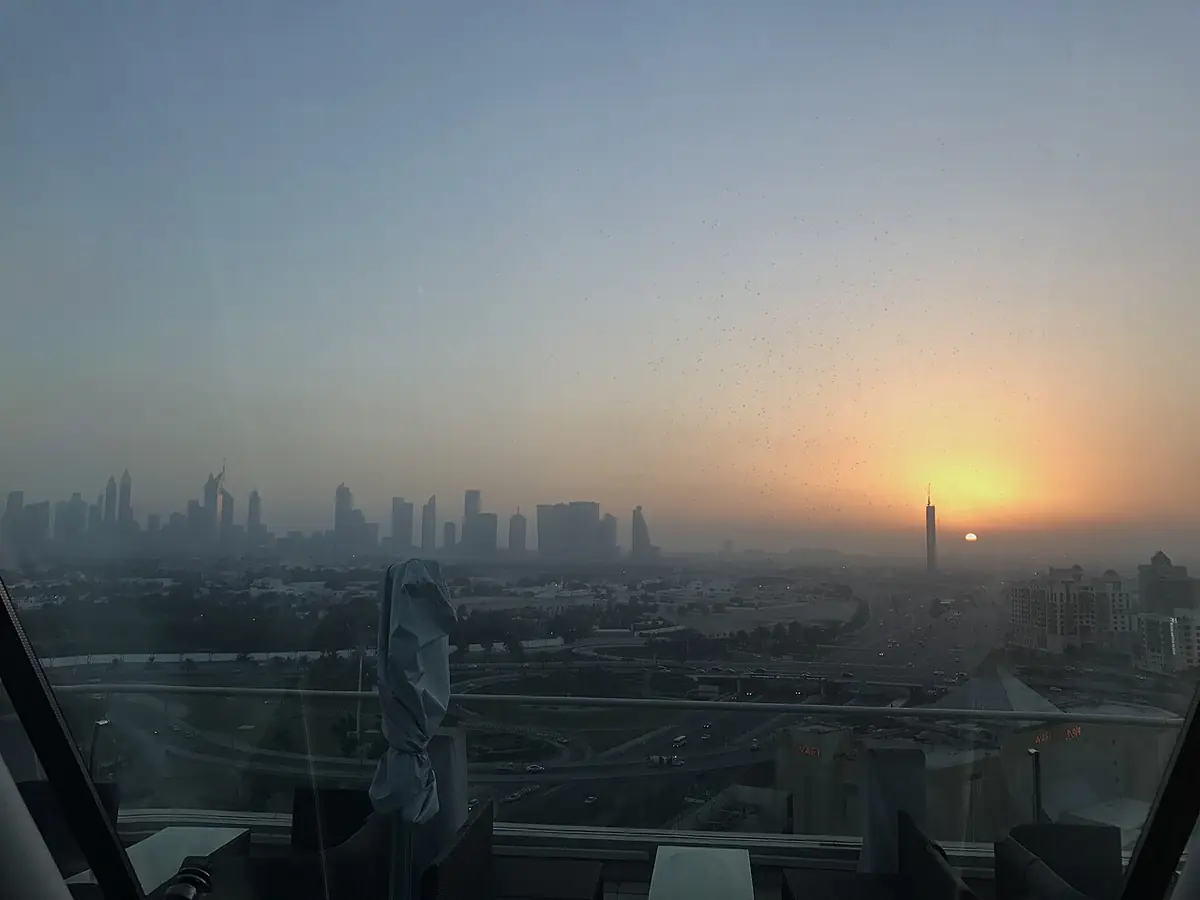
Dubai's skyline at sunset, a fitting close to the day — Photo: Lxs · CC BY 4.0 · Wikimedia Commons
Beyond that well-oiled routine, plenty of things the brochures never mention deserve to be brought into the light.
Grasping the reality of a long stay in Dubai means looking past the leisure imagery and examining how an ordinary working day unfolds. Between traffic on Sheikh Zayed Road, the morning school run and making the most of local services, every hour is carefully paced. The smoothness of the road and digital infrastructure sometimes contrasts with occasional congestion in the denser residential areas. Describing a typical Tuesday reveals the real logistical friction a resident faces as the seasons turn.
06:45Home, residential districtWaking and getting ready in an air-conditioned home. A quick check of the outdoor temperature to plan how comfortable the day's journeys will be.
07:30School run and main roadsDropping the children at an international school. Traffic on the secondary roads is heavy but moves well if you stick to the recommended departure windows.
08:45Workplace or business districtArriving at the office in Business Bay or DIFC. Settling into an ultra-connected professional environment with every modern convenience for the morning's work.
13:00Midday break and local amenitiesLunch in the business district, or using the very fast delivery services that are well developed in the emirate, to make the most of work and break time.
17:30Journey home and everyday shoppingThe return trip is marked by slower traffic on the main boulevards. A quick stop at a supermarket in the community for the household's fresh food.
19:30Downtime and running the homeFamily time at the residence, making use of the pool or the gym in the development before setting out the next day's work schedule.
22:00Locking up for the nightChecking the community's security systems and shutting down appliances for a quiet night's rest in a secure environment.
What the property listing will not tell you about how leases really work in Dubai
With those contractual subtleties mastered, it is just as important to look at the disappointments residents most often report after a few months.
Dubai's rental market follows legal and customary rules of its own that differ appreciably from the standards found elsewhere. Behind the promise of flexible leases and high-specification developments sit strict contract clauses, compulsory extra fees and regulatory subtleties administered by the Real Estate Regulatory Agency. Ignoring these when you sign exposes you to significant extra costs and to difficulties in resolving any dispute with the landlord. A careful reading of the terms is essential before you commit any money.
Agency fees and compulsory security deposits
On top of the rent, you pay a standard agency commission of 5 percent and a security deposit equivalent to 5 or 10 percent of the annual rent. That tied-up sum weighs heavily on a tenant's cash position at the moment of moving in.
The complexity of RERA-governed rent increases
The legal calculation of rent increases in Dubai depends on an official index published by the competent authority. A landlord cannot set a new figure unilaterally at will, but can use break clauses or produce valuations if the market runs hot.
The impact of service charges and minor maintenance costs
Most tenancy contracts include a clause stating that repairs below a certain amount, often 500 AED, are the tenant's sole responsibility. A run of small technical faults can therefore add significantly to the monthly budget.
Penalties for ending the lease early
Ending a tenancy before the end of its annual term generally means a financial penalty equivalent to two or three months of rent. That contractual rigidity limits short-term mobility if your professional situation changes suddenly.
The obligation to register with Ejari to make the tenancy official
The tenancy contract must be registered through the Ejari system to be legally valid and to allow water, electricity and telecoms lines to be opened. Without that compulsory step, no official household connection can be completed.
The disappointments tenants discover six months after signing in Dubai
With those traps identified, one decisive question remains: whether this kind of move genuinely suits your profile.
Looked likeAn unbroken, open view over the skyline from the tower balcony
Turned outA construction site opened next door overnight, generating constant noise from six in the morning and blocking the view entirely.
Would have caught itSystematically checking with the developer and the municipality whether neighbouring plots are earmarked for future development before committing to the apartment.
Looked likeModerate energy use thanks to modern, recent equipment
Turned outAn extremely high DEWA bill, caused by poor thermal insulation on the glazing and a central air conditioning system badly sized for the summer heatwaves.
Would have caught itAsking to see the previous occupants' electricity bills for the hottest summer months, so you can estimate the real cost of utilities precisely.
Looked likeA calm, perfectly peaceful residential district in which to raise children
Turned outRecurring traffic jams at school drop-off and pick-up times, turning a five-minute journey into a daily test of patience.
Would have caught itDriving the route yourself at peak times on a weekday before signing the final lease, to measure the real impact of local traffic.
Looked likeAn ultra-responsive concierge and maintenance service included in the service charges
Turned outEndless waits for the building management company to fix lift breakdowns or recurring water leaks in the common areas.
Would have caught itAsking other residents already living in the building about the real reputation and effectiveness of the building manager.
Who should probably think twice before renting a property in Dubai?
Now that those limits are clearly set out, it is time to decide and make your final call with clear eyes.
Dubai's appeal shows no sign of fading, but the emirate's rental market does not suit every life path or every professional temperament. The financial demands, the pace of a city in constant transformation and the absence of certain social safety nets can be major sources of stress for some profiles. Identifying these structural mismatches in advance helps you avoid risky life transitions and damaging emotional and financial investments.
The self-employed worker with fluctuating, irregular income
→Moves without a cash cushion, betting on landing significant local contracts straight away.
The market often demands payment in advance by cheque and tolerates no late rent, on pain of swift legal action and eviction.
The lover of rural quiet and historic character
→Looks for absolute calm, preserved historic landscapes and a traditional pedestrian neighbourhood life.
Dubai is a heavily urbanised megacity, geared to modernity, concrete and the car, where absolute quiet exists only in the most isolated villa communities.
The household on a tightly fixed budget with no room to manoeuvre
→Rents at the very top of what it can afford, ignoring the impact of higher summer bills.
Volatile utility bills and the absence of direct housing benefits make any budgetary squeeze extremely hard to recover from.
So, are you ready to take the step and rent a home in Dubai?
Committing to renting a home in Dubai is a structural decision that cannot rest on the enthusiasm of a holiday or the promise of a distant job opportunity. The city offers an exceptional, secure and extremely dynamic setting, but in exchange it demands logistical and financial discipline at every moment. If you have measured the real costs involved, accepted that you will need to plan your journeys and absorbed the local legal specifics, then the ground is ready for a successful move.
The success of your search will depend above all on your ability to resist the pull of superficial listings. Take the time to visit several districts, to compare the real charges between towers and villas, and to validate every clause of your contract through the Ejari system. Working with recognised, straight-dealing professionals will spare you many disappointments and make your move here durable.
In the end, renting in Dubai is an exhilarating experience for anyone who learns to decode its mechanics and respect its rules. Whether you choose the verticality of an apartment with a view over the horizon or the green privacy of a villa in a gated community, each choice traces the outline of a distinctive way of living. It is now up to you to lay the groundwork for your new residential chapter in the emirate.
Related questions
What documents do you need to rent an apartment in Dubai as an expatriate?
To rent a property in Dubai you need to provide a copy of your valid passport, a current residence visa or an official letter from your employer confirming that one is being issued shortly, plus proof of income or recent bank statements showing that you can afford the rent.
Is it possible to rent in Dubai without a local UAE bank account?
It is extremely difficult to rent long term without a local bank account, because landlords traditionally require post-dated cheques or automated transfers from a bank established in the United Arab Emirates as a guarantee that the rent will be paid on schedule.
What is the Ejari system and why is it compulsory for tenants?
Ejari is a government regulatory system run by the Dubai Land Department that officially registers every tenancy contract in the emirate. Registration is compulsory: it protects the tenant legally, makes the lease official, and allows utility accounts such as electricity and water to be opened.
How are electricity and water charges calculated in summer in Dubai?
Electricity and water bills, managed by the public utility DEWA, rise very sharply during the summer months because air conditioning runs constantly to keep indoor temperatures bearable.
What extra costs should you budget for when signing a tenancy agreement?
On top of the annual rent, the tenant pays an agency commission of generally 5 percent of the rent, a refundable security deposit equivalent to 5 or 10 percent, plus the Ejari registration fee and the deposits required for utility connections.
Can a landlord raise the rent every year at will?
No. Rent increases in Dubai are strictly governed by an official index published by the Real Estate Regulatory Agency. A landlord can only raise the rent if the official index for that area allows it, based on average local market prices.
What is the standard length of a residential tenancy contract in Dubai?
The standard residential tenancy in Dubai runs for one year and is renewable. Short-term or monthly leases do exist, but they belong to a separate and often more expensive market handled by dedicated platforms or agencies specialising in furnished lets.
What penalties apply if you break the lease early?
Ending a tenancy before the end of its annual term generally means paying compensation equivalent to two or three months of rent, unless a specific negotiated break clause was written into the particular conditions of the lease from the outset.
Are pets accepted in every rental property in Dubai?
No. Whether pets are accepted depends entirely on the rules of each building or villa community. Many developments ban animals from common areas, so it is essential to check this clause with the landlord before signing.
Who pays for maintenance and repairs when something breaks in the home?
How maintenance costs are shared is normally set out in the tenancy contract. Major structural repairs fall to the landlord, while routine upkeep and small repairs below a threshold fixed in the contract remain the tenant's responsibility.