Buying a house in Dubai is a major financial decision, and not one to improvise on the strength of the sunshine and an attractive tax position. This guide sets out the realities of the local market in detail — what you can own, what it costs to buy and to run, and who should think twice.
Get the app
What nobody tells you.
Real prices, hidden costs and the traps to check before you commit.
Buying a house in Dubai: between the promise of yield and the reality of the market
Scroll
Buying a house in Dubai: between the promise of yield and the reality of the market
Buying a house in Dubai is a major financial decision, and not one to improvise on the strength of the sunshine and an attractive tax position. This guide sets out the realities of the local market in detail — what you can own, what it costs to buy and to run, and who should think twice.
Written by the ting.ad editorial team ·
Dubai in Street View: drag to look around.
Buying a villa or a detached house in the emirate does not follow the traditional European logic of building wealth through property. Behind the appeal of generous space and secure gated communities, every buyer has to work with a distinctive set of urban dynamics. This is not simply a matter of settling under the sun; it means understanding how the structure of the local market shapes the long-term value of your investment. That permanent tension between the comfort you are looking for and the real cost of maintaining a property in the desert deserves a cold assessment before you sign anything.
Considerable living space at a price per square metre often below the major European capitals.vsMaintenance, air-conditioning and community service charges that stay high all year round.
The floor area on paper hides recurring running costs that belong in your annual budget from the first calculation, or your net return will erode faster than you expect.
The promise of an exclusive lifestyle inside highly secure communities with artificial lagoons and golf courses.vsNear-total dependence on a car for every journey, in an environment built around road traffic rather than pedestrians.
The quiet of your villa is paid for in distance from the main hubs, turning each daily errand into a planned trip along motorways that are frequently congested at peak hours.
An attractive tax position, with no income tax and no annual property tax on residential ownership.vsRegulated but substantial up-front transaction costs, plus service charges paid to the developer or the community that rise over time.
The absence of conventional taxation should not obscure the entry costs, or the risk to valuation if you have to sell quickly in a cyclical and highly competitive market.
Eligibility for a long-term residence visa tied to the value of the property you buy.vsA local regulatory framework that differs profoundly from European standards on owner protection and dispute resolution.
Gaining residency through property is a genuine advantage, but it means following local administrative procedure and community law closely.
Which kind of buyer are you, measured against the realities of Dubai property?
Buying a house in Dubai does not follow the same criteria whether you are coming to work, to spend a few months a year here, or to prepare for retirement. Each situation calls for precise trade-offs on location, property type and how you manage daily life in a demanding climate. Being honest about your own profile is what prevents the classic mistake of buying a product designed for a different kind of occupant.
Permanent resident with children
Your first priority will be proximity to the main school corridors and to the sports facilities built into the communities. Houses in mature areas such as Arabian Ranches or The Springs offer parks, reachable schools and an established social fabric. You will have to accept significant travel times to the business district in exchange for a secure, green setting for your children.
Seasonal investor
You will favour villas near the coast or the major leisure hubs such as Palm Jumeirah or Jumeirah Golf Estates. Managing from a distance means delegating maintenance and letting to a licensed agency, which mechanically reduces your gross income. Treat the purchase as a liquid asset requiring discipline, with constant attention to how the building holds up under sun and salt air.
Mobile professional
Detached houses demand more upkeep than your schedule allows; modern townhouses in the closer suburbs, or semi-managed products, will suit you better. You want faultless fibre, a functional home-office space and quick access to the airport hubs. The community dimension matters little to you, provided concierge and security services run in the background without your involvement.
Transplanting your life: what changes radically when you arrive from abroad
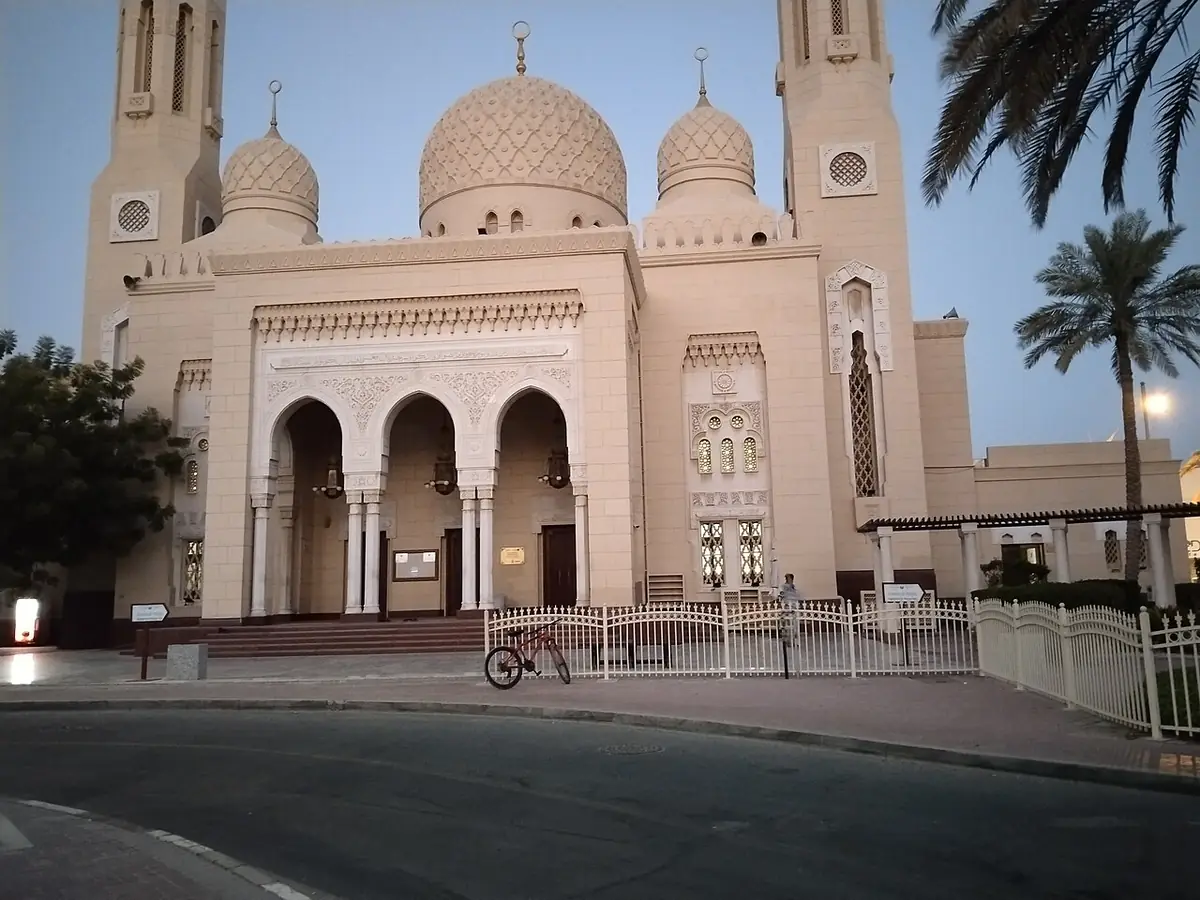
Jumeirah Mosque, a well-known landmark in Dubai — Photo: ZI Jony · CC BY-SA 4.0 · Wikimedia Commons
Moving from Europe or another temperate country into a house in Dubai confronts you immediately with cultural, climatic and urban assumptions turned upside down. What felt automatic at home — walking to the shops, opening a window for air, relying on centralised public services — gives way to a city organised entirely around air-conditioned interiors and the car. Measuring these structural differences is what prevents disillusion in the first few months.
From abroad
Older or classic housing in dense, walkable historic towns.
Dubai
Recent, uniform gated communities stretching along major motorway corridors.
You gain space and modern fittings, but lose the spontaneous street life of a European neighbourhood and the ability to do everything on foot.
From abroad
A temperate climate that lets you live outdoors most of the year.
Dubai
Constant sunshine, but extreme temperatures for more than four summer months.
From May to October your life moves indoors into air-conditioned space, and the garden of your villa becomes unusable during daylight.
From abroad
A dense administrative system formalised by decades of case law and civil codes.
Dubai
A fast digital administration governed by regulations specific to free zones and to investors.
Procedures are quick thanks to technology, but anything outside the contract, or any neighbour dispute, follows local rules that must be respected rather than argued against by the standards of home.
From abroad
Moderate service charges and local taxes funding universal public services.
Dubai
No direct income tax, but maintenance fees — service charges — paid to developers or owners' associations.
No property tax does not mean no cost: you fund security, landscaping and community infrastructure directly through compulsory annual contributions.
From abroad
Buying under a legal system you already understand, in your own language.
Dubai
Freehold zones, escrow accounts, NOC certificates and a title deed issued by the Dubai Land Department.
Budget time to learn the local vocabulary of the transaction, and use a RERA-licensed agent rather than assuming the process mirrors the one you know.
Mapping the communities: where to settle according to what matters to you
Where you buy in Dubai decides not only your daily quality of life but how easily you can sell later. Areas differ in maturity, in whether the planting has grown in, and in how close they sit to schools and business districts. Look carefully at the individual communities before signing the final purchase.
Arabian Ranches & The Springs
A mature residential suburb, with tall trees, artificial lakes and families crossing paths in the parks at the end of the day.
Suits
Families wanting stability, a neighbourhood established for more than a decade, and schools and medical facilities immediately to hand.
Trade-off
Finishes in the original houses can show their age, and bringing them up to date takes a real renovation budget.
Dubai Hills Estate
The modern compromise, built around a large central park and a golf course, with clean contemporary architecture.
Suits
Professionals and families wanting the best balance between proximity to Downtown and the calm of a large green community.
Trade-off
Prices per square metre are firm, and construction on neighbouring plots can disturb the quiet in some sections.
Palm Jumeirah
An exclusive island life at the water's edge, with direct beach access and long views over the sea and the skyline.
Suits
Buyers who put prestige, direct sea access and long-term asset value at the top of their list.
Trade-off
The single access route along the trunk creates chronic congestion at peak times, and salt exposure demands constant upkeep of the building.
Damac Hills & Akoya
More space and better value on the outskirts, offering large floor areas for a budget comparable to more central areas.
Suits
Buyers on a tighter budget for a detached house who want the maximum liveable square metres for their money.
Trade-off
The distance from the main business districts means heavy daily travel on the motorway network.
The financial reality: what a house actually costs to buy and to run
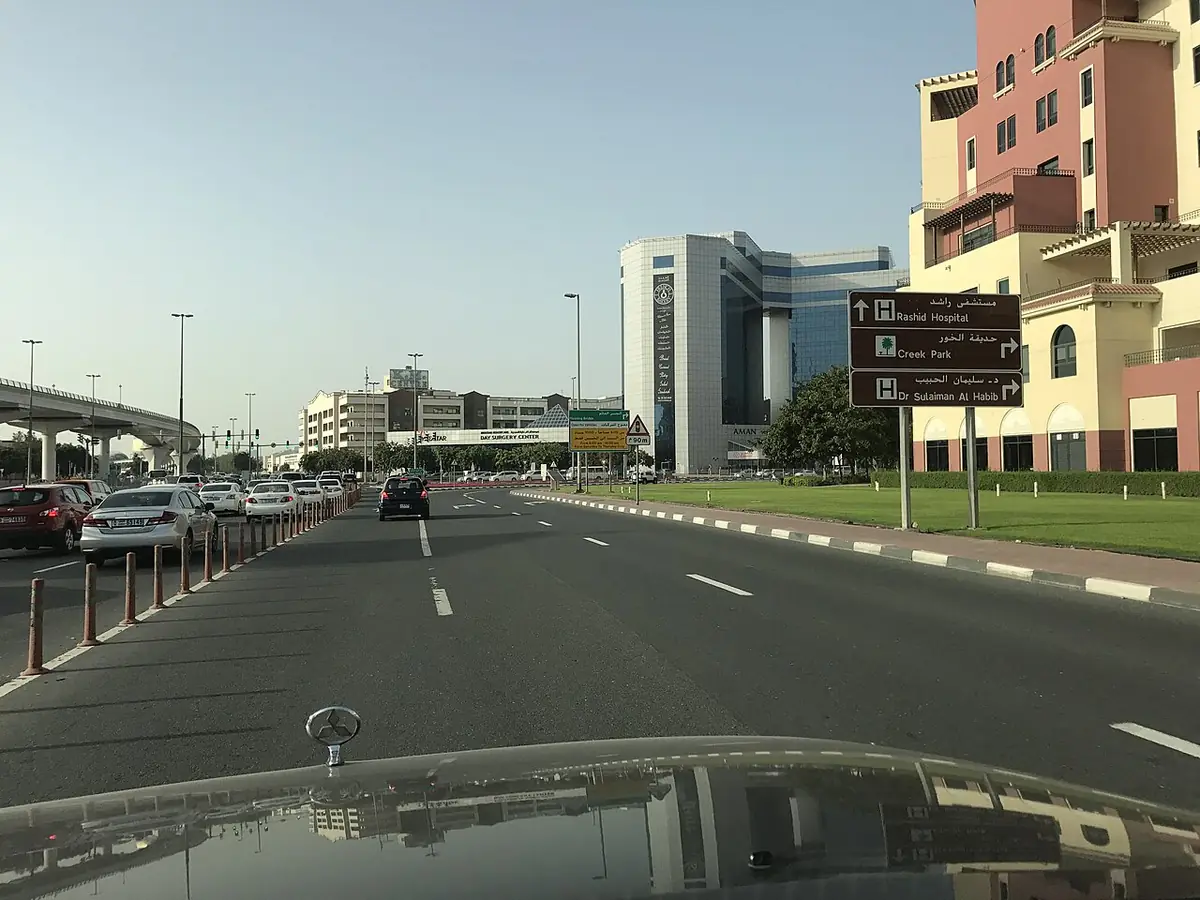
A typical Dubai street, wide and lined with modern buildings — Photo: Darvin.wilson · CC BY-SA 4.0 · Wikimedia Commons
Buying property in Dubai is never just the price on the developer's or the agency's brochure. To judge the investment properly you have to include every compulsory acquisition cost, plus the recurring service and maintenance charges. The figures below give the orders of magnitude currently seen in the market for villas and townhouses.
dubaiFor saleHouseestimate
Median price / m²AED 11,685Half the apartments sell below this
Median priceAED 2.26mthe average is 14% higher — a few very large properties pull it up
Most common2 bedrooms58 % of listings
Average size184 m²
By number of bedrooms
Bedrooms
Share of market
Avg price
Price / m²
Avg size
2most common
58 %
AED 2.24m
AED 12,177
184 m²
3
31 %
AED 2.83m
AED 11,562best value / m²
245 m²
4
11 %
AED 4.29m
AED 12,915 +5 %
333 m²
Each row is an average, compared against the area average of AED 12,300 / m². These are indicative estimates of a typical local market, not a measured sample of live listings. Check current listings before relying on them.
Freehold versus leasehold: what you can genuinely own
Property ownership in Dubai follows a specific legal framework that you must understand to avoid confusion at purchase. Contrary to a common assumption, foreign nationals cannot buy anywhere they like, and the legal regime differs according to whether you are buying in a designated zone or on a long lease. Understanding this distinction protects your asset for the long term.
Freehold — full ownership
This status allows any investor, of any nationality, to acquire outright ownership of both the building and the plot it stands on. Registered officially with the Dubai Land Department, the right passes to your heirs and gives you full legal autonomy over the asset.
What it changesYou hold something comparable to European private ownership, with freedom to let, alter or sell as you see fit.
Leasehold — long-term lease
Here you buy the right to occupy and use the property for a fixed contractual period, usually between 30 and 99 years, from the owner of the land. The land is not yours, and the property reverts to the landowner at the end of the term unless a renewal is negotiated on the original terms.
What it changesRead the contractual clauses with extra care to establish how many years remain and to anticipate the discount that builds as the term approaches.
The one legal rule to satisfy before you pay a deposit
In the Dubai market, haste is the leading cause of disputes between buyers and developers or sellers. The local system rests on strict procedures in which every deposit is protected by regulated escrow accounts. Ignoring the chain of responsibility, or skipping verification of the official permissions, can turn your investment into an administrative nightmare.
The decision to buy becomes concrete when you make a written offer accompanied by a deposit, usually 10 per cent, which starts a rigorous process.
Careful verification that the property is registered with the Dubai Land Department, and obtaining the No Objection Certificate (NOC) from the developer or community management.
Placing funds in an official escrow account approved by the central bank, which guarantees that on off-plan purchases your money cannot fund the developer's other projects.
Signing the official sale contract — Form F on the secondary market, or an SPA for new build — before a licensed agent or an authorised notary.
Final validation of the transfer through issue of the new Title Deed in your name at the emirate's land registry.
You become the registered owner, ready to occupy the house or hand it to a licensed letting agency.
Transaction timeline: who does what, and in what order
Buying property in Dubai requires close coordination between several regulated parties: licensed agents, auditors, developers and land department officials. To avoid delays and misunderstandings, it helps to know the order in which each party acts.
The buyerSelecting the property and making an offerYou identify the house that matches your criteria and make a formal offer — a Memorandum of Understanding — negotiated through your agent.
The estate agentChecking title and the NOCThe agent confirms with the developer that the seller has no unpaid service charges and obtains the essential No Objection Certificate.
The bank / escrowSecuring funds and the depositThe 10 per cent deposit is held in a blocked account pending satisfaction of the conditions and the agreed transfer date.
The Dubai Land DepartmentProcessing the transfer fileGovernment services examine the supporting documents, verify the identity of both parties and confirm the transaction complies with current law.
Notary / trusteeFinal signature and release of fundsThe parties meet in person or by proxy at a registration centre to sign the final deeds and release the money.
The buyerKeys and moving inYou collect the keys, open your utility accounts with DEWA for electricity and water, and take possession.
House or apartment in Dubai: private space against the ease of a managed community
Once the type of property is settled, the question of total budget and recurring costs follows immediately.
Buying a detached house in Dubai, whether in an established community such as Arabian Ranches or in a recent development, is a decisive choice about how you live and what you take on financially. Unlike apartments in the towers of Marina or Downtown, owning a villa means managing the outside directly — the central air-conditioning plant, the private garden, the boundary walls. It suits buyers looking for long-term residential stability, at the cost of a higher entry price and markedly more space to maintain.
An urban apartment, by contrast, offers operational flexibility and pooled services that change daily life completely. Service charges cover the pools, the gym, round-the-clock security and the common areas, freeing the resident from technical responsibility. That format suits professionals and investors wanting better liquidity in the rental market, despite denser neighbours and no private ground. The choice between the two comes down to independence of space against lightness of operation.
Financially, resale discount and gross rental yield diverge noticeably between the two. Townhouses and villas often record stronger capital appreciation when land supply tightens, since buildable plots in prime Dubai are limited. Apartments generally generate a higher gross yield thanks to a lower entry price and steady demand from young international professionals. Hidden costs — extraordinary maintenance on a villa, or rising service charges in an older building — should guide your final decision.
Finally, geography decides which choice makes sense given how you actually travel. Villas sit mostly on the immediate periphery near the main motorway corridors such as Emirates Road or Al Khail Road, requiring a car for everything. Apartments let you live in dense areas connected to the metro, cutting commuting time to the business districts considerably. Your daily pattern of use, more than anything else, determines which asset will protect your quality of life over the medium and long term.
What budget do you really need to buy and run a property in Dubai?
With the budget framed, it is worth looking at an ordinary day to judge what this environment is like in practice.
Buying property in Dubai is not just the price on the reservation contract. You have to build in a series of compulsory acquisition costs plus recurring annual charges that overseas first-time buyers routinely underestimate. Working through these lines carefully protects your investment and keeps your cash flow predictable.
Initial acquisition costs and one-off fees
Cost
Rate or typical amount
When it is paid
DLD registration fee (Dubai Land Department)
4 per cent of the purchase price
Payable on the day of transfer
Estate agency fee
2 per cent of the purchase price
Payable on signature of the MOU
Transfer administration (trustee fee)
Between AED 2,000 and AED 4,000
Payable at the Dubai Trustee Office
These acquisition costs sit entirely on top of the price agreed with the seller and must be funded from your own capital even where a mortgage is used.
Recurring annual charges and running costs
Charge
Estimate for a villa
Estimate for an apartment
Service charges
AED 3 to 8 per square foot per year
AED 10 to 25 per square foot per year
Water and electricity (DEWA)
AED 1,000 to 2,500 per month, by season
AED 400 to 1,000 per month, by size
Home insurance
AED 3,000 to 6,000 per year
AED 1,000 to 2,500 per year
Service charges vary considerably with the quality of the shared facilities and the reputation of the developer or community manager.
An ordinary Tuesday: logistics, travel and neighbourhood life in Dubai
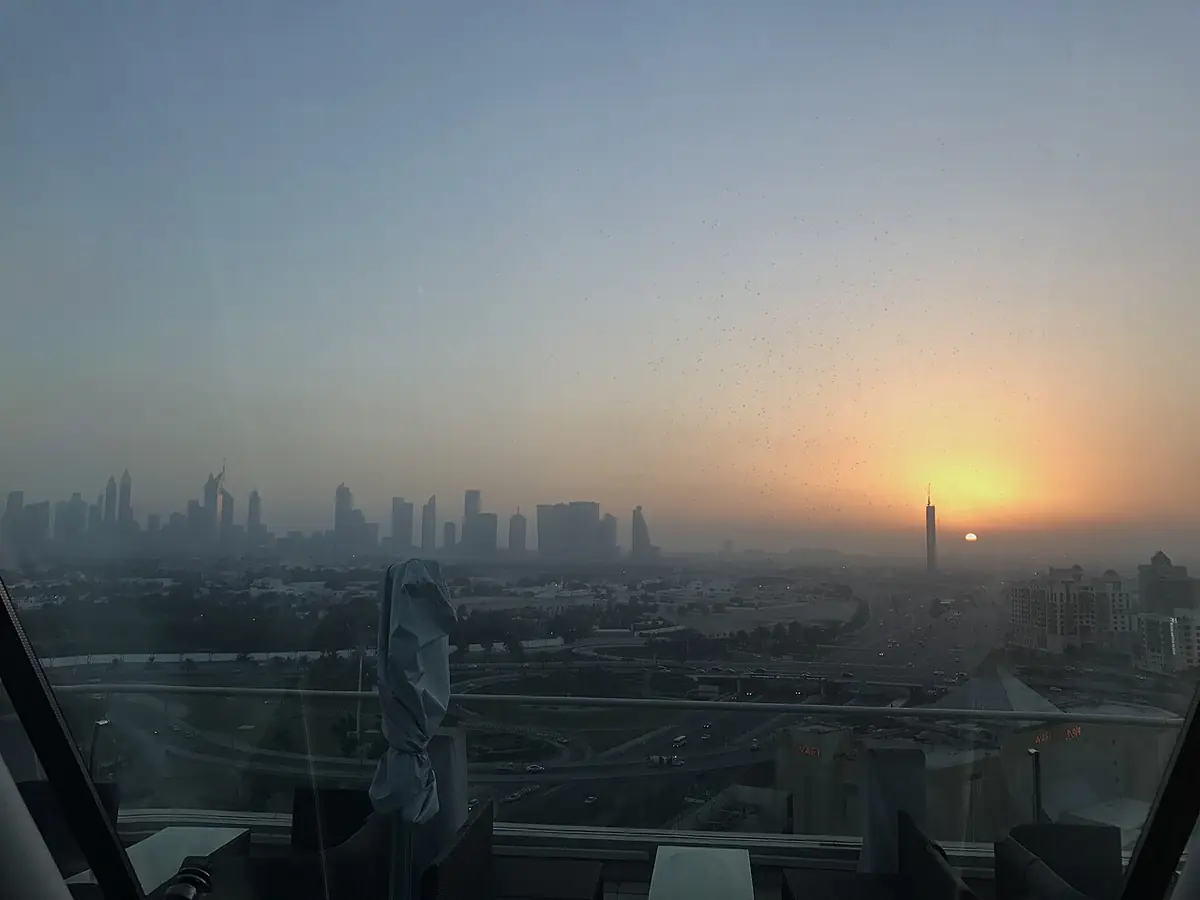
Dubai's skyline at sunset, a fitting close to the day — Photo: Lxs · CC BY 4.0 · Wikimedia Commons
Beyond the official picture and the brochures, some technical realities deserve particular attention.
Understanding what living in Dubai is really like means watching the daily rhythm of travel, services and work. Transport infrastructure, schooling and access to healthcare structure every week tightly. Here is an ordinary Tuesday for an established resident.
07:00Leaving home, school runTraffic on the main corridors such as Sheikh Zayed Road or Al Khail Road is heavy but moves if you leave before half past seven. Journey times depend directly on how close you are to the international schools.
08:30Arriving at the office or co-working spaceThe main business districts — DIFC, Downtown, Dubai Marina — offer modern facilities with concierge services and automated parking.
12:30Lunch and local servicesIntegrated residential communities all have a local mall or a community centre bringing together supermarkets, pharmacies and cafés.
17:00After-school activities or a medical appointmentDubai's private healthcare gives quick access to good general and specialist clinics, often open late in the larger residential hubs.
19:30Home, and household adminGated communities provide a calm, secure setting for families, with lit and monitored walking routes in the evening.
21:00Community appsOwners use the dedicated portals to book maintenance visits, reserve the tennis courts or settle their bills.
What the developers' brochures never tell you about Dubai
These technical realities point directly at the misjudgements buyers discover six months after moving in.
The Dubai market has regulatory and operational specifics that escape overseas investors who have not been warned. Between air-conditioning failures, the real effect of summer heat on the building, and the workings of owners' associations, several critical points are worth anticipating before you sign.
What continuous air-conditioning does to the summer energy bill
From June to September, cooling runs continuously to hold a tolerable temperature. That consumption drives DEWA bills up sharply — a monthly line that can double or triple against the temperate winter months.
Build quality varies considerably between developers
Not every developer works to the same acoustic and thermal standards. An off-plan purchase carries real risk of a gap between the 3D renders and the materials actually delivered at handover.
Service charges move
Regulated by RERA, service charges can still rise significantly if the community votes for upgrades or renewal of ageing shared equipment.
Waterproofing and water ingress
An arid climate combined with marked coastal humidity in some areas puts terrace and roof waterproofing under strain. Without preventive maintenance, leaks lead to expensive repairs that the local build warranty will not cover.
The buying mistakes people only discover after six months in the property
These accounts lead to the fundamental question of who should not buy here at all.
Looked likeImmediate proximity to the beach and the lively marina areas
Turned outPersistent night-time noise from neighbouring construction sites, and permanent weekend congestion.
Would have caught itView at different times of day, particularly Thursday evening and Friday, and check the planning position of surrounding plots with the municipality.
Looked likeA very high net rental yield quoted by an unscrupulous intermediary
Turned outHigh management fees, void periods between seasons and unpaid charges, all cutting the real return.
Would have caught itDemand a certified history of previous tenancies and build in a safety margin of at least fifteen per cent against gross income forecasts.
Looked likeA spacious villa with private garden and pool in a green community
Turned outGeographic isolation that forced long daily trips for school and for food shopping.
Would have caught itActually drive the route at peak hours between the area you are considering and where you work before you commit.
Looked likeAn attractive off-plan purchase with an interest-free payment plan
Turned outHandover delayed by months or years by the developer, tying up funds and pushing back the whole plan.
Would have caught itChoose only long-established developers with a clean delivery record, and check the state of the escrow account.
Who should absolutely not buy property in Dubai
Now to draw all of this together into a clear decision.
Buying in Dubai is a strong opportunity for stable residents, and a serious strategic error for others. The fluidity of the local rental market and the absence of tax on rental income should not disguise how much capital an outright purchase ties up. These are the situations where renting remains clearly better.
An employee on a short posting or a fixed-term contract of under three years
→A flexible annual or monthly tenancy
Acquisition costs of roughly six per cent of the price cannot be amortised over so short a period, producing a net loss on a quick resale.
An investor with no cash reserve for the unexpected
→To keep capital in liquid form
Without a reserve for exceptional service charges or air-conditioning repairs, an owner is exposed to defaults that are damaging and hard to unwind.
A first-time buyer still unsure which area suits them
→To rent for a full year first
Living here reveals the micro-climates, the traffic patterns and the character of each community, and prevents buying something that does not fit how you actually live.
The decision: are you genuinely ready to buy in Dubai?
Deciding to buy property in Dubai means separating enthusiasm for the emirate's economic momentum from the structural realities of an international property investment. If your horizon runs beyond five years, your professional position is settled, and you have accounted for every recurring and incidental cost, the Dubai market offers a transparent and protective legal framework through the regulations of the Dubai Land Department and RERA.
Success rests on method: choose the type of property for how you will actually use it rather than on speculative off-plan projections, check the history and financial strength of the developers or the existing community carefully, and always keep a reserve dedicated to technical maintenance. Property here rewards patience, clear financial analysis and precise knowledge of the local micro-markets.
In short, if this forms part of a long-term diversification strategy or the establishment of a stable main residence, current conditions allow a secure purchase. Take the time to view at the difficult hours, check every line of the projected budget, and use independent professionals to validate the final deed. The decision should follow from a considered economic conviction, not an impulse prompted by the shop window.
Related questions
What registration and transfer fees apply when buying in Dubai?
Registration with the Dubai Land Department is 4 per cent of the total purchase price. On top of that, expect around 2 per cent in agency fees plus transfer administration costs ranging from AED 2,000 to AED 4,000.
Can a foreign national buy freehold property in Dubai?
Yes. Foreign nationals can acquire outright ownership in the designated freehold areas, which cover almost all of the emirate's recent residential districts and business zones.
What do service charges typically cost?
They vary considerably with the standard of the development and the services included, generally running between AED 3 and 8 per square foot per year for villas, and between AED 10 and 25 for apartments.
Can a non-resident get a mortgage in Dubai?
Yes. Several local and international banks lend to non-residents, generally covering up to 50 to 60 per cent of the property value, subject to solid evidence of income.
What is an escrow account in off-plan purchases?
It is a bank account regulated by law into which all buyer payments for an off-plan development are paid. The funds can only be used for the construction of that specific project.
Is there an annual property tax in Dubai?
Dubai levies no recurring annual property tax on residential ownership comparable to European property taxes. Only community management fees and utility bills are payable on an ongoing basis.
How does signing a property sale work in Dubai?
The transaction begins with a Memorandum of Understanding, or Form F, between buyer and seller, followed by a 10 per cent deposit cheque, then the official transfer of ownership at the Dubai Trustee Office.
How much does summer affect energy consumption?
During summer, the intensive cooling needed to hold a comfortable temperature drives a substantial rise in the utility bills managed by DEWA, which can double against the winter season.
What should I check when choosing a gated community?
Look at the quality of the leisure facilities, how well landscaping maintenance is managed, how easily traffic flows in and out, and the developer's record on after-sales service.
Do I need a licensed agent to buy in Dubai?
It is strongly advised to work only with an agent holding a professional card issued by RERA, the Real Estate Regulatory Agency, to keep every stage of the transaction legally secure.