Buying a villa on the island of Koh Samui is a major financial decision that calls for a clear-eyed reading of local realities. Between the particulars of Thai land law, the choice of residential area and the upkeep a tropical climate demands, every step deserves careful attention. This guide gives you a practical method for making your investment safely.
Tell us about your life. Ex: I’m relocating to Nice next year
Attach file
Get the app
Buy Villas Koh Samui
Buying a villa on the island of Koh Samui is a major financial decision that calls for a clear-eyed reading of local realities. Between the particulars of Thai land law, the choice of residential area and the upkeep a tropical climate demands, every step deserves careful attention. This guide gives you a practical method for making your investment safely.
What owning a villa in Koh Samui really involves
Scroll
What owning a villa in Koh Samui really involves
Buying a villa on the island of Koh Samui is a major financial decision that calls for a clear-eyed reading of local realities. Between the particulars of Thai land law, the choice of residential area and the upkeep a tropical climate demands, every step deserves careful attention. This guide gives you a practical method for making your investment safely.
Written by the ting.ad editorial team ·
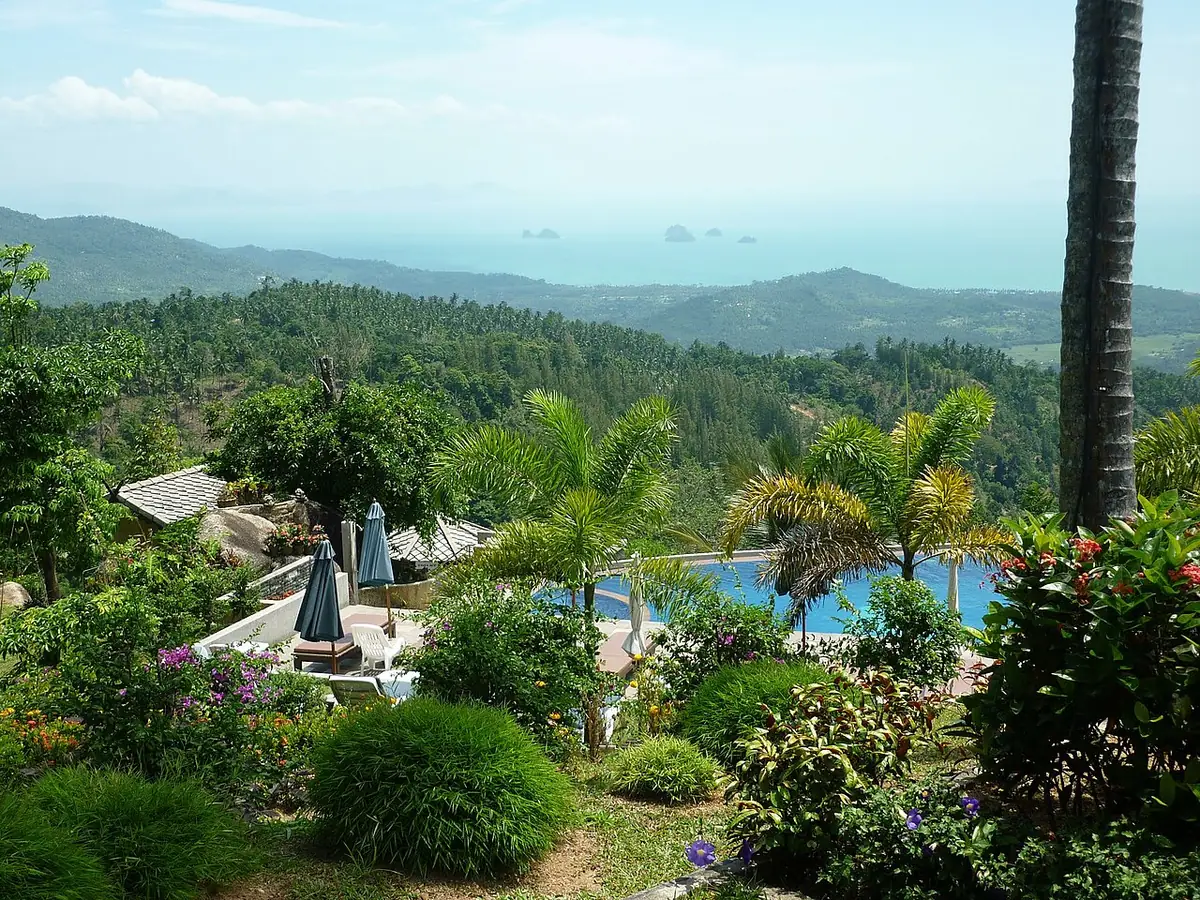
Koh Samui's hills roll down to the sea — Photo: Dirk Enthoven · CC BY 3.0 · Wikimedia Commons
Let us now turn to buyer profiles to see whether this destination fits your situation.
Buying a villa on the island of Koh Samui is about more than acquiring a roof under the palm trees. Between the legal constraints on land ownership in Thailand and the reality of a tropical island market, the terms of ownership need a careful read. Developers highlight the sea view and the rental returns, but often forget to mention how complicated managing from a distance can be. Understanding exactly what you are buying helps you avoid financial and administrative disappointments from the very first months.
The promise of a tropical haven of peacevsThe reality of a property asset governed by local law
You are buying an idyllic lifestyle, but legally you are signing for an asset governed by Thai law. The distinction between owning the building and owning the land remains fundamental to securing your investment over the long term.
The illusion of simple, hands-off managementvsThe need for constant professional maintenance
The tropical climate, humidity and salt air call for constant monitoring of the installations. Without a reliable management company on site, your villa will lose value far faster than it would in a temperate climate.
The mirage of an immediate rental returnvsStrong seasonality and marketing costs
Income from holiday lets fluctuates sharply with the weather and global tourist flows. Platform commissions and management fees cut well into the net yield the agencies advertise.
What kind of buyer are you when faced with island reality?
To gauge the scale of the change properly, let us compare your current daily life with island reality.
Not everyone who settles or invests in Koh Samui shares the same goals or the same appetite for risk. Between the permanent resident looking for peace and quiet, the digital nomad seeking flexibility and the pure investor chasing a return, the trade-offs are entirely different. Assessing your personal situation before signing a preliminary contract will spare you from funding a property that does not meet your real needs.
Permanent or part-time resident
Your top priority shifts to the quality of the surrounding infrastructure and proximity to international healthcare and schools. You should favour established residential areas such as Bophut or Maenam over isolated hillsides that become hard to reach during the monsoon season. Sound insulation, the quality of the running water and a stable power supply weigh far more in your daily life than a panoramic view from the hill.
Holiday-let investor
Being right by the beaches of Chaweng or Lamai, with easy access to restaurants and beach clubs, becomes your number one criterion for keeping occupancy high. You have to accept handing day-to-day management entirely to a certified local agency, which takes a substantial commission out of your gross revenue. The villa's design should specifically target well-off holidaymakers looking for upmarket, hotel-style service.
Speculator or wealth-building investor
The choice of developer and the quality of the land title take precedence over the villa's interior look. You need to scrutinise the local zoning plan, upcoming road infrastructure and how built-up the different parts of the island are becoming. Properties with an undisputed Chanote title in areas with strong potential for gentrification are your best guarantee of future liquidity.
What changes radically between your life back home and here?
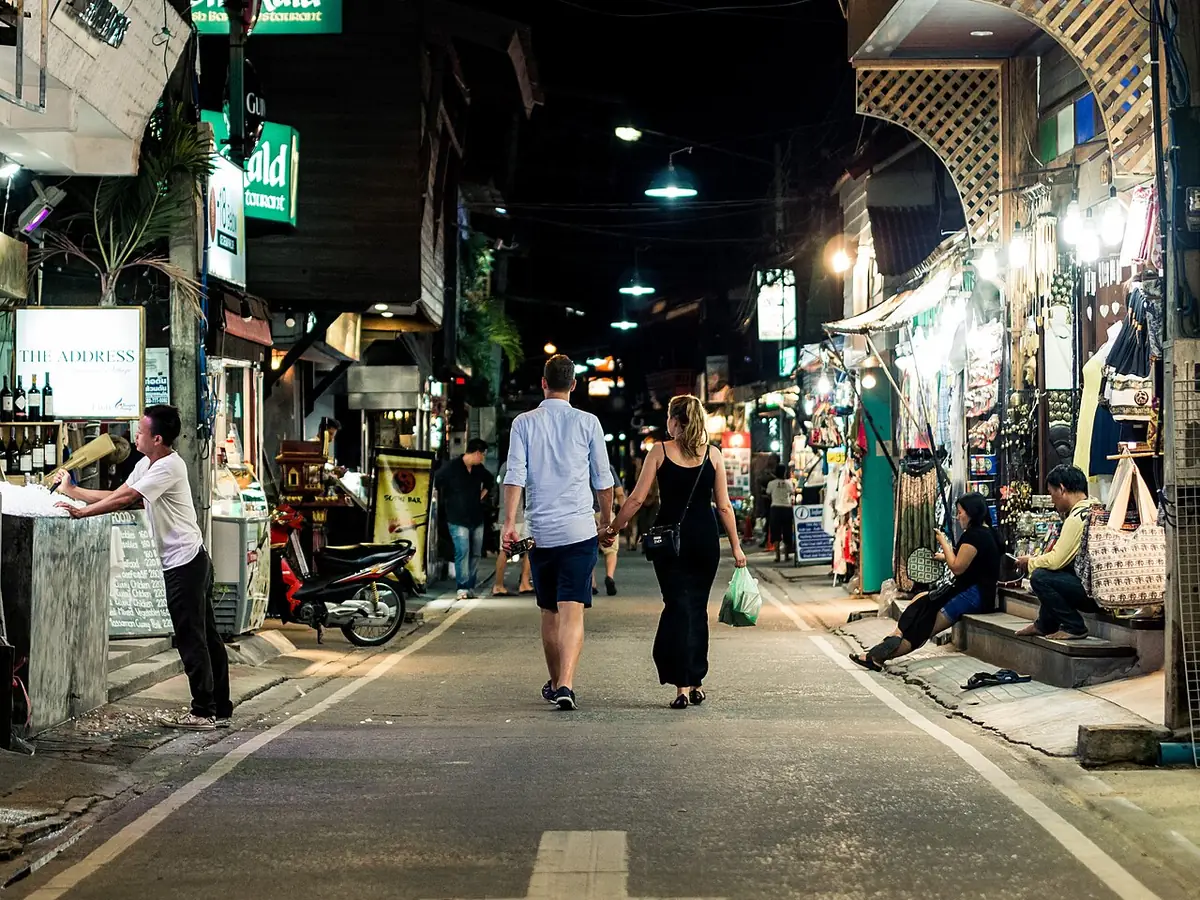
Evening market streets, part of everyday life on Koh Samui — Photo: Goh Rhy Yan gryshoots · CC0 · Wikimedia Commons
Now that the framework is set, let us look at the different areas to place your project.
Leaving your home country to buy property in the tropics means a cultural, administrative and climatic break that should not be underestimated. The pace of life, the way unexpected problems are handled and dealings with the local administration follow codes completely unlike Western standards. Setting your usual reference points against local reality gives you a clear-eyed view of your future move.
From abroad
The protective, well-regulated legal framework for property back home
Koh Samui
Complex Thai land law with its restrictions on foreigners
You must surround yourself with independent specialist lawyers to secure each ownership structure and avoid risky arrangements.
From abroad
Predictable building service charges regulated by law
Koh Samui
Estate management and maintenance costs handled case by case
The upkeep budget for a detached villa can climb quickly because of wear from the climate and the unreliable availability of some imported materials.
From abroad
A temperate climate with distinct winters and mild summers
Koh Samui
A hot tropical climate all year round, punctuated by an intense rainy season
Constant humidity calls for sophisticated ventilation systems and ongoing vigilance against mould and wood-boring insects.
From abroad
A unified, centralised and predictable public utilities network
Koh Samui
An island setup where services depend on private, local providers
You have to accept some flexibility in how technical breakdowns get fixed and plan for occasional power or water cuts.
Which part of the island matches your ambitions?
Let us look at the financial and budget reality of these purchases.
Each area of Koh Samui has its own identity, microclimate and mix of residents. Where you place your villa shapes both your quality of life day to day and the future growth of your property's value. The atmosphere varies enormously between the lively north, the unspoilt south and the hills overlooking the tourist bays.
Bophut and Maenam (North)
A peaceful, family-friendly and authentic residential feel, shaped by the historic charm of Fisherman's Village and quiet beaches.
Suits
Families and retirees looking for calm, a good expat community and direct access to the island's medical facilities.
Trade-off
Land prices here are among the highest on the island, and good beachfront opportunities are becoming increasingly rare.
Chaweng and Choeng Mon (East and North-East)
Constant buzz, busy postcard beaches and an abundance of restaurants, bars and shopping centres.
Suits
Investors aiming for maximum rental returns and buyers who absolutely want to be at the heart of the action, day and night.
Trade-off
Noise levels are noticeably higher, traffic can be heavy in high season and local authenticity gives way to tourism.
Lamai and Hua Thanon (South-East and South)
A balanced mix of traditional local life and tourist amenities, with wild coastal scenery and superb coves.
Suits
Those looking for the best value for money and a setting better protected from mass tourism.
Trade-off
Being relatively far from the major international hospitals and the business districts in the north of the island means longer journey times.
Taling Ngam and Nathon (West)
A wild atmosphere, spectacular sunsets over the Ang Thong archipelago and a way of life deeply rooted in Thai culture.
Suits
Lovers of raw nature, total silence and wide open spaces far from the usual tourist bustle.
Trade-off
Services are scarcer, and resale can take longer because demand for this area is more limited.
How much do you really need to budget for a villa?
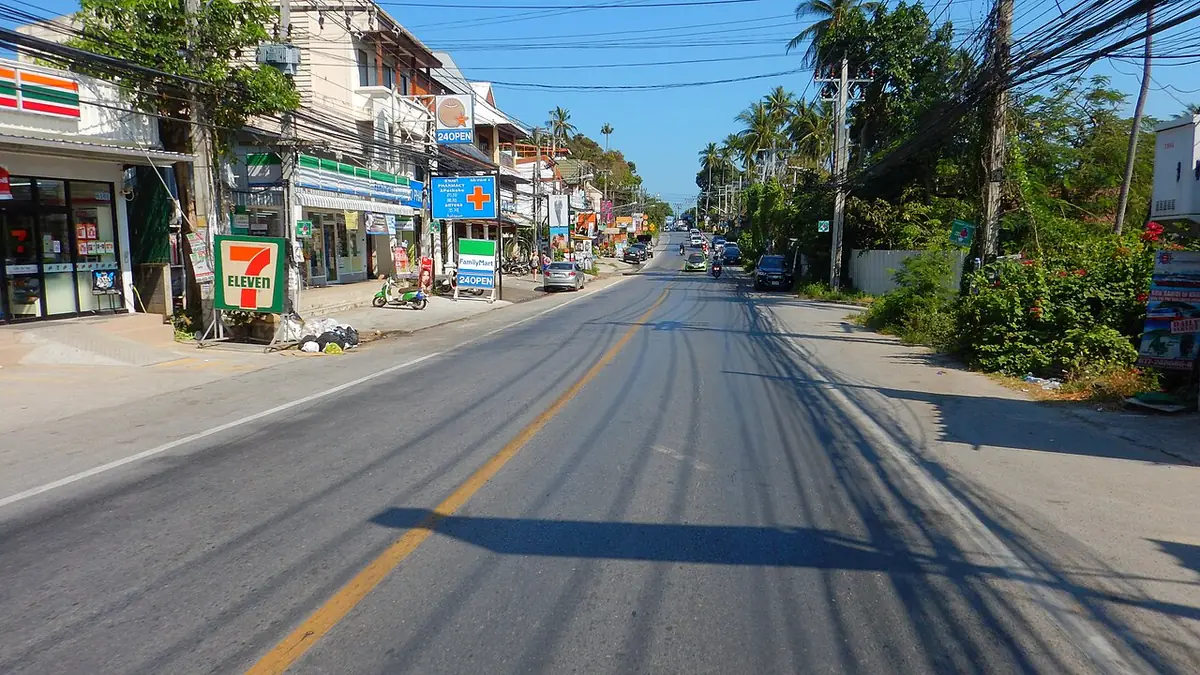
A typical street of shophouses on the island — Photo: Roma Neus · CC BY 3.0 · Wikimedia Commons
Beyond the figures, let us look at what you can actually own under local legal rules.
Koh Samui's property market spans an extremely wide price range, from a compact villa set back from the beach to an ultra-luxury estate high in the hills. Prices depend closely on the size of the plot, the sea view and the quality of the structural finish. Setting a realistic budget protects you from unpleasant surprises over transfer taxes and connection costs.
Koh SamuiFor saleVillaestimate
Median price / m²THB 81,795Half the apartments sell below this
Median priceTHB 9.79mthe average is 14% higher — a few very large properties pull it up
Most common2 bedrooms64 % of listings
Average size114 m²
By number of bedrooms
Bedrooms
Share of market
Avg price
Price / m²
Avg size
2most common
64 %
THB 10.3m
THB 84,378
123 m²
3
31 %
THB 15.2m
THB 82,656
184 m²
4
6 %
THB 20.8m
THB 81,795best value / m²
254 m²
Each row is an average, compared against the area average of THB 86,100 / m². These are indicative estimates of a typical local market, not a measured sample of live listings. Check current listings before relying on them.
Owning the land versus owning the building: the legal reality
Now let us look at the critical step before you pay any deposit on a project.
Thai law expressly forbids foreign nationals from directly holding freehold title to land in the country. That legal reality means structuring your property investment through long-term leases or approved companies. Knowing exactly where the limits of your ownership lie helps you avoid fragile legal arrangements that put your capital at risk.
The long-term lease structure (Leasehold)
You own 100 % of the villa's building, while the land is held under a long-term lease officially registered with the local Land Department. This contract offers robust legal security when it is properly drafted by a qualified lawyer.
What it changesYou have an undisputed, secure right of use for a long period, renewable on the terms originally negotiated with the Thai landowner.
The Thai company structure (Company Limited)
The land is acquired by setting up a Thai trading company in which you hold management control despite a minority stake in the share capital. This long-standing option demands absolute accounting discipline and rigorous legal follow-up to comply with all government rules.
What it changesYou gain a form of overall control over both land and building, but you expose yourself to strict tax and regulatory checks by the local authorities.
The one rule to understand before signing a preliminary contract
Let us finish with the precise timeline of a successful property transaction.
Committing to buy an off-plan or existing villa without checking that the land titles are genuine exposes the buyer to enormous financial losses. Many inexperienced investors are won over by a spectacular view without auditing whether the plot can actually be built on. Following a strict sequence of checks removes almost all risk of fraud or land disputes.
Spotting an attractive property on the local market
Insist on an official copy of the land title deed, ideally a Chanote title that guarantees the exact boundaries of the plot.
Have all the administrative documents and the contract audited by an independent law firm with no ties to the developer.
Check rights of way, access to drinking water and actual connection to the island's main power grid.
Negotiate a staged payment schedule tied strictly to the construction progress verified on site.
Final signing of the transfer deed before the Land Department officer
How does the transaction unfold, from offer to handing over the keys?
You now have all the facts you need to approach your purchase with confidence.
A property transaction in Thailand follows a precise protocol involving several local parties, from the licensed estate agent to the Land Department official. Knowing each stage of the procedure lets you stay in control of your purchase timeline and secure your international fund transfers.
The buyerMaking a written offerSetting out the financial terms, the payment schedule and the conditions tied to the legal checks on the property.
The lawyerDue diligence and land title auditThorough checks on the title deed, the current owner's history and the villa's compliance with planning rules.
Both partiesSigning the preliminary sale contractPayment of a deposit held in escrow (usually 10 %) that reserves the property while the final administrative checks are completed.
The buyerBringing the funds in from abroadInternational transfer in foreign currency, with the official FET document (Foreign Exchange Transaction form) obtained as required.
The Land Department officerRegistering the transactionSigning the final deed before the authorities, paying local transfer taxes and registering the lease or the company.
Buying a villa with a pool or choosing another type of property in Koh Samui
Now that the choice of property type is clear, let us look at the overall budget reality of your move.
Buying a villa in Koh Samui means entering a very particular island property market, where the supply of detached houses with private pools often outstrips that of conventional apartments in shared buildings. This style of home meets strong demand from foreign investors looking for rental returns or a tropical second home. Yet running a standalone villa day to day brings considerable technical responsibilities that many people underestimate when they sign. Between maintaining a saltwater pool, running air conditioning constantly against the humidity and looking after the outdoor spaces, the hidden cost of owning a detached home goes well beyond the initial purchase repayments. Prospective buyers therefore need to weigh comfort and complete independence against the logistical constraints of a tropical island, where specialist tradespeople are not always available straight away when something major breaks.
From a purely financial and wealth-building point of view, a villa in a development run by a developer or hotel brand offers an interesting compromise that deserves a close look. This model lets you hand over rental management and technical upkeep entirely, while guaranteeing you the right to stay there yourself during the tourist low season. However, it greatly limits your freedom to customise the architecture and imposes service charges that are often high and eat into net returns over the long term. Conversely, owning a plot and building your own bespoke villa gives you total design freedom but runs into major legal complications over freehold land ownership for non-Thai nationals, forcing you into long-term leasehold or Thai company structures whose regulatory compliance demands constant, absolute vigilance.
Choosing between these property types in Koh Samui is therefore not a matter of simple aesthetic preference or love at first sight during a three-day scouting trip. It is a structural decision driven by your tolerance for legal risk, your ability to manage local contractors from a distance and how you will actually use the property across the seasons. If you plan to live in the villa only a few weeks a year and do not want to worry about roof leaks during the monsoon, a managed development is the obvious choice despite its financial drawbacks. If, on the other hand, you are looking to put down long-term roots for your retirement and are willing to learn how the local market works, buying an independent villa on its own land with a clean chanote title is an exciting but demanding option. Take the time to cost not only the initial purchase price shown in the brochures, but also the total cost of ownership over ten years, including periodic renovation and local taxes.
In short, the classic newcomer's mistake in Koh Samui is to carry over the habits of a homeowner from back home into a tropical island setting with radically different legal and climatic rules. The villa of your dreams under the palm trees can quickly become a money pit or a constant source of stress if it was built without proper waterproofing standards or sits in an area not connected to the main power grid. Set aside the marketing pitch of local agencies touting illusory guaranteed returns and focus on the soundness of the structure, the clarity of the title deeds and the real level of service charges or maintenance costs. Your future peace of mind depends entirely on doing this rigorous analysis before any money changes hands.
What overall budget to plan for living in and maintaining your villa in Koh Samui
With the budget set, let us see what a typical day in your future villa actually looks like.
Drawing up an early, realistic budget is essential if you want to avoid financial disappointments once you have settled in Koh Samui. Between local taxes, service charges, regular pool maintenance and the cost of electricity from heavy air conditioning use, running costs often exceed buyers' initial estimates. This table sets out the monthly and annual expenses observed for a standard three-bedroom villa, giving you a clear, costed view of the island's economic reality.
Monthly running costs for a three-bedroom villa
Expense
Estimated amount (THB)
Estimated amount (EUR)
Practical comment
Electricity (air conditioning 24/7)
THB 6,000 to 12,000
EUR 160 to 320
Varies widely depending on the villa's insulation and how much the split units are used.
Pool and garden maintenance
THB 3,500 to 6,000
EUR 95 to 160
Weekly visits from qualified local contractors.
Service charges (Common Fee)
THB 4,000 to 10,000
EUR 110 to 270
Only if the villa is in a secure development (Estate).
Fibre internet and subscriptions
THB 800 to 1,500
EUR 22 to 40
A high-speed connection is essential for remote work.
These amounts are indicative and depend on the living area and your own day-to-day lifestyle.
Annual expenses and provisions for major works
Type of expense
Annual range (THB)
Annual range (EUR)
Details
Comprehensive home insurance
THB 15,000 to 40,000
EUR 400 to 1,100
Covers storm, fire and water damage.
Provision for painting and waterproofing
THB 30,000 to 80,000
EUR 800 to 2,150
Needed because of tropical humidity and sea salt.
Land and local taxes
THB 5,000 to 15,000
EUR 135 to 400
Calculated on the official value assessed by the Land Department.
Set aside a contingency fund for unexpected repairs to the roof or the drainage pumps.
Healthcare, shopping and logistics: how an ordinary Tuesday unfolds
Behind this idyllic daily life lie technical realities that sales brochures often leave out.
Settling in Koh Samui for the long term means adapting to an island rhythm that blends modern conveniences with local particularities. Far from the tourist clichés of endless lounging, running a household day to day takes careful organisation for shopping, healthcare and getting around. This timeline of an ordinary Tuesday shows the practical side of your future life on the island, from waking up in the morning to the evening shop at the island's supermarkets.
07:30On the villa terraceA quiet start with a coffee and a quick check that the pool pump and the air conditioning filters are working.
09:00International school or coworking spaceA scooter or car ride to drop the children off or settle in for a remote work session with colleagues in Europe.
11:30International medical centre (Bandon Hospital or Bangkok Hospital Samui)A routine visit or quick consultation when needed, thanks to a private healthcare network built to very high Western standards.
13:30Local market (Chaweng or Mae Nam)Buying fresh tropical fruit, vegetables and the catch of the day from local traders for lunch.
16:00Central supermarket (Macro or Big C in Chaweng)The weekly shop for imported goods, cleaning products and specific items you cannot find at the markets.
18:30Bophut or Maenam beachWinding down at the end of the day with the sunset before heading home to cook dinner.
What the glossy developer brochures will never tell you
Knowing these pitfalls avoids disillusionment, but let us now look at the concrete mistakes buyers regret six months after moving in.
Koh Samui's property development industry excels at producing paradise-like 3D renderings that completely smooth over the rough edges of island life. Behind the promise of a safe investment and an idyllic setting lie major technical, regulatory and environmental constraints. This selection of critical points sets out the on-the-ground truths that sales staff deliberately avoid raising on the first viewing, so you can buy with your eyes open.
Access to water and electricity infrastructure
Many hillside villas rely on private boreholes or tanker trucks during the dry season. A pump failure or a prolonged drought can leave you without running water, forcing you to pay for costly emergency water deliveries.
The complexity of rights of way and access roads
A beautiful plot with a sea view can lose all its value if the steep access road becomes impassable during heavy monsoon rains. Always check whether the road is public and officially maintained by the municipality or whether it crosses private land.
Strict limits on building height and zoning
Thai law protects coastal landscapes and imposes very strict height limits depending on the distance from the sea. An unscrupulous developer can sell you an unbeatable view that is completely blocked the following year by a new project in front.
The complex handling of shared-development disputes under Thai law
If a persistent disagreement arises with the developer or other owners over the management of shared areas, legal action before the Thai courts proves slow, costly and culturally bewildering for a foreign national.
The misjudgements you only discover six months after buying
These first-hand accounts raise an essential question: is buying property in Koh Samui really for everyone?
Looked likeA spectacular panoramic view over the Gulf of Thailand from the hills
Turned outA direct east-west orientation that turns the villa into a real greenhouse all afternoon, leading to exorbitant electricity bills to keep the air conditioners running flat out without a break.
Would have caught itStudy the plot's exact sun exposure across the seasons and check for sufficient roof overhangs and professional-quality insulating double glazing on all the glass doors.
Looked likeA guaranteed rental contract showing a very attractive net yield on paper
Turned outPoor management by the partner agency, very low real occupancy outside the two months of high season, and refurbishment costs arbitrarily charged to you.
Would have caught itInsist on the actual accounts for previous years signed off by an independent accountant, and refuse any guaranteed return not backed by a recognised, financially sound international hotel brand.
Looked likeA quick purchase through a ready-made Thai company structure
Turned outUnderestimated annual accounting costs, complex tax filing obligations and the discovery that the Thai nominee shareholders have no real operational role, creating a major legal risk.
Would have caught itConsult an international lawyer specialising in Thai property law before signing anything and, where possible, favour a long-term leasehold officially registered with the Land Department.
Looked likeA quiet, unspoilt neighbourhood far from the tourist bustle of Chaweng
Turned outThe sudden start of large construction sites on neighbouring plots, turning your haven of peace into a dusty, noisy zone from Monday to Saturday from dawn.
Would have caught itAsk at the local planning office (OrBorTor) about building permits issued nearby and look carefully at the adjoining vacant plots before completing the purchase.
Investor and resident profiles: who should definitely not buy here
The time has come to pull these points together so you can make your final decision with full knowledge of the facts.
The irresistible appeal of tropical beaches and a cost of living seen as favourable sometimes pushes unsuitable buyers into heavy property commitments in Koh Samui. The Thai island market has very strict cultural, legal and climatic rules that do not forgive improvisation or a low tolerance for logistical surprises. This overview of buyer profiles helps you judge honestly whether your temperament and financial goals match the island's realities.
The investor looking for a guaranteed passive rental return without getting involved
→Buying an isolated villa managed by a small local agency with no solid track record.
Koh Samui's rental market is highly seasonal and competitive. Without a strong brand or an active presence on the platforms, the villa sits empty half the year, making the return illusory and covering the costs impossible.
The first-time buyer on a tight budget with no contingency savings
→Putting all their savings into an older property that needs renovation work.
Salty tropical humidity speeds up the deterioration of materials. The slightest roof or foundation problem triggers considerable emergency spending that can choke a budget calculated to the last baht with no safety margin.
The retiree seeking absolute legal security and familiar Western reference points
→Accepting complex freehold land arrangements through opaque companies.
The Thai legal system differs fundamentally from the one back home. Trying to get around the rules on foreign land ownership exposes the buyer to the risk of the arrangement being reclassified or of losing their rights over time.
The highly connected remote worker who needs flawless technical reliability
→Settling in a villa perched high in the jungle without checking the networks.
Power cuts caused by tropical storms and outages on mobile or fibre networks are common in isolated areas, which seriously hampers work that depends on the internet.
Summary and final decision: are you really ready to take the plunge?
At the end of this in-depth analysis, buying a villa in Koh Samui shows itself for what it truly is: an exciting but demanding life adventure that tolerates neither legal guesswork nor financial improvisation. If you have measured the reality of the hidden costs, accepted the constraints of upkeep in a tropical environment and secured your contractual arrangements with the help of an independent lawyer, the island will offer you an exceptional setting and way of life every day.
The key to success lies in your ability to separate the emotional pull of falling for a property from cold economic and technical reasoning. A well-chosen, sound villa with impeccable title deeds in an area with a lasting future will be not only an incomparable personal retreat but also a quality asset in one of the most sought-after island destinations in Southeast Asia.
Take the time to spend several months renting on the island before signing any preliminary sale contract. That extended stay will let you get to know the island's different areas, test how the infrastructure really holds up during the rainy season and build valuable contacts with long-established owners who will share their experience without a sales filter.
Ultimately, do not look for the perfect financial investment or a flawless ideal villa, because they exist nowhere, least of all in the tropics. Look for the balanced compromise that respects your overall budget, matches your tolerance for risk and fits naturally into the life you are building for the years ahead in Koh Samui.
Related questions
Can a foreigner buy a house with land in Koh Samui?
Under Thai law, a foreign national cannot directly hold freehold title to land in their own name. It is, however, entirely possible to legally buy the building (the villa itself) while leasing the land beneath it through a long-term leasehold contract officially registered with the Land Department for a renewable term of thirty years, which gives your investment legal security over the long run.
What legal fees and taxes apply when buying property?
Property transactions in Thailand do not involve a notary in the sense you may know back home; deeds are registered directly at the local land office (Land Department). The transfer fee is generally two per cent of the property's official appraised value, plus various specific taxes and administrative charges, and how these are split between buyer and seller is negotiated beforehand in the sale contract.
How does rental management of a villa work while I am away?
Rental management in Koh Samui is most often handed to specialist local agencies or professional concierge companies that take care of marketing, welcoming guests, cleaning and routine maintenance. These services come at a cost, generally between twenty and thirty per cent of gross rental income, but they are essential to keep your property profitable and well maintained from a distance.
Which areas of Koh Samui are most sought after by buyers?
The coastal areas of the north and east, such as Bophut, Maenam, Choeng Mon and Chaweng Noi, are the most popular with investors and foreign residents. Bophut and Maenam appeal with their calmer, more authentic residential feel, while Chaweng Noi and Choeng Mon draw buyers with their superb fine-sand beaches and immediate access to upmarket amenities, restaurants and international medical centres.
What are the average service charges for a villa in a managed development?
For a villa in a gated development or managed estate, the monthly charges, usually called the Common Fee, generally range from four thousand to ten thousand Thai baht. This covers upkeep of the shared gardens, round-the-clock manned security, lighting along the paths and sometimes rubbish collection and maintenance of the internal roads.
What precautions should you take over water supply for hillside villas?
Villas perched on Koh Samui's hills are not always connected to the public mains water supply and often rely on deep boreholes or tanker deliveries. It is essential to check the capacity of the property's underground storage tanks, the tested water quality and the reliability of the pumping system so you can anticipate and avoid any water shortage during the dry summer months.
Is it easy to resell your villa in Koh Samui if you want to leave?
Reselling a property in Koh Samui depends mainly on the quality of its location, the clarity of its title deeds (chanote) and its price relative to the market at the time. A correctly valued and well-maintained property generally finds a buyer within a few months, as the market enjoys steady interest from a varied international clientele looking for second homes or places to retire.
What are the tax obligations for an owner who rents out their villa?
Any owner earning income from renting out a villa in Koh Samui must declare it to the Thai tax authorities. Rental income is subject to local income tax on a progressive scale, and using a company structure or a professional manager makes tax compliance and keeping the required accounting records much simpler.
Do tropical storms and the monsoon pose risks to buildings?
The monsoon season, which generally runs from October to December in Koh Samui, brings spells of heavy rain and wind that can put a building's waterproofing to a severe test. It is therefore vital to make sure the villa was built to proper standards, with materials that resist salty humidity, suitably raised foundations and a roof that is fully insulated and watertight.
What are the steps to open a bank account in Thailand as a buyer?
Opening a bank account in Thailand is strongly recommended to make paying everyday bills and transferring the purchase funds easier. Requirements vary between local banks and branches, but they generally include a valid passport, a long-stay visa or a property purchase contract in progress, and a letter of recommendation or proof of address depending on the bank you choose.
Property review of ting
No ting properties in Koh Samui yet
Be the first — share it on ting and it shows up right here.