Investing in property in Brisbane calls for a close understanding of local specifics, from the riverside neighbourhoods to Queensland's strata rules. This guide sets out the essential mechanics so you can make your purchase decision with confidence and on your own terms.
Get the app
What nobody tells you.
Real prices, hidden costs and the traps to check before you commit.
What you really get when you buy an apartment in Brisbane
Scroll
What you really get when you buy an apartment in Brisbane
Investing in property in Brisbane calls for a close understanding of local specifics, from the riverside neighbourhoods to Queensland's strata rules. This guide sets out the essential mechanics so you can make your purchase decision with confidence and on your own terms.
Written by the ting.ad editorial team ·
Brisbane in Street View: drag to look around.
Understanding these physical and financial balances is the first step towards matching your purchase to the way you really live.
Buying an apartment in Brisbane is about more than square metres in a warm, temperate climate. Between the promise of an unrivalled coastal lifestyle and the reality of strata levies in the modern towers of the Central Business District or Bowen Hills, the gap is noticeable. Buyers quickly find that a property's real value here lies as much in its closeness to river and rail transport as in its gross floor area. It is therefore essential to look beyond the floor space to understand what gives your investment lasting value in a city undergoing rapid urban change.
The promise of a bright, relaxed lifestyle all year roundvsThe reality of heavy reliance on air conditioning and harsh sun exposure
Large open west-facing balconies quickly become unbearable on summer afternoons. Proper external sun shading is essential if you want to live comfortably without your electricity bill soaring.
The appeal of luxurious shared amenities in newer complexesvsThe recurring financial weight of strata levies to maintain pools and gyms
Lagoon pools and landscaped rooftops catch the eye at viewings, but they translate into high quarterly levies. Those costs weigh on rental returns or an owner-occupier's budget for years.
Being right next to major transport routes and the riverbanksvsExposure to noise and to flood risk in some low-lying areas
Buying near the river offers an exceptional setting, but you must carefully check the historical flood maps from 2011. Some areas still trade at a justified discount because of their climate vulnerability.
Does this place fit your everyday life in Brisbane?
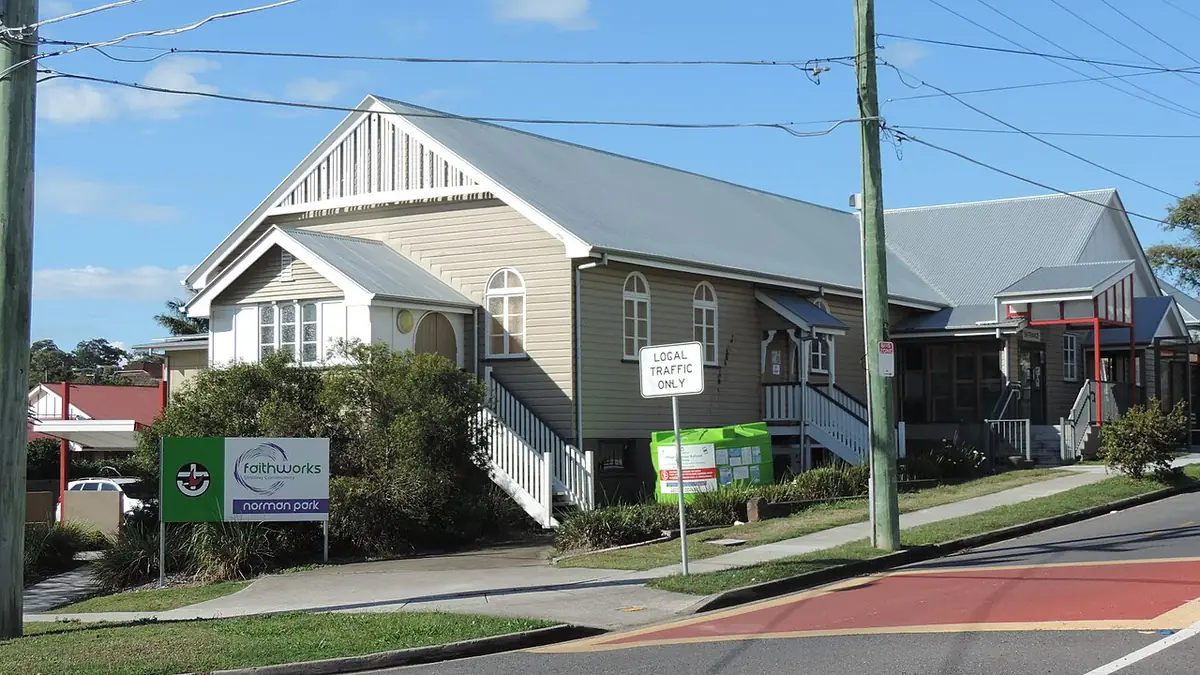
Timber buildings and quiet streets in Norman Park, Brisbane — Photo: Kerry Raymond · CC BY 4.0 · Wikimedia Commons
Your lifestyle directly shapes your choice of neighbourhood, but where you come from also colours how you see local ways of doing things.
Brisbane's property market offers a wide variety of apartment types, and they do not all meet the same expectations depending on your profile. Whether you are a young professional after nightlife and the tech hubs, a couple looking for a quiet residential area or an investor targeting student catchments, location dictates your daily life. Each area has its own rhythm, transport links and local services, and they are worth weighing against your personal habits to avoid disappointment after signing.
Choosing the city centre
Living in an apartment in the Central Business District or Fortitude Valley puts you within walking distance of your office and the city's cultural life. You give up a large garden in exchange for easy urban living, getting around on foot, on the CityCat ferry or by train. In return, you have to accept less indoor space and sometimes lively late nights at weekends in certain areas.
The trendy residential neighbourhood option
Settling in areas such as West End or New Farm offers an ideal balance between neighbourhood buzz and residential calm. You often get apartments on a more human scale, right next to riverside parks and local markets. Getting into the city centre is easy by bike or on a regular bus, which preserves a work-life balance that local residents value highly.
The university proximity strategy
Targeting the areas around the University of Queensland in St Lucia or the Queensland University of Technology in Kelvin Grove guarantees high, structural rental demand. One- and two-bedroom apartments are especially sought after there, keeping vacancies to a minimum. You do, however, have to deal with a very competitive market and prices per square metre held up by this constant population pressure.
Living here when you arrive from abroad: what actually changes
Once these cultural reference points are in place, the central question becomes which neighbourhood to settle in.
Moving into the Australian property market from abroad means setting aside many of the legal and architectural reference points you are used to. The purchase process, dealings with strata managers and the very design of homes follow well-established Anglo-Saxon logic. Understanding these cultural and administrative differences will save you misunderstandings when drafting offers and in the day-to-day running of your future strata scheme.
From abroad
A centralised notary system back home, with sale deeds closely regulated by the state
Brisbane
Systematic use of specialist conveyancers or solicitors for each party
The transaction rests on a contract drafted by lawyers on both sides, where every condition (such as the building and pest inspection) must be negotiated precisely from the outset.
From abroad
Reinforced thermal insulation and standard double glazing in European-style construction
Brisbane
A historically lightweight building tradition relying on natural ventilation and air conditioning
Older apartments can be hot in summer and cool in winter. It is vital to check the property's orientation and whether it has recent reverse-cycle air conditioning.
From abroad
The familiar in-person general meetings of owners back home
Brisbane
Management delegated to professional body corporate managers, with votes often held electronically
Decisions about building maintenance are made in a very structured way, and levies are compulsory and payable quarterly without delay.
From abroad
Floor area stated under strict rules that count interior space only
Brisbane
Overall floor area that includes large outdoor balconies
The dimensions in listings often include private outdoor space, which gives a misleading impression of size if you only look at the raw figures.
Which neighbourhood should you choose for your Brisbane apartment?
With the area narrowed down, it is time to look at the financial reality of prices on the local market.
Choosing a neighbourhood in Brisbane depends closely on how you relate to the city centre, how much green space matters to you and your overall purchase budget. Each part of Queensland's capital has its own identity, from the financial skyscrapers of the CBD to former industrial areas turned trendy havens. Analysing what each area offers day to day lets you target your viewings precisely and avoid heading in the wrong direction.
New Farm / Teneriffe
An upmarket, riverside residential feel, enlivened by high-end neighbourhood cafés.
Suits
Buyers looking for preserved heritage character, the river on their doorstep and a walkable lifestyle.
Trade-off
One of the most expensive markets in the city, with older apartment stock that sometimes needs a sizeable renovation budget.
West End
A bohemian, multicultural and creative spirit, set by farmers' markets and landscaped riverbanks.
Suits
Those who enjoy an alternative way of life, diverse food and a quick link to the South Bank cultural precinct.
Trade-off
A high density of new construction and congested traffic at peak times on the neighbourhood's main roads.
Spring Hill / Bowen Hills
A dense urban environment, extremely well connected to transport and undergoing architectural change.
Suits
Professionals who want to live a stone's throw from their CBD office in modern, well-equipped apartments.
Trade-off
A lack of intimate green spaces compared with the riverside neighbourhoods, and a typically urban soundscape.
South Brisbane
A vibrant cultural hub, backing onto the city's landmark museums, theatres and urban parks.
Suits
Lovers of a rich cultural life, museums and walks along the Brisbane River without needing a car.
Trade-off
A predominance of large high-rise residential complexes and prices per square metre held up by institutional demand.
What does an apartment in Brisbane really cost?
Beyond the headline purchase price, the legal structure of ownership determines what you actually hold.
Assessing the cost of an apartment in Brisbane means separating the headline purchase price from the compulsory extra costs built into Queensland's property system. Price ranges vary considerably between a student studio, a three-bedroom family apartment in a recent building with amenities, and a characterful 1970s unit in need of renovation. To help you structure your financing plan, here is an overview of the orders of magnitude seen on the current market for the different property types.
BrisbaneFor saleApartmentestimate
Median price / m²A$8,170Half the apartments sell below this
Median priceA$860kthe average is 14% higher — a few very large properties pull it up
Most common2 bedrooms34 % of listings
Average size105 m²
By number of bedrooms
Bedrooms
Share of market
Avg price
Price / m²
Avg size
1
18 %
A$511k
A$9,288 +8 %
55 m²
2most common
34 %
A$731k
A$8,600
85 m²
3
32 %
A$980k
A$8,170 −5 %
120 m²
4
16 %
A$1.35m
A$7,912best value / m²
170 m²
Each row is an average, compared against the area average of A$8,600 / m². These are indicative estimates of a typical local market, not a measured sample of live listings. Check current listings before relying on them.
What you can actually own: property titles and strata
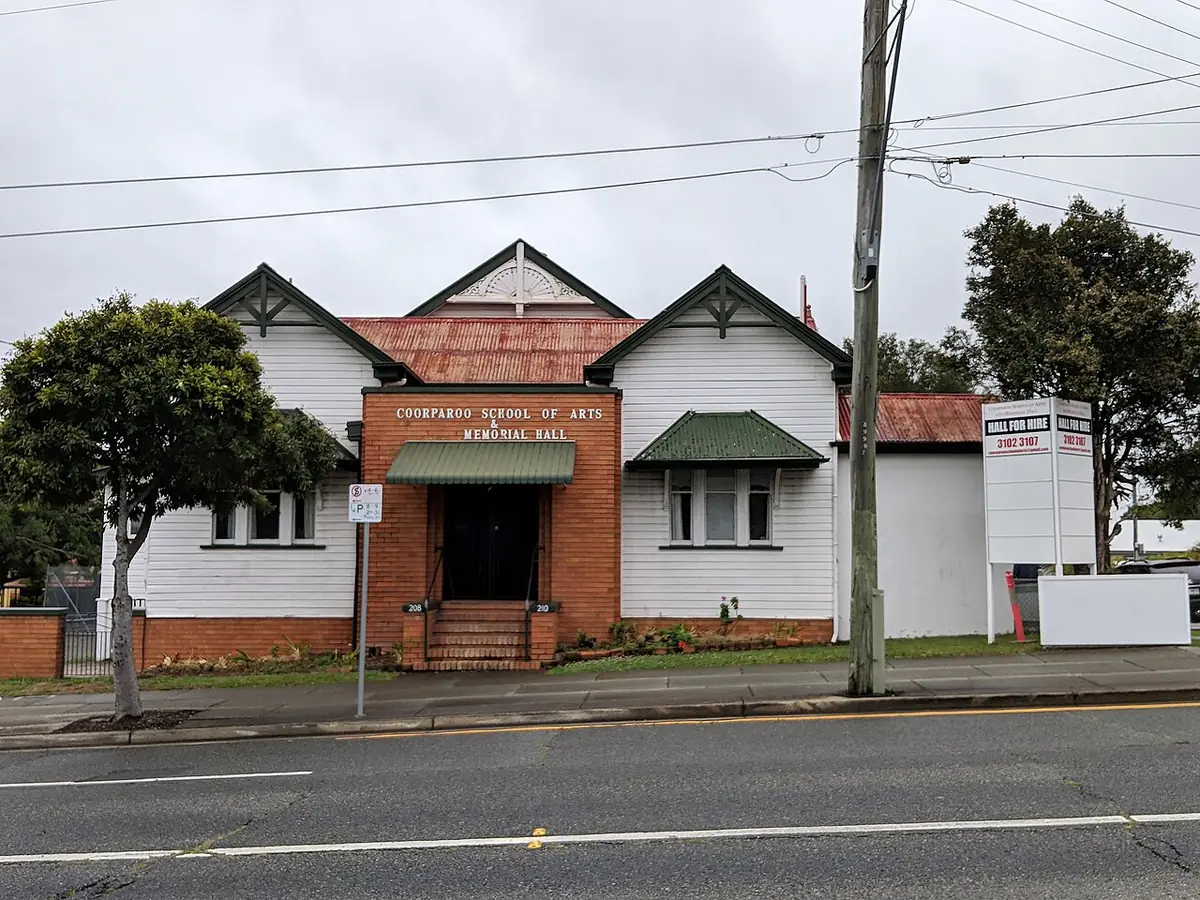
The heritage School of Arts hall on a Coorparoo street — Photo: Nickw25 · CC BY-SA 4.0 · Wikimedia Commons
Once the legal framework is clear, the purchase process itself follows strict timing rules that must be respected.
Under Australian law, the ownership structure of an apartment directly affects your freedom to make changes, the level of your levies and your say within the building. Unlike systems built around a single standard form of shared ownership, the Queensland market draws a clear line between types of land title. Understanding these legal nuances is essential to avoid unpleasant surprises when managing common property and future compliance works.
Strata Title (standard strata ownership)
You own your private lot (the apartment) plus an undivided share of the common property and the land beneath it. An owners' corporation (the Body Corporate) manages the general upkeep of the building through an elected committee and a professional manager.
What it changesYou must comply strictly with the by-laws, which can restrict short-term letting, keeping pets or changes to the facade.
Company Title (company shares)
The whole building belongs to a company, and you buy shares in it that give you the exclusive right to occupy a specific apartment. This historic model is still found in some prestigious older buildings in New Farm.
What it changesThe company's approval is required for any resale or letting, which makes buying more rigid but keeps the resident profile in the building consistent.
The rule to understand before paying a deposit on an apartment
Once all these checks are done, the transaction unfolds in sequence, with clearly defined roles for each party.
The Australian property market runs on strict contractual mechanisms, where commitment comes very early in the buying process. Paying a deposit before all the technical and legal conditions have been satisfied exposes the buyer to losing significant sums. Mastering the chain of preliminary checks, from the building inspection to analysing the strata's sinking fund accounts, is the best protection against financial setbacks.
You spot an apartment that meets your criteria and obtain pre-approval from your bank.
Commission an independent building and pest inspection to detect any sign of damp, termites or hidden defects.
Review the Body Corporate records to check the financial state of the sinking fund and anticipate any works already voted.
Have your solicitor review the Contract of Sale before formally signing and paying the initial deposit.
Use the statutory five-business-day cooling-off period to finalise your last financing decisions.
The sale becomes unconditional and the settlement date is officially set.
How a property transaction in Brisbane unfolds, step by step
By following this rigorous method, your Brisbane property purchase stays fully secure and suited to local reality.
Completing a property purchase in Brisbane involves close coordination between your solicitor, your mortgage broker, the seller's agent and you. Each party plays a precise role in carrying the transfer of ownership through within the legal timeframes that apply in Queensland. Following this timeline step by step gives you maximum peace of mind right up to the day you get the keys.
Your mortgage brokerSecuring final finance approvalThe Australian bank gives final approval of the mortgage based on the official valuation of the property.
Your solicitorTitle and land searchesChecks with Queensland government services that no encumbrance, hidden mortgage or public infrastructure project affects the property.
The real estate agentSigning the offer and paying the depositThe contract signed by both parties is exchanged and the initial deposit (usually 10% of the price) is securely paid into a trust account.
YouFinal inspection before settlement (Pre-settlement inspection)A visit to the empty apartment just before the big day to make sure the included fittings work and the overall condition is as agreed.
Both parties' solicitorsSettlement dayFunds and title are exchanged electronically through the PEXA platform; the transfer takes effect and you collect the keys.
Apartment or house in Brisbane: which suits your everyday life?
Once that fundamental choice between house and apartment is made, the crucial question of your overall purchase and running budget comes straight to the fore.
The choice between a strata apartment and a detached house with a garden in Brisbane shapes your lifestyle and long-term budget for years. Apartments are heavily concentrated in central areas such as the CBD, Fortitude Valley and New Farm, offering immediate access to public transport, the Brisbane River ferry routes and the main office employment hubs. This option removes the weekly chore of maintaining a garden, but exposes you to sometimes high strata levies and to collective committee decisions on structural works or the management of shared facilities such as pools and gyms.
Opting for a house, by contrast, pushes you towards residential areas a little further from the centre, such as Paddington, Camp Hill or Chermside. You gain space, quiet and freedom to make changes, without answering to a general meeting of owners. In return, the roof, the stormwater drainage and the subtropical vegetation are entirely your responsibility, requiring either time or a substantial budget to outsource garden maintenance and urgent repairs after summer storms.
Brisbane's subtropical climate also plays a decisive role in this architectural and thermal choice. A poorly oriented house without proper sun protection takes the full brunt of summer heat, driving up the energy bill for near-constant air conditioning. An apartment in a recent building often benefits from stricter thermal standards and good insulation, although fully west-facing units can build up heat late in the day despite treated glazing. Examining orientation plans and construction materials should therefore take priority over the immediate appeal of interior finishes.
Finally, liquidity and future resale differ markedly between these two property types in Queensland's capital. Well-located houses on their own blocks of land have historically shown stronger capital growth, as land becomes scarcer while the city spreads. Apartments, on the other hand, sometimes face competition from new developments delivered just outside the centre, which can temper short-term value growth but usually secures a higher gross rental yield if you plan to let the property later.
What realistic budget should you plan to live and buy in Brisbane?
With that financial framework in place, it is worth looking at how a typical day actually runs in this city to judge the real quality of life.
Drawing up a forecast budget for buying and everyday living in Brisbane means accounting for every extra cost, from local taxes to energy bills. Queensland property market data shows clear differences depending on how close you are to the river and to transport corridors. This financial simulation helps you calibrate your offer without compromising your monthly savings capacity in the face of the Australian cost of living.
Estimated purchase price ranges and strata levies in Brisbane
Property type
Observed median price
Strata levies / year
Local council rates / year
1-bedroom apartment (centre / outskirts)
AUD 450,000 to AUD 600,000
AUD 3,500 to AUD 5,500
AUD 1,200 to AUD 1,800
2-bedroom apartment (sought-after areas)
AUD 650,000 to AUD 950,000
AUD 4,500 to AUD 8,000
AUD 1,600 to AUD 2,400
Detached house (inner suburbs)
AUD 850,000 to AUD 1,400,000
Not applicable
AUD 2,200 to AUD 3,800
Amounts include average estimates provided by local Queensland agencies and Brisbane City Council services.
Indicative monthly budget for a resident household in Brisbane
Main expense item
Low monthly budget
High monthly budget
Comment on variability
Food and household goods
AUD 600
AUD 1,000
Varies with the share of fresh local produce and shopping at the major supermarkets.
Energy (electricity, air conditioning, gas)
AUD 150
AUD 350
A sharp peak in the summer months because of heavy air conditioning use.
Transport (Translink, fuel, tolls)
AUD 120
AUD 300
Depends on your use of the public transport network and the distance between home and work.
These figures reflect the cost of living observed for a standard household in urban and suburban areas.
Health, schools, transport: what does an ordinary Tuesday look like in Brisbane?
Beyond this well-oiled routine, many crucial aspects often go unnoticed during property viewings.
Picturing an ordinary day in Brisbane lets you measure the real impact of commuting times and how public services are organised. From the Translink public transport network to public and private schools, every detail of daily life influences where you choose to settle. Here is how a typical Tuesday unfolds for an established resident of Queensland's capital.
07:30Bus stop or suburban train stationA smooth morning commute thanks to timed Translink connections, quickly linking residential areas to the CBD's employment hubs.
08:30Business district or CBD office hubArriving at the office in a lively commercial setting, often right next to the landscaped riverbanks.
12:30Local medical centre or pharmacyEveryday health needs handled simply through private GP clinics offering quick appointments.
16:00School or after-school carePicking the children up from schools with generous outdoor areas and sports facilities suited to the climate.
18:00Public park or the banks of the Brisbane RiverUnwinding outdoors or exercising along the landscaped paths, making the most of the light and the mild early evening.
What Brisbane property listings will never tell you
Knowing these blind spots avoids plenty of setbacks, but other misjudgements lie in wait for first-time buyers in the early months.
The marketing photos and glowing descriptions from Brisbane real estate agencies regularly leave out fundamental structural and environmental factors. Yet these details, invisible online, determine the long-term value of your investment and your everyday acoustic and thermal comfort. Here are the technical realities sellers take care not to highlight.
The historical flood risk in low-lying areas
Some areas near the Brisbane River or its tributary creeks have seen major floods. Checking Brisbane City Council's official flood maps is essential before signing anything, to avoid an insurance loading or a loss of value.
Sun orientation and summer overheating
A fully west-facing apartment or house without adequate sun shading turns into a greenhouse during the southern summer. Air conditioning bills climb fast if the building's thermal envelope is poor.
Noise from transport routes and flight paths
The rapid expansion of Brisbane Airport and the density of urban motorways create unexpected noise, even at weekends. A site visit at peak hour is essential to judge how quiet it really is.
The real financial health of the strata scheme
For an apartment, an underfunded sinking fund means that upcoming major works (facade repairs, lifts, waterproofing) will turn into immediate, heavy special levies for new owners.
The Brisbane buying mistakes you only discover six months later
Even if you avoid these technical traps, this property market does not suit every type of buyer.
Looked likeAn excellent deal in a very well-located older building in the centre
Turned outHidden structural defects in the masonry and fire-safety compliance works voted by the strata committee.
Would have caught itAsk for the full minutes of the last three years of general meetings and commission an independent report from a licensed building inspector.
Looked likeA quiet, leafy suburb on the outskirts with a seemingly simple drive
Turned outDaily traffic gridlock at peak hour on the river bridges, combined with almost non-existent public transport.
Would have caught itTest the exact commute at peak hour on a weekday before making a firm offer, recreating real traffic conditions.
Looked likeA charming house with a large, lush and shady tropical garden
Turned outRecurring invasions of aggressive termites and swarms of mosquitoes that make the outdoor space unusable in the evening without heavy treatment.
Would have caught itAlways commission a certified specialist for a full pest inspection before lifting any conditions of sale.
Looked likeA quick purchase with no finance condition to beat other buyers
Turned outThe bank valued the property below the price during its mortgage valuation, forcing an unplanned emergency top-up of personal funds to cover the gap.
Would have caught itKeep strict finance conditions in the purchase contract and never give in to artificial pressure from local agents.
Who really should not buy property in Brisbane?
Having weighed the risks and opportunities clearly, it is time to make a call on your project.
Buying property in Brisbane, although it holds solid long-term prospects, is a major strategic mistake for certain profiles. The rigidity of the market, high entry costs and liquidity constraints demand a perfect fit between your personal situation and local economic reality. Here are the profiles for whom renting or waiting remain the most rational options.
The professional on a short assignment or an uncertain international career move
→Insisting on buying on arrival so as not to 'throw money away' on rent
Transaction costs (Queensland transfer duty, agency fees, legal fees) swallow the equivalent of several years' rent, making any short-term resale heavily loss-making.
The investor who cannot stand regulatory constraints and strata levies
→Buying an upmarket apartment without analysing the ten-year management budget
Queensland law strongly protects tenants and tightly regulates short-term letting, while strata management costs rise steadily with maintenance cost inflation.
The household with too thin a safety cushion and no room for manoeuvre
→Putting all their cash into the deposit and purchase costs
The slightest change in the Reserve Bank of Australia's cash rate or an unexpected maintenance bill (roof, air conditioning) would immediately put the household's finances at risk.
So, are you ready to take the plunge and buy in Brisbane?
Deciding to buy an apartment or a house in Brisbane means reconciling your hopes for a subtropical lifestyle with absolute financial discipline. If your career is set to stay in Queensland's capital for the long term and you accept the constraints that come with the climate and maintenance, the local market offers remarkable stability. Never, however, give in to haste driven by a tight market or by intermediaries keen to speed up sales.
Your success rests on carefully checking the fundamentals: the flood history of the site, the transparent financial health of the strata scheme for apartments, and a realistic assessment of peak-hour commuting times. By building up your deposit while keeping a robust safety cushion, you protect yourself against economic downturns and changes in the interest rates set by Australia's monetary authorities.
Ultimately, buying property in Brisbane should be seen not as a short-term speculative bet but as putting down roots for a new chapter of life. Take the time to rent for a few months in the area you are targeting to experience the neighbours, the noise levels and the climate exposure first-hand. That, together with uncompromising technical analysis, is what will let your property investment pay off fully without nasty surprises.
Related questions
What transfer duty and purchase costs apply in Brisbane?
In Brisbane, in the state of Queensland, buyers must pay transfer duty (stamp duty), charged on a sliding scale according to the value of the property. On top of that come the fees of the solicitors or conveyancers who secure the legal side of the transaction, plus the cost of building and pest inspections.
Can foreigners easily buy property in Brisbane?
Property purchases by non-residents are tightly regulated by the Foreign Investment Review Board (FIRB). Foreign investors must obtain approval before buying and are generally restricted to new or off-the-plan properties, so that housing stays accessible to local residents.
How does strata ownership work for apartments in Brisbane?
Apartments are governed by a 'strata title' system. Each owner holds their own lot plus a share of the common property. An elected committee (the Body Corporate) manages maintenance and building insurance and sets the compulsory annual levies each owner pays.
How does the wet season affect property in Brisbane?
Queensland's subtropical climate brings bouts of heavy summer rain and occasional cyclone risk. It is therefore vital to check roof waterproofing, stormwater drainage and the property's history of river flooding before committing to a house or a ground-floor unit.
Do you have to go through a real estate agent to buy in Brisbane?
In Australia, the vast majority of sales go through agents acting for the seller. A buyer can hire a buyer's agent to represent them, negotiate on their behalf and find off-market properties, which is particularly useful for expats.
Which Brisbane neighbourhoods suit a first apartment purchase?
Areas such as New Farm, Fortitude Valley, West End and South Brisbane are highly sought after for their cultural life, their parks and their direct access to multiple modes of transport. Prices are higher there, but resale liquidity and rental demand remain strong.
How do you assess a property's real value before making an offer?
It is best to analyse recent comparable sales of similar properties in the same street or building over the last six months. Valuation reports from independent platforms or from your broker help you avoid overpaying in a competitive market.
How long does a typical property transaction take in Brisbane?
Once the offer is accepted and the contract signed (often with a 'cooling-off' period of a few business days), the standard settlement period is generally between 30 and 60 days, leaving time to finalise bank finance and legal checks.
What does home insurance typically cost in the Brisbane area?
Home and contents insurance premiums in Brisbane are among the highest in Australia because of weather risks, particularly floods and summer hailstorms. You must build these costs into your recurring annual budget.
Can you rent your property out on Airbnb after buying in Brisbane?
Short-term letting is subject to increasingly strict local regulations from Brisbane City Council and to the by-laws of each strata scheme (Body Corporate rules). Some buildings formally ban short stays to protect the peace of permanent residents.
Property review of ting
No ting properties in Brisbane yet
Be the first — share it on ting and it shows up right here.