Buying an apartment in Manchester means reading a market in the middle of a transformation, one governed by legal and financial rules specific to the United Kingdom. From picking carefully among the districts still being redeveloped to understanding what leasehold ownership really commits you to, this guide walks you through each step so you can secure your purchase and protect the value of what you buy in the north of England.
Get the app
What nobody tells you.
Real prices, hidden costs and the traps to check before you commit.
What you are really buying with an apartment in Manchester
Scroll
What you are really buying with an apartment in Manchester
Buying an apartment in Manchester means reading a market in the middle of a transformation, one governed by legal and financial rules specific to the United Kingdom. From picking carefully among the districts still being redeveloped to understanding what leasehold ownership really commits you to, this guide walks you through each step so you can secure your purchase and protect the value of what you buy in the north of England.
Written by the ting.ad editorial team ·
Albert Square, Manchester in Street View: drag to look around.
That split between economic momentum and technical demands leads naturally into the question of what kind of buyer you are.
Buying an apartment in Manchester is not simply acquiring square metres in a fast-growing economic centre in the north of England. Behind the promise of attractive rental yields and continuous urban renewal sits a more nuanced reality that deserves a cool-headed look. Every district has its own value dynamics and its own infrastructure constraints, and those redefine the nature of the investment itself. Understanding the gap between developer marketing and what the local market actually does is the first step in protecting your capital and avoiding an expensive disappointment.
An exceptional wave of urban regenerationvsA sharp gap between new-build schemes and older stock
Large redevelopment projects are reshaping whole districts, but build quality and communal charges vary enormously from one block to the next. A central location is no guarantee that structural work will not be needed within a few years.
A rental market supported by a young, working populationvsHigh tenant turnover and rising expectations on standards
The large student and young professional population keeps demand strong, but it also imposes modern comfort standards, particularly on energy performance and the EPC rating, on pain of empty months.
Long-term capital growth prospects driven by decentralisationvsA high entry cost in the most central zones and management fees that are far from trivial
Population growth across the city region supports prices, but fierce competition for the better properties calls for genuine selectivity in both the property you choose and the way you finance it.
Liquidity that has traditionally been better than in rural areasvsGreater sensitivity to UK interest rate movements
The Manchester market reacts quickly to national macroeconomic conditions, which can stretch resale timelines when mortgage credit tightens, especially for non-resident investors.
What kind of buyer are you in the Manchester market?
Moving between one legal and cultural system and another makes it worth measuring the practical contrasts of daily life.
Not every buyer arrives with the same ambitions, or the same relationship to time and risk. Whether you are securing a city base, diversifying your assets through a pure rental investment, or preparing a long-term move to the North West, each situation calls for a different approach to contracts and to location. Pinning down your own profile lets you rule out from the start the properties that do not suit your time horizon, and manage your cross-border tax position sensibly.
Remote investor
Your absolute priority is operational simplicity and control over the communal charges, which are often high in modern residential towers. You need to audit the management fees and the service charge history closely before you sign, because an unpleasant surprise on maintenance can weigh on your net return for years.
Future resident
Your approach puts immediate quality of life first: proximity to public transport such as the Metrolink, and access to green space or to employment centres. You can accept a lower initial rental yield in exchange for a district with real neighbourhood life and architecture that has proven it will last.
Portfolio reallocation
You want to diversify outside your home currency while keeping reasonable liquidity should you need it. Your attention should go to completed schemes with a solid resale record and an unambiguous title, avoiding speculative off-plan bets in secondary locations.
Buying in Manchester when you are arriving from abroad: what actually changes
New builds sit right beside Manchester's older stone architecture — Photo: Benjamin Shaw · CC BY-SA 4.0 · Wikimedia Commons
Once those ground rules are absorbed, choosing the right micro-location within the city becomes the central trade-off.
The legal and practical habits you built up buying property in your own country do not carry over to England. From the central role of solicitors to the idea of a lease (leasehold as against freehold), the very structure of a British transaction takes overseas buyers by surprise. Anticipating these differences avoids costly misunderstandings and makes the timetable for buying your apartment run far more smoothly.
From abroad
In many countries a state-appointed officer draws up the deed and holds all the funds neutrally
Manchester
Solicitors acting for each side negotiate the terms of the contract and run detailed searches on the title
The buying process generally takes longer and rests on a formal commitment that only arrives at exchange of contracts.
From abroad
Shared ownership of a block is tightly framed by statute, with a professional managing agent appointed by the owners
Manchester
Leasehold is the dominant tenure for apartments, involving an annual ground rent and service charges
You must look hard at how many years are left on the lease and at the history of charge increases, because a lease under 80 years complicates both resale and financing.
From abroad
A signed preliminary sale agreement binds both parties, subject to conditions such as obtaining a mortgage
Manchester
The initial agreement (subject to contract) has no binding legal force at all until contracts are formally exchanged
It is common for a seller or a buyer to walk away without penalty right up to that late stage, which demands quick reactions and rigorous legal support.
From abroad
Local taxation usually rests on a property tax and an occupancy tax
Manchester
Council Tax applies according to valuation bands (Council Tax Bands) from A to H set by the value of the property
That annual bill has to be built into your running budget from the start, because it varies a great deal between local authorities.
Which Manchester district should you target, given your goals?
Those district dynamics translate directly into price realities that deserve a methodical look.
Manchester has many faces, from the financial and cultural core to former industrial districts now well into gentrification. Each area has developed its own identity, its own demographic profile and its own prospects for yield or capital growth. Choosing the wrong district means exposing yourself to longer void periods, or to a harder resale when you come to sell your apartment.
Northern Quarter
A creative, independent and fashionable atmosphere with plenty of cafes, designer shops and lively restaurants.
Suits
Investors after strong rental appeal among a young population, and buyers who want intense cultural life on the doorstep.
Trade-off
Largely older stock, high prices per square metre, and the night-time noise that comes with a district built on going out.
Spinningfields and Deansgate
An ultra-modern business district, clean and secure, dominated by high-rise residential towers offering upmarket services.
Suits
Buyers who want prestige, proximity to corporate headquarters and first-rate institutional letting management.
Trade-off
A high purchase cost, service charges that can be very heavy indeed, and an atmosphere some find impersonal at weekends.
Ancoats and New Islington
The successful model of post-industrial regeneration, combining quiet canals, restored architecture and contemporary living space.
Suits
Those looking for the best compromise between residential quality of life, community energy and medium-term growth potential.
Trade-off
Supply is sometimes tight against sustained demand, which leaves little room to negotiate on price.
Salford Quays and MediaCityUK
A waterside technology and media hub, resolutely modern, linked to the centre by tram and equipped with recent infrastructure.
Suits
Investors after a lower entry price than the strict city core while still reaching media and tech professionals as tenants.
Trade-off
A certain distance from the historic heart of Manchester and heavy reliance on transport links for daily life.
What does an apartment in Manchester really cost?
A quiet tree-lined corner in Didsbury, Manchester — Photo: Tom Jolliffe · CC BY-SA 2.0 · Wikimedia Commons
Beyond the purely financial side, the legal nature of property ownership in the United Kingdom deserves particular attention.
Working out what an apartment in Manchester costs goes well beyond the asking price shown on the property portals. You have to fold in all the additional costs the British system brings with it, including Stamp Duty Land Tax, solicitor's fees and the recurring communal charges. A rigorous financial picture is what keeps the purchase profitable and prevents nasty surprises when the final money moves.
manchesterFor saleApartmentestimate
Median price / m²£3,420Half the apartments sell below this
Median price£235kthe average is 14% higher — a few very large properties pull it up
Most common2 bedrooms45 % of listings
Average size65 m²
By number of bedrooms
Bedrooms
Share of market
Avg price
Price / m²
Avg size
1
40 %
£190k
£3,960 +10 %
48 m²
2most common
45 %
£245k
£3,600
68 m²
3
13 %
£308k
£3,348best value / m²
92 m²
4
2 %
£373k
£3,240 −10 %
115 m²
Each row is an average, compared against the area average of £3,600 / m². These are indicative estimates of a typical local market, not a measured sample of live listings. Check current listings before relying on them.
What you can actually own: leasehold against freehold
Mastering those legal subtleties prepares you to follow the chronology of a transaction without anxiety.
One of the most common traps for an overseas buyer lies in the distinction between leasehold and freehold. For the great majority of apartments in Manchester, what you buy is a long lease, not the land or the structure of the building. That legal reality reshapes your long-term financial obligations and your ability to resell or alter the property as you see fit.
Leasehold (a long lease of the property)
You buy the right to occupy the apartment for a fixed term, often 125, 250 or 999 years. You pay an annual ground rent to the owner of the land (the freeholder) plus service charges towards the upkeep of the building. Those aspects are handled by a managing agent whose record deserves the most rigorous scrutiny.
What it changesYou must check how many years are left on the lease before making any offer. Below 85 years, the value of the property falls away faster and getting a mortgage from a British lender becomes complicated or more expensive, which means going through a lease extension.
Share of freehold (a share in ownership of the land)
Rarer in large developments but common in smaller blocks or houses divided into flats, this arrangement lets you and the other owners jointly hold the freehold of the building through a dedicated company.
What it changesYou have direct, democratic control over how the building is run, over decisions on works and over the level of charges, which removes potential conflict with an outside landowner and protects the value of what you own.
The rule to understand before you hand over a deposit in Manchester
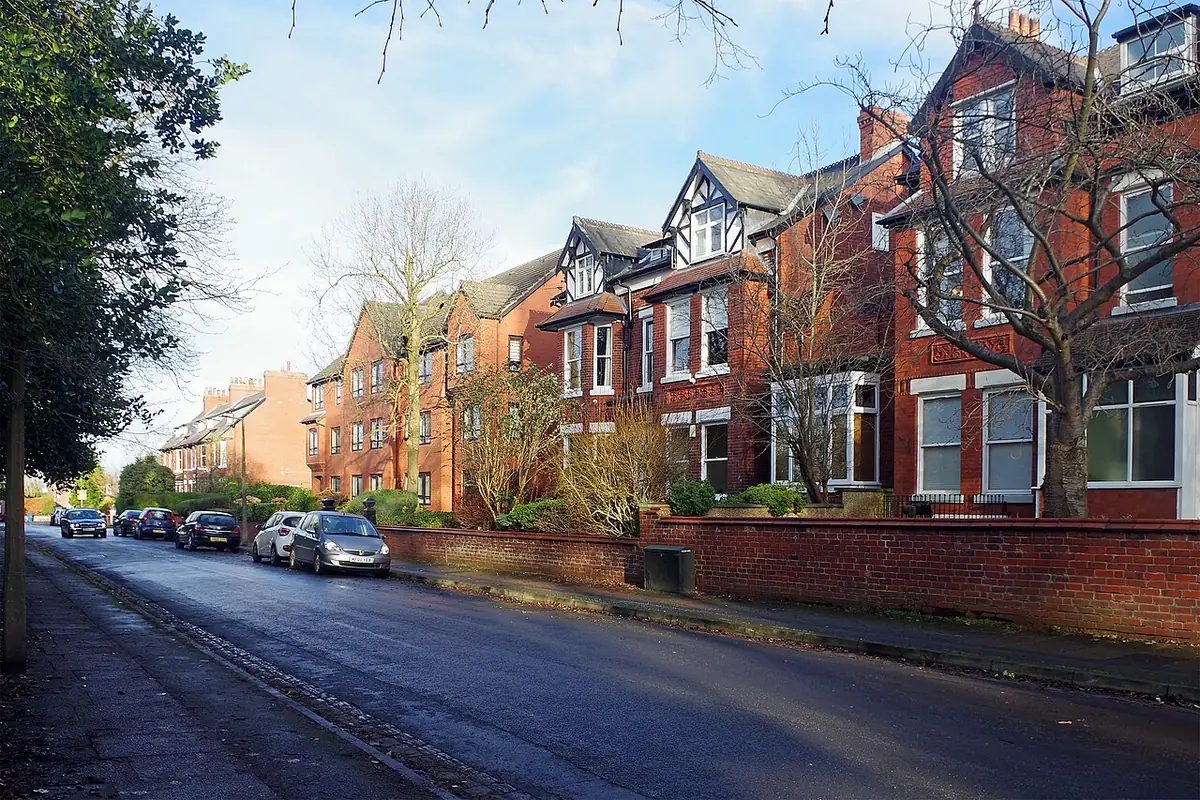
Terraced streets like this make up much of Manchester's housing — Photo: Stephen McKay · CC BY-SA 2.0 · Wikimedia Commons
That strict chronology leads into a precise operational sequence that needs to be steered with method.
In the British system, signing an initial agreement is in no sense a binding commitment. Between your offer being accepted and the final transfer of ownership, a rigorous process of legal and financial investigation gets under way. Understanding that chain of events protects you against last-minute withdrawals and keeps the money you have committed safe.
The estate agent puts your offer to the seller and has it accepted, at which point the property moves to 'under offer'.
Instructing your solicitor to run the legal searches on the title and on the planning history of the area.
Commissioning the technical survey (building survey) to identify hidden defects, damp problems or structural faults in the block.
Confirming your financing and obtaining a formal mortgage offer if you are borrowing.
Negotiating and finalising the contract of sale through the solicitors on each side, including fixing the completion date.
Formal exchange of contracts, with the 10% deposit paid over, which makes the deal legally irrevocable ahead of completion.
How a property transaction in Manchester unfolds, step by step
A successful purchase in the United Kingdom rests on close coordination between several professionals: the estate agent, the solicitors, the surveyor and the mortgage broker. Knowing exactly what each of them does, and in what order things happen, lets you run your purchase from a distance with no blind spots and avoid administrative stalls.
You and your mortgage brokerGetting the funding in placeObtaining an Agreement in Principle from a lender and evidencing the source of your funds to satisfy British anti-money-laundering rules.
The estate agentChoosing the property and negotiating the offerTargeted viewings, comparison against the local market, and submitting your offer in writing.
Your solicitorLegal due diligence and searchesReviewing the lease, checking the service charges, consulting HM Land Registry and running enquiries about the local environment.
The chartered surveyorTechnical survey of the propertyProducing a detailed inspection report (HomeBuyer Report or Building Survey) to assess the condition of the structure and identify work coming up.
The solicitors on both sidesExchange of contractsFormal signature of contracts and payment of the deposit into escrow (usually 10%). The purchase becomes legally binding.
All partiesCompletion and handover of keysTransfer of the remaining funds, registration of the change of ownership at HM Land Registry, and collecting the keys from the agent.
Apartment or house in Manchester: space or centrality?
Once that choice of property type is settled, what remains is testing the financial reality of your plan against local conditions.
The trade-off between a city-centre apartment and a suburban house shapes the whole of your buying journey in Manchester. On one side, recent schemes in districts such as Deansgate or Ancoats offer walkable daily life, services built into the building and energy performance that is often close to faultless, which appeals to young professionals and investors alike. On the other, residential rings such as Chorlton or Didsbury offer Victorian or terraced houses with gardens, ideal for families wanting to put down roots in a local community, at the price of a longer journey every morning.
Charges and communal ownership weigh heavily in that balance. Buying an apartment in Manchester means accepting service charges and ground rents that can be substantial, that rise regularly, and that can eat noticeably into your annual budget. In a house those hidden costs disappear, replaced by full responsibility for the roof, the foundations and the insulation, items that call for a solid contingency fund from your very first year in the property.
Liquidity is another decisive factor, and one first-time buyers often underestimate. Well-placed apartments near Metrolink tram stops resell or let quickly thanks to steady rental demand from the technology and university employment centres. Family houses with genuine Victorian character in sought-after districts, by contrast, benefit from a structural scarcity that protects their value over the long run, even if the pool of buyers who can afford them narrows when the market turns.
Finally, how you actually live should outweigh how you imagine living. If your weekends go on travel, restaurants and the venues of the Northern Quarter, a city-centre apartment spares you the maintenance chores and maximises your free time. If instead your days revolve around parks, local schools and the garden, buying a house makes itself obvious, despite the daily commute at peak hours that comes with it.
What overall budget do you need to settle in Manchester for the long term?
With those financial markers in place, it is worth looking at what daily life actually looks like for a resident.
Buying property in Manchester is never just the headline price on a listing. You have to fold in the local taxes, the British conveyancing costs and Stamp Duty Land Tax, and the recurring running expenses, or the first few months will bring budget surprises. Figures gathered from local sources allow realistic ranges to be set for each unavoidable line of spending.
Upfront and recurring costs of buying a property in Manchester
Cost item
Estimated range
Comment and frequency
Two-room city-centre apartment
GBP 220,000 - GBP 320,000
Average purchase price for a recent or refurbished property with services.
Three-bedroom family house
GBP 350,000 - GBP 550,000
The range seen in sought-after residential districts.
Council Tax (annual)
GBP 1,400 - GBP 2,500
Local tax varying with the valuation band of the property (bands A to H).
Service charges (apartment)
GBP 1,500 - GBP 3,500
Annual communal charges for upkeep of shared areas and lifts.
The amounts shown reflect averages seen across the Manchester market and should be confirmed with an independent financial adviser.
Average monthly energy and transport spending
Item
Indicative monthly budget
What moves the figure
Electricity, gas and water
GBP 150 - GBP 250
Depends heavily on the energy performance rating (EPC rating).
Metrolink season ticket (zones 1-3)
GBP 100 - GBP 160
Essential for anyone commuting daily into the business district.
Home insurance (buildings and contents)
GBP 25 - GBP 50
Cover required by mortgage lenders.
These running costs move with the seasons, particularly through the winter months.
What does an ordinary Tuesday in Manchester look like, between work, schools and transport?
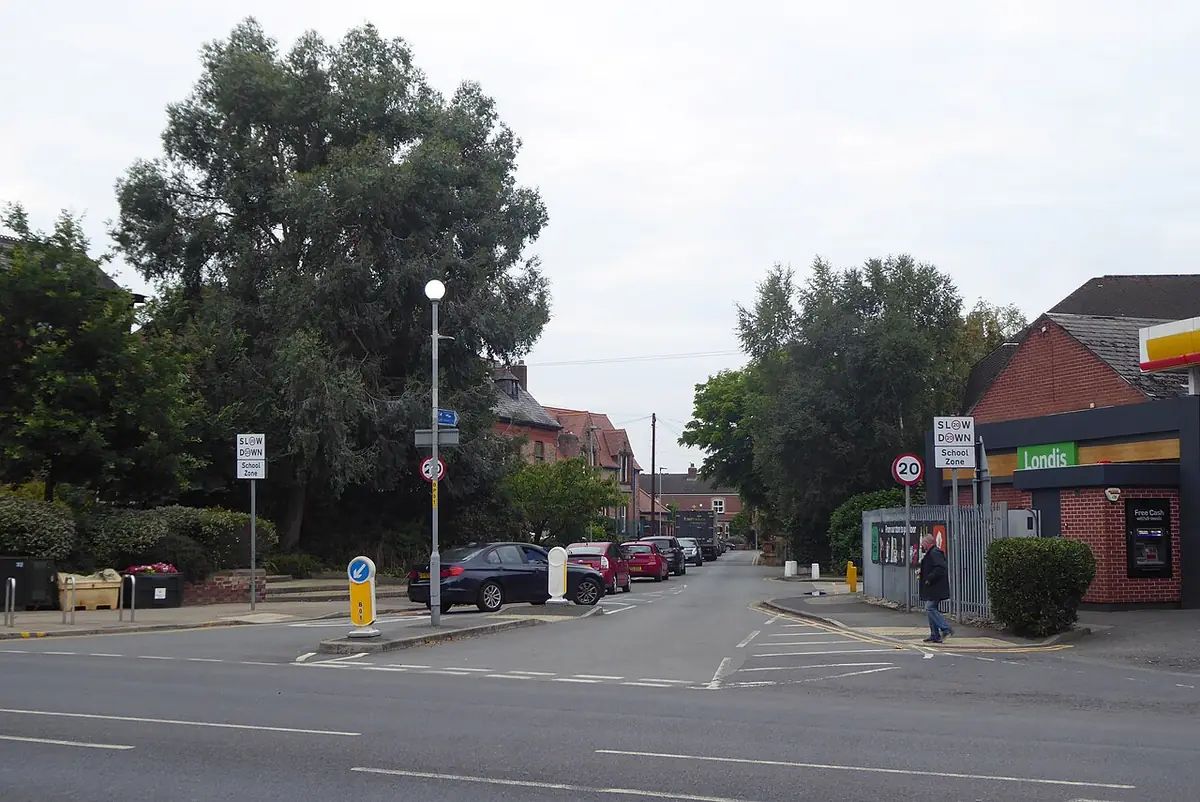
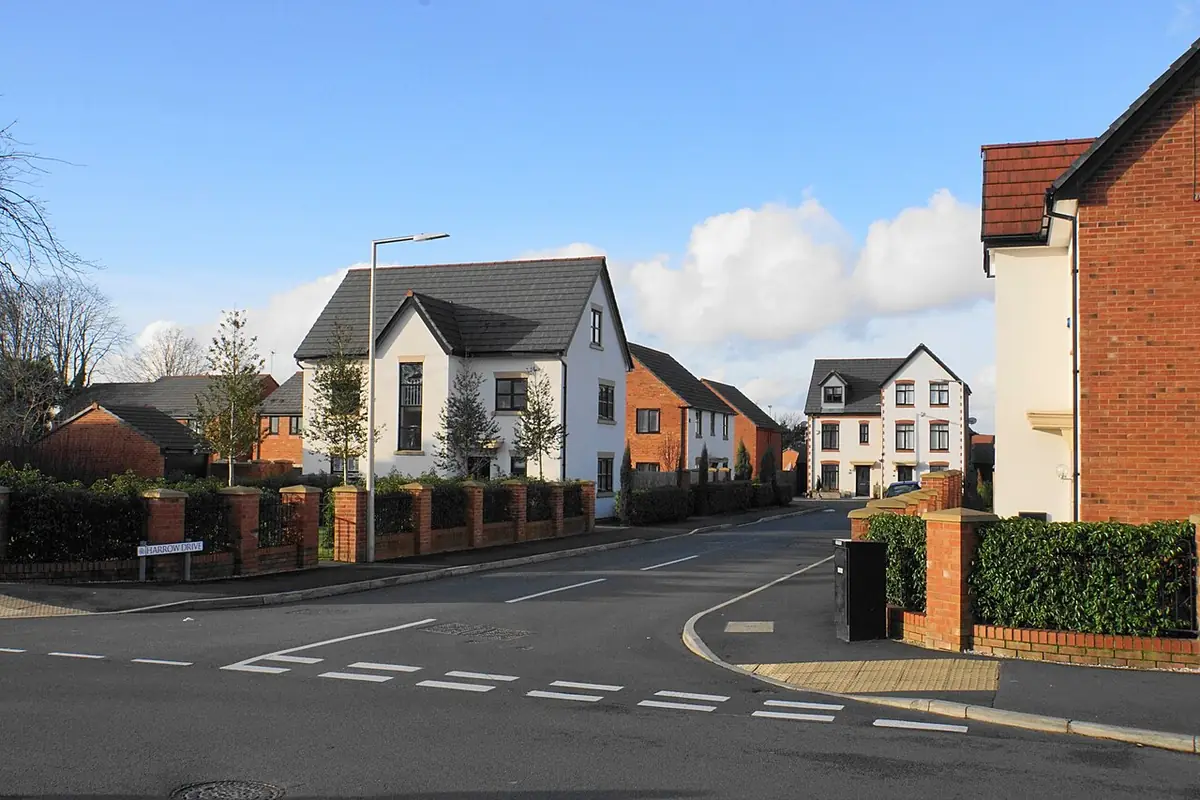
New-build streets like this add to Manchester's newer housing supply — Photo: Bill Boaden · CC BY-SA 2.0 · Wikimedia Commons
Beyond that well-oiled routine, some hidden aspects deserve your full attention before you sign.
The rhythm of a day in Manchester is set by how well the public transport network runs and by how close local amenities are. From the morning Metrolink commute to the end-of-day shop at a local market, each stage illustrates the compromise between location and quality of life. This hour-by-hour picture helps you gauge the logistical reality of where you are thinking of living.
07:30Residential district or city centreAn early start to avoid traffic building up on main routes such as Princess Parkway or Regent Road.
08:15Local Metrolink stopBoarding the tram, the backbone of city travel towards the employment hubs of Piccadilly or MediaCityUK.
12:30City centre or business districtLunch in an independent cafe in the Northern Quarter or along the Castlefield canals, good ground for local networking.
17:00School or nurseryCollecting the children, often made easier by well-rated primary schools at the heart of residential districts.
18:15Local shopsLast-minute shopping at neighbourhood convenience stores or local producers' markets for dinner.
20:00HomeBack to quiet in a well-insulated home with modern heating, with the cultural life of the city a reasonable distance away.
What crucial details does a Manchester listing never mention?
Ignoring those technical realities leads straight to the classic disappointments newcomers report.
Online listings systematically idealise properties, dwelling on light and on how close the fashionable streets are. A careful look on the ground reveals structural and regulatory constraints that sellers tend to leave unsaid. Here are the factual points it falls to you to dig into before committing money.
The legal tenure of the property (leasehold or freehold)
Many apartments and even some houses are sold leasehold, meaning you buy the building but rent the land. The number of years left on the lease and the ground rent review clauses can destroy the value of your investment over time.
Planning proposals and future construction sites
Manchester's momentum comes with rapid densification. An empty plot opposite your future window can quickly become a high-rise that blocks your view and your daylight entirely.
The local history of flooding
Some areas near the River Irwell or the Mersey carry a historic flood risk. Getting a full insurance report before you make an offer is essential if you want to avoid extreme surprises on your premiums.
The real state of the sound insulation
Victorian buildings converted into apartments often have undeniable character but suffer from poor acoustic separation between floors, which makes neighbours audible day to day.
Restrictions attached to listed buildings
If the property has heritage status, the smallest external change, from replacing windows to fitting a heat pump, will need slow official consents and expensive materials.
Which buying mistakes usually surface six months after moving in?
With those traps avoided, the question becomes whether this kind of purchase really fits your own situation.
Looked likeA fashionable, lively district with plenty going on at night right below the building.
Turned outA constant source of weekend noise, plus recurring difficulty parking or taking deliveries.
Would have caught itViewing the property late on a Friday and a Saturday evening to judge the real atmosphere and the noise outside.
Looked likeAn affordable apartment thanks to service charges that started out moderate.
Turned outA sudden jump in communal maintenance bills, voted through at a meeting to fund compliance works.
Would have caught itAsking for the full minutes of owners' meetings for the past three years to spot works that have been deferred.
Looked likeAn ideal commute into the business district thanks to a main road nearby.
Turned outDaily gridlock at peak hours because of permanent roadworks and saturated city traffic.
Would have caught itTesting the journey at the exact times you would travel, ideally on a rainy day when traffic is heavier.
Looked likeAn excellent energy rating on the seller's official certificate.
Turned outInvisible thermal bridges and winter heating bills far higher than expected because of poor insulation work.
Would have caught itCommissioning an independent thermal inspection with an infrared camera before your conditions are satisfied.
Who should definitely not buy property in Manchester right now?
It is time to draw these threads together so you can make your decision calmly.
Buying is not the universal answer to every situation in life. The Manchester market, marked by strong cycles and strict rules on leases and refurbishment, can turn a promising plan into a money pit if the buyer's profile does not match it. Here are the cases where it is better to hold off, or to postpone.
The highly mobile buyer, or one in the middle of a career change
→Buying an apartment quickly in order to have somewhere to live on arrival in the region.
Conveyancing costs, Stamp Duty Land Tax and the costs of selling again (agency fees, taxes) need a horizon of at least five years to be recovered against simply renting.
The investor with no patience for the administration of communal ownership
→Buying leasehold without checking the clauses governing the managing agent.
The complexity of relations between leaseholders, managing agents and freeholders in the United Kingdom regularly produces legal deadlock when a dispute arises.
The household with too thin a cash buffer
→Committing every last pound of savings to the largest deposit the lender will take.
Without a financial cushion for an urgent roof repair or a failed heating system, the household is immediately exposed to the risk of missing payments.
So, are you ready to buy in Manchester?
Green spaces like this sit within easy reach of the surrounding streets — Photo: Stephen McKay · CC BY-SA 2.0 · Wikimedia Commons
At the end of this analysis, buying property in Manchester shows itself for what it is: a highly strategic decision that forgives neither improvisation nor haste. If you have confirmed you can absorb the hidden costs, accepted the trade-offs between the buzz of the centre and the calm of the residential districts, and measured the real weight of local charges, then the economic fundamentals of the city support your plan to settle here for the long term.
The Manchester market consistently rewards patient buyers who look past the marketing in the brochures. By combining close scrutiny of the lease, a rigorous read of energy performance and a check on planning proposals nearby, you turn a risky purchase into a solid long-term asset. Take the time to view at different hours and to test every line of the budget with independent professionals before you formalise your offer.
Never forget that the best purchase is the one that fits your personal and professional life, not the one that answers a passing urgency or the pressure of a tight market. Manchester offers an exceptional setting and a rare economic energy within the United Kingdom, provided you approach its property market with method, clear eyes and absolute financial realism.
Related questions
What legal and tax costs should you budget for when buying in Manchester?
There is no civil-law notary in the United Kingdom; conveyancing is handled by solicitors. Legal fees and taxes, above all Stamp Duty Land Tax, vary with the price of the property and with your residence status or first-time-buyer status, and together they often come to several thousand pounds that must be set aside in advance.
What is the difference between leasehold and freehold?
Freehold means you own both the building and the land it stands on. Leasehold means you own the right to occupy the home for a fixed term (often several decades or even centuries) while paying an annual ground rent to the owner of the land.
How does Council Tax work in Manchester?
Council Tax is an annual local tax levied by the city council to pay for local public services. It is calculated from the assessed value of the property on 1 April 1991 and sorted into bands running from A (the cheapest) to H (the most expensive).
Can a non-resident buy in Manchester?
Yes, overseas and non-resident buyers can acquire property in Manchester, but they face additional Stamp Duty Land Tax surcharges and rigorous financial compliance checks (anti-money laundering).
Which Manchester districts suit a first family purchase?
Areas such as Chorlton, Didsbury and Altrincham are particularly popular with families because of the quality of their schools, their green space and their village feel, while staying connected to the centre by tram.
What effect does the Metrolink network have on property prices?
Being within immediate walking distance of a Metrolink tram stop is a powerful driver of value and guarantees an easy resale or letting, because buyers actively look for a smooth daily commute.
What is a listed building and what restrictions come with it?
A listed building is one protected for its historic and architectural importance. Any renovation or alteration requires special consents granted under very strict conditions, along with traditional techniques and materials that cost more.
How long does a property transaction in Manchester usually take?
A standard UK transaction generally takes between three and six months from the seller accepting the offer to legal completion, provided nothing goes wrong further up or down the chain.
What is an EPC rating and why does it matter?
The Energy Performance Certificate rates a home's energy efficiency on a scale from A to G. A poor score (E, F or G) points to high heating bills and will mean compulsory upgrade work within the medium term.
Do you have to go through an estate agent to buy?
Sellers almost always instruct an estate agent to market their property, so as a buyer you deal with those agencies. It is strongly advised to have your own solicitor alongside you, and possibly a buying agent, to defend your interests.
Property review of ting
No ting properties in Manchester yet
Be the first — share it on ting and it shows up right here.