Finding and renting a house in Manchester takes a solid grasp of the residential districts, the local administrative requirements and the real budgets the market demands. This guide walks through every stage of the move so you can make sound decisions without rushing.
Get the app
What nobody tells you.
Real prices, hidden costs and the traps to check before you commit.
Renting a house in Manchester: the trade-off between space and distance from the centre
Scroll
Renting a house in Manchester: the trade-off between space and distance from the centre
Finding and renting a house in Manchester takes a solid grasp of the residential districts, the local administrative requirements and the real budgets the market demands. This guide walks through every stage of the move so you can make sound decisions without rushing.
Written by the ting.ad editorial team ·
Albert Square, Manchester in Street View: drag to look around.
That opening tension over location raises the question of what kind of occupant you are and what your daily routine looks like.
Renting a house in Manchester means weighing floor space against being a short walk from lively districts such as the Northern Quarter or Deansgate. The more you want a private garden and several bedrooms, the further your daily life shifts towards well-served residential areas on the edge of the city. That single choice shapes your whole move and quietly reshapes your transport budget month after month. It is worth examining these balances coolly before signing a long tenancy.
Living just outside the corevsRenting in the city centre
Houses are scarce there and go for very high rents for what is often a modest floor area. You gain commuting time but lose the outdoor space most people are after in this kind of property.
Aiming for the residential beltvsAccepting a daily commute
The Metrolink tram network and the main bus corridors bring you into the heart of the city in thirty to forty minutes. That is the price of a genuine family house with a bit of green space.
Prioritising warmth and low billsvsLiving with an older property
Manchester's housing stock mixes charming but sometimes energy-hungry Victorian terraces with newer, better-insulated builds. Your monthly energy bill follows directly from that choice.
What kind of occupant are you, and does a Manchester house suit you?
These profiles show how far the local experience can sit from the habits you arrive with.
Renting a house in Manchester answers very different needs depending on whether you arrive alone for work, as a couple, or with children in school. Each situation sets its own requirements for local services, parking and how the rooms are arranged. A quiet night and a lively cultural scene are rarely found in the same district. Here is how to match your own situation to what the local rental market actually offers.
Residential districts and school catchments
Your first priority is being close to strong schools and to parks you can walk to. Areas like Chorlton or Didsbury offer a green, settled setting for family life. Houses there generally come with three bedrooms and an enclosed garden, which matters a great deal with children. In exchange, rents are among the highest anywhere in Manchester's outer ring.
Space and a reliable connection
You need a dedicated room to work in and a fast fibre connection, which points your search towards refurbished properties. Slightly further out, places such as Sale or Altrincham give you noticeably more floor space for the same rent. You get a quiet setting while staying connected to the region's technology hubs. Travel time to the stations matters less if you rarely make the trip.
Good links and a lively setting
You want a compromise between the character of a Victorian terrace and quick access to the city's nightlife and culture. Changing districts like Ancoats or the edges of Salford let you keep an urban rhythm while gaining space compared with a flat. Residential parking and at least a small outdoor space become your main selection criteria. Your budget should allow for spending more of your leisure money closer to home.
Renting a house in Manchester when you arrive from abroad: what really changes day to day
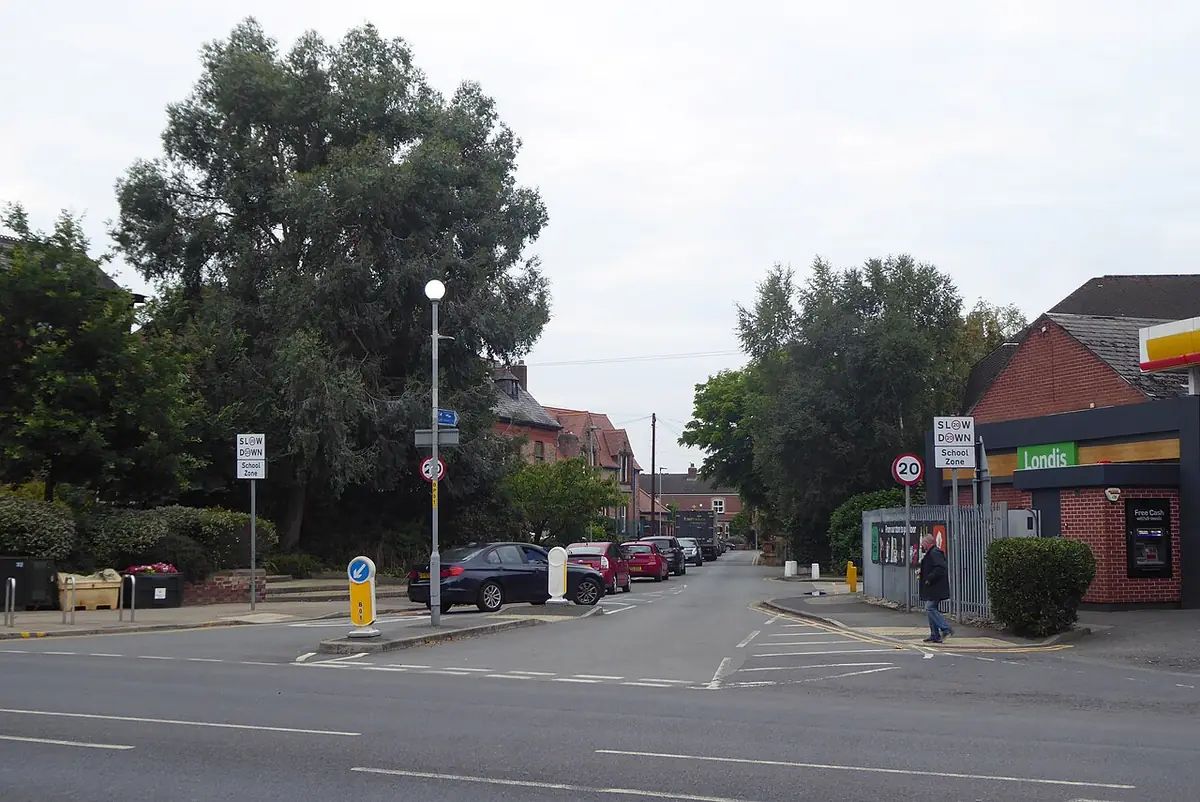
New builds sit right beside Manchester's older stone architecture — Photo: Benjamin Shaw · CC BY-SA 4.0 · Wikimedia Commons
With those administrative reference points in place, the next job is pinning down the exact area that suits you.
The UK rental market runs on legal rules and everyday customs that are a long way from what most newcomers are used to. From assembling an application to the check-in inventory, every stage takes a methodical adjustment if you want to avoid getting stuck. Landlords and their agents apply strict tests of affordability and of where your money comes from. Here are the main gaps to anticipate so your move in is a calm one.
From abroad
A standard rental file backed by a named personal guarantor
Manchester
In-depth checks by a referencing agency (affordability, UK credit history, income)
Prepare translated proof of income and reference letters from previous landlords, and plan around having no local credit history by offering rent in advance or a UK-based guarantor if needed.
From abroad
A regulated deposit held in a blocked third-party account
Manchester
The deposit must by law go into a government-approved protection scheme (such as the Deposit Protection Service)
Your money is protected by UK law, but getting it back at the end of the tenancy depends on an extremely careful, photographed check-out inventory.
From abroad
A housing tax set nationally on the basis of floor area
Manchester
Council Tax paid directly to the local authority according to the property's valuation band
This sits on top of the monthly rent and varies sharply between authorities such as Manchester City Council and Trafford. Build it into your overall budget from the start.
From abroad
Furnished or unfurnished leases with tightly regulated terms
Manchester
Assured shorthold tenancy agreements, often with a break clause available after six months
The market's apparent flexibility hides strict notice rules that deserve a careful read before you sign anything.
Which Manchester district should you target for a house to rent?
These district-level dynamics feed straight into the price ranges you need to read carefully.
Manchester is far more than its city centre, and it offers a mosaic of districts with strong, distinct identities. Choosing a house means looking past the property itself to judge the overall quality of life in the area. Between urban energy, green space and transport links, every zone has its advantages and its costs. Here is a comparison of the areas renters chase hardest.
Chorlton-cum-Hardy
The feel of an independent village, with its own cafes, organic markets and green space everywhere you look.
Suits
Families and couples who want an active neighbourhood life and a strong sense of community.
Trade-off
Rents among the highest in south Manchester, and competition so strong that you get very little time to think.
Salford Quays and MediaCity
An ultra-modern waterside setting dominated by contemporary architecture and technology hubs.
Suits
People working in digital, media or finance who want a flat or a recent townhouse.
Trade-off
An environment that can feel impersonal once the working day ends, and a thin supply of traditional standalone houses.
Didsbury (East and West)
Complete quiet along streets lined with mature trees, matched with beautiful parks along the River Mersey.
Suits
Renters who put quiet, safety and proximity to excellent schools first.
Trade-off
A longer trip into central Manchester, which calls for a transport budget to match.
Altrincham
Exceptional retail energy crowned by its well-known covered market and direct tram links.
Suits
Anyone wanting to combine the calm of a prosperous suburb with quick access to city amenities.
Trade-off
An extremely competitive market where good properties are taken within hours.
What does renting a house in Manchester really cost?
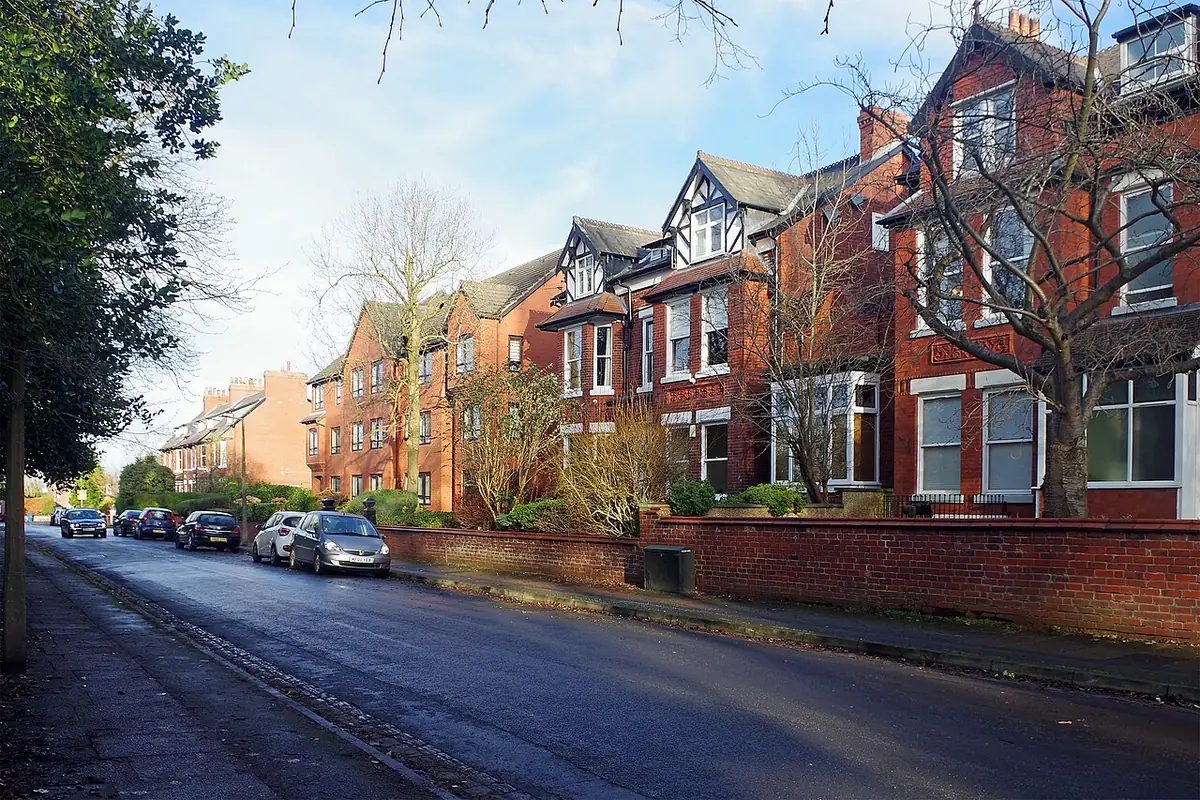
A quiet tree-lined corner in Didsbury, Manchester — Photo: Tom Jolliffe · CC BY-SA 2.0 · Wikimedia Commons
Beyond the raw figures, what you can actually rent deserves a closer look.
Manchester's rental market shows wide price swings driven by how close a property sits to a tram stop and by the reputation of the local schools. An advertised rent never represents the full monthly outlay, because council and energy costs sit on top of it. The figures below set out the ranges the market shows for properties at current standards. Use them to size up your application.
manchesterTo rentHouseestimate
Median price / m²£15Half the apartments sell below this
Median price£1.77kthe average is 14% higher — a few very large properties pull it up
Most common2 bedrooms75 % of listings
Average size114 m²
By number of bedrooms
Bedrooms
Share of market
Avg price
Price / m²
Avg size
2most common
75 %
£1.85k
£16
119 m²
3
22 %
£2.33k
£14best value / m²
161 m²
4
3 %
£2.82k
£14best value / m²
201 m²
Each row is an average, compared against the area average of £16 / m². These are indicative estimates of a typical local market, not a measured sample of live listings. Check current listings before relying on them.
A Victorian house with character or a recent build: which trade-off do you take?
With that choice of style and fabric settled, a few basic legal rules apply before you hand over any money.
The architectural choice in a Manchester rental usually comes down to weighing authentic character against technical performance. The famous red-brick terraces offer generous proportions and a central location, but they call for close attention to the state of the insulation. Newer estates, by contrast, guarantee immediate comfort at the cost of being further from the action. Here are the market's two headline options side by side.
The charm of Victorian and Edwardian houses
These late nineteenth-century properties win people over with their high ceilings, period fireplaces and distinctive bay windows. They usually sit in mature districts with shops within walking distance. Their energy performance, though, is often poor, which shows up as heavy heating bills through the harder winter months. Landlords can also be more reluctant about interior changes.
What it changesYou get an authentic setting rooted in the city's history, at the price of closer scrutiny of the general condition and the energy use.
The practicality of modern, energy-efficient builds
These recent houses meet the latest thermal and acoustic insulation standards, which keeps energy bills moderate and comfort steady. The internal layout is designed around how people live now, with open kitchens and built-in storage. Often part of new developments on the outskirts, they can lack the picturesque character of the traditional Victorian streets. Outdoor space also tends to be smaller.
What it changesYou gain budget calm and everyday comfort, accepting a more standardised residential setting that may sit further from the buzz of the city.
The one rule to understand before you pay any money towards a Manchester rental
Terraced streets like this make up much of Manchester's housing — Photo: Stephen McKay · CC BY-SA 2.0 · Wikimedia Commons
Once that step is cleared, the practical timetable of your move runs in a straight line.
Reserving a rental property in the UK follows a strict timetable that protects the applicant as much as it commits them. Paying a holding deposit immediately freezes further viewings by the letting agent. That sum is capped by law and cannot exceed one week's rent. Understanding how this stage unfolds prevents misunderstandings and secures your position.
The viewing goes well and you decide to submit a complete application.
The agency sends you a rental proposal form setting out the financial terms and the move-in date you have asked for.
You pay the legally capped holding deposit to show serious intent and take the house off the market.
The agency runs tenant referencing and affordability checks through a specialist third-party provider.
The final assured shorthold tenancy agreement is drawn up and put to you for review before signing.
The first month's rent and the deposit are paid, and the keys are formally handed over.
How does a Manchester letting work, step by step?
Settling into a house in Manchester means coordinating several institutional and private parties on a tight schedule. Between viewings, whether virtual or in person, assembling your application and the check-in inventory, each party plays a defined role. Following this chronological route map keeps the move to your new home smooth. Here are the stages that mark out the process.
YouShortlisting properties onlineReviewing listings on the major portals and contacting local agencies quickly so viewings can be grouped together.
Letting agentViewing and offerShowing the property, taking in your application and negotiating any terms of the tenancy.
Referencing providerReference checksAssessing your affordability, verifying your employer and confirming your rental history through an approved provider.
LandlordSigning the tenancy agreementConfirming the specific clauses (term, pets, garden upkeep rules) and signing electronically.
Inventory clerkCheck-in inventoryProducing an extremely detailed joint report, with photographs, recording the initial state of the fittings and the walls.
Energy suppliersOpening the metersTaking gas, electricity and water readings on moving day so the accounts switch into your name.
Renting in Manchester: should you go for a flat or a house of your own?
Once the type of property is settled, the central question becomes the overall financial balance you need to hold.
The choice between a house and a flat in Manchester comes down to your stage of life and how much upkeep you are willing to take on. Flats are concentrated in the central core, around Deansgate, the Northern Quarter and Ancoats, offering city living where cafes, gyms and stations are a few minutes' walk away. In exchange, those properties often carry a heavy service charge, no private outdoor space, and a level of noise transfer that can be hard to live with day after day for a family or for anyone working from home.
Renting a house, by contrast, means moving slightly away from the central axes into residential districts such as Chorlton, Didsbury, Altrincham or Sale. These areas buy you a garden, private parking and noticeably more floor space for the same rent or a little more. The direct cost is the daily tram or bus journey into the business district, along with responsibility for the outside of the property, for keeping the garden in order and for the small day-to-day jobs that English tenancies traditionally leave with the tenant.
For a couple with children, or anyone planning to stay for a while, the house tends to win on warmth, quiet and closeness to the well-regarded schools of the southern suburbs. For a young professional or a childless couple working in finance or tech in the middle of the city, a flat remains the more rational call: it avoids the rush-hour crawl and puts Manchester's cultural life within reach without any logistical strain.
You also have to factor in the hidden financial dimension of each option, beyond the headline rent on the property portals. Older Victorian terraced houses can produce very high energy bills because the original insulation is often poor, whatever refurbishment the landlord has done. Newer flats in the central towers usually perform better on energy, but they load the monthly budget with a fixed service charge that rises every year without the tenant having any say in how it is managed.
What monthly budget do you really need to live in a house in Manchester?
With that budget framework in place, it is worth looking at how daily life in the city actually runs.
Building a forecast budget for renting a house in Manchester means going well beyond the gross monthly rent. Between Council Tax, energy bills, broadband and travel costs, the overall envelope can swing considerably depending on the area you choose. Landlords consistently want solid financial guarantees, including a deposit often equal to five weeks' rent and strict proof of income. It is essential to look hard at each line of spending so the first quarter of your tenancy holds no surprises.
Estimated monthly outgoings for a family house in Manchester
Cost item
Lower end
Upper end
Analysis
Monthly rent (3 bedrooms)
1,200 GBP
2,200 GBP
Varies sharply between affordable outer areas and the highly rated southern suburbs.
Council Tax (bands C to E)
150 GBP
250 GBP
A compulsory local tax based on the property's valuation band and the local authority.
Electricity and gas
180 GBP
320 GBP
Follows directly from the building's energy rating and from movements in market tariffs.
Water and wastewater
40 GBP
70 GBP
Usually billed by United Utilities, either on a meter or on a fixed charge.
The amounts shown reflect market averages in Manchester for properties at current standards.
Additional costs and running charges
Type of cost
Estimated amount
Frequency
Regulatory detail
Tenancy deposit
1,400 GBP
One-off (at move-in)
Capped by law at five weeks' rent for tenancies under 50,000 GBP a year.
Fibre broadband
30 GBP
50 GBP
Monthly, depending on the provider and the top speed available in your street.
Contents insurance
15 GBP
35 GBP
Monthly, covering the contents of the home and tenant liability.
No agency fees can be charged to the tenant in the UK since the Tenant Fees Act came into force.
What does everyday life actually look like in a Manchester house?
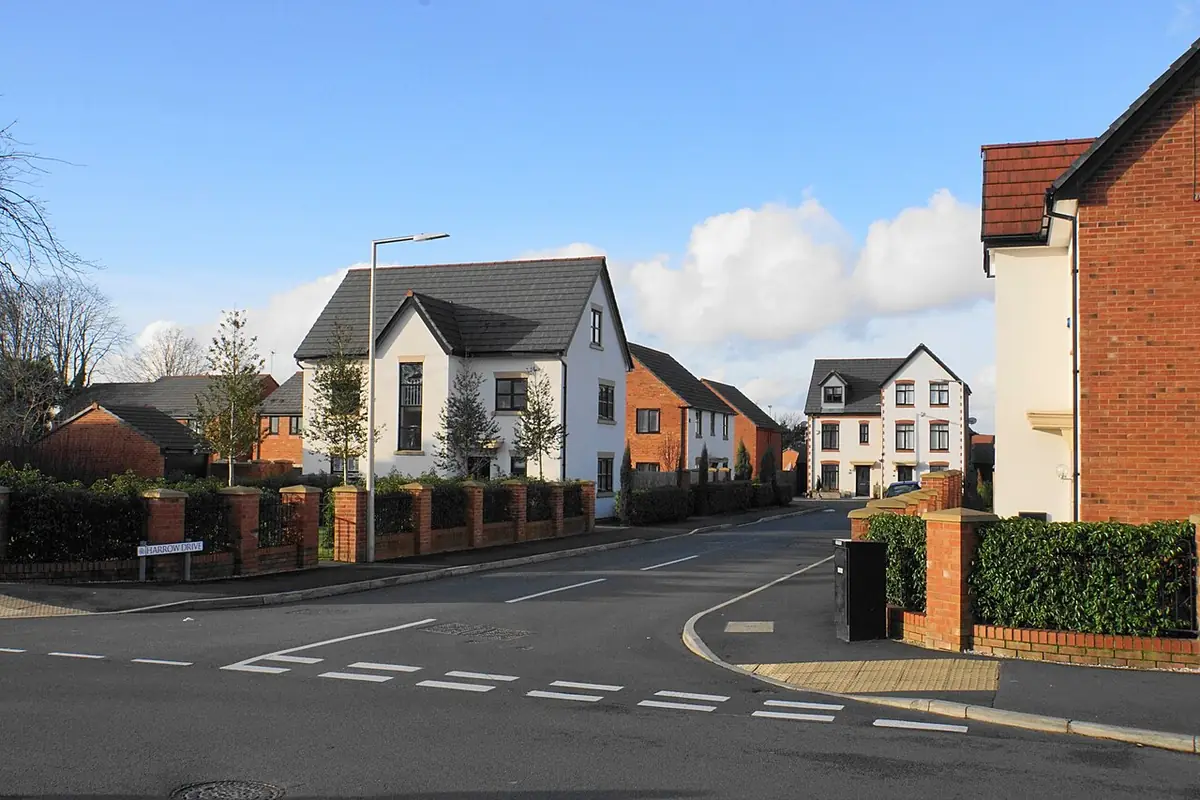
New-build streets like this add to Manchester's newer housing supply — Photo: Bill Boaden · CC BY-SA 2.0 · Wikimedia Commons
Beyond that well-oiled routine, some less visible parts of the rental market deserve careful attention.
Living in a house in Manchester calls for a well-drilled routine, shaped by the transport network and the timetables of local services. From the morning trip towards the business districts to the local shopping at the end of the day, each part of the week reveals how the city really works. Contrary to the cliches, the changeable weather has a direct effect on how people travel and how they use outdoor space, which makes having amenities within walking or tram distance particularly valuable for quality of life.
07:30Residential district (for example Chorlton)Waking and getting ready in a bright house, checking the central heating and the outside doors.
08:30Local Metrolink stopA light rail trip into central Manchester on a frequent network that is broadly reliable at peak times.
09:15Business district (Spinningfields or Piccadilly)Arriving at the office or settling into a coworking space after a brisk walk from the stop.
13:00Lunch break in the neighbourhoodGetting a feel for local life in the small independent cafes and the city's covered markets.
17:30Local supermarket (Co-op or Sainsbury's)Picking up fresh food for dinner on the way back out to the residential suburbs.
19:00Home againTime to unwind in the living room or the garden, deal with the chores and get ready for the next day.
What crucial details do Manchester rental listings deliberately leave out?
With those blind spots identified, it is just as useful to look at what newcomers most often come to regret.
Property portals and agency brochures show homes at their best and carefully smooth over the rough edges. In Manchester, several practical, planning and environmental realities only surface when you visit at different times of day or talk to the neighbours. Overlooking them exposes a future tenant to noise, unexpected energy costs or persistent parking problems that quickly spoil the pleasure of a new house.
Which way the rooms actually face, and how much sun they get
Given how often the British sky is grey, a house facing due north or blocked by a neighbouring building will stay dark all year, driving up the need for artificial light and weighing on the occupants' mood.
How well the party walls really block sound
Many Victorian houses share thin load-bearing walls with the properties next door. Without an upgraded acoustic layer, ordinary household noise travels straight through and eats into your peace and quiet.
Water pressure and how steady the supply is
Some older parts of outer Manchester suffer from weak water pressure at peak hours, which makes running the shower and the washing machine at the same time difficult.
The local street parking policy
Owning a car with no private driveway means buying a paid residents' permit from the council, and the permit is never guaranteed if the quota for the street has already been reached.
Which misjudgements do people bitterly regret six months after moving in?
With those classic traps mapped out, the question is whether this way of living really suits everyone.
Looked likeA charming period house full of character, with exposed beams and large sash windows.
Turned outA property that leaks heat and is hard to warm in winter, producing eye-watering gas bills and persistent damp on the north-facing walls.
Would have caught itInsisting on seeing the EPC and checking the condition of the external windows and doors during the viewing.
Looked likeA perfectly quiet, residential street, seen on a Sunday afternoon viewing.
Turned outA busy, noisy through route at peak times morning and evening, making it impossible to open the windows.
Would have caught itGoing back on a weekday between 8:00 and 9:00, or in the late afternoon, to gauge the real traffic.
Looked likeA rent slightly below the market average for the same size of property in the same street.
Turned outA neglectful landlord refusing to carry out urgent plumbing repairs, and a managing agent you cannot reach when something breaks.
Would have caught itChecking the letting agency's reputation and confirming that the deposit is genuinely held in a government-approved protection scheme.
Looked likeBeing right next to a busy shopping street with plenty of lively pubs.
Turned outRecurring late-night noise on Thursday, Friday and Saturday evenings, along with fly-tipped rubbish on the pavements nearby.
Would have caught itLooking at the immediate surroundings after dark and noting any late-night venues or takeaways.
Which renters should absolutely not be looking at a house in Manchester?
With those counter-indications examined, it is time to decide clearly one way or the other.
Renting a house in Manchester is a logistical and financial commitment that does not match what every city dweller is after. Certain ways of living, work constraints or expectations about freedom of movement make the option a poor fit, and sometimes a source of daily frustration. Recognising these profiles early saves wasted effort and steers the search towards something closer to what you actually need right now.
The highly mobile, always-travelling young professional
→Prefers a furnished flat in the very centre.
Running a house takes more organisation, upkeep and travel time than a packed work diary with frequent trips away can absorb.
The walk-everywhere renter who wants no household chores
→Goes for a serviced apartment building.
Garden upkeep, putting the bins out on a fixed schedule and dealing with boiler breakdowns are unacceptable chores for someone used to everything being included.
The tight budget with no financial headroom
→Opts for a house share or a compact studio.
The fixed costs of energy, Council Tax and maintaining a house on your own can wreck the monthly balance the moment something unexpected happens.
So are you genuinely ready to take the step and rent a house in Manchester?
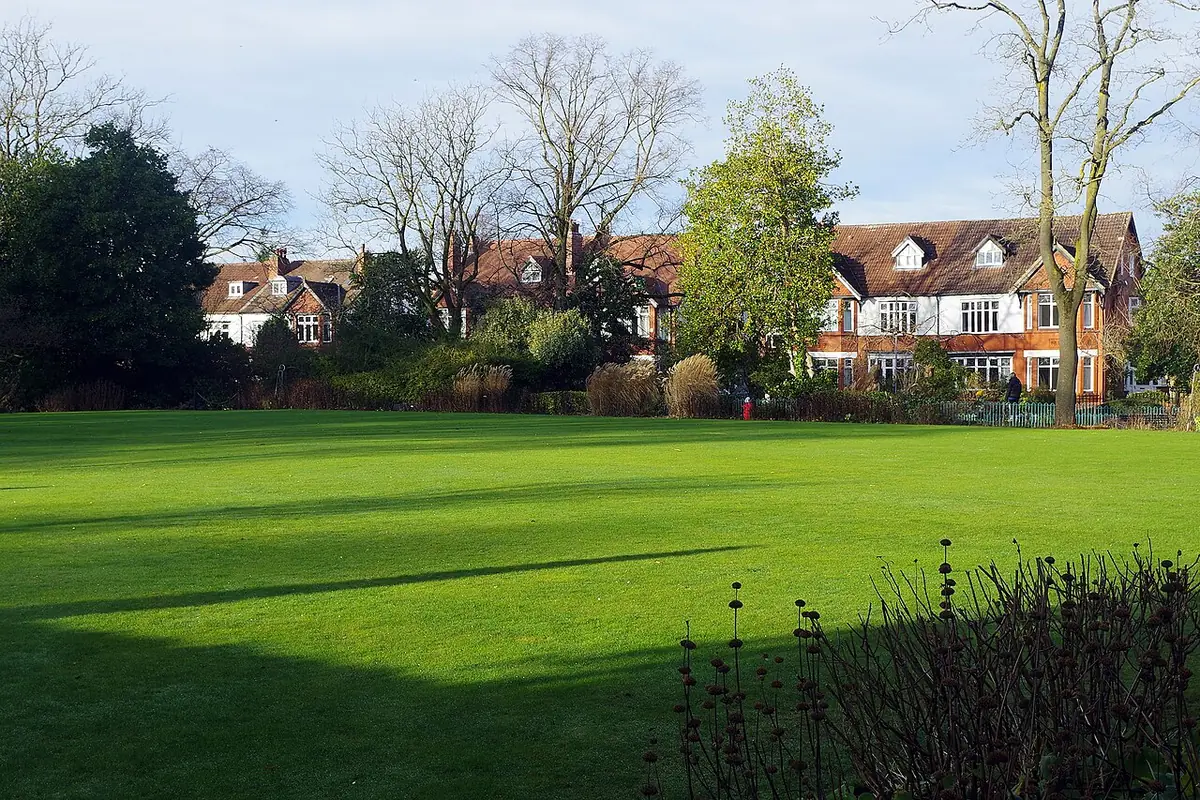
Green spaces like this sit within easy reach of the surrounding streets — Photo: Stephen McKay · CC BY-SA 2.0 · Wikimedia Commons
Deciding to rent a house in Manchester marks a real turning point, a move towards a more settled, more spacious way of living that is rooted in the reality of British neighbourhoods. If you have measured the true additional costs, accepted the upkeep that comes with a house of your own and picked an area that matches your daily journeys, then you have everything you need to settle in without disappointment.
Manchester's rental market remains busy, competitive and demanding. Good properties in the sought-after southern suburbs are gone within days. It is therefore vital to prepare your referencing pack in advance, gather your proof of income and move fast as soon as a serious opportunity appears on the portals or through an established local agency.
Keep in mind that a first UK tenancy is not a commitment for life. It is a way in: a chance to get to know the city, understand the local customs and work out, over the months, exactly which district you might want to put down longer roots in. The flexibility of the market and the depth of the city make it an unusually welcoming place to land, provided you approach the move with method, pragmatism and a clear head about money.
In the end, trust your reading of the facts rather than the polished promises of the marketing copy. Visit, ask questions, cost out every line of the forecast budget and commit only once you are sure you have explored every hidden side of your future home. Manchester will repay that care with its cultural energy and the warmth of its neighbourhood life.
Related questions
How long does it usually take to find and rent a house in Manchester?
The full process normally runs three to six weeks, from the first online search to the handover of keys, depending on how quickly the agency clears your referencing and affordability checks.
What supporting documents do Manchester landlords ask for?
You will need a valid passport, proof of income covering at least 2.5 to 3 times the annual rent, bank references, and rent receipts or contact details for your previous landlords.
Does the deposit have to be held by an independent scheme?
Yes. UK law requires landlords and agents to place the deposit in a government-approved scheme such as the Deposit Protection Service within thirty days.
How is Council Tax paid on a rented house?
Council Tax is paid directly by the tenant occupying the property, usually spread over ten monthly instalments, to Manchester City Council or the neighbouring local authority, depending on the exact address.
Can you negotiate the advertised rent on a Manchester house?
In a market as tight as Manchester the room to negotiate on good properties is very small, but it stays possible if the house has sat empty for several weeks or if you can offer unusually strong guarantees.
Which districts are most sought after for renting a house with children?
Families overwhelmingly favour Didsbury, Chorlton, Altrincham, Sale and Worsley for the quality of their schools and the many green spaces within walking distance.
Are pets accepted in Manchester house lets?
Since the law changed, landlords can no longer refuse pets as a matter of course without a valid reason, but they often ask for extra security or a prior written agreement setting out the conditions.
Who is responsible for looking after the garden of a rented house?
Unless the tenancy agreement says otherwise, routine garden upkeep (mowing the lawn, weeding the paths) falls to the tenant, while pruning large trees remains the landlord's responsibility.
How are urgent plumbing or heating repairs handled during a tenancy?
The tenant must contact the agency or landlord immediately, and they are legally obliged to act as quickly as possible on faults affecting essential services such as central heating or running water.
Can you end a house tenancy in the UK before its initial term is up?
Most tenancies include a break clause, usually usable after six months of occupancy, subject to two months' written notice served correctly.
Property review of ting
No ting properties in Manchester yet
Be the first — share it on ting and it shows up right here.