Settling into Greater Manchester means getting to grips with a rental market that is fast moving and demanding. This practical guide walks you through it step by step, from picking a neighbourhood to collecting the keys, so you can secure a home without unpleasant surprises.
Get the app
What nobody tells you.
Real prices, hidden costs and the traps to check before you commit.
What renting a flat in Manchester really involves day to day
Scroll
What renting a flat in Manchester really involves day to day
Settling into Greater Manchester means getting to grips with a rental market that is fast moving and demanding. This practical guide walks you through it step by step, from picking a neighbourhood to collecting the keys, so you can secure a home without unpleasant surprises.
Written by the ting.ad editorial team ·
Albert Square, Manchester in Street View: drag to look around.
Before you throw yourself into a frantic search, take the time to work out whether your own profile matches what this market demands.
Renting a flat in Manchester is not just a matter of signing a tenancy and dropping off boxes. The city attracts people with its economic and cultural energy, but the rental market carries strong structural pressures that every applicant should anticipate. Between how fast homes turn over and the sometimes ageing condition of the stock, understanding what sits behind the listings helps you avoid financial and logistical disappointment from the day you move into this large northern English city.
An attractive, fast-growing cityvsA chronic shortage of well-located homes
Demand far outstrips supply in the popular neighbourhoods, which means reacting within hours of a viewing or watching the ideal flat go to someone else. Landlords hold the stronger hand when applicants are this numerous.
Advertised rents that look competitivevsExtra costs and charges that are routinely underestimated
The headline monthly rent does not reflect the real bill. You need to factor in council tax, energy bills that can run high in older buildings, and the upfront sums that weigh heavily on your opening budget.
A modern, refurbished housing stockvsNew developments with uneven finishes
City centre towers may shine for their amenities, but many homes suffer from sound or heat insulation problems that are hard to spot during a quick viewing rushed through at speed.
What kind of tenant are you against what this market expects?
Moving here from another country or another region means adjusting your administrative and cultural bearings well beyond the simple act of signing a tenancy agreement.
Not every tenant experiences Manchester the same way, depending on whether they arrive for a tech job, to study, or in search of a more residential setting. The flat you choose follows directly from your working situation and your tolerance for urban noise. Assessing your own profile honestly will stop you renting somewhere too central or, on the contrary, too far from the main transport routes.
The choice of the busy centre
You want to cut your commute to the bare minimum and make the most of the nightlife and the coworking spaces. Living in the central neighbourhoods does expose you to very high rents per square metre and to constant activity that can wear you down over time. Newer flats offer modern comfort but often lack storage and any greenery you can reach straight from the front door.
The option of the inner suburbs
You need an extra room to set up a desk and you value calm while staying under twenty minutes from the centre by tram. This alternative gets you noticeably more living space for the same budget. In exchange you accept regular journey times and a quieter local life, where the shops close earlier in the evening.
The administrative obstacle course
Without local guarantees or an established UK credit score, finding a landlord willing to sign a tenancy with you is a genuine challenge. Letting agents frequently ask for six months' rent in advance or for a guarantor based in the UK. Prepare a faultless application with translated and certified proof of income to reassure landlords who scrutinise affordability closely.
What changes radically between how you usually organise things and life here
New builds sit right beside Manchester's older stone architecture — Photo: Benjamin Shaw · CC BY-SA 4.0 · Wikimedia Commons
Once these administrative principles are clear, choosing the district where you put down your bags becomes the most structuring geographical decision you make.
The British rental system has its own codes, and they are a long way from what most newcomers are used to. From deposits held by approved third parties to the complexity of energy billing, every stage holds a surprise or two. Understanding these structural differences will keep you from making legal missteps and let you budget your spending correctly from the first weeks.
From abroad
A national framework that is highly protective of the tenant
Manchester
A market driven by free negotiation and often short tenancies
Assured shorthold tenancy agreements normally open with a fixed term of six or twelve months, after which the landlord can recover the property more easily than in many other countries.
From abroad
A deposit paid straight to the landlord
Manchester
A deposit that must be held in an official government-approved protection scheme
Your money is secured by law, and the deposit is capped at five weeks' rent, but the check-out inspection becomes a crucial and heavily documented moment if you want to avoid disputes when the funds are returned.
From abroad
Service charges often paid as a flat sum or reconciled once a year
Manchester
Water, electricity and local tax bills entirely in your own name
You have to open your own accounts with suppliers as soon as you move in, and plan for council tax, which varies considerably by band, property size and location.
From abroad
Inventories carried out by an official or recorded in a simple way
Manchester
Extremely detailed photographic inventory reports produced by specialist firms
Every scratch and every carpet stain is recorded precisely. Never skip reading this document carefully on the day you move in, or you risk losing part of your deposit.
Which Manchester neighbourhood matches your pace of life and your budget?
Knowing the neighbourhoods is not enough; you also need the financial reality of rents and running costs to build a workable budget.
Manchester is a mosaic of neighbourhoods with sharply drawn identities, from the intensely busy core to leafy residential areas. Choosing where to live means weighing being close to work against the quality of your everyday surroundings. Each area has its own price curve and its own noise level, and both feed directly into how comfortable you feel.
Northern Quarter
A creative, fashionable district that never stands still, ideal for anyone who loves independent cafes and street art.
Suits
Young professionals without children and people working in the arts who want to do everything on foot.
Trade-off
Very high rents for often small floor areas, and significant night-time noise at the weekend.
Ancoats
A former industrial district rebuilt as a model of urban design, mixing historic brick with very modern lofts.
Suits
Anyone after a carefully designed setting, first-rate food and drink, and quiet but connected neighbours.
Trade-off
Fierce competition for tenancies that makes openings rare, and a cost of living well above the regional average.
Salford Quays and MediaCityUK
A waterside, forward-looking environment built around the old docks and the big television studios.
Suits
People working in tech and media, and anyone who likes recent flats with an open outlook.
Trade-off
A slight sense of being cut off from historic central Manchester and an atmosphere that can feel impersonal in the evening.
Didsbury or Chorlton
The feel of a green, well-shopped village in the south of the city, perfect for winding down after work.
Suits
Families, couples and tenants who want parks, green space and well-regarded schools nearby.
Trade-off
Longer daily journeys into the business district and family-sized homes that attract a great deal of competition.
What does the budget reality of rents and running costs look like in Manchester?
A quiet tree-lined corner in Didsbury, Manchester — Photo: Tom Jolliffe · CC BY-SA 2.0 · Wikimedia Commons
Beyond the raw figures, the legal nature of your tenancy and exactly what it covers define what you actually hold for the length of the agreement.
The Manchester rental market has seen strong inflation in recent years, driven by new arrivals and the economic development of Greater Manchester. Building a realistic budget means separating the headline rent from the unavoidable costs such as energy and council tax. The ranges shown here reflect what is observed on the ground for homes meeting standard comfort criteria.
manchesterTo rentApartmentestimate
Median price / m²£18Half the apartments sell below this
Median price£1.25kthe average is 14% higher — a few very large properties pull it up
Most common2 bedrooms45 % of listings
Average size65 m²
By number of bedrooms
Bedrooms
Share of market
Avg price
Price / m²
Avg size
1
40 %
£1k
£21 +11 %
48 m²
2most common
45 %
£1.29k
£19
68 m²
3
13 %
£1.63k
£18best value / m²
92 m²
4
2 %
£1.97k
£17 −11 %
115 m²
Each row is an average, compared against the area average of £19 / m². These are indicative estimates of a typical local market, not a measured sample of live listings. Check current listings before relying on them.
Renting with your eyes open: what you can really expect from your tenancy
Before you hand over a penny to hold a flat, one administrative golden rule protects everything that follows.
Given the flexibility landlords look for and a body of UK legislation that keeps evolving, it is vital to understand the legal nature of your occupation. Between a standard residential tenancy and the particulars of agreements run by institutional operators, the guarantees are not the same. Here are two complementary ways of approaching your contract calmly.
The private landlord tenancy arranged through a letting agent
This traditional format makes up most of the rental stock available. You deal with a manager instructed by a private landlord. The human relationship matters, but it can become complicated when urgent repairs are needed or when you disagree about the upkeep of appliances. Rent increases are generally negotiated on the anniversary of the agreement or when it rolls over.
What it changesYou often get a home with real character, but you depend on how quickly the landlord responds when something breaks.
Institutional renting, or build to rent
These large developments run by professional operators include shared services on site, such as a gym, a coworking space and a concierge desk. The agreements tend to be more standardised and transparent, and they provide for longer-term renewals with rent rises governed by clear internal schedules.
What it changesYou get faultless day-to-day management and modern facilities, at the cost of higher service charges and a certain architectural sameness.
The absolute rule to master before you pay a holding deposit
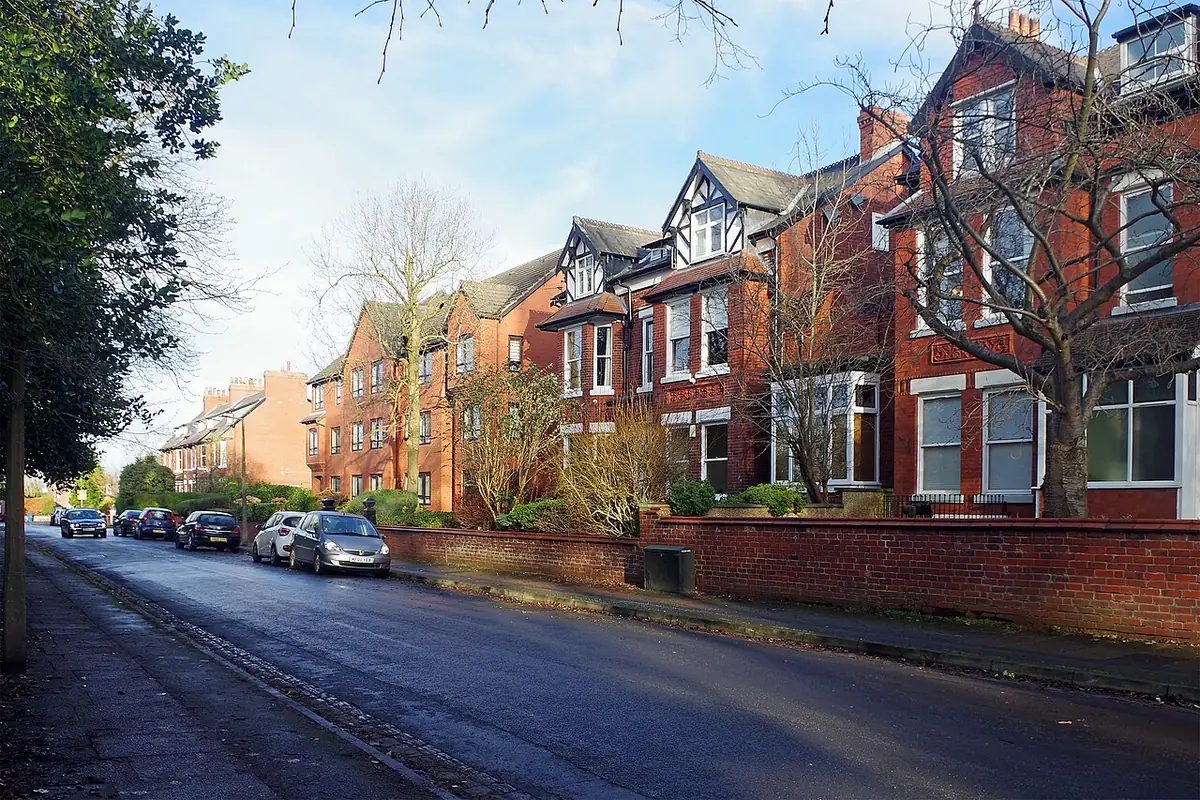
Terraced streets like this make up much of Manchester's housing — Photo: Stephen McKay · CC BY-SA 2.0 · Wikimedia Commons
Once that crucial step is behind you, the chronological run of the tenancy itself can begin methodically.
In the rush of the Manchester market, agents almost always ask for a sum of money, called a holding deposit, to take the property off the market while your application is assessed. This step is standardised, yet it hides strict regulatory traps that many applicants do not know about. Knowing the legal sequence protects you against financial abuse.
You spot a flat that fits your criteria and view it with an accredited letting agent.
The agent invites you to submit a formal offer together with a holding deposit capped at one week's rent, which stops further viewings.
The assessment window, known as the deadline for agreement, formally begins and runs for fifteen calendar days by default unless you agree otherwise in writing.
The agent runs the usual checks on your financial history, your payslips and your professional or personal references.
The landlord makes the final decision to accept or decline your application on the strength of the referencing reports.
If the agreement goes ahead, the sum you paid is deducted directly from your first month's rent or from your overall deposit.
How the letting process actually unfolds, step by step
In closing, renting well in Manchester takes method, a rigorous read of the real costs and a solid grasp of local practice.
Moving into a new flat means coordinating a lot of people, from the letting agent to the landlord by way of the energy suppliers and the referencing firms. Following a strict timetable spares you the last-minute administrative oversights that could delay your move. Here is the detailed running order of what to do and when.
The prospective tenantViewing and checking your criteriaView the property, ask about insulation and heating, and check the general condition of the plumbing and the electrics.
The letting agentSubmitting the offer and paying the holding depositPut in the financial offer and pay the lawful one-week holding deposit while completing the referencing forms.
The referencing providerAffordability and referencing checksValidation of your employment history, verification of payslips and, where required, a solvent guarantor.
The landlord or managing agentDrafting and signing the tenancy agreementElectronic or handwritten signature of the tenancy agreement, setting out each party's obligations and the fixed term.
The tenant and the agentCheck-in inspection and inventoryProduction of the detailed inventory report backed by photographs, along with a joint reading of the water and electricity meters.
The tenantInitial payment and moving inPayment of the first month's rent and the protected deposit, then setting up energy accounts and registering for council tax.
Flat or house in Manchester: space or centrality?
Choosing between a flat in the heart of Manchester and a family house in the outer residential neighbourhoods is not simply a matter of taste. It is a structuring trade-off between immediate access to the city's energy and long-term control of your outgoings and your living space. New developments and converted industrial warehouses offer extremely well-located homes, but their service charges can climb steadily from one year to the next.
Terraced and Victorian houses in the suburbs, by contrast, often give you more living space, a private garden and no shared management charges at all. These homes do, however, demand real time and money when it comes to heating them properly and keeping the fabric in order, and much of that lands on your monthly bills as a tenant. The Manchester market values the two types differently depending on whether you want a demanding city-centre standard or a lasting family base.
Public transport also plays a decisive role in this trade-off. Renting a flat in the centre lets you do without a car for daily journeys, cutting your transport budget to the bare minimum. Choosing a house further out means dealing with the morning traffic or depending closely on the regional rail network to reach your workplace.
Finally, how quickly a home comes back onto the market varies noticeably with your initial choice. Well-located flats in the fashionable districts turn over fast, while well-kept family houses attract steady, constant demand from households looking to settle in Greater Manchester for the long run.
What overall budget should you plan to settle in Manchester for the long term?
Building a realistic budget in Manchester goes well beyond the rent itself. It takes in specific local taxes, energy costs tied to the British climate and service charges that can run high in managed blocks. A careful look at these recurring items spares you financial surprises in your first year. The upfront table below is built from the rental figures given elsewhere on this page, because move-in costs, not purchase costs, are what a tenant actually pays.
Indicative monthly and annual running costs in Manchester
Cost item
Estimated range
Frequency
Council tax (bands C to D)
GBP 1,400 - GBP 2,000
Annual
Service charges (flat, where billed to the tenant)
GBP 1,200 - GBP 2,500
Annual
Energy bills (gas and electricity)
GBP 150 - GBP 250
Monthly
Transport pass (zones 1 to 3)
GBP 90 - GBP 140
Monthly
These amounts are indicative and vary with the exact energy performance of the home and the exact size of the living space.
Upfront costs of taking on a tenancy, based on the rents shown above
Type of cost
How it is calculated
Budget impact
Holding deposit
Capped at one week's rent under the Tenant Fees Act
About GBP 290 on the median rent of GBP 1,250, credited back against your first payment
Protected tenancy deposit
Capped at five weeks' rent, held in a government-approved scheme
About GBP 1,440 on the median rent of GBP 1,250
First month's rent in advance
One month at the agreed rent
GBP 1,000 for a one-bedroom flat, GBP 1,290 for a two-bedroom
The source article priced this table for buyers, which does not apply to a tenancy; it has been rebuilt from the rent figures already given on this page. Referencing and inventory fees cannot be charged to tenants in England under the Tenant Fees Act.
Health, schools and transport: what does an ordinary Tuesday look like in Manchester?
New-build streets like this add to Manchester's newer housing supply — Photo: Bill Boaden · CC BY-SA 2.0 · Wikimedia Commons
Picturing your future daily routine is how you test whether the location works. Between morning journeys on the Metrolink network, access to good schools and how close the health centres are, each neighbourhood sets its own rhythm. An ordinary Tuesday shows immediately whether the address you have chosen simplifies your life or traps you in chronic, tiring congestion.
07:30Home and setting offGetting the day ready and checking traffic conditions or the state of the local public transport network.
08:15School drop-offA walk or a short ride to the local school, whose academic reputation feeds directly into where people choose to rent.
09:00Arriving at work or the coworking spaceConnecting to the city centre business hubs such as Spinningfields or Deansgate, easily reached from most residential areas.
13:00Lunch break and local amenitiesUsing the nearby services, independent shops and urban green spaces to take a breath in the middle of the working day.
17:30Last-minute shoppingA stop at the neighbourhood shops or local markets for fresh food before heading back home.
19:00Neighbourhood life and activitiesMaking the most of the cultural, community and sporting options that give the different districts their appeal.
What the listing will never tell you about Manchester
Marketing descriptions naturally lead with the most flattering selling points and push the structural constraints of the building and its surroundings into the background. Yet it is precisely these unwritten elements that dictate your daily comfort and how happy you will be by the end of the fixed term. Spotting these blind spots protects you from disappointment once you have signed.
Sound insulation in industrial conversions
Old warehouses turned into fashionable lofts often have undeniable architectural charm, but their original floors and thin partitions let neighbours' noise straight through. Checking the acoustic insulation carefully is essential before you commit to a tenancy.
Planning schemes and building work to come
Manchester is a city in permanent change with many construction projects under way. A patch of empty ground opposite your future living room can quickly become the site of a twenty-storey residential tower, radically altering your view and your daylight.
The actual energy performance rating (EPC)
Many older homes carry poor energy ratings that call for heavy investment in insulation to meet current standards. Ignoring that rating will weigh heavily on your winter heating bills, which you pay as the tenant.
How the communal areas are really run by the managing agent
In blocks of flats, the quality of upkeep in shared spaces depends entirely on how seriously the managing agent or the management company takes the job. Unpaid charges among the owners can bring maintenance of the building to a halt.
The traps and regrets you only discover six months into a tenancy
Looked likeAn exceptional deal in a rapidly gentrifying neighbourhood with an obvious upside.
Turned outAn area whose transformation proves far slower than promised, leaving nuisance and a sense of unease late at night.
Would have caught itVisiting the neighbourhood at different times, especially late in the evening at the weekend, to judge the real atmosphere away from the sales pitch.
Looked likeA modern, move-in-ready flat with no visible work to be done.
Turned outCosmetic patching that hid recurring damp problems in the load-bearing walls.
Would have caught itInspecting the property thoroughly, asking the agent directly about damp history and having the inventory record every mark before you sign.
Looked likeA supposedly ultra-central location where everything was minutes away on foot.
Turned outAn address subject to constant noise because of the pubs and late-night clubs immediately nearby.
Would have caught itChecking local planning records and whether the surrounding late-night venues hold operating licences.
Looked likeModerate service charges presented by the agent as included and stable.
Turned outA sharp rise passed on mid-tenancy to fund urgent repairs to the building's roof.
Would have caught itInsisting the tenancy agreement states in writing exactly which charges are included in the rent and which can be varied.
Unusual profiles: who really should not rent in Manchester?
Renting in Manchester is not a universal answer that fits every personal trajectory. Some tenants risk finding themselves quickly boxed in by the economic and regulatory specifics of the local market. Recognising these mismatches early spares you a heavy commitment that does not match what you actually want.
The tenant expecting an easy, immediate move with no effort
→Steering clear of the fiercely competitive city centre developments.
Saturation in parts of the market and rising costs mean applications are decided in hours and the strongest, best-documented file wins.
The highly mobile tenant thinking of leaving the region within months
→Looking for a short let or a serviced apartment rather than a standard fixed-term tenancy.
The upfront outlay (holding deposit, five weeks' deposit, first month in advance) cannot be recovered if you break a six or twelve month fixed term early.
The household determined to avoid any upkeep obligation at all
→Avoiding older Victorian properties that need constant attention.
Keeping the character of these older houses in good order calls for a level of day-to-day involvement that sits badly with an all-inclusive way of living.
So, are you ready to sign a tenancy in Manchester?
Green spaces like this sit within easy reach of the surrounding streets — Photo: Stephen McKay · CC BY-SA 2.0 · Wikimedia Commons
Deciding to rent a home in Manchester means setting your personal hopes against the cold reality of the figures and the local constraints. If you have measured the real impact of service charges and council tax, anticipated the running costs of the building and confirmed that your location works day to day, then you are starting from solid ground. This market rewards patience and clear-headed analysis, and punishes the impulsive signature driven by urgency.
It is worth remembering that a tenancy that works out well is not measured only by how attractive the rooms look or how modern the fittings seem on the first viewing. It rests on how the building is managed, the structural quality of the fabric and whether the neighbourhood keeps its appeal for as long as you plan to stay. Take the time to go through every clause of the agreement, to talk to current residents and to test your budget assumptions against real bills.
In the end, renting a flat or a house in this fast-moving city is a real commitment that will shape your daily life for a good while. If every piece of the puzzle fits together after your checks, you have what you need to move forward calmly and sign with confidence. Your search in Manchester deserves that level of care at every step.
Related questions
Is renting in Manchester still good value compared with London?
Manchester offers rents that are markedly more affordable than the capital, while keeping a dynamic job market and steady population growth that keep demand for good rental homes strong over the long term.
Which neighbourhoods are most sought after by renters?
Areas such as Didsbury, Chorlton and Altrincham appeal to families for their green space and well-regarded schools, while younger professionals favour Ancoats, the Northern Quarter and Spinningfields for the cultural life and the short walk to the centre.
How does the deposit work when you sign a tenancy here?
Your deposit is capped at five weeks' rent and must be placed in a government-approved protection scheme within thirty days, so the money is held by a third party rather than by the landlord and is returned at the end subject to the check-out report.
Should you prefer a new build or an older flat in Greater Manchester?
New builds give you better energy performance and lower running costs, while older stock often provides more generous floor space and architectural character at the price of higher heating bills you need to budget for.
What hidden costs should you watch for when renting a flat in a managed block?
Check very carefully whether service charges are included in the rent or billed on top, how the building's communal areas are maintained, and whether major works to the roof or the facades are planned during your tenancy.
How long does it usually take to go from viewing to moving in?
From an accepted offer to the keys, a tenancy in England typically takes two to four weeks, depending on how quickly referencing, guarantor checks and the tenancy agreement itself are completed.
Is it worth inspecting a property carefully before you commit?
Viewing the flat thoroughly and asking about damp, the roof and the structure is strongly advised, because those problems rarely show up during a rushed first viewing and become your daily discomfort once you have signed.
How do public transport links affect rents locally?
Being a short walk from a Metrolink tram stop or a rail station connected to the city centre is a major driver of rent levels and means those homes are snapped up quickly whenever they come back on the market.
What are the energy performance obligations for landlords?
UK regulations set strict minimum energy performance thresholds measured by the EPC rating, which pushes landlords to invest in insulation and means a poorly rated home should raise questions about your winter heating bills.
How do regeneration projects affect the local rental market?
Large regeneration schemes and transport extensions turn formerly industrial districts into sought-after residential areas quickly, which brings new rental stock but also pushes local rents upward once the work is finished.
Property review of ting
No ting properties in Manchester yet
Be the first — share it on ting and it shows up right here.