Valuing a villa or a house in the Emirate of Sharjah calls for a careful reading of local dynamics, land rules and the particulars of each district. This practical guide sets out the price ranges, the ownership rights and the checks you need in order to arrive at a figure you can defend.
Get the app
What nobody tells you.
Real prices, hidden costs and the traps to check before you commit.
Why valuing a house in Sharjah means reading far beyond the floor area
Scroll
Why valuing a house in Sharjah means reading far beyond the floor area
Valuing a villa or a house in the Emirate of Sharjah calls for a careful reading of local dynamics, land rules and the particulars of each district. This practical guide sets out the price ranges, the ownership rights and the checks you need in order to arrive at a figure you can defend.
Written by the ting.ad editorial team ·
Sharjah in Street View: drag to look around.
Let us turn now to owner profiles, to work out which kind of setting your property actually sits in.
Valuing a property in this emirate rests on very local urban dynamics that do not fit the grids a newcomer brings with them. The historic districts and the newer developments on the edge of the city do not respond to the same pressure indicators. Understanding that gap is what stops you from overpaying, or from putting too low a figure on a family asset that is still being built up. Every parameter of the local market has to be examined closely before a valuation can be called faithful.
Immediate proximity to DubaivsHow self-sufficient the local service infrastructure is
Many owners assume value depends purely on the distance to the neighbouring emirate's border. In practice, the density of local amenities and the quality of the internal road network weigh just as heavily in the final figure. A district well supplied with schools and clinics consistently outperforms purely residential zones.
The age of the construction and the condition of the fit-outvsThe reputation of the original developer and the standard of building management
Older properties often need costly upgrades to meet current energy standards, and that materially changes the net return a valuation should assume. Newer houses, by contrast, benefit from recent insulating materials but start from a high price per square metre. The trade-off between headline value and near-term maintenance cost has to be priced in.
The layout of the plot and the arrangement of the spacesvsThe gross built area printed on the title deed
Two villas of similar dimensions can be worth considerably different sums depending on orientation and how private the internal courtyards are. The local market puts a particular premium on a mature garden and secure covered parking. These features never show up on a basic floor plan, yet they decide the figure at resale.
The legal regime attached to the land and any restrictions on transfervsFreedom of use and the terms on which the asset can be passed on
Certain zones impose specific conditions on owners depending on nationality or residency status. That regulatory nuance narrows the pool of potential buyers and bears directly on how liquid the property is. A rigorous valuation has to take that administrative dimension into account from the outset.
Which residential setting does your Sharjah property sit in, and how does that shape its value?
Let us look now at how the experience of an owner arriving from abroad translates into local practice.
What a house in the emirate is worth depends closely on the daily habits it supports, on how much road commuting its occupants will tolerate, and on family priorities. Quiet outlying districts offer generous living space but demand disciplined travel planning. Central areas make shops and services easy to reach but expose residents to heavier traffic at peak hours. Placing your property in the right one of these profiles is what keeps a valuation honest.
The exit-route effect
This profile covers districts in the west of the emirate, close to the main roads running towards the neighbouring emirate. The value here rests on a trade: a daily commute in exchange for far more living space than the same budget buys on the other side of the border. Any valuation should take account of planned public transport schemes, since they will change how easily those journeys flow and therefore what buyers will pay.
The coastal residential profile
Districts near the waterfront offer a calm setting, with landscaped promenades and a distinctly residential atmosphere. Houses there often have larger private gardens, which supports family living and holds value well. Against that, the entry price is higher and the cooling costs deserve particular attention because of the marine exposure, so an estimate that ignores those running costs will read high.
The activity-hub profile
Zones near the universities or the newer commercial hubs sustain steady rental demand from professionals and teachers, and that demand is the strongest evidence a valuer has. Houses in these districts let quickly but need regular upkeep to stay competitive against new-build schemes. Valuing them properly means allowing for that maintenance and for the resale horizon a careful owner works to.
Valuing a property in Sharjah when you are used to another market: what actually changes
Comparing the districts one against another will let you place your property precisely.
Owning property across borders puts you in front of legal, tax and cultural codes that are entirely new. What seems obvious in the market you came from is handled here through specific procedures, and they have to be taken on their own terms. From the sale agreement to the handover of keys, the pace and the contractual guarantees follow well organised local standards. These are the structural gaps to hold in mind before you settle on a figure.
From abroad
A centralised conveyancing system built around notaries, with statutory cooling-off periods
Sharjah
Licensed agents working under state supervision, and funds transferred through trusted third parties
Transfers of ownership are often faster but demand immediate financial readiness from the buyer. Once a formal offer is accepted there is no extended period for reflection, which means a valuation has to be ready before you go to market, not after.
From abroad
Heavy taxation of capital gains and recurring property taxes
Sharjah
No income tax on rent and much lighter charges on the transfer of ownership
That tax position completely changes the long-term return calculation. Net yield comes very close to gross yield, which shifts the arithmetic behind any valuation compared with the assumptions common elsewhere.
From abroad
A premium placed on age and on the historic character of a building
Sharjah
A premium placed on modern fittings and recent construction standards
Older properties lose value faster if they have not been substantially refurbished. The market prices energy efficiency and contemporary materials first, so condition adjustments here run in the opposite direction to what many owners expect.
From abroad
Strict tenant-protection regimes, including seasonal bans on eviction
Sharjah
A balanced contractual framework, with disputes arbitrated directly by the emirate's specialist bodies
Managing a tenancy calls for constant administrative discipline if disputes are to be avoided. Lease clauses should be drawn up with the help of an experienced local lawyer, because a poorly drafted tenancy will show up as a discount on the valuation.
Which district of Sharjah is your property in, and what does that do to the estimate?
Let us move on to the financial reality and the ranges the market itself records.
Placing a district is not simply a matter of reading a price-per-square-metre map. Each zone in the emirate has developed its own identity, its own amenities and its own neighbourhood profile. Between the lively coastal districts, the quiet residential areas and the modern extensions near the main roads, ways of living differ completely, and so do the comparables you should be using. Weigh these four options against the property you are valuing.
Al Majaz
A lively waterside atmosphere, set by family activities and urban green space.
Suits
Properties whose value rests on a busy neighbourhood life with direct access to restaurants and lakeside walks.
Trade-off
Parking can be awkward, and the price per square metre is among the highest in the emirate, so comparables need care.
Al Khan
A distinctive mix of maritime heritage and recent residential development facing the coast.
Suits
Properties sold on a seaside setting while staying connected to the main centres of activity.
Trade-off
Exposure to sea winds means regular upkeep of facades and cooling systems, which is a standing condition adjustment.
Muwaileh
A district in full swing, popular with families thanks to its proximity to the school campuses.
Suits
Properties valued on an excellent space-to-price ratio and strong future rental demand.
Trade-off
Building sites are still active on some neighbouring streets, and traffic is heavy at school run times.
Al Nahda
A dense residential hub, defined by its position right at the gates of the neighbouring emirate.
Suits
Properties whose value comes from being a practical, immediately connected base for people working outside the emirate.
Trade-off
A more urban and less green setting than the inland residential enclaves, which caps the top of the range.
What does a house in Sharjah actually come out at?
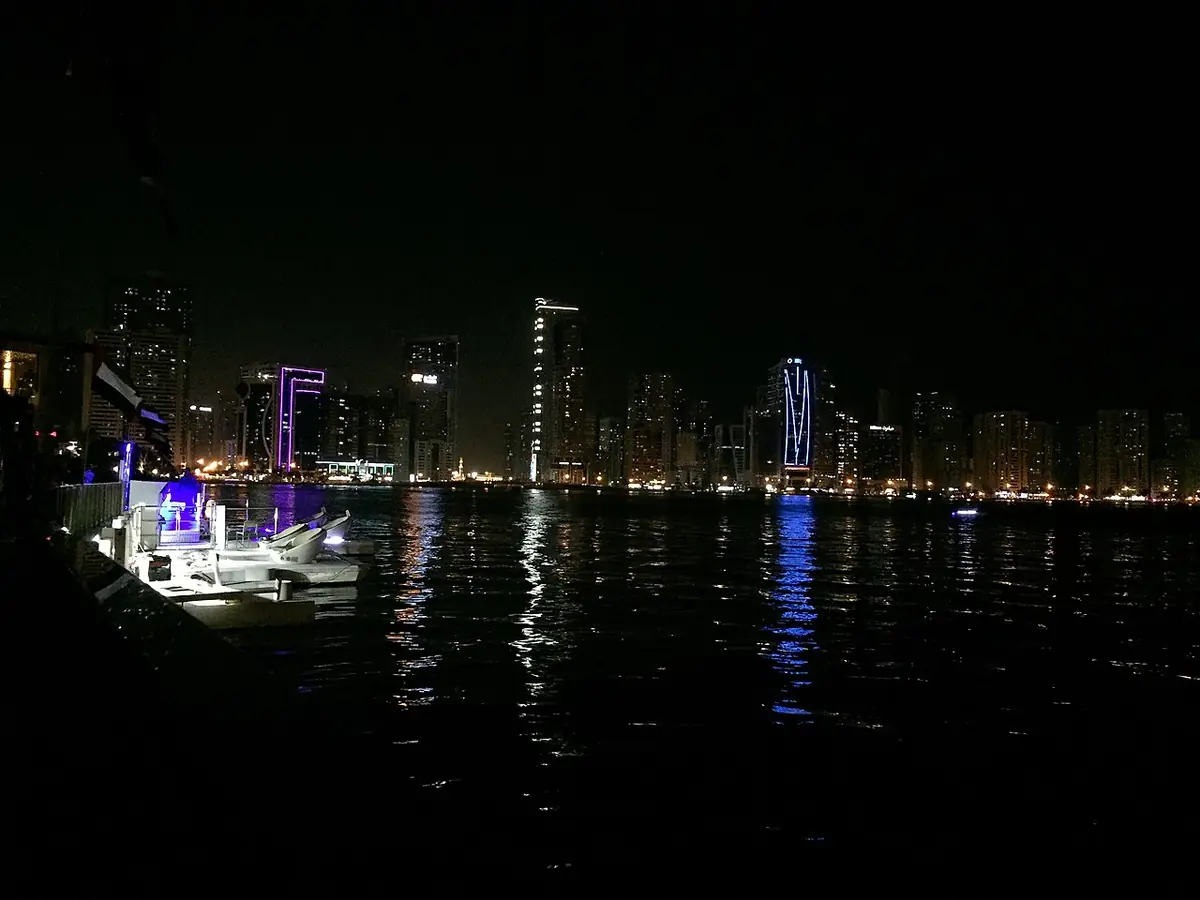
Boats and city lights along Sharjah's waterfront at night — Photo: Clintonpeter · CC BY-SA 4.0 · Wikimedia Commons
Let us look more closely at the exact ownership rights attached to property in this territory.
Putting a budget figure on a property means separating the headline value from the unavoidable side costs. Prices vary considerably with plot size, the age of the property and the standing of the residential district. Market data shows clear bands, and reading your own property against them is the quickest sanity check on any estimate you are given.
sharjahFor saleHouseestimate
Median price / m²AED 6,232Half the apartments sell below this
Median priceAED 1.26mthe average is 14% higher — a few very large properties pull it up
Most common2 bedrooms54 % of listings
Average size193 m²
By number of bedrooms
Bedrooms
Share of market
Avg price
Price / m²
Avg size
2most common
54 %
AED 1.23m
AED 6,691
184 m²
3
34 %
AED 1.64m
AED 6,232 −5 %
263 m²
4
11 %
AED 2.17m
AED 5,904best value / m²
368 m²
Each row is an average, compared against the area average of AED 6,560 / m². These are indicative estimates of a typical local market, not a measured sample of live listings. Check current listings before relying on them.
What you actually hold, and what that does to the figure
Let us turn now to the order in which the evidence behind a valuation has to be assembled.
The legal status of the ownership is the first question for any international investor, and it is the first thing that moves a valuation. Local regulations set out precisely which zones are open to full freehold ownership by foreign nationals and which are held on long leasehold. Confirming that the title issued by the land registration services matches what you assume is what makes the rest of the estimate meaningful.
Zones declared open to freehold ownership
In the areas authorised by recent decrees of the emirate, owners of any nationality can obtain an unconditional freehold title. That official document carries the same rights of transfer and resale as the largest financial centres in the world.
What it changesThe asset can be passed on without particular restriction, and it should be valued against open-market comparables with no discount for tenure.
Long leases and sector-specific restrictions
Some historic districts and specific plots remain governed by renewable long leases running for a maximum of ninety-nine years. Legally these are very secure, but they call for close reading of the renewal clauses and of the maintenance obligations falling on the lessee.
What it changesHave a specialist lawyer confirm the exact nature of the land title, because remaining lease term and repair liabilities both feed straight into the figure.
The order in which the evidence behind your house valuation has to be assembled
Let us set out the different parties and what each of them contributes to the exercise.
Putting a number on a property without following the exact sequence of verifications exposes you to avoidable financial risk. The local process runs through strict sequential stages, and each stage is tied to obtaining a specific administrative document. Understanding that chain of cause and effect is what puts you in a strong position when the figure is negotiated.
The preliminary sale agreement (MOU) sets the reference point for the figure
Careful verification of the title deed and confirmation that no charge is registered against it with the land department
The security deposit (generally ten percent of the amount) placed in the licensed agency's escrow account, which anchors the agreed value
The no-objection certificates (NOC) issued by the developer or the building management, confirming nothing is owed against the property
Final validation of the transfer before the registration officer at the emirate's land registry, where the recorded price becomes a comparable
Issue of the new official title deed, and with it the evidence that supports the next valuation
How a property is valued and transferred, step by step
You now have the analytical tools you need to arrive at a figure you can stand behind in this emirate.
A sound figure rests on the careful coordination of several independent professionals. From the first appraisal through to the utility connections taken over by the incoming owner, every party plays a regulated role. The table below sets out, in order, what each of them contributes.
The ownerSetting the budget frame and identifying the comparable zonesYou establish a precise financial picture, with your bank adviser or from your own funds, taking in every unavoidable side cost so that the figure you work to is a net one.
The estate agentSelecting comparable properties and arranging targeted viewingsThe agent arranges viewings against your strict criteria and shows you the history of similar transactions completed in the same district, which is the raw material of any estimate.
The legal adviserAuditing the title deed and drafting the MOUThe lawyer checks that no dispute is outstanding on the property, reviews the penalty clauses and drafts a protective preliminary reservation contract.
The developer or the building managementIssuing the no-objection certificate (NOC)The managing entity confirms that all service charges and earlier utility bills have been settled in full by the seller, so no arrears sit hidden behind the figure.
The land administrationOfficial transfer and issue of the new titleBefore the competent officer the final funds are released to the seller and the digitised title deed is drawn up immediately in the buyer's name, recording the price that will serve as the next comparable.
House or apartment in Sharjah: why the two are valued differently
Let us move on to the concrete financial side, to understand the costs that sit alongside the figure.
Weighing the value of a detached house against that of an apartment in the Emirate of Sharjah rests on structural parameters that differ profoundly from those at work in other cities in the region, such as Dubai. In Sharjah the property market is characterised by a high proportion of long-established family residents, and that directly shapes the type of property available, where it sits, and how it holds value over the medium and long term. A house, whether a standalone villa or a townhouse in a gated community, is valued on space, independence and lasting integration into the traditional or suburban residential fabric of the emirate, in landmark districts such as Al Majaz or the quieter areas on the outskirts.
An apartment, by contrast, answers a more liquid investment logic, often driven by the search for immediate urban centrality close to the major roads linking Sharjah to Dubai. The residential towers along the corniche or Khalid Lagoon offer open views and built-in amenities, such as security services and underground parking, which simplify day-to-day management for owner-occupiers and for investors looking for a stable rental yield. Life in a jointly owned building does, however, carry regular service charges, and the history of those charges has to be analysed, because a rising charge line is one of the clearest downward pressures on the figure a buyer will accept at resale.
Which basis applies to you therefore depends fundamentally on your time horizon and your personal situation. If you plan to settle for the long term with your family, a house offers stability and freedom to adapt the space that nothing else matches, despite higher initial maintenance costs, and it is valued accordingly against local family demand. If instead you value flexibility, outsourced maintenance and an easier future letting, the apartment is the more rational option, and its value tracks the rent it can command. Each basis carries its own financial and logistical trade-offs, and they deserve rigorous weighing before you commit to any registered undertaking.
It is also essential to take account of the regulatory shift and the gradual opening of certain zones of the emirate to full freehold ownership by foreign nationals, a factor that noticeably changes the asset picture. Houses in those specific zones therefore carry greater legal security, and that shows up in the price, while older apartments in the central districts require careful inspection of the common parts and the building's technical infrastructure before any condition adjustment is made. In short, a sound valuation in Sharjah does not come from chasing an abstract ideal property, but from matching the real characteristics of the building in front of you against the way people actually live in it.
What sits alongside the valuation figure for a property in Sharjah?
To grasp what those numbers mean day to day, let us look at how an ordinary day runs in the emirate.
Working out what a Sharjah property is really worth to you does not stop at the headline figure quoted by agencies or developers. You have to take in every unavoidable side cost, including registration fees, brokerage fees and the provisions set aside for service charges and maintenance. That whole-picture view keeps you from understating the initial financial effort and keeps your cash flow sound from the first year of ownership in the emirate.
Transaction fees and initial costs for a property in Sharjah
Cost item
Percentage or estimated amount
Effect on the overall figure
Registration fees (transfer duty)
2% to 4% of the value of the property
Payable to the Sharjah planning and property registration department at the point of transfer.
Estate agency fees
2% of the sale price (market standard)
Generally borne by the buyer, and open to negotiation depending on the additional services provided.
Administrative and conveyancing fees
Between AED 3,000 and AED 7,000
Covering the drafting of contracts, the no-objection certificates and the issue of the title deed.
These estimates are based on standard practice in the Sharjah property market and can vary with the developer or the exact nature of the property.
Projected annual running costs
Type of cost
Estimated range (AED per year)
What it covers
Service charges
AED 5,000 to AED 18,000
Maintenance of the common parts, security, lifts and landscaping for apartments and townhouses.
Comprehensive home insurance
AED 1,500 to AED 4,000
Cover against fire, water damage and the owner-occupier's civil liability.
Utilities (electricity, water, cooling)
AED 8,000 to AED 20,000
Consumption managed by the Sharjah Electricity, Water and Gas Authority (SEWA) according to the size of the property.
Utility bills tend to rise significantly through the summer months because of heavy air conditioning use, and a valuation that assumes winter figures will read high.
What an ordinary Tuesday looks like for someone living in Sharjah
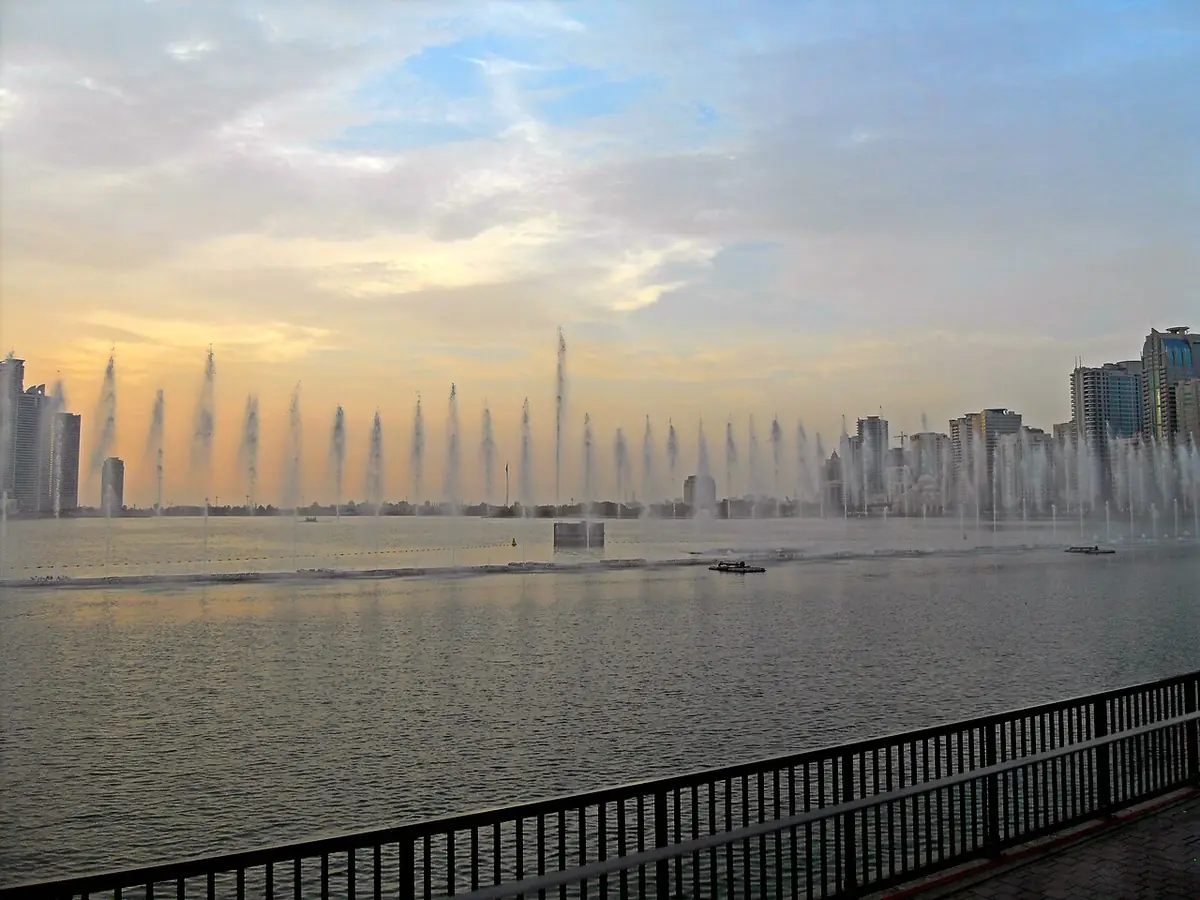
The Al Majaz fountain lighting up the Sharjah evening — Photo: Farrah Zakir · CC BY-SA 4.0 · Wikimedia Commons
Beyond that apparent routine, a number of crucial factors escape owners on a first inspection.
Living in Sharjah calls for disciplined daily organisation, dictated by the rhythm of commuting between the emirate and the neighbouring centres of activity, Dubai above all. An ordinary Tuesday brings out how much the location of a property, measured against the main roads, the schools and the leading health facilities, decides what it is worth. Reading those daily flows is the surest way to sanity-check a location premium before you accept it.
06:30 - 07:15Residential district (for example Al Majaz or Muwaileh)The early start coincides with families leaving for local or international schools. How freely traffic moves in the district depends directly on how its accesses onto the main road are arranged, and that shows up in prices street by street.
07:30 - 08:30Sharjah to Dubai corridor (Al Ittihad Street or Sheikh Mohammed Bin Zayed Road)The peak period for road traffic. A home close to the motorway slip roads or to the inter-emirate bus routes makes a decisive difference to the morning, and that convenience is priced into the figure.
09:00 - 12:30Workplace or office in Sharjah or DubaiThe morning is spent in the emirate's business zones, such as Sharjah Publishing City or the modernised industrial areas, which offer connected and functional professional infrastructure.
13:00 - 14:00Local shops or neighbourhood supermarketLunch and a quick shop in the neighbourhood malls or independent supermarkets, which carry a varied range suited to every resident community. Walkable everyday shopping is one of the steadier supports under local values.
15:30 - 17:00Schools and after-school activitiesCollecting the children and driving on to sports clubs or the cultural centres of Sharjah, known for its artistic energy and accessible museums. Proximity to the school campuses is among the clearest premiums a valuer can identify.
18:00 - 20:00Waterfront walk (Al Khan or Al Majaz Waterfront)Family time in the evening along the landscaped lagoons, enjoying the relative cool and the secure pedestrian spaces maintained by the municipality. Access to those stretches is consistently reflected in what buyers pay nearby.
What the listing will never tell you, and what it costs on the estimate
That vigilance is what keeps you clear of the classic traps, which otherwise surface far too late.
Behind the polished promotional photographs and the promise of exceptional returns sit technical and planning realities that only long-standing residents know properly. Standardised listings systematically leave out fundamental criteria that bear directly on value and on day-to-day comfort. These are the points you have to investigate yourself before you accept any figure.
The real age of the building services and the plumbing
Many buildings from the 1990s and 2000s carry invisible wear on the water supply and drainage, which can generate unforeseen renovation costs in the first year of ownership. That is a condition adjustment a desktop estimate will never make for you.
The overnight parking situation in the surrounding streets
Some very dense districts suffer chronic saturation of public parking spaces in the evening, turning the journey home into a daily search if your property has no allocated space. Buyers discount noticeably for it.
Planned urban development and building sites nearby
An open view can quickly be lost to a new tower going up next door, radically changing the light and the quiet of the home. A view premium is only worth paying for if the planning position supports it.
The real acoustic and thermal performance of the facades
Against extreme temperature swings and the proximity of busy roads, the quality of the double glazing and the wall insulation drives your energy bills and your acoustic comfort, and both feed straight into what the property will fetch.
The valuation mistakes people usually discover about six months later
It matters just as much to recognise, clearly, the cases where relying on a headline figure in Sharjah is a strategic error.
Looked likeAn excellent piece of value, on a price per square metre well below the district average.
Turned outHidden service charges at punishing levels and a building reserve fund nowhere near sufficient for the major structural work the municipality requires.
Would have caught itAlways ask for the minutes of the last three owners association meetings and review the financial health of the building management before you accept any figure or sign a sale agreement.
Looked likeA supposedly strategic location offering very fast access to the neighbouring emirates.
Turned outAn inescapable traffic trap at peak hours, caused by road bottlenecks that appear nowhere on the original circulation plans, and a location premium that the market does not in fact pay.
Would have caught itDrive the home-to-work route yourself at exactly the peak times on a weekday before you accept that the location justifies the price.
Looked likeA verbal assurance from the agent that additional parking would soon be available.
Turned outNo way at all to buy or rent a second parking space in the development, which weighs heavily on households running two vehicles and on what the property fetches.
Would have caught itHave the allocation of specific parking spaces written explicitly into the sale contract, so that the space is part of what is being valued.
Looked likeA modern central cooling system, taken as a guarantee of thermal comfort with no intervention needed.
Turned outRepeated failures of the building plant and corrective maintenance charges billed arbitrarily to owners with no straightforward recourse, none of which was in the estimate.
Would have caught itHave the cooling system inspected by an independent certified technician and check what contractual warranties are still running before you settle on a figure.
Who should not be acting on a Sharjah valuation right now?
Now that every critical aspect has been set out, it is time to take stock of your own preparation.
Owning property is a long-term commitment that does not suit every life path or every professional profile. In Sharjah, acting on a valuation without a clear view of your medium-term future can turn into a genuine financial and psychological burden. It is worth establishing objectively whether your own situation really matches the structural demands of the local market before you commit your savings.
The professional on a temporary posting or facing uncertain international mobility
→Buying an apartment on the assumption that a few years of presence will show a gain.
The initial transaction costs (registration fees and commissions) combined with the cost of a quick resale wipe out the potential gain over a period shorter than five years, whatever the valuation says, which makes renting far more rational.
The investor chasing a very high gross rental yield in the short term
→Buying into speculative off-plan schemes without checking the developer's reputation.
The Sharjah market rewards long-term residential and family stability rather than aggressive speculation, which translates into moderate but stable rental yields and valuations that will not support a flip strategy.
The household with too thin a cash reserve
→Using all its liquidity for the deposit and the registration and administrative fees.
With no financial cushion the owner is exposed to the first unforeseen event, whether major repairs that are not covered or a temporary rise in running costs, and neither of those appears in the headline figure.
So, is the figure you are working with one you can actually stand behind?
Reaching the end of this analysis calls for complete intellectual honesty about your objectives and your real financial capacity. Putting a value on an apartment or a house in Sharjah is not a matter of instinct, guided by emotion or by the ambient talk of easy returns, but a considered judgement that commits your assets for many years. If you have taken on board the need to absorb the side costs without weakening your reserve, you already hold the first key to a figure that will survive contact with the market.
The soundness of your approach also rests on accepting the compromises the local market imposes: positioning your comparables against the reality of traffic flows, valuing the structural quality of a building above its surface appeal, and planning your horizon over several years. The owners who do well in Sharjah are those who treat their property not as a speculative product to be flipped, but as the durable base of a family or investment position in the region, and who value it on that basis.
Take the time to view several properties at different hours, to question the building management closely on the state of the accounts and the works coming up, and to test every line of the budget with a critical eye. If after that examination the figure and the real characteristics of the property still agree, you are fully equipped to act on it with confidence. Property rewards those who approach it with method, clear sight and complete command of their numbers.
Related questions
What legal conditions apply to a foreign owner's property in Sharjah, and how do they affect its value?
Property held by foreign nationals in Sharjah falls under specific provisions that allow either full freehold ownership or long leasehold (usufruct) in zones designated by the government of the emirate. Because the two regimes do not price the same way, it is essential to confirm which one applies to the zone in question with the planning and property registration department before you rely on any figure.
Which unavoidable side costs should be set against the valuation figure for an apartment in Sharjah?
Beyond the headline value of the property, the buyer has to budget for land registration fees (generally between 2% and 4%), the agency fee if an intermediary is involved (around 2%), and the administrative costs of issuing the official title deed and the no-objection certificates. A valuation that ignores these costs overstates what an owner actually walks away with.
How are service charges calculated in Sharjah residences, and why do valuers ask about them?
Service charges are calculated pro rata to the built area of your property in square feet. They cover maintenance of the common parts, round-the-clock security, lift servicing and landscaping. Asking for three years of charge history is essential, because a rising charge line pulls down the value a buyer will place on the unit.
Does the availability of mortgage finance in Sharjah change what a property is worth?
Banks operating in Sharjah and the United Arab Emirates offer mortgage finance to residents and non-residents alike. For non-residents the conditions usually require a larger deposit, often between 25% and 50% of the value of the property, together with a close review of income. The narrower the pool of buyers who can finance a purchase, the softer the realistic valuation.
Which districts of Sharjah hold their value best for a family buyer looking for quiet?
Areas such as Al Majaz, Al Khan and the gated residential communities on the outskirts suit families particularly well. They offer good schools, landscaped open space and easy access to the waterfront, in a secure and peaceful setting, and that combination is what sustains values in those districts.
How much does air conditioning really weigh on the annual energy budget in Sharjah?
Given the high summer temperatures, the electricity used for cooling accounts for a large share of the utility budget managed by SEWA. Reviewing the efficiency of the equipment and the glazing before you settle on a figure is strongly advised, because these recurring costs feed directly into what a buyer is prepared to pay.
How long does the full property transaction procedure take on average?
The average time to complete a property transaction in Sharjah is generally between 4 and 6 weeks from the signing of the preliminary sale agreement (Memorandum of Understanding). That window is needed to obtain the no-objection certificates (NOC) from the developer, carry out the mortgage checks and complete the final transfer of ownership, and it is also how long a valuation figure needs to stay credible.
Do older apartments in Sharjah value up well?
Older properties in the central districts often offer more generous floor areas at an attractive price per square metre compared with new build. They do, however, need a thorough technical inspection of the plumbing, the electrical system and the structure of the building, since the cost of bringing them up to standard has to be deducted from any estimate.
How do the rules on letting a Sharjah property feed into its valuation?
Letting property in Sharjah is governed by strict regulatory provisions that protect the rights of owners and tenants alike. Tenancy contracts must be registered with the municipality, which secures the legal validity of the arrangement and makes disputes easier to settle. A registered tenancy with a documented rent gives a valuer firm evidence of the income the property produces.
Do you need a lawyer or legal adviser to value and sell a property in Sharjah?
While a lawyer is not strictly required for a standard transaction handled by a licensed agent and the land department, independent legal advice is strongly recommended for complex holdings, large sums, or a close reading of contractual clauses that may restrict what the property can be sold for.