Buying a house in Sharjah is a structural decision that calls for a clear-eyed reading of the local market, its neighbourhoods and its legal framework. This guide sets out the unavoidable trade-offs between space and location, the financial realities of the emirate and the steps that make a purchase go through cleanly.
Get the app
What nobody tells you.
Real prices, hidden costs and the traps to check before you commit.
What you actually get when you buy a house in Sharjah
Scroll
What you actually get when you buy a house in Sharjah
Buying a house in Sharjah is a structural decision that calls for a clear-eyed reading of the local market, its neighbourhoods and its legal framework. This guide sets out the unavoidable trade-offs between space and location, the financial realities of the emirate and the steps that make a purchase go through cleanly.
Written by the ting.ad editorial team ·
Sharjah in Street View: drag to look around.
These basic trade-offs come into focus once you look at how your own week is organised.
Buying a house in Sharjah means looking past the surface promises to understand how the local market really works. On one side, the emirate offers a more affordable and more family-oriented residential alternative than its immediate neighbours. On the other, you accept a specific regulatory framework and an urban fabric still changing fast. Weighing both sides of that balance is what keeps the signing free of surprises.
Noticeably more living spacevsLonger daily journeys
Villas here offer generous volumes and private plots that the same budget could not buy in the large economic centres nearby. That extra space is paid for with a marked dependence on the car and heavy traffic at peak hours towards the business districts.
A quiet, family residential settingvsA quieter nightlife and cultural scene
The low-rise residential districts favour rest, safety for children and traditional neighbourhood life. In exchange, cultural life and evening entertainment mean travelling regularly to the neighbouring urban hubs.
A stable regulatory framework for residentsvsFreehold and usufruct rules that are tightly defined
Property acquisition policy protects investors while maintaining clear distinctions by geographic zone and by the buyer's nationality. Checking the exact status of the land before committing is therefore essential.
Does this place suit the way you live?
These different ways of living land differently depending on the cultural and practical reference points you are leaving behind.
How well a property fits your daily life is not measured in bedrooms alone. Whether you work locally, work remotely or are managing school runs, the geographic and logistical impact changes completely. Each resident profile meets a distinct set of constraints and advantages, and anticipating yours is what makes life in the emirate comfortable.
The local resident
If your work is anchored in Sharjah or you work remotely, you get the full benefit of the easy pace of the residential districts and of a cost of living that is relatively lower than in the neighbouring cities. Your daily journeys stay short and you enjoy considerable domestic comfort at a measured cost per square metre. It is the ideal configuration for stabilising a long-term budget without the pressure of rising rents.
The household with children
Here the search for a house answers a need for space, private gardens and quiet for the children. Residential districts generally have suitable schools and local services. You do have to factor in school runs at peak hours and after-school activities, which often mean running two cars every day.
The investor buyer
For an investment profile, buying a villa or a townhouse answers steady rental demand from families looking for large spaces. Gross returns tend to be stable, supported by a limited supply of detached houses against a very abundant stock of apartment blocks. Management does, however, demand close attention to the condition of the building and to community or estate charges.
Living here when you arrive from abroad: what really changes
Once those reference points are absorbed, the choice of district becomes the central question of the whole project.
Leaving a familiar setting to settle in Sharjah means adjusting your expectations about town planning, services and climate. Your sense of distance is upended within the first few days, not through any brutal culture shock but through an accumulation of small administrative and practical details. Understanding those structural gaps lets you pick up the right habits straight away.
From abroad
A dense city you can cross on foot
Sharjah
A spread-out layout designed around the car
Forget the bakery and the corner shop a few minutes' walk away. Everyday errands are organised around the car and the main road corridors.
From abroad
Age and historic stonework
Sharjah
A recent, air-conditioned housing stock
Thermal comfort and modern internal fittings replace the charm of old buildings. Managing the air conditioning becomes an unavoidable budget line and technical chore across your year.
From abroad
A centralised, form-heavy administration
Sharjah
Digital procedures and integrated services
Housing and utility formalities are largely handled online through dedicated apps, and are often processed faster than in the country you came from.
From abroad
Public space that is everywhere and walkable
Sharjah
Indoor and air-conditioned spaces
A large part of social life happens in private spaces, clubs, landscaped parks or indoor venues, particularly during the hottest months of the year.
Which district should you settle in?
This tour of the districts hints at the financial reality of buying in the emirate.
Sharjah is made up of areas with sharply distinct identities, from historic coastal quarters to modern extensions out in the desert. Each district directly shapes your commute, the profile of your neighbours and the kind of house you can realistically aim for. Reading these micro-markets keeps you from ending up isolated or, conversely, stuck with traffic on your doorstep.
The coastal and historic areas
A traditional maritime atmosphere, close to the museums, the souks and corniches lively with sea breezes.
Suits
Anyone after historic character, immediate proximity to the water and the occasional walkable day.
Trade-off
An often older housing stock, recurring parking difficulties and higher prices per square metre.
The new outlying residential districts
Large developments of contemporary villas, wide streets, planned green space and absolute quiet.
Suits
Families with children who want large volumes, private gardens and a secure, modern setting.
Trade-off
Total dependence on the car for the smallest errand and a real distance from the cultural centres.
The mixed zones near the emirate borders
Intense urban energy, heavy traffic flows and an active, cosmopolitan mix of people.
Suits
Working buyers who want to cut commuting time to the neighbouring emirates while keeping the budget under control.
Trade-off
Higher urban density, occasional noise and a less green setting.
What does a house here really cost?
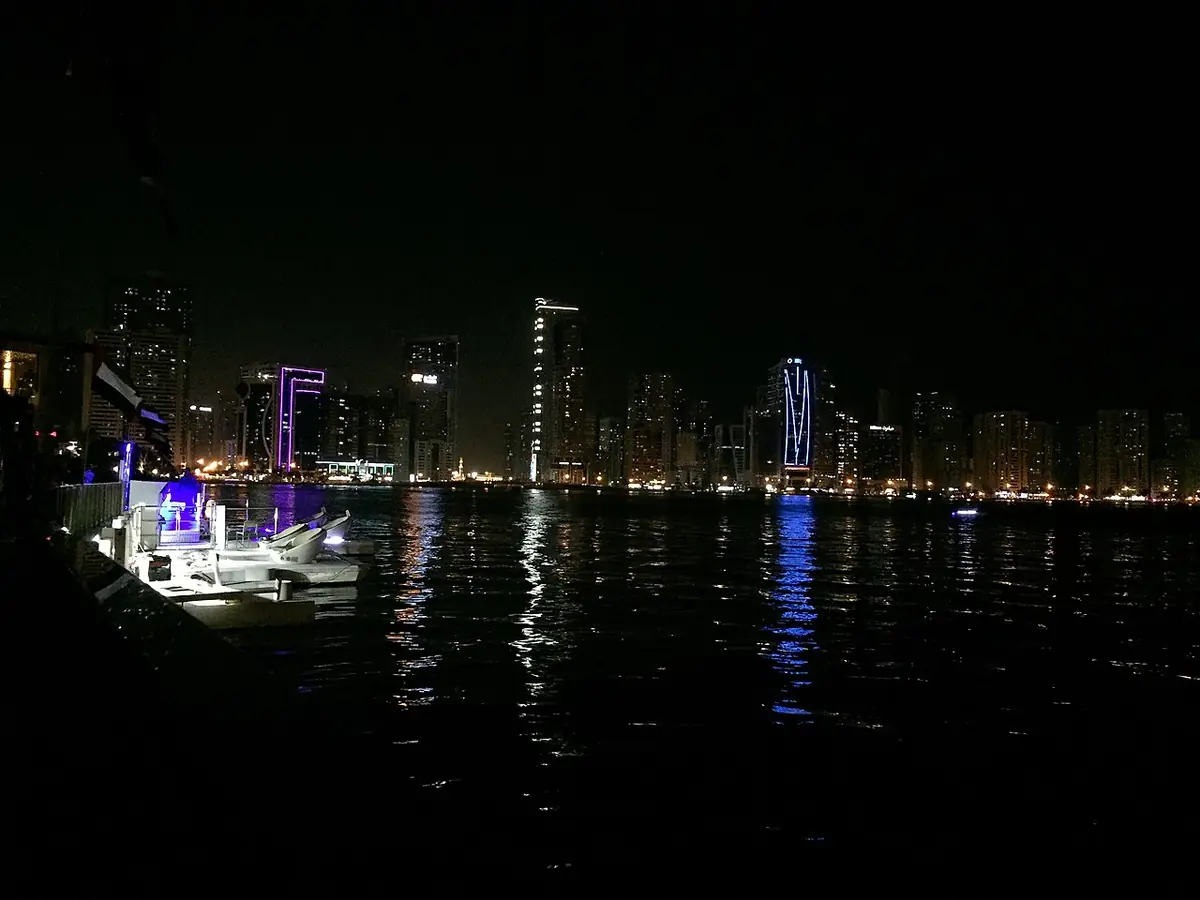
Boats and city lights along Sharjah's waterfront at night — Photo: Clintonpeter · CC BY-SA 4.0 · Wikimedia Commons
Beyond the price tag itself, the question of what you legally own deserves close examination.
The Sharjah property market shows price ranges that are markedly more accessible than those in the neighbouring emirate of Dubai, while offering equivalent or better specification in terms of floor area. Amounts vary sharply with the age of the property, whether it has a private plot and how close it sits to the main roads. Here are the orders of magnitude to anchor your own financial modelling.
sharjahFor saleHouseestimate
Median price / m²AED 6,232Half the apartments sell below this
Median priceAED 1.26mthe average is 14% higher — a few very large properties pull it up
Most common2 bedrooms54 % of listings
Average size193 m²
By number of bedrooms
Bedrooms
Share of market
Avg price
Price / m²
Avg size
2most common
54 %
AED 1.23m
AED 6,691
184 m²
3
34 %
AED 1.64m
AED 6,232 −5 %
263 m²
4
11 %
AED 2.17m
AED 5,904best value / m²
368 m²
Each row is an average, compared against the area average of AED 6,560 / m². These are indicative estimates of a typical local market, not a measured sample of live listings. Check current listings before relying on them.
What you can actually hold as a buyer
That legal security rests on following the chronological steps of the transaction to the letter.
Property ownership follows precise legal rules that distinguish local citizens from foreign nationals. Grasping those nuances protects you from any confusion when you sign the sale contract. Two main regimes coexist, and they determine the exact nature of your long-term investment.
The freehold regime
This lets eligible investors acquire outright ownership of the property and of the land it stands on, with no time limit. It is the most sought-after arrangement because it guarantees full inheritance rights and unquestionable legal security for foreign buyers inside the designated zones.
What it changesYou hold an asset you can pass on and sell under ordinary local law, which greatly simplifies a future resale or a long-term letting.
The usufruct or long-lease regime
In certain specific areas, the purchase takes the form of an extended right of use and enjoyment over a long period, renewable on terms set by the emirate's regulatory authorities. This framework is historically rooted in local urban planning and applies to areas with particular heritage characteristics.
What it changesYou must check exactly how much of the lease term remains and on what terms it renews before you confirm your offer to the seller.
Once that safeguarding mechanism is clear, the practical calendar of the deal is what to work through next.
The local transaction system runs on a strict sequence of procedures in which each step validates the one before it. Committing money too early, without having checked every certificate attached to the property, exposes a buyer to complicated administrative blockages. Understanding the logic of that chain of commitments is what keeps your funds safe.
The viewing you fall for and the verbal price negotiation with the seller or their agent.
Signing a preliminary agreement (MOU) setting the conditions and the timetable for the sale.
Lodging an escrow security cheque (typically 10% of the price) with a licensed agent or a registered conveyancing officer.
The authorities' verification of the title deeds and of the absence of charges or mortgages on the property.
Obtaining the No Objection Certificate issued by the developer or the estate management.
The final transfer of ownership, formally registered with the emirate's land registration service.
How a transaction runs, step by step
This marked-out route lets you approach the purchase with a clear, methodical view.
Buying a property in Sharjah brings in several institutional and professional parties whose roles are strictly separated. Coordinating them within the deadlines takes method and careful preparation of the supporting documents. Here is exactly how the operational timeline unfolds.
The buyerAssembling the financial fileGather your proof of income, identity documents and bank statements so your solvency is established before you make any offer.
The estate agentSelection and the offer to buyView the shortlisted properties, compare prices across the area and put in a written offer formalised through a licensed agent.
The sellerAcceptance and signature of the MOUThe financial and legal terms are agreed in a preliminary contract that governs payment of the security deposit.
The developer or estate managerObtaining the NOCThe manager of the complex or community issues the certificate confirming that no unpaid charges are outstanding on the property.
The land registration authorityOfficial transfer of titleSettlement of the balance, signature of the deeds before the registration officer and issue of the new title deed in your name.
House or apartment in Sharjah: private space against shared-community management
Once that structural choice is settled, a precise reading of the real running costs is what validates your capacity to invest.
Buying a property in Sharjah forces an immediate, fundamental choice between the independence of a detached house, often sited in communities well away from the historic centre, and the practicality of an apartment that comes with shared ownership and service charges. Villas and townhouses offer generous floor areas, private gardens and nobody living above you, which appeals immediately to families looking for space. That autonomy carries a structural price, though: the roof, the central air conditioning and the outdoor areas are entirely the owner's to maintain, with no collective reserve fund to smooth out unexpected major works.
Buying an apartment in dense districts such as Al Majaz or Al Khan shifts the burden onto the community rules and the annual service charges. Those charges cover security and the upkeep of pools, gyms and common parts, giving you a turnkey living environment with no direct involvement on your side. In exchange you have to live with strict rules on structural alterations, with managed underground parking and with owners' general meetings where the voice of local investors weighs heavily on budget decisions.
As an asset, houses in the zones open to foreign buyers appreciate steadily as land becomes scarce, while apartments often show a higher gross rental yield in the short term but depreciate structurally faster as they age. Your final choice should therefore follow your investment horizon: a long-term family base points clearly to the house for the stability of the setting, whereas an asset-optimisation strategy or a professional pied-a-terre points naturally to a well-located apartment.
Location deserves the same analysis for daily life. Houses tend to sit along the main corridors leading to the neighbouring emirate of Dubai, which means long journeys at peak hours for anyone working outside Sharjah. Urban apartments let you do everything on foot along the corniche, but expose you to higher city noise and to constant traffic density, a sharp contrast with the calm of the secure outlying estates.
What budget do you really need to buy and run a property in Sharjah?
With the finances mapped out, look next at the daily rhythm that living in the emirate involves.
Buying a house in Sharjah does not stop at the price the developer or the secondary-market seller puts on it. You have to build in a series of compulsory extra costs from the moment you sign, covering land registration fees, agency commission and recurring maintenance spending. Underestimating those lines can quickly put your personal finances under strain and undermine the long-term return on the purchase.
Upfront purchase costs for a house in Sharjah
Cost item
Estimated rate or amount
Effect on the upfront budget
Land registration fee
2% to 4% of the value
Payable to the Sharjah real estate registration department
Agency commission
2% of the sale price
Market standard for property brokerage
Listing and file-handling fees
AED 3,000 to AED 5,000
Administrative costs of transferring ownership
These fees have to be settled in full on the day the final deed is signed.
Annual running budget for a 3-bedroom house
Type of cost
Annual range
What makes it vary
Air conditioning (HVAC) maintenance
AED 3,000 to AED 6,000
Compulsory preventive maintenance contract
Community (HOA) fees where applicable
AED 2 to AED 5 per square foot
Depends on the facilities in the gated community
Comprehensive home insurance
AED 1,500 to AED 3,000
Structural cover and public liability
Summer energy spending sits on top of this table and can double the electricity bill.
The rhythm of an ordinary Tuesday for a Sharjah resident
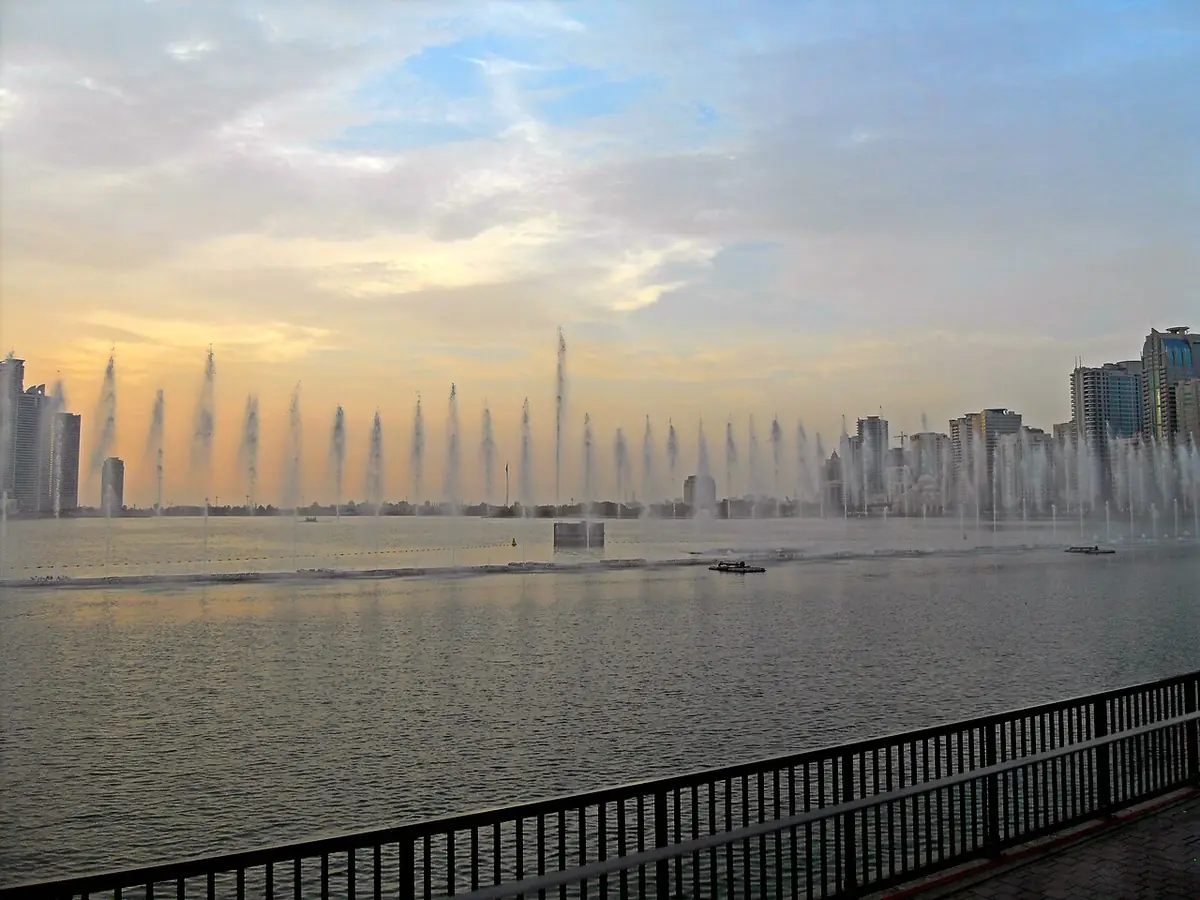
The Al Majaz fountain lighting up the Sharjah evening — Photo: Farrah Zakir · CC BY-SA 4.0 · Wikimedia Commons
Beyond that well-oiled routine, some hidden realities of the property market deserve your attention before you sign.
Living in a house in Sharjah imposes precise timing, dictated by the road network and by local school hours. Nothing conveys the reality of your future daily life better than the hour-by-hour detail of a standard weekday. Between the morning drives, running the household and work commitments, every hour shows what it takes to live comfortably in the emirate without wearing yourself out.
06:30Waking up on the outlying estateThe morning calm typical of residential communities far from the bustle of the city centre and the corniche.
07:30Leaving for the school runA drive to the school campuses sited near the emirate's main road corridors.
08:30Commute to work or start of the home working dayDealing with heavy morning traffic heading for the business zones of Sharjah or Dubai.
13:00Lunch break and household adminChecking the air conditioning units and dealing with routine deliveries at home.
17:00Home again and outdoor activitiesMaking the most of the private garden or the community's secure play areas before nightfall.
20:00Family dinner and preparing for tomorrowThe quiet typical of Sharjah's family residential areas, far from any nightlife.
What the developer brochures do not tell you about Sharjah property
These technical details point straight at the classic traps that catch too many inexperienced buyers.
Developer brochures describe an idyllic place where the sun shines permanently on spotless homes. The reality on the ground is more nuanced and involves technical, administrative and environmental constraints that sellers routinely leave out during viewings. Here are the factors that make the difference between a purchase that works and a permanent source of trouble.
Air conditioning systems wearing out early
The dry, very hot regional climate works the compressors hard. Without rigorous servicing every three months, breakdowns arrive in the middle of summer and require expensive emergency call-outs.
Changes to the surrounding planning framework
An empty plot behind your future house can quickly turn into a construction site for a new road or building, radically changing your view and how quiet the place is.
Reselling quickly if work moves you on
The secondary market for houses in Sharjah is less liquid than Dubai's. Finding a buyer at the price you want can take several months, which limits your immediate financial mobility.
Variable quality in the secondary finishes
Some recent developments show waterproofing or plumbing defects that only appear after the first heavy rains or after a few years of intensive use.
The misjudgements owners discover six months after moving in
With those risks measured, it is time to check whether this kind of purchase genuinely suits you.
Looked likeA spacious, cheap villa at the edge of the emirate
Turned outA daily ordeal of two hours in traffic morning and evening to get to work.
Would have caught itAlways testing the journey at peak hours on a Tuesday morning before making an offer.
Looked likeA hands-off rental investment in a new development
Turned outUnforeseen maintenance costs and handover delays that eat into the net return you expected.
Would have caught itInsisting on an independent audit of the developer's financial strength and checking the late-delivery penalty clauses.
Looked likeA high-end fitted kitchen included in the overall price of the house
Turned outEntry-level equipment needing the ovens and refrigeration replaced outright.
Would have caught itHaving the brands and model references of the appliances listed precisely in the schedule attached to the deed.
Looked likeA quiet, family district with no intrusive commercial activity
Turned outThe imminent opening of an industrial zone or a heavy-transit road right next to the plot.
Would have caught itConsulting Sharjah Municipality's urban development plans with the relevant authorities.
Which buyers should firmly avoid buying a house in Sharjah?
Now is the moment to take a decisive view of your ambition to own in the emirate.
Buying in Sharjah is an excellent opportunity for a settled resident profile, but a major strategic mistake for others. The particular structure of the local market, the lack of immediate flexibility on resale and the maintenance demands all call for specific living conditions. Identifying honestly the situations in which buying is a bad idea will spare you a heavy commitment that does not match your circumstances.
The employee on a short contract or a transitional assignment
→Staying a tenant in a flexible apartment
The high transaction costs (registration and agency) cannot be recovered over a stay of less than five continuous years.
The investor after an immediate, high net rental yield
→Turning to studios in the dense urban centre
Detached houses in Sharjah offer attractive capital appreciation but a gross rental yield below that of small apartments.
The household with no appetite for maintenance and DIY
→Renting with services included
Owning a villa means dealing directly with maintenance contractors, air conditioning breakdowns and outdoor repairs.
So are you genuinely ready to buy in Sharjah?
Reaching the end of this analysis calls for a clear-headed look at your own motives. Buying a house in Sharjah is not a casual act you carry out on impulse; it is a strong geographic and financial anchoring that sets your living arrangements for several years. If you have a solid deposit that covers the registration fees without draining your emergency savings, and your work situation in the region is stable, then buying in the emirate is a sound decision that frees you for good from recurring rent increases.
If, however, the slightest doubt remains about your future mobility or your tolerance for the upkeep a villa demands, the wise course is to extend your tenancy and watch how the market develops. The Sharjah market offers healthy prospects, but it does not forgive initial miscalculations on location or running costs. Take the time to visit several communities, to test journey times at the critical hours and to validate every line of your financing plan before signing any official document.
Your final decision should rest on tangible facts, not on the promise of a flattering brochure. By following the assessment steps set out here, you will turn your Sharjah purchase into a genuinely durable asset for you and your family, and keep the nasty surprises six months after moving in well away.
Related questions
Which parts of Sharjah are foreign buyers allowed to buy property in?
Foreign nationals can buy freehold property in specific zones designated by the Sharjah government, such as Tilal City, Al Zahia and parts of Maryam Island. You must confirm the exact legal status of the plot with the Sharjah Real Estate Registration Department before signing any financial commitment.
What transfer and registration fees should a buyer budget for in Sharjah?
Land registration fees generally run between 2% and 4% of the total value of the property, split by custom between buyer and seller, although the buyer often takes the whole amount on in secondary-market negotiations.
Can an expatriate get a mortgage in Sharjah?
Yes. The main banks operating in the United Arab Emirates offer mortgages to non-residents and to resident expatriates, generally requiring a minimum deposit of 20% to 25% of the value of the property, plus evidence of stable income.
What recurring costs come with owning a villa in Sharjah?
Villa owners have to pay for preventive maintenance contracts on the central air conditioning, take out comprehensive home insurance and, where the house sits inside a gated community, pay community contributions (HOA fees).
How long does a property transaction usually take in Sharjah?
The full process, from signing the Memorandum of Understanding (MoU) to the final transfer of title with the Sharjah authorities, generally takes between 4 and 6 weeks where there are no mortgage complications.
How much do schools shape the choice of neighbourhood in Sharjah?
Being close to international schools is a decisive criterion for families. Choosing a villa too far from the main school corridors means long daily journeys, which pushes many parents to favour proximity to the education campuses when they buy.
How do yields differ between apartments and houses in Sharjah?
Apartments in dense districts such as Al Majaz generally show higher gross rental yields in the short term, while townhouses deliver stronger long-term capital appreciation because buildable land is becoming scarce.
Are community service charges regulated in Sharjah?
Service and common-area maintenance charges in jointly owned communities are supervised by the local authorities to prevent abuse, but they remain the owners' sole responsibility and generally rise as the building ages.
What should a buyer check on waterproofing and air conditioning?
The hot, humid coastal climate calls for a careful check of thermal insulation and of the state of the air conditioning ductwork during the pre-purchase technical inspection, as HVAC repairs are particularly expensive.
Does buying in Sharjah give a foreign purchaser a residence visa?
Buying a property that meets certain minimum value thresholds can indeed open the way to a long-term residence permit in the United Arab Emirates, subject to meeting the immigration conditions in force.