Settling into a rented house in San Antonio means getting to grips with what Texas neighbourhoods are really like, how local leases work and how daily life is organised around them. This guide walks you through it step by step so you can plan your move with confidence.
Get the app
What nobody tells you.
Real prices, hidden costs and the traps to check before you commit.
What do you actually gain by renting a house in San Antonio?
Scroll
What do you actually gain by renting a house in San Antonio?
Settling into a rented house in San Antonio means getting to grips with what Texas neighbourhoods are really like, how local leases work and how daily life is organised around them. This guide walks you through it step by step so you can plan your move with confidence.
Written by the ting.ad editorial team ·
West Commerce Street, San Antonio in Street View: drag to look around.
To work out whether this way of living suits your habits, let us look at how your own profile fits the local rhythm.
Renting a house in San Antonio is a very different proposition from a standard city apartment. On one side, the space, a private yard and a deeper foothold in residential neighbourhoods reshape daily life. On the other, keeping the outside of the property in order and organising everything around the car take real discipline. It is worth weighing precisely what this arrangement involves before committing to a long lease in this Texas metro.
Space and a home of your ownvsThe upkeep the outdoors demands
A yard and extra rooms change everyday comfort completely. Keeping the lawn alive in the Texas heat, though, takes constant effort or a regular landscaping budget.
Life inside quiet neighbourhoodsvsBeing some way from the action downtown
Residential areas are remarkably calm and give you a genuine sense of community. In exchange, getting to the cultural or dining hubs almost always means driving.
A stable setting for family lifevsHow rigid a long lease can be
Moving into a house lets you settle properly into an area valued for its schools and parks. Changing your plans mid-lease, however, carries financial penalties you should anticipate.
Easy parking and storagevsRunning costs that are often higher
An enclosed garage and storage space make daily life far simpler to manage. In exchange, the electricity bill for cooling large volumes weighs heavily on the monthly budget.
Does this Texas way of living match what you want day to day?
Moving from a compact, transit-served city to the Texas reality means recalibrating your sense of distance and of housing.
San Antonio's rental market serves very different kinds of occupier, from young professionals to families looking for stability. Each situation calls for precise trade-offs on location, the size of the property and how far it sits from the main road corridors. It is worth being honest about how you actually live before signing a lease in this region.
Choosing space on the edge of town
Working from home changes the search completely. In residential areas away from the centre you get an extra room for a bright office and a quiet setting around it. The cost per square metre is more favourable there, so you end up with far more space than an urban apartment would give you. You do need to check the quality of the internet connections available and how close everyday amenities are, so the quiet does not turn into isolation.
School zones come first
For families, where you rent a house depends almost entirely on the reputation of the school districts. Some outlying areas offer an exceptional setting, with parks, safe open space and well-regarded schools. That search for calm often means longer morning drives to reach the main routes. Daily logistics therefore have to be built into the choice of address from the outset.
The trade-off in the central neighbourhoods
If you like going out, walking along the river or eating out without always taking the car, look at the neighbourhoods near the centre or historic areas such as King William. Houses there are rarer and often older, so pay close attention to the state of the insulation and the fittings. Rents also carry a noticeable premium, offset by the considerable time you save on everyday journeys.
Which habits do you have to reset when you arrive from abroad?
St. Mary's University, a Gothic Revival landmark in San Antonio — Photo: Larry D. Moore · CC BY 4.0 · Wikimedia Commons
Once those differences have sunk in, the next job is mapping the city's residential sectors to narrow your choice.
Arriving in San Antonio from another country unsettles a lot of assumptions about housing and about what a lease is. American rental practice runs on very particular standards of space and management, and the car dictates how everything is laid out. Understanding those structural differences saves a great deal of disappointment while you hunt for your house.
From abroad
Central locations and compact city homes
San Antonio
Sprawl and considerably larger floor areas
You get far more space for a comparable rent, but the absence of dense public transport makes owning a car essential for every journey.
From abroad
Rents and notice periods tightly framed by law
San Antonio
Lighter local regulation and standard annual leases under the Texas Property Code
Rent is negotiated straight against supply and demand in that neighbourhood, and renewal terms call for a careful read of the financial clauses.
From abroad
Kitchens the tenant often has to fit and equip
San Antonio
Full appliances included with the property as a matter of course
The fridge, washer and dryer are part of the rental, which makes moving in far simpler but means checking that they all work at the move-in inspection.
From abroad
A capped, closely regulated deposit
San Antonio
Security deposits that vary, plus thorough credit and background screening
Landlords ask for detailed proof of income, a credit history or an equivalent guarantee, so your file needs preparing carefully before you arrive.
Which part of San Antonio should you rent in?
Because the neighbourhood drives the rent directly, let us look at the budget ranges the market actually shows.
San Antonio is a city of very varied neighbourhoods, each with its own identity, atmosphere and road access. Between the energy of the historic areas and the calm of the modern outlying subdivisions, the sector you pick decides what your days feel like. Here is how the most sought-after options compare, to help steer your rental decision.
Alamo Heights and the central sectors
Tree-lined streets, walkable blocks and a settled residential atmosphere that is much in demand.
Suits
Anyone after architectural character, neighbourhood shops close by and well-regarded schools.
Trade-off
Noticeably higher rents, and houses that are sometimes smaller or in need of updating.
The north side along Loop 1604
Newer neighbourhoods, large retail centres and a modern layout to the whole area.
Suits
Families and working households who want spacious houses with recent fittings and a double garage.
Trade-off
A very uniform streetscape and heavy traffic on the main corridors at peak times.
Southtown and the arts neighbourhoods
A creative feel, art galleries, independent coffee shops and busy street life.
Suits
People who want culture, design and easy trips into the historic downtown.
Trade-off
A thin supply of houses to rent, strong competition and some of the highest prices per square metre in the city.
The residential areas of the West Side
A balanced compromise between affordability, quiet and closeness to natural parkland.
Suits
Anyone on a measured budget who wants a large house with a yard without moving too far from the job centres.
Trade-off
Longer daily journeys to reach the business hubs in the north and the centre.
What budget should you plan for renting a house in San Antonio?
Beyond the headline rent, the legal shape of a Texas lease deserves close attention.
San Antonio's rental market shows wide price gaps depending on floor area, the age of the property and above all where it sits. Do not look only at the headline rent: fold in all the running costs tied to upkeep and energy. The table below sets out the ranges generally seen for single-family houses.
san-antonioTo rentHouseestimate
Median price / m²US$12Half the apartments sell below this
Median priceUS$2.07kthe average is 14% higher — a few very large properties pull it up
Most common2 bedrooms70 % of listings
Average size158 m²
By number of bedrooms
Bedrooms
Share of market
Avg price
Price / m²
Avg size
2most common
70 %
US$2.18k
US$13
166 m²
3
27 %
US$2.73k
US$12best value / m²
219 m²
4
3 %
US$3.38k
US$12best value / m²
280 m²
Each row is an average, compared against the area average of US$13 / m². These are indicative estimates of a typical local market, not a measured sample of live listings. Check current listings before relying on them.
What should you know about local leases and rental rules?
Now let us walk through the concrete steps, in order, that carry your move through to the end.
Renting in Texas rests on a very practical contractual balance between landlord and tenant. The rules covering security deposits, upkeep responsibilities and how a lease ends are clearly framed by Texas law. Getting on top of these points is what makes your move stable in the long run.
Freedom of contract and the clauses specific to your lease
Texas leases are detailed documents that set out each party's obligations precisely, particularly around maintaining equipment and the grounds. Landlords often hand the tenant responsibility for mowing the lawn and for small routine maintenance. Falling short of those clauses can bring financial penalties or complicate the annual renewal.
What it changesRead every line of the lease to see exactly how maintenance costs are split, and avoid disputes when the term ends.
Screening and background checks
To land a good rental, every adult applicant has to go through a thorough credit check and supply certified proof of income. Landlords generally look for gross monthly income equal to three times the rent. If you arrive straight from abroad with no local credit history, expect to be asked for alternative guarantees or a larger security deposit.
What it changesGet your translated proof of income, employment contracts and banking references together in advance to reassure the managing agents.
What is the ideal timeline for getting into a house here?
A century-old commercial building on a San Antonio corner — Photo: Larry D. Moore · CC BY 4.0 · Wikimedia Commons
To put all this into practice, here is what to do from the first day of your search.
Planning each stage of the search keeps you from making rushed decisions in a competitive market. From setting your full budget to the move-in inspection, every phase follows its own calendar. Respecting that sequence is what makes the transition into your new home smooth.
Define the rental you are looking for and shortlist neighbourhoods against your criteria for daily life.
Set a realistic budget covering rent, electricity and the cost of keeping the outside of the property in order.
Pick three areas that work for your commute and for your children's schools.
View the shortlisted properties, either in person or through a local agent you trust.
Put together a complete rental application with proof of income and verifiable financial references.
Negotiate and sign the lease, checking every clause about which appliances and fittings are included.
Carry out a meticulous move-in inspection and set up your utility accounts.
Who does what: the timeline for moving in
A rental that goes smoothly depends on good coordination between you, the landlord or the managing agent, and the various local providers. Each of them plays a precise role at a particular point in the move. This recap helps you see who you are dealing with and what each is responsible for.
You (the tenant)Preparing your applicationGather your proof of income and identity documents, and have the funds ready for the initial security deposit.
The agent or property managerShortlisting and viewingsThey show you the available houses that match your criteria and arrange the viewings on the ground.
The landlordReviewing the file and approving the leaseThey assess whether you can carry the rent and approve the general terms of the lease on offer.
The utility providersOpening your service accountsYou need to set up electricity, water and internet before your move-in date, since utilities are billed separately here.
The move-in inspectorRecording the condition of the propertyTogether you go through a precise inventory of the fittings and the condition of every surface, so nothing is disputed later.
House or apartment: the quiet trade-off in San Antonio
Once that basic choice is settled, it becomes essential to look closely at the budget the local market actually demands.
Renting a single-family house in San Antonio means accepting a very particular urban and climatic reality, shaped by Texas scale and by sprawl. Unlike dense metros where the vertical apartment dominates by default, here the house with a yard and an enclosed garage is the cultural and architectural norm. It gives you complete freedom over how you arrange your space, where you park and how private your life is, which matters a great deal when summer temperatures sit above the comfortable range for weeks on end. Living in a house does, though, mean shouldering the day-to-day care of the plot, and living with an air conditioning system that runs hard for much of the year.
Renting in a managed complex or an apartment, even though the choice is narrower locally outside the newer developments, changes the nature of your monthly outgoings completely. When the cost of keeping the grounds, the shared pool and the perimeter security is pooled, the heavy logistics stop being your problem. That suits working households without children, couples trying to cut the drive to the business districts, and anyone who would rather not spend weekends on upkeep. In exchange you accept the strict rules of the complex and monthly charges that are sometimes substantial and entirely outside your control.
The financial trade-off is not the headline rent on the listing portals but the total cost across the whole lease. A single-family house produces higher energy bills, because of the volume to cool and the direct exposure to the Texas sun, while an apartment folds fixed HOA-style fees into what you pay and those rise steadily. Weigh how you actually live, how much weekend maintenance you are willing to take on and how much a private outdoor space means to you before settling on one or the other.
How easily you can move again also weighs in the balance when you sign. Single-family houses in well-regarded residential neighbourhoods hold their appeal and turn over among a wide pool of family tenants, so good ones are taken quickly and replaced quickly. Apartments and townhouses, more sensitive to swings in the wider market and to how many new developments have just opened, call for careful attention to location if you want a rental that is still worth renewing in a year or two.
What does it really cost each month to live in a rented house in San Antonio?
These raw figures make far more sense once you set them against an ordinary day in the city.
Building a solid budget for a rented house in San Antonio means looking well beyond the advertised rent. Texas levies no state income tax, an attractive quirk that is offset by some of the highest local property taxes in the country: tenants never see that bill, but landlords fold it into what they ask. Utilities are billed separately here and are not part of the rent, so electricity, water and the upkeep the lease assigns to you have to sit in the monthly plan from the start. Insurance costs across the region have also climbed sharply in recent years because of the weather risks, which feeds through into what houses let for. Set these figures against what you can comfortably carry each month before you commit to a twelve-month lease.
Monthly rent ranges by size of house
Type of property
Average monthly rent
Typical floor area
Rent per m2
Two-bedroom house
about $2,180
about 166.2 m2
about $13
Three-bedroom house
about $2,730
about 218.8 m2
about $12
Four-bedroom house
about $3,380
about 280.0 m2
about $12
Across all house sizes the median rent sits at about $2,070 and the average at about $2,360, on an average floor area of 157.5 m2. Rents vary noticeably by school district and by the municipal improvement districts a given plot falls under.
The monthly costs you cannot avoid in a house
Budget line
Estimated monthly cost
Main things that move it
Electricity and air conditioning (HVAC)
$180 - $350
Floor area, insulation and summer temperatures
Upkeep of fittings and the yard
$100 - $250
Watering, tree trimming and air conditioning servicing
Water and sewer
$70 - $140
Household use and watering the lawn in summer
The energy bill peaks between June and September, when the air conditioning is running hardest.
What does the daily logistics of San Antonio actually look like?
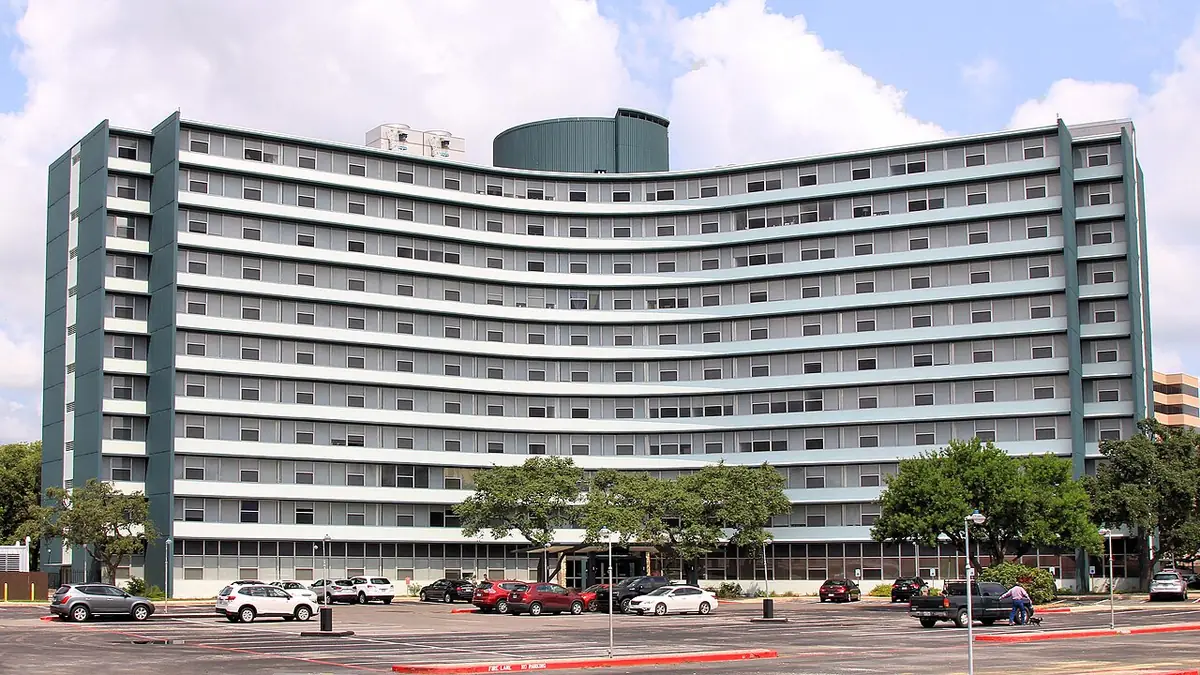
A mid-century apartment tower typical of San Antonio living — Photo: Larry D. Moore · CC BY 4.0 · Wikimedia Commons
Beyond that well-oiled routine, a closer look at the market reveals subtleties the listing sheets always leave out.
To grasp the geography of San Antonio, watch an ordinary day unfold rather than the idealised brochure version. The city runs almost entirely on the private car, gridded by big highway corridors such as I-410 and Loop 1604 that decide how long any journey takes. Schools and medical facilities are spread unevenly across the sectors, which forces tight family scheduling from the first hour of the morning. Understanding those daily flows is what tells you which residential areas keep life in balance and which condemn you to hours of traffic every week.
07:15Leaving the house (North Central sector)The morning departure has to allow for getting the children ready and for checking the main routes to stay ahead of the first slowdowns on the expressways.
07:45School drop-off in the local independent school districtThe neighbourhood you pick decides the quality and reputation of the public school your address is assigned to, a criterion that weighs heavily on housing costs.
08:30Arriving at work or at a coworking spacePeople working in the Medical Center area or downtown have to live with dense but predictable traffic flows.
12:30Lunch break and errands nearbyMidday is often when people restock at the big local supermarket chains, which come with the vast parking lots the city is built around.
17:30The drive home, with a stop at a medical appointmentThe major health hubs are easy to reach by car, the city being home to several large hospital complexes known for the quality of their facilities.
19:00Home again and household jobsThe evening revolves around the living areas of the house, often with a shaded patio outside to enjoy once the temperature drops a little.
What the agency listing sheets leave out
These blind spots explain why so many tenants sour on a house quickly if they have not seen the classic traps coming.
Read the listings in San Antonio closely and you find a regular gap between the marketing and the physical constraints of the ground. Portals lead with light, volume and lot size while staying quiet about technical points that decide how the house behaves once you live in it. The particular clay soils of the region, the strict rules imposed on subdivisions run by an HOA, and the real exposure to wind and hailstorms are all worth digging into before you sign anything. Ignore them and you can face heavy unplanned costs within your first year in the house.
Local clay soils that swell and shrink
The ground under San Antonio is expansive clay that moves with changes in moisture, which can crack a house's foundations if the perimeter watering is not kept up rigorously. Many leases put that watering on the tenant, so ask who is responsible before you sign.
How much power a homeowners association holds
The great majority of newer houses in subdivisions fall under an HOA that sets strict rules on exterior paint colours, where vehicles may be parked and how the lawn is kept, with fines behind them. As a tenant you inherit those obligations through the lease.
Hidden wear in the drains and plumbing
Houses built in the 1970s and 1980s sometimes still have old cast iron or otherwise obsolete pipework, worth having looked at with a camera before you take the property and note its condition.
The rules protecting mature trees
The city fiercely protects certain local species such as century-old oaks, banning outright any felling or even changes around their roots without an expensive municipal permit. Nobody, tenant or landlord, can simply cut one back.
The most common disappointments six months after moving in
Given these practical and financial demands, it is worth asking honestly whether a house lease is the right move at all.
Looked likeA charming house with big mature trees giving welcome shade and real character.
Turned outA maintenance nightmare, with invasive roots lifting the concrete paths and fallen leaves constantly blocking the gutters.
Would have caught itAsk for the condition of the trees near the structure to be assessed, and get in writing which of that yard work the lease puts on you.
Looked likeAn extremely quiet, peaceful residential street when it was viewed in the middle of the day.
Turned outA road saturated with commuter traffic at peak times, and a noisy flight path nobody mentioned.
Would have caught itGo back to the immediate surroundings at different times, particularly Friday evening and Monday morning at the start of the working day.
Looked likeA generous floor area at a very competitive price per square metre compared with other big Texas cities.
Turned outAn eye-watering electricity bill in summer, caused by poor insulation and an obsolete, power-hungry air conditioning system.
Would have caught itAsk for the past twelve months of energy bills from the provider before you sign the lease.
Looked likeSubdivision or complex rules that looked relaxed and unobtrusive, never getting in the residents' way.
Turned outA nitpicking homeowners association issuing warnings over minor cosmetic details and raising its dues without warning.
Would have caught itRead the HOA's rules in full, along with two years of meeting minutes, before you hand over a deposit.
Who should not sign a house lease here?
Now it is time to pull these threads together so you can decide clearly.
Renting a house is not a universal answer and is sometimes a poor fit for a particular personal or professional situation. Despite the region's economic strengths and its recognised quality of life, a house in San Antonio asks for a degree of stability and forward planning that not everyone has or wants. The running costs of a single-family property, from summer cooling to the upkeep the lease hands you, call for a genuinely robust monthly margin. Sketching the profiles that struggle here helps you avoid a hasty twelve-month commitment.
The young professional moving frequently between countries or cities
→A flexible apartment or townhouse rental rather than a standard annual house lease.
The deposit, the utility connections and the cost of moving in and out swallow whatever you save on space if you leave before the term is up.
The household on a tightly calibrated budget with no emergency savings
→A smaller property while they build a financial cushion.
One brutal summer electricity bill or a mid-lease rent increase at renewal could push the household straight into arrears.
The tenant with no appetite for practical upkeep
→A managed apartment complex where the grounds and the equipment are somebody else's responsibility.
A single-family house means mowing, watering and calling out tradespeople, plus dealing with the HOA and the municipal services yourself.
Deciding to rent a house in San Antonio means facing the economic and logistical reality of this Texas metro squarely. If you expect to stay put for more than a couple of lease terms, have a cushion that can absorb a fierce summer of cooling bills and genuinely want the residential way of life, a house is the right call and a stable one. The region's population growth and the breadth of its economy keep the rental market well supplied.
If, on the other hand, your work situation is still uncertain, the upkeep of a single-family property worries you, or your budget leaves no room for weather and energy surprises, the sensible move is a smaller or managed rental. The local market offers high-quality alternatives that let you get to know the different neighbourhoods without the financial and administrative pressure of a house you have to run yourself.
Your next step is to audit what you can genuinely carry each month, including all the running costs particular to this area, and then to document the condition of every property you shortlist before you sign for it. Settling well in San Antonio rests entirely on that methodical care, and on refusing to be swept along by a house you fell for at first sight.
Related questions
How much property tax sits behind the rent on a house in San Antonio?
Property taxes are a very heavy line item in Texas, because the state levies no income tax. On a standard house valued at $300,000 to $400,000 the annual bill generally runs from $6,500 to $10,000 depending on the school district and local improvement taxes. Tenants do not pay it directly, but landlords price it into the rent they ask.
Do you really need a car to live in a house in San Antonio?
Yes. San Antonio is a spread-out city and its public transport network is poorly suited to trips from outlying residential areas. A personal vehicle is essential for every daily journey, whether that is shopping, work or leisure.
Which areas are most sought after for renting a family house?
The north and north-west sectors of the city, including areas such as Alamo Heights or the newer subdivisions near Loop 1604, draw the strongest demand thanks to the quality of their schools and their safe, settled residential feel.
How do homeowners associations (HOAs) work in the subdivisions?
Almost every house built in a recent subdivision falls under an HOA that charges monthly or annual dues. In return the association looks after the common areas and enforces strict rules on the appearance and upkeep of private property visible from the street. As a tenant you are bound by those rules through your lease.
What do the clay soils mean for the house you are renting?
The region's clay soils expand in wet weather and shrink sharply during the summer drought. That movement can weaken foundations if watering around the perimeter of the house is not kept up steadily all year, which is why many leases in San Antonio make that watering the tenant's job.
What should you check before signing a lease?
Have the condition of the house documented in detail at move-in, look closely at the drains and plumbing, and ask for the past year of energy bills so you know what the air conditioning really costs. Where the property sits in a subdivision, read the HOA rules and the dues schedule before you commit.
What should you budget for air conditioning in summer?
Air conditioning (HVAC) runs flat out from June to September, producing monthly electricity bills that generally swing between $180 and $350 depending on floor area, orientation and how well the house is insulated.
Do rental houses in San Antonio come and go quickly?
How fast a house lets depends directly on its location, the reputation of its assigned school and how well it matches current standards. Homes in the sought-after sectors are taken quickly, while isolated houses or ones in poor repair sit on the market far longer.
Which major weather risks shape insurance here?
Beyond the indoor heatwaves, the region is exposed to violent hailstorms and to sudden flooding during intense rain. Those hazards have pushed insurers to raise their rates significantly and to require specific deductibles.
Who should look at a short lease rather than a standard annual one?
People on a work posting whose stay in San Antonio will be under five years are the ones who benefit most from staying flexible. Between the security deposit, the cost of connecting utilities and moving in and out, a long commitment on a house rarely pays off over too short a stay.
Property review of ting
No ting properties in San Antonio yet
Be the first — share it on ting and it shows up right here.