Buying a house in San Antonio is a major financial commitment that calls for a deep understanding of how the Texas city is laid out and of the legal rules that come with it. This guide takes an uncompromising look at the criteria you need in order to choose your area, keep control of your budget and secure your investment step by step.
Get the app
What nobody tells you.
Real prices, hidden costs and the traps to check before you commit.
Why lot size and urban sprawl change the equation in San Antonio
Scroll
Why lot size and urban sprawl change the equation in San Antonio
Buying a house in San Antonio is a major financial commitment that calls for a deep understanding of how the Texas city is laid out and of the legal rules that come with it. This guide takes an uncompromising look at the criteria you need in order to choose your area, keep control of your budget and secure your investment step by step.
Written by the ting.ad editorial team ·
West Commerce Street, San Antonio in Street View: drag to look around.
Moving from the theory of space to your daily reality means measuring your own buyer profile against what San Antonio specifically asks of you.
San Antonio's first attraction is its promise of space and buildable square footage, but that apparent generosity comes with logistical and financial trade-offs that are often underestimated at the moment of signing. When you leave a dense market to settle here, you swap walkable proximity for a markedly larger living area and a private lot. That configuration also transforms your daily life by making you entirely dependent on a car for every trip, however short. So you have to weigh, methodically, the comfort of a single-story house with a large yard against the constraints of unavoidable car travel in a demanding climate. Facing this reality at the start of your search is what keeps you from imagining an outdoor life with no strings attached.
A generous living area and large lotsvsComplete car dependence for every daily trip
San Antonio's urban structure rests on significant sprawl, which makes walking inefficient for errands or for work. Owning a large house means accepting regular drive times on the main highways to reach the employment centers.
A sunny climate that favors outdoor living and leisure featuresvsVery high air conditioning and landscaping costs in summer
The Texas heat turns your yard and your pool into energy sinks if the building is not optimized. You have to fold these recurring expenses into your long-term return calculation so they do not knock your budget off balance.
An attractive local tax picture with no state income taxvsSome of the highest property taxes in the country to compensate
The absence of a state income tax in Texas translates into a local property tax calculated on the assessed value of your home. That recurring annual charge weighs heavily on holding a high-value property in San Antonio.
Quiet neighborhood life centered on family and privacyvsLimited urban buzz outside the tourist hubs
Residential subdivisions offer a secure haven but often lack the spontaneity of a walkable downtown. The energy is concentrated in a few specific pockets that are worth identifying before you choose your street.
What kind of buyer are you against the realities of the San Antonio market?
Putting your own needs in perspective now has to be measured against the cultural and administrative reference points you are leaving behind.
Buying a house in San Antonio does not follow a single template, because the city shows radically different faces depending on whether you arrive with a family, in search of professional calm, or for a long-term investment. Each situation calls for precise trade-offs on location, size of the property and integration into the local community. By examining how your plan actually meshes with the Texas market, you will avoid the disappointments that come from misreading distances and services. It is essential to project your future way of life into this environment before you finalize your offer with the sellers. Here is how your personal profile redefines the equation of your purchase here.
Choosing school districts and residential safety
For a family, buying a house in San Antonio is structured almost entirely around the quality of the independent school districts, which directly influence the value and resale of the property. The northern neighborhoods hold the most highly rated schools, but they carry noticeably higher prices per square meter and heavy property taxes. You have to arbitrate between a longer daily trip for your children and the search for an active community with parks and sports facilities close at hand. That decision commits not only your purchase budget but the daily rhythm of your whole household for many years.
The search for stable rental yield and measured appreciation
Investing in a San Antonio house without living there year-round demands particular rigor in the face of the local economy, which is driven by healthcare, tourism and defense. The mid-tier neighborhoods offer more accessible entry prices and rental demand sustained by a steadily growing working population. Managing from a distance, however, requires surrounding yourself with reliable local professionals to handle the maintenance surprises that come with the Texas climate. Your strategy should favor the structural soundness of the property and its position relative to the main routes rather than speculation on a rapid price surge.
Balancing digital connectivity against quiet living space
The remote worker finds in San Antonio a considerable amount of living space for an overall budget often lower than in the large American coastal metros. Even so, isolating yourself in an area too far out can cut you off from coworking hubs and from the social life your integration depends on. It is essential to verify the real quality of very high speed internet connections before you sign, because some recently built residential areas suffer from congested networks. Your house then becomes a permanent office, which means it needs work spaces that are enclosed and separately air conditioned.
Buying in San Antonio when you arrive from abroad: decoding what really changes
St. Mary's University, a Gothic Revival landmark in San Antonio — Photo: Larry D. Moore · CC BY 4.0 · Wikimedia Commons
Once you have absorbed these rules of the game, choosing your area becomes the decisive step in your move.
Leaving the buying system you grew up with to settle in San Antonio drops you into a legal and cultural framework that is entirely different, where the rules of negotiation and of ownership have little in common with your usual reference points. In many countries, buyer protection rests on strict cooling-off periods and on a single centralized official acting as trusted third party. In Texas, the transaction relies on complex standardized contracts, handled by licensed real estate agents and validated by specialist title companies. Understanding these fundamental mechanisms will save you from misreading things when you sign the initial purchase offer. Here is a direct comparison so you can measure what concretely changes between where you come from and your new Texas reality.
From abroad
A single centralized notarial framework that secures the whole chain of transfer
San Antonio
Responsibility shared between real estate agents, mortgage brokers and private title companies
The centralized conveyancing official you may be used to does not exist in that form in Texas; the title company verifies that ownership is legitimate and guarantees there are no hidden legal defects in the history of the title.
From abroad
A moderate local tax system, pooled at national or municipal level
San Antonio
A very high local property tax that varies precisely by neighborhood and by county votes
This recurring tax is a permanent line of spending to build strictly into your annual financing plan, because it often equals a significant fraction of your monthly loan payment.
From abroad
Withdrawal periods and contingency conditions set by law
San Antonio
A due diligence window (the option period) negotiated in the contract that costs you money but gives you complete freedom to cancel
You pay the seller a flat sum (the option fee) to obtain the right to inspect the property thoroughly and to walk away without penalty within a fixed window of a few days.
From abroad
A market where listings are often centralized and mandates sometimes exclusive
San Antonio
A unified database system (the MLS) where every agent can see the entire available inventory on the market
The search is more transparent in data terms, but competition between buyers on well-located homes demands immediate responsiveness and impeccable financial pre-qualification.
How to choose your area among the different faces of San Antonio
Picking your ideal neighborhood immediately raises the central question of the real budget you need to commit.
San Antonio is a mosaic of neighborhoods with strongly marked identities, running from the historic charm of the riverside center to the large modern residential developments on the northern edge. Each zone offers a distinct balance between commute times, neighborhood atmosphere, quality of schools and price per square meter. Choosing your area is not simply a matter of prestige but of a fine fit between your daily habits and the way the city is organized. The comparison cards below set out the lived reality of each broad type of area to guide you toward the most sensible choice. Take the time to weigh these compromises before you settle definitively on your search zone.
Alamo Heights and the central historic neighborhoods
A settled atmosphere, streets lined with mature trees, architecture with character and immediate proximity to cafes and museums. The pace here is more walkable than elsewhere in the city.
Suits
Buyers looking for pronounced architectural character, a rooted sense of community and quick access to the cultural institutions of the center.
Trade-off
An older housing stock that often needs substantial work to bring it up to code, smaller lots and prices per square meter well above average.
The North Side and the large recent subdivisions
Wide avenues, modern open-air shopping centers, a high sense of safety and a layout built around the car and the main routes.
Suits
Families with high expectations of school quality, people who want modern comfort and owners looking for spacious, move-in-ready houses.
Trade-off
An architectural sameness that is sometimes pronounced, absolute car dependence for the smallest purchase and particularly heavy property taxes in these fast-growing areas.
Southtown and the areas in creative transition
A pronounced artistic spirit, warehouses converted into lofts, art galleries and a mixed population of young professionals and long-time residents.
Suits
Creative profiles, investors betting on urban gentrification and those who enjoy a lively neighborhood life within reasonable distance of the river.
Trade-off
Marked variation from one street to the next in safety and quiet, and a rental and sales market subject to strong volatility.
What does buying a house in San Antonio actually cost today?
Beyond the purely financial side, the legal structure of your ownership in San Antonio deserves very particular attention.
Accurately assessing your purchase budget in San Antonio should never stop at the headline price shown on the listing portals, because many unavoidable costs are added from the moment you sign. The Texas market shows significant gaps depending on proximity to the major routes and the age of the construction, and it still offers more accessible alternatives than other large Texas metros such as Austin or Dallas. That said, the combination of current interest rates, high home insurance because of climate risk, and the property tax changes the overall financial equation. The table below summarizes the orders of magnitude being seen so you can calibrate your financing plan transparently. These factual figures protect you from unpleasant surprises when you sit down with the lender.
san-antonioFor saleHouseestimate
Median price / m²US$1,519Half the apartments sell below this
Median priceUS$252kthe average is 14% higher — a few very large properties pull it up
Most common2 bedrooms70 % of listings
Average size158 m²
By number of bedrooms
Bedrooms
Share of market
Avg price
Price / m²
Avg size
2most common
70 %
US$266k
US$1,599
166 m²
3
27 %
US$332k
US$1,519 −5 %
219 m²
4
3 %
US$412k
US$1,471best value / m²
280 m²
Each row is an average, compared against the area average of US$1,599 / m². These are indicative estimates of a typical local market, not a measured sample of live listings. Check current listings before relying on them.
What you can actually own: understanding the legal nature of the property
This legal vigilance carries straight over into the chronological unfolding of the transaction, from the first agreement to the final transfer.
Buying a house in the United States comes with covenants and easements that place strict limits on your freedom to change the outside of your property. Contrary to a common assumption, owning the walls and the land does not mean you can modify your property without the approval of a collective body. Understanding these legal mechanisms will spare you neighbor disputes or substantial fines after you move in. It is essential to read every line of the association rules before you release your purchase contingencies. The two perspectives below highlight the balance between individual freedom and collective regulation in San Antonio.
Outright ownership of land and building (fee simple)
You buy the land and the structure with no perpetual ground charge owed to a third party, which is the strongest and most sought-after form of ownership on the Texas market. That autonomy guarantees you full control of your asset, subject to complying with the City of San Antonio's municipal zoning codes. You decide the schedule for improvement work and for the upkeep of your lot according to your own financial and aesthetic criteria.
What it changesYou keep complete freedom in managing your capital, but you alone carry the burden of bringing your property into line as municipal rules evolve.
The strict framework of homeowners associations (HOAs)
In the great majority of San Antonio's recent subdivisions and planned neighborhoods, a homeowners association imposes fussy rules on the exterior appearance of your house. It dictates the colors allowed on your facade, the tree species tolerated in your yard, the height of your fence and the ban on parking certain vehicles in the driveway. Failing to follow these directives brings automatic fines and, in extreme cases, lien proceedings by the association.
What it changesYou get a visually harmonious setting and maintained common areas, but you give up part of your sovereignty as a resident owner.
The rule to understand before you put money down on a house in San Antonio
A century-old commercial building on a San Antonio corner — Photo: Larry D. Moore · CC BY 4.0 · Wikimedia Commons
Once that critical step is cleared, the administrative machinery of the transaction starts up in a well-established methodical sequence.
The home buying process in Texas is governed by very strict standardized contracts in which every calendar step carries absolute legal force. Unlike other markets where negotiation stretches out informally, here every day counts from the moment the seller accepts your offer. Mastering the inspection and financing contingencies is your only real protection against losing your deposits. Ignoring these mechanisms exposes the foreign or first-time buyer to immediate financial penalties in the event of a late withdrawal. The logical chain below sets out the key moments where the legal and financial security of your San Antonio investment is decided.
The purchase offer is signed and countersigned by the seller, marking the official start of the contractual countdown.
Payment of the earnest money deposit into an escrow account held by the title company, within the strict deadlines set in the contract.
Opening of the option period of a few days, bought from the seller with a non-refundable flat sum, allowing you to inspect the property for any reason at all.
Completion of the detailed technical assessments (home inspection, foundation survey and termite check) by certified independent professionals.
Possible negotiation of repairs or a targeted price reduction on the basis of the inspection reports, before the option period expires.
Release of the contingencies and firm commitment to carry the transaction through to the final signing at closing.
How a San Antonio property transaction unfolds, step by step
The success of your San Antonio purchase rests on rigorous coordination between your agent, the mortgage broker, the inspector and the title company. Each party plays a precise, chronological role in clearing legal risk, validating the financing and officially transferring ownership into your name. Following this sequence scrupulously avoids the last-minute delays that could jeopardize your move-in. The sequence table below sets out the seven unavoidable steps that pace your journey as a buyer, from the initial search to the handover of the keys.
The buyer and their agentSelecting properties and drafting the purchase offerAnalysis of market comparables (comps) to frame a realistic offer, backed by a solid pre-approval letter from a lender.
The title companyDepositing funds and opening the fileSecuring the earnest money in a third-party account and launching the detailed search into the legal history of the title.
The independent inspectorThe full technical inspection of the building and the groundCareful checking of the framing, the roof, the concrete slab foundation and the central air conditioning system.
The bank or lenderThe independent valuation (appraisal)Confirmation by a licensed appraiser that the market value of the property matches the transaction amount written into the purchase contract.
The buyer and their insurerTaking out home insurance and the associated coveragePutting in place the essential policies, including the specific risks tied to local storms and flooding.
The title companyPreparing the final closing disclosureExact calculation of prorated property taxes and title and closing fees to determine the net amount to wire on the day.
All partiesThe final signing (closing) and recording of the titleSigning the legal documents, wiring the remaining funds and officially recording ownership with Bexar County.
Standalone house or HOA community in San Antonio: how to decide?
Buying a single-family house in San Antonio means rethinking your whole relationship with ownership and with the daily upkeep of where you live. Unlike dense markets where the apartment dominates, the Texas model rests on urban sprawl and the standalone house with its own lot. That configuration offers complete architectural freedom and no immediately adjoining neighbors, which removes the direct noise problems that come with shared floors or walls. This independence has a direct cost in maintenance, however, since every roof repair, every outdoor plumbing job and every air conditioning fix falls on the owner alone.
At the other end, communities run by a homeowners association offer a compromise that looks appealing but is restrictive in practice. These gated subdivisions often include high-end shared amenities such as pools, maintained green spaces and sometimes a security service. In exchange, the association rules can prove extremely fussy, dictating the color of your front door, the height of your lawn or where you park your vehicles. The monthly dues, known as HOA fees, are never fixed and tend to rise steadily over the years to cover the maintenance costs of the shared infrastructure.
Financially, reselling a standalone house in a historic neighborhood such as Alamo Heights or Monte Vista follows market dynamics very different from those of a recent build in a fast-growing suburb such as Stone Oak. Older properties have an undeniable architectural charm and a historically more stable value, but they often need considerable work to meet current energy standards. Central air conditioning, essential in the strong Texas heat, generally consumes more energy in these homes because of period insulation that usually has to be redone entirely.
Location also dictates the type of property you can buy for a given budget. Moving away from downtown toward the outskirts gets you noticeably larger living areas and bigger lots, but you pay for it heavily in daily commuting time on saturated highways such as I-35 or Loop 410. Conversely, targeting more central areas means making drastic concessions on lot size, or accepting a property that needs heavy renovation before it is fully livable on move-in day.
In the end, your final decision has to rest on your real way of life and on your capacity to delegate or handle yourself the logistical side of your home. If you hate doing repairs at the weekend and prefer a uniformly maintained landscaped setting with no effort, a house in an HOA is a sensible option despite its regulatory constraints. If you value your independence above all and refuse to let a neighborhood committee dictate the layout of your yard, look for a standalone house outside a gated subdivision, even if that means accepting a far heavier maintenance workload.
What overall budget should you plan for to live in a house in San Antonio?
Now that the financial picture is clearly set out, let us look concretely at what daily life is like in this city.
Buying a house in San Antonio never comes down to the loan repayment alone. The total cost of ownership includes some of the highest property taxes in the country, a consequence of Texas having no state income tax. On top of that, home insurance premiums have risen dramatically in recent years because of the recurring climate risks in the region. It is therefore imperative to build all these hidden charges into your initial financing plan so you avoid any nasty financial surprise after closing with the title company.
Monthly and annual cost items for a typical house in San Antonio
Cost item
Estimated amount
Frequency
Impact on the budget
Property tax
2.2% to 2.8% of assessed value
Annual
Varies by county and by the school districts attached to it.
Homeowners insurance
$2,500 to $4,000
Annual
Rising sharply following episodes of hail and severe freeze.
HOA dues (where applicable)
$30 to $250
Monthly
Mandatory in recent subdivisions, to fund the common areas.
Electricity bill (air conditioning)
$150 to $400
Monthly
Major consumption peak during the summer months from June to September.
These estimates are based on properties at the median value seen on the current local market.
Additional costs tied to the initial transaction
Type of cost
Price range
When due
Whether it is mandatory
Lender fees and origination
$1,500 to $3,500
Cash at purchase
Essential to obtaining the mortgage.
Home inspection
$400 to $700
Before purchase
Strongly recommended to identify hidden defects and foundation problems.
Appraisal
$500 to $800
Before purchase
Required as a matter of course by the lender.
Title and closing costs
2% to 3% of the purchase price
Cash at purchase
Covers the legal searches and the recording of ownership.
Always keep an emergency reserve worth at least six months of fixed charges.
What does an ordinary Tuesday look like in a San Antonio residential neighborhood?
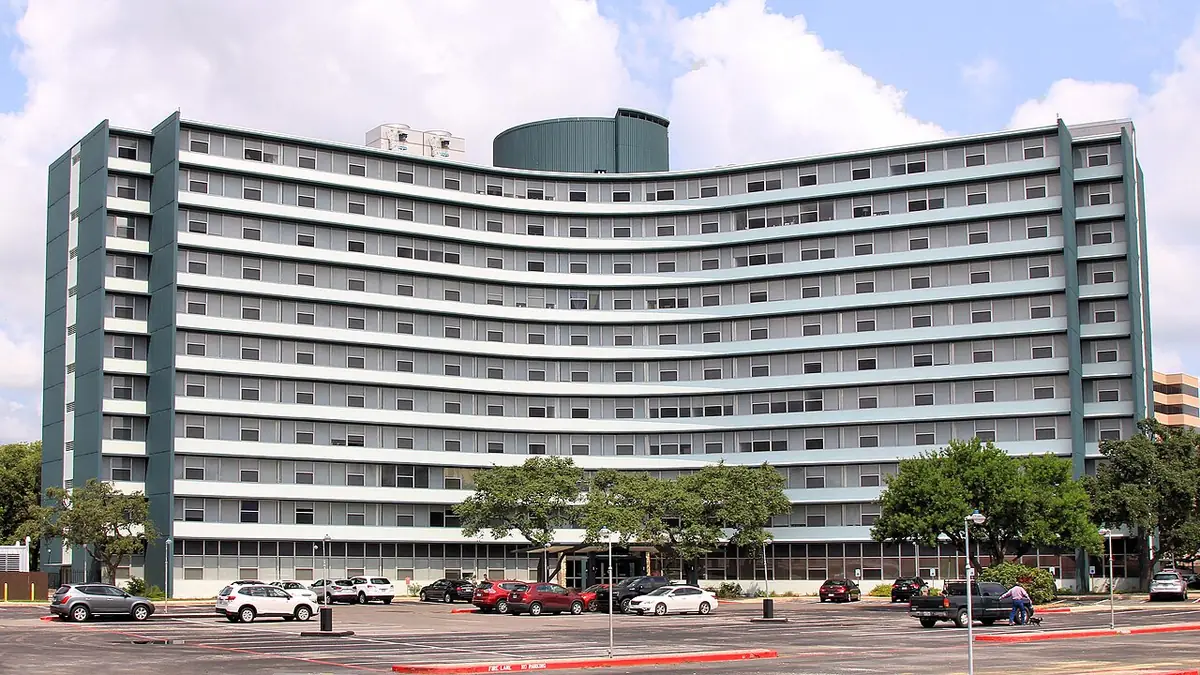
A mid-century apartment tower typical of San Antonio living — Photo: Larry D. Moore · CC BY 4.0 · Wikimedia Commons
Beyond this well-oiled routine, plenty of things invisible in the brochures deserve your full attention before you commit.
Living in San Antonio imposes a rhythm largely dictated by car use and by managing the temperature of your surroundings. The distances between residential areas, employment centers and schools call for careful planning of every trip. Between sun-drenched mornings and afternoons with the air conditioning running flat out, a resident's typical day is built around a strict balance between work, logistics and adapting to the local climate.
07:00Morning routine and a check on the air conditioningYou often wake in a house that has been kept cool all night. You check the forecast right away, because summer temperatures regularly pass thirty-five degrees Celsius by mid-morning.
08:15The school run and working around the congested routesDropping the children at the local district school. Traffic on the outer boulevards begins to build heavily, which makes knowing the alternative routes essential to avoid the jams.
12:30Midday break and picking up local errandsA good moment to restock at an air-conditioned local supermarket. The distances to the retail areas generally mean a ten to fifteen minute drive from the subdivisions.
17:30The trip home and the evening traffic peakThe drive back on the urban highways takes patience. On arrival you close the exterior shades to block the fierce rays of the setting sun and keep the inside cool.
20:00Relaxing outside in the yard or the courtyardThe temperature finally starts to drop a little as night falls. This is the moment residents favor for enjoying the patio or the deck, often protected by the screens that prove indispensable here.
What the beautiful agency photos leave out about San Antonio
These technical traps lead straight to the regrets most often voiced by new buyers.
The enthusiasm generated by viewing a beautiful sunlit house often crowds out any analysis of the structural constraints specific to the ground and the Texas climate. Behind the green lawn and the welcoming facade sit technical realities that sellers are careful not to put forward. Knowing about them in advance will save you from facing astronomical repair bills only a few months after moving into your new home.
Expansive clay soil and fragile foundations
Texas soil contains a clay that shrinks in drought and swells in heavy rain. That constant movement puts enormous stress on concrete slabs, frequently causing structural cracks that have to be stabilized with the expensive installation of steel piers.
The hidden wear in central air conditioning systems
An air conditioning unit running flat out for eight months of the year wears out prematurely. Replacing a complete heat pump and ductwork system is an immediate expense of several thousand dollars that has to be anticipated when buying an older property.
The aggressive presence of local insects and pests
Termites, fire ants and mosquitoes are an integral part of the local ecosystem. Without preventive treatment and a regular maintenance contract with a pest control company, these pests can do considerable damage to wooden framing and make your yard unusable.
Severe watering restrictions during drought
The city regularly imposes strict limits on using drinking water to irrigate outdoor lawns. If your sprinkler system is faulty, or if you do not manage the switch to drought-tolerant planting, your lawn will die quickly, bringing fines from the city or from your HOA.
The regrets people discover six months after settling in San Antonio
These disappointments lead naturally to the question of which buyer profiles this market is entirely wrong for.
Looked likeA magnificent opportunity offering a large wooded lot in a calm, peaceful neighborhood.
Turned outA money pit in water and electricity bills, combined with insufficient thermal insulation that turns the house into a furnace as soon as the first spring heat arrives.
Would have caught itInsisting on a full energy record for the past three years and having the depth of the attic insulation audited by an independent thermal specialist before releasing any contingencies.
Looked likeA perfect rental or long-term investment in a modern subdivision run by an active association.
Turned outA fussy neighborhood dictatorship where every exterior change is refused, along with arbitrary and unpredictable increases in the monthly dues, voted without real consultation.
Would have caught itGoing carefully through the minutes of the HOA's general meetings for the past three years and reading every line of the rules to spot abusive restrictions.
Looked likeAn ideal location out in the country while staying right next to the metro area's main highways.
Turned outA daily commuting nightmare at peak hours, with the fast access routes completely saturated by the region's population boom and no effective public transport alternative.
Would have caught itPersonally testing the round trip between the house you want and your workplace on a Tuesday at eight in the morning and at half past five before signing the offer.
Looked likeAn older house full of historic character in a central neighborhood with a strong cultural identity.
Turned outPlumbing entirely in corroded cast iron and an obsolete electrical panel unable to carry the combined load of modern appliances and air conditioners.
Would have caught itHiring a specialist plumber to inspect the inside of the pipes with a camera, and refusing any property whose electrical system has not been fully redone in the past twenty years.
Who should absolutely not buy a house in San Antonio right now?
It is now time to lay the groundwork for your final decision with complete clarity.
Buying property in San Antonio follows very specific economic and geographic logic that effectively rules out certain buyers. Insisting on settling here without buying into the local way of life, or underestimating the reality of the climate and tax constraints, leads inevitably to a poor financial outcome. Working out clearly whether you fall into one of these at-risk profiles will keep you from committing your savings to a plan that does not fit what you actually want.
The investor looking for immediate rental yield with no management effort
→To drop the plan of buying an older property and turn to other markets that move faster in terms of quick appreciation.
High property taxes and steadily rising insurance premiums eat drastically into net rental margins, making net returns very thin compared with other American metros.
The city dweller viscerally attached to public transport and walking
→To give up on buying a suburban single-family house and favor a very central apartment in a large dense metro instead.
San Antonio is a city designed exclusively around the car, where the complete absence of structuring public transport makes owning and using a car daily strictly indispensable for the smallest trip.
The buyer on a tight budget with no emergency savings available
→To extend the time spent renting while significantly building up a down payment and a cash cushion.
The combination of local taxes, unpredictable climate-driven maintenance costs and expensive insurance immediately exposes any owner without reserves to a risk of default when something major goes wrong.
So, are you really ready to take the step of buying in San Antonio?
Deciding to buy a house in San Antonio means facing reality squarely, far from the advertising postcards and the promise of a Texas paradise without constraints. If you have accepted that your monthly budget will absorb high property taxes and heavy energy bills in summer, you already have the financial maturity to approach this market calmly. The essential thing is your ability not to be blinded by the apparent living area at the expense of the real condition of the structure and the location of your future home.
The success of your purchase rests entirely on the rigor of your technical choices and the clarity of your budget planning. By refusing to skip thorough inspections of the foundation, the roof and the air conditioning, you turn a potentially risky purchase into a solid, durable asset. Never forget that the ideal house does not exist off the shelf: it is built through informed compromises between distance from the center, lot size and the amount of renovation work you are prepared to take on.
If your plan in life is to put down lasting roots in a warm community, to enjoy generous living space and to accept the rules of a southern way of life, then San Antonio offers an exceptional setting in which to unpack. Take the time to visit several neighborhoods at different times of day, talk to your future neighbors and check every line of the financing plan with your loan officer. The final decision is entirely yours, and it is by making it with full knowledge of the facts that you will succeed in settling here.
Related questions
Which neighborhoods are most sought after for buying a house in San Antonio?
The most highly rated areas include Alamo Heights for its historic character and excellent schools, Monte Vista for its remarkable traditional architecture, and Stone Oak to the north for its modern family infrastructure and its gated subdivisions run by homeowners associations.
How are property taxes calculated on a home here?
Property taxes are assessed each year by the Bexar County Appraisal District based on the estimated market value of your home. The overall rate combines the levies of the city, the county and the local school district, and generally falls between 2.2% and 2.8% of the property's value.
Is joining a homeowners association mandatory when you buy a house?
Membership in a homeowners association is not universal, but it has become close to automatic in all new construction and recent subdivisions. It is therefore essential to check this point from your very first showings so you know the exact amount of the monthly dues.
What are the main climate risks to factor in for a house here?
The Texas climate exposes homes to episodes of extreme drought that set the clay soil moving, to intense heat waves that put heavy demand on air conditioning, and to the occasional risk of violent hailstorms that damage roofs.
How long does it typically take to complete a purchase from start to finish?
Expect thirty to forty-five days between the moment the seller accepts your offer and the final signing at the title company, a period needed to carry out the appraisal, the inspection and the release of the loan funds.
Do you really need to hire an independent home inspector before buying?
This step is absolutely essential and non-negotiable for any serious buyer. The inspector will pick up hidden defects and the real condition of the framing, the foundation and the electrical system, giving you solid grounds to negotiate the price or walk away.
How is the housing market changing as new residents arrive?
San Antonio benefits from steady demographic appeal thanks to a cost of living that has historically been more affordable than in other large Texas metros such as Austin or Dallas, which sustains firm housing demand and moderate but regular price growth.
What closing costs should you budget for at signing?
Closing costs, which include the title company's fees, prorated taxes and the lender's origination charges, generally represent between 2% and 3% of the total purchase price of the property.
Is it easy to resell a single-family house quickly in this area?
How quickly a home sells depends directly on its location, its asking price and its overall condition. A well-maintained house in a good school district finds a buyer within a few weeks, while a poorly located one calls for more patience.
What assistance is available for a first home purchase?
Several federal and state programs, notably those run by the Texas Department of Housing and Community Affairs, offer down payment grants or preferential-rate loans reserved for first-time buyers who meet income criteria.
Property review of ting
No ting properties in San Antonio yet
Be the first — share it on ting and it shows up right here.