Buying a property in the Toronto area calls for a close reading of its neighbourhoods, its legal rules and its financial realities. This guide works through every aspect of the local market so you can carry your purchase through with clear eyes.
Get the app
What nobody tells you.
Real prices, hidden costs and the traps to check before you commit.
Why deciding to buy a house in Toronto means looking past the facades
Scroll
Why deciding to buy a house in Toronto means looking past the facades
Buying a property in the Toronto area calls for a close reading of its neighbourhoods, its legal rules and its financial realities. This guide works through every aspect of the local market so you can carry your purchase through with clear eyes.
Written by the ting.ad editorial team ·
Bloor Street East, Toronto in Street View: drag to look around.
That gap between the space you hoped for and the reality of the urban fabric shapes your day-to-day life directly.
Buying a property in the Toronto market is not simply a matter of adding up floor area and a postal code. The shape of the city forces a constant trade-off between the central location you want and the reality of the transport infrastructure. Behind the image of a dynamic city sits an arrangement of neighbourhoods with sharply contrasting dynamics. You need to work out precisely what each area offers in services and in real travel time.
The promise of a single-family house with a private garden in the heart of the cityvsThe reality of an extremely competitive market where space is getting scarcer
Detached properties with a meaningful piece of land in established areas are becoming rarer and rarer. That structural scarcity keeps prices under pressure in a way that does not always reflect the true condition of older housing stock in need of major renovation.
The appeal of quiet, leafy residential neighbourhoods with good transitvsThe impact of densification schemes and infrastructure work under way
Buyer or investor, you have to anticipate how the urban landscape will change. Transit corridors and new streetcar or subway lines continually redefine how useful each area is to live in.
The sense of a secure long-term investmentvsExposure to interest rate swings and to annual maintenance costs
Owning a house in Toronto brings ownership and upkeep costs that often turn out higher than first estimates. Harsh winters demand steady spending on insulation, roofing and heating systems.
The idea of slotting quickly into a tight-knit local communityvsThe pace of large North American cities, which is built around self-reliance
Each neighbourhood has its own commercial identity along the main streets, but daily life stays very independent. Relations with neighbours are cordial and scrupulously respectful of everyone's privacy.
Which part of Toronto really fits your way of life and your working commitments?
Moving into the Toronto property market from elsewhere means weighing the cultural and practical compromises carefully.
The Toronto area works like an archipelago of neighbourhoods with strong identities. Choosing a house depends less on falling for the architecture than on the fit between your daily journeys and where the property sits. Buyer profiles separate out by how much travel time they will tolerate and how much they need services close at hand.
The central and near-central neighbourhoods
In areas such as The Annex, Cabbagetown or Rosedale, you are paying for immediate proximity to the subway lines and the business core. The houses are older, often semi-detached with Victorian facades, and sit on small lots. The compromise is the price per square metre and, for some properties, the absence of private parking. What you buy here is time saved every morning and a very dense, walkable neighbourhood life.
The middle-ring residential neighbourhoods
Areas such as High Park, Bloor West Village or the residential pockets along the subway line running west or east offer a balanced setting. The houses have real gardens and the tree-lined streets create a village feel. Prices stay high, but values hold up thanks to steady demand from local families. Journey times into the centre remain reasonable given the frequency of the transit service.
Well-served residential suburbs
Heading for outer areas or neighbouring municipalities connected by the GO Transit network changes the nature of what you buy entirely. For the same budget you get a modern detached house with a double garage and a substantial green space. In exchange, you become completely dependent on a car for shopping and leisure, and rush-hour journeys demand careful planning.
Living here when you have moved from abroad: what changes in housing and co-ownership
St. Gregory Armenian Catholic Church, a Toronto landmark — Photo: Amakuha · CC BY 4.0 · Wikimedia Commons
Once those reference points are in place, working through the different kinds of neighbourhood becomes the decisive filter in your search.
Buying property in Canada unsettles a number of cultural and legal assumptions that buyers bring with them. The idea of individual ownership, the building materials and the planning rules all follow specific North American logics. Understanding those differences is what keeps the inspection or the renovation from turning into a financial surprise.
From abroad
In many countries, stone and reinforced concrete dominate traditional construction and give buildings strong thermal mass.
Toronto
In Toronto, the great majority of detached and semi-detached houses are wood-frame structures clad in brick or siding.
That design calls for extra vigilance on insulation, on managing damp in the basement and on regular upkeep of the frame and the poured concrete foundations.
From abroad
Elsewhere, a central land registry, notarised deeds and a single state-appointed officer handle the transaction from one desk.
Toronto
In Toronto, the transaction runs on the Land Titles registration system and on real estate lawyers.
The lawyer's job is to check title, verify easements and confirm there are no claims or hidden debts attached to the property before funds change hands.
From abroad
In some jurisdictions, technical surveys covering asbestos, lead, termites and energy performance are tightly regulated and compulsory the moment a property goes on the market.
Toronto
In Toronto, the pre-purchase home inspection is the buyer's responsibility, and the buyer hires an independent professional to assess overall condition.
It is strongly advisable to include an inspection condition in your offer so you can identify hidden defects or work required to bring the property up to code.
From abroad
In many places, property and local taxes are capped and stay moderate from one municipality to the next.
Toronto
In Toronto, municipal property tax is calculated each year from the value assessed by the public agency MPAC.
That annual amount is a significant recurring line in your budget and has to be built precisely into your long-term repayment calculation.
From abroad
Elsewhere, buying into a co-ownership or a residents' association follows national statute with tightly regulated general meetings.
Toronto
In Toronto, for certain townhouse or horizontal condominium developments, the rules set by the condominium corporations are very strict.
You have to go through the reserve fund study in detail to satisfy yourself that the corporation has the money it needs for major work ahead.
Which Toronto neighbourhood should you target given your profile and your budget?
That variety of areas translates into sharply contrasting price realities that deserve methodical analysis.
The property map of Toronto is built around busy commercial streets and quiet residential ones. Each area has its own rhythm, its own demographic profile and its own comparative advantages when it comes to holding value. Weighing up these micro-markets stops you buying into an area that is out of step with what you want from daily life.
The Annex and Seaton Village
An academic, lively atmosphere set by the nearby University of Toronto, independent bookshops and neighbourhood cafes. The streets are lined with mature trees and handsome Victorian houses.
Suits
Buyers after a highly walkable neighbourhood life, direct transit access and a strong cultural mix.
Trade-off
The price per square metre is among the highest in the city, and the houses often need substantial electrical and plumbing upgrades.
High Park and Swansea
A striking balance between nature and city life, backing onto the vast urban park at High Park. The mood is family-oriented and calm, with local shops along Bloor Street.
Suits
Families with children, or professionals who want quick access to green space while staying twenty minutes from downtown by subway.
Trade-off
Competition is fierce whenever a single-family house comes up, and bidding frequently pushes sales well above the initial asking price.
Leslieville and Riverside
A creative, fashionable and sociable spirit, shaped by the conversion of former industrial land into lofts, design shops and craft breweries.
Suits
Energetic couples and first-time buyers looking for an area in full transformation with a strong cultural and artistic identity.
Trade-off
The main roads can clog at rush hour, and heavy rail options (the subway) are less direct than in the west of the city.
The Beaches (The Beach)
A distinctive lakeside way of life along Lake Ontario, with its boardwalks, waterfront parks and the relaxed feel of a small coastal town.
Suits
Anyone who puts the quality of the natural setting, being close to the water and residential quiet at the top of their list.
Trade-off
The relative distance from the financial core and the high cost of properties south of Queen Street East call for a substantial budget.
What does buying a house in Toronto actually cost in the current market?
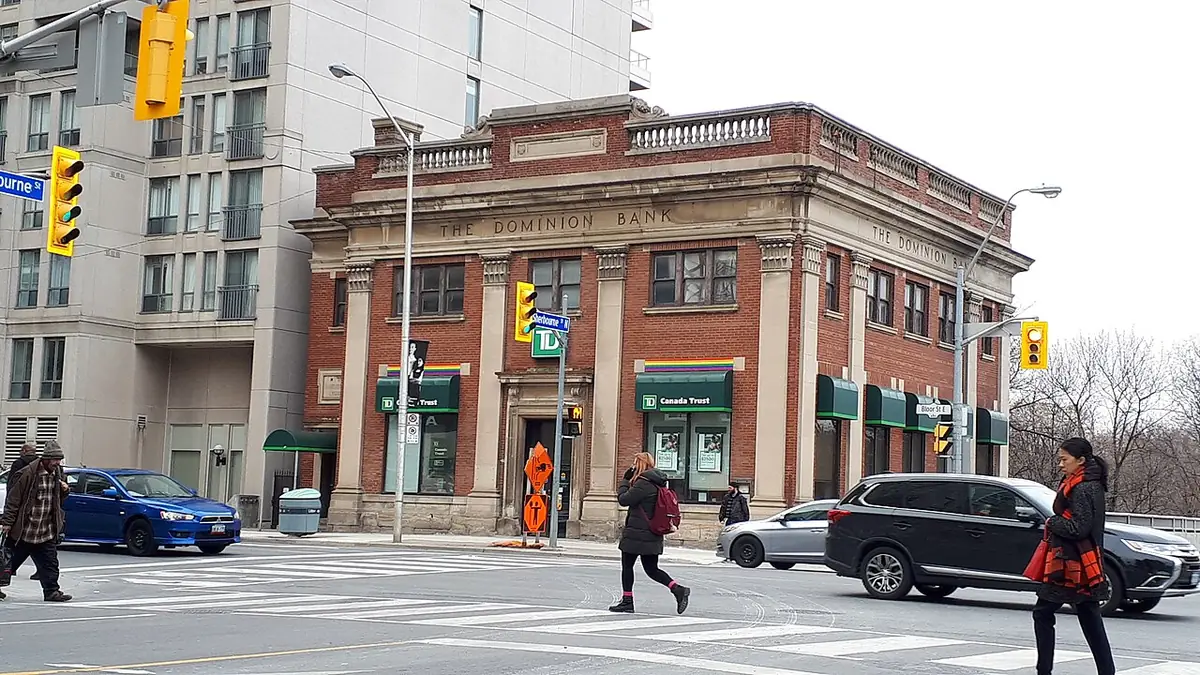
A heritage corner building on a lively Toronto street — Photo: Oaktree b · CC BY-SA 4.0 · Wikimedia Commons
Beyond the headline value of the property, the legal nature of what you actually own deserves close attention.
The Toronto property market is strictly segmented between vertical condominiums, semi-detached houses and detached single-family properties. Prices vary considerably with proximity to downtown, the age of the building and the size of the lot. Your financing plan has to take in all the ancillary costs, from land transfer tax to inspection fees.
torontoFor saleHouseestimate
Median price / m²CA$8,180Half the apartments sell below this
Median priceCA$994kthe average is 14% higher — a few very large properties pull it up
Most common2 bedrooms73 % of listings
Average size116 m²
By number of bedrooms
Bedrooms
Share of market
Avg price
Price / m²
Avg size
2most common
73 %
CA$1.06m
CA$8,438
126 m²
3
21 %
CA$1.4m
CA$8,180best value / m²
172 m²
4
6 %
CA$1.79m
CA$8,180best value / m²
219 m²
Each row is an average, compared against the area average of CA$8,610 / m². These are indicative estimates of a typical local market, not a measured sample of live listings. Check current listings before relying on them.
What you can actually own: freehold versus horizontal condominium
That legal rigour runs through every stage of the buying process, starting with drafting and submitting your offer.
The legal structure of your purchase determines your financial independence and your maintenance obligations. In Toronto, the distinction between outright ownership and collective regimes shapes how you manage your asset over the long term. Understanding these mechanisms protects you from unpleasant financial surprises.
Freehold ownership
You own the building and the land with no monthly charge payable to a corporation of unit owners. You alone decide when to redo the roof, replace the heating system or change the exterior layout, within the limits of municipal planning rules. That complete freedom comes with the obligation to set aside, on your own, the full cost of all future maintenance with no pooled support.
What it changesYou keep total control of your running costs, but you carry sole financial responsibility for every piece of technical work on your house.
Horizontal or townhouse condominium (Condo Freehold / POTL)
You own your dwelling and sometimes an adjoining piece of land, while the shared infrastructure (private roadways, green space, visitor parking) belongs to a condominium. Each month you pay condo fees that cover collective upkeep and feed the reserve fund for major work. This arrangement guarantees maintained landscaping and pools some of the heavy risks around roofing or exterior structure.
What it changesYou gain logistical peace of mind on the common elements, but you depend on the condominium corporation's financial health and on its regular fee increases.
The legal and financial rule to understand before you hand over a deposit in Toronto
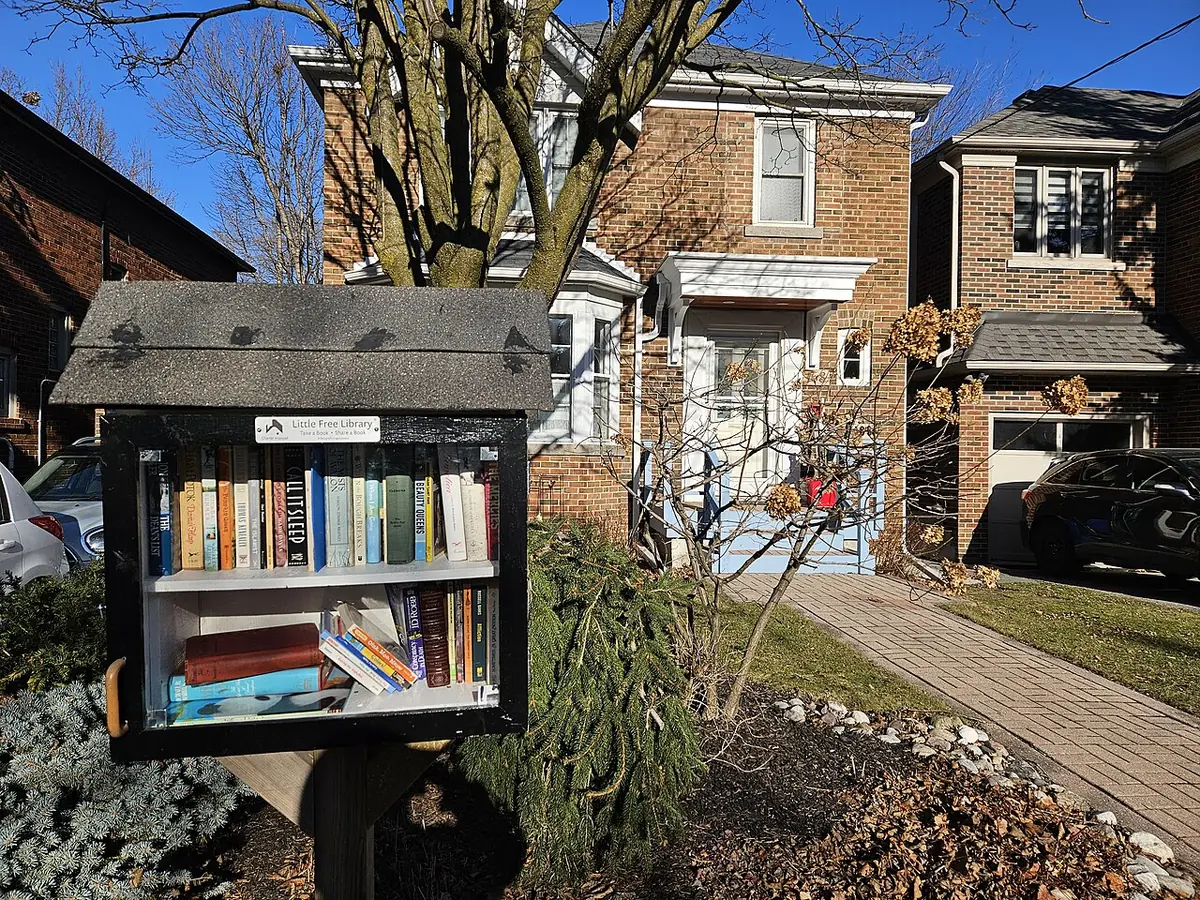
A quiet residential street with a neighborhood book box — Photo: ArthurGron · CC0 · Wikimedia Commons
That marked-out route follows a precise chronological sequence run by regulated professionals.
Buying property in Ontario follows a strict legal formalism that protects both parties while imposing tight deadlines. Once the offer is accepted, the machinery of conditions and the deposit engages on a precise timetable. Neglecting a single one of those contractual steps can cost you your deposit or expose you to a claim for damages.
Identifying the property and comparing it against recent sales in the same area.
Drafting the Agreement of Purchase and Sale through your real estate agent, including the protective clauses and the price offered.
Presenting the offer to the seller, who has a limited window to accept it, refuse it or come back with a formal counter-offer.
Paying the deposit into the brokerage's trust account within 24 hours of mutual acceptance.
Waiving the conditions (building inspection and final mortgage approval), generally within 3 to 5 business days.
The respective lawyers sign off the transfer on closing day and the keys change hands.
How a property transaction in Toronto unfolds, step by step
That methodical organisation is what makes for a calm, secure purchase in the middle of the Toronto market.
Carrying a Toronto purchase through takes careful coordination between your mortgage broker, your real estate agent and your lawyer. Each one has a precise role in securing the financing, checking that the property is legally sound and completing the transfer of ownership. Here is the full sequence.
You and your mortgage brokerGetting a mortgage pre-approvalThis first step sets your real maximum budget with the Canadian lenders and gives you immediate credibility with sellers.
Your licensed real estate agentThe active search and targeted viewingsSelecting properties that match your criteria in your target neighbourhoods, reviewing price comparables and assessing the visible condition of the buildings.
You and your real estate agentDrafting and negotiating the offerSetting the price, the inspection and financing conditions, and the closing date both parties want.
A certified home inspectorThe full technical inspectionA close examination of the structure, the roof, the insulation, the plumbing and the electrical system to pick up defects or urgent work.
Your real estate lawyerChecking title and encumbrancesOfficial Land Registry searches, review of easements, confirmation that no liens exist, and preparation of the closing documents.
The lawyers for both partiesClosing dayTransfer of the mortgage funds, payment of taxes and closing costs, official registration of the new title and handover of the keys.
House or condominium in Toronto: weighing independence against day-to-day upkeep
Buying a single-family house in Toronto brings a kind of independence that is rare in Canada's larger cities. Owning the structure and the land means freeing yourself from the decisions of a condominium corporation, from monthly maintenance charges that are often volatile, and from the sometimes heavy restrictions written into internal rules. That freedom carries a direct financial price, though, and demands constant personal involvement in corrective and preventive maintenance of the building, which is tested hard by severe Ontario winters and by summer temperature swings.
A condominium apartment or a unit in a managed residential tower answers the opposite need: rationalising your time and pooling services. Pools, gyms, round-the-clock security and the condominium's immediate responsibility for the building envelope free the occupant from any heavy operational burden. That balance rests entirely, however, on the financial health of the corporation's reserve fund and on the quality of the building's management. Poor collective management shows up without fail as substantial special assessments, which can weigh heavily on an owner's annual budget.
The structural choice between house and condo in Toronto is therefore not a simple matter of taste or of immediate floor area. It is a deep trade-off between the time you are willing to spend managing your property and your tolerance for unexpected expenses voted through by other people. Buyers who value operational peace of mind gravitate naturally towards a managed condominium, while those who want absolute control of their long-term costs and the value of the land turn to a detached or semi-detached house, accepting a substantial weekly maintenance load in return.
It is also worth looking at how geography shapes that dual market across the Greater Toronto Area. Houses with land sit increasingly in outer areas or in mature, well-served residential neighbourhoods such as East York or Etobicoke, while condominiums cluster along the heavy transit corridors of the Toronto Transit Commission network, particularly around the Yonge-University subway line. Your decision therefore has to weigh your tolerance for a daily commute alongside your appetite for hands-on renovation work.
The full cost of owning a property in Toronto, beyond the mortgage alone
Budgeting for a Toronto purchase cannot stop at the monthly mortgage payment. The local tax structure and the charges that come with ownership call for careful financial modelling that takes in municipal property taxes, insurance, utilities and, where they apply, condo fees. Ignoring those recurring components exposes a buyer to severe cash-flow strain in the very first year, all the more so because inflation weighs heavily on maintenance and renovation costs in Ontario.
Estimated recurring costs for an average residential property in Toronto
Budget line
Indicative monthly range
Main factors behind the variation
Municipal property taxes
$350 to $750
The value assessed by MPAC and the City of Toronto's annual rate
Condo fees
$450 to $1,200
Floor area in square feet, age of the building and services included
Comprehensive home insurance
$120 to $280
Replacement value of the structure, claims history and location
Utilities (electricity, gas, water)
$200 to $450
Insulation, energy source and total volume of living space
These ranges reflect historical averages across the metropolitan area and shift with inflation in Ontario energy costs.
Unavoidable upfront costs when buying in Toronto
Type of cost
Order of magnitude
When it is due
Municipal and provincial land transfer tax
1.5% to 3% of the purchase price
On signing the transfer at the real estate lawyer's office
Legal fees and lawyer's charges
$1,500 to $3,000
Closing of the transaction
Professional pre-purchase inspection
$500 to $900
During the period for satisfying the conditions
Toronto charges land transfer tax twice, combining the municipal tax with the Ontario provincial tax, for buyers who are not exempt.
Daily rhythm and logistics: an ordinary Tuesday in the Toronto property market
Daily life for a Toronto owner is organised around how well the transport infrastructure works and how carefully journeys across the city are planned. Between work in the downtown financial core and running a household, every part of the day tests the fit between the neighbourhood you chose and the reality of traffic on the roads and on the subway lines. Here is how a weekday typically unfolds for a household settled in an established residential neighbourhood.
07:30Residential neighbourhood (for example the Danforth or High Park)Getting ready and checking the state of the TTC transit network on local apps before setting off.
08:30Subway station or main transit corridorThe commute to the financial district, combining a Line 2 subway train with a quick connection onto Line 1.
09:00Workplace or office downtownArriving at work after a journey made efficient by being right beside a major transit station.
12:30Local shops in the business districtA midday break and a few errands in the retail units built into the underground PATH complex or at street level.
17:30The journey home across TorontoVariable transit times and managing connections during the heaviest part of the evening rush.
19:00Home and local servicesDinner at home and planning routine maintenance or handling the household's day-to-day business.
21:00Residential neighbourhood and green spaceWinding down in the evening nearby or walking in the local municipal park before the public facilities close.
The invisible side of Toronto property that listings routinely leave out
Listing platforms and sales presentations lead with light, glossy finishes and gross floor area. Yet the intrinsic value of a Toronto purchase depends on technical, planning and regulatory factors that marketing copy hides or plays down. Understanding those blind spots protects a buyer from heavy financial disappointment after the keys change hands.
The real condition of underground infrastructure and municipal sewer connections
Many mature residential areas of Toronto have combined or ageing drainage networks that significantly raise the risk of stormwater getting into basements during heavy summer downpours.
Nearby densification schemes and condominium tower proposals
A vacant lot or a small commercial building next door can be the subject of a rezoning application to the City, radically changing the light, the view and the quiet of your future property within months.
The possible presence of asbestos, lead in the pipework or hidden structural defects
Houses built before the 1980s need careful checks by independent experts, because bringing electrical and plumbing systems up to code represents a considerable renovation budget.
Strict heritage restrictions and zoning bylaws
Altering the facade, removing a mature tree on your own land or adding a storey often proves impossible, or subject to demolition and planning committee approvals that are extremely slow and demanding.
The classic traps of buying in Toronto: looking back six months later
Looked likeAn exceptional opportunity during a temporary lull in bidding, with a very attractive asking price.
Turned outA property with major hidden defects in the foundation, needing the structure rebuilt at a cost of more than a hundred thousand dollars.
Would have caught itInsisting on a thorough technical inspection every time, and refusing to waive conditions under pressure from a broker.
Looked likeA rapidly gentrifying neighbourhood with immediate, guaranteed speculative upside.
Turned outAn area cut off from heavy transit, with persistent noise problems and hard to sell on if you suddenly need to move.
Would have caught itTesting how transit actually flows at rush hour and asking long-established residents how the area has really changed.
Looked likeUnusually low condo fees for a high-end building with plenty of amenities.
Turned outA dramatically underfunded reserve fund, leading straight to a massive special assessment to repair the roof and the central heating system.
Would have caught itHiring a specialist to go deep into the reserve fund study covering the building's last thirty years.
Looked likeAn attractive variable-rate mortgage plan built on optimistic projections from the lenders.
Turned outA sharp jump in monthly payments after successive Bank of Canada policy rate increases, creating unbearable budget stress.
Would have caught itBorrowing well below your maximum capacity and stress-testing your budget against interest rates markedly higher than those on offer when you buy.
Buyers and investors for whom buying in Toronto is a false good idea
The general enthusiasm for property across the Greater Toronto Area sometimes pushes households into purchases that do not suit their time horizon or their working situation. Far from being a universal, risk-free investment, buying a home in this market demands a stability and a financial commitment that some profiles cannot, or should not, take on. Here are the situations where not buying is the more rational decision.
The young professional facing an international or domestic move in the near term
→Insisting on buying a small condo to avoid paying rent they see as money down the drain.
Transaction costs and land transfer tax absorb the whole of any potential gain if the property is resold within five to seven years.
The household whose savings barely cover the minimum down payment
→Borrowing to the very limit of their capacity with no cushion for the unexpected.
The smallest rate movement or major maintenance bill tips the household straight into default and a forced sale just as prices are correcting.
The buyer who cannot stand paperwork or do-it-yourself work
→Buying an older house in a heritage neighbourhood because they fell for the look of it.
Maintaining a single-family house in Toronto takes an investment of personal time and money that is incompatible with an all-inclusive or leisure-focused way of life.
Pulling it together: are you really ready to commit to Toronto property?
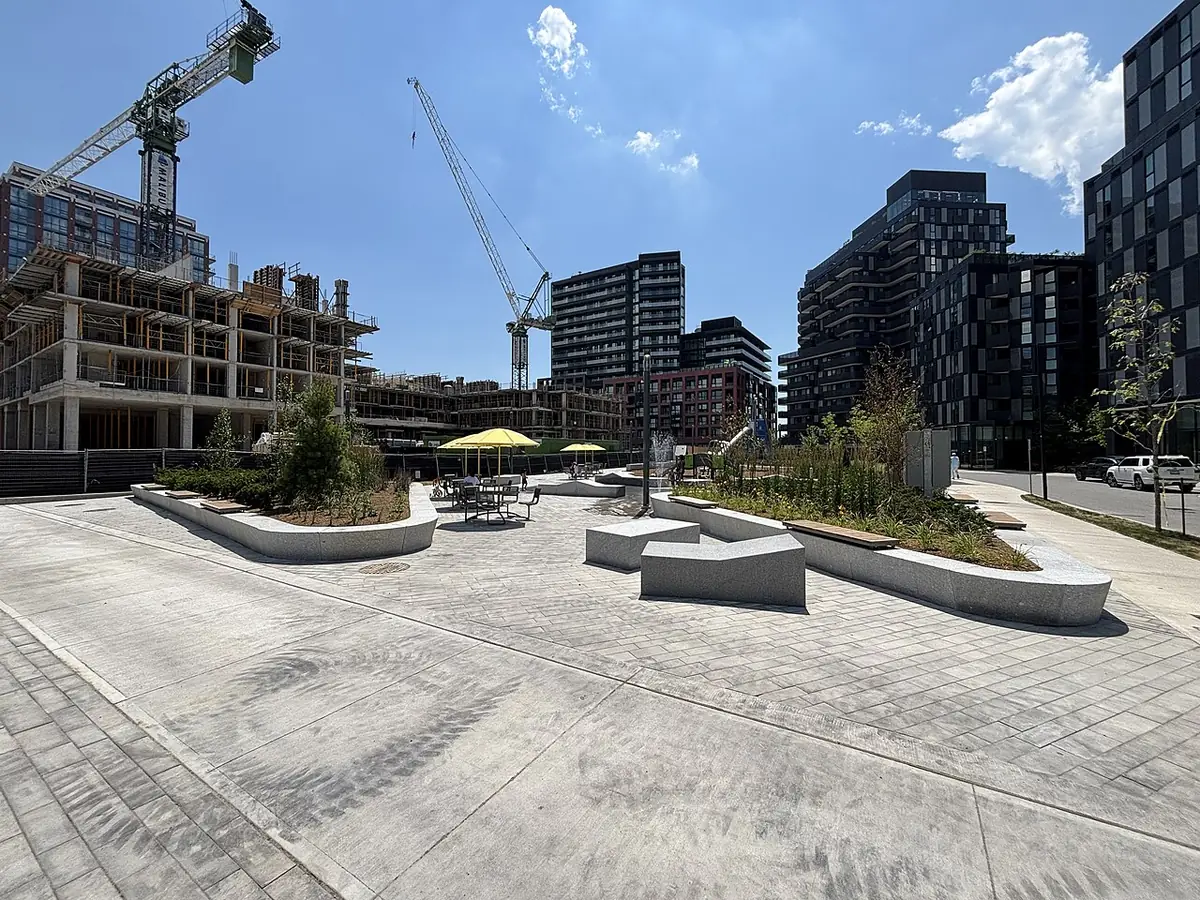
A new public plaza taking shape in Toronto — Photo: Canmenwalker · CC BY 4.0 · Wikimedia Commons
Reaching the end of your thinking about Toronto property means setting your personal hopes against the structural and financial realities of the local market. Buying a home in this city is not an end in itself, nor an automatic guarantee of effortless enrichment. It is a long-term commitment of capital that lastingly changes the balance of your life, your freedom to move and the shape of your available savings. If your decision rests on the certainty of staying in the region for at least seven to ten years, then the fundamentals of the Toronto market support you.
Take the time to work out what liquid savings you will have left after the down payment and the municipal and provincial land transfer taxes. A shrewd buyer never empties every account to become an owner; they keep a substantial reserve for technical emergencies, for mortgage rate movements and for the ups and downs of working life. If the thought of having to cover a new roof on your own, or replace an air conditioning system in the middle of an Ontario winter, produces anxiety you cannot live with, a managed condominium or simply renting a while longer deserves serious reconsideration.
Finally, keep in mind that the Toronto property market rewards patience, analytical rigour and strategic clarity. Never give in to the panic of an artificial bidding war or to the urgency of people with a commission at stake. Your ability to say no to an imperfect or overpriced property is your best financial shield. When your budget calculations account for the worst rate scenarios and your investment horizon matches the economic reality of the city, you cross the line that separates the speculator from the owner who sleeps at night.
Related questions
How much is land transfer tax on a purchase in Toronto?
In Toronto, buyers pay land transfer tax twice: the Ontario provincial land transfer tax and the additional municipal tax charged by the City of Toronto. The combined rate generally runs between 1.5% and 3% of the transaction value depending on the purchase price, with rebates available to first-time buyers who meet specific eligibility criteria.
Is a pre-purchase inspection mandatory for a house in Toronto?
Ontario law does not formally require an inspection by a certified professional, but skipping it is a considerable financial risk. The inspector picks up hidden defects and reports on the condition of the structure, the foundations and the electrical systems, which gives you essential negotiating leverage or a legitimate reason to walk away.
How do condo fees work in Toronto residential buildings?
Monthly condo fees cover maintenance of the common elements, security, administrative management and the mandatory funding of a reserve fund for major future work. The amount depends on the size of your unit and the range of services the building offers, and fees are raised regularly in line with inflation.
Which Toronto neighbourhoods are most sought after for buying a single-family house?
Areas such as The Danforth, High Park, Leslieville and Lawrence Park draw strong demand because of the quality of their schools, their green space and how easily they connect to the city's public transit network heading into the financial district.
How do Bank of Canada interest rates affect my buying power?
Movements in the policy rate feed straight through to the mortgage terms offered by Canadian chartered banks. A rate increase mechanically reduces the maximum loan amount you can be approved for and raises the total cost of servicing that debt over the full term of the contract.
How long does it take to complete a property transaction in Toronto?
The standard gap between acceptance of a firm offer and the effective closing date at the real estate lawyer's office is generally thirty to sixty days. That window is used to finalise the mortgage approval, run the legal title searches and assemble the funds required.
What is a special assessment in a Toronto condominium?
A special assessment is a one-off lump sum demanded from every unit owner by the condominium corporation when the reserve fund turns out to be too small to pay for unforeseen major repairs, such as a full roof replacement or new elevators.
Can a non-resident of Canada buy property in Toronto?
Purchases by non-residents of Canada are governed by strict federal and provincial rules, including specific taxes on foreign buyers in certain parts of Ontario, intended to ease pressure on the local residential market and protect housing affordability.
What is the difference between divided and undivided co-ownership in Toronto?
The Toronto market runs almost entirely on divided co-ownership, the condominium, where each owner holds exclusive title to their own unit plus a clearly defined share of the building's common elements registered with Ontario's land registry.
How do I assess a condominium corporation's financial health before making an offer?
You must go through the Status Certificate, the official legal document setting out the annual budget, the exact balance of the reserve fund, the record of ongoing disputes and any legal proceedings involving the building or its manager.
Property review of ting
No ting properties in Toronto yet
Be the first — share it on ting and it shows up right here.