Renting a house in Toronto means getting to grips with an Ontario market that runs on its own rules, and choosing your residential pocket with care. This guide sets out the budgets, the paperwork and the day-to-day realities so you can sign a lease without a misstep.
Get the app
What nobody tells you.
Real prices, hidden costs and the traps to check before you commit.
What renting a house in Toronto really involves day to day
Scroll
What renting a house in Toronto really involves day to day
Renting a house in Toronto means getting to grips with an Ontario market that runs on its own rules, and choosing your residential pocket with care. This guide sets out the budgets, the paperwork and the day-to-day realities so you can sign a lease without a misstep.
Written by the ting.ad editorial team ·
Bloor Street East, Toronto in Street View: drag to look around.
Moving from theory to practice means looking closely at your own profile.
Renting a house in Toronto changes your relationship with the city and with the running of your own household. Unlike the high-rise condos that concentrate life in the central neighbourhoods, a house drops you into quieter residential pockets but demands constant involvement in keeping the place up. You are trading floor area against distance from the major transit lines, because what comes on the market varies enormously from one neighbourhood to the next. This kind of home reshapes your budget not only through the headline rent but through the running costs a house tenant usually carries alone. Understanding that from the start spares you both financial and organisational surprises once you are settled in the city.
Considerably more living spacevsA much heavier load of bills and upkeep
House tenants are often the ones mowing the lawn, clearing snow in winter and keeping an eye on the fabric of the building, which takes real time and personal effort every week.
A footing in calm residential neighbourhoodsvsA longer daily journey to the financial core and the main employment districts
Moving away from the dense subway corridors to find a house with a yard means accepting longer connections and a greater dependence on the TTC bus and streetcar network.
More independence and a more private settingvsHigher heating and cooling costs simply because of the floor area
Detached houses and semis lose far more heat than a modern condo unit, which pushes up the seasonal energy bills that land on the tenant.
Which kind of tenant gets the most out of a house in Toronto?
The cultural and administrative approach differs sharply from what you are used to.
The Toronto rental market is heavily segmented and does not answer every situation the same way. Renting a whole house meets specific needs and is not simply a bigger version of an apartment. It is worth judging honestly whether your working life and your personal habits fit the constraints of this kind of home. Tenants who are a poor match quickly find themselves isolated, or swamped by the logistics that a large property in a city and suburban setting brings with it. Here is how to read your own situation before committing to a long residential lease.
Chasing a school catchment and a secure yard
For families settling in Toronto, renting a house opens up residential areas known for the quality of their public and Catholic schools. You get the private outdoor space that children need and you put down roots in an active local community. In exchange you accept being further from the cultural pull of downtown, which calls for tight organisation around after-school activities and everyone's daily journeys.
Needing a dedicated office and a quiet setting
Working from home in a Toronto condo often becomes stifling over time, simply because there are no rooms to spare. Renting a house lets you set up a genuine closed office away from the living space, which helps both concentration and balance. The trap is social isolation if the neighbourhood you pick has no cafes, local shops or co-working space within walking distance.
Weighing architectural character against being central
Some areas close to the core, such as the Victorian pockets to the east and west, offer terraced houses full of character but at very high rents. Choose that life and you get a vibrant neighbourhood rich in restaurants and galleries, but you have to live with smaller rooms and fierce competition for anything that comes free. The financial trade-off is far more aggressive here than in the outer residential suburbs.
What changes most when you arrive from abroad to rent in Toronto
St. Gregory Armenian Catholic Church, a Toronto landmark — Photo: Amakuha · CC BY 4.0 · Wikimedia Commons
The area you choose will decide how well the move goes.
Coming into the Ontario rental market from another country means discovering a legal system and a set of habits that may be nothing like the ones you know. The apparent flexibility of the contracts comes with much stricter checks on your ability to pay, and with a culture of informal but regulated negotiation. Parental guarantors and the bank guarantees that are standard in many countries do not carry the same weight here: local landlords work from Canadian credit scores and from very precise local proof of income. Grasping those codes on day one is what stops your application being turned down again and again by agents and landlords.
From abroad
Leases and rents tightly regulated by national law, with automatic renewal by default
Toronto
A market governed by Ontario's Residential Tenancies Act, with capped rent increases for buildings completed before 2018
Checking the year the home was built is vital, because newer housing falls outside the annual cap and can see very large increases from one year to the next.
From abroad
Heavy reliance on a named guarantor and on conventional payslips
Toronto
An absolute requirement for a Canadian credit history and verifiable employment letters
Newcomers with no local financial record often end up offering several months of rent in advance, although the law does not exactly encourage that, or producing substantial international bank guarantees.
From abroad
Move-in and move-out condition reports that are exhaustive and signed by both sides
Toronto
A quicker walk-through in which the tenant is strongly advised to record the condition of the property in writing and in photographs at key handover
Take the time to photograph every existing defect and notify the landlord in writing on day one, to avoid a dispute over the deposit or over the state of the place when you leave.
From abroad
Running costs bundled into a flat charge or settled once a year against receipts
Toronto
Electricity (Toronto Hydro), gas and water bills that usually fall entirely on the tenant of a whole house
Build those running costs, which swing hard with the severity of an Ontario winter, into your monthly budget so nothing catches you out.
How to choose a neighbourhood when renting a house in Toronto
Looking at the financial side lets you frame the search precisely.
Toronto is a mosaic of neighbourhoods with strong identities, where the feel can change from one street to the next. Choosing an area is not only about budget: it is about how much travel time you will tolerate and whether you want a lively street life or something strictly residential. Houses to rent cluster mainly in the mature parts of the old city and in the leafy residential districts just beyond it. Each area strikes its own balance between transit access, the quality of the parks and how close the local shops are.
The Annex and Seaton Village
A mix of Victorian arches, university students and families settled for decades on streets lined with enormous trees.
Suits
People who want old architectural character together with immediate access to the University of Toronto campus and the subway.
Trade-off
Very high rents for often elderly properties whose insulation needs watching.
High Park and Swansea
A permanent holiday atmosphere at the gates of a huge natural park, ideal for anyone who wants the outdoors and quiet.
Suits
Families and pet owners looking for large green spaces within walking distance without leaving the city.
Trade-off
Detached houses rarely come up for rent here and competition is fierce the moment one does.
Leslieville and The Beaches
A relaxed, creative village spirit turned towards Lake Ontario, with independent cafes and design shops.
Suits
Professionals after an easy-going way of life, a strong community and direct access to the lakeshore.
Trade-off
Slower streetcar journeys into the heart of the business district at peak times.
Midtown (Yonge and Eglinton / Lawrence)
Orderly urban energy, with busy shopping avenues and extremely quiet residential pockets behind them.
Suits
People who need a fast connection to the subway (Line 1) and first-rate schools.
Trade-off
A skyline in constant densification, with plenty of construction sites along the main roads.
What renting a house in Toronto actually costs
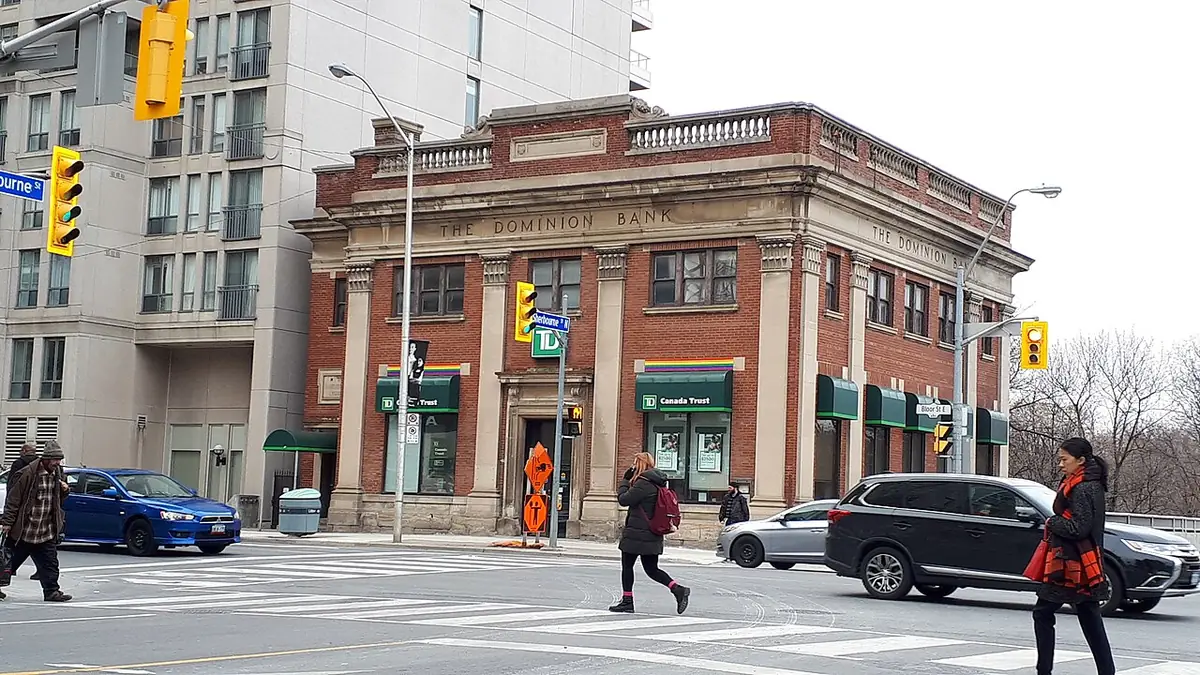
A heritage corner building on a lively Toronto street — Photo: Oaktree b · CC BY-SA 4.0 · Wikimedia Commons
Beyond the figures, the legal nature of what is available deserves close attention.
The Toronto rental market sits among the most expensive in North America, and renting a whole house is a substantial financial commitment. Rents vary a great deal with floor area, the number of bedrooms, whether the basement is finished and, above all, how close the property is to rapid transit. You have to fold in the running costs that come with it, such as heating, electricity and outdoor upkeep, which are very rarely included in the advertised rent. The table below sets out the orders of magnitude seen on the market to guide your budgeting.
torontoTo rentHouseestimate
Median price / m²CA$33Half the apartments sell below this
Median priceCA$4.07kthe average is 14% higher — a few very large properties pull it up
Most common2 bedrooms73 % of listings
Average size116 m²
By number of bedrooms
Bedrooms
Share of market
Avg price
Price / m²
Avg size
2most common
73 %
CA$4.35k
CA$35
126 m²
3
21 %
CA$5.74k
CA$33best value / m²
172 m²
4
6 %
CA$7.33k
CA$33best value / m²
219 m²
Each row is an average, compared against the area average of CA$35 / m². These are indicative estimates of a typical local market, not a measured sample of live listings. Check current listings before relying on them.
What you can realistically rent and live in on the Toronto market
Getting the tenancy over the line depends on following each step of the process closely.
On the Toronto market the word house covers very different kinds of building, and the difference can transform your daily experience. Between a period detached Victorian and a modern duplex carved out of a former single-family home, the trade-offs in sound insulation and privacy are considerable. It pays to understand how the building is legally divided, so you avoid disputes with neighbours over shared outdoor space or shared equipment. The two main models each call for their own judgement.
The whole detached or semi-detached house
You have the entire building, basement to attic, plus exclusive use of the yard and any garage. In a detached house nobody shares your walls, which guarantees acoustic comfort and complete freedom of movement. In exchange the whole energy bill is yours, and so is the daily responsibility for keeping the grounds in order, which in Toronto means mowing in summer and clearing snow in winter.
What it changesYou get complete residential independence, at the price of a high monthly rent and a real burden of upkeep.
The duplex unit or finished basement apartment
This is often the more affordable route: renting either the main floor or the lower level of a large house whose owners or other tenants occupy the rest. These homes offer comfortable space but frequently come with lower ceilings, less natural light and audible closeness to the occupants on the other floors.
What it changesYou reach a sought-after neighbourhood for less, but you accept real compromises on light and on quiet.
The rule to understand before you hand over any money for a rental
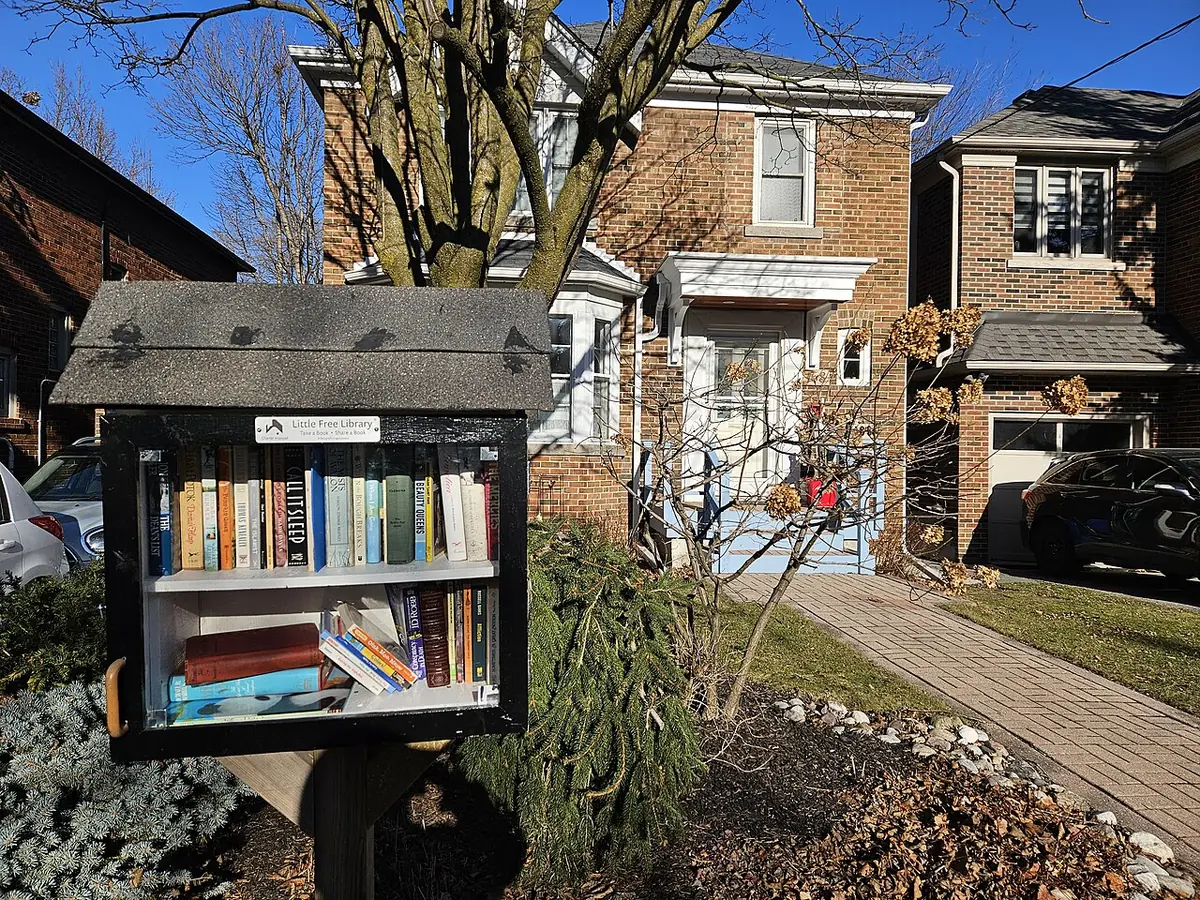
A quiet residential street with a neighborhood book box — Photo: ArthurGron · CC0 · Wikimedia Commons
Here is exactly how the practical side of moving in unfolds.
Renting in Toronto is extremely fast and competitive, which sometimes pushes applicants to skip steps for fear of losing the perfect house. Yet committing funds or signing up without having checked every clause and the real state of the fittings exposes you to serious financial risk. Ontario law protects both landlord and tenant, but it demands constant care when the Agreement to Lease is being drawn up. Following a logical chain of actions keeps you safe from end to end.
You find a house that matches your criteria and view it with an agent or directly with the landlord.
Complete a detailed rental application including your professional references and your credit history.
Submit a written Agreement to Lease setting out the rent offered, the move-in date and any conditions.
Pay the deposit, normally the first and last month's rent, by certified cheque or secure transfer once the offer is accepted.
Sign the official lease on Ontario's standard form of lease, which sets out your rights and duties.
You carry out a thorough move-in inspection and collect the keys to settle in with your mind at rest.
How a rental transaction unfolds, step by step
Anticipating each phase of your move to Toronto spares you the stress of last-minute searching in a tight market. From putting your application together to switching on the utility accounts, everyone involved has a precise role that needs coordinating. This chronological run-through sets out who does what, so that moving into your new house goes without a hitch.
The prospective tenantPutting the application togetherGather your employer letters, recent pay stubs, references from past landlords and your Canadian credit report to prove you can carry the rent.
The agent or the landlordViewing and choosing the propertyView the house paying attention to the plumbing, the heating system and the roof, then put your rent offer in writing.
The landlordReviewing and accepting the offerThe landlord goes through your financial file and approves the terms of the Agreement to Lease, which formally starts the agreement between the parties.
The tenantPaying the deposit fundsSend the first and last month's rent by certified cheque within the strict deadlines the agreement sets.
Both partiesSigning the Ontario standard leaseSign the official provincially regulated contract, which protects your rights and defines exactly how the rent can be reviewed.
The utility providersOpening the accountsContact Toronto Hydro and the gas supplier to switch the accounts into your name from the exact day you take possession.
The tenantCondition report and move-inCarry out the final walk-through, note every imperfection and settle into your new Toronto home.
House or apartment in Toronto: weighing the independence of a whole house against the simplicity of a condo rental
Once that basic choice is made, it is worth looking closely at what the decision does to your overall budget.
Renting in Toronto means choosing straight away between two ways of living that differ in almost everything, from the structure of the hidden costs to the daily management of your space. On one side the house, often in the greener residential districts just out from the core such as East York or North York, promises complete autonomy, a private yard and no condo board looking over your shoulder. On the other, the condo apartment, concentrated in the downtown glass towers or strung along the rapid transit corridors of the TTC network, comes with services built in, such as a concierge, a gym and outdoor maintenance handled entirely for you, but with building rules and running costs you do not control.
Financially, a whole house in Toronto is a heavy monthly commitment, with a headline rent that regularly runs well above the city average for an apartment, and with a set of bills the tenant carries alone. Every dollar of heat you buy in January is yours, and no neighbour above or below is sharing the load. Looking after the day-to-day condition of the roof, the gas-fired central heating, the basement and the storm drainage falls to the occupant in practice, which means a whole-house tenant needs both a cushion of time and a habit of reporting problems in writing to the landlord early, before the harsh Ontario winter turns a small fault into a serious one.
The condo rental, by contrast, attracts people who want liquidity in their arrangements and a life without logistical worry, where clearing the pavements of snow and mowing the grass are the building's business, not yours. That comfort is priced into the rent, and building management can be excellent or dismal without you having any say in it. Poor management shows up as saturated lifts, deferred repairs and works that disrupt the building for months, turning what looked like a predictable, low-effort home into a daily irritation.
The final choice therefore depends far less on aesthetic preference than on your tolerance for practical work and your willingness to hand the running of your home to someone else. If you value space, the freedom to spread out and independence from a strict set of building rules, the house remains the obvious option despite what it takes out of your week. If you value being central, the security of a supervised building and the freedom to travel for weeks without a thought for the property, the urban apartment wins on its own terms, provided you have read every line of the lease before you sign it.
What monthly and up-front budget do you really need to live in Toronto?
Beyond the raw figures, it is the shape of an ordinary day that reveals what life in Toronto is like.
Building a budget for Toronto cannot stop at the rent advertised on the listing platforms. It has to take in the money you need on day one, the energy bills that run high because of the seasonal temperature swings, and the upkeep of a house that falls to the tenant. This cost structure is built from a few rigid items, and it is essential to map them accurately before committing yourself financially in the Ontario capital. The figures below are drawn from the rental market data set out earlier on this page, since the original cost tables covered purchase costs rather than renting.
Fixed and recurring costs for a rented house in Toronto
Cost line
House rental (3 bedrooms)
House rental (2 bedrooms)
Average advertised monthly rent
$5,740 CAD
$4,350 CAD
Funds due on signing (first and last month's rent)
$11,480 CAD
$8,700 CAD
Monthly energy bills (electricity and gas), tenant-paid
Between $300 and $550 CAD
Between $300 and $550 CAD
Average floor area behind the figure
171.5 m2
126.0 m2
Rents and floor areas are the market averages given in the market data section above; the energy range is the one quoted for a house rather than a condo unit.
Other costs tied to taking on a tenancy
Item
How it works in Toronto
Budget impact
Last month's rent deposit
Collected up front and applied to the final month of the tenancy
One month's rent, $4,070 CAD at the market median
Annual rent increase
Capped under the Residential Tenancies Act for homes built before 2018
No cap on homes completed after 2018, so increases can be steep
Utility accounts in your name
Toronto Hydro, gas and water switched over on the day you take possession
Between $300 and $550 CAD a month for a whole house
This table has been rebuilt from the rental figures already given on this page, because the source figures covered purchase taxes and legal costs that a tenant never pays.
What an ordinary Tuesday actually looks like, between transit, health services and school runs
That apparent routine hides technical and legal realities that the marketing brochures never mention.
Judging the quality of life in Toronto means testing it against a standard day. Between connections on the Toronto Transit Commission subway, the commute in from the residential suburbs to the financial district, and access to health services under strain, every minute counts. This hour-by-hour run-through brings out the logistical trade-offs you have to make to keep your balance.
07:30Residential neighbourhood and the walk to the subway (for example a Line 1 station)The commute starts at peak time, and how smoothly it goes depends directly on how close you are to a rapid transit station.
08:45Arrival in the Financial DistrictInto the PATH underground pedestrian network, which links dozens of office towers and keeps commuters out of the winter weather.
12:30Near a neighbourhood walk-in clinicA reminder to register with a family doctor as soon as you arrive, since walk-in clinics often carry long waits.
16:00Public schools (Toronto District School Board)Collecting the children from the local schools, whose academic reputation feeds directly into what the surrounding streets cost to rent.
18:30The local shopping street (Queen Street West or Danforth Avenue, say)Everyday shopping and neighbourhood life, showing the cultural and commercial mix that marks out each residential pocket of the city.
21:00Home again, and dealing with the utilitiesChecking the broadband connection and planning the household jobs, in a city where almost everything runs online.
What the handsome listing photographs never tell you about the Toronto rental market
Ignoring these invisible details leads straight to the bitter disappointment people report six months after signing the lease.
Behind the flattering staging of virtual tours and wide-angle photographs sit technical and regulatory constraints particular to Toronto's housing stock. Tenants who do not know what to ask discover too late that the drains are failing, that the short-term letting rules kill a side plan, or that the building has faults inherent in its age. Here are the things that deserve surgical attention before you commit.
The real state of the underground services and the sewer connection
Many single-family houses built in the middle of the twentieth century still have lead service pipes or clay drains vulnerable to the roots of the century-old street trees, which means backups and days of disruptive digging in the front garden during your tenancy.
The strict municipal rules on short-term letting
Toronto applies a hard rule barring short-term rental of any home that is not the operator's principal residence, and requiring registration where it is, so there is no prospect of offsetting your rent with short-stay income.
Densification schemes and towers planned next door
A vacant lot or a modest garage opposite your new home can be redeveloped as a high-rise, permanently changing the light, the view and the traffic on your street for the length of your lease and beyond.
The age of the shared equipment in a divided house or a condo building
Unusually low running costs often mean the major works have been deferred, and a boiler or furnace at the end of its life leaves tenants without heat in the middle of an Ontario winter while the replacement is argued over.
Hidden defects caused by the hard winters
Repeated freeze and thaw cycles quietly damage poured concrete foundations and flat roof membranes, so a damp basement or a leak that only shows itself in February is a real risk you should look for before signing.
What Toronto tenants most often regret six months after moving in
Faced with these structural traps, it is just as important to know when to hold back and to see clearly which people should stay off this market.
Looked likeA charming period house full of character on a quiet, wooded street
Turned outA thermal sieve on an obsolete 60-amp electrical service, with winter bills that swallowed the saving on the rent and no capacity for modern appliances.
Would have caught itAsking the landlord for the last twelve months of energy bills and having a good look at the electrical panel before you sign anything.
Looked likeAn ultra-modern apartment on the thirtieth floor with a sweeping view over Lake Ontario
Turned outA daily ordeal of chronically saturated lifts at peak times and a building run so badly that repairs dragged on for months.
Would have caught itTalking directly to several current residents in the common areas and asking how long recent repairs took.
Looked likeA chance to sign quickly in an up-and-coming outer district that everyone said was about to take off
Turned outComplete road gridlock at peak times, turning every work journey into a test of patience on saturated roads.
Would have caught itTesting the commute yourself at the exact peak hours on a Tuesday or a Wednesday before putting in a firm offer.
Looked likeA property advertised at a very attractive rent with a competing-offers deadline a few days away
Turned outAn aggressive psychological tactic designed to provoke irrational bidding, ending in a rent clearly above what the house was worth.
Would have caught itGoing carefully through what comparable homes on the same street have recently let for, and fixing a ceiling you will not cross.
Who this market is really for: the people who should not rent a house in Toronto
With those warnings on the table, it is time to take stock and decide whether you go ahead.
The Toronto rental market is not a universal answer that suits every stage of life. The money needed up front, combined with running costs that a house tenant carries alone and with strict rules on what you may and may not do with the property, makes a whole house the wrong move for some people. Recognising that you do not fit what this city demands, financially or practically, is a sign of clear thinking that protects your savings.
The professional here on a short international posting
→A smaller, more flexible home rather than a whole house
A house ties up the first and last month's rent from the outset and leaves the utility accounts, the snow clearing and the yard upkeep in your name for the whole term, none of which you recover by leaving early.
The household that can just cover the deposit with nothing left over
→Keeping capital liquid and taking a home where the running costs are included
With no cushion, the first hard Ontario winter or a mid-lease problem with the heating lands on a budget with no room in it.
The tenant hoping to offset the rent with short-stay lettings
→Budgeting for the full rent, or looking at another arrangement entirely
Toronto strictly bars short-term letting of any home that is not the operator's principal residence, so that income simply is not available.
The first-time renter who wants no administration and no upkeep at all
→An apartment where the building handles the outside maintenance
A whole-house lease puts the lawn, the snow and every utility account on you, and you still have to read the Ontario standard lease line by line to know where you stand.
So are you really ready to sign a lease in Toronto?
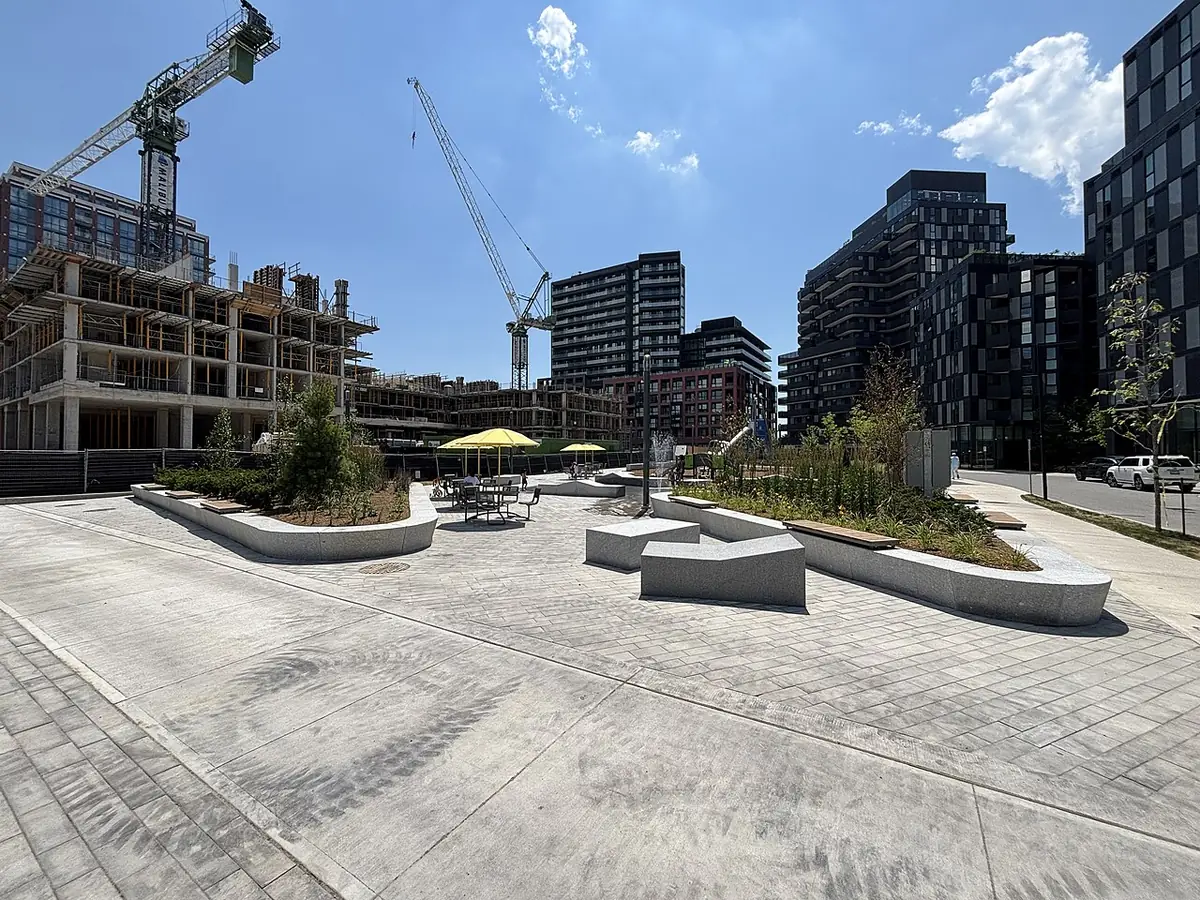
A new public plaza taking shape in Toronto — Photo: Canmenwalker · CC BY 4.0 · Wikimedia Commons
At the end of this look at the Toronto rental market, the question is no longer whether the city offers an attractive place to live, but whether your personal, financial and practical situation matches what it asks of you. Taking on a house here is not an impulse born of one good viewing: it is a decision that shapes your monthly budget and your weekends for as long as the lease runs. If you have measured the running costs that come with a whole house, accepted what the commute will take out of your day and set aside enough to cover the first and last month's rent, you have what you need to make it work.
What remains is to move from thinking to method. Get your application pack ready before you start viewing, with employment letters, recent pay stubs, past landlord references and your Canadian credit report, so you can move the moment the right house appears. Walk each property looking at the plumbing, the heating and the roof rather than at the staging, and refuse to be hurried by the artificial deadlines that competitive listings create. The Toronto market rewards preparation and a clear head, and punishes improvisation.
Take the time to revisit the neighbourhoods you have shortlisted at different points in the week, talk to people who have lived there for years, and read every line of the standard lease before you put your name to it. Photograph the condition of the place on the day you get the keys and put anything you find in writing to the landlord straight away. Renting in Toronto should be a base for a settled life, not a permanent source of stress, and if doubt remains, keep looking: the market will still be there when you are ready for it.
Related questions
What do you have to pay up front to move into a rented house in Toronto?
Once your offer is accepted you hand over the first and last month's rent, normally by certified cheque or secure transfer, and you then open the utility accounts in your own name. At the market median of $4,070 CAD a month, that is roughly $8,140 CAD to find before you move a single box.
How are rent increases regulated in Toronto?
The market is governed by Ontario's Residential Tenancies Act, which caps annual increases for homes built before 2018. Newer homes fall outside that cap, so checking the year the property was built is essential: a recent building can see a much steeper jump from one year to the next.
Should I have a rental house inspected before I sign?
Ontario law does not require an inspection for a tenancy, but you should walk the property looking hard at the plumbing, the heating system and the roof, then photograph and note in writing every existing defect on the day you get the keys so it cannot be charged to you later.
What is the Ontario standard form of lease?
It is the province's standardized lease document, and signing it is the final step of the rental process. It sets out the rights and duties of both parties and spells out precisely the conditions under which the rent can be reviewed.
How do Toronto landlords assess a rental application?
Landlords and agents work from a detailed rental application backed by a Canadian credit report, verifiable employment letters, recent pay stubs and references from previous landlords. The screening is far stricter than the paperwork many newcomers are used to.
What is the practical difference between renting a whole house and renting a basement apartment?
Renting the whole house gives you the building from basement to attic plus exclusive use of the yard and any garage, along with the entire energy bill and the upkeep of the grounds. A basement or lower-level unit in a divided house costs less and sits in the same sought-after street, but usually means lower ceilings, less natural light and noise from the occupants above.
Are utilities included in the rent for a house in Toronto?
Very rarely. For a whole house the electricity account with Toronto Hydro, the gas supply and the water are normally borne in full by the tenant, and those bills swing sharply with the severity of the Ontario winter, so they belong in your monthly budget from the outset.
What is the real effect of the short-term rental rules in Toronto?
The city strictly bars short-term letting of any home that is not the operator's principal residence, and requires registration even for a principal residence. Any plan to offset your rent with short-stay income is therefore a dead end.
How can I judge the public schools attached to a Toronto neighbourhood?
Toronto's public school system is run by the Toronto District School Board. Annual rankings and the scores published by the Education Quality and Accountability Office let you compare how schools perform from one catchment to the next.
How fast does the Toronto rental market actually move?
Very fast, and it is fiercely competitive, which tempts applicants to skip steps for fear of losing the right house. The sequence is a rental application, a written Agreement to Lease, the deposit paid within the strict deadlines the agreement sets, then the standard lease and the key handover.
Property review of ting
No ting properties in Toronto yet
Be the first — share it on ting and it shows up right here.