Putting a credible figure on a single-family house in the Toronto area takes a clear-eyed reading of local dynamics, climate pressure on the building stock and the Ontario legal framework. This guide sets out what actually drives the number, how neighbourhoods differ, and the steps that let you sanity-check a valuation before you rely on it.
Get the app
What nobody tells you.
Real prices, hidden costs and the traps to check before you commit.
What a valuation of a Toronto house is really measuring
Scroll
What a valuation of a Toronto house is really measuring
Putting a credible figure on a single-family house in the Toronto area takes a clear-eyed reading of local dynamics, climate pressure on the building stock and the Ontario legal framework. This guide sets out what actually drives the number, how neighbourhoods differ, and the steps that let you sanity-check a valuation before you rely on it.
Written by the ting.ad editorial team ·
Bloor Street East, Toronto in Street View: drag to look around.
Beyond the purely physical features, the figure that fits your property depends heavily on your own profile and how you live in it.
Valuing a single-family house in the Ontario metropolis is not a matter of counting a roof and a few square metres of land. It is a reading of an urban model where old structures sit under heavy demographic pressure. Many owners discover too late that a neighbourhood's perceived standing does not by itself carry the figure. Every estimate arbitrates between the pull of a central location and the reality of local structural constraints. Understanding those dynamics from the outset is what keeps an estimate from collapsing when it meets the market.
Living space and the charm of period woodwork in the established residential neighbourhoodsvsCentury-old foundations that need expensive electrical and plumbing upgrades to current standards
Visual character lifts an estimate immediately at spring viewings, but it often masks monumental insulation and structural renovation bills that a careful valuation deducts once the harsh winters are taken into account.
Immediate proximity to transit corridors and to the business districtvsHeavy traffic, almost no parking and constant noise
Minutes saved on the commute are priced into the figure, but so is permanent exposure to city noise and to an urban closeness that many owners find hard to live with in the long run.
The apparent independence of owning your own land and private gardenvsThe duty to comply strictly with fussy municipal bylaws and with immediate neighbours
Owning a detached house does not mean you can do as you please, because local planning rules govern every external change and the treatment of trees, which limits what an extension or a redesign can add to the value.
A solid asset in one of the most dynamic areas of CanadavsA very high entry cost that locks up capital and weighs heavily on the monthly budget
The historic solidity of Toronto property does not remove interest rate risk, nor the property tax burden that rises steadily from one year to the next, and both belong in any honest reading of the figure.
Does the Toronto value picture match the property you actually own?
If you are arriving from abroad or from another property system, the cultural and regulatory gap is worth anticipating from your first searches.
The Toronto market produces sharply different value pictures depending on whether a property serves people working in the financial core or people working entirely from home. Distance from the lake and the parks changes how the winter season, close to five months a year, is experienced and therefore how a property shows. Families with children do not weigh the same features as young professionals or buyers late in their careers. Reading your own situation through the lens of local geography is what stops you from applying a figure drawn from an incompatible part of the city.
How the figure reads in the central, sought-after neighbourhoods
Comparables here come from areas such as the Annex, Leslieville or Roncesvalles, valued for their street life and independent cafes. Houses are scarce, often semi-detached and sitting on small lots, but they carry direct access to the streetcar and subway lines, and the estimate reflects that. The financial trade-off is steep: the price per square metre reaches its highest levels for properties that frequently need modernisation work, so condition adjustments are large. Value here is carried by walkability and transit rather than by quiet or greenery, and an estimate that ignores that distinction will be wrong in both directions.
How outer residential neighbourhoods are valued
The relevant comparables come from areas such as High Park, Swansea or districts further north in Midtown. Streets are wider, parks are everywhere and local life turns around the schools and sports activities, all of which support the figure. The offsetting factor is a significantly longer commute into downtown at peak hours, which the market discounts. The same budget buys more floor area here, so a value per square metre imported from the centre will overstate the total, and full dependence on a car for family errands and leisure belongs in the same adjustment.
How the green edge and neighbouring municipalities are valued
Comparables come from further east or west, or along the Ontario green belt, where houses sit on genuine treed lots. That distance lowers the cost per square metre and delivers restful quiet away from the intensity of the centre, and both effects show up plainly in the figure. In exchange, the estimate loses the premium attached to the cultural and dining spontaneity of the metropolis. Every trip to the theatres, museums or major restaurants becomes a logistical expedition, and buyers price that in, so a downtown benchmark should never be carried out here unchanged.
Valuing here when you come from abroad: what changes in your approach
St. Gregory Armenian Catholic Church, a Toronto landmark — Photo: Amakuha · CC BY 4.0 · Wikimedia Commons
Once those principles are absorbed, the question of which area a property sits in remains decisive.
Carrying property reflexes from another country into the Toronto context reliably produces strategic misreadings of value. The Ontario legal system, local taxation and negotiating custom differ deeply from what buyers and owners know elsewhere. What looks like an administrative formality in many countries is here a technical stage handled by professionals with clearly separated roles. Taking the measure of those gaps is what lets you secure a figure you can defend.
From abroad
Historic, walkable town centres and old stone buildings, where value follows the address
Toronto
A grid layout, widely spread out, dominated by wood and red brick
Distance, accessibility and urban density work on a different scale here, which changes how comparables are chosen and how a commute is priced into the figure.
From abroad
A centralised notarial system in which one officer draws the deed and secures the transaction
Toronto
Real estate lawyers acting for each party separately
Legal fees and title checks (title insurance) follow a common law logic that demands absolute documentary rigour on both sides, and the resulting file is part of what makes a value defensible.
From abroad
Tightly regulated, standardised technical surveys handed over as a matter of course
Toronto
A culture of the independent home inspection, paid for by the buyer before conditions are waived
The inspection report becomes the main lever for renegotiating a figure or walking away, in a market where 'caveat emptor' (buyer beware) largely prevails.
From abroad
Bank lending often fixed for long terms, with heavy guarantees behind it
Toronto
Mortgages renewable every three or five years and a strict qualification system (the stress test)
Borrowing capacity depends directly on volatile policy rates, which moves what buyers can pay and therefore what a property is worth at any given moment.
From abroad
Local taxes set on modest bases that vary by municipality
Toronto
A municipal property tax calculated on the value assessed by the province and revised regularly
That recurring cost weighs heavily on an owner's annual budget and gives you a second, official figure to compare your market estimate against.
Which Toronto neighbourhood sets the benchmark for your property?
Knowing the neighbourhoods is not enough; you still have to read the financial reality of current transactions.
The mosaic of Toronto neighbourhoods carries identities that feed directly into daily life, commutes and social life, and therefore into value. Each area shows sharply contrasting price dynamics, demographic profiles and levels of access. There is no perfect neighbourhood in the abstract, only good matches between a way of life and a local character, and a valuation is only as good as the match between your property and the comparables you pull. Weighing the trade-offs specific to each area keeps you from trusting a figure built on the wrong street.
The Annex and Yorkville
Constant cultural activity, streets lined with mature trees and remarkable Victorian architecture a short walk from the universities.
Suits
Comparables for sophisticated urban living where everything is done on foot or by subway rather than in transit.
Trade-off
An extremely high price per square metre, and houses that are often semi-detached with very small outdoor space, so lot adjustments matter.
Leslieville and Roncesvalles
A strong village feel, independent cafes, designer shops and a very active artistic and family community.
Suits
Comparables where a warm, relaxed neighbourhood atmosphere is the main value driver.
Trade-off
Fierce competition on purchases, regularly producing bidding wars on older properties, which can push recorded sale prices above a steady-state estimate.
High Park and Swansea
The privilege of living beside the vast green space of the city's largest park, between wooded trails and the shore of Lake Ontario.
Suits
Comparables for families and nature-minded owners combining city life with room to breathe.
Trade-off
A highly sought-after stock where well-built houses are scarce and go at a premium, so recent comparables are thin on the ground.
Midtown (Yonge and Eglinton)
An urban hub densifying fast, mixing modern residential towers, quiet residential streets and excellent school infrastructure.
Suits
Pragmatic owners looking for a balanced read across economic activity, well-regarded schools and efficient transit.
Trade-off
Permanent construction sites and a fast-changing streetscape that erodes the traditional quiet and makes older comparables age quickly.
What is a Toronto house actually worth?
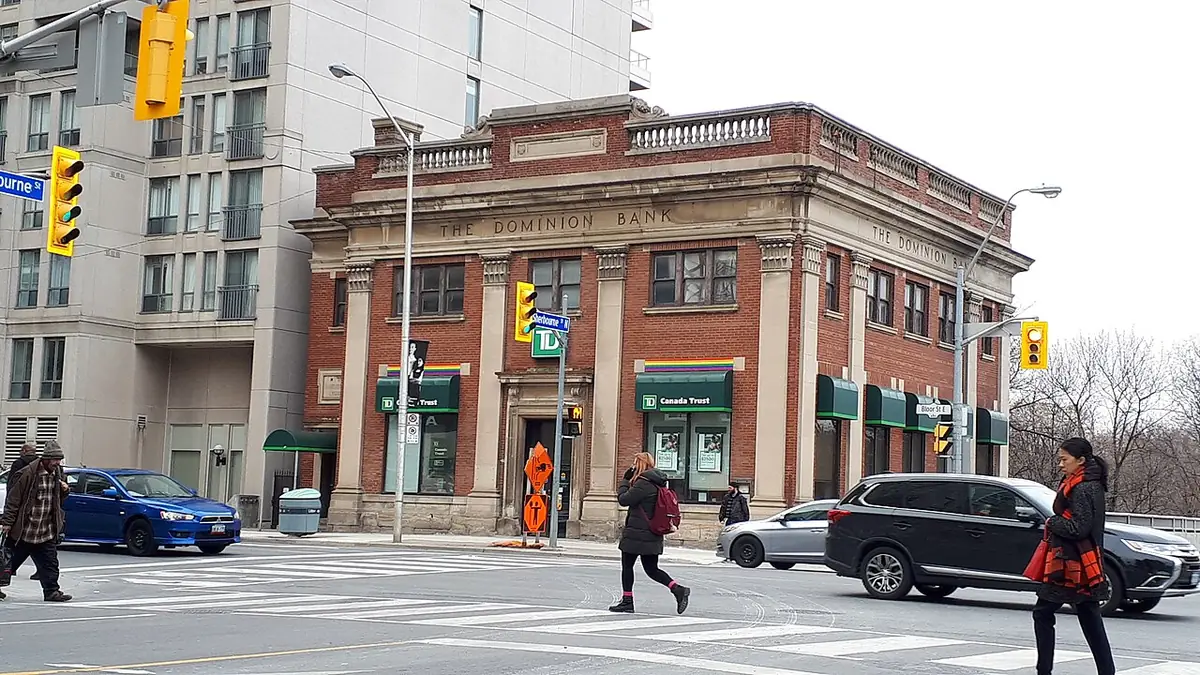
A heritage corner building on a lively Toronto street — Photo: Oaktree b · CC BY-SA 4.0 · Wikimedia Commons
Beyond the headline figure, the legal nature of what you own deserves close attention.
The Toronto market is defined by a persistent shortage of single-family houses, which holds values high despite swings in interest rates. Quoting an average figure only means something once you qualify it by the condition of the property, the size of the lot and the exact location relative to transit corridors. The costs that sit around a transaction (land transfer taxes, legal fees, inspection and property taxes) also shape what a given value is really worth to you. Here are the orders of magnitude to hold in mind when you test an estimate for a Toronto house.
torontoFor saleHouseestimate
Median price / m²CA$8,180Half the apartments sell below this
Median priceCA$994kthe average is 14% higher — a few very large properties pull it up
Most common2 bedrooms73 % of listings
Average size116 m²
By number of bedrooms
Bedrooms
Share of market
Avg price
Price / m²
Avg size
2most common
73 %
CA$1.06m
CA$8,438
126 m²
3
21 %
CA$1.4m
CA$8,180best value / m²
172 m²
4
6 %
CA$1.79m
CA$8,180best value / m²
219 m²
Each row is an average, compared against the area average of CA$8,610 / m². These are indicative estimates of a typical local market, not a measured sample of live listings. Check current listings before relying on them.
What you actually hold: freehold versus shared ownership, and how each is valued
Once the type of property is settled, the chronology of an Ontario transaction follows strict rules.
In Toronto property law, the distinction between outright freehold ownership and shared or condominium forms (condo townhouse or common elements) is fundamental, and it changes the valuation method as much as the paperwork. Two apparently similar properties can carry very different financial obligations and restrictions on use, and the figure has to reflect that. Many owners arriving from abroad underestimate the effect of condominium rules or of the monthly fees attached to certain developments. Knowing what you hold legally is what lets you compare like with like.
Outright freehold ownership
You own both the building and the land it stands on, with no condominium corporation and no collective monthly fees to pay. You alone decide when to replace the roof, repaint the facade or landscape the garden, within municipal bylaws. That full autonomy comes with sole financial responsibility for all maintenance and emergency work, which is exactly what a valuer prices when reviewing the condition of the structure.
What it changesThe figure reflects total freedom of use and the full land value, but it also has to absorb the owner's exclusive exposure to structural surprises and energy upgrades.
Ownership with fees or common elements (condo)
You own your house and its small plot, but you share ownership of private roads, green space or leisure facilities with your neighbours inside a condominium. You must pay monthly maintenance fees and comply with bylaws that are often very strict about external appearance, pets or parking. Both the fee level and the health of the corporation feed directly into what a buyer will pay.
What it changesThe figure gains from a maintained setting and shared services, but it carries a discount for unpredictable fee increases and for the limits placed on how the property can be used.
The rule to understand before you rely on a figure for a Toronto house
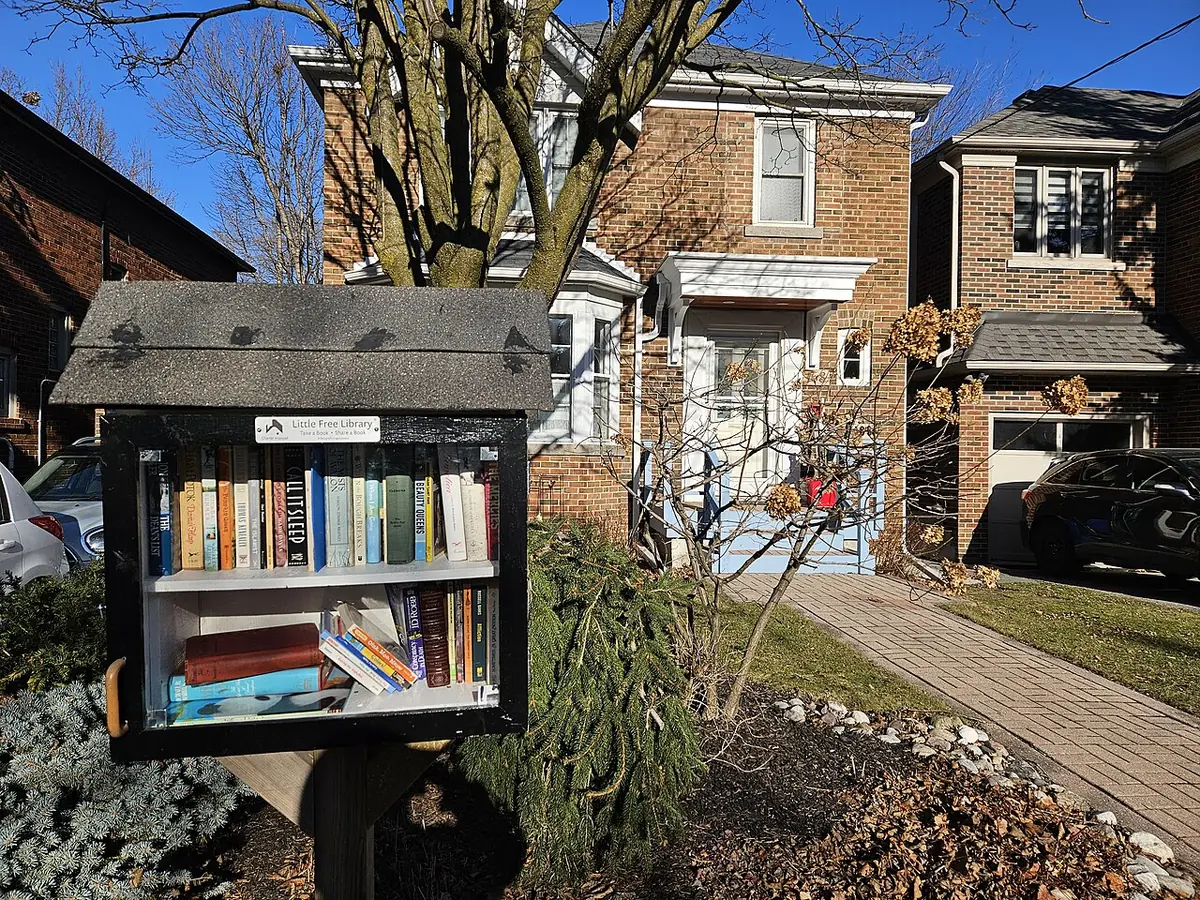
A quiet residential street with a neighborhood book box — Photo: ArthurGron · CC0 · Wikimedia Commons
Let us now look in detail at the people and the sequence behind a well-founded figure.
Valuation in Ontario sits inside a precise contractual machine, in which the agreement of purchase and sale becomes a legal commitment the moment it is accepted. Unlike markets where negotiation stays loose, a firm offer, or one whose conditions are not waived in time, binds you legally and financially at whatever figure it names. Mastering this sequence of checks is the only way to protect both your interests and your deposit, and it is what separates a number on a screen from a value that holds.
The decision to establish a written, costed figure through your registered real estate agent, drawn from recent sales rather than from asking prices.
The seller's acceptance or counter-offer, which fixes the conditions (inspection, financing) and the closing date, and so tests whether the figure survives contact with the other side.
The good faith deposit, usually paid into the listing brokerage's trust account within 24 hours of acceptance, which puts real money behind the number agreed.
The independent building inspection, which detects hidden defects, foundation problems or water ingress and provides the documented basis for adjusting the figure.
The formal waiving of conditions within the agreed deadline, which makes the value firm and final rather than provisional.
The title search and preparation of the legal documents by your real estate lawyer, confirming that what is being valued is what is actually being sold.
Closing day, when funds are transferred and keys handed over by the lawyers, and the figure becomes a recorded comparable for the next valuation on the street.
How a Toronto property is valued and sold, step by step
Getting to a defensible figure in the Ontario metropolis takes method, anticipation and coordination between several local specialists. Each one plays a precise role in testing your finances, securing the legal integrity of the property and completing the transfer. Following this chronology closely keeps administrative gaps and last-minute surprises from undermining the number on signing day.
You and your brokerSetting the budget frame and mortgage pre-approvalMeet a financial adviser or mortgage broker for a pre-approval that fixes your rate and your maximum envelope, which is the ceiling any figure has to work under.
Your real estate agentSelecting comparables and targeted neighbourhood viewingsWork through Toronto's different areas to sharpen your criteria, compare available properties and analyse the record of recent sales, which is the raw material of the estimate.
You and your adviserDrafting and negotiating the agreement of purchase and saleSet out a detailed offer naming the price, the inspection and financing conditions and the possession date, which is where the estimate is put to the test.
The building inspectorDetailed inspection of the structure and the propertyExamine every corner of the house to identify urgent work and the state of the roof, the electrical system and the plumbing, each of which carries a measurable adjustment.
Your real estate lawyerTitle checks and land searchesYour lawyer confirms there are no liens or restrictive easements and arranges title insurance, so that the value covers a clean and transferable title.
The financial institutionsTransfer of funds and signingOn closing day, the mortgage funds are wired to the seller's lawyer and the keys are formally handed over, which is the point at which the agreed value is settled.
House or condominium in Toronto: how the two are valued differently
Now to the concrete financial flows that sit around the figure in the Ontario metropolis.
Comparing a detached house with a condominium unit in Toronto involves far more than taste. It is a structural difference in how value is built: one figure rests on full control of a building and its land, the other on delegated maintenance and shared infrastructure. In a market where urban density constantly redefines neighbourhoods, each form carries long-term financial implications that behave differently over a holding period.
On one side, a single-family or semi-detached house in Toronto carries intrinsic value tied to outright ownership of the land, and land is the component that resists depreciation. You decide on renovations, manage the roof and drive the insulation work without negotiating with a fussy board or restrictive condominium rules, so improvements translate more directly into the estimate. In exchange, that autonomy means direct exposure to every maintenance event, from protecting foundations against the Ontario winter to replacing a gas heating system outright, and a valuer will deduct for each one that is overdue.
A condominium unit, by contrast, offers budget predictability on the building envelope and access to integrated services such as a concierge, security or a gym, all of which support the figure. Monthly fees pool the heavy costs but introduce the risk of unpredictable increases, particularly where the building's reserve fund has been poorly managed in the past, and a weak reserve fund shows up as a discount. Resale of a condominium also responds more directly to swings in an abundant supply, which makes an individual estimate more volatile.
Reading your own figure therefore depends on your tolerance for operational risk and your capacity to absorb unplanned repair costs. If large renovation projects worry you and central neighbourhood life is the priority, the condominium comparables are the right set. If you are looking for a transferable asset with no perpetual monthly charge, house comparables are the right set, despite the far larger capital the metropolis demands.
What to provision around the figure: the costs a Toronto valuation has to be read against
Let us see what daily life looks like under these constraints, through a typical day.
A Toronto valuation stops well short of the money actually involved in owning the property. Multiple local taxes, unavoidable transaction fees and recurring costs weigh on the equation from the first year onwards. Sizing these items rigorously is what turns a headline figure into something you can plan around during the first twelve months in the property.
Transaction costs and initial taxes measured against the value
Cost item
Basis of calculation or estimated rate
Typical budget impact
Municipal land transfer tax
Toronto's progressive municipal scale
Between 1.5% and 2.5% of the value
Provincial land transfer tax
The Ontario provincial land transfer tax
Between 1% and 2% depending on the band
Legal fees
Real estate lawyer's fees and disbursements
Between CAD 1,500 and CAD 3,000
Pre-purchase inspection
Work by a certified professional
Between CAD 500 and CAD 900
First-time buyers may qualify for partial tax credits against the municipal and provincial land transfer taxes, subject to eligibility conditions.
Recurring costs once the property is owned
Type of cost
Payment frequency
Annual order of magnitude
Municipal property tax
Quarterly or monthly instalments
0.6% to 0.7% of the value assessed by the city
Condominium fees (where applicable)
Automatic monthly debit
CAD 600 to CAD 1,200 per month depending on floor area
Comprehensive home insurance
Annual premium or monthly debit
CAD 1,200 to CAD 2,500 per year
Reserve for maintenance
Provision for routine upkeep
1% to 2% of the building value per year
These amounts are indicative and vary with the age of the building, its exact position across the different neighbourhoods and its level of energy efficiency.
Health, schools and transport: what an ordinary Tuesday looks like for a Toronto owner
Beyond that well-drilled routine, some invisible aspects of Toronto property deserve surgical attention.
How a day is organised in the Canadian metropolis depends closely on where a property sits relative to transit corridors and local services, and those are the same factors that carry the figure. Between connections on the TTC network and managing work travel, every hour is timed carefully to avoid losses in the traffic on the Gardiner Expressway, and buyers pay for the minutes saved.
07:30Residential neighbourhood and surroundingsMorning preparation and a check on traffic conditions on the main routes downtown. This is the moment to gauge how winter weather affects journey times, an exposure that shows up in what the street commands.
08:45Subway station or main arteryThe commute via the Toronto Transit Commission network or the GO Transit commuter rail lines. How smoothly the connections run decides whether you reach the office on time, and proximity to those lines is one of the strongest value drivers here.
12:30Business district or local hubA midday break suited to quick errands in the neighbourhood shops or to handling local administrative tasks, such as registering children for school activities. The density of nearby services supports the figure.
17:15School or daycareCollecting children from the public education system or local childcare, a fixed point that forces working hours to be planned tightly. Catchment and school quality are among the features buyers pay for.
19:00Home and local shopsHome again, household tasks and possibly a stop at the corner grocery before the neighbourhood shops close. Everyday convenience of this kind is difficult to quantify but consistently present in the comparables.
What commercial brochures and agents systematically leave out of an estimate
These omissions often lead to bitter disappointments that only register after several months in the property.
Promotional material and virtual tours idealise the urban setting and smooth away the frictions of daily life, and an automated estimate does much the same. Behind the appealing facade of a gentrifying neighbourhood sit technical and regulatory realities that sellers are careful not to put forward, and each of them can move a figure by a meaningful margin.
Densification plans and future construction sites opposite the property
A building permit for a residential tower next door can transform the light, destroy an open view and generate noise for years with no recourse, and none of that appears in a figure drawn from past sales.
The real state of underground infrastructure and municipal plumbing
Many of the city's water mains are decades old, raising the risk of sewer backup during heavy spring or summer rain, a claim that is expensive to handle and that affects both insurance and value.
Restrictive clauses in the condominium rules concerning letting
If you count on short-term letting or on handing the property to a third party occasionally, internal building rules often forbid it on pain of financial penalties, which removes an income stream some estimates quietly assume.
Hidden ageing of central heating and air conditioning systems
An air exchanger or furnace at the end of its life means an immediate bill of several thousand dollars in the first winter, and it is exactly the kind of deduction an inspection turns into a documented adjustment.
The valuation misjudgments that only surface after six months in the property
Given those structural risks, it is worth asking whether this kind of commitment really matches your profile.
Looked likeAn attractively priced opportunity in an area said to be transforming, where the figure looked like a bargain
Turned outAn area clogged with construction traffic, without essential shops open in the evening and poorly served by transit at peak hours, none of which the headline number captured
Would have caught itVisiting the neighbourhood at off hours, especially evenings and weekends, to audit the reality of local life and how access actually flows before you trust the estimate.
Looked likeA charming condominium unit showing modest initial monthly fees, which made the figure look clean
Turned outLax management by the condominium corporation, which had accumulated a structural deficit, leading to a punitive special assessment to fund urgent roof repairs
Would have caught itInsisting on the full reserve fund study and the minutes of the last three owners' meetings before you treat any figure as firm.
Looked likeA characterful older house with period woodwork and a large treed lot, which the comparables valued generously
Turned outA property burdened by period insulation, producing astronomical gas bills through the harsh Toronto winters and a figure that had to be revised down
Would have caught itCommissioning a thorough energy audit and reviewing the previous occupants' consumption bills across a full year before accepting the estimate.
Looked likeParking included or easy to find on the street outside, treated as a value feature
Turned outA municipal parking ban during winter snowstorms, making the car unusable or a source of fines, so the feature was worth much less than it appeared
Would have caught itChecking the exact legal status of the parking and the municipal snow clearing rules that apply to that street before you price it in.
Unusual profiles: who should not act on a Toronto valuation right now?
Time now to pull these elements together and decide whether your own figure is ready to act on.
Home ownership is treated as an article of faith, but it is a financial trap for certain profiles whose personal or working situation lacks stability, however encouraging the headline figure looks. Knowing when to set an estimate aside and rent instead is sometimes the soundest way to protect capital.
The internationally mobile professional, or anyone in an uncertain career transition
→Continuing to rent something flexible rather than acting on a valuation
Transaction costs on the way in and out in Toronto destroy any return if the property is sold before a minimum period of five to seven years, whatever the estimate says today.
The saver with just enough for a down payment and no safety reserve
→Keeping capital in secure liquid investments and waiting for a comfortable cushion
The smallest health problem, drop in income or urgent structural repair would immediately put the budget at risk, and a favourable figure offers no protection against that.
The household still undecided about its family plans over the medium term
→Testing life in different neighbourhoods as a tenant before settling on a definitive area
Acquiring a property unsuited to a fast-changing household forces an urgent resale at whatever the market offers that month, well below any figure you had counted on.
Where your figure stands: is the valuation you hold solid enough to act on?
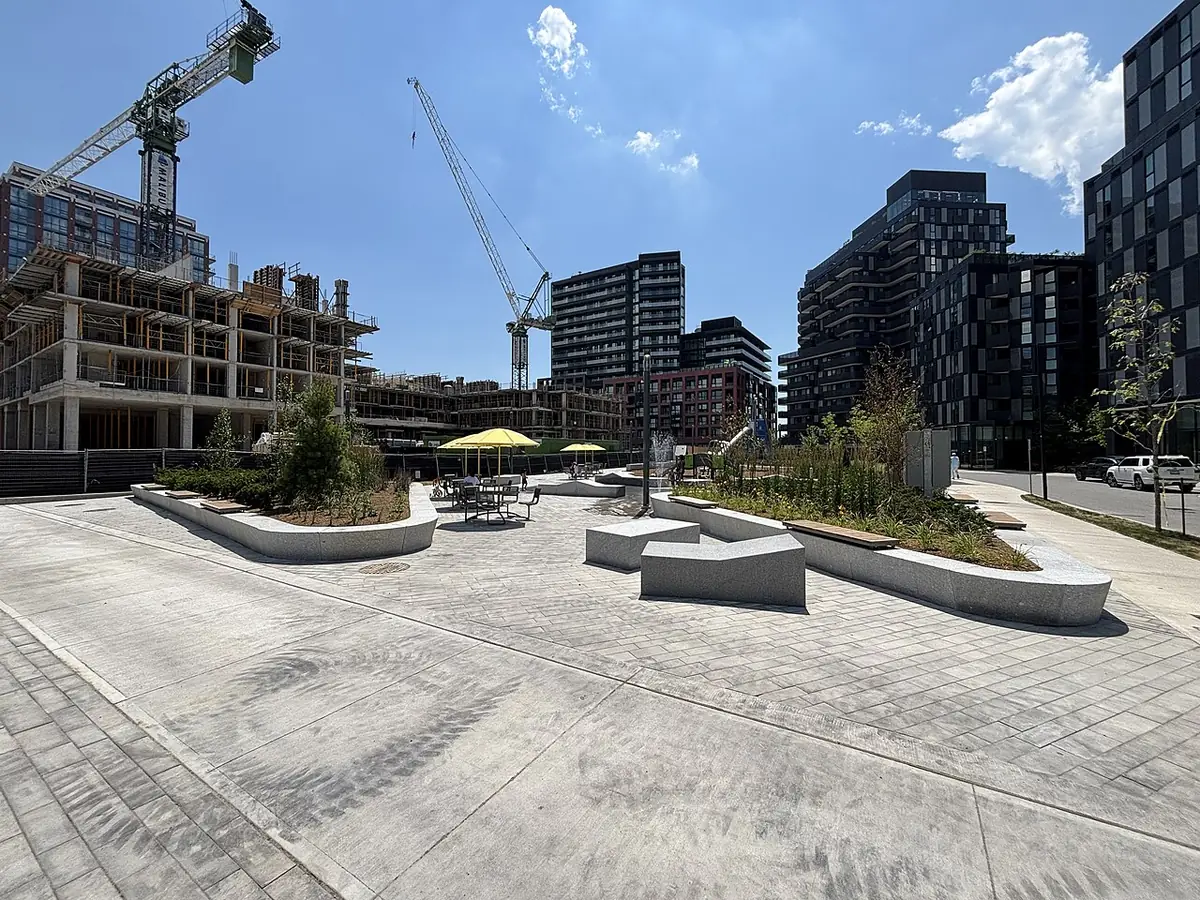
A new public plaza taking shape in Toronto — Photo: Canmenwalker · CC BY 4.0 · Wikimedia Commons
At the end of this analysis, a Toronto property figure should no longer read as an automatic promise or a simple administrative formality, but as the output of a method that demands composure. If your holding horizon runs beyond seven years, if your cash can absorb the land transfer taxes without emptying your emergency savings, and if you accept the operational constraints of Ontario building stock, then the figure you hold is a considered one and you can work from it.
Conversely, if your presence in the metropolis is uncertain, or if the budget looks tight once property taxes and legal fees are folded in, renting remains a formidably effective way to preserve capital and the figure can wait. The Toronto market rewards patience and punishes impulsiveness severely, and it does the same to estimates built in a hurry.
Take the time to test these criteria with your banker and an independent legal adviser before you commit to any figure. Your future peace of mind depends on the rigour of that final check, well away from the flourishes of a sales pitch.
Related questions
What legal fees should a Toronto valuation be read alongside?
Legal fees and lawyer's charges for a Toronto property transaction generally run between CAD 1,500 and CAD 3,000, excluding the municipal and provincial land transfer taxes, which represent a far higher percentage of the price.
How does the municipal land transfer tax work in Toronto?
Toronto applies a double land transfer tax: the Ontario provincial tax and a municipal tax specific to the city. Both are calculated in progressive bands based on the market value of the property changing hands.
Is a building inspection required before a value is agreed?
Although technically optional in some competitive bidding situations, a pre-purchase inspection by a certified professional is strongly recommended to identify hidden defects, foundation problems or ageing electrical installations, all of which move the figure.
What are property taxes typically worth on a Toronto property?
Municipal property tax rates in Toronto are among the lowest in the province as a percentage of assessed value, generally around 0.6% to 0.7%, but they apply to high property valuations.
What monthly charges apply to a condominium unit?
On top of mortgage repayments, monthly condominium fees must be paid (maintenance of common areas, building services, heating or water depending on the rules) and they rise steadily.
Can a non-resident of Canada buy a property in Toronto?
Purchases by non-residents are governed by strict rules, including specific taxes for foreign buyers in certain high-pressure areas of Ontario, intended to curb speculation in the local market.
What minimum down payment is needed for a Canadian mortgage?
The minimum down payment depends on the purchase price. Below CAD 500,000 it is 5%, and it rises in bands above that, with tighter requirements for second homes or rental properties.
How long does a Toronto property transaction take on average?
Between the first viewings on the listing portals and the closing date, allow roughly 30 to 90 days, depending on the conditions negotiated into the offer.
What is the reserve fund in a Toronto condominium?
It is mandatory savings built up by the condominium corporation to meet future major work on the building, such as facade repair, roof replacement or renewing the elevators.
Which Toronto neighbourhoods offer the best balance of price and access?
Outer neighbourhoods well served by transit lines or the GO Transit network have traditionally offered better space-to-price ratios than the downtown financial core, at the cost of a longer commute.
Property review of ting
No ting properties in Toronto yet
Be the first — share it on ting and it shows up right here.