Buying property in Ontario's largest city means understanding the mechanics of a vertical, demanding market. This guide works through the trade-offs that matter between neighbourhoods, ways of living and legal realities, so you can secure your purchase without leaving anything to chance.
Get the app
What nobody tells you.
Real prices, hidden costs and the traps to check before you commit.
What you are really getting when you buy an apartment in Toronto
Scroll
What you are really getting when you buy an apartment in Toronto
Buying property in Ontario's largest city means understanding the mechanics of a vertical, demanding market. This guide works through the trade-offs that matter between neighbourhoods, ways of living and legal realities, so you can secure your purchase without leaving anything to chance.
Written by the ting.ad editorial team ·
Bloor Street East, Toronto in Street View: drag to look around.
Beyond these financial and structural trade-offs, it is your daily life that changes most, and it changes differently depending on the kind of buyer you are.
Buying an apartment in Ontario's largest city is not simply a matter of acquiring residential square metres in a glass tower. It is an entry into a dense urban system where verticality redefines daily life, between strict condominium requirements and being right next to the places where things happen. You need to work out what that density means for your budget and for the way you live day to day. The promise of a panoramic view and built-in amenities often masks structural realities worth examining from the outset.
The promise of a new building with amenities includedvsThe reality of condo fees and the way they climb
Modern towers offer a concierge, a gym and sometimes a pool, but those services translate into monthly maintenance fees that are often high and can be revised upward depending on the building's financial health. You absolutely must assess the strength of the reserve fund to avoid unpleasant surprises after closing.
The appeal of a central location close to transitvsThe squeeze on living space at a high price per square metre
Living along the main corridors or near a subway station saves precious time on the daily commute, but you pay for it with a smaller floor area and direct exposure to city noise. The trade-off between location and size remains the central variable in any purchase here.
The apparent liquidity of an active marketvsRegulatory constraints and competition from investors
While the Toronto market has traditionally shown high transaction volumes, it also feels every jolt in interest rates and every provincial rule aimed at reining in speculation. Buying to resell in the short term carries real financial risk that should not be underestimated.
The apparent independence of owning verticallyvsComplete dependence on the decisions of the condominium corporation
Owning your walls does not mean doing as you please: the building's rules tightly govern short-term rentals, interior alterations and even whether you can keep a pet. That collective governance weighs heavily on your freedom of use from one day to the next.
Does this place really fit the life you have now, and the one you are planning?
For a buyer arriving from abroad, these urban reference points upend familiar assumptions about how you become a homeowner.
Every kind of buyer approaches the Toronto market with particular expectations that quickly meet local realities. The professional who wants mobility, the couple planning for more space and the distant investor are not weighing the same things. You need to hold your actual way of living up against the apartment layouts available in the city's different neighbourhoods, so that nothing disappoints you once you have moved in.
Choosing the busy centre
Opting for a studio or a small one-bedroom in the Core removes the commute entirely and gives you a lively neighbourhood on your doorstep. In exchange you have to accept living in a small space, often with no real private outdoor area, and to put up with very high population density seven days a week. Everything is within walking distance, but the local cost of living weighs heavily on the day-to-day budget on top of the mortgage payment itself.
Planning ahead for family space
Buying a family-sized apartment in Toronto means thinking now about extra bedrooms and about being close to parks and public schools. Large apartments are rare and much sought after, which often pushes buyers toward neighbourhoods a little further from the centre but better served by family infrastructure. You are trading commuting time into downtown against the comfort of a greener, quieter setting.
Managing flexibility
Owning a second home in a managed tower gives you welcome security and very little upkeep while you are away. Even so, you should check the rules on subletting and extended vacancy carefully, because some condominium corporations impose strict limits on occupancy. The fixed costs keep running while the unit sits empty, which calls for disciplined management of the asset.
Choosing comfort and accessibility
Leaving a large single-family house for a well-connected apartment frees you from outdoor maintenance and from clearing snow all winter. The move does mean accepting close quarters in the common areas and giving up private grounds. How well the building is managed then becomes the single decisive factor in how satisfied you are day to day.
Living here when you have come from abroad: what changes completely
St. Gregory Armenian Catholic Church, a Toronto landmark — Photo: Amakuha · CC BY 4.0 · Wikimedia Commons
Once these broad principles have sunk in, everything comes down to which neighbourhood you settle in.
Buying property in Ontario follows legal, financial and cultural codes that sit a long way from the practice many newcomers are used to. Where a single state-appointed officer might handle the deed elsewhere, here independent lawyers act for each side, and the very idea of shared ownership rests on different governance mechanics. Understanding those structural differences is the best way to avoid missteps during negotiation and at signing.
From abroad
The legal certainty of one official deed drawn up by a single neutral officer
Toronto
A real estate lawyer acting independently for each party, with a full title search
The buying process demands more administrative rigour and a specific budget line for legal fees, without the single-officer protection that covers both sides in many other systems.
From abroad
The familiar structure of modest shared-ownership charges
Toronto
Monthly maintenance fees that are often high and cover collective services
Your borrowing calculation has to include these recurring fees from the start, because they weigh on your monthly budget for good and rise steadily as the building ages.
From abroad
A culture of mandatory, standardised technical surveys supplied by the seller
Toronto
The critical importance of the pre-purchase inspection and of reading the condominium corporation's documents
You have to hire your own experts to audit the state of the unit and go through the condominium's financial history, or risk discovering hidden defects or major work already voted through.
From abroad
Mortgage lending tightly framed by a national financial stability regulator
Toronto
Flexible mortgage products, but ones exposed to swings in the policy rate
Negotiating your loan with Canadian financial institutions means understanding fixed versus variable rates and the prepayment penalties that apply.
From abroad
A supply of older homes shaped by stone and history
Toronto
A housing stock dominated by modern concrete and glass towers
Vertical architecture defines the skyline here, which means adapting to standardised construction methods and to insulation designed for hard winters.
Which Toronto neighbourhood suits the pace of your life?
Where you land geographically shows up directly on the price tags you will meet during your search.
Toronto is a mosaic of neighbourhoods with strongly drawn identities, where the atmosphere can change completely from one street to the next. Your choice of location determines not only how easy your daily journeys are, but also how your property holds its value over the long run. It is worth reading the real feel of each area before narrowing your search on the local market.
Downtown / Entertainment District
Constant activity set by the flow of pedestrians, the noise of construction and theatres and offices right there beside you.
Suits
Working people who want to cut commuting to the bare minimum and enjoy a dense cultural and night-time scene without a car.
Trade-off
Outdoor space reduced to almost nothing, a high price per square metre and a visual density that can feel stifling day after day.
King West / Queen West
A stylish mix of art galleries, independent cafes, designer boutiques and a young, creative population.
Suits
People after a lively, fashionable and highly walkable setting, with a heavy concentration of restaurants and places to meet up.
Trade-off
Housing stock in high demand, where competition is fierce and units sell fast and often at a premium, with late-night noise.
The Annex / Yorkville
Streets lined with mature trees, historic Victorian houses beside quieter residential buildings, and elegant shopping avenues.
Suits
Buyers who value calm, proximity to the university campuses and leafy parks, and a more residential, established atmosphere.
Trade-off
A purchase budget well above the city average and a narrower supply of condominium units to choose from.
St. Lawrence / Waterfront
A smooth transition between the historic market quarter and the shore of Lake Ontario, with room to walk and more open air.
Suits
Those who like being near the water, local producers' markets and a slightly more spacious layout than the financial core offers.
Trade-off
Areas that can be swept by cold winds off the lake in winter, and a mood that can feel a little quiet in the evening depending on the street.
What does an apartment on the Toronto market really cost?
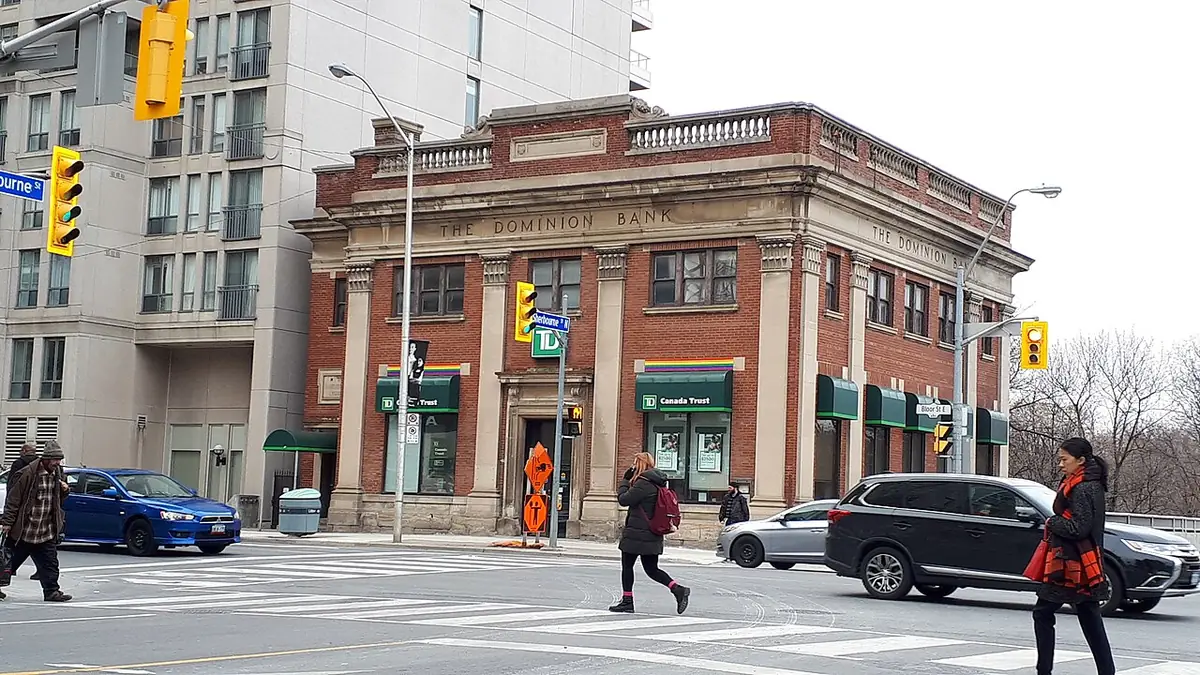
A heritage corner building on a lively Toronto street — Photo: Oaktree b · CC BY-SA 4.0 · Wikimedia Commons
Beyond the raw numbers, the legal nature of what you are buying deserves particular attention.
Working out what a Toronto purchase costs does not stop at the asking price. You have to fold in all the related costs, from the municipal and provincial land transfer tax to the inspection fee, by way of the monthly condo fees. Price ranges vary considerably with floor area, the age of the building and exactly where it sits relative to the transit lines.
torontoFor saleApartmentestimate
Median price / m²CA$9,975Half the apartments sell below this
Median priceCA$690kthe average is 14% higher — a few very large properties pull it up
Most common1 bedroom48 % of listings
Average size66 m²
By number of bedrooms
Bedrooms
Share of market
Avg price
Price / m²
Avg size
1most common
48 %
CA$578k
CA$11,550 +10 %
50 m²
2
38 %
CA$741k
CA$10,290
72 m²
3
11 %
CA$978k
CA$9,975best value / m²
98 m²
4
3 %
CA$1.25m
CA$9,975best value / m²
125 m²
Each row is an average, compared against the area average of CA$10,500 / m². These are indicative estimates of a typical local market, not a measured sample of live listings. Check current listings before relying on them.
What you can actually own: understanding Toronto condominiums
That legal rigour carries into the precise choreography of the transaction, where every step is closely governed.
On the Toronto property market, the legal form of your purchase radically changes how much control you have over the unit and what you owe financially. Between the standard condominium and co-operative or other shared tenure forms, the rules of the game are not the same. It is essential to establish the legal framework of your future home before committing to an offer.
The standard condominium: private unit plus shared common elements
You buy the interior of your home along with a share of the building's common elements (corridors, elevators, recreation facilities). Management sits with a board elected by the owners and is carried out by a professional management company. The condominium's rules are often strict, in order to protect the quiet enjoyment and the appearance of the whole building.
What it changesYou get built-in services without having to look after the roof or the facade yourself, but you have to live with collective decisions and accept fee increases voted through at owners' meetings.
Alternative forms of shared ownership and what makes them different
Some residential complexes use co-operative structures or complex land tenures where the resale rules, the criteria for approving buyers and the availability of bank financing differ noticeably from a standard condo. These options sometimes offer a lower entry price, but they sharply restrict your freedom to rent out the unit or to sell it to a buyer of your choosing.
What it changesYou need to go through the governing documents carefully with your real estate lawyer, so that you are not blocked later when you want to sell or to change how the property is used.
The rule to understand before you hand over a deposit
A quiet residential street with a neighborhood book box — Photo: ArthurGron · CC0 · Wikimedia Commons
To get through this properly, it helps to picture the chronological chain of people and actions.
Buying property in Ontario rests on strict contractual commitments as soon as the conditions are waived. Unlike markets where an offer can be withdrawn easily, a firm offer once accepted binds you legally and financially in a very serious way. Understanding the sequence of conditions is the best shield against committing too early.
Your real estate agent drafts the conditional offer to purchase.
The formal offer goes to the seller, with a deposit held in trust that is often required within 24 hours of acceptance.
A conditional period opens (usually 3 to 7 days) in which the home inspection is carried out and the condominium documents are reviewed.
Final confirmation that your mortgage financing has been approved by your financial institution or your mortgage broker.
Formal written waiver of the conditions, which makes the offer irrevocable and final, on pain of losing your deposit if you back out without cause.
The lawyers register the transfer of title on the closing date.
How a property transaction unfolds, step by step
From the first viewing, whether off plan or in person, to the handover of keys on closing day, a property transaction follows a tight calendar involving several professionals working in step. Knowing that sequence lets you plan for the administrative delays and prepare for each payment without being rushed.
You and your agentSearching and reading the neighbourhoodsTargeted viewings of what is available, a comparative analysis of the local market and a shortlist of areas that fit your way of living and your budget.
Your real estate agentDrafting and negotiating the offerSetting the price offered, framing the conditions (inspection, financing, condominium documents) and negotiating with the seller.
Home inspectorThe technical audit and the review of the Status CertificateA careful check of the unit's condition and a critical reading of the owners' meeting minutes and the engineer's report on the building.
Financial institutionFinal mortgage approvalDefinitive confirmation of the financing terms and issue of formal instructions to the lawyer handling your file.
Lawyers for both partiesTitle search and preparation for closingSearching title, calculating the pro-rated property taxes and condo fees, and drafting the legal transfer documents.
Everyone involvedClosing day and the handover of keysTransfer of the final funds, official registration of the transfer of title in Ontario's land registry and the handover of the keys to your new apartment.
Condominium apartment or house: which choice makes sense in Toronto?
Once that fundamental choice between the vertical condo and the horizontal house is settled, the unavoidable question of what it actually costs arrives immediately.
The choice between a condominium apartment, commonly called a condo in Toronto, and a house is the first real financial and logistical fork in the road for anyone buying in Ontario's largest city. The Toronto property market is not simply a question of floor area or the number of bedrooms; it is fundamentally a choice between the delegated management of an ultra-central urban life and outright ownership of land that demands considerable time and work. Condos have traditionally offered a more accessible way into ownership downtown, letting you live within walking distance of heavy transit such as the Yonge-University subway line or the Queen Street streetcars, while pooling the cost of maintaining the structure, the roof and shared facilities like the gym or the outdoor pool.
A house, whether detached or semi-detached, speaks instead to buyers ready to accept the volatility and the burden of upkeep in exchange for complete independence and the long-term appreciation of the land. In established residential neighbourhoods such as The Danforth, Roncesvalles or North Toronto, the appeal of a private garden and the absence of monthly condo fees exert a lasting pull, particularly on families with children. That independence carries a prohibitive entry cost, though, and comes with direct exposure to Ontario's weather, where hard winters test foundations, gutters and heating systems with no condominium corporation to spread the bill.
Comparing the two ways of living shows that a Toronto condo imposes strict rules set out in its governing documents, covering short-term rentals of the Airbnb type as much as keeping pets or using the common areas. Those constraints, irritating as some find them, guarantee a predictable immediate environment and protect the building's market value against individual neglect. In return, the monthly condo fees, calculated by the square foot, keep climbing under the pressure of energy costs and the reserve fund funding requirements set by Ontario legislation. A careful buyer therefore has to look well past the headline price on the listing and take apart the building's financial record to avoid nasty surprises.
In the end, whether you buy an apartment rather than a house in Toronto depends closely on your investment horizon and your tolerance for operational risk. If you value easy daily journeys into the Financial District and refuse to spend your weekends mowing a lawn or clearing an icy driveway, the urban condo wins on sheer logistical efficiency. If instead you want to root your family in a neighbourhood community while betting on the absolute scarcity of Toronto land in the decades ahead, buying a house, even one needing energy-efficiency work, remains the classic way to build wealth.
What does it really cost to live in Toronto and own your home there?
Mastering these numbers in theory is one thing, but seeing how a typical day in this city actually fits together is what will confirm where you should settle.
Building a purchase and living budget for Toronto cannot stop at the mortgage payment to your financial institution. You have to include the municipal property tax, the monthly condo fees that cover the common expenses and the contribution to the reserve fund, and the high cost of home insurance. This overall cost structure decides whether your purchase is viable over the medium term and protects your household against sharp moves in Canadian interest rates.
Recurring monthly costs for a 750 square foot apartment in Toronto
Cost item
Monthly range (CAD)
Analysis
Condo fees
$550 to $850
Cover water, upkeep of the common elements and sometimes heating, depending on the age of the building.
Municipal property tax (City of Toronto)
$300 to $500
Calculated on the assessed value set by the assessment authority, at rates that have historically been moderate but are rising.
Home insurance
$60 to $110
Essential to cover liability and the water damage that is common in high-rise buildings.
Utilities (electricity, internet)
$120 to $220
Electricity (Toronto Hydro) varies a great deal with how much central air conditioning you run during summer heat waves.
These figures are indicative and based on the averages observed for a standard two-bedroom apartment in the central neighbourhoods.
Health, transit and amenities: what does an ordinary Tuesday look like for a resident?
If that city routine looks idyllic on the surface, plenty of crucial details escape you entirely at a first viewing.
How smoothly your day runs in Toronto depends directly on how close you are to the transit infrastructure run by the Toronto Transit Commission (TTC). Living in an apartment in the central or semi-central neighbourhoods changes how you get around, cutting your dependence on a personal car in favour of a mix of the subway, the historic streetcars and the cycle lanes. Here is how an ordinary Tuesday tends to unfold for a settled resident.
07:30Residential street and the local subway stationLeaving the apartment and walking five minutes through tree-lined streets to reach the station on the main line, avoiding the morning jams on the Gardiner Expressway.
08:15The commute into the Financial DistrictA fast, reliable subway ride, the ideal moment to catch up on local news or plan the working day in the heart of the business district.
12:30Lunch break in the shopping districtStraight into the bustle of the neighbourhood, with immediate access to a range of food that reflects the city's distinctive multiculturalism.
17:45Local shopping and neighbourhood grocersA strategic stop on the way home at a specialist grocer to pick up fresh food without needing a car.
19:30Unwinding in a neighbourhood green spaceA walk in a local park after dinner, a reminder of how much the green lungs woven through the dense built-up areas matter.
Hidden rules and condo boards: what the listing will never tell you
These administrative blind spots explain why so many buyers voice bitter regrets only a few months after taking the keys.
The Toronto market has its own unwritten rules and legal subtleties, and they can turn your purchase into an ordeal quickly if you are not watchful. Behind flattering professional photography and immaculate staging sit technical and administrative realities that listing agents frequently leave unmentioned to buyers who do not know to ask.
Strict limits on short-term rentals (Airbnb)
The City of Toronto and the great majority of condominium corporations formally prohibit Airbnb-style rentals for stays shorter than 28 days. Ignoring that rule exposes owners to steep fines set directly by the building's board.
The true state of the condominium's reserve fund
An underfunded reserve in a building more than twenty years old is the clearest possible warning of a future special assessment charged to every owner to pay for replacing the elevators or the roof.
Severe rules on keeping pets
Some Toronto condominiums impose weight limits or ban large dogs outright. Failing to check the building's rules before you buy can force you to give up your pet.
The complexity of long land leases (leasehold)
A minority of Toronto apartment towers stand on land the condominium does not own, which creates major legal uncertainty as the long-term ground lease approaches renewal.
Buyer's remorse: what people discover six months after moving in
Faced with these traps and possible disappointments, it is fair to ask whether this kind of purchase really suits your own situation.
Looked likeA clear, spectacular view of the downtown skyline from the nineteenth floor.
Turned outAn enormous construction site for a new fifty-storey tower opened directly opposite, blocking the natural light and generating noise from seven in the morning to seven in the evening.
Would have caught itAlways checking the municipal planning framework and the building permit applications filed with the City of Toronto for every lot within two hundred metres.
Looked likeExtremely attractive, low condo fees at the time of purchase.
Turned outA sudden thirty percent increase in the monthly fees, voted at the first owners' meeting to cope with rising facade maintenance contracts and energy costs.
Would have caught itInsisting on the full history of condo fee increases over the past five years and reading how the budgets voted by the previous owners have moved.
Looked likeA fashionable, lively neighbourhood with plenty of trendy bars and restaurants.
Turned outConstant late-night noise at weekends, no visitor parking for family and friends, and chronic difficulty driving anywhere during major events.
Would have caught itVisiting the immediate surroundings of the building at various hours of the night and over a weekend before signing a firm offer.
Looked likeModern soundproofing promising complete quiet between neighbours in a recent building.
Turned outPoor-quality drywall partitions letting through impact noise from the floors above and conversations from the corridors.
Would have caught itChecking the construction date and compliance with Ontario's acoustic insulation standards, or arranging a second viewing in complete silence to test the acoustics.
Who should definitely not buy an apartment in Toronto right now?
Now that every facet has been examined closely, the moment of decision has arrived.
Buying in Toronto is not a universal solution, and it carries serious financial and personal risks for buyers who are ill-suited to the constraints of Canadian urban condominium life. A poor fit between your short-term plans and the rigidity of the Ontario mortgage market can turn a wealth-building purchase into a money pit. It matters to work out honestly whether you are one of the profiles who should hold off in the current economic climate.
The expatriate or professional on a short international posting
→Postponing the purchase and renting flexibly in Toronto's private rental market.
The transaction costs (provincial and municipal land transfer tax, agency fees and mortgage break penalties) require a holding period of at least five to seven years before appreciation can absorb them fully.
The buyer whose down payment is stretched thin with no safety savings
→Building a solid financial cushion before going into the market.
Having no cash available to meet an unforeseen special assessment or a sudden rise in variable rates exposes the household to a forced sale at a low price if anything goes wrong.
The keen renovator who wants to make major structural changes
→Looking at a house to renovate rather than an apartment.
The rules in Toronto condominiums forbid altering load-bearing structures or moving drainage, and severely restrict the hours and the types of work permitted inside individual units.
So, are you ready to buy a home in Toronto?
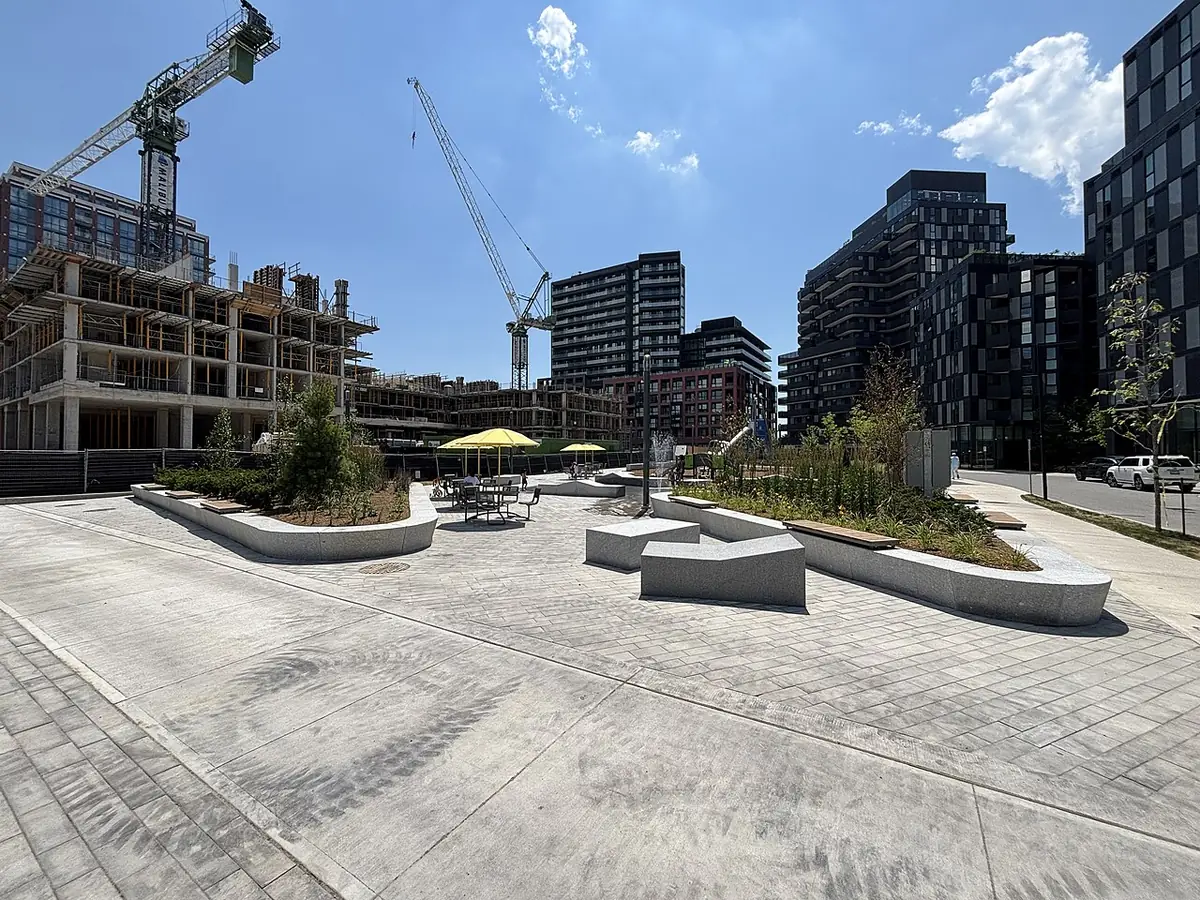
A new public plaza taking shape in Toronto — Photo: Canmenwalker · CC BY 4.0 · Wikimedia Commons
Deciding to buy an apartment in Toronto means moving past the emotional lift of finding a bright unit and taking on the full complexity of a long-term financial commitment. Ontario's largest city offers unmatched professional and cultural opportunities, but its property market forgives neither improvisation nor ignorance of the local rules. Your approach has to rest on a cool assessment of your finances, your job security and your tolerance for the constraints of condominium living.
If you have confirmed the strength of your down payment, allowed for every recurring cost beyond the mortgage payment itself, and accepted the strict rules set by condominium boards, then buying an apartment in Toronto's central or well-connected neighbourhoods is a sound choice. It is a bet on the economic vitality of Ontario and on the lasting scarcity of well-located urban land close to the TTC network.
If, on the other hand, there is any doubt about your working life three or five years out, or if the prospect of special assessments voted at an owners' meeting would cost you sleep, renting remains a financially healthy alternative with none of the operational stress. The Toronto market will still be there when your personal situation and your savings buffer line up to carry the purchase comfortably.
Related questions
What legal fees and taxes should you budget for when buying property in Toronto?
In Toronto, the buyer pays the provincial Land Transfer Tax as well as a municipal land transfer tax specific to the City of Toronto, which doubles the tax bill on transactions inside the city. On top of that come the fees of the real estate lawyer, the appraisal costs and the adjustments for property taxes the seller has already paid in advance.
Can you buy an apartment in Toronto if you are not a Canadian resident?
Yes, a foreign citizen or a non-resident can certainly buy property in Toronto, but the purchase is subject to strict federal and provincial rules, including Ontario's Non-Resident Speculation Tax, which adds substantially to the total cost of the deal.
How does the offer process work on the Toronto market?
The Toronto market traditionally works through offers presented on a set date chosen by the seller, which frequently leads to bidding wars when demand in an area outstrips the supply on hand. It is strongly advisable to include conditions for a home inspection and for financing, although some buyers waive them to win the property at the expense of their own protection.
What is the 'Status Certificate' for a Toronto condo?
The Status Certificate is an official and mandatory legal document provided by the condominium corporation setting out the financial health of the building, the exact size of the reserve fund, any litigation under way, the building's rules and the amount of the monthly fees. Having a lawyer or a specialist agent read it closely is the single most critical step before waiving the conditions on an offer.
Which neighbourhoods are most sought after for buying an apartment in Toronto?
The most prized areas take in the central Downtown (the Financial District and the Entertainment District), the lively King West and Queen West districts, and desirable residential pockets such as The Annex, Yorkville, Leslieville and Roncesvalles. Each neighbourhood has a radically different price per square foot and a radically different feel.
Why does the reserve fund matter so much in a condominium?
The reserve fund is the collective savings built up from owners' monthly contributions to pay for the building's major future work (roof, elevators, facade repairs, central heating system). An underfunded reserve inevitably exposes owners to heavy special assessments at short notice.
How do Canadian mortgage rates affect what you can afford?
Movements in the Bank of Canada's policy rate feed straight through to the interest rate financial institutions offer on your mortgage, raising or lowering your maximum borrowing capacity. Regulatory stress tests require banks to check that you could still repay at a rate above the one actually written into your contract.
Do you have to use a real estate agent to buy in Toronto?
Using a real estate salesperson is not strictly required in law, but it is strongly advised on the Toronto market given the complexity of the standard OREA contracts, the access to historical transaction data on MLS and the command of local bidding practices.
What should a pre-purchase inspection of an older apartment look out for?
For units high in a tower, the inspector should focus on the condition of the plumbing inside the unit, the risk of water getting in through balconies or window walls, and the state of the appliances included. For the common elements, it is the Status Certificate that takes the place of a physical inspection of the foundations and the roof.
What tax breaks exist for a first purchase in Ontario?
First-Time Home Buyers can claim federal and provincial tax credits as well as partial Land Transfer Tax rebates, subject to residency conditions and purchase price ceilings, which lowers the cost of getting into your first home.
Property review of ting
No ting properties in Toronto yet
Be the first — share it on ting and it shows up right here.