

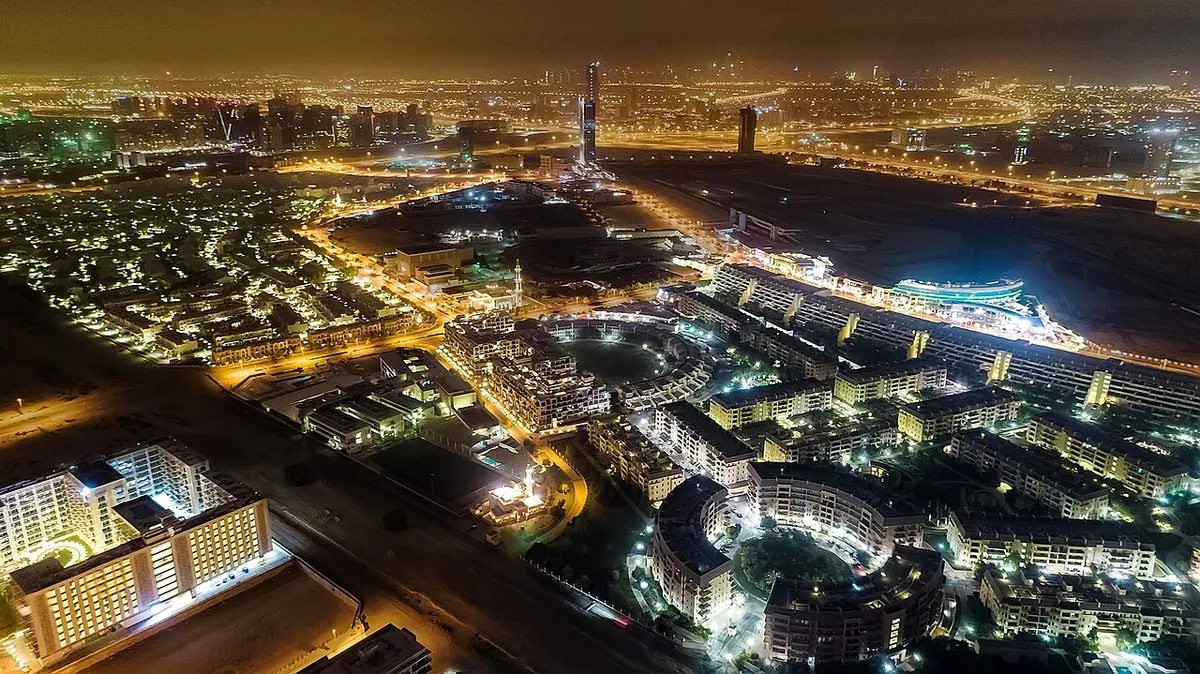
The vibe
Motor City feels calmer than its location — roughly 30 minutes from both Downtown Dubai and Dubai Marina — might suggest. Low-rise buildings, greenery, wide cycling paths, and a layout that discourages cut-through traffic give it a quiet residential character most of the time. When the Autodrome hosts events, there's a buzz that the community either loves or puts up with, depending on who you ask. The Dubai Autodrome is a genuine community asset for motorsport fans — track days, karting, racing events, and driver training programmes are all available to residents.
The community attracts a broad mix: families drawn by the space and schools, young professionals priced out of closer-in communities, and motorsport enthusiasts for whom the Autodrome access is the whole point. There's a strong sense of community, with a local Facebook group and WhatsApp network that most long-term residents are plugged into.
Property and rents
At an average price of around AED 1.82 million, Motor City sits in the accessible end of mid-market Dubai. The range is wide — from AED 590,000 for smaller apartments up to AED 7.4 million for larger villas — but the typical transaction is an apartment or mid-size townhouse in the AED 1–2.5 million bracket. Annual rents average AED 133,542, broadly in line with comparable suburban communities. Apartments typically rent in the AED 70,000–110,000 range; villas and Green Community Motor City homes are naturally higher.
The per-sqft average is not published in our verified data, but the community's value proposition is clear: you get significantly more floor area per dirham than you would in closer-in communities. Investors benefit from a stable tenant base — families tend to commit to multi-year leases here — and the overall price appreciation story has been positive through 2024–25.
Getting around
Motor City's single biggest practical challenge is transport. There is no metro station in or immediately near the community, and the bus network is limited. Driving is the only realistic daily option, and the commute to Downtown Dubai, DIFC, or Dubai Marina typically runs 30–40 minutes in normal traffic — longer during peak hours. Sheikh Mohammed Bin Zayed Road provides the main arterial connection, and Al Qudra Road adds useful flexibility for reaching Abu Dhabi or the southern suburbs.
Within the community, it's genuinely walkable — the cycling paths and pedestrian routes are well-maintained, and residents regularly walk or cycle to the local retail strip, parks, and the Autodrome facilities. The gap is anything beyond the community boundary, where car dependency is total.
Schools and daily life
Motor City's amenities cover the essentials well. Supermarkets, pharmacies, a clinic, a gym, and a reasonable spread of cafes and casual restaurants are all within walking distance of most apartments. The community retail strip around Umm Suqeim Street has enough variety to handle day-to-day life without needing to leave. For weekly shopping or specialty needs, a drive to nearby communities adds 15–20 minutes.
Schools in the immediate area include Victory Heights Primary School and a range of options in nearby Dubai Sports City and Arabian Ranches. The catchment area for schooling is manageable, though families will drive rather than walk to school regardless of which option they choose. Healthcare requires a drive — either to the nearby Mediclinic or further toward Al Barsha or Jumeirah.
Who Motor City suits
Value-seekers who want genuine suburban quality — space, greenery, a community feel — without the price tags of Arabian Ranches or Jumeirah Golf Estates will find Motor City a compelling package. Families appreciate the layout and low-traffic streets. Motorsport enthusiasts get access to the Autodrome that is simply unmatched anywhere else in Dubai. Young professionals willing to drive to work gain significantly more space per dirham than closer-in options.
It's less suited to anyone who works long hours and can't afford the commute time, or who expects walking-distance metro access. The honest summary: Motor City delivers a high quality of daily life for residents who've accepted that Dubai's outer-suburban communities work better with a car than without one.
I cover Dubai's quieter communities — the ones that don't make the Instagram feed but make the most liveable homes.
FAQ
What is special about Motor City in Dubai?
Motor City is built around the Dubai Autodrome, a FIA-grade motorsport facility that hosts racing events, track days, and karting. It offers a unique combination of suburban calm and motorsport access that no other Dubai community can match.
What is the average property price in Motor City?
Average property prices are around AED 1.82 million, with a range from AED 590,000 for smaller apartments to AED 7.4 million at the top end. It sits in the accessible mid-market segment for Dubai.
Is there a metro station in Motor City?
No. Motor City has no metro station and limited public bus service. A car is required for practical daily living. The nearest major road connections are Sheikh Mohammed Bin Zayed Road and Al Qudra Road.
Is Motor City good for families?
Yes. Low-rise buildings, green parks, cycling tracks, playgrounds, a calm environment and multiple school options in the vicinity make it popular with families. The community has a well-established, neighbourly character.
What is the average rent in Motor City Dubai?
Annual rents average around AED 133,542 across all property types. Studio and one-bedroom apartments start from around AED 55,000–75,000; villas in Green Community Motor City are significantly higher.
How far is Motor City from Downtown Dubai?
Approximately 30–40 minutes by car depending on traffic. There is no direct public transport route, so all commuting is by car or rideshare.
Post review of ting
 change background colour (opens in a new tab)


change background colour
 change background colour (opens in a new tab)
 change background colour
 Own a Premium Address in Silicon Oasis, Dubai! 🏙️✨ Discover this… (opens in a new tab)
  Ting - Dubai
 Own a Premium Address in Silicon Oasis, Dubai! 🏙️✨ Discover this…
 They say racing is 90% preparation, but sometimes the remaining 10%… (opens in a new tab) Ting - Dubai
 They say racing is 90% preparation, but sometimes the remaining 10%…
 hello (opens in a new tab)
  yaam
yaam hello
 On teste l’un des meilleurs burger du champions burger à Paris : le… (opens in a new tab) yaam
 On teste l’un des meilleurs burger du champions burger à Paris : le…
 Dear Grandma — (opens in a new tab) yaam
 Dear Grandma —
 SDASCF (opens in a new tab)