

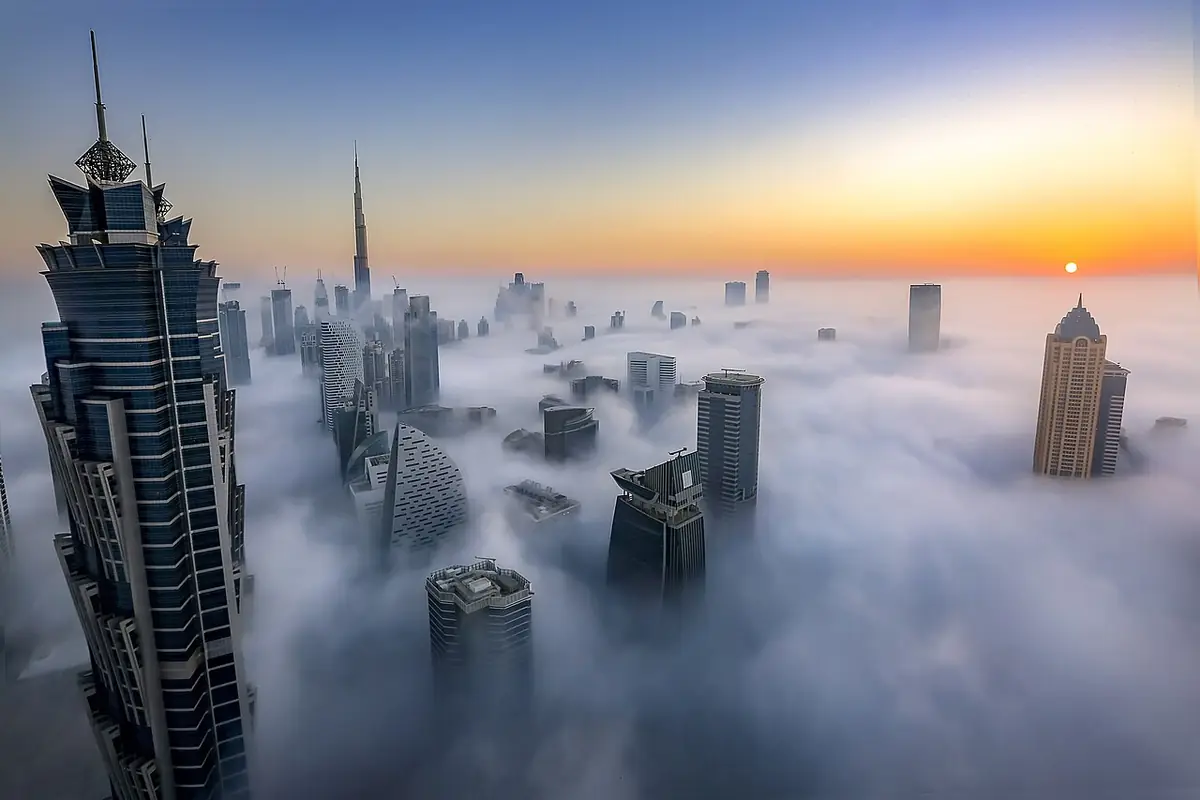
The vibe
Emirates City is a practical, unpretentious place to live. It is not a lifestyle destination — there are no beach clubs, rooftop lounges, or destination restaurants. What it offers is decent housing at genuinely low cost, functional connectivity to the wider UAE, and a community that is predominantly made up of working professionals and families who have made a deliberate value-over-gloss choice. The towers are dense and the environment is urban rather than leafy, but the community is generally safe, well-maintained, and has the basic services residents need day to day.
Ground-floor retail units across the development carry salons, pharmacies, convenience stores, and small eateries. It functions as a self-contained residential zone for essential needs, though anything beyond basics requires a drive out.
Property and rents
The numbers here are striking by any UAE standard. An average property price of AED 482,000 — with entry points from AED 164,600 — places Emirates City among the most accessible freehold residential markets in the greater Dubai-Ajman corridor. The extremely wide range up to AED 17.5 million is unusual and likely reflects a small number of atypical commercial or large-format units skewing the ceiling; the typical apartment transaction sits well below AED 2 million.
Annual rents averaging AED 23,726 are exceptionally low — this is Ajman pricing, which Numbeo data suggests runs roughly 50% cheaper than equivalent Dubai accommodation. For single professionals, couples, and small families who need to keep housing costs down, the value proposition is hard to argue with. Rental yields for investors can be attractive in percentage terms, though the absolute rent values are modest. The trade-off is that capital appreciation has historically been slow, and the market is supply-rich.
Getting around
The E311 is Emirates City's lifeline. Direct motorway access puts Sharjah roughly 15 minutes away and central Dubai 40–60 minutes in moderate traffic. The honest reality is that peak-hour congestion on the E311 approaching Dubai can be brutal — residents who commute daily to DIFC or Downtown should budget 60–90 minutes in morning traffic. There is no metro. Most residents drive; some use shared taxis or inter-emirate buses for the Sharjah-Dubai leg and switch to the metro at Sharjah-border interchange zones.
Within the community, the layout is driveable and parking is generally available, which is a meaningful advantage over denser urban areas in Dubai.
Amenities and daily life
Emirates City is self-sufficient for basics: groceries, salons, pharmacies, and casual dining are all accessible within the development. For a full supermarket, mall shopping, or healthcare beyond a clinic, residents typically drive to nearby Ajman commercial areas or cross into Sharjah. Ajman as a whole has been improving its retail and healthcare infrastructure, with a number of malls and hospitals now within a short drive. Schools in and around Al Amerah cater to the community, with several international and government options accessible.
Who it suits
Emirates City makes the most sense for three kinds of residents: professionals who work in Sharjah or are happy to commute and want maximum housing value; small families or couples who need a clean, functional home at the lowest possible UAE cost; and investors seeking high-yield rental income from a low entry price, accepting that capital growth will be gradual. It is not a lifestyle community in the Dubai sense, and anyone prioritising beach access, nightlife, walkable retail, or proximity to central Dubai should look elsewhere. But for clear-eyed value seekers, it delivers what it promises.
I focus on the areas that don't always make the glossy magazine spreads — the ones where real people make real housing decisions — and I try to give them the same rigour as any prime market guide.
FAQ
Is Emirates City in Dubai or Ajman?
Emirates City is in Ajman, specifically in the Al Amerah district. It is close to the Dubai and Sharjah borders and sits directly on the E311 highway, giving fast access to both emirates.
What is the average property price in Emirates City?
The average property price is approximately AED 482,000, with entry-level units from around AED 164,600. Most typical apartment transactions fall well below AED 2 million.
What are average rents in Emirates City?
Annual rents average around AED 24,000 — among the most affordable residential rents in the UAE. Individual units vary by size and floor, but the market is broadly accessible even on modest incomes.
How far is Emirates City from Dubai?
It is approximately 40–50 minutes from central Dubai in moderate traffic via E311. Peak-hour commutes can stretch to 60–90 minutes, so commuters should factor this in carefully.
Is Emirates City a good investment?
It can offer strong rental yields due to low entry prices, but capital appreciation has historically been slow. It suits investors seeking income returns rather than capital growth, ideally across a portfolio of units.
What types of properties are available in Emirates City?
Primarily high-rise apartments from studios to four-bedroom units, plus some villas. The development is predominantly residential towers with ground-floor commercial units.
Post review of ting
 change background colour (opens in a new tab)


change background colour
 change background colour (opens in a new tab)
 change background colour
 Own a Premium Address in Silicon Oasis, Dubai! 🏙️✨ Discover this… (opens in a new tab)
  Ting - Dubai
 Own a Premium Address in Silicon Oasis, Dubai! 🏙️✨ Discover this…
 They say racing is 90% preparation, but sometimes the remaining 10%… (opens in a new tab) Ting - Dubai
 They say racing is 90% preparation, but sometimes the remaining 10%…
 hello (opens in a new tab)
  yaam
yaam hello
 On teste l’un des meilleurs burger du champions burger à Paris : le… (opens in a new tab) yaam
 On teste l’un des meilleurs burger du champions burger à Paris : le…
 Dear Grandma — (opens in a new tab) yaam
 Dear Grandma —
 SDASCF (opens in a new tab)