Investing in a house in Al Ain, the garden city of the Emirates, means understanding local dynamics well beyond the listings. This guide takes a close look at the neighbourhoods, the real budgets, the legal framework for freehold ownership and the essential steps to secure your property purchase with complete peace of mind.
Get the app
What nobody tells you.
Real prices, hidden costs and the traps to check before you commit.
What you really get when you buy a house in Al Ain
Scroll
What you really get when you buy a house in Al Ain
Investing in a house in Al Ain, the garden city of the Emirates, means understanding local dynamics well beyond the listings. This guide takes a close look at the neighbourhoods, the real budgets, the legal framework for freehold ownership and the essential steps to secure your property purchase with complete peace of mind.
Written by the ting.ad editorial team ·
Al Ain in Street View: drag to look around.
Understanding this property reality leads naturally to looking at how your own profile fits the pace of the city.
Buying a property in this garden city of the Emirates is about more than acquiring square metres. It gives you access to a distinctive way of life, shaped by ever-present palm groves and a low-rise, far more spread-out urban layout than in the coastal cities. The local property market offers generously sized homes, often designed for long-term family life, but it comes with very specific dynamics when it comes to how value builds over time.
Exceptional living space for a moderate price per square metrevsAir conditioning and structural upkeep costs in proportion to those large volumes
Villas generally have large reception rooms and their own plots, which offer rare freedom, but they call for a substantial recurring maintenance budget in the face of the desert climate.
Strong roots in a cultural, residential cityvsResale liquidity that may be slower than in the red-hot markets of Dubai or Abu Dhabi
Buyers in Al Ain are mostly long-term residents or UAE nationals looking for a main home, which keeps short-term speculation in check.
The tranquillity of a green, low-density settingvsRelative distance from the major business districts and international airport hubs
The calm that buyers are looking for inevitably means long journeys to reach the neighbouring cities when travelling for work.
Does this place suit your lifestyle and your plans?
Moving from a Western setting to this desert oasis means weighing up the concrete changes to your daily life.
Choosing to put your property wealth into an inland oasis depends closely on your stage of life and your work commitments. Between the search for family stability and the constraints of mobility, every type of buyer needs to weigh how well daily life here matches the reality of their budget.
Residential stability
Al Ain appeals to families for the quality of its schools, its safe atmosphere and the space available in detached houses. The plots leave room for gardens and indoor play areas, which are essential in this climate. However, you have to accept a more home-centred pace of life and plan ahead for the journeys to after-school activities or larger-scale city entertainment.
Buy-to-let investment
The rental market for houses in Al Ain is aimed mainly at local families and professionals in education or healthcare looking for plenty of space. Demand is stable but less lively than for small apartments in the big cities. Yields are pleasingly consistent, but capital gains on resale depend on a medium- to long-term investment horizon.
Everyday peace of mind
For buyers free from the daily commute, Al Ain offers a calm way of life, far from the bustle of the coastal corridors. The cost of living is generally more moderate and the local community keeps up a warm, traditional way of living. It is the ideal option if you want to prioritise comfort in the heat, space and tranquillity without giving up modern conveniences.
Living here when you come from abroad: what really changes
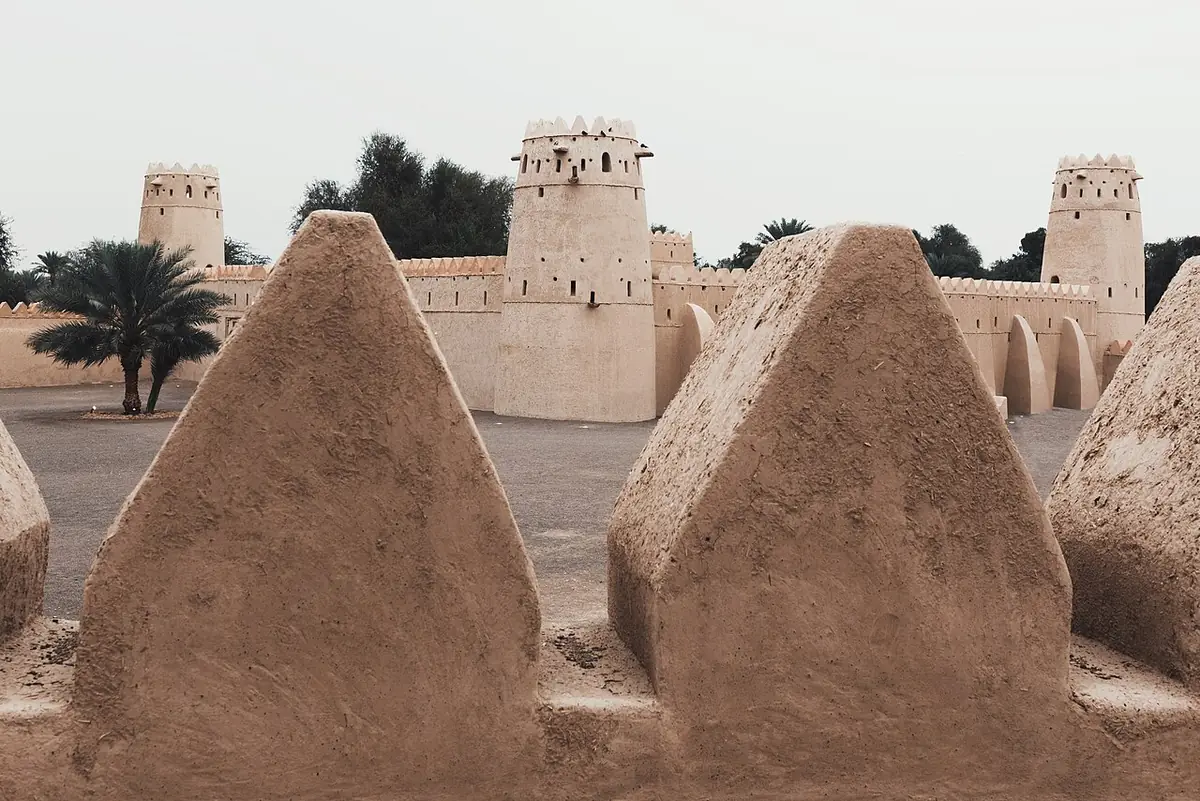
The mudbrick towers of Al Jahili Fort in Al Ain under a clear sky — Photo: Jeff2rado · CC BY-SA 4.0 · Wikimedia Commons
Once those reference points are in place, the question of where exactly to settle within the city becomes the priority.
Moving abroad or investing in property from overseas brings you face to face with radically different reference points in terms of space and climate. The transition is not limited to a change of language or currency; it touches the very foundations of housing, of how domestic space is managed and of how you relate to your neighbours.
From abroad
Life in an apartment or terraced house with rigid co-ownership charges back home
Al Ain
Freehold ownership of a detached villa on a walled plot, with management arrangements that are often independent
You gain complete freedom over your renovation choices but take on full responsibility for technical maintenance.
From abroad
A temperate climate with marked seasonal changes that dictate heating and insulation
Al Ain
Almost constant sunshine and extreme summer temperatures that make air conditioning vital around the clock
Energy spending becomes a central part of running your house and should never be underestimated.
From abroad
A dense, walkable urban fabric where shops and services can be reached on foot
Al Ain
Urban planning designed around the car, where getting around happens almost exclusively in an air-conditioned vehicle
Not having amenities within walking distance reshapes the daily logistics of every member of the household.
From abroad
A dense administrative framework governed by your home country's construction and co-ownership law
Al Ain
An Emirati regulatory framework specific to freehold areas for eligible nationals
It is essential to work with local experts to confirm that title deeds and contracts are in order.
Which neighbourhood should you target to settle and invest?
These local dynamics translate into precise price realities that are worth analysing without extrapolating.
Al Ain's urban structure is built around neighbourhoods with distinct identities, ranging from green historic districts to modern extensions with all the latest infrastructure. The area you choose will directly shape your access to main roads, schools and the leading shopping centres.
Al Jimi
A mature, central area, very popular for being right next to the long-established shopping centres and busy roads.
Suits
Families who want to keep daily journeys short and enjoy an urban setting that is already well established.
Trade-off
The housing stock is older, which often means budgeting for works to modernise the interiors.
Al Maqam
A quiet residential neighbourhood, popular for its proximity to the large university campuses and major medical facilities.
Suits
Investors aiming for stable lettings to professionals, or families looking for a peaceful setting.
Trade-off
The atmosphere is more subdued, and nearby nightlife and shopping options are more limited.
Zakher
A growing area in the south of the city, known for its spacious villas and a strong family neighbourhood spirit.
Suits
Those looking for larger living space for what is often a more affordable price per square metre.
Trade-off
Its distance from the historic city centre means longer daily journeys to reach the main business areas.
How much does buying a house in Al Ain really cost?
Beyond the headline figures, the legal nature of what you can actually own deserves your full attention.
Al Ain's property market stands out for valuations that are noticeably more moderate than those seen in Dubai or Abu Dhabi, while still offering first-class features. Prices vary with the age of the property, the size of the plot and the quality of the interior finishes, not forgetting the mandatory additional costs that come with any property transaction in the Emirates.
Al AinFor saleHouseestimate
Median price / m²AED 5,842Half the apartments sell below this
Median priceAED 1.18mthe average is 14% higher — a few very large properties pull it up
Most common2 bedrooms54 % of listings
Average size193 m²
By number of bedrooms
Bedrooms
Share of market
Avg price
Price / m²
Avg size
2most common
54 %
AED 1.18m
AED 6,150
193 m²
3
31 %
AED 1.53m
AED 5,842best value / m²
263 m²
4
14 %
AED 2.15m
AED 5,842best value / m²
368 m²
Each row is an average, compared against the area average of AED 6,150 / m². These are indicative estimates of a typical local market, not a measured sample of live listings. Check current listings before relying on them.
What you can actually own as a buyer
Once the legal framework is confirmed, it is a carefully run transaction that makes sure your project succeeds.
The legal security of a property investment rests on a clear distinction between areas open to freehold ownership and more restrictive arrangements. Understanding these statuses before you sign an offer protects your assets over the long term and makes any future inheritance or resale simpler.
Freehold ownership
This arrangement allows people of any nationality to buy the property and its land outright, in perpetuity. It is the ideal route for securing a long-term investment, obtaining a title deed registered with the relevant authorities and having complete freedom to dispose of the property with no time limit.
What it changesYou own an asset that can be passed on and sold under the inheritance rules in force, giving you full long-term visibility over your wealth.
Long leasehold
Rarer for detached houses sold on the standard resale market but found in certain specific developments, this status grants the right to use and enjoy the property for a set period, generally between 30 and 99 years. The land belongs to a developer or a public institutional body.
What it changesYou must check exactly how long the lease has left to run before buying, to avoid a drop in value as the end of the term approaches.
The rule to understand before paying a deposit
To handle these steps calmly, let us break down the order of the people involved and the actions to take.
Committing funds to buying a house in the Emirates follows a strict protocol in which every step engages the buyer's financial and legal responsibility. Overlooking a single one of these milestones exposes you to losing your deposit or to costly administrative delays at the final transfer of ownership.
Making a written offer to purchase (Form F or the local equivalent)
A thorough check of any charges and confirmation that there is no outstanding mortgage on the official title deed.
Signing the preliminary memorandum of understanding (MOU) and paying the security deposit (generally 10%), held in escrow by the agent or an approved intermediary.
The period for clearing the conditions precedent, including the bank valuation and the technical survey of the house's structure.
Obtaining the no-objection certificates (NOC) from the developer or the management of the residential community.
The final transfer of ownership and registration of the new title deed with the land department.
How a transaction works, step by step
Successfully buying a house takes coordination between several key players, from first choosing the property to being handed the keys. Knowing each person's role in advance avoids confusion and speeds up the administrative approvals.
The buyerSetting the budget and getting bank pre-approvalConfirm your borrowing capacity in advance with an established financial institution in the Emirates so you can make credible offers.
The estate agentShortlisting properties and targeted viewingsIdentify villas that match your location and budget criteria while ruling out properties with hidden defects.
The technical surveyorStructural inspection of the houseCarry out a full survey of the roof, waterproofing, air conditioning systems and plumbing before making a firm commitment.
The notary or administratorDrafting and signing the Memorandum of UnderstandingSet out the conditions precedent, the late-payment penalties and the schedule of payments into a secure escrow account.
The developer / the administrationIssuing the no-objection certificate (NOC)Confirm that all service charges and utility bills relating to the villa have been paid in full by the seller.
The land departmentFinal transfer and issue of the title deedMake the final payment by manager's cheque or certified transfer and record the official transfer of the title into the buyer's name.
House or apartment in Al Ain: how to decide based on your lifestyle
Once you have made that choice of property type, it is time to look closely at the financial reality of settling here.
Choosing between a detached house and an apartment in Al Ain is not simply a matter of taste; it has a profound effect on how you manage daily life, your maintenance budget and your relationship with the city. Al Ain, nicknamed the Garden City of the United Arab Emirates, has a far more low-rise, spread-out layout than Dubai or Abu Dhabi. Here, the villa with an inner courtyard or private garden is the long-standing cultural and family norm, while apartments are concentrated in the denser central neighbourhoods such as Al Jimi or near the university campuses. Opting for a house means having no service charges but taking on all of the maintenance, from central air conditioning to facades exposed to the intense desert sun. It is a choice of staying put and having space to yourself, and it particularly suits large families who want to get away from the bustle of the city.
An apartment in Al Ain, by contrast, suits buyers looking for flexibility, shared building costs and amenities right on the doorstep. Recent residential buildings often have shared pools, gyms and security included in predictable annual charges. For a couple without children, or an investor targeting a stable rental yield from healthcare and education professionals, an apartment offers better liquidity on resale. However, living at close quarters, the lack of a large private outdoor space and dependence on the decisions of the building management are major compromises that you need to factor in from the start when thinking about buying.
The shape of the local property market shows that houses gain value differently depending on how close they are to major roads and the city's large parks. Villas in gated communities or sought-after neighbourhoods such as Asharej or Al Mutawaa show remarkable resilience to economic swings thanks to a limited supply of land. Apartments, on the other hand, face fiercer competition because of the regular delivery of new developments, which means buyers need to scrutinise the build quality and the developer's reputation. Your final decision should therefore weigh how much time you are willing to spend maintaining your property against the immediate comfort of outsourced management.
You also need to factor daily journeys into your choice between a house and an apartment in Al Ain. Villas are often on the outskirts or in spacious residential areas, which means slightly longer drives to reach shopping areas or the large school complexes. Apartments in the heart of the city drastically cut the time spent behind the wheel, a significant factor in a climate where the hot season lasts several months. By carefully weighing your priorities between maximum living space and a central location, you avoid the classic mistake of buying a property that does not fit the way you really live.
What overall budget should you plan for to live in and maintain your property in Al Ain?
These figures translate very concretely into how you organise your days and your journeys around the city.
Budgeting for a property purchase in Al Ain is not just about your monthly mortgage repayment or the headline purchase price. You need to factor in a set of recurring costs specific to the arid climate and local infrastructure, including air conditioning, upkeep of outdoor areas and indirect administrative charges. Planning carefully for these items avoids unpleasant financial surprises from your very first year in your new home.
Estimated monthly and annual costs for a household in Al Ain
Cost item
Apartment (1-2 bedrooms)
House / villa (3-4 bedrooms)
What makes it vary
Electricity and air conditioning (local DEWA equivalent)
AED 400 to 700 / month
AED 1,200 to 2,500 / month
Volume to cool and thermal insulation
Service charges / maintenance
AED 3,000 to 7,000 / year
AED 0 to 4,000 / year (private contracts)
Whether there is a pool and building services
Comprehensive home insurance
AED 1,000 to 1,800 / year
AED 2,500 to 4,500 / year
Replacement value and outdoor fixtures
General maintenance and unexpected costs
AED 1,500 to 3,000 / year
AED 6,000 to 15,000 / year
Waterproofing, plumbing and split air conditioners
Energy costs rise significantly between June and September because of intensive use of air conditioning.
Healthcare, schools and transport: what does an ordinary Tuesday look like in Al Ain?
Behind this apparent everyday calm lie regulatory and technical subtleties that the brochures often leave out.
Getting to grips with the geography and logistics of Al Ain means following a typical weekday. Far from the frantic pace of Dubai, the city offers relatively smooth movement while still requiring well-planned journeys to schools and hospitals. This route shows how residents juggle work, their children's education and the running of daily life.
07:00Residential neighbourhood (e.g. Asharej or Al Jimi)Waking up and leaving early to avoid peak traffic outside the city's large international school complexes.
08:00School or universityDropping the children off at one of Al Ain's well-regarded campuses, with modern facilities and secure green spaces.
09:00Business district or institutional hubArriving at work, often less than twenty minutes from any residential part of the city.
13:00Medical centre or local clinicAccess to first-rate healthcare facilities, such as Tawam Hospital or the private clinics in the city centre.
17:00Central market or neighbourhood supermarketBuying fresh produce and doing the routine shopping in commercial areas spread evenly across the different districts.
19:00Public park or Al Ain oasisRelaxing with the family in one of the city's iconic green spaces, making the most of the cooler evening temperatures.
What the sales brochures won't tell you about property in Al Ain
Misjudging these technical realities inevitably leads to bitter regrets a few months after signing.
Al Ain's property market has customary rules and technical specifics that marketing agencies rarely mention. To protect your capital and avoid disappointment after buying, you need to decode the subtleties of title deeds, local legislation and the real condition of existing infrastructure.
Freehold restrictions by area
Unlike some open areas of the Emirate of Abu Dhabi, freehold purchases by foreign nationals are strictly limited to specific designated areas. You must check the exact nature of the title (usufruct, long lease or freehold) before signing any irreversible financial commitment.
The real age and insulation quality of homes built in the 2000s
Many villas built twenty years ago suffer from outdated thermal insulation and plumbing worn down by the local hard water. An independent technical survey is essential to cost the energy upgrade works before you move in.
The complexity of dealing with the municipal authorities and water services
Transferring utility accounts and obtaining municipal compliance certificates can take several weeks. Planning for these administrative delays avoids finding yourself temporarily without basic services when you are handed the keys to your new home.
The impact of future infrastructure projects on resale value
Al Ain's urban development follows a precise master plan. A neighbourhood that is currently quiet and secluded may see major roads or building sites appear nearby, radically changing how peaceful it is and the future value of your property.
The misjudgements people discover six months after buying in Al Ain
These disappointments show that buying property in Al Ain does not suit every type of investor or resident.
Looked likeA villa that was cheap to buy, with a large plot on the far outskirts of the city.
Turned outExorbitant daily transport costs and a sense of social isolation for family members without a car.
Would have caught itWork out the combined cost of fuel and travel time over a year before settling on an outlying location.
Looked likeAn affordable apartment in an older building with no apparent management fees.
Turned outA hefty bill for exceptional works voted through at the general meeting in the very first year to repair the lifts and the facade.
Would have caught itInsist on seeing the minutes of the last three owners' general meetings to identify any outstanding works.
Looked likeA central air conditioning system that performed well during a winter viewing in mild weather.
Turned outAn electricity bill that tripled with the first heatwaves in June, along with repeated breakdowns needing expensive repairs.
Would have caught itHave an independent refrigeration technician assess the age and energy rating of the compressors before making an offer.
Looked likeA booming neighbourhood with shops and parks shown on the developer's plans.
Turned outPublic amenities delivered several years late, leaving residents isolated with no facilities nearby.
Would have caught itCheck the official urban plan directly with Al Ain Municipality rather than relying on advertising promises.
Atypical profiles: who should definitely not buy property in Al Ain?
If you recognise yourself in these stable, well-informed profiles, the time has come to confirm your final decision.
Owning property is often presented as the logical culmination of life in the United Arab Emirates. Yet Al Ain's particular market, centred on family stability and staying put, makes buying unsuitable for several kinds of people. Recognising these warning signs helps you avoid a rigid and damaging financial commitment.
The professional on a short assignment or who moves countries frequently
→Flexible renting or a renewable annual lease rather than buying outright.
Transfer fees, agency commissions and the time it takes to resell a property in Al Ain make any purchase unprofitable if the stay is shorter than five full years.
The investor looking for short-term rental returns and speculative capital gains
→The more volatile, fast-moving markets of Dubai or Abu Dhabi.
Al Ain has a stable, deep, family-oriented rental market, with moderate but steady yields, far from the speculative swings seen in the big coastal cities.
The household with a deposit that is only just enough and no emergency savings
→To build up savings before taking the step of buying property.
Maintaining a villa, or unexpected charges in an apartment building in Al Ain, requires readily available emergency funds to cope with climate-related and technical problems.
So, are you ready to make your property plans in Al Ain a reality?
Below you will find answers to the most frequently asked questions to fine-tune the final details of your plans.
Having reached the end of this analysis, buying a property in Al Ain is no longer about a simple impulse or reading an appealing listing. You now have a realistic view of the trade-offs between a house and an apartment, of the real structure of your monthly costs, and of the logistical demands of a daily life shaped by the climate and local infrastructure. Deciding to buy here is above all a lifestyle choice rooted in stability, the search for a peaceful family setting and building long-term wealth at the heart of the Garden City.
If your professional and personal horizons lie in this region of the United Arab Emirates for the long term, and you have confirmed that your savings can cover the real maintenance costs, everything is in place. Take the time to view several properties at different times of day, insist on thorough technical reports and never give in to the rush of an offer made under pressure. Your future home in Al Ain deserves careful preparation to turn this investment into a lasting source of peace of mind and everyday comfort.
Related questions
Is it easy to get a mortgage to buy a property in Al Ain as an expatriate?
Yes, the main local and international banks offer financing to foreign residents, generally up to 75 to 80% of the property's value for a first purchase. You do, however, need to present a solid application with proof of stable income and a debt-to-income ratio that complies with the regulations of the Central Bank of the UAE.
What notary and property transfer fees apply in Al Ain?
In the United Arab Emirates, the traditional notary system gives way to direct registration with the municipal land department (Municipality). Transfer fees generally amount to 2% of the property's transaction value, plus the standard estate agency commission, which is most often set at 2%.
Can you buy a property in Al Ain without living in the United Arab Emirates?
Whether non-residents can buy depends strictly on the area in question. Some areas of Al Ain are classed as freehold and allow purchases by non-resident foreign citizens, while other districts remain reserved for UAE nationals or require a particular legal status.
How long does it take on average to complete a property transaction in Al Ain?
A standard sale between private parties generally takes between four and six weeks, from signing the preliminary sale agreement (MOU - Memorandum of Understanding) to the final transfer of the title deed at the municipality, and this can take longer if bank financing is involved.
Are service charges high in Al Ain's residential buildings?
Service charges vary considerably depending on the amenities the development offers, such as a pool, a gym or round-the-clock security. They are generally calculated per square foot and should be checked in detail before buying to avoid unpleasant budget surprises.
How is Al Ain's rental market doing for an investor?
Al Ain's rental market is known for its strong stability, supported by its universities, leading hospitals and public institutions. Gross yields generally range between 6% and 8% a year, with steady demand from families and professionals working locally.
Should you budget for renovating an older villa in Al Ain?
Villas built more than fifteen years ago often need upgrading work, particularly on thermal insulation, air conditioning systems and roof waterproofing. It is wise to set aside a dedicated budget of 10 to 15% of the purchase price for this work.
Which neighbourhoods of Al Ain are best for a family investment?
Residential neighbourhoods such as Asharej, Al Jimi, Al Mutawaa and Falaj Hazza are particularly sought after for their proximity to schools, shopping centres and main roads, offering a setting that families appreciate.
Are there recurring property taxes on real estate in Al Ain?
Unlike many Western countries, there is no recurring annual property tax or residence tax levied by the local government on owning a residential property in the United Arab Emirates.
What precautions are essential before signing a purchase contract?
You must check that there are no charges or mortgages on the property, have the actual condition of the structure assessed by an independent surveyor and make sure the seller holds an official, undisputed title deed issued by the Al Ain authorities.
Property review of ting
No ting properties in Al Ain yet
Be the first — share it on ting and it shows up right here.